Rhoads Plans $100M Investment to Expand Operations at Philly’s Navy Yard
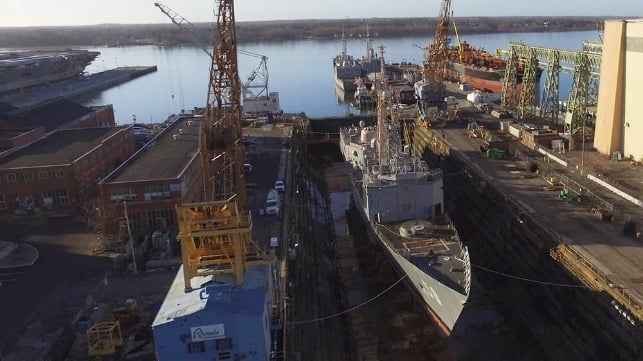
Rhoads Industries, alongside Pennsylvania Governor Josh Shapiro, announced its plans for a nearly $100 million investment to expand manufacturing capacity at its shipyard facilities in Philadelphia at the site of the former Navy shipyard. Rhodes operates layup and recycling operations as well as a repair facility. It will grow its manufacturing operations as the U.S. Navy looks to expand and the Trump administration promises large investments into the U.S. shipbuilding and repair industry.
“Shipbuilding has always been a key part of Philadelphia’s identity and our economy, and today, I’m proud to announce that Rhoads Industries is investing $100 million and creating over 450 new jobs at the Navy Yard,” said Governor Shapiro. “With support from the Commonwealth — including a new $4 million investment and more than $17 million over the past decade — Rhoads will expand its footprint, double its capacity for the U.S. Navy’s submarine program, and strengthen our national security. The future of shipbuilding runs through Philadelphia.”
Rhoads will build a new 95,000-square-foot manufacturing facility to increase its production capacity for the U.S. Navy’s Maritime Industrial Base, supporting its submarine program. This new facility will allow for a continuous fabrication process, speeding up their manufacturing, additional outfitting, and provide direct access to a pier for barge shipping of completed products. This project will reportedly create at least 450 new jobs and retain 541 existing full-time positions.
Rhoads received a funding proposal from Pennsylvania’s Department of Community and Economic Development (DCED) that includes a $4 million Redevelopment Assistance Capital Program (RACP) grant. The company is also located in a Keystone Opportunity Zone (KOZ), which provides significant tax savings. The Commonwealth reports it has invested in Rhoads throughout the years, totalling more than $17 million in multiple grants to support the company’s expansions and facility upgrades.
Founded and family?owned since 1896, Rhoads is a provider of large-scale industrial fabrication, along with mechanical and maintenance maritime services. In addition to field service and project skilled labor, the company has shipyard facilities and more than 300,000 square feet of heavy manufacturing space located in the Navy Yard in Philadelphia.
After the former Philadelphia Naval Yard closed in 1996, the area was redeveloped as an industrial zone by the state, and is now home to over 150 employers, including the shipyard acquired in 2024 by Hanwha Ocean and now known as Hanwha Philly Shipyard. The Korean company has separately announced that it would also like to expand its operations as it seeks government contracts in addition to the current work to build containerships for Matson and complete the MARAD training ship program.
Rhoads became a contractor performing work for the then Kvaerner Shipyard starting in 1998, and began expanding its operations at the Navy Yard in the early 2000s. It launched its maritime division in 2010, gaining the lease for Pier 5 and Dry Dock 2 (now decommissioned). It expanded with Pier 2 and recently took over Pier 6 and Dry Dock 3 at the yard.
It becomes the latest U.S. shipyard to look to expand its operations to position itself for the opportunities resulting from the Trump administration’s support of naval and commercial shipbuilding.
One Big Beautiful Bill Contains $5 Billion for U.S. Shipbuilding
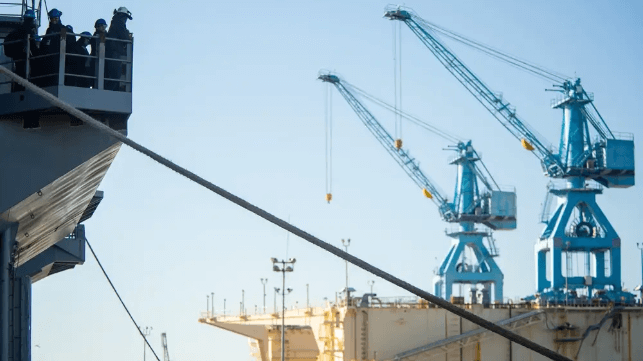
On Thursday, just ahead of the White House's July 4 deadline request, the U.S. House of Representatives passed the One Big Beautiful Bill Act, a massive budget reconciliation package carefully tailored to bypass a Senate filibuster. The bill's provisions have been pored over at length by analysts and partisans, and will continue to be scrutinized for years to come - but overlooked in the popular debate, the bill also contains $5 billion for naval shipbuilding initiatives.
The funding is tightly focused on pressing U.S. Navy needs. The service's shipbuilding programs are all behind schedule, and its repair activities are also challenged. Workforce and supply chain issues are the leading causes.
Among the larger line-items, the bill includes:
- $250 million more for accelerated training for the defense manufacturing workforce;
- $750 million for supplier development in the naval shipbuilding supply chain, plus another $250 million for naval supply chain advanced manufacturing processes
- half a billion dollars for additive manufacturing, not generally used by private sector shipbuilders;
- $400 million for a collaborative campus for naval shipbuilding;
- and half a billion dollars to apply AI to naval shipbuilding, a new area of focus.
Some of the provisions might have secondary benefits for commercial shipbuilders, including:
- half a billion dollars for advanced manufacturing in the shipbuilding industrial base;
- half a billion for advanced shipbuilding techniques;
- and half a billion for maritime industrial workforce training.
The funding is especially remarkable because of its tradeoffs: some traditional acquisitions did not get funded at all, notably the next Constellation-class frigate hull, which was zeroed-out in the Navy's FY2026 budget request and absent from the One Big Beautiful Bill. Instead of the frigate, Congress paid for new initiatives that were (until recently) somewhat controversial: $1.8 billion for the Marine Corps' long-awaited Landing Ship Medium and $2.1 billion to develop and buy the Medium Unmanned Surface Vessel (MUSV).
Tsuneishi Buys Mitsui E&S Shipbuilding to Consolidate Japanese Shipbuilding
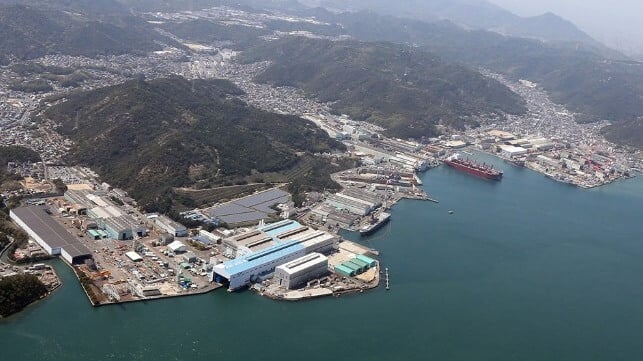
In a further move to consolidate the Japanese shipbuilding and repair businesses, Tsuneishi Shipbuilding reports it acquired its former joint venture with Mitsui E&S Shipbuilding. It is part of a broader reorganization and rebranding of all Tsuneishi’s operations as the Japanese shipbuilding sector works to respond to competition and a changing market.
Mitsui E&S Shipbuilding, which traces its origins back 110 years to 1917, had been one of Japan’s leading shipbuilders. The company’s focus had shifted to commercial ships such as dry bulk carriers and government work, including construction and repair work for auxiliary ships, such as supply ships and oceanographic survey ships for Japan’s Ministry of Defense. It had also been actively developing new technologies incorporated into autonomous underwater vehicles (AUV) and autonomous surface vehicles (ASV), before in 2021 announcing plans to exit the shipbuilding sector.
Mitsubishi Heavy Industries took over the naval and governmental ship business of Mitsui E&S Shipbuilding Co., including the construction and repair work at the Tamano Works. Separately, Mitsui and Tsuneishi formed a joint venture for the commercial shipbuilding operations, expanding on a cooperation that had been launched in 2018. Tsuneishi owned 49 percent of the joint company, while Mitsui E&S Shipbuilding shifted to engineering services as well as its operations in machinery and IT services. Mitsui E&S’s last commercial newbuilding was delivered four years ago in July 2021.
Tsuneishi acquired the remaining ships in the joint venture and has renamed the operation Tsuneishi Solutions Tokyobay. The operation will focus on engineering services, engineering for alternative fuel and gas-related equipment, monitoring, and technical support, while Mitsui E&S will complete its transformation to focus on marine engines, port cranes, and industrial machinery.
Since entering into the alliance in October 2021, Tsuneishi highlights that the two operations have “collaborated to leverage the synergies of cost competitiveness and technological expertise. In light of the need for further integration to ensure sustainable growth and enhanced competitiveness in the future, Tsuneishi Shipbuilding has decided to proceed with the full acquisition. Moving forward, both companies will continue to maximize their respective strengths and strive to further enhance corporate value.”
Tsuneishi announced at the end of June that it was rebranding all its shipyards, which include four locations in addition to the former Mitsui yard, to a unified Tsuneishi brand.
“These changes follow a strategic review of the capital structure within the segment and form part of broader efforts to respond to the fast-changing maritime landscape while pursuing sustainable growth,” wrote Tuneshi. Its operation includes a total of nine domestic companies in the shipbuilding segment, and it said the rebranding was being undertaken to strengthen unity and cohesion across the group.
Faced with stiff competition from South Korea and now China, Japan has slipped to a distant third in shipbuilding output. Once having as much as a 50 percent market share, Japan has seen its shipbuilding business decline by 30 percent in the past five years, and today it has under 10 percent of the total market.
The country’s largest builder, Imabari Shipbuilding, last week announced that it would consolidate JMU (Japan Marine United) to become a fully-controlled subsidiary. They called it a strategic step to realize further economies of scale in design and material costs. They pointed to the potential cost savings for purchases, including steel and engines. Combined, the operation will be the fourth-largest shipbuilder based on current order volume.
Japan's conservative Liberal Democratic Party recently put forward a new proposal to address the rebuilding of the Japanese shipbuilding industry. It is calling for a $7 billion shipyard investment used to modernize the yards and adopt technologies such as automation and robots. Japan is also reported to have approached the Trump administration presenting its capabilities as a tool to reduce China’s dominance in shipbuilding and expand U.S. capacity.
MSC Invests in Grand Bahama Shipyard with Carnival and Royal Caribbean
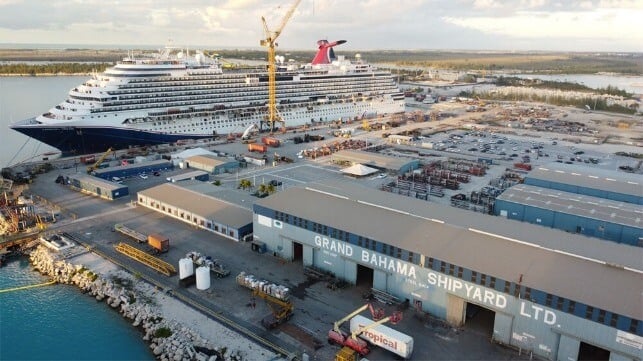
MSC Cruises is set to become a third investor in the Grand Bahama Shipyard as the yard prepares to relaunch full services in 2026 with two new dry docks, which will be among the largest in the Western Hemisphere. It comes as the shipping giant has also expressed interest in a European shipbuilder and looks to continue to grow its cruise operations.
Terms of the investment were not announced, but the Minister for Grand Bahama, Ginger Moxey, announced the deal on July 1 with MSC becoming a shareholder alongside Carnival Corporation and Royal Caribbean Group. The two cruise corporations invested in the company in 2000 to start the shipyard as a near-shore repair facility for the cruise industry. They each own 40 percent of the shares with the Bahamas through the Ports Group holding the remaining 20 percent.
The investment is being called a major milestone for the Bahamas, which has been anxious to see the yard restored to full operations for its economic contribution to the Bahamas. In 2020, Carnival and Royal Caribbean agreed to an investment that is now reported at $665 million to transform the yard, including building two very large dry docks in China. The yard has been limited in its capacity since its large dry dock broke in 2019 when it was attempting a partial lift of the 225,000 gross ton 1,120-foot-long Oasis of the Seas. The dry dock was sold, and a shortened version operates in Texas, but it left Grand Bahama with limited lift capacity.
Currently, the largest cruise ships have been forced to travel to Europe for their overhauls, maintenance, and regulatory inspections. The cruise corporations have scrambled to find capacity and adjust schedules. Recently, Carnival Cruise Line was forced to pull one of its ships from a yard in Spain due to a strike, which caused it to delay the vessel’s return and cancel a cruise. The cruise line is reportedly seeking compensation from the shipyard after the cruise ship was moved to a dry dock in France.
The first of Grand Bahama’s new docks, named East End, is 357 meters (1,171 feet) long and can lift 93,500 tons. It will have four state-of-the-art cranes and is due to reach the Bahamas by November. It will be ready for operations in January 2026 and will be joined by a second, larger dry dock, to be named Lucayan. The yard is also extending its pier, and once both dry docks are commissioned, Grand Bahama will have the capability to lift the largest cruise ships currently in service.
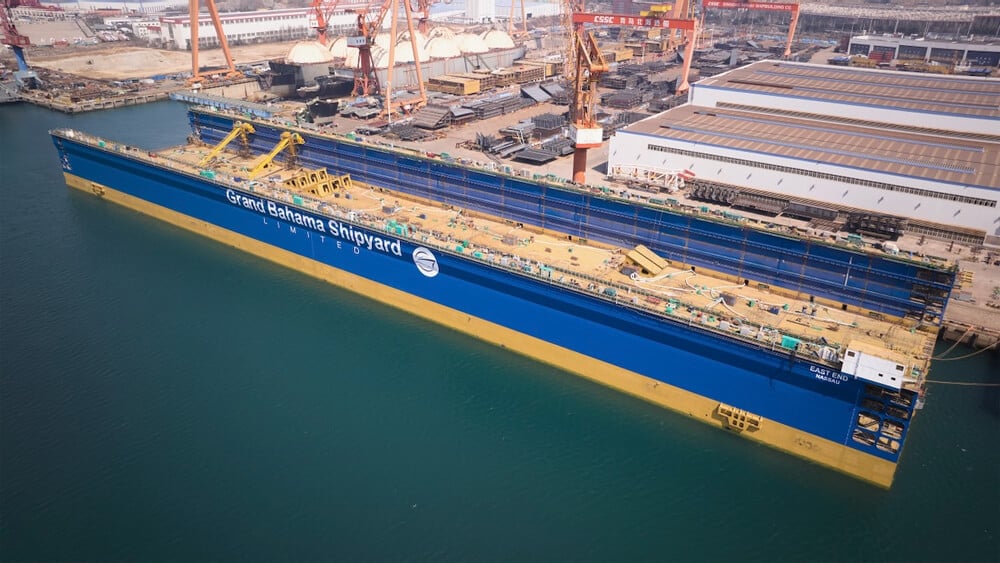
New East End dry dock completed in China and preparing for shipment to the Bahamas (GBS)
When the yard is at full capacity, it has performed 85 to 100 drydockings a year. It also expanded its operations to manage larger overhauls and refurbishment projects with its wet dock and storage capabilities. With the cruise industry continuing its rapid growth, they expect to surpass the yard’s previous performance. During the off-season for cruises, the yard also performs work for the commercial shipping industry as well as emergency repairs.
Leading the relaunch and expansion of the shipyard will be Grand Bahama Shipyard’s new CEO, retired Rear Admiral from the Royal Canadian Navy, Chris Earl. His appointment was announced in May as David Skentelbery retired after being CEO of the yard for the past eight years. In addition to 35 years with the Royal Canadian Navy, Earl had led all Naval ship and submarine repair programs, commercial ship repair, and shipbuilding in Vancouver for Seaspan Shipyard.
MSC Shipping Group, according to media reports, has also recently proposed taking over the operations of Romania’s Mangalia Shipyard. The government is looking for a new partner after the yard lapsed into bankruptcy, and an agreement was terminated with Damen Group. MSC says it is looking to diversify shipbuilding capabilities away from Asia and could also use the yard for repairs. Longer-term, it has suggested it could look to build cruise ships, ropax, and tugboats in Romania.

No comments:
Post a Comment