Document – Analysis
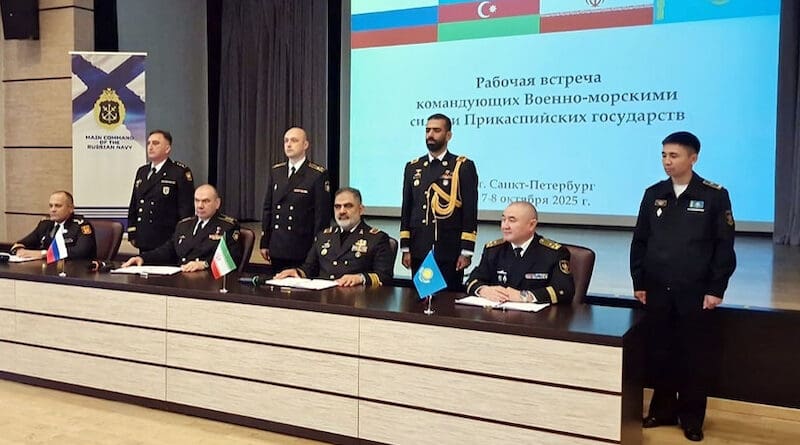
Naval commanders from Azerbaijan, Iran, Kazakhstan and Russia signed a strategic agreement to enhance security and cooperation in the Caspian Sea, during a meeting held in Saint Petersburg, Russia, on October 8, 2025. / Mod.Gov.Az
November 26, 2025
The Jamestown Foundation
By John C. K. Daly
On October 8, the naval leaders of Iran, Russia, Kazakhstan, and Azerbaijan signed the “Caspian Sea Comprehensive Strategic Cooperation Agreement,” rejecting any foreign interference in the sea (Agentstvo Azeri-Press, October 8). Turkmenistan notably did not send a delegation. While many post-Soviet states have discreetly been distancing themselves from Russia since its full-scale invasion of Ukraine in 2022, this agreement demonstrates that some ties remain.
The agreement commits signatories to strengthened security cooperation in the 143,244 square-mile Caspian while emphasizing that no country or force outside the region will be able to interfere in the Caspian’s internal affairs. Apart from Russia, of the Caspian littoral states—Azerbaijan, Iran, Turkmenistan, and Kazakhstan—only Iran has access to a second sea, the Persian Gulf. The Caspian is endorheic, and its only connection to the ocean is the 63-mile Volga-Don Canal, which provides a navigable waterway between the Caspian and the Azov Sea.
This October 8 agreement comes as post-Soviet Central Asian and Caucasian nations are forging deeper ties with Russia’s rivals, including the People’s Republic of China (PRC), the European Union, Türkiye, the United States, and the Gulf states. These countries are pursuing multi-vector diplomacy partly as protection against possible Russian aggression in the aftermath of its war against Ukraine.
The agreement stresses that the Caspian belongs solely to its littoral states, and that security and related matters would be determined among them. Since Russia controls the Volga-Don Canal, the agreement effectively shuts out foreign navies from the Caspian, even though many post-Soviet Caspian maritime forces include foreign-built warships, including several built in the United States. Before the 1991 collapse of the Soviet Union, Azerbaijan’s capital, Baku, was the only modern naval base on the Caspian’s shores.
The agreement builds on the 24-article 2018 “Caspian Sea Legal Status Convention,” which delineated seabed sectors by state (President of Russia, August 12, 2018). The convention, signed by all five littoral states on August 12 at the Fifth Caspian Summit in Aktau, Kazakhstan, has proven difficult to enforce due to the signatories’ differing priorities.
Russia remains the predominant naval force in the Caspian, with its Caspian Flotilla consisting of more than seven dozen warships, among them patrol ships, missile carriers, and small artillery ships, several of which have been transferred to the Black Sea for the Kremlin’s war against Ukraine (VKontakte/Kaspiiskaia Flotiliia, March 25). The flotilla’s core consists of two patrol ships, three small missile ships, three small artillery ships, and one missile boat (Pravda.ru, October 30, 2024).
During the October 8 meeting of naval delegations from Iran, Russia, Azerbaijan, and Kazakhstan in Saint Petersburg, Russia proposed holding a multilateral naval exercise in the Caspian in 2026 to practice guarding shipping and maritime economic facilities (RIA Novosti, October 8). The Russian naval delegation was led by Russian Navy Fleet Commander-in-Chief Admiral Aleksandr Moiseev, who said:
The fundamental principle we are guided by is a strict and clear understanding that the Caspian Sea is a closed waterway, where naval activity should be carried out exclusively by the five Caspian littoral states (KOROBEL.RU, October 8).
In the wake of the 1991 collapse of the Soviet Union, the Soviet Caspian Flotilla was divided among Russia, Azerbaijan, and Turkmenistan, with Russia retaining the lion’s share. Today, the Russian Caspian Flotilla is the most powerful of the post–Soviet naval forces on the Caspian, with many warships mounting long-range missiles, unlike the other Caspian navies (VKontakte/Kaspiiskaia Flotiliia, March 25). Russia has used the Caspian to launch missiles at Ukraine, and could use the Caspian Flotilla as a reserve for the Black Sea Fleet via the Volga-Don Canal.
Iran’s Caspian naval forces field six ships, including a new 1,400-ton Dilman destroyer, capable of carrying cruise missiles and torpedoes (Topwar.ru, January 12, 2024). The ships are based at Bandar Anzali, the Iranian fleet’s Caspian main base. Azerbaijan has utilized its vast oil wealth to strengthen its navy, which now deploys 38 warships, primarily based in Baku, including four submarines, among them the Triton-2submarine (VMS Azerbaidzhana, accessed November 18).
Kazakhstan did not receive any of the Soviet Navy Caspian Flotilla warships, so it constructed its own fleet. The Kazakh Navy began in 1993, when its formation was decreed by former President of Kazakhstan Nursultan Nazarbayev. Currently, the Kazakh Navy consists of 25 warships, based primarily in Aktau. While many were built in Kazakhstan, the Kazakh Navy also includes vessels of South Korean, U.S., Israeli, Turkish, and Russian origin (Statbase.ru, accessed November 18).
Turkmenistan was the last of the five littoral states to develop a navy. When the Soviet Navy’s Caspian Flotilla was divided following the 1991 collapse of the Soviet Union, most of the ships went to Russia and Azerbaijan, with only a handful destined for Turkmenistan. In July 1992, Russia and Turkmenistan signed a treaty on joint defense actions, under which the Russian Federation acted as Turkmenistan’s security guarantor, obviating Turkmenistan’s immediate need for its own naval force. In January 2010, a meeting of the State Security Council of Turkmenistan approved the “Program for the Development of the Naval Forces of the Armed Forces of Turkmenistan through 2015” (Kaspiiskii vestnik, February 12, 2018). In early September 2012, Turkmenistan held its first-ever naval exercises, “Khazar-2012.” The Turkmen navy had been the weakest in the Caspian, so the exercises were intended to showcase their increased capabilities (Stoletie, September 19, 2012). In the subsequent decade, Turkmenistan’s naval forces, based at Karshi, a new naval port opened in 2021, have expanded to 35 warships, including corvettes, offshore patrol ships, and amphibious assault vessels (World Directory of Modern Military Warships, January 4).
Besides multilateral training exercises, the Caspian navies carry out their own training operations, particularly Russia’s Caspian Flotilla. From July 23 to July 27, the Russian Caspian Flotilla participated in the navy-wide “July Storm” exercises, which included forces from the Northern, Pacific, and Baltic fleets under the command of the Russian Navy’s commander-in-chief, Admiral Aleksandr Moiseev. More than 150 warships and support vessels, 120 aircraft, 10 coastal missile systems, 950 units of military and special equipment, and over 15 thousand military personnel were involved in the exercises (Port News, July 26). The operation concluded on Navy Day, during which Russian President Vladimir Putin addressed participants via video link, noting that such exercises would improve the combat training of crews of surface and submarine vessels. The Kremlin plans to equip them with the most modern equipment and weapons, and “as a result, the strike power and combat capabilities of the fleet will qualitatively increase” (Port News, July 27).
Other Caspian states have been conducting solo exercises, sometimes with their neighbors. On October 15, Iran and Azerbaijan began the AZIREX 2025, a four-day bilateral naval drill and maritime rescue and relief exercise near Boyuk Zira Island off the coast of Baku. Forces from the Iranian Navy and the Islamic Revolution Guards Corps (IRGC) Navy participated alongside Azeri naval units. The Iranian flotilla included the Paykan and Separ missile warships along with the IRGC Navy’s Shahid Basir. The joint exercise was intended to enhance maritime security, promote naval cooperation, and strengthen operational coordination between the Iranian and Azeri armed forces (Tasnim News Agency, October 19).
The Caspian is a geopolitical nexus where the interests of coastal states and global powers converge. Key transport routes such as the Russia–India North–South Corridor and the PRC–Europe Middle Corridor (Trans-Caspian International Trade Route) intersect there, intertwining Russia, Iran, Türkiye, the PRC, Central Asia, the Caucasus, and the European Union in a constantly shifting geopolitical, economic, military, and diplomatic matrix of cooperation and competition.
The assets the five littoral states are scrambling to protect include subsea reserves, offshore production fields, undersea pipelines, and tankers, heightening the possibility of disputes. The murkiness of the Caspian’s maritime borders has led to past clashes. On July 23, 2001, Iran sent military aircraft and a warship to intimidate two Azeri survey vessels—Geofizik-3 and Alif Hajiyev, which were working for BP-Amoco—into leaving the Alov-Araz-Sharq field. Azerbaijan claimed the site was well within its national sector, which Iran disputed (Azer History, accessed November 18). Azerbaijan ceased exploration activities for the Araz-Alov-Sharq project until the dispute over its maritime border with Iran was resolved. A month after the survey vessel incident, then-Azeri President Heydar Aliyev hosted the chief of the General Staff of the Turkish Armed Forces, Huseyin Kırçoğlu, for a performance by the “Turkish Stars” military acrobatic team in Azerbaijan. Türkiye followed the aerial display with a pointed diplomatic note to Iran stating that if Iran committed further military aggression against Azerbaijan, it would encounter the Turkish Armed Forces, after which tensions ebbed (VKontakte/Azerbaijan Army, June 30, 2021).
Russia has used its Caspian Flotilla for military operations beyond the Caspian, seeing it as a secure launch site for cruise missiles and a storage depot for Russian ships equipped with precision-guided weapons. On October 7, 2015, four Caspian Flotilla warships launched 26 Kalibr SS-N-30A cruise missiles approximately 932 miles at Islamic State targets in Syria. Russia was fulfilling its role as a member of the international anti-terrorist coalition, and its missiles flew through both Iranian and Iraqi airspace on their way to their targets (RBC, October 7, 2015).
More recently, on March 18, 2022, less than a month after Russia’s full-scale invasion of Ukraine, the armed forces of Ukraine reported the first missile attacks by Russia’s Caspian Flotilla against Ukraine (RBC-Ukraine, March 18, 2022). Russian missile launches from the Caspian at Ukrainian targets have intermittently occurred. On November 6, 2024, the Ukrainian military launched its first retaliatory drone raid against the Caspian Flotilla’s base in Kaspiisk, damaging the missile ships Tatarstan and Dagestan, the flagship of the Caspian Flotilla (Haqqin.az, November 6, 2024).
Russia’s Caspian Flotilla’s military advantage over its Caspian neighbors lies in the Volga-Don Canal, built under Stalin. The canal ends westwards from the Volga in the Sea of Azov, which connects with the rest of the Black Sea via the Kerch Strait, now controlled on both sides by Russia after its 2014 Crimean annexation and 2022 full-scale invasion of Ukraine. While the Volga-Don Canal, as Russian “internal waters,” allows Russia to control the entry of warships from the world’s oceans into the Caspian from the Black Sea, its shallowness means that it can currently only handle ships up to 5,000 tons. The canal, in some places less than 12 feet deep, requires constant dredging. In 2025, the Kremlin-owned Rosmorport deployed seven vessels for dredging, which, since the beginning of the year, have removed more than 4 million cubic meters of a planned 5 million cubic meters of earth (KORABEL.RU, October 17).
Despite benign displays of naval solidarity, the Caspian littoral states face growing challenges that extend well beyond their borders. Caspian environmental changes have become regional security and sustainable development concerns. Climate change, increased evaporation, and reduced inflows from feeder rivers such as the Volga are contributing to a dramatic, rapid drop in water levels in the Caspian, with grave implications for surrounding countries (see EDM, November 16, 2023,June 3).
According to Kazakhstan’s Ministry of Ecology, since 2006, the Caspian’s surface area has decreased by more than 48,050 square miles, and water levels have dropped approximately 4.9 to 6.5 feet (The Times of Central Asia, October 17). Projections indicate severe consequences for spawning grounds, the Caspian seal population, port infrastructure, and the regional economy.
An upcoming opportunity to address Caspian hydraulic issues will occur in Rasht, Iran, on November 18 and 19. Iranian Deputy Foreign Minister for Legal and International Affairs Kazem Gharibabadi will convene the first International Conference of Governors of the Caspian Sea Littoral States, hosting governors, officials, and economic activists from Iran, Russia, Azerbaijan, Turkmenistan, and Kazakhstan. The proposed agenda includes economic issues, investment, regional development, transit, logistics, the North–South Corridor, and the Caspian Sea ecosystem (Mehr News Agency, November 10).
Beyond fraternal declarations of solidarity, fissiparous forces still stymie collective efforts on problems of rising importance, most notably the shrinkage of the Caspian. Given the Aral Sea’s earlier fate, it is difficult to be optimistic that the Caspian littoral will find the collective will to solve its most pressing environmental concern.
Naval commanders from Azerbaijan, Iran, Kazakhstan and Russia signed a strategic agreement to enhance security and cooperation in the Caspian Sea, during a meeting held in Saint Petersburg, Russia, on October 8, 2025. / Mod.Gov.Az
November 26, 2025
The Jamestown Foundation
By John C. K. Daly
On October 8, the naval leaders of Iran, Russia, Kazakhstan, and Azerbaijan signed the “Caspian Sea Comprehensive Strategic Cooperation Agreement,” rejecting any foreign interference in the sea (Agentstvo Azeri-Press, October 8). Turkmenistan notably did not send a delegation. While many post-Soviet states have discreetly been distancing themselves from Russia since its full-scale invasion of Ukraine in 2022, this agreement demonstrates that some ties remain.
The agreement commits signatories to strengthened security cooperation in the 143,244 square-mile Caspian while emphasizing that no country or force outside the region will be able to interfere in the Caspian’s internal affairs. Apart from Russia, of the Caspian littoral states—Azerbaijan, Iran, Turkmenistan, and Kazakhstan—only Iran has access to a second sea, the Persian Gulf. The Caspian is endorheic, and its only connection to the ocean is the 63-mile Volga-Don Canal, which provides a navigable waterway between the Caspian and the Azov Sea.
This October 8 agreement comes as post-Soviet Central Asian and Caucasian nations are forging deeper ties with Russia’s rivals, including the People’s Republic of China (PRC), the European Union, Türkiye, the United States, and the Gulf states. These countries are pursuing multi-vector diplomacy partly as protection against possible Russian aggression in the aftermath of its war against Ukraine.
The agreement stresses that the Caspian belongs solely to its littoral states, and that security and related matters would be determined among them. Since Russia controls the Volga-Don Canal, the agreement effectively shuts out foreign navies from the Caspian, even though many post-Soviet Caspian maritime forces include foreign-built warships, including several built in the United States. Before the 1991 collapse of the Soviet Union, Azerbaijan’s capital, Baku, was the only modern naval base on the Caspian’s shores.
The agreement builds on the 24-article 2018 “Caspian Sea Legal Status Convention,” which delineated seabed sectors by state (President of Russia, August 12, 2018). The convention, signed by all five littoral states on August 12 at the Fifth Caspian Summit in Aktau, Kazakhstan, has proven difficult to enforce due to the signatories’ differing priorities.
Russia remains the predominant naval force in the Caspian, with its Caspian Flotilla consisting of more than seven dozen warships, among them patrol ships, missile carriers, and small artillery ships, several of which have been transferred to the Black Sea for the Kremlin’s war against Ukraine (VKontakte/Kaspiiskaia Flotiliia, March 25). The flotilla’s core consists of two patrol ships, three small missile ships, three small artillery ships, and one missile boat (Pravda.ru, October 30, 2024).
During the October 8 meeting of naval delegations from Iran, Russia, Azerbaijan, and Kazakhstan in Saint Petersburg, Russia proposed holding a multilateral naval exercise in the Caspian in 2026 to practice guarding shipping and maritime economic facilities (RIA Novosti, October 8). The Russian naval delegation was led by Russian Navy Fleet Commander-in-Chief Admiral Aleksandr Moiseev, who said:
The fundamental principle we are guided by is a strict and clear understanding that the Caspian Sea is a closed waterway, where naval activity should be carried out exclusively by the five Caspian littoral states (KOROBEL.RU, October 8).
In the wake of the 1991 collapse of the Soviet Union, the Soviet Caspian Flotilla was divided among Russia, Azerbaijan, and Turkmenistan, with Russia retaining the lion’s share. Today, the Russian Caspian Flotilla is the most powerful of the post–Soviet naval forces on the Caspian, with many warships mounting long-range missiles, unlike the other Caspian navies (VKontakte/Kaspiiskaia Flotiliia, March 25). Russia has used the Caspian to launch missiles at Ukraine, and could use the Caspian Flotilla as a reserve for the Black Sea Fleet via the Volga-Don Canal.
Iran’s Caspian naval forces field six ships, including a new 1,400-ton Dilman destroyer, capable of carrying cruise missiles and torpedoes (Topwar.ru, January 12, 2024). The ships are based at Bandar Anzali, the Iranian fleet’s Caspian main base. Azerbaijan has utilized its vast oil wealth to strengthen its navy, which now deploys 38 warships, primarily based in Baku, including four submarines, among them the Triton-2submarine (VMS Azerbaidzhana, accessed November 18).
Kazakhstan did not receive any of the Soviet Navy Caspian Flotilla warships, so it constructed its own fleet. The Kazakh Navy began in 1993, when its formation was decreed by former President of Kazakhstan Nursultan Nazarbayev. Currently, the Kazakh Navy consists of 25 warships, based primarily in Aktau. While many were built in Kazakhstan, the Kazakh Navy also includes vessels of South Korean, U.S., Israeli, Turkish, and Russian origin (Statbase.ru, accessed November 18).
Turkmenistan was the last of the five littoral states to develop a navy. When the Soviet Navy’s Caspian Flotilla was divided following the 1991 collapse of the Soviet Union, most of the ships went to Russia and Azerbaijan, with only a handful destined for Turkmenistan. In July 1992, Russia and Turkmenistan signed a treaty on joint defense actions, under which the Russian Federation acted as Turkmenistan’s security guarantor, obviating Turkmenistan’s immediate need for its own naval force. In January 2010, a meeting of the State Security Council of Turkmenistan approved the “Program for the Development of the Naval Forces of the Armed Forces of Turkmenistan through 2015” (Kaspiiskii vestnik, February 12, 2018). In early September 2012, Turkmenistan held its first-ever naval exercises, “Khazar-2012.” The Turkmen navy had been the weakest in the Caspian, so the exercises were intended to showcase their increased capabilities (Stoletie, September 19, 2012). In the subsequent decade, Turkmenistan’s naval forces, based at Karshi, a new naval port opened in 2021, have expanded to 35 warships, including corvettes, offshore patrol ships, and amphibious assault vessels (World Directory of Modern Military Warships, January 4).
Besides multilateral training exercises, the Caspian navies carry out their own training operations, particularly Russia’s Caspian Flotilla. From July 23 to July 27, the Russian Caspian Flotilla participated in the navy-wide “July Storm” exercises, which included forces from the Northern, Pacific, and Baltic fleets under the command of the Russian Navy’s commander-in-chief, Admiral Aleksandr Moiseev. More than 150 warships and support vessels, 120 aircraft, 10 coastal missile systems, 950 units of military and special equipment, and over 15 thousand military personnel were involved in the exercises (Port News, July 26). The operation concluded on Navy Day, during which Russian President Vladimir Putin addressed participants via video link, noting that such exercises would improve the combat training of crews of surface and submarine vessels. The Kremlin plans to equip them with the most modern equipment and weapons, and “as a result, the strike power and combat capabilities of the fleet will qualitatively increase” (Port News, July 27).
Other Caspian states have been conducting solo exercises, sometimes with their neighbors. On October 15, Iran and Azerbaijan began the AZIREX 2025, a four-day bilateral naval drill and maritime rescue and relief exercise near Boyuk Zira Island off the coast of Baku. Forces from the Iranian Navy and the Islamic Revolution Guards Corps (IRGC) Navy participated alongside Azeri naval units. The Iranian flotilla included the Paykan and Separ missile warships along with the IRGC Navy’s Shahid Basir. The joint exercise was intended to enhance maritime security, promote naval cooperation, and strengthen operational coordination between the Iranian and Azeri armed forces (Tasnim News Agency, October 19).
The Caspian is a geopolitical nexus where the interests of coastal states and global powers converge. Key transport routes such as the Russia–India North–South Corridor and the PRC–Europe Middle Corridor (Trans-Caspian International Trade Route) intersect there, intertwining Russia, Iran, Türkiye, the PRC, Central Asia, the Caucasus, and the European Union in a constantly shifting geopolitical, economic, military, and diplomatic matrix of cooperation and competition.
The assets the five littoral states are scrambling to protect include subsea reserves, offshore production fields, undersea pipelines, and tankers, heightening the possibility of disputes. The murkiness of the Caspian’s maritime borders has led to past clashes. On July 23, 2001, Iran sent military aircraft and a warship to intimidate two Azeri survey vessels—Geofizik-3 and Alif Hajiyev, which were working for BP-Amoco—into leaving the Alov-Araz-Sharq field. Azerbaijan claimed the site was well within its national sector, which Iran disputed (Azer History, accessed November 18). Azerbaijan ceased exploration activities for the Araz-Alov-Sharq project until the dispute over its maritime border with Iran was resolved. A month after the survey vessel incident, then-Azeri President Heydar Aliyev hosted the chief of the General Staff of the Turkish Armed Forces, Huseyin Kırçoğlu, for a performance by the “Turkish Stars” military acrobatic team in Azerbaijan. Türkiye followed the aerial display with a pointed diplomatic note to Iran stating that if Iran committed further military aggression against Azerbaijan, it would encounter the Turkish Armed Forces, after which tensions ebbed (VKontakte/Azerbaijan Army, June 30, 2021).
Russia has used its Caspian Flotilla for military operations beyond the Caspian, seeing it as a secure launch site for cruise missiles and a storage depot for Russian ships equipped with precision-guided weapons. On October 7, 2015, four Caspian Flotilla warships launched 26 Kalibr SS-N-30A cruise missiles approximately 932 miles at Islamic State targets in Syria. Russia was fulfilling its role as a member of the international anti-terrorist coalition, and its missiles flew through both Iranian and Iraqi airspace on their way to their targets (RBC, October 7, 2015).
More recently, on March 18, 2022, less than a month after Russia’s full-scale invasion of Ukraine, the armed forces of Ukraine reported the first missile attacks by Russia’s Caspian Flotilla against Ukraine (RBC-Ukraine, March 18, 2022). Russian missile launches from the Caspian at Ukrainian targets have intermittently occurred. On November 6, 2024, the Ukrainian military launched its first retaliatory drone raid against the Caspian Flotilla’s base in Kaspiisk, damaging the missile ships Tatarstan and Dagestan, the flagship of the Caspian Flotilla (Haqqin.az, November 6, 2024).
Russia’s Caspian Flotilla’s military advantage over its Caspian neighbors lies in the Volga-Don Canal, built under Stalin. The canal ends westwards from the Volga in the Sea of Azov, which connects with the rest of the Black Sea via the Kerch Strait, now controlled on both sides by Russia after its 2014 Crimean annexation and 2022 full-scale invasion of Ukraine. While the Volga-Don Canal, as Russian “internal waters,” allows Russia to control the entry of warships from the world’s oceans into the Caspian from the Black Sea, its shallowness means that it can currently only handle ships up to 5,000 tons. The canal, in some places less than 12 feet deep, requires constant dredging. In 2025, the Kremlin-owned Rosmorport deployed seven vessels for dredging, which, since the beginning of the year, have removed more than 4 million cubic meters of a planned 5 million cubic meters of earth (KORABEL.RU, October 17).
Despite benign displays of naval solidarity, the Caspian littoral states face growing challenges that extend well beyond their borders. Caspian environmental changes have become regional security and sustainable development concerns. Climate change, increased evaporation, and reduced inflows from feeder rivers such as the Volga are contributing to a dramatic, rapid drop in water levels in the Caspian, with grave implications for surrounding countries (see EDM, November 16, 2023,June 3).
According to Kazakhstan’s Ministry of Ecology, since 2006, the Caspian’s surface area has decreased by more than 48,050 square miles, and water levels have dropped approximately 4.9 to 6.5 feet (The Times of Central Asia, October 17). Projections indicate severe consequences for spawning grounds, the Caspian seal population, port infrastructure, and the regional economy.
An upcoming opportunity to address Caspian hydraulic issues will occur in Rasht, Iran, on November 18 and 19. Iranian Deputy Foreign Minister for Legal and International Affairs Kazem Gharibabadi will convene the first International Conference of Governors of the Caspian Sea Littoral States, hosting governors, officials, and economic activists from Iran, Russia, Azerbaijan, Turkmenistan, and Kazakhstan. The proposed agenda includes economic issues, investment, regional development, transit, logistics, the North–South Corridor, and the Caspian Sea ecosystem (Mehr News Agency, November 10).
Beyond fraternal declarations of solidarity, fissiparous forces still stymie collective efforts on problems of rising importance, most notably the shrinkage of the Caspian. Given the Aral Sea’s earlier fate, it is difficult to be optimistic that the Caspian littoral will find the collective will to solve its most pressing environmental concern.
About the author: Dr. John C. K. Daly is a Eurasian foreign affairs and defense policy expert for The Jamestown Foundation and a non-resident fellow at the Central Asia-Caucasus Institute in Washington DC.
Source: This article was published at The Jamestown Foundation
The Jamestown Foundation
The Jamestown Foundation’s mission is to inform and educate policy makers and the broader community about events and trends in those societies which are strategically or tactically important to the United States and which frequently restrict access to such information. Utilizing indigenous and primary sources, Jamestown’s material is delivered without political bias, filter or agenda. It is often the only source of information which should be, but is not always, available through official or intelligence channels, especially in regard to Eurasia and terrorism.


No comments:
Post a Comment