'For a very long time, Ukrainians have suspected that Steve Witkoff was working for the Russians'
Issued on: 26/11/2025 - FRANCE24
Russia will make no big concessions on a peace plan for Ukraine, a senior Russian diplomat said on Wednesday, after a leaked recording of a call involving U.S. envoy Steve Witkoff showed he had advised Moscow on how to pitch to Donald Trump. FRANCE 24's Kyiv correspondent Gulliver Cragg says the leaks may confirm suspicions long held by Ukrainians that Witkoff was working for the Russians.
Video by: Gulliver CRAGG
‘Traitor’: US representatives call for Trump envoy Witkoff to be fired after leaked Kremlin call
Republicans and Democrats warn Witkoff ‘cannot be trusted’ after reportedly advising officials on peace plan
Joseph Gedeon in Washington
A handful of US representatives have reacted furiously to a leaked recording in which the special envoy to Ukraine reportedly coached Moscow on how to handle Donald Trump, but most have so far remained mute on the revelation that American officials were advising a US adversary.
Don Bacon, a Republican representative, called for Steve Witkoff’s immediate dismissal. “For those who oppose the Russian invasion and want to see Ukraine prevail as a sovereign & democratic country, it is clear that Witkoff fully favors the Russians,” the Nebraska lawmaker wrote on X.
“He cannot be trusted to lead these negotiations. Would a Russian paid agent do less than he? He should be fired.”
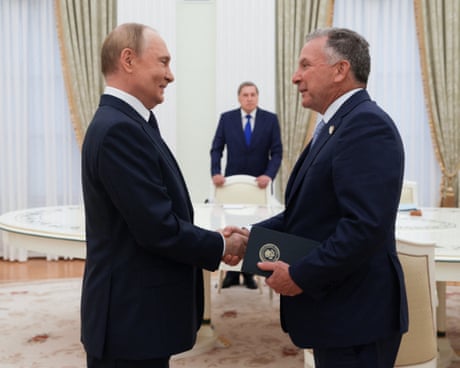
Trump envoy Witkoff reportedly advised Kremlin official on Ukraine peace deal
Brian Fitzpatrick, a Pennsylvania Republican wrote that the leak represented “a major problem” and “one of the many reasons why these ridiculous side shows and secret meetings need to stop”. He urged that the secretary of state, Marco Rubio, be allowed to “do his job in a fair and objective manner”.
Democratic representative Ted Lieu went further, calling Witkoff an “actual traitor,” and adding: “Steve Witkoff is supposed to work for the United States, not Russia.”
In a recording obtained by Bloomberg of a 14 October phone call between Witkoff and Yuri Ushakov, Vladimir Putin’s top foreign policy aide, Witkoff said peace would require Moscow gaining control of Donetsk and potentially additional Ukrainian territory.
“Now, me to you, I know what it’s going to take to get a peace deal done: Donetsk and maybe a land swap somewhere,” Witkoff said, according to Bloomberg’s transcript. “But I’m saying instead of talking like that, let’s talk more hopefully because I think we’re going to get to a deal here.”
Witkoff also gave Ushakov tactical advice, including how the Russian leader should approach the issue with Trump. It included suggestions about scheduling a Trump-Putin phone call before the planned visit of the Ukrainian president, Volodymyr Zelenskyy, to the White House.
On Wednesday, Ushakov appeared to confirm the call’s authenticity to Russian state television, suggesting the leak was meant to “hinder” negotiations. During the conversation, Ushakov said Putin would congratulate Trump and call him “a real peace man”.
Trump defended Witkoff on Tuesday night. “That’s what a dealmaker does. You’ve got to say look, they want this, you’ve got to convince them of this,” Trump said while onboard Air Force One. “That’s a very standard form of negotiation.” He added that he imagined Witkoff “is saying the same thing to Ukraine”.
The president’s special missions envoy, Richard Grenell, meanwhile, called for the leaker to be fired, not Witkoff. “Find the leaker and fire them immediately. No excuses. The anonymous leaker is a national security risk,” he wrote in a social media post.
Who leaked Witkoff’s call advising Kremlin on how to get Trump on side?
The controversial, 28-point proposal would force Ukraine to surrender the entire Donetsk region, including areas currently under Ukrainian control. These territories would become a demilitarized buffer zone recognized internationally as Russian territory.
The plan would also grant Russia control of Luhansk and Crimea while freezing battle lines in Kherson and Zaporizhzhia. Russia has not fully captured Donetsk despite nearly four years of war.
Putin said earlier this month that the US plan could form the basis for a final settlement, though the Kremlin claims it has not discussed details with Washington.
Trump announced earlier on Tuesday he is sending Witkoff to Moscow to meet Putin and the US army secretary, Dan Driscoll, to meet Ukrainian officials, ahead of a possible Trump-Zelenskyy meeting on Friday.
'Truly extraordinary': Analyst shocked by Trump insider's conduct in negotiation
November 26, 2025
A stunned analyst Wednesday said that a Trump administration official coached Russia on how to win over President Donald Trump in the proposed peace plan between Russia and Ukraine.
Trump envoy Steve Witkoff is facing criticism over his handling of the negotiations with Russia to end the conflict in Ukraine, which has been considered overly favorable to Russia. The unusual move was questioned by Ben Rhodes, former Deputy National Security advisor in the President Barack Obama administration, in a conversation with MS NOW's Chris Jansing on Wednesday.
"It's unthinkable that we'd have a situation like this where it feels like the Russians kind of brought their own maximalist surrender plan, essentially for Ukraine to Witkoff thinking that he would be, you know, essentially a friendly voice inside the administration. And then we subsequently learned that, as you know, Marco Rubio is over there trying to make this a little bit more balanced and still overwhelmingly favoring Russia," Rhodes said.
Rhodes explained that the scenario would never have happened during the Obama administration.
"You've got, you know, Witkoff coaching the Russians on how to flatter trump to get him on their side before he talks to Zelenskyy. I mean, I could see a scenario in which you might coach an ally, you know, about how to enter negotiations, not how to handle your own president, but how to deal with negotiations. But it's truly extraordinary that we're kind of so far through the looking glass here, Chris, that we have a close associate of the president, United States, coaching Russia on how to get the best terms possible in a quote unquote peace deal that is essentially validating their invasion of Ukraine," Rhodes added.
US envoy Witkoff advised Russia on getting Trump to Ukraine deal, Bloomberg reports
US envoy Steve Witkoff advised the Kremlin on how Russian President Vladimir Putin should negotiate a deal on Ukraine with President Donald Trump in mid-October, Bloomberg reported Tuesday. A 28-point US peace proposal was widely seen as favouring Russia, requiring Ukraine to make large territorial concessions and renounce its NATO ambitions.
Issued on: 26/11/2025
By: FRANCE 24
Video by: Gulliver CRAGG
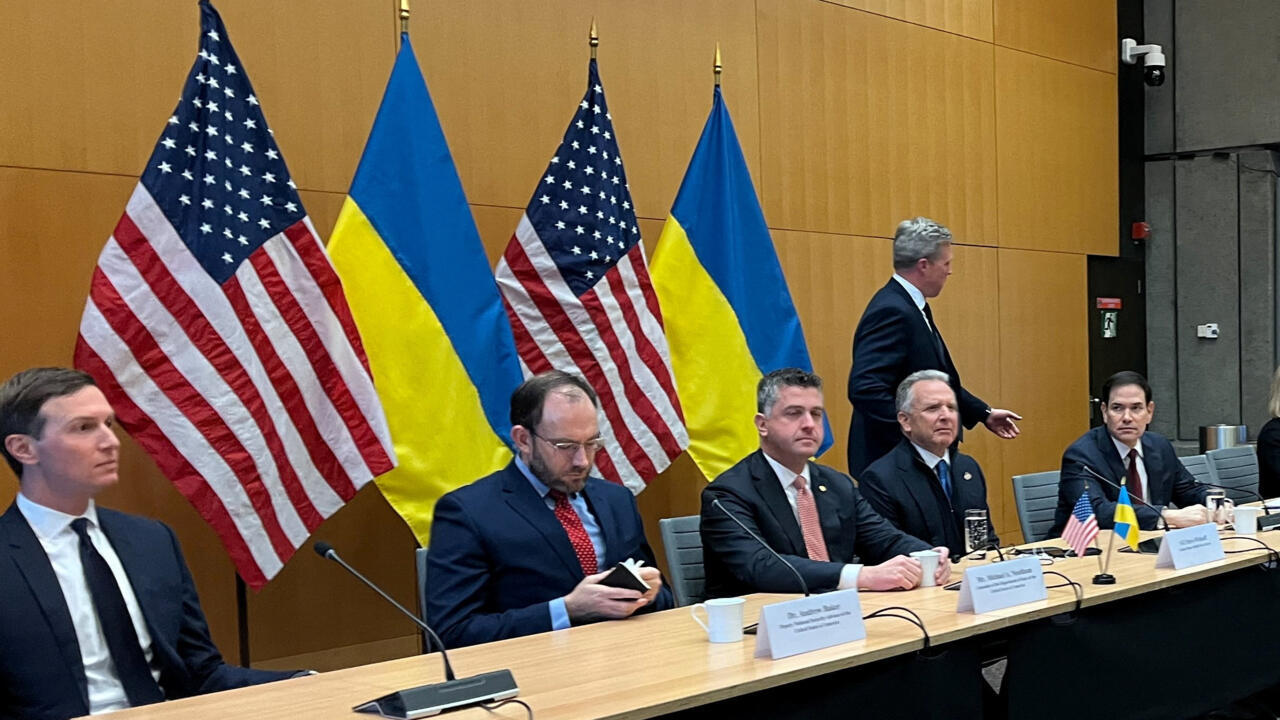
02:16
US presidential envoy Steve Witkoff advised a senior Kremlin official on how Vladimir Putin should pitch a Ukraine peace deal to President Donald Trump, according to a transcript of their discussion published Tuesday by Bloomberg.
The phone conversation in mid-October appears to point to the origins of a Trump-endorsed 28-point proposal that was widely seen as favouring Moscow by requiring Ukraine to make significant territorial concessions and pledge not to join NATO.
Trump forces Zelensky into a corner with plan to end war on Russian terms
Bloomberg said it had produced the transcript after reviewing a recording of the conversation between Witkoff and Yuri Ushakov, Putin's foreign policy advisor – but gave no indication of how the recording was acquired.
According to the transcript, Witkoff said during the call that he believes Russia – which started the war in Ukraine by launching a full-scale invasion in February 2022 – "has always wanted a peace deal", and that he has "the deepest respect for President Putin".
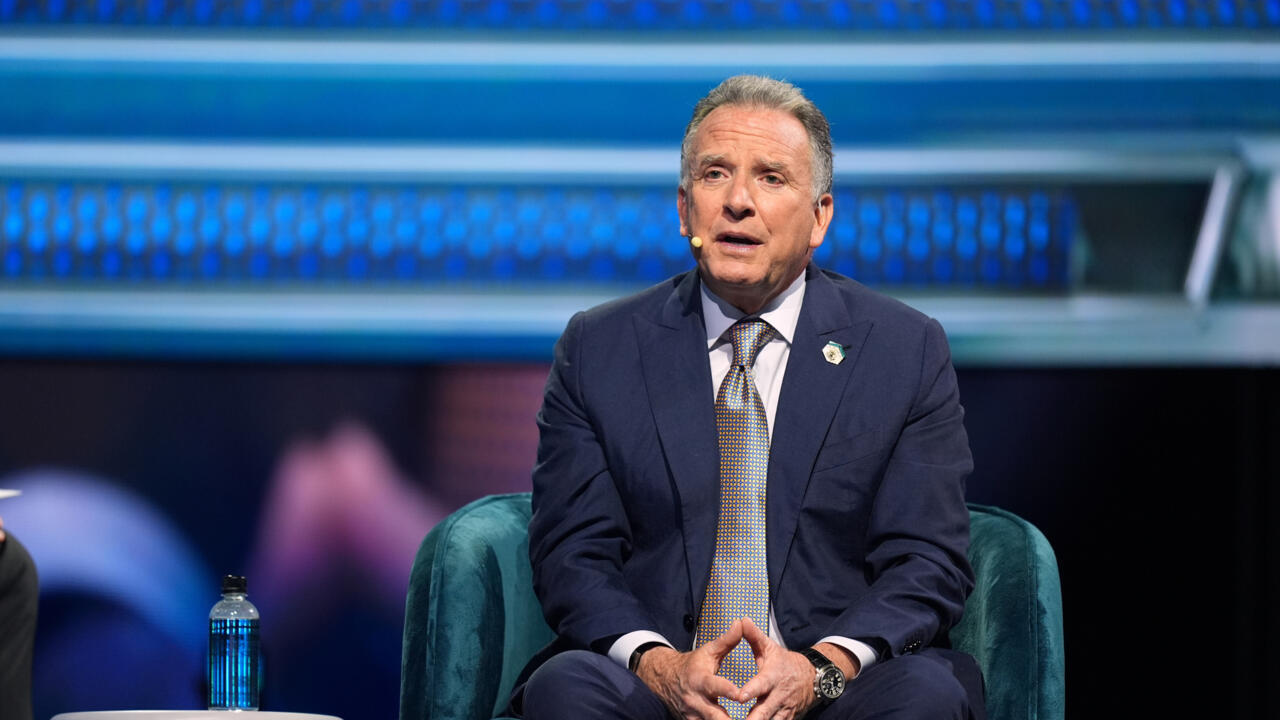
08:23
Witkoff also suggested the creation of a 20-point peace plan for Ukraine "just like we did in Gaza", and urged that Putin bring it up with Trump.
"I think... the president will give me a lot of space and discretion to get to the deal," he told Ushakov.
The phone call between Trump and Putin took place on October 16, with the US president describing it as "very productive" and subsequently questioning Kyiv's push for Tomahawk missiles just a day before hosting Ukraine's President Volodymyr Zelensky at the White House.
Washington's 28-point proposal to end the war has since been replaced by one taking in more of Ukraine's interests.
Witkoff will soon discuss that new version with Putin in Moscow, with Trump saying there were "only a few remaining points of disagreement".
Speaking to reporters Tuesday, Trump said he hadn't heard the tape but called it "a very standard form of negotiation".
When asked if he's concerned Witkoff is too pro-Russian, the president instead addressed the human cost of the war.
"Look, this war could go on for years, and Russia's got a lot more people, got a lot more soldiers, so I think if Ukraine can make a deal, it's a good thing," Trump said, adding "I think it's great for both."
(FRANCE 24 with AFP)
Leaked Witkoff, Dmitriev phone conversations detail the Ukraine peace plan negotiations
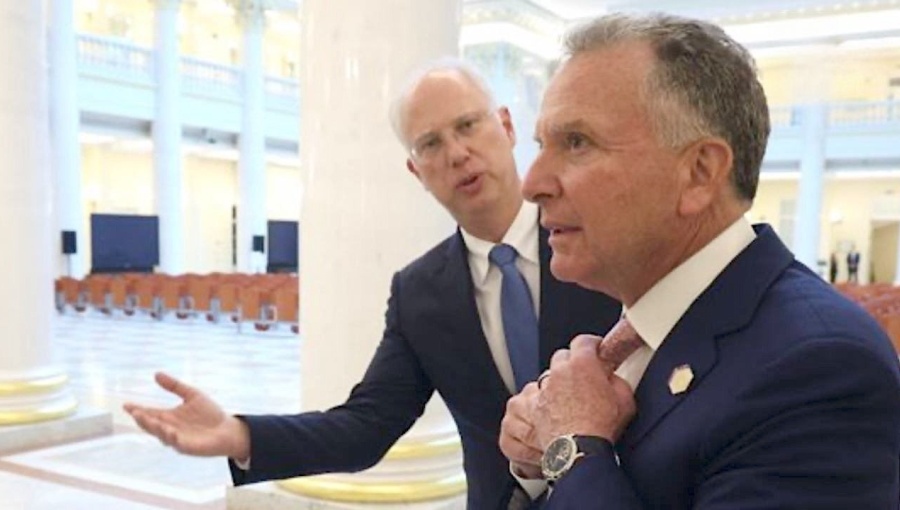
Conversations involving the two main protagonists drawn up the 28-point peace plan (28PPP) were caught on tape giving damning details of the negotiations that lead up to the release of the plan, Bloomberg reported on November 25.
The original version of what has been dubbed the Witkoff-Dmitriev plan, named after its reported authors, US Special Envoy to the Middle East Steve Witkoff and the head of Russia’s sovereign wealth fund, Kirill Dmitriev, caused a storm of controversy, but remains the most serious attempt to end the war in Ukraine since the Istanbul peace deal in April 2022.
However, there is a great deal of confusion over who wrote the plan, which many have lambasted as simply being a Kremlin wish list of demands for Ukraine’s capitulation. The story was broken by Axios on November 19 and initially Witkoff suggested that Dmitriev leaked the story in a social media post. Dmitriev later denied that accusation, in the transcript of a phone call between him and Yuri Ushakov, Putin’s top foreign policy advisor, suggesting he was both the author and the source of the leak. Axios has since claimed Dmitriev was not the source of the leak.
Dmitriev-Ushakov call
The transcript of a leaked call between Dmitriev and Ushakov on October 29 published by Bloomberg shows them discussing what appears to be the 28PPP which Dmitriev suggested should be leaked to the press to get the ball moving on negotiations. Ushakov expressed hesitancy, afraid that it could back fire and Russia would be blamed for authoring the plan – which is what happened.
However, at the conclusion of the conversation the men appeared to proceed with the plan to release the draft list of proposals.
Dmitriev challenged the authenticity of the recording with a one word post on social media: “Fake.”
The transcript shows compelling evidence that it was Dmitriev that leaked the list of proposals, first published by Axios last week.
“No, look. I think we’ll just make this paper from our position, and I’ll informally pass it along, making it clear that it’s all informal. And let them do like their own. But, I don’t think they’ll take exactly our version, but at least it’ll be as close to it as possible,” Dmitriev said, according to the transcript.
Ushakov was nervous about going public but gave his go ahead to release the list.
“Well, that’s exactly the point. They might not take it and say that it was agreed with us. That’s what I’m afraid of… They might twist it later, that’s all. There is that risk. There is. Well, alright, never mind. We’ll see,” Ushakov said.
Witkoff on Trump
More damning is a transcript of another conversation, also published by Bloomberg, that Witkoff schooled Ushakov on how to deal with US President Donald Trump.
The call offers the first direct evidence of behind-the-scenes efforts by the Trump administration to broker an end to the war.
In a five-minute conversation on October 14, Witkoff advised Ushakov on how to frame the proposal with Trump. According to the transcript by Bloomberg, Witkoff said, “We put a 20-point Trump plan together that was 20 points for peace and I’m thinking maybe we do the same thing with you.”
He also suggested arranging a call between Trump and Putin ahead of Ukrainian President Volodymyr Zelenskiy’s White House visit on October 17, using the recent Gaza ceasefire deal as diplomatic leverage.
Witkoff proposed modeling the plan on the recent Gaza agreement, telling Ushakov that he and Trump had created a “20-point plan for peace” and could develop a similar one with Russia. He advised Putin to call Trump, congratulate him on the Gaza deal, and present Russia as eager for peace before Zelensky visited the White House.
“Here’s what I think would be amazing,” Witkoff said. “Maybe he says to President Trump: you know, Steve [Witkoff] and Yuri [Ushakov] discussed a very similar 20-point plan to peace and that could be something that we think might move the needle a little bit, we’re open to those sorts of things.”
Trump and Putin held the call two days later on October 16, at Russia’s request, which Trump described as a “very productive” conversation. Following up on that call, Witkoff met with Dmitriev for three days in Miami from October 24 where they thrashed out the details of the 28-point plan.
On his return to Moscow, Dmitriev immediately called Ushakov on October 29 to discuss the results of the meeting and a plan to leak the list to the press.
At the time of the Witkoff-Ushakov call, Trump had just secured the release of the final 20 hostages held by Hamas and addressed the Israeli Knesset, becoming the first US president to do so since 2008. However, his stance on Putin had cooled. “I don’t know why he continues with this war,” Trump said on October 14. “He just doesn’t want to end that war. And I think it’s making him look very bad.”
The White House is defending Witkoff over the call made on an insecure line, in breach of regular diplomatic protocols. Trump told reporters he had not reviewed the call but described Witkoff’s approach as a “standard negotiation.” He added, “He’s got to sell this to Ukraine. He’s going to sell Ukraine to Russia. That’s what a dealmaker does… I would imagine he’s saying the same thing to Ukraine, because each party has to give and take.”
Next steps
The transcript supports the theory that Witkoff met with Dmitriev in Miami on October 24-26 where they thrashed out the basis of the plan. Russian Foreign Minister Sergei Lavrov commenting on the plan on November 25 said that it was largely based on agreements reached by Trump and Putin at the Alaska summit on August 15 and was “largely acceptable” to the Kremlin.
“The original 28-Point Peace Plan, which was drafted by the United States, has been fine-tuned, with additional input from both sides, and there are only a few remaining points of disagreement,” the president said in a post on Truth Social.
Since then top officials from the US, Ukraine and Europe met in Geneva at the weekend and dramatically altered the plan, cutting it down to a 19-point peace plan (19PPP) that removes all the items not directly pertaining to a ceasefire. Since then, the European Commission President Ursula von der Leyen has released an alternative 24-point peace plan (24PPP) that contains many of the EU’s maximalist points that will be unacceptable to the Kremlin, including: no territorial concessions at all, Nato troops stationed in Ukraine, and no cap on Ukraine’s military.
The Kremlin has strongly signaled that while it is positive on the original 28PPP version, Ushakov said the amended European versions were “unacceptable" and very likely to be rejected by the Kremlin.
A US delegation led by US Army Secretary Daniel Driscoll met with a Russian delegation in Abu Dhabi on November 25. Trump has ordered Witkoff to meet Putin in Moscow next week to continue the negotiations.
The talks now enter a delicate stage. Ukrainian President Volodymyr Zelenskiy still needs to meet with Trump to nail down the details of a US proposed security guarantee, which Ukraine’s Defence Minister Rustam Umerov, who was also in Miami and also involved in drawing up the 28PPP version, says will be key to any deal for Bankova (Ukraine’s equivalent of the Kremlin). That meeting may take place as soon as this week, according to comments from the Ukrainian side.
Then the plan needs to be presented to Putin by Witkoff, which may happen next week. In a National Security Council meeting last week, Putin said that the Kremlin is open to a peace deal agreement, but if its demands are not taken into account he was prepared to continue the military operation in Ukraine. Putin signaled that the Kremlin wants to negotiate using the original Witkoff-Dmitriev version of the plan, the outlines of which were agreed at the Alaska summit, but is not prepared to discuss the later European-supported versions.
KYIV BLOG: Kremlin leaks phone conversations to refocus attention on original 28-point Ukraine peace plan
Bloomberg scored a major scoop yesterday, publishing transcripts of conversations between US Special Envoy to the Middle East Steve Witkoff and Yuri Ushakov, Putin’s top foreign policy advisor, and another one between Ushakov and head of Russia’s sovereign wealth fund, Kirill Dmitriev a few days later.
Before I go on, for me the main question is not the content of the conversations, albeit interesting, but who the hell leaked these conversations? Surely, there is little doubt that it was Kremlin-ordered? Then to what end? Well, it seems to me the upshot is that it's now crystal clear the Kremlin wants the 28-point peace plan (28PPP) version of the plan and will not contemplate the European versions.
There has been a lot of manipulation going on with these deals. The Dmitriev-Ushakov conversation makes it clear that Dmitriev played a central role in drawing up the deal. It also confirms that he was the source of the leak of the original story, despite his own and Axios’ denial. Dmitriev himself denied the veracity of the transcript with a one-word social media post: “Fake.”
It highlights that the Kremlin wanted the 28PPP deal released and in play to get the show moving. It also highlights that this is THE deal they want to do – and are willing to do. That is key. Both Ushakov and yesterday Russian Foreign Minister Sergei Lavrov came out and confirmed that the 28PPP deal is “very close” to something the Kremlin can accept and that the other versions (the Geneva 19-point peace plan (19PPP) and the EU’s 24-point peace plan (24PPP)) are unacceptable.
The Witkoff leak was also very interesting. The White House has come out in his defence for coaching Ushakov on how to deal with US President Donald Trump. Commentators have slammed him for sounding more like a “partner” of the Russians than a – I don’t know what he should be; the implication is “adversary”. The White House has correctly pointed out that he was negotiating a deal that both sides want ,and in the course of those talks, you do end up as a partner if you want to get the deal over the line.
Having good and friendly relations with your counterpart interlocutor, even if the country relations are poor, is not only perfectly normal, it's desirable. A great example of this is Nikki Haley, who served as US ambassador to the UN from 2017 to 2018 under President Donald Trump’s first term. She is noted for having a very cordial relationship with Vitaly Churkin, the long-serving Russian Ambassador to the UN, who died suddenly in February 2017 while still in office. After his death she wrote a glowing obituary and said they would sit for hours dreaming up solutions to problems that both would then run by their leaders, trying to find compromise solutions. This is how diplomacy is done. In exemplifying how Putin could sell an idea to Trump, Witkoff didn’t do anything unusual at all.
What also emerged is a very clear timeline of how this deal came about.
August 15: The process started at the Alaska summit between Putin and Trump. Clearly the outline of a deal was thrashed out there, that included mineral deals (of course) and how to use the frozen Russian money, as well as a bunch of other business deals we don’t know about but were going to be plonked in to the $200bn joint US-Russia investment fund mentioned in the original list.
October 14: Witkoff spoke to Ushakov, the subject of the first Bloomberg transcript, and advised him on how to sell the peace plan deal to Putin in the wake of his triumph on a Gaza deal a few days later. The full plan was not worked out at this point, but clearly both the White House and the Kremlin had a very clear idea that they were going to put a plan together and the White House was already selling this idea to the Kremlin, not the other way round.
October 24-27: Witkoff and Dmitriev then met in Miami, of all places, for three days to thrash out the details. Interestingly, another downplayed detail is that Ukraine’s Defence Minister Rustam Umerov apparently was present at some of these meetings. He was in the US at the time (where his family lives) and was also reportedly in Miami, but the exact timing of his presence and what he contributed remains unclear. The one point that has been reported is that the idea of a 600,000 men cap on the Armed Forces of Ukraine (AFU) was his idea.
October 29: As soon as Dmitriev got home to Moscow he called Ushakov to discuss leaking the details of the plan, the subject of the second Bloomberg transcript.
November 1: Since the start of November, the Kremlin has thrown everything its got into the battle for Pokrovsk and made real progress. Putin has moved a reported 150,000 troops to the region and 11,000 Russian soldiers are reportedly directly engaged in the battle for the city itself. Pokrovsk looked close to falling two weeks ago after nearly a year of fighting, but the AFU has put up a heroic defence with reportedly some successful counterattacks. But the slow attrition of Ukraine’s defences is another pressure point that the Kremlin is exploiting as the ceasefire talks gather momentum and the situation on the battlefront is “critical” according to military blogger reports.
November 11: The $100mn Energoatom corruption scandal has been a bonus for the Kremlin as it piles new unexpected pressure on Zelenskiy to end the war. The scandal is by far the worst since he came to power in 2019 and significantly improves the prospects for reaching a peace deal, as it undermines the already wobbly support for Kyiv in the EU.
November 18: Axios published its report, “Scoop: US secretly drafting new plan to end Ukraine war” setting the cat amongst the pigeons. Within 24 hours the text of the entire list was leaked by Ukrainian politician Oleksiy Honcharenko, a member of former president Petro Poroshenko’s European Solidarity party.
The list has been sold as a “Russian wish list” and to back that idea up, The Guardian’s Luke Harding wrote a textual analysis of the list shows the original was very likely written in Russian, and not English, so that it had to come from the Kremlin. Except it came from Ukraine where Russian is one of the diplomatic working languages.
November 23: The circus of amending the proposals began, culminating with the Geneva meeting on November 23 and is still going on. Geneva produced the 19-point alternative peace plan (19PPP) and European Commission President Ursula von der Leyen has also issued a 24-point EU version (24PPP) that will be completely unacceptable to the Kremlin.
Why would the Kremlin go to all this effort and leak key conversations to the Western press? One explanation could be that it is trying to refocus everyone back on the original 28PPP list as that is the deal it wants to do. Presidential spokesman Dmitry Peskov complained yesterday that the story was descending into an “information frenzy”, but the two transcripts clear up a lot of points and also make it clear that the original proposal was thrashed out by the three parties of the US, Russia and Ukraine. The leak is an attempt to undermine all the other iterations and refocus Trump at least on the need to stick to the original deal he has been working on for almost two months.
A negotiated deal would provide a clean end to the war that not only ties off the multiple loose ends, but would be a step towards starting talks on a new post-Cold War pan-European security deal that the Kremlin has wanted since 2008. (Ukraine’s neutrality and no-NAto status is only part of this wider goal.) It would also allow a restart of talks on renewing the Cold War-era missile agreements which the Kremlin also wants very badly. Both of these are real leverage the West has over Russia that have been almost completely ignored in the talks so far.
Doing business deals with Trump will also appeal to Putin as improved relations with the US would act as a useful counterbalance to his current dependency on Beijing. For the US, business deals would allow Washington to drive a wedge in between Beijing and Moscow in a “reverse Nixon”, which is not a stupid long-term strategy at all. The role of business in adversarial geopolitics is underscored by the presence of a Pepsi factory in Russia since 1972 that Nixon set up; bizarrely even today, most older Russians think that Pepsi is a Russian drink as they know it from their childhood.
The other option for Putin, a military victory, is much messier. He would get his buffer zone on his border and Ukraine would de facto be excluded from Nato for as long as Russia occupies Ukrainian land, but sanctions would remain on Russia for generations and a new post Trump administration could well restart supplying Ukraine. Russia’s investment into securing the territory it already holds would have to be massive and the rebuilding costs of its part of the country would be a significant drain on Russia’s resources.
Zelenskiy has a very nasty choice now. The Kremlin is making it clear that it is finally ready to reach a negotiated
Rubio Neo-Conned Trump’s Ukraine Peace Plan – OpEd
November 26, 2025By Daniel McAdams
Lie down with dogs, you wake up with fleas; lie down with neocons, you wake up with wars. –Me
So goes President Trump’s 28 point peace plan to end the Russia/Ukraine war. Revealed at the end of last week, the plan initially received a cautious but cautiously optimistic reception in Moscow.
It was hardly a dramatic tilt toward the Russian position. Many of the plan’s points ranged from the implausible to the bizarre. For example the idea that President Trump would be crowned some sort of “peace czar” overseeing the deal, and that Russia would agree to use its seized assets to rebuild Ukraine. Then there is the one that Russia should accept a demilitarized “buffer” zone taking up a good chunk of Donetsk (which itself would be “de facto” part of Russia but not de jure – and thereby subject to the vicissitudes of Western electoral politics). And of course there was the part where the US would share the “profits” from Russia’s paid reconstruction of Ukraine.
Very Trumpian, very weird.
Nevertheless the flawed plan (in terms of Russian acceptance) dropped like an atom bomb on the US neocons and their European counterparts. Trump’s peace plan was “entirely dictated by Putin,” the UK Independent breathlessly tells us. Yes, that is how propagandistic the western mainstream media really is. And suddenly we are back to Russiagate and accusations the Trump is acting as Putin’s puppet – or at least stenographer.
At the political level, EU foreign affairs chief Kaja Kallas pretty well summed up the level of delusion among the European elite: “We have not heard of any concessions from Russia. If Russia really wanted peace, it could have agreed to an unconditional ceasefire a long time ago.’”
Yes, Kaja “Sun Tzu” Kallas. Military history teaches us that every army making rapid gains on the battlefield periodically pauses to make concessions to the losing side. Otherwise it wouldn’t be fair and not everyone would get a trophy.
President Trump’s demand that Ukraine’s acting president, Zelensky, accept the terms by Thanksgiving or face a cut-off in US military and intelligence assistance put the Europeans and US hawks in panic mode. It appeared Trump was finally tired of playing Hamlet after the framework he presented in Alaska in August was agreed upon by Russia and then abandoned by Trump himself after receiving an earful from said Europeans and US neocons.
This time, by golly, Trump was finally going to step up and end a conflict nearly a year after he promised to end it 24 hours.
And then Rubio walked in.
The one lesson Trump 2.0 did not learn from Trump 1.0 is that the personnel is the policy, particularly with a president who appears uninterested in details and disengaged from complex processes. Trump 1.0 was dragged down by neocon albatrosses John Bolton and Mike Pompeo, among others.
Even a Col. Douglas Macgregor brought in in the 4th quarter at the two minute warning to throw a “Hail Mary” pass to get us out of Afghanistan was tackled behind the line of scrimmage by Robert O’Brien, Trump’s final National Security Advisor and neocon dead-ender.
Neocons are wreckers. That’s the one thing they are good at.
The inclusion of new blood in the person of Vice President Vance ally, Army Secretary Dan Driscoll – who supplanted terminally clueless Trump envoy Keith Kellogg – offered the promise that finally the realist faction in the shadows of the Trump Administration would have their shot.
Then the rug was pulled. Again.
Rubio jetted off to Geneva to help lick the wounds of the European “leaders” who are dedicated to fighting the Russians down to the last Ukrainian.
Politico lets us in on what happened next, in a piece titled, “Rubio changes the tack of Trump’s Ukraine negotiations after week of chaos.”
Before Rubio showed up in Switzerland, it largely felt like Vice President JD Vance, via his close friend Driscoll, was leading the process. By the end of the weekend, Rubio had taken the reins because the conversations became more flexible, the official said.
“Flexibility” means that we are back to square one, with a reversion to the Kellogg/Euro view that the side winning a war should unilaterally freeze military operations in favor of the losing side.
Politico continued:
Rubio’s participation in the talks produced much more American flexibility, the four people familiar with the discussions said. Rubio told reporters on Sunday night that the aim is simply to finalize discussions ‘as soon as possible,’ rather than by Thanksgiving.
That loss of momentum and destruction of the sense of urgency means we have returned to the endless bickering of the eternally deluded voices who even in the face of rapid recent Russian advances believe that Ukraine is winning – or could win with a few hundred billion more dollars – the war against Russia.
Never mind the golden toilets. Suddenly that’s out of the news.
At the end of the day, all the drama changes little. As President Putinhimself said while meeting with his own national security council (h/t MoA):
Either Kiev’s leadership lacks objective reporting about the developments on the front, or, even if they receive such information, they are unable to assess it objectively. If Kiev refuses to discuss President Trump’s proposals and declines to engage in dialogue, then both they and their European instigators must understand that what happened in Kupyansk will inevitably occur in other key areas of the front. Perhaps not as quickly as we would prefer, but inevitably.
And overall, this development suits us, as it leads to achieving the goals of the special military operation by force, through armed confrontation.
In other words, Russia is happy to achieve its objectives through negotiation, which would save lives and infrastructure especially in Ukraine. But it is also willing to continue its accelerating push to achieve those objectives militarily. And no fever dreams of war with Russia from the likes of former NATO chief Anders Fogh Rasmussen is going to change that.
Marco Rubio is a pretty bad Kissinger, and Kissinger was bad enough. At some point – and that point may have now passed – the Russians are going to rightly conclude that they have no negotiating partner in a US still dominated by people like the former Senator from Florida whose first love is regime change in Venezuela and Cuba.
Whatever the case, Trump should be pretty miffed that Marco threw a spanner in what would have been a world record, unprecedented, universally-praised, like-nothing-the-world-has-ever-seen, solving of NINE wars in just his first year in office!
Daniel McAdams
Daniel McAdams is the Executive Director of the Ron Paul Institute for Peace and Prosperity and co-Producer/co-Host, Ron Paul Liberty Report. Daniel served as the foreign affairs, civil liberties, and defense/intel policy advisor to U.S. Congressman Ron Paul, MD (R-Texas) from 2001 until Dr. Paul’s retirement at the end of 2012. From 1993-1999 he worked as a journalist based in Budapest, Hungary, and traveled through the former communist bloc as a human rights monitor and election observer.
The ongoing discussions on a possible US sponsored peace deal to end the Ukraine war has put fresh pressure on the EU to come up with a solution to Ukraine’s acute funding shortfall.
As part of the US 28-point peace plan (28PPP), Russia’s $300bn of frozen assets may be used to seed several reconstruction and investment funds that would take the cash off the table for use to finance Kyiv in 2026.
In response, the European Commission (EC) is urgently working on an alternative plan to offer Ukraine a bridge loan in parallel to talks on the mooted €140bn Reparation Loans using Russian frozen cash.
It's an emergency plan B to secure more cash for Ukraine which could run out of money as soon as February after the Trump administration pulled out of support for the war in Ukraine. US President Donald Trump has sent no money to Ukraine since taking office in January and there is a $70bn hole in its funding needs for 2026, as donors account for at least half of the budget’s funds.
The EC has turned to the frozen Central Bank of Russia (CBR) reserves, two thirds of which are held by Belgium’s Euroclear, as the only source of money available. Brussels has objected to the idea as it will be on the hook if Ukraine defaults on the loan, or if the Kremlin wins anticipated lawsuits and courts demand its funds are returned to Moscow.
Earlier this month, European Commission President Ursula von der Leyen floated two alternative schemes to keep the funds flowing: member states make individual loans to Ukraine that don’t need a unanimous approval by the EU members; and the EU raises the money by collectively issuing bonds, which does. None of the member states are keen on either idea. Hungary, amongst others, is almost certain to veto an attempt to issue collective EU-backed bonds to fund Ukraine.
Ukraine faces the prospect of depleting its funds by February. It is still short somewhere between $8bn-$19bn (depending on war costs) for this year and the International Monetary Fund (IMF) said last month that Kyiv needs an additional $65bn of funds for 2026, which is so far unfunded. Economists have warned that Ukraine faces a macroeconomic collapse if the money is not secured sometime in the first quarter of next year.
Ukraine will be unable to cover its non-military expenditures in February without a loan, say economists. The planned budget deficit exceeds 18% of its GDP and will need at least €70bn in external financial support next year, according to the European Commission.
In addition, defence spending currently accounts for approximately 25% of Ukraine’s economic output that brings the total funding needs up to in excess of €100bn a year.
Some EU members are already providing Kyiv with substantial funds, but collectively it is still not enough to plug the hole. Berlin has increased its commitments from €3bn a year under the previous Scholtz administration to €11.5bn for next year. And other EU members like Sweden and Denmark have also pencilled in billions of euros of support. But even with these funds, the sums on offer remain an order of magnitude too little.
An attempt to pass legislation to create a mechanism for the Reparation Loans in November failed. A second vote is due to be held at the next EU summit on December 19, but expectations for success are low. The plan continues to face fierce opposition from Bart De Wever, the prime minister of Belgium, where the money is held, who wants assurances from all EU members that they will be prepared to share the risk should Belgium be forced to repay Russia’s money.
Last month, Norway suggested that it might use €100bn of its €1.8 trillion sovereign wealth fund cash-pile to collateralise the loan, but that idea seems to have been dropped in the meantime.
Adding to the uncertainty, among the points in the mooted US 28-point peace plan (28PPP) for Ukraine were some clauses that would take the Russian frozen funds off the table. The US was proposing to use $100bn of the funds for a Ukraine reconstruction fund. The remaining money would be used to seed a joint US-Russia investment fund to finance commercial projects. Reportedly, both these suggestions have been removed from the cut-down 19-point peace plan (19PPP) proposed in Geneva over the weekend.
Von der Leyen has fiercely opposed any suggestion by the US to use the frozen assets, which Brussels has made clear it wants to remain under European control for eventual use to pay for reparations after the war has ended. The cash would only become repayable to Moscow in the unlikely scenario that Russia agrees to pay war damages in an eventual ceasefire deal.
However, Ukraine’s ardent supporters are pushing the EC to come up with a solution. At an informal coalition of the willing meeting on November 25, France, Germany, the Netherlands, Lithuania and Luxembourg all lobbied the EC to outline the details of this plan B.
French President Emmanuel Macron said at the meeting that EU allies will finalize "in the coming days" a solution that will "secure funding" and "give visibility to Ukraine."
But EU members are all very reluctant to dip into their own pockets to finance Ukraine. As bne IntelliNews has reported, Europe can’t afford to take over the burden of supporting Ukraine from the US, as most EU countries are either in recession or approaching a crisis.
“We hope to be able to solve their hesitation,” one EU diplomat told Politico. “We really do not see any other possible option than the reparations loan.”
BACKGROUND
1. Ukraine's sovereignty will be confirmed.
2. A comprehensive non-aggression agreement will be concluded between Russia, Ukraine and Europe. All ambiguities of the last 30 years will be considered settled.
3. It is expected that Russia will not invade neighbouring countries and NATO will not expand further.
4. A dialogue will be held between Russia and NATO, mediated by the United States, to resolve all security issues and create conditions for de-escalation.
5. Ukraine will receive reliable security guarantees.
6. The size of the Ukrainian Armed Forces will be limited to 600,000 personnel.
7. Ukraine agrees to enshrine in its constitution that it will not join NATO, and NATO agrees to include in its statutes a provision that Ukraine will not be admitted in the future.
8. NATO agrees not to station troops in Ukraine.
9. European fighter jets will be stationed in Poland.
10. The US will receive compensation for the security guarantees it provides. If Ukraine invades Russia, it will lose the guarantee. If Russia invades Ukraine, in addition to a decisive coordinated military response, all global sanctions will be reinstated and recognition of its new territories and all other benefits of this deal will be revoked. If Ukraine launches a missile at Moscow or St. Petersburg without cause, the security guarantee will also be deemed invalid.
11. Ukraine is eligible for EU membership and will receive short-term preferential access to the European market while this issue is being considered.
12. A powerful global package of measures to rebuild Ukraine will be established, including the creation of a Ukraine Development Fund, the rebuilding of Ukraine's gas infrastructure, the rehabilitation of war-affected areas, the development of new infrastructure and a resumption of the extraction of minerals and natural resources, all with a special finance package developed by the World Bank.
13. Russia will be reintegrated into the global economy, with discussions on lifting sanctions, rejoining the G8 group and entering a long-term economic cooperation agreement with the United States.
14. Some $100 billion in frozen Russian assets will be invested in US-led efforts to rebuild and invest in Ukraine, with the US receiving 50 percent of the profits from the venture. Europe will add $100 billion to increase the amount of investment available for Ukraine's reconstruction. Frozen European funds will be unfrozen, and the remainder of the frozen Russian funds will be invested in a separate US-Russian investment vehicle.
15. A joint American-Russian working group on security issues will be established to promote and ensure compliance with all provisions of this agreement.
16. Russia will enshrine in law its policy of non-aggression towards Europe and Ukraine.
17. The United States and Russia will agree to extend the validity of treaties on the non-proliferation and control of nuclear weapons, including the START I Treaty.
18. Ukraine agrees to be a non-nuclear state in accordance with the Treaty on the Non-Proliferation of Nuclear Weapons.
19. The Zaporizhzhia Nuclear Power Plant will be launched under the supervision of the UN's International Atomic Energy Agency (IAEA), and the electricity produced will be distributed equally between Russia and Ukraine.
20. Both countries undertake to implement educational programmes in schools and society aimed at promoting understanding and tolerance.
21. Crimea, Luhansk and Donetsk will be recognised as de facto Russian, including by the United States. Kherson and Zaporizhzhia will be frozen along the line of contact, which will mean de-facto recognition along the line of contact. Russia will relinquish other agreed territories it controls outside the five regions. Ukrainian forces will withdraw from the part of Donetsk Oblast that they currently control, which will then be used to create a buffer zone.
22. After agreeing on future territorial arrangements, both the Russian Federation and Ukraine undertake not to change these arrangements by force. Any security guarantees will not apply in the event of a breach of this commitment.
23. Russia will not prevent Ukraine from using the Dnieper River for commercial activities, and agreements will be reached on the free transport of grain across the Black Sea.
24. A humanitarian committee will be established to resolve prisoner exchanges and the return of remains, hostages and civilian detainees, and a family reunification programme will be implemented.
25. Ukraine will hold elections in 100 days.
26. All parties involved in this conflict will receive full amnesty for their actions during the war and agree not to make any claims or consider any complaints in the future.
27. This agreement will be legally binding. Its implementation will be monitored and guaranteed by the Peace Council, headed by US President Donald Trump. Sanctions will be imposed for violations.
28. Once all parties agree to this memorandum, the ceasefire will take effect immediately after both sides retreat to the agreed points to begin implementation of the agreement.
(FRANCE 24 with AFP)


No comments:
Post a Comment