Tehran tops world pollution rankings as air quality reaches hazardous levels

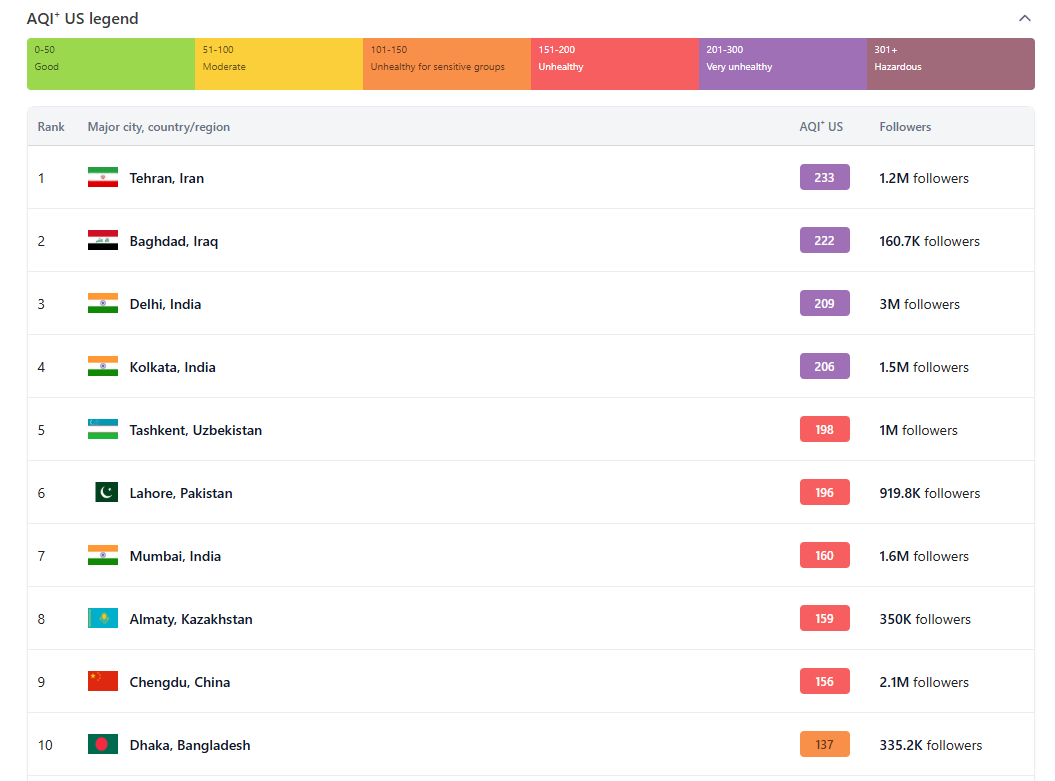
Tehran has been ranked the world's most polluted city with an Air Quality Index of 233, according to Swiss-based air quality monitor IQAir, as critical pollution levels affect all monitoring stations across the Iranian capital.
Pollution has been lingering for days over the Iranian capital as autumnal rains have failed to arrive, only worsening the issue of airborne particles hovering close to the ground due to the so-called "inversion effect", which, due to cool temperatures and a lack of wind, traps pollution close to the ground.
The Tehran Air Quality Control Company reported that 25 stations registered critical "red" conditions on November 25, with the capital's average Air Quality Index reaching 171 and no areas recording acceptable air quality levels, ISNA reported on November 25.
IQAir's real-time rankings place Tehran ahead of Baghdad (AQI 222), Delhi (209), and Kolkata (206) in the "very unhealthy" category, indicating severe health risks for all residents. The primary pollutant affecting most stations was particulate matter smaller than 2.5 microns (PM2.5).
Fatah Square station in District 9 recorded the highest pollution level with an AQI of 195, marking it as the most polluted monitoring point in the capital. One station registered "very unhealthy" purple-level conditions on November 24, when the citywide average stood at 169 with 21 stations in red status.
Stations recording unhealthy conditions for all groups included Aghdasiyeh, Sharif, Poonak, Tarbiat Modares, Tehran University, Crisis Headquarters, Golbarg and Fatah Square. Critical red-level readings were reported at stations across Districts 11, 13, 15, 17, 18, 19, 20, 21 and 22.
The pollution stems from multiple sources, including vehicular emissions, heavy fuel oil and mazut burning in power plants, and temperature inversion that traps pollutants close to the ground. Vehicle emissions account for approximately 80% of Tehran's air pollution.
Tehran's chronic air pollution stems from a combination of geographic and industrial factors, with the city's location in a valley surrounded by mountains creating an atmospheric inversion effect that traps pollutants close to ground level due to cold weather.
The Air Quality Index is divided into six categories: zero to 50 indicates clean air, 51 to 100 is acceptable, 101 to 150 is unhealthy for sensitive groups, 151 to 200 is unhealthy for all groups, 201 to 300 is very unhealthy, and 301 to 500 indicates hazardous conditions.
Online social media across Iran has become increasingly critical of government pollution readings, fearing that monitoring stations have been either switched off or producing metered-down readings in recent days, according top previous reports.
Further west, schools and government offices in Tabriz will close on November 26 and 27 after the city's Air Quality Index reached 182, entering the "unhealthy for all groups" red category.
The Emergency Working Group announced the closures due to continuing pollution levels in Iran's fifth-largest city. The AQI reading of 182 places Tabriz firmly in the unhealthy range, which extends from 151 to 200 on the Air Quality Index scale.
The closures affect all educational institutions and government offices across the city for the two-day period, as authorities respond to the sustained deterioration in air quality.
Other cities across Asia are also suffering under a blanket of smog, including more northernly Tashkent in Uzbekistan, which also reported high readings of airbourne particles. The Uzbek capital, similar in layout to Tehran near mountains is currently suffering with a PM 2.5 level of 198, accordign to the latest readings.
Uzbekistan
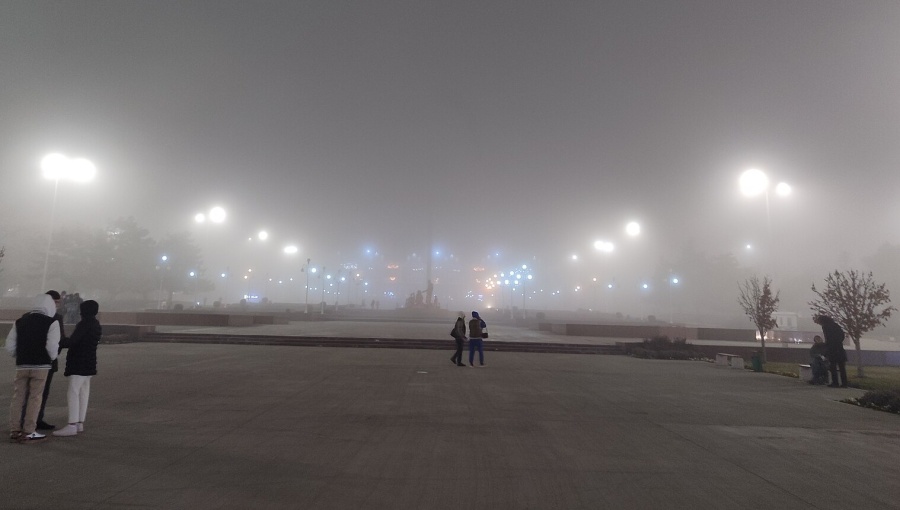
In recent days, Tashkent has been engulfed by a dense haze. The sharp smell of burning permeates neighbourhoods of the Uzbek capital and air-quality readings taken in the city confirm what residents sense first-hand: residents are once again choking on dangerously high levels of pollution.
The situation has prompted urgent government action with international comparisons showing Tashkent is faring so badly with smog that, on November 20, it was ranked first among the world’s 10 most polluted cities by the International Air Quality Index (IQAir), with an air quality index of 250 units classified as “very harmful.”
After several days of near-normal air quality, the situation began to worsen again on the afternoon of November 23.
Uzhydromet reported that by 8:00 pm local time that day, the concentration of fine particulate matter PM10 in the air had reached 373 micrograms (μg) per cubic metre, 20% above the maximum permissible concentration of 300 μg/m³.
Even more concerning, PM2.5 levels surged to 202 μg/m³, more than three times the daily safe limit of 60 μg/m³.
Authorities reminded city dwellers that it is sudden temperature fluctuations that cause an atmospheric inversion, trapping fine particles close to the ground and exacerbating pollution levels.
"These weather conditions will persist throughout our republic for several more days," Uzhydromet said, urging residents to limit outdoor activities and wear protective masks.
In response to the crisis, President Shavkat Mirziyoyev signed a decree on November 25 introducing urgent measures to improve Tashkent’s ecological status.
A special commission, headed by the chairperson of the National Ecology Committee and the president’s environmental advisor, Aziz Abduhakimov, has been established to monitor the situation, forecast trends and implement immediate interventions when air quality reaches dangerous levels.
The commission is empowered to:
- Restrict operations at industrial enterprises, transport and other sources of pollution.
- Impose vehicle restrictions based on licence plate numbers, excluding electric vehicles (EVs).
- Temporarily close facilities that burn polluting substances, including certain greenhouses.
- Identify industrial zones for potential relocation outside the city.
- Enforce limits on industrial discharges and suspend non-compliant enterprises.
- Introduce construction regulations to reduce dust emissions and ensure green zones.
Construction sites in Tashkent are to undergo immediate inspections to ensure compliance with environmental measures. Developers must allocate 25% of their territory to green zones, install water sprayers and provide wheel-washing facilities for construction vehicles. Air quality monitoring stations will be installed across all major sites.
The city administration will also increase watering of trees and bushes.
Over the next three months, 12 artificial lakes are set to open and the number of fountains in the city will be doubled to improve urban air humidity.
The government has also ordered the accelerated gasification of greenhouses in and around Tashkent, reversing a previous push to use coal. Facilities burning waste or pollutants may face fines or confiscation, while all greenhouses will be required to install proper air and gas filtering systems.
Additionally, an expanded “Air Monitoring Uzbekistan” network is being launched, incorporating Tashkent stations and new monitoring laboratories. Household air purifiers will now be duty-free and by December 1, colour-coded national air quality indicators and corresponding health safety guidelines will be introduced.
As conditions worsened, Saida Mirziyoyeva, head of the Presidential Administration, convened an emergency meeting on November 24 with top officials. The discussion centred on citizen complaints, updated air-quality data and the main factors driving the pollution surge.
Mirziyoyeva stressed that polluters, state-owned or private, must face uncompromising consequences for violating environmental standards. She emphasised that public health must be fully protected, calling for coordinated short, medium and long-term measures.
Uzbekistan has also instructed major industrial enterprises to cut harmful emissions by 50% by December 1, particularly given the ongoing temperature inversions.
Category I and II enterprises must comply with environmental regulations or face severe penalties, including temporary shutdowns, fines, or criminal liability. Construction companies have also been reminded of air protection obligations.
Amid public concern, the Muslim Office of Uzbekistan announced that on November 28, istisqa prayers, traditionally performed to pray for rain, will be held after Friday prayers across the country. The initiative, led by Mufti Sheikh Nuriddin Khaliqnazar, seeks divine intervention amid the dry autumn and worsening air quality.
As of 8:00 pm local time on November 25, Tashkent’s air quality index reached 251 US AQI – very unhealthy, with PM2.5 at 175.9 µg/m³, signalling a severe spike in pollution that was blanketing the city in thick haze.

No comments:
Post a Comment