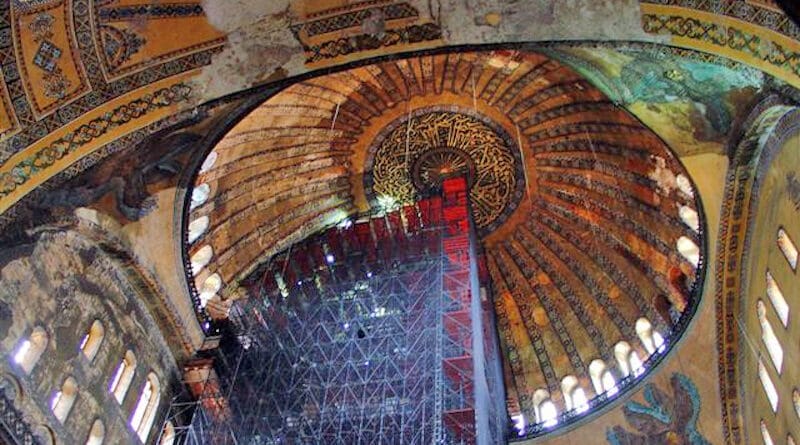
The dome of the Hagia Sophia undergoing restoration, Istanbul, Turkey.
Photo Credit: David Bjorgen, Wikimedia Commons
November 26, 2025
By Haluk Direskeneli
Hagia Sophia (Ayasofya), built in 532–537 under Emperor Justinian I, is more than a religious building. Its architects — Anthemios of Tralles and Isidoros of Miletos — designed a massive dome that was considered a marvel of engineering for its time. Later, in the 16th century, the Ottoman master architect Mimar Sinan recognized structural stresses in the building and added external support buttresses. Those interventions helped preserve Hagia Sophia’s stability over centuries.
Today, Hagia Sophia stands not just as a relic of ancient architecture, but as a preserved monument shaped by centuries of architectural care and engineering. The building’s survival is thanks to the original Byzantine design, Ottoman respect and reinforcement, and Sinan’s structural insights.
November 26, 2025
By Haluk Direskeneli
Hagia Sophia (Ayasofya), built in 532–537 under Emperor Justinian I, is more than a religious building. Its architects — Anthemios of Tralles and Isidoros of Miletos — designed a massive dome that was considered a marvel of engineering for its time. Later, in the 16th century, the Ottoman master architect Mimar Sinan recognized structural stresses in the building and added external support buttresses. Those interventions helped preserve Hagia Sophia’s stability over centuries.
Today, Hagia Sophia stands not just as a relic of ancient architecture, but as a preserved monument shaped by centuries of architectural care and engineering. The building’s survival is thanks to the original Byzantine design, Ottoman respect and reinforcement, and Sinan’s structural insights.
What’s Happening Now — and Why It Matters
Recently, photos and videos have shown heavy cranes and trucks inside Hagia Sophia’s interior, used for ongoing restoration and reinforcement work. Authorities say the equipment is needed to replace lead roofing on the main dome and to install internal supports for earthquake-strengthening work. They also claim that a multi-layer protective floor platform was installed to carry heavy loads.¹
Yet these developments have triggered serious concern among historians, architects and conservation specialists. The core issue: Hagia Sophia is not a modern building, but a complex historic structure with ancient masonry, layered floors, mosaics, and centuries-old structural elements.
Why Some Experts Are Worried
• Hagia Sophia’s floor is not a simple concrete slab. Beneath the surface there may be mosaics, old stone pavements, or even structural hollows — not ideal conditions for bearing heavy concentrated loads.²
• The “protective floor platform” whose installation is claimed has not been independently documented or publicly verified with detailed technical data. Some photos published show only simple flat panels, not a reinforced grid or load-distributing substructure.³
• Heavy machinery — cranes, trucks, loading/unloading operations — generates not only vertical load but also vibrations and dynamic stresses. In ancient masonry structures like Hagia Sophia, such stresses can cause micro-cracks, loosening of mortar joints, displacement of stone blocks or mosaics, and long-term structural weakening.⁴
• International standards of heritage conservation generally recommend minimal intervention and avoidance of heavy machinery in ancient monuments, especially when the original load-bearing logic is fragile or not fully known.⁵
The Key Question: Restoration — or Risk?
The issue is not restoration itself — which is often necessary in historic monuments — but how it is done. When a thousand-year-old architectural masterpiece becomes a temporary construction site, the risk is not only physical damage but also the loss of heritage value.
Hagia Sophia’s resilience over centuries depended on careful balancing of structure, materials and engineering. Each addition — from Byzantine masons to Ottoman builders to Sinan’s buttresses — respected that balance. Heavy cranes and modern vehicles inside the sacred space might disturb it.
What Should Be Done Instead
• Before proceeding, full independent structural and geotechnical analysis should be conducted: surveys of the floor, subsurface mapping (e.g. ground-penetrating radar), calculation of load-bearing capacity, and dynamic stress tests.
• Use of lighter, minimally invasive tools and methods — manual scaffolding, rope-and-pulley systems, small-scale lifts — should replace heavy cranes whenever possible.
• All restoration plans, engineering data and risk assessments must be shared transparently with heritage conservation experts and made publicly available.
• Restoration must adhere to international heritage conservation principles: prioritize protection, preservation, and minimal intervention over speed or convenience.
Hagia Sophia is not just a building. It is a living record of human history, faith, architecture and engineering brilliance spanning nearly fifteen centuries. Restoring it is a duty. But this duty must be carried out with utmost respect — not as a modern construction job, but as a careful conservation effort.
When cranes and trucks enter holy halls built by master architects of ancient and medieval times — the work is not mere maintenance. It becomes a test of whether heritage can survive modern engineering pressures, or whether it will be an irreversible loss.
The question is not “Can we restore it quickly?” — but “Can we preserve it safely, for a thousand more years?”
FootnotesAuthorities claim a multi-layer protective platform was installed on the floor to carry heavy loads safely.
Historic reports and conservation assessments indicate that beneath the visible floor of Hagia Sophia there are mosaics, old stone slabs and possible structural hollows.
Photographic evidence made public shows only flat floor panels; no detailed diagrams or structural subgrid have been shared.
Experts warn that the vibrations and dynamic loads from heavy machinery can lead to micro-cracks, loosening of mortar joints, displacement of structural stones, or damage to mosaics and decorative surfaces.
International heritage conservation norms emphasize minimal intervention and caution against heavy equipment inside ancient monuments.
Haluk Direskeneli
Haluk Direskeneli, is a graduate of METU Mechanical Engineering department (1973). He worked in public, private enterprises, USA Turkish JV companies (B&W, CSWI, AEP, Entergy), in fabrication, basic and detail design, marketing, sales and project management of thermal power plants. He is currently working as freelance consultant/ energy analyst with thermal power plants basic/ detail design software expertise for private engineering companies, investors, universities and research institutions. He is a member of Chamber of Turkish Mechanical Engineers Energy Working Group.

No comments:
Post a Comment