Northwest Europe Doubles Down on Offshore Wind despite Trump’s Jab
Nine northwest European countries are set to commit to speeding up the deployment of offshore wind capacity on Monday, days after U.S. President Donald Trump criticized “money-losing windmills”, which, he said, were partly to blame for Europe’s economic decline.
The UK, Ireland, Germany, France, Belgium, Luxembourg, the Netherlands, Denmark, and Norway will pledge on Monday at the international North Sea Summit in Hamburg, Germany, to accelerate offshore wind power via large-scale cross-border projects, according to a draft declaration of the summit seen by Reuters.
These countries plan to have as much as 300 gigawatts (GW) of offshore wind capacity by 2050, of which 100 GW are expected to come from cross-border projects.
The pledge will come days after President Trump told the audience in Davos “Because of my landslide election victory, the United States avoided the catastrophic energy collapse which befell every European nation that pursued the Green New Scam – perhaps the greatest hoax in history.”
President Trump also said “There are windmills all over Europe. There are windmills all over the place, and they are losers. One thing I've noticed is that the more windmills a country has, the more money that country loses, and the worst that country is doing.”
Earlier this month, the UK awarded a record-breaking 8.4 GW capacity of offshore wind in its latest auction round, which puts Britain “firmly on track to achieve its clean power mission by 2030,” the government said.
The Contracts for Difference AR7 auction secured offshore wind capacity capable of generating enough clean electricity to power the equivalent of 12 million UK homes.
Germany, for its part, is trying to get its offshore wind auctions back on track, following a disastrous flop in the latest auction last year without a single bid made.
The German Parliament has approved legislation narrowing the capacity in the 2026 tender to just 2.5 GW to 5 GW, compared with an earlier plan of auctioning off 6 GW of offshore wind capacity and with as much as 10 GW offered in the auction in August.
By Charles Kennedy for Oilprice.com

Nine northwest European countries are set to commit to speeding up the deployment of offshore wind capacity on Monday, days after U.S. President Donald Trump criticized “money-losing windmills”, which, he said, were partly to blame for Europe’s economic decline.
The UK, Ireland, Germany, France, Belgium, Luxembourg, the Netherlands, Denmark, and Norway will pledge on Monday at the international North Sea Summit in Hamburg, Germany, to accelerate offshore wind power via large-scale cross-border projects, according to a draft declaration of the summit seen by Reuters.
These countries plan to have as much as 300 gigawatts (GW) of offshore wind capacity by 2050, of which 100 GW are expected to come from cross-border projects.
The pledge will come days after President Trump told the audience in Davos “Because of my landslide election victory, the United States avoided the catastrophic energy collapse which befell every European nation that pursued the Green New Scam – perhaps the greatest hoax in history.”
President Trump also said “There are windmills all over Europe. There are windmills all over the place, and they are losers. One thing I've noticed is that the more windmills a country has, the more money that country loses, and the worst that country is doing.”
Earlier this month, the UK awarded a record-breaking 8.4 GW capacity of offshore wind in its latest auction round, which puts Britain “firmly on track to achieve its clean power mission by 2030,” the government said.
The Contracts for Difference AR7 auction secured offshore wind capacity capable of generating enough clean electricity to power the equivalent of 12 million UK homes.
Germany, for its part, is trying to get its offshore wind auctions back on track, following a disastrous flop in the latest auction last year without a single bid made.
The German Parliament has approved legislation narrowing the capacity in the 2026 tender to just 2.5 GW to 5 GW, compared with an earlier plan of auctioning off 6 GW of offshore wind capacity and with as much as 10 GW offered in the auction in August.
By Charles Kennedy for Oilprice.com

First Towers and Turbines Installing for Virginia Offshore Wind Farm
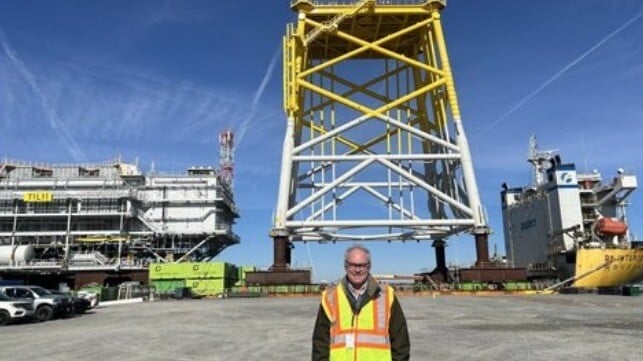
Just days after a U.S. District Court judge agreed to issue a temporary injunction to let work resume on Virginia’s offshore wind farm, work is underway with the first towers and wind turbines being installed. Dominion Energy’s Coastal Virginia Offshore Wind is the largest project in the United States and is using the only U.S.-built wind turbine installation vessel.
Virginia’s Senator Tim Kaine reported the process on January 21 after having toured the Portsmouth Marine Terminal and received an update on the progress made on the wind farm project. He told local news outlet WAVY, “Number one of 176” had been installed.
The development is being hailed as a milestone on the project, which was expected to generate its first power early this year. It will continue commissioning in 2026 and will reach a rated capacity of 2.6 GW when finished. It is located at least 30 miles east of Virginia Beach.
The report said the first installation was near the two pilot wind turbines Dominion Energy installed in 2020. The pilot turbines are smaller, standing 630 feet, while the Siemens Gamesa 14 MW turbines for the wind farm will stand about 830 feet.
WAVY’s coverage showed images of the massive wind turbine installation vessel Charybdis in operation. Dominion Energy ordered the vessel from Seatrium AmFELS in Texas, which was delivered last year. It had been undergoing additional commissioning and U.S. Coast Guard certifications in Virginia.
Dominion Energy issued a statement on January 16 after its request for a preliminary injunction was granted by the court. Work on the project was stopped about a month after the Trump administration issued a stop-work order for all five of the offshore wind farms under construction on the U.S. East Coast. Three of the projects have each received preliminary injunctions, while the other two have filed with the courts. The merits of the case, which challenges the assertion that new information shows a national security risk from radar clutter caused by the wind turbines is yet to be decided.
The company had told the court the project, which is expected to cost $11.2 billion, was 70 percent completed and that its team would focus on safely restarting work for CVOW. The company reports it has spent approximately $9 billion to date on the project and told the court each day of the stop-work order was costing it $5 million. Estimates are month’s long delay added $130 million to the cost of the project.
Dominion Energy argues that the project is critical to meeting the growing power demands of the region. It asserts that not completing the project would be a challenge to national security as its service region includes the navy’s largest shipbuilder and critical military installations, as well as the state having the largest concentration of data centers supporting the growth of AI.
The company did not comment on the work underway, but Senator Kaine called it an “incredible project will bolster offshore wind in VA, lower costs, and grow the local economy.”
China Installs First 20 MW Offshore Wind Turbine
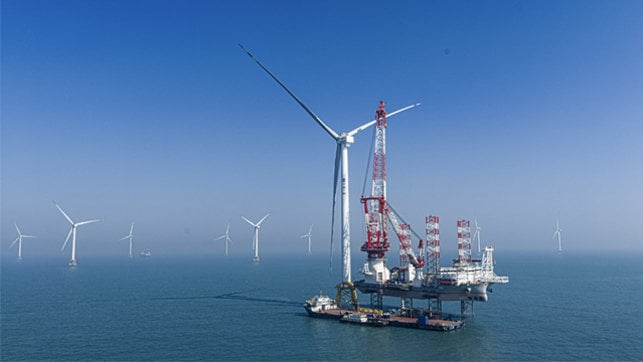
China continues to build its global lead in offshore wind energy. In the latest development, a national research and development project has successfully installed the first 20 MW offshore wind turbine.
The massive turbine was recently installed in the southern Fujian Province, which is located north of Hong Kong and borders the Taiwan Strait. The turbine was installed on water depth of 130 feet (40 km) at a position approximately 18 miles (30 km) offshore. The turbine, built by Goldwind, is part of a project managed by the Three Gorges Group.
Chinese officials highlighted that it was just three years ago, in 2023, that they installed a 16 MW turbine also in Fujian. It was followed by an 18 MW turbine, and they continue to explore larger capacity turbines.
A key advantage of the 20 MW turbine is that it benefits from higher power generation per unit and lower cost. It increases the yield, enhancing productivity in the sea area usage.
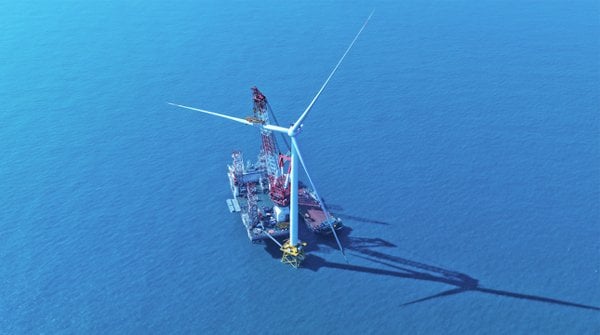
(Goldwind)
Building and installing the turbine, which stands at the equivalent of a 58-story building, required addressing unique challenges. Goldwind developed a new lightweight design, which they said reduces the weight per megawatt for the unit, including the nacelle, hub, and blades. It weighs less than 40 tons, reducing its weight by more than 20 percent compared to the industry average.
Hoisting the turbine to its position, approximately 174 meters (570 feet) to the hub, required a fourth-generation wind installation vessel. It had a 2,000-ton lifting capacity. It also required high-precision in placing the three blades. Each of the blades is 147 meters (482 feet) in length. The companies report that the sweep area is equivalent to 10 standard football fields.
The system integrates lidar and blade root sensors to ensure safe operations. It is also designed to withstand strong typhoons. They report it unit’s airfoil blades have a wind energy utilization coefficient of .49, which significantly improves wind power capture and generation efficiency. After being connected to the grid, they report the unit is expected to generate over 80 million kWh annually.
The new turbine project is being called a “flagship of China’s energy goals.” China was expected to surpass 40 GW of installed offshore wind capacity by the end of 2025, far ahead of the UK, which is the largest in Europe. They report a generating capacity of over 600 million kilowatts, up 22.4 percent year-on-year.
Three Gorges last month reported the completion of the farthest offshore wind farm. It is located 85.5 km (53 miles) from the shore in Jiangsu province, north of Shanghai. The project features 98 turbines with a total capacity of 800 MW. It is expected to generate over 2.8 billion kWh of electricity.
China’s current Five-year Plan calls for installing 15 GW of offshore wind power capacity annually. Its goal is to reach 1.3 TW total wind capacity by 2030, 2 TW by 2035, and 5 TW by 2060.

No comments:
Post a Comment