KURDISTAN (SYRIA)
To defend Rojava is to defend humanity

The Syrian regime and Turkey are seeking the complete surrender of Kurdish autonomous areas, reports Sarah Glynn.
Like so many others, I first heard of the Kurds in Syria in 2014, when the news was full of images of women fighters defending their city and the world against ISIS. Alongside these images, the occasional reporter stopped to enquire not only what these women and their male comrades were fighting against, but also what they were fighting for. The answer was startling – inspiring. While we were arguing that another world was possible, far away, in the middle of a warzone, these people were actually building a different society: a society that, in accordance with the philosophy of imprisoned Kurdish leader, Abdullah Öcalan, prioritised community over the crude economic interests that we had been trained to regard as inescapable. That society is in mortal danger.
Hope and its enemies
I am not going to claim that Rojava achieved all that it set out to do, or that the liberating proposals for radical democracy were able to properly survive the pressures of war, and of interaction with a world of nation states; but the inclusive community mindset remains strong, and – against all the odds – the Kurdish areas were able to create an oasis of peaceful coexistence and women’s rights.
Rojava is living proof of two suppressed ideas – that Kurdish culture and society is strong and resilient, and that a society that prioritises social values really is possible.
But, even as people across the world found hope for their own struggles in Rojava, we knew that the powers that be would never allow such a radical approach to succeed and to provide an example for others. We could also see that Turkey would never allow such Kurdish autonomy – especially an autonomy inspired by Öcalan. Western powers have made no secret of their desire to appease Turkey, which is a geopolitically important member of Nato, and this sits easily with their distrust of Rojava’s politics.
In Rojava, the Kurds created an extraordinary gift of hope for humanity. The attacks of the Turkish-backed Syrian Government, supported by the United States, aim to destroy this hope and to extinguish the people who created it – to extinguish them both culturally and physically.
2014 and the fight against ISIS
In 2014, the Kurdish regions of Rojava, which had gained autonomy in the power vacuum of the Syrian civil war, came under existential attack from ISIS, whose forces were sweeping across Iraq and Syria. In the small Kurdish city of Kobanê, ISIS met their first defeat – at the hands of a rag-tag army of Kurdish women and men – while the Turkish government, which had facilitated the passage of international ISIS recruits, watched from across the border, hoping for Kobanê to fall.
It was at this time that the United States, realising the danger of the forces that had been unleashed by their Iraq war, began to provide air support for the Kurdish fighters on the ground, beginning a tactical partnership that, by 2019, had liberated the last part of ISIS held territory. The Kurds tried, with limited success, to bring their social ideas to the liberated areas, and continued to work with American troops in combatting ISIS sleeper cells and preventing further attacks.
In the fight against ISIS, around 12,000 Kurds lost their lives, and the Kurdish region was left to manage tens of thousands of ISIS prisoners for whom no one wanted to take responsibility. But, despite their reliance on the Kurdish forces, no foreign power would give official recognition to the Kurds’ Autonomous Administration, nor protect them from Turkish attacks and invasions.
Islamists and the West in partnership
From the early years of the Syrian civil war, when the CIA-led Operation Timber Sycamore provided weapons and training to Islamist groups fighting the Assad government, up to the grooming and official recognition of Syria’s Interim President Ahmed al-Sharaa – former wanted terrorist al-Jolani – the United States and other Western nations have always backed conservative Islamists, just as they did so disastrously in Afghanistan against the Russians. And they have always avoided upsetting Turkey.
2026
These first weeks of 2026 have demonstrated, yet again, the cruel reality of international self-interest – or perceived self-interest- as forces have been unleashed that are beyond the control of those causing this international disaster. For months, Turkey obstructed any agreement between the Kurds and al-Sharaa’s government short of complete Kurdish surrender; but military attack had been restrained by fear of Turkey’s rival for regional hegemony, Israel. On 6th January, in Paris, Israel and Syria signed an agreement that appears to have allowed Turkey to dominate the greater part of the country in exchange for leaving Israel free to dominate the south.
Supported by Turkish weaponry and intelligence, and spearheaded by Turkey’s mercenary militias – now officially part of the Syrian army – al-Sharaa has been able to take control of the greater part of the Kurdish-led Autonomous Administration, with Arab fighters switching loyalty to the winning side.
To achieve this, al-Sharaa’s government has not hesitated to break every agreement they have made, to target civilians, and to give leading roles to men notorious for their sadistic brutality. The Syrian army includes many men who have fought for ISIS or similar groups, and some who still wear ISIS patches. The militias have already released ISIS prisoners from captured prisons – prisoners whose nihilistic ideology has been reinforced by the desire for revenge. Videos shared by Syrian army fighters show them abusing captured Kurds in ways that have become only too familiar from the times of the ISIS ‘caliphate’ and from the many reports of human rights abuses in the Turkish-occupied areas.
America turns their back
The new American position has been starkly spelt out by their Ambassador to Turkey and Special Envoy to Syria, Tom Barrack, who had already announced his dismissal of democracy. In a long Twitter post, he stated that the US had no more need for the Kurds, and that the al-Sharaa government were their new partners in the fight against ISIS. It is clear that they don’t actually trust the al-Sharaa government in this role as they are transferring remaining ISIS prisoners to Iraq; but the fight against ISIS was never America’s primary reason for being in Syria. It was always about countering Iran.
Kobanê under siege
As I write, and despite another ‘ceasefire’, the Kurds remain under fire and have been pushed back to their core cities. Kobanê, the city that turned the tide against ISIS, is isolated and under siege. To its north, is the Turkish border, south, east and west, Syrian government forces are preparing to deal a final blow to freedom and hope. Electricity and water have been cut off, and fuel deliveries stopped. People are struggling to keep warm through freezing temperatures.
Despite internet disruption Commander Nisrin Abdullah of the Women’s Protection Units (YPJ) held a press conference today [Thursday] from Kobanê. In 2014, the battle of Kobanê was heralded as a modern Stalingrad – a vital victory against great odds. She was there in 2014 and later active in international diplomacy on behalf of Rojava, even visiting the Elysée Palace. Now, in her words, the Syrian Interim Government is “reestablishing the Islamic State”; and this time, international doors have been closed to the Kurds, so that “the siege today is even more dangerous’’ than it was eleven years ago.
While international leaders were reeling off sentences about integration, unity, and stability, Syria’s Ministry of Endowments issued a call for mosques to celebrate the army’s conquests and victories, headed with the same Quranic verse used by Saddam Hussein in his genocide of the Kurds of Iraq.
Sarah Glynn is a writer and activist – check her website and follow her on Twitter or bluesky. For four and a half years she wrote a weekly review of Kurdish news for Medya News. She blogs regularly on Kurdish affairs here. This article is drawn from the blog: it first appeared here.
Image: https://commons.wikimedia.org/wiki/File:YPJ_-_Rojava.jpg Kurdish female fighter of the Women’s Protection Units of Rojava, Syria, November 2014. Author: Denilaur, licensed under the Creative Commons Attribution-Share Alike 4.0 International license.
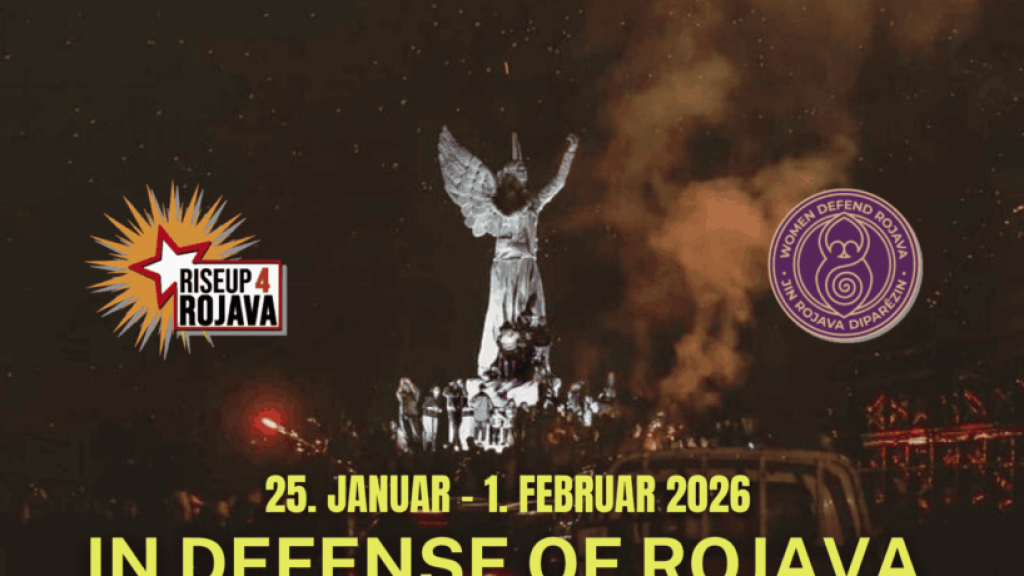
Below we republish two calls for solidarity with the Rojavan revolution, one initiated by Women for Rovaja and RiseUp4Rojava (and signed by 183 organizations and 72 individuals from 39 different countries), the other from universities in Rojava/Northern and Eastern Syria.
Global Call for Solidarity: Days of Action in Defense of Rojava (January 25 – February 1)
Initiated by Women for Rovaja and RiseUp4Rojava, January 24
We, 183 organizations and 72 individuals from 39 different countries declare that:
Since January 6th, Kurdish and Arab regions in Syria have been subjected to sustained attacks, posing the most serious existential threat to Kurdish society and the autonomous system of self-governance that has been developed there for over 14 years. This military offensive is being coordinated by al-Sharaa’s islamist regime, the so called “transitional government” in Damascus, in collaboration with the Turkish Defense Minister, Yaşar Güler, and the Foreign Minister, Hakan Fidan. It is being carried out in direct collaboration with jihadist militias. This war of extermination has been greenlighted by western governments.
Rojava is under immediate threat from HTS and ISIS. These attacks endanger the hard-won achievements of the Women’s Revolution in Rojava, including the principles of local democracy and equal rights for ethnic and religious communities. They are trying to force the Democratic Autonomous Administration of North and East Syria to choose between total surrender and complete physical annihilation. The attack on Rojava is not solely aimed at destroying the achievements of Kurdish society. Rather, the goal of this international plan is to destroy the idea and project of a democratic Syria and a democratic Middle East.
Through these attacks, we are witnessing a new resurgence of ISIS. Thousands of ISIS-fighters have been freed by the government-militias of al-Sharaa, who himself shares a common history with the terrorist organization. Once again, ISIS is committing massacres against civil society all over Syria. Kobanê, the site of historic resistance against ISIS, is once again under attack and total siege by the same forces operating under different banners. Emboldened by these attacks ISIS once again poses a threat to societies worldwide.
Across all over Kurdistan, and all over the world, people are rising up to defend the Rojava Revolution and the hope it offers humanity. The Kurdish people, particularly women and young people, have responded to the call for a general mobilization by holding mass demonstrations and traveling to Rojava in thousands, to defend the territory. Social movements, trade unions, civil society organizations and academic communities on all continents have organized solidarity actions with the peoples of Rojava.
In 2014, millions of people took to the streets worldwide and together we liberated Kobanê. The defeat of ISIS at that time was made possible not only by the YPG and YPJ, but also by broad international solidarity, including political, social and moral support from democratic forces worldwide.
Today, we once again call for global solidarity to defend the revolution and human dignity.
In an era of increasing global fragmentation driven by profit rather than the needs of people, we must unite to demand the freedom of Rojava and stand up for humanity. In the face of coordinated military and political pressure, democratic forces must strengthen their solidarity.
We, the organizations and individuals listed below, therefore call to:
- Organize actions in solidarity with Rojava, condemning the attacks and underlining the imminent threat of ethnic cleansing by the Syrian transitional government, Turkey and its allied jihadist militias.
- Create a counter-public sphere in the media and civil society about the situation in Rojava and expose blatant Western support for the attacks.
- Hold national governments and international institutions responsable for their complicity in the war crimes in Rojava.
- Demand political and legal recognition and status for the DAANES in order to force Damascus to accept a decentralized solution that guarantees the existence and rights of Alawites, Druze, Yazidis, Assyrians, Armenians and all ethnic and religious communities in a future democratic Syria.
See list here
A Call for Solidarity from the Universities in Rojava/Northern and Eastern Syria
Universities in Rojava/Northern and Eastern Syria, January 22
We, the faculty, students, and staff of the Universities in Rojava/Northern and Eastern Syria, send you this message as we leave our classrooms to help defend our universities, our cities, and our revolution alongside the self-defense forces. Before the autonomous administration, Raqqa (Sharq) and Kobanê had no universities. Our campuses, built in the midst of war, have reclaimed long-denied education to young people, grounding learning in women’s liberation, ecology, and a democratic, communal life for the people.
For the past fifteen years in Rojava/Northern and Eastern Syria, under constant pressure and repeated attacks by imperial, sub-imperial, and colonial powers, our people have built a shared life through collective capacity. Against capitalism and patriarchy, we have worked to advance a society rooted in women’s liberation, ecological life, and democratic self-rule. Under the conditions of war across the region, and against the violence and impositions of regional states and their mercenaries, we relied on our own self-defense and our own diplomacy to carve out space, and within that space, we struggled to build a life that once seemed impossible.
Today, that life is under attack. What we have built, this source of hope for oppressed peoples in the region and around the world, is being targeted from all sides by the fascist forces of the Syrian Arab Army, an al-Qaeda lineage rebranded into state authority and dressed in suits, and by mercenaries, backed by regional and global imperial powers.
We are living through an unfolding feminicide and genocide. The situation on the ground is urgent and worsening by the day. Our university buildings are full of displaced people trying to survive the winter without blankets or extra clothing. Turkish drones have targeted several places near the University of Rojava in Qamishlo during the last few days. Students in the dormitories in Qamishlo are cut off from their families in Kobanê, not knowing if their loved ones are safe, and unable to reach them.
The situation in Kobanê is particularly dire. The city is currently under siege, surrounded by Syrian Army forces on one side and the Turkish army on the other. For seven days, there has been no electricity, no access to water, and no reliable access to basic necessities. Under these conditions, learning, safety, and survival are being targeted as part of a coordinated siege.
We say this clearly to our friends, colleagues, and comrades: we will defend ourselves with everything we have. We will defend our people, our universities, and the possibility of the life we have struggled to build.
We call on you, wherever you are, to stand with Rojava. Raise your voice. Organize on your campuses, in your unions, and in your communities. Use your positions, however limited they may feel, to push for action, to demand accountability, and to refuse silence. Strengthen the networks of solidarity that make resistance possible. Stand up for the revolutionary aims of freedom, women’s liberation, ecological life, and democratic communal life. Your solidarity is part of our self-defense, and it can help shift the balance and prevent yet another genocide in the region.
Universities in Rojava/Northern and Eastern Syria
University of Rojava,
Kobani University,
University of Al-Sharq Students,
Faculty and Staff
Through the actions of regional and international hegemonic powers, the Middle East is being reshaped once again, a century after its last major reordering. The genocide in Gaza and the political elimination of Hamas, the intelligence-driven operations in Lebanon that have crippled Hezbollah, and finally the rapid overthrow of the Assad government by HTS under the leadership of the Salafi jihadist Mohammed al-Jolani, whose past is rooted in Al-Qaeda in Iraq, ISIS and Jabhat al-Nusra, mark a new phase of regional transformation. The process that began with Hamas’ attack on Israel on 7 October 2023 has continued with the dismantling of Iran’s so-called “axis of resistance.” Step by step, the focus appears to be shifting toward Iraq’s Hashd al-Shaabi forces and ultimately toward Iran itself. Scenarios are now openly discussed in which all ISIS elements are reorganized under the Damascus regime into a Sunni jihadist army to be used against Shiite communities in Iraq. This points to the likelihood of new massacres and an even deeper humanitarian catastrophe.
What some commentators describe as cold and calculated chess moves is, in reality, a state of collective madness of war crimes akin to genocide, where tens of thousands of civilians have lost their lives.
In a region where forced displacement, executions, abductions, sexual violence, and the desecration of bodies have become normalized, new atrocities emerged with the establishment of an HTS-centered jihadist regime in Damascus. Following the regime change, armed groups aligned with the new authority carried out continuous attacks, kidnappings, and acts of violence against Alawite communities along Syria’s coastal region. According to the Syrian Observatory for Human Rights (SOHR), at least 1,068 civilians were killed in these attacks, which began on 6 March 2025.
In July 2025, after the circulation of an audio recording allegedly insulting the Prophet Muhammad and attributed to a Druze cleric, armed Sunni jihadist groups affiliated with Damascus launched attacks against Druze communities in Suwayda. Reports stated that at least 196 people were executed in mass killings, including 28 women, 8 children, and one elderly person. According to SOHR, between 15 and 22 July, 1,311 people were killed, including 637 Druze and 104 civilians.
With the support and approval of regional and international powers, these same forces turned their weapons to Kurdish neighborhoods in Aleppo on 6 January 2026, and soon after, towards the entire territory of the Autonomous Administration of North and East Syria, known as Rojava. These unilateral attacks and the humanitarian crisis they created have largely gone uncovered in the international media. Instead, they are often portrayed as clashes in which both sides are equally aggressive.
The chronology below illustrates how the siege on Rojava gradually intensified, by examining the attacks and humanitarian devastation launched by Sunni jihadist forces loyal to Damascus on two Kurdish neighborhoods in Aleppo in January 2026.
1 January | Violence escalates
Violence intensified in areas controlled by Sunni jihadist forces aligned with Damascus. In December, 181 people, including women and children, were killed, and a mass grave was discovered in Aleppo.
2 to 4 January | Talks on “integration” with Damascus
The Autonomous Administration announced that contacts with the Damascus regime regarding military integration were ongoing and that high-level meetings were being planned. It was also announced that schools in the Kurdish neighborhoods of Aleppo, which had been closed on 30 December 2025 due to fuel shortages and an ongoing blockade, would reopen on 4 January 2026.
5 to 6 January | Damascus and Israel reach an understanding under US mediation
Damascus and Israeli delegations reached an understanding in Paris under US mediation. At the same time, talks between Turkey and Damascus accelerated. On 6 January, Sunni jihadist forces aligned with Damascus launched a large-scale attack on Kurdish neighborhoods in Aleppo. Civilians were targeted with heavy weapons, and the neighborhoods were besieged.
7 to 8 January | Civilian infrastructure targeted, humanitarian crisis deepens
The Damascus regime declared the Kurdish neighborhoods legitimate military targets. The Kurdish-led Syrian Democratic Forces (SDF) stated that it had no military presence in Aleppo and had withdrawn under a public agreement, transferring security to the Internal Security Forces. Osman Hospital in Ashrafiyah was directly bombed, and disabled from service, and health workers were executed. Many Sunni jihadist groups on the international sanctions lists participated in assaults under the name of the transitional government. The Turkish Ministry of Defense stated that Turkey would provide support if the Damascus regime requested. Statements from the European Union were limited to calls for restraint.
9 January | EU aid to Damascus
European Commission President Ursula von der Leyen and European Council President Antonio Costa met Ahmed al-Sharaa in Damascus. Von der Leyen announced a 722 million dollar aid package. On the same day, Khalid Fecir Hospital in Sheikh Maqsoud was also heavily attacked and hit at least seven times by reconnaissance aircraft and heavy weapons.
10 January | Attack on the body of a Kurdish woman fighter
A humanitarian aid convoy was blocked by Sunni jihadist forces aligned with Damascus, and safe corridors were not opened. Images circulated showing jihadist fighters throwing the body of a Kurdish woman fighter from a building while chanting religious slogans.
11 to 12 January | Ceasefire and civilian losses
A ceasefire and the evacuation of civilians were announced through international mediators. Local sources reported that women were taken to mosques, men to unknown locations, and that more than 271 people were missing.
13 to 14 January | Attacks spread to eastern Aleppo
The Israeli army shelled the areas around Abdin and Koya in Daraa, in parallel with its advances in the Quneitra countryside in southern Syria. At the same time, Sunni jihadist forces aligned with Damascus, with Turkish support, moved to the east of Aleppo and bombed Deir Hafir and the town of Meskene near Tabqa.
15 January | The heavy toll in Aleppo
The Turkish Ministry of Defense reiterated its support for the Damascus regime. According to the UN Office for the Coordination of Humanitarian Affairs, at least 120,000 people were displaced from the neighborhoods of Sheikh Maqsoud, Ashrafiyah and Beni Zed, and human rights organizations reported more than 500 missing persons. Ilham Ahmed, Co-Chair of the Foreign Relations Department of the Autonomous Administration, presented documentation detailing how the attacks were carried out, the forces that participated in them, and the war crimes that were committed.
16 to 17 January | SDF withdraws east of the Euphrates, clashes continue
US President Donald Trump announced the creation of a Gaza Peace Council. The SDF stated that it would reposition its forces to the east of the Euphrates. Despite this decision, attacks by Sunni jihadist forces aligned with Damascus continued. The Imrali delegation of the DEM Party stated that Abdullah Öcalan viewed the escalation in Syria as an attempt to sabotage the process of Peace and Democratic Society.
18 January | Jihadist attacks spread
The attacks launched by Sunni jihadist forces aligned with Damascus spread to Tabqa, Tishrin, Mansura, Raqqa and the countryside of Deir ez-Zor. The Autonomous Administration declared general mobilization. On the same day, Damascus announced that a 14-point agreement and a comprehensive ceasefire had been reached with the SDF. The SDF stated that to prevent a major civil war, it had decided to withdraw from Raqqa and Deir ez-Zor and would talk to the Damascus regime.
19 January | Attacks continue despite ceasefire, ISIS prisoners released
Despite the ceasefire, attacks continued. The SDF announced that Shaddadi Prison, which holds thousands of ISIS detainees, had fallen under the control of Sunni jihadist groups aligned with Damascus, and footage showed ISIS prisoners being released. It was reported that more than 10,000 civilians were displaced from Raqqa to Hasakah. Iraqi Shiite leader Muqtada al-Sadr warned that the conflict could spread to Iraq. President Recep Tayyip Erdoğan and President Donald Trump held a phone call that included discussions on ISIS and the prisons in Syria. The SDF stated that the Damascus regime was demanding total surrender and that it had therefore decided to resist. The Damascus regime invoked the Quranic chapter al-Anfal to declare a conquest against the Kurds.
20 January | Hasakah and Kobane under blockade
More than 25,000 people fled from Raqqa and Tabqa toward Hasakah within 48 hours, and around 500 people were reported missing or forcibly disappeared. Civilians attempting to reach Hasakah were attacked by forces aligned with Damascus. The SDF stated that the Damascus regime imposed a blockade on Hasakah and Kobane and launched heavy attacks. The SDF also announced that it had withdrawn from Hol Camp due to attacks by Sunni jihadist forces and the failure of international forces to fulfill their responsibilities. The Damascus regime declared another ceasefire, while the SDF reported continued violations.
President Trump claimed he had prevented ISIS prisoners from escaping and shared a message that he said was sent by President Macron. US diplomat Tom Barrack stated that a centralized authority had been re-established in Syria, that the SDF’s role as the primary force against ISIS had largely ended, and that the Damascus regime was ready to take over the security of ISIS prisons and camps.
21 January | Military buildup
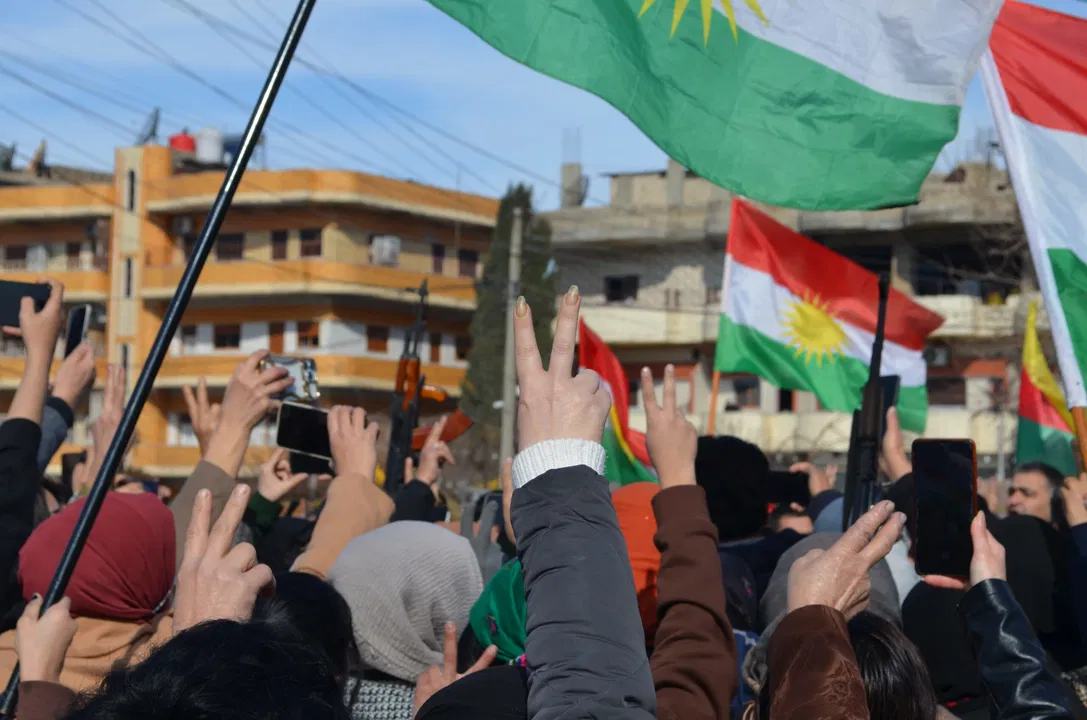
Protests were held across Kurdistan and in many European cities against the attacks on Rojava. Thousands of people displaced from Afrin, Shahba, Raqqa, and Tabqa took refuge in the Jazira Canton, sheltering in schools and mosques. The SDF reported systematic ceasefire violations in the Jazira and Kobane regions. ISIS flags were reported to have been raised again at the entrance to Raqqa. Turkey deployed tanks and artillery to the Kobane Suruc border line.
22 January | Humanitarian disaster warning
According to nine separate sources who spoke to Reuters, the attacks carried out by the Damascus regime against North and East Syria were approved by the United States, Israel, and Turkey at the meeting held in Paris in early January.
The Syrian Observatory for Human Rights (SOHR) issued a warning of a “humanitarian catastrophe” in Kobane, which is under siege by the Turkish state and Sunni jihadist forces aligned with Damascus. It condemned the international community’s silence.
In a video said to have been recorded in Raqqa, which is under the control of the Damascus regime, a severed braid claimed to belong to a YPJ woman fighter was shown. The footage sparked anger and outrage in many parts of the world. Kurdish and Yazidi women launched a solidarity campaign on social media using the hashtag #kezi (braid).
23 January | ISIS prisoners released
US Defense Secretary Pete Hegseth stated that non-Iraqi ISIS detainees would be temporarily held in Iraq. Sunni jihadist forces aligned with Damascus released hundreds of ISIS prisoners from al-Aktan prison in Raqqa.
Conclusion
The events that took place between 1 and 23 January 2026 show that the attacks against Rojava are part of a plan by global and regional powers to reshape the Middle East. What began with assaults on Kurdish neighborhoods in Aleppo has evolved into a multi-layered siege strategy that aims not only to dismantle the Rojava model but also to carry out a systematic destruction targeting the very existence of the Kurdish people. The horrific images coming from the region demonstrate that the crimes ISIS committed against humanity, particularly against the Kurdish people in 2014, are being re-enacted today.
The silence of international actors, along with direct or indirect approval of certain powers, has created the conditions for this destruction and the continuation of these crimes. What is happening in Rojava today is not only about one region; it is a clear indication of the kind of violent order shaping the future of the Middle East. The attacks on prisons holding ISIS detainees under SDF control, and the footage showing the release of these prisoners by forces aligned with the Damascus regime, provide serious evidence that a new Sunni jihadist army is being formed by uniting ISIS elements under the umbrella of the Damascus regime. These developments mark an extremely dangerous threshold, signaling that the Middle East is being pushed towards far wider humanitarian catastrophes and new waves of war.


No comments:
Post a Comment