From the Ashes of the Arab Spring
Wednesday 14 January 2026, by Gilbert Achcar
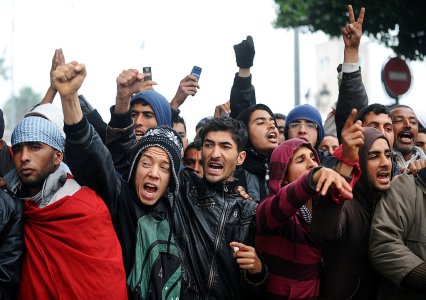
Today marks 15 years since the overthrow of Tunisian dictator Ben Ali, one of the high points of the Arab Spring. [1] The events of 2011 gave rise to an impressive wave of revolutions. Almost all were bloodily suppressed.
On January 14, 2011, Tunisian dictator Zine El Abidine Ben Ali was forced to resign, after four weeks of revolt in the north African country. It was a first major scalp for the wave of upheaval known as the Arab Spring — a democratic upsurge across the region, which, however, also ended in many defeats. In an interview for the Swiss website marx21.ch, scholar Gilbert Achcar reflects on the legacy of those years and the prospects of a resurgent revolutionary process today. The interview was conducted before the most recent uprising in Iran.
Jean Batou: It’s been fifteen years since the fall of the Ben Ali regime, representing the Arab Spring’s first major victory. After Tunisia, many other peoples launched mass struggles, notably in Egypt and Syria. Yet this impressive revolutionary wave was contained by bloody civil wars, fueled by foreign interventions (jihadist groups, Gulf states, Iran, Turkey, Russia, etc.), but also by repression from the existing states, leading to the reestablishment of authoritarian regimes. What is your assessment of this long period?
Gilbert Achcar: The balance sheet is very negative at present. The democratic regime in Tunisia, the last of the major democratic gains of the 2011 wave of uprisings, commonly known as the Arab Spring, was overthrown by an internal coup in 2021, ten years later. Popular resistance against the coup in Sudan, the last bastion of the 2019 revolutionary wave dubbed Second Arab Spring, was drowned out by the war that erupted in 2023 between two armed factions of the military regime. It was against this backdrop of defeats that Israel launched its genocidal war against the population of Gaza, as part of a dramatic escalation of the Zionist offensive against the Palestinian people and Israel’s regional enemies.
But this negative assessment is a moment of what I analyzed from the outset as a “long-term revolutionary process,” when the illusions embodied by the label Arab Spring were dominant. It was clear to me that this was not a relatively brief democratic transition, like those experienced by the states of Central and Eastern Europe in the late 1980s. The bureaucracies of those states offered only weak resistance to the rising tide of political change imposed by a profound crisis in the bureaucratic mode of production and supported by a triumphant Western imperialism at the height of its power. And this political change consisted only of adapting to the model promoted by this Western imperialism by sliding down a path of least resistance.
In the Middle East and North Africa, things were quite different and remain so. There, the ruling classes are propertied classes — sometimes even possessive of the state itself — and fiercely oppose the radical political change required to unlock economic development and satisfy the social aspirations of the people, a change that runs very much counter to Western imperialist interests in the region.
The difficulty of change, however, was bound to result in a prolonged historical deadlock, since the structural crisis remained unresolved: the socioeconomic crisis continued to worsen, and the political context deteriorated. This deterioration manifested itself in a series of civil wars — in Syria, Libya, Yemen, and now Sudan — which contribute to the demoralization and demobilization of the region’s populations.
But the stability of the old order cannot be restored: the structural deadlock inevitably fuels social tensions that sooner or later erupt into political explosions. A “long-term revolutionary process” can last several decades and, if it encounters a continuous deadlock, can lead to a widespread civilizational collapse in the affected region. The two sides of the alternative are thus social revolution or barbarism.
Jean Batou: Can the establishment of the autonomous administration of the Democratic Union Party (PYD) in Rojava and the eventual fall of the [Bashar al-] Assad regime in Syria be considered results of this revolutionary cycle, even if Syria’s future remains highly uncertain? Furthermore, doesn’t the recent uprising of Moroccan youth demonstrate that the social crisis remains as profound as ever throughout the region?
Gilbert Achcar: The Kurdish autonomous administration in northeastern Syria is not an integral part of the ongoing revolutionary process in the Arab world. It is a byproduct, made possible by the civil war that weakened the Syrian state and led it to tolerate the existence of this regional administration. From the outset, this administration distanced itself from the confrontation between the Syrian regime and the opposition. It allied itself with the United States in the fight against ISIS (the Islamic State).
Furthermore, the combination of interference from the oil monarchies, the Machiavellian maneuvers of the Syrian regime, and the inaptitude of the Left within the Syrian popular movement led the revolutionary uprising in that country to quickly morph into a civil war between two counterrevolutionary camps: the Assad regime on one side, and various armed forces belonging to the political sphere of Islamic fundamentalism on the other.
It was the most reactionary of the latter — the al-Nusra Front, formerly al-Qaeda’s branch, which had governed the Idlib region in the north of the country for several years and developed relations with the Turkish state (long unacknowledged by the latter) — that ultimately reaped the benefits of the collapse of the Assad regime. The latter fell because it was abandoned by Russia, bogged down in the invasion of Ukraine, and then by Iran, which became incapable of intervening, especially after Israel’s decapitation of Hezbollah in Lebanon in the fall of 2024.
The new government established in Damascus, rebranded after Idlib but retaining essentially the same parameters, is a reactionary, sectarian, and antidemocratic regime, and, of course, a proponent of the crudest form of capitalism. This is indeed why it was immediately embraced by Donald Trump and Western capitals.
In contrast, the recent Moroccan youth movement is fully in line with the revolutionary process that began in 2011. It perfectly illustrates its deep roots: a developmental stagnation with anemic growth, the main symptom of which was and remains youth unemployment. The Middle East and North Africa region has held the world record for this unemployment for decades. It is the despair of young people, in particular, that is the driving force behind regional uprisings.
Jean Batou: If the causes that triggered this chain of popular uprisings remain, what explains the current decline in social mobilizations in most countries? Is it due to the long-term effects of repression? To the exhaustion of the sectors that were at the forefront of these struggles? To the absence of political leadership offering a prospect of breaking with mafia-like neoliberal capitalism and/or reactionary Islamism?
Gilbert Achcar: The primary reason is the absence of a structured political movement representing the youth’s revolutionary aspirations independently of politically reformist or socially reactionary oppositions. These oppositions have been able to partially divert the masses’ revolutionary energy, resulting in a triangular relationship between one revolutionary pole and two counterrevolutionary poles.
Things came closest to addressing this lacuna in the Sudanese revolution, whose spearhead was made up of committees of radicalized youth in the neighborhoods — the Resistance Committees, a decentralized structure, capable of unity of action nevertheless thanks to the use of modern communication technologies for coordination. What was missing was a political organization that could have prepared the ground for the revolution by building a network within the armed forces, or at least worked to build such a network once the revolution had begun. This alone could have prevented the revolution from being stifled by an internal power struggle among reactionary military officers.
This is also what is most lacking in Morocco: there, the youth movement, known as GenZ 212, is far less structured than the Sudanese Resistance Committees, and lacks even more than they did a political response commensurate with the challenges. Repression cannot be considered a cause in itself, since it is one of the inevitable obstacles to overcome, and its extreme severity is well known in this part of the world. The question is precisely how to organize to overcome this repression. And this is where the organizational factor becomes paramount.
Jean Batou: To what extent has the “necropolitics” carried out by Israel in Gaza or by the UAE in Sudan dealt a severe blow to the fighting spirit of the Palestinian and Sudanese peoples?
Gilbert Achcar: These two situations are hardly comparable. The genocidal war waged by Israel against the population of Gaza is an offensive against the whole Palestinian people. The United Arab Emirates does not intervene directly in Sudan: it supports one of the two sides in the war between military forces, the Rapid Support Forces, whose origins can be traced back to the paramilitaries who perpetrated the Darfur genocide some twenty years ago.
As previously mentioned, the war that erupted in Sudan stifled the revolutionary process underway since 2019. Its regional impact, however, is limited. In contrast, the genocidal war waged by the Zionist state in Gaza has certainly had a major regional impact. It has compounded the accumulated defeats since the Arab Spring, exacerbating a sense of helplessness and exasperation among the peoples of the region. I believe that exasperation will ultimately prevail as a consequence of an explosive combination of frustrations — socioeconomic and political at the national level, and political and emotional at the regional level.
Jean Batou: Doesn’t the emergence of Middle Eastern sub-imperialisms, such as Saudi Arabia, the UAE, and Israel, that are increasingly powerful and aggressive, militarily as well as financially, and willing to pursue their interests by any means necessary, pose growing problems for the United States? I am thinking in particular of Israel’s bellicose frenzy against several of its neighbors, including its bombing of Qatar, but also of the rivalry between the Emiratis and the Saudis in Sudan.
Gilbert Achcar: Rivalries between vassals of imperialism benefit imperialism insofar as they increase each vassal state’s dependence on the overlord, in this case, the United States. Washington is careful not to take sides in such rivalries but rather plays a moderating role and acts when necessary to reconcile its clients. Thus, the first Trump administration (2017–2020) had given the green light to the boycott of Qatar by the Emiratis and Saudis, while maintaining relations with the Emirate of Qatar, host of the main US military base in that part of the world. The boycott ceased at the end of Trump’s first term. During his second term, he radically changed his policy toward the Qataris, who have essentially bribed him — an art at which they excel.
[Benjamin] Netanyahu’s case is different: there may be minor disagreements between him and Trump, but each is careful to keep them contained. Netanyahu has become a master at appeasing Trump. He lets it slide when necessary, as is the case with the so-called “peace plan,” which Netanyahu is convinced will go nowhere and inevitably stall in the short or medium term. As for Israel’s “bellicose frenzy,” it was not only approved by Washington, but the United States directly contributed to it — even more directly under Trump, who ordered his armed forces to contribute to the bombing of Iran. Given his personal and family business ties with the Qataris, Trump had no choice but to distance himself from the Israeli attempt to assassinate Hamas leaders in Qatar. But he did so half-heartedly and moved immediately to reconcile his two allies.
The Gulf oil monarchies, the Jordanian and Moroccan monarchies, Egypt, and Israel are all parts of a regional system closely linked to the United States. All these states depend on Washington in one way or another, and their roles are more complementary than antithetical. Their complementarity was blatantly on display during the genocide perpetrated by Israel in Gaza.
14 January 2026
Source: Jacobin.
Attached documentsfrom-the-ashes-of-the-arab-spring_a9362.pdf (PDF - 1.1 MiB)
Extraction PDF [->article9362]
Footnotes
[1] Image: Demonstrators in front of the prime minister’s offices in Tunis on January 27, 2011. (Fethi Belaid / AFP via Getty Images).
Gilbert Achcar grew up in Lebanon. He is currently Professor of Development Studies and International Relations at the School of Oriental and African Studies (SOAS) in London. A regular and historical contributor to the press of the Fourth International, his books include The Clash of Barbarisms. The Making of the New World Disorder (2006), The Arabs and the Holocaust: The Arab-Israeli War of Narratives (2012), The People Want: A Radical Exploration of the Arab Uprising (2022). His most recent books are The New Cold War: The United States, Russia and China, from Kosovo to Ukraine (2023) and the collection of articles Israel’s War on Gaza (2023). His next book, Gaza, A Genocide Foretold, will come out in 2025. He is a member of AntiCapitalist Resistance in Britain.

No comments:
Post a Comment