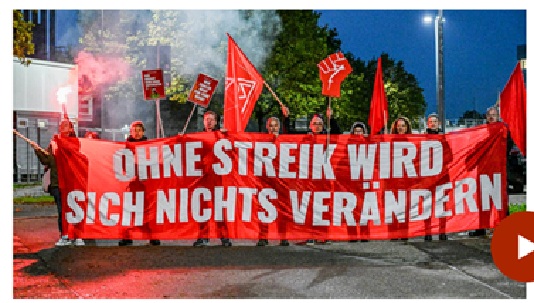
With the rapid advance of Germany’s extreme right and adjacent neo-Nazis, a serious challenge for Germany’s trade unions – organized within Germany’s peak body, the DGB – has emerged.
The outlook for German trade unions will be even more grim in the upcoming works council elections to be held in spring 2026. German trade unionists are already preparing defensive strategies against the onslaught of the anti-democratic and anti-union AfD, its far-right members, and their counterfeit, pretend-to-be unions.
Since the end of Nazism in 1945, German trade unions have operated under the one-union principle, in which members of all political parties are united as union members within a single trade union. This might be called “one-unionism” or “unitary union” principle.
The German concept should not be confused with the idea of the “One Big Union” (IWW) that originated in the late nineteenth and early twentieth centuries. The One Big Union concept is designed to unite the interests of workers and offer solutions to all labor problems.
Yet it also sought to overcome the fragmentation of the working class into a multitude of competing trade unions. Germany’s idea of “one-unionism” is radically different.
Yet, with the rise of the deeply anti-democratic AfD, the principle of unifying all union members – regardless of their political affiliations and party politics – within one trade union may need to be reconsidered.
In other words, the principle of a unitary union might, in the future, constitute a grave danger to German trade unions, since it allows far-right pseudo-unions such as the AfD’s so-called “Center” to gain a foothold inside Germany’s trade union and labor relations structures.
In short, what was once designed to strengthen German trade unions – organizing all workers in one trade union regardless of their political attitudes – might now be used by the anti-democratic AfD and its pseudo union-like organizations to infiltrate, undermine, and potentially destroy German trade unions.
Historically, the invention of worker-like organizations by Germany’s far right and the Nazis to undermine and destroy the working class is nothing new. Just as the terms “socialist” and “workers” in the official name of Hitler’s Nazi Party in the 1930s – the National “Socialist” German “Workers” Party – as well as the color red in the Nazi flag, were mere deceptions designed to con workers into supporting the Nazis. Today’s AfD and its phony “Center” [Zentrum Auto] are not trade unions either. They are mere deceptions intended to con workers.
One might speculate that the neo-fascist AfD assumes that what worked so well as a Nazi con in the 1930s might also work again in 2026 – and that enough workers will support the AfD’s far-right organizations currently infiltrating workplaces and challenging German trade unions.
Historically, there was a strong anti-fascist element in the unitary “one-unionism” principle of Germany’s trade unions. After Nazism, German trade unions learned from previous mistakes. Such post-war unity was intended to work against Nazism – should it ever reappear. Preventing a re-emergence of Nazism during the immediate post-war years – which was by no means an illusion – was a core element from which Germany’s one-union principle emerged.
Over time, and given its success in post-Nazi Germany, this unitary principle developed into a taboo. It allowed for union members to belong to various political parties. Throughout Germany’s post-war history, these political parties were democratic parties.
With the rise of the neo-fascist AfD, this is no longer the case. This is particularly true given that voter support for the AfD currently stands at around 25–27 percent. In other words, roughly a quarter of all Germans support the AfD. Sadly but inevitably, among them are workers and trade union members.
Meanwhile, the unity principle is generally regarded as an outcome of the experience of Nazism, which had eliminated trade unions – often brutally, through torture, murder, and concentration camps.
Germany’s resistance fighter and trade unionist Wilhelm Leuschner, for example, is regularly quoted in trade union halls. Leuschner is said to have remarked – shortly before his execution by the Nazis in 1944:
“Tomorrow I will be hanged; create unity!”
His words alluded to the fact that unity among German workers – without the destructive infighting between socialists and communists during the 1920s and early 1930s – might have prevented Nazism.
Similarly, the Buchenwald Concentration Camp Committee, consisting of members of the communist KPD, the social-democratic SPD, and the conservative CDU, stated in its resolution of 19 April 1945 that one of the upcoming tasks of a newly founded union movement was the “formation of an anti-fascist unitary union”.
However, all of this may – historically speaking – only tell half the story. The historical fact is that the concept of a unitary union ultimately prevailed in the western parts of Germany “only” at the instigation of the Allied Forces.
It is revealing that the very same Allied power advocated the exact opposite in Italy. The USA feared that a unified trade union in Italy would become communist-dominated. In Germany, the situation was assessed differently. Yet the goal was the same: to integrate Germany and Italy into the West while eliminating anti-capitalist tendencies.
With most communists murdered by the Nazis and the emerging Cold War reinvigorating anti-communist ideology, a unitary union system was seen as a bulwark against communism, militant workers, and union radicalism. It would support rather than challenge capitalism – an economic system imperative to US dominance in Europe.
The constellation of powerful forces shaping Germany’s union movement was intended to create a trade union system reflecting the policy objectives of the three western (that is, pro-capitalist) occupying powers: France, the UK, and the USA.
In the wake of these interests, the foundation of West Germany’s peak union body – the DGB – took place in October 1949. Even then, the Western Allied Forces remained hesitant in their recognition of German trade unions, particularly regarding supra-regional union networks.
To retain a free hand in the “emerging conflict” with the Soviet Union (read: well choreographed and ideologically legitimized) – that is, securing US dominance in Europe – German actors such as trade unions and the labor movement were to be kept small, manageable, and above all controllable.
Their intended function was to integrate West Germany into the Western (capitalist) system and not, for example, to encourage workers to strike – lest such actions damage the carefully designed myth of the Wirtschaftswunder, showcasing capitalism’s supposed superiority over “evil” communism.
Yet it was the general strike against price rises shortly after the introduction of the Deutsche Mark (DM) in the Anglo-American zone in autumn 1948 that threatened to escalate labor’s struggle. In those days, US tanks fired on striking workers in Germany’s southern city of Stuttgart, among other places.
This made it seem reasonable to the Allies to recognize a central negotiating partner – not only “on behalf” of workers but also to channel worker protest into institutions designed to secure the survival of post-Nazi capitalism. The idea was to suppress radical workers by merging them into a unitary trade union in which more moderate workers would form the majority.
With great difficulty, Germany’s re-emerging trade unions – managed and controlled by Allied Forces in the immediate post-Nazi years – succeeded in channeling sometimes violent (and, God forbid, uncontrolled and “spontaneous”) strike actions into officially recognized unions. The aim was to pacify workers who fought against price rises and the whims of the capitalist commodity market.
According to a trade union representative at the time, this was about disciplining trade unions and enforcing restraint. Trade unions were expected to appease workers who had lost their savings during the DM currency reform.
Meanwhile, factory owners kept their factories, but the value of workers’ wages diminished – capital won, while workers lost. Many of those newly impoverished workers stood in front of freshly stocked shop windows with empty purses. In other words, even consumer capitalism can fail.
At the time, it should not be forgotten that another, far more troubling historical institution already existed as a unifying labor organization. The idea of a unified trade union umbrella was not foreign to German workers.
The German Labor Front (DAF) of the Nazis (1933–1945) was such a unified organization. It organized German labor (defined racially as Aryan) and capital under Nazi Party control, in support of a Volksgemeinschaft preparing for a war that soon spread across Europe and beyond.
Within Germany’s resistance to Nazism, it was above all former SPD Reichstag members Julius Leber and Wilhelm Leuschner who developed the concept of a unified union.
The conservative-authoritarian and deeply militarist circle around Claus Schenk Graf von Stauffenberg, by contrast, had no trade unions in mind. Had their assassination attempt on Hitler succeeded, these hawkish military men envisioned something closer to Hitler’s DAF – an authoritarian, military-led post-Hitler dictatorship intended to end a war already lost by July 1944.
While rejecting Nazi anti-Semitism and seeking to close Auschwitz, these Wehrmacht officers were by no means trade unionists and were hostile to labor organizations.
Since unity is a resource of power, Stauffenberg’s militarists were not concerned with unitary unionism. Nevertheless, the idea emerged as a founding myth in the immediate post-Nazi years.
Today, in the context of a possible anti-fascist resistance against the neo-fascist AfD and its apparatchiks seeking to undermine trade unions, the unitary union is first and foremost an internal trade-union concept.
It ensures that workers are not isolated under the prevailing ideology of individualism. Set against the atomization of workers, it organizes them collectively so that they, in turn, cannot be isolated by corporate management at company, industry, regional, or national levels.
In all of this, the concept of “organizational power” remains central. The associated rule is simple: the more unity, the more organizational power. Expressed differently: united we bargain – divided we beg.
Many trade unionists recognize that struggle or negotiation with overwhelmingly powerful capital – backed by an array of institutions – can only be conducted in this way. This is why the principle of a unitary union remained largely uncontested in Germany.
It is supported by conservative union members, syndicalists, and progressive trade unionists alike. Virtually all agree that it is a “One Big Union” that can stand up to capital. This is exemplified by the tradition of French syndicalism, particularly the Charter of Amiens of 1906, pioneered by the CGT, which emphasized worker unity regardless of political affiliation.
It advocated a trade union independent of party organizations and party disputes. Hence trade unions were described as the “party of labor”. The party of labor is exactly what the term implies: the unification of workers into a homogeneous bloc – the autonomous organization of the working class on an economic basis.
This independence was recognized by Germany’s Social Democratic Party in the 1906 Mannheim Agreement. Unfortunately, this also ended debates on the general strike. The SPD had convinced itself that it lacked the power to initiate such a strike, leaving it instead to the trade unions.
Rosa Luxemburg – one Germany’s finest – strongly disagreed. In short, French syndicalists advocated a unified union opposed to political parties; German syndicalists argued for independent unions; and the majority of social-democratic union members supported the concept of a unified union.
With Luxemburg murdered by proto-fascist death squads and Nazism ruling from 1933 to 1945, the idea of a unitary union was not invented in 1945 but gained renewed momentum in the immediate post-Nazi period.
In Germany and elsewhere, competition between trade unions remains manageable. Competition from Germany’s progressive FAU or the right-wing CGB poses no serious threat to the DGB unions.
This may change, however, with the rise of the AfD’s crypto-unions and the far-right “Center” promoted by right-wing media.
Even if the AfD’s pseudo-unions are unlikely to match the organizational strength of DGB unions, they nonetheless challenge and undermine Germany’s established labor-relations regime.
Even in states and industries with multiple trade unions, a dominant majority union typically emerges, enjoying a quasi-monopoly on worker organization. These are democratic unions – not AfD pseudo-unions.
It is reasonable to assume that when workers organize, they follow the logic of power resources and thus the principle of unity. Whether a union adopts a social-partnership orientation or embraces class struggle depends largely on concrete circumstances. Recent strikes in Germany have demonstrated precisely this.
Yet none of this diminishes the threat posed by AfD pseudo-unions seeking to undermine German trade unions – and, more dangerously, to gain influence in the crucial works councils during the elections scheduled for spring 2026.

What Did U.S. Workers Have to Say in 2025?
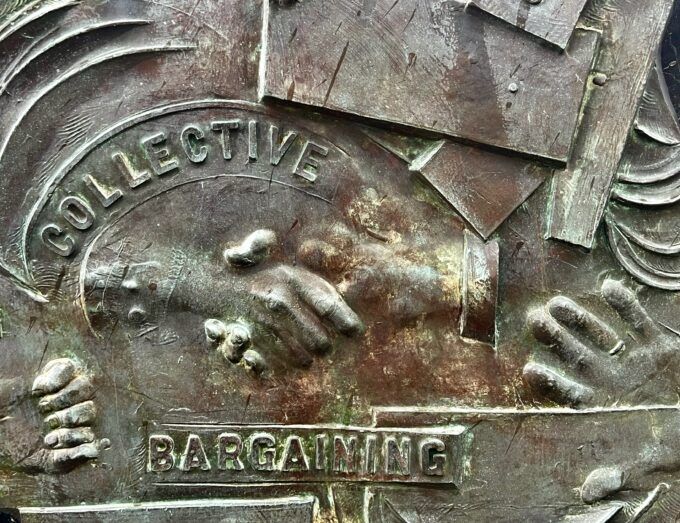
Michigan’s Labor Legacy sculpture (detail), Hart Plaza, Detroit. Photo: Jeffrey St. Clair.
Despite experiencing the harm of corporate greed and our collapsing social safety net firsthand, workers remain underrepresented in mainstream media. Here at Inequality.org we do our best to counteract that blind spot by publishing pieces with worker voices front and center. Not only do we give workers a platform to voice their perspectives, but we also help disseminate their opinions to newspapers and other media across America through our OtherWords editorial service.
Below is a selection of the worker perspectives we published in 2025. If you’re also a worker interested in sharing your thoughts, don’t hesitate to get in touch with us at inequality@ips-dc.org.
1. Get on the Job and Organize: A Q&A with Jaz Brisack
Jaz Brisack’s 2025 book “Get on the Job and Organize” traces the labor organizer’s experience from Nissan plants in the South to forming part of the nucleus taking on Starbucks to fighting for a union at Tesla. Inequality.org managing editor Chris Mills Rodrigo spoke with Brisack to discuss key takeaways from those hugely important campaigns and the path forward for the labor movement.
2. Fighting for Fair and Fast Contracts
The anti-union playbook is well rehearsed at this point: sow uncertainty among workers with propaganda and promises that employers will listen, as long as a union doesn’t get in the way. But even if workers successfully win an election, companies have a trump card in their back pockets: delay a first contract as long as possible. Registered nurses Sarah Johnson and Jason Fratangelo have experienced that tactic firsthand. Since winning an election at Michigan’s Corewell Health East in 2024, the company has used every excuse in the book to delay contract negotiations. That’s why Johnson and Fratangelo wrote a piece supporting the Faster Labor Contracts Act, which would require employers to come to the bargaining table after just 20 days.
3. We Closed JFK8 After a Sewage Pipe Burst, One of Many Victories for Amazon Teamsters This Year
Speaking of delaying contract bargaining, that’s just what Amazon has done since workers at the company’s JFK8 facility in Staten Island shocked the country by voting to unionize in 2021. Despite the company’s intransigence, the union at the warehouse — now affiliated with the Teamsters — has been giving a critical voice to workers. When the bosses refused to do anything about a sewage leak at the facility last August, Yackisha Nebot Lopez and other workers successfully organized to demand to be sent home with pay.
4. Political Gerrymandering Is an Attack on Working Families and Black Voters Like Me
Assaults on worker rights came from all sides in 2025. Fran Marion, a fast food worker and organizer, detailed how a plan from Missouri lawmakers to redistrict the state would suppress working-class participation in elections and facilitate the roll-back of hard-fought labor wins. “We were already living in modern-day economic slavery,” Marion wrote. “Now they’re trying to put us in political slavery too. But we won’t let them.”
5. We Started a Co-op to Empower Workers
When Flequer Vera was thinking about starting a business, he was worried about replicating the same economic system that he’d struggled through as a migrant worker years earlier. Inspired by a trip to Spain’s Basque Country, Vera opted for a cooperative model. The company he helped found, Sustainergy, has helped retrofit thousands of homes in the Cincinnati area to be more energy efficient. But the primary success of Sustainergy for Vera has been the family-sustaining jobs that the work has supported.

No comments:
Post a Comment