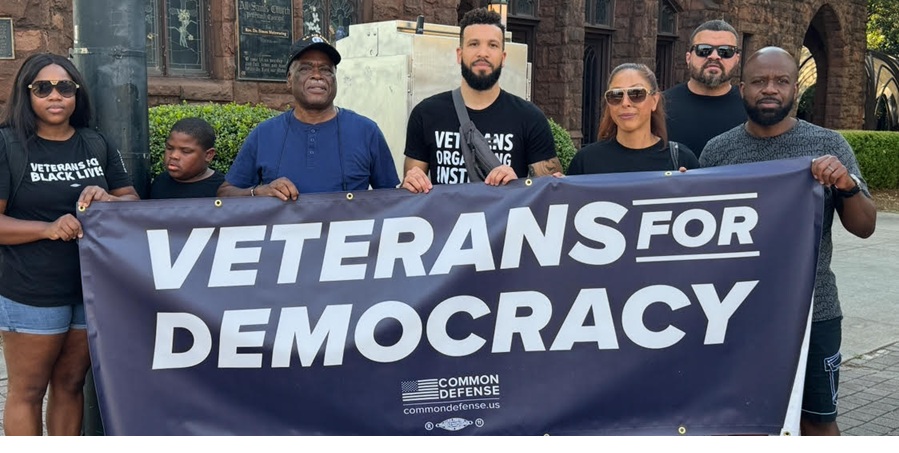
In the U.S., seventeen million people, across multiple generations, have a shared personal identity based on their past military service. About 1.3 million former service members currently work in union jobs, with women and people of color making up the fastest-growing cohorts in their ranks. According to the AFL-CIO, veterans are more likely to join a union than nonveterans. In a half dozen states, 25 percent or more of all actively employed veterans belong to unions.
In the heyday of industrial unionism in the 1950s and ‘60s, tens of thousands of former soldiers could be found on the front lines of labor struggles in auto, steel, meat-packing, electrical equipment manufacturing, mining, trucking, and the telephone industry. Many World War II vets became militant stewards, local union officers, and, in some cases, well-known union reformers in the United Mine Workers (UMW) and Oil, Chemical and Atomic Workers.
According to labor consultant and author Jane McAlevy, the post-war union movement better understood the “strategic value” of veterans than organized labor today. In her own advice to labor clients about contract campaign planning, she recommended the enlistment of former service members whose past “experience with discipline, military formation, and overcoming fear and adversity” could be employed on picket-lines and strike committees.
In addition, the high social standing of military veterans in many blue-collar communities can be a valuable PR asset when “bargaining for the public good” or trying to general greater public support for any legislative/political campaign.
A D-Day Rally in DC
The wisdom of that advice has been confirmed repeatedly– since January of this year—by the front-line role that veterans in labor have played in resisting Trump Administration attempts to cut government jobs and services and strip federal workers of their bargaining rights. At agencies like the Department of Veterans Affairs (VA), more than 100,000 former service members have been adversely affected by these right-wing Republican attacks.
In response, the Union Veterans Council of the national AFL-CIO brought thousands of protestors to a June 6 rally on the Mall in Washington, D.C., to hear speakers including now retired United Mine Workers President Cecil Roberts, a Vietnam veteran.
With local turnout help from the American Federation of Government Employees (AFGE), National Nurses United, and the Labor Notes-assisted Federal Unionist Network (FUN), other anti-Trump activists participated in 225 simultaneous actions in locations around the country, including in red states like Alaska, Alabama, Florida, Georgia, North Carolina, Idaho, Kansas, and Kentucky. Some “watch parties,” organized for real-time viewing of the D.C. event, were held in local union halls to highlight the labor-vet overlap.
James Jones, a FUN member and Gulf War veteran from Boone, North Carolina, traveled all the way to D.C. on the 81st anniversary of D-Day because he wanted Congress to understand the importance of VA services to veterans like himself.
Jones now works for the National Park Service and belongs to AFGE. He’s urging all his friends who are vets, fellow VA patients, and federal workers to start “going to rallies, and join these groups that are really fighting back. The government needs to keep the promise it made to veterans. We served our country, and now they’re breaking their promise to take care of us. We can’t accept that.”
VA Not For Sale
Private sector union activists, like CWA Local 6251 Executive Vice-President David Marshall, a former Marine and member of Common Defense, the progressive veterans’ group, have also been rallying their fellow veterans, inside and outside the labor movement.
Marshall has joined rank-and-file lobbying in Washington, D.C. against Trump-Vance cuts in VA staffing and services, calling them “a betrayal of a promise to care for us.” Supporters of Common Defense’s “VA Not for Sale” campaign fear that privatization of veterans’ healthcare will destroy what Marshall calls the “sense of community and solidarity” that VA patients experience when they get in-house treatment, as opposed to the costly and less effective out-sourced care favored by President Trump. “Regular hospitals don’t understand PTSD or anything else about conditions specifically related to military service,” he says.
An AT&T technician in Dallas, Marshall was also a fiery and effective speaker at that city’s big “No Kings Day” rally last June, when he explained why he and other veterans in labor are opposing MAGA extremism, political and state violence and related threats to democracy. “We’ve seen peaceful protestors met with riot gear, and we’ve heard the threats to deploy active-duty Marines against American citizens,” he told a crowd of ten thousand in Dallas last June. “Let me be clear: using the military to silence dissent is not strength; it’s tyranny. And no one knows that better than those who have worn the uniform.”
Veterans for Social Change
Marshall is a third-generation union member born and raised in southern West Virginia. His father and grandfather were coal miners; his grandmother Molly Marshall was active in the Black Lung Association that helped propel disabled World War II veteran Arnold Miller into the presidency of the UMW in 1972. During his own 25- year career as a CWA member, Marshall has served as a safety committee member, national union convention delegate, and now officer of his local.
Marshall belongs to CWA’s Minority Caucus, the Coalition of Black Trade Unionists, and the NAACP. Along with Britni Cuington, a Local 6251 steward and Air Force vet, he attended a founding meeting of Common Defense’s Black Veterans Caucus at the Highlander Center in Tennessee.
Both Marshall and Cuington have since lobbied against the re-districting scheme concocted by Texas Republicans to secure more House seats in mid-term voting this year. Testifying at a public hearing on behalf of the Texas AFL-CIO, Cuington pointed out that “minority veterans already face barriers to access to the services, benefits, and economic opportunities we have earned.” She condemned the state’s new district lines as racial gerrymandering in disguise that will disenfranchise “veteran heavy, working class neighborhoods.”
In his role as a CWA organizer, Marshall has signed up thirty Common Defense field organizers around the country—almost all fellow vets—as new members of his local. He’s now helping them negotiate their first staff union contract. In addition, Marshall encourages former service members in other bargaining units to participate in the union’s Veterans for Social Change program, which has done joint Veterans Organizing Institute training with CWA.
One fellow leader of that rank-and-file network is Keturah Johnson, a speaker at the 2024 Labor Notes conference. She got a job at Piedmont Airlines in 2013 as a ramp agent, after her military service and then become a flight attendant. A decade later, she became the first queer woman of color and combat veteran to serve as international vice president of the fifty-thousand-member Association of Flight Attendants-CWA.
A National Guard Casualty
One CWA member much in the news lately because of his current National Guard service is 24-year-old Andrew Wolfe, a lineman for Frontier Communications in Martinsburg, W. Va. He was seriously wounded—and a fellow Guard member killed– in late November after being sent to patrol duty in Washington, D.C. (His assailant was a mentally ill, CIA-trained former death squad member from Afghanistan, relocated to the U.S. after the collapse of the U.S. backed government there in 2021.)
According to Marshall, “it’s shameful that they were ever put in that position,” by a Republican governor going along with Trump’s federalization of Guard units for domestic policing purposes. “It’s all political theatre,” he says. “They were just props, just standing around, with no real mission.” Along with Common Defense, Marshall praises the six fellow veterans in Congress whose recent video statement reminding active duty service members of their “duty not to follow illegal orders” led President Trump to call them “traitors” guilty of “seditious behavior” that should be punished by hanging.
“We have to stay in lock-step with them and show everyone following the Constitution that we have their back,” Marshall says.


No comments:
Post a Comment