
Cooperation Between Cuba and Venezuela:
A War Target for the US
January 14, 2026
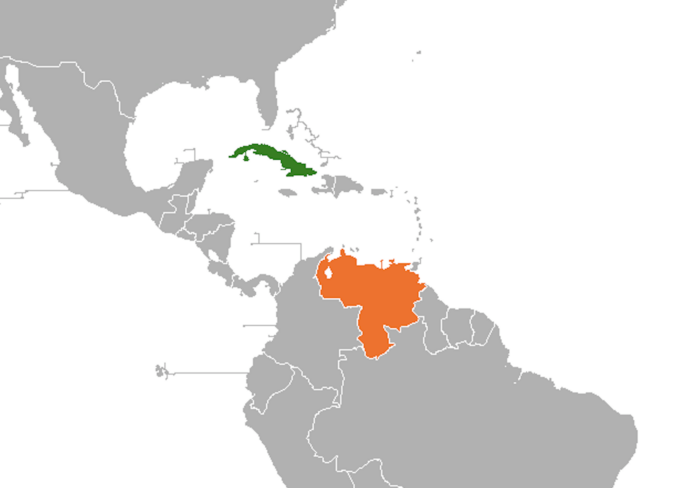
Image Source: Fobos92 – Public Domain
After the triumph of the Cuban Revolution in 1959, the initially cordial bilateral relationship deteriorated rapidly. With the fall of the Marcos Pérez Jiménez dictatorship and the rise of Rómulo Betancourt to power, Venezuela became Fidel Castro’s main regional antagonist. The ‘Betancourt Doctrine,’aligned with Washington’s interests, led to the breakdown of relations and spearheaded Cuba’s expulsion from the OAS in 1962.
Tensions reached their peak with the landing at Machurucuto (1967), where a dozen Cuban military personnel and Venezuelan guerrillas attempted to start an insurgency on the coast of Miranda. This event was used by the Raúl Leoni administration and the US to consolidate the narrative of the Cuban Revolution as Venezuela’s ‘external enemy’ and to advance the politics and military strategy of anti-communism in this country.
However, for the Venezuelan left, Cuba was always a beacon. Despite the repression of Punto Fijo democracy, the Sierra Maestra inspired a generation of young people who saw in that feat a model to follow. Movements such as the Revolutionary Left Movement (MIR) and the Armed Forces of National Liberation (FALN), under figures such as Fabricio Ojeda, sought to replicate ‘foquismo’ in the Venezuelan mountains, keeping alive an ideological link that resisted the subordination to the US mandate by successive governments.
1994: The Meeting That Changed History
14 December 1994 marked a turning point. Hugo Chávez, recently released from prison after the 1992 military rebellion, landed in Havana and was received with Head of State honors by Fidel Castro himself at the foot of the airplane stairs.
That calculated and visionary gesture not only legitimized Chávez as the future leader of the continental left, but also sowed the seeds of a political and personal relationship that would become the basis of an unprecedented strategic alliance.
The Bolivarian Revolution and the Cuban Revolution: A New Integration Model
With Chávez’s arrival in power in 1999, rhetoric was transformed into concrete action. The Comprehensive Cooperation Agreement between Venezuela and Cuba, signed on 30 October 2000, became the cornerstone of this new stage. An unprecedented solidarity compensation mechanism was established: Venezuela guaranteed energy supplies to the island under fair financial conditions, while Cuba reciprocated with its most valuable capital: human talent and scientific advances.
This exchange gave rise to the Social Missions in Venezuela, the executive arm of Chavismo’s social policy:
Barrio Adentro Mission: Brings free primary health care to the poorest corners of the country with thousands of Cuban doctors.
Robinson Mission: Eradicated illiteracy in Venezuela (recognized by UNESCO in 2005) through the ‘Yo, sí puedo’ (Yes, I can) method.
Misión Milagro: Restored sight to hundreds of thousands of Latin Americans through free eye surgery.
Beyond social issues, cooperation covered strategic areas such as the modernization of the identification system (SAIME), agricultural development, and the popularization of sports.
The Defense Alliance and the Cuban Martyr Heroes
The most sensitive and profound dimension of this alliance has been cooperation in security and defense. Cuba played a key role in restructuring the Bolivarian National Armed Force (FANB) and updating intelligence and counterintelligence doctrine, preparing the nation for asymmetric warfare scenarios.
It is in this context of combative brotherhood that the recent event of the 32 Cuban military cooperants killed in combat takes place. These men lost their lives on Venezuelan territory during the direct aggression perpetrated by the United States on 3 January, an operation that led to the kidnapping of President Nicolás Maduro and the First Lady and First Combatant, Cilia Flores.
This bloody event is not isolated; it responds to the historical internationalist mystique of the Cuban Revolution. It is the same vocation that led its fighters to Africa to fight for the liberation of Angola and Namibia and help defeat apartheid. Today, the death in combat of these 32 Cubans, along with more than 50 Venezuelan soldiers, definitively seals with blood a relationship of brotherhood between two peoples who, together, face the most violent and desperate phase of US imperialism.
This article was produced by Globetrotter.

No comments:
Post a Comment