Climate change is largely driven by human activity – industrial emissions and the overuse of natural resources. Those who study the field know that one of the most striking examples of environmental mismanagement is the drying of the Aral Sea.
The Aral Sea was once the fourth-largest lake on Earth and a natural regulator of Central Asia’s climate. Over the course of 50 years, however, it has lost around 90% of its surface area. That has left behind a desert whose salt and dust are carried for hundreds of kilometres, causing disease and soil degradation.
The tragedy of the Aral Sea was caused by excessive water diversion for cotton irrigation during Soviet times. Combined with extreme heat – summer temperatures often exceed 40°C – this led to rapid evaporation and an ecological disaster. The hulks of rusting ships that are stranded on the former seabed have become an enduring symbol of this disaster. Fishing collapsed, populations migrated and the once-rich biodiversity of the region continues to decline.
Today, sandstorms carrying toxic dust and salt remain the most serious challenge. Traces of this dust have been found as far away as Europe, the Himalayas and the Arctic, showing that the Aral Sea crisis is not only a local problem, but a global environmental issue too.
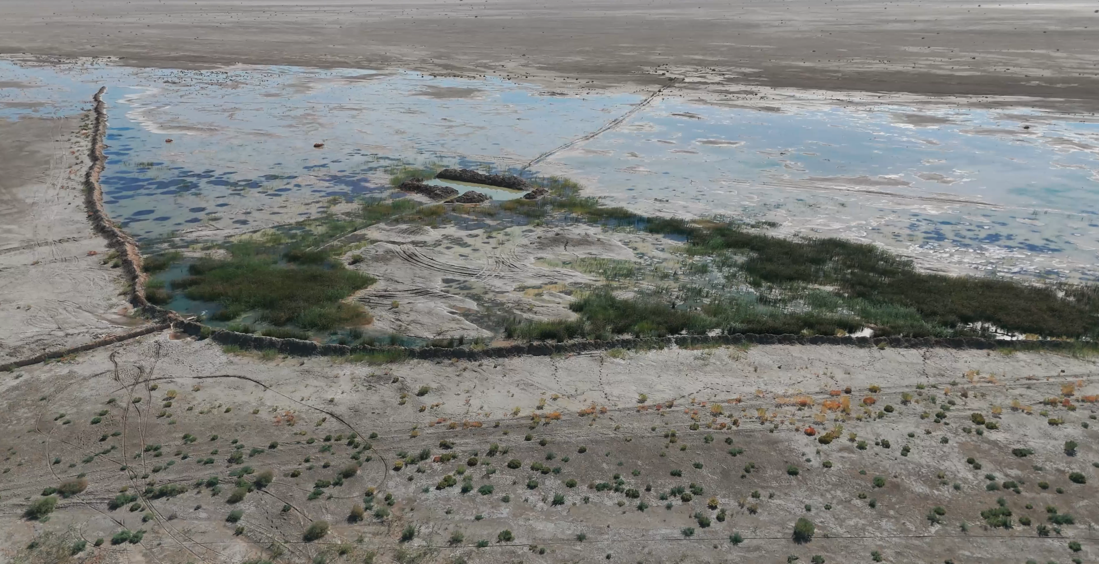
By seeding salt-tolerant vegetation, the soil can be stabilised. The difficulty is that the area in question is the size of Ireland (Credit: Bulat Utemuratov Foundation).
Kazakhstan and Uzbekistan, supported by international organisations, have long worked to restore the Aral Sea ecosystem. Their efforts focus on preserving remaining water bodies and planting salt-tolerant vegetation to stabilise the soil.
Uzbekistan has restored over two million hectares, while Kazakhstan has committed to restoring 1.1mn hectares, half of which has already been planted. Yet restoring vegetation over an area the size of Ireland remains difficult and costly, with low survival rates and limited monitoring capacity.
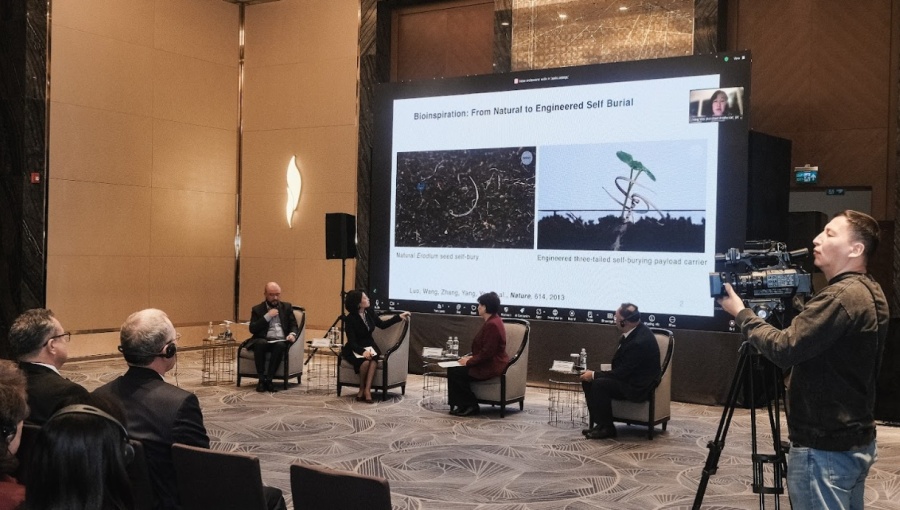
The Bulat Utemuratov Foundation is responding to this challenge with an innovative approach. The foundation is introducing E-Seed technology, developed at the University of California, Berkeley, which packages seeds in biodegradable capsules containing a moisture-retaining gel and wooden spirals inspired by the Erodium plant. That enables them to drill into the soil naturally. Drones distribute and monitor the capsules, making the process efficient and scalable. The project is being implemented in partnership with the executive directorate of the International Fund for Saving the Aral Sea in Kazakhstan and Korkyt Ata Kyzylorda University.
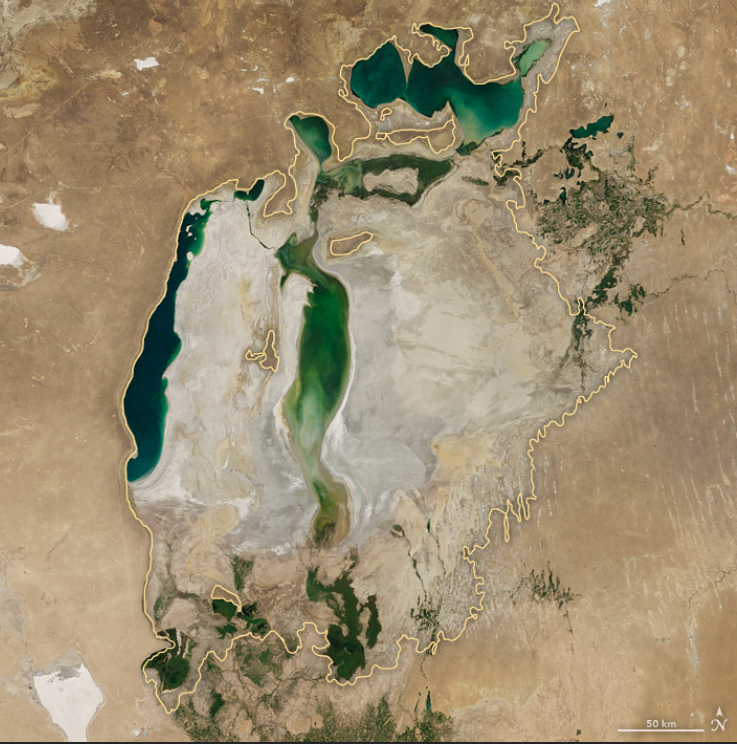
The devastation is enormous, but the foundation believes its project holds great promise (Credit: Bulat Utemuratov Foundation).
Pilot plantings will begin in spring 2026 on a one-hectare site, with plans to expand to 50 hectares in 2027 and further expansion in subsequent years. The cost of the pilot project is estimated at $600,000.
While climate stability is a public good, the role of private capital and philanthropy in ecosystem restoration is growing. The Land Degradation Neutrality Fund, managed by France’s Mirova, and support for the Great Salt Lake project from US businessman Josh Romney are good examples of this emerging cooperation.
The Bulat Utemuratov Foundation has previously supported major environmental and recovery efforts – from funding post-flood reconstruction in western Kazakhstan (2025) to restoring the Almaty Botanical Garden (2020). The Sustainable Kazakhstan Research Institute, supported by the Foundation’s benefactor, has developed a technology for creating vegetative barriers that capture harmful airborne particles (phytocapture) near mining facilities. It uses big data to identify the most suitable trees and shrubs for each site and to optimise planting distances.
The Foundation’s project to restore the Aral Sea ecosystem remains modest, but it holds great promise. The experience of the Aral Sea shows that the solutions to climate challenges require cooperation – between countries and between governments and private philanthropy – and the application of innovative technologies.
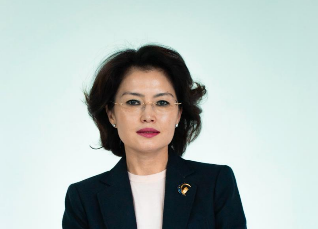
The author of this article is Ainur Karbozova, CEO of the Bulat Utemuratov Foundation.

No comments:
Post a Comment