First published at Counterpunch.
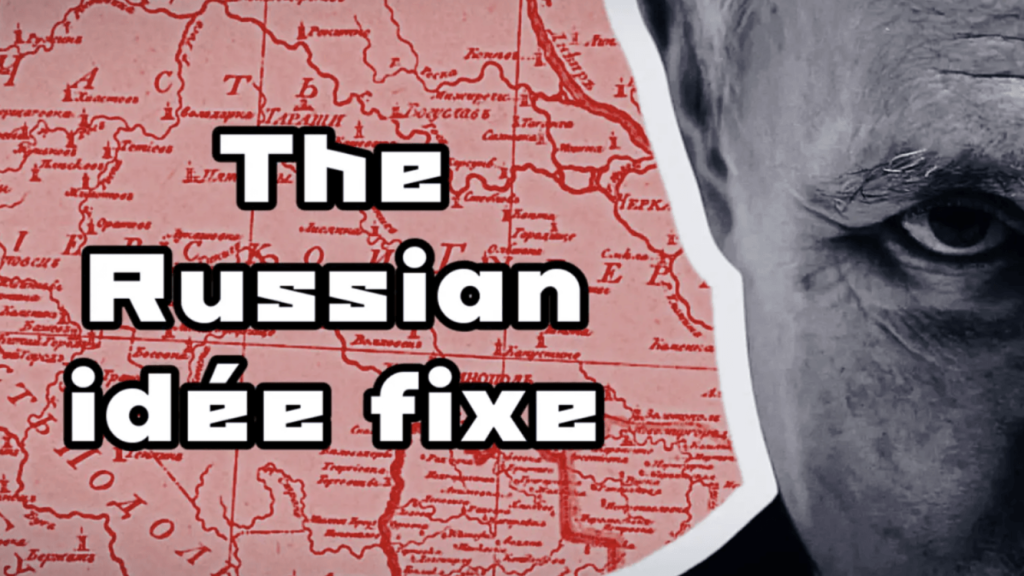
“Russia’s defensive war against NATO expansion” — a concept that has become almost axiomatic for many Western leftists. This concept conveniently serves both to rationalize Russia’s actions and to radicalize criticism of their own governments. But what role does Putin himself assign to the supposed NATO threat? A close reading of his key speeches reveals that Putin explicitly denies any danger of a NATO attack on Russia. Instead, all the ruler’s attention and passion are focused elsewhere — on the question of primordial ‘historical justice.’ Putin dusts off millennia-old chronicles, finding in them proof of his reactionary utopia, his imagined historical right to possess Ukraine. Let’s talk about the most underestimated cause of this war — ideological obsession. The Russian idée fixe.
1,300 kilometers. That’s how much longer Russia’s border with the NATO military bloc became in 2022 after two previously neutral countries — Sweden and Finland — joined the alliance. The Baltic Sea effectively turned into an internal sea of NATO. St. Petersburg, Russia’s northern capital, now lies just 148 kilometers from the border of a hostile bloc. What was Russia’s reaction? Did Putin issue a military ultimatum? Threaten a preemptive operation? Concentrate troops on the border? No. None of that happened.
Meanwhile, in the context of Ukraine, the NATO question keeps surfacing in Russian discourse. An even greater role is assigned to NATO in the discourse of the Western left. And this despite the fact that Ukraine was denied membership back in 2008. Germany, France, and many other states openly opposed Ukraine’s accession — when the veto of even one member is enough to block it. The very presence of Russia’s naval base in Sevastopol already made Ukraine’s accession to the alliance barely possible. After the annexation of Crimea and the outbreak of war in Donbas, Ukraine’s NATO membership became even more unthinkable — the existence of territorial disputes and ongoing conflicts automatically closes the alliance’s doors to any applicant.
It turns out that Russia’s northern neighbor joining NATO poses no threat to it — while Ukraine, which had no chance of membership, became the target of a full-scale invasion. How can this be explained? Let’s give the floor to Vladimir Putin himself.
Who is Mr. Ruric?
Let’s go back to February 2024. Moscow. After two years of boycotts by Western media, an American journalist arrives in Russia’s snow-covered capital to interview Vladimir Putin. That journalist is Tucker Carlson — a conservative blogger and supporter of Donald Trump. Skeptical of liberal media explanations for the reasons behind Russia’s invasion, he wants to hear firsthand what drove Putin to launch the largest land war in Europe since World War II. After all, the leader of the world’s biggest nuclear power couldn’t have sent tank columns toward a neighboring capital without serious reasons. Perhaps there was something that pushed Putin to make this difficult decision — something the Western audience doesn’t know? Moreover, Carlson already has his own guesses on the matter: most likely, it all comes down to the Democrats’ administration and their eastern NATO policy, which, he suspects, provoked Russia into this desperate move, leaving it no choice.
“On February 24, 2022, you addressed your country in your nationwide address when the conflict in Ukraine started and you said that you were acting because you had come to the conclusion that the United States through NATO might initiate a quote, ‘surprise attack on our country.” And to American ears that sounds paranoid. Tell us why you believe the United States might strike Russia out of the blue. How did you conclude that?” Tucker Carlson asks his first question.
The question is as precise as it is fair. After all, in the twenty-first century, no state can openly wage a war of conquest without framing it as defense against an external threat. Every aggressor — from Hitler to Netanyahu — has called their war forced, defensive, provoked from the outside, a response to danger facing the state and its citizens. And if Russia sees itself as defending, then surely it must have the strongest possible arguments for doing so. What was threatening Russia? What danger was Putin trying to prevent?
“It’s not that the United States was preparing to launch a surprise attack on Russia, I never said so.” Putin deflects. “Are we having a talk show here, or a serious conversation? I will take only 30 seconds or one minute of your time to give you a brief historical background. Don’t you mind?”
In an attempt to explain to the Western audience his true motives for attacking Ukraine, Putin delivers a 25-minute pseudo-historical lecture. From it, astonished Americans hear for the first time names like the ancient Rus’ prince Rurik, princes Oleg and Yaroslav the Wise, Mongol leaders Genghis Khan and Batu Khan, cossack hetman Bohdan Khmelnytsky, and Empress Catherine II. Putin speaks of the blood and spiritual unity of Ukrainians and Russians, calling them “one people.” He even tries to hand Carlson a stack of seventeenth-century archival letters supposedly proving that Ukrainians are inseparable from Russians.
Any efforts by Carlson to interrupt and return to the main question — what exactly threatened Russia in 2022? — fail. Putin keeps dragging the American back through the centuries, trying to explain how Russia’s enemies “artificially separated” Ukrainians from the one Russian people. All of this, Putin insists, must be understood in order to grasp the deeper causes of the invasion.
For half an hour, the Russian leader, referring to ancient chronicles and medieval charters, tries to convince the American that Ukrainian lands have belonged to Russia from time immemorial. The Ukrainian nation and its statehood, he argues, are artificial — a historical accident, an awkward mistake that it is now time to correct.
‘They want to attack Russia,’ ‘They want to destroy Russia,’ ‘The country faces a military invasion,’ ‘Our citizens could become victims of aggression,’ ‘Our internationally recognized territory is being seized’ — not a single one of these phrases was said, nor could it have been.
Putin himself admits: the Russian Federation as a state faced no threat. The danger loomed over another Russia — the mythological, thousand-year-old Russia encompassing broader “historical” lands. The Russian Federation within the borders of the former RSFSR, once outlined by the Bolsheviks, is merely a fragment of the former great Rus’ territory, including Belarus and Ukraine. The separation and ultimate departure of Ukraine from the imagined spiritual and political space of the “Russian World” — that is the threat Putin seeks to prevent. And at the end of the conversation, he states this to Carlson directly:
“The reunification [of one people] will happen. It never went anywhere,” Putin concludes confidently.
Right to Ukraine
Let’s ask ourselves: if the leader of a warring country delivers a lengthy lecture about the depths of history to explain his motives — does it matter to him? Yes, it does. Nothing matters more. “A serious conversation.”
Putin was given two hours of airtime to explain to the world that he isn’t a villain and is merely defending Russia from the NATO threat. Yet instead, he devotes the bulk of his airtime to what he sees as the most important thing — a primordialist justification of his supposed “right” to possess Ukraine.
What should we call this? An ideological obsession — an idée fixe.
Unlike the thousands of Western Marxists who insist that Russia faces a NATO threat, Putin himself claims nothing of the sort. On the contrary, he denies it outright. No one was planning — or is planning — to attack the Russian Federation. The reason for the war, Putin says, is the “unlawful,” “blasphemous,” and “historically criminal” removal of Russia’s mythical cradle — Kyiv and the surrounding southern Rus’ lands — from its sphere of influence.
Little wonder that Putin shows complete indifference toward Sweden and Finland joining NATO. The reason is simple: they do not belong to the imagined primordial space known as the “Russian World.” People there do not speak Russian; there are no ancient Rus’ churches, no sites of great battles, no sacred artifacts of nationalist mythology. The Finns can hardly be called “one people” with the Russians. But Ukraine is a different story — the possession of which is the idée fixe of Russian imperial nationalism, and of Vladimir Putin personally.
Indeed, the ruler of Russia does see the war as defensive. But in what sense? Simply put, he is not “defending” the Russian Federation within its 1991 borders, but rather the frontiers of an ancient Empire that, in his deepest conviction, were unlawfully and artificially torn away by enemies from the bosom of Russia’s thousand-year-year-old statehood.
Just as Zionist leaders firmly believe that their “right to Judea and Samaria is written in the Bible,” the Russian leadership has come to believe that its right to possess Ukraine is confirmed by the chronicles of Kyivan Rus’ and the letters of Bohdan Khmelnytsky.
For both Israel and Russia, the concept of international law is far too young and has not yet stood the test of time. The UN-based system of international law is only eighty years old; the European treaty on the inviolability of borders — barely fifty. What is this nonsense compared to millennia-old chronicles and sacred texts?
If international law humiliates Russia by denying its “legitimate claims” to the cradle of Russian civilization, then it must be bad international law! If it does not allow the return of historical lands, it serves Russia’s enemies. If it perpetuates the dismemberment of the once-unified Russian Empire, if it allows Ukrainians to leave the bosom of the “Russian World,” then following such law is not only harmful but criminal. This is roughly the logic of the Kremlin elders.
Few would doubt the deep ideological motives driving Israel’s leaders in their permanent war for territorial expansion. Why, then, do the international left refuse to see the similar ideological impulses behind Russia’s leadership?
To ignore how obsessed Putin is with the conquest of Ukraine requires an exceptional kind of blindness.
The concept of a divided people
Perhaps one interview isn’t enough to draw conclusions? Let us turn to Putin’s other key speeches and statements.
Six months before the invasion, in July 2021 — as the world was only beginning to recover from the pandemic and no one could imagine a coming full-scale war — Vladimir Putin published his infamous article “On the Historical Unity of Russians and Ukrainians.” In it, he for the first time laid out a comprehensive declaration of his commitment to the primordialist myth, preparing the ideological ground for his future invasion.
In this completely pseudo-scientific article, full of manipulations and false claims, Putin declares that Russians, Belarusians, and Ukrainians are not distinct nations but branches of one Russian people. The main idea running through the entire article is clear: Ukrainian identity was artificially constructed and nurtured by Russia’s enemies to split one people apart and pit its parts against each other.
Ukrainians are denied a separate national identity, their own statehood, and the ability to exercise sovereignty as they see fit. For the first time, Vladimir Putin systematically lays out his views on the proper world order: Ukraine must exist exclusively within the Russian “spiritual and political space.” Any attempt by Ukrainians to leave this sphere will be regarded as an infringement on the integrity of primordialist harmony.
What is this, if not a direct declaration of the ideological motives behind the war?
Some might say: “Perhaps this is just one of many statements. Surely there are others in which Putin pragmatically describes threats to Russia from Western imperialism.” No — Putin has written no other programmatic article. His piece “On the Historical Unity…” remains the sole and defining manifesto of the invasion.
Vladimir Putin repeated the same theses in his keynote speech on 21 February 2022, three days before the invasion began.
“Since ancient times, the inhabitants of the southwestern historical lands of Kyivan Rus’ called themselves Russians and Orthodox,” this is how he begins his yet another pseudo-historical excursus.
Exactly half of his speech is devoted to the ideological argument that Ukraine is an artificial state, created by the Bolsheviks. That Lenin’s criminal mistake in national policy resulted in the excision from the unified Russian Empire of an “ugly creature” — an independent Ukraine. And, apparently, it now falls to Vladimir Putin to correct this fateful mistake.
Yes, this speech also touches on the expansion of NATO’s military influence across Ukraine. But what matters is the context in which it is mentioned. The problem, from Putin’s perspective, is this: Ukraine’s coastal cities were conquered in the eighteenth century by Russian tsarist warlords at the cost of Russian soldiers’ blood, and therefore the presence of NATO bases there would be a mockery of the memory of heroic Russian colonisers.
For the sake of fairness, it should be noted that in two brief paragraphs, Vladimir Putin does mention a possible NATO threat to Russia’s internationally recognized territory. He warns that if the Americans deploy their missiles and strategic bombers in Ukraine, it would be a “knife to the throat.”
But… First, these brief passages are completely lost against the backdrop of his extensive primordialist justification for the war. If defending against a hypothetical NATO military aggression were truly the primary motive, it would clearly have been a higher priority. Second, the scenario of nuclear weapons being deployed in Ukraine and the Americans attacking the world’s largest nuclear power is utterly far-fetched — something Putin himself would acknowledge two years later in the Carlson interview cited above. Third, as already mentioned, when the “knife to the throat” came from Finland, Putin did… nothing!
What are we left with? Putin’s two main encyclicals on the invasion stand as pure distillations of ideology.
Core argument
Perhaps, after four years of war — after the enormous sacrifices made by the Ukrainian people in resisting the invasion, after Ukrainians have demonstrated through every action that they refuse to live under Russian rule — perhaps, after all this, Vladimir Putin has come down to a more pragmatic stance and abandoned his idée fixe of “reuniting the divided people”? No, he remains faithful to his reactionary utopia.
“I have said many times that I consider the Russian and Ukrainian peoples to be one people, in fact. In that sense, all of Ukraine is ours,” Putin declared in the summer of 2025.
That same summer, Donald Trump decided to lift Russia out of international isolation and invited Putin to a summit in Alaska. Offering fairly generous concessions, he hoped that the Russian leader, as a pragmatic politician, would strike a deal and make peace. But Trump was wrong. No deal took place. The FT describes the details of the closed-door meeting as follows:
Putin rejected the US offer of sanctions relief for a ceasefire, insisting the war would end only if Ukraine capitulated… The Russian president then delivered a rambling historical discursion spanning medieval princes such as Rurik of Novgorod and Yaroslav the Wise, along with the 17th century Cossack chieftain Bohdan Khmelnytsky — figures he often cites to support his claim Ukraine and Russia are one nation. Taken aback, Trump raised his voice several times and at one point threatened to walk out. He ultimately cut the meeting short and cancelled a planned lunch…
Let us just reiterate this point. At the very first talks since 2022 between the leaders of the world’s two largest nuclear powers, Vladimir Putin discusses with his counterpart not the ‘encirclement of Russia by NATO bases,’ not American nuclear weapons in Europe, not ‘Russia’s security concerns,’ not intermediate-range missiles or anti-missile defence — in short, none of the issues constantly cited by Western leftists when discussing Russia’s supposedly defensive war against NATO expansion.
No, Putin is preoccupied with entirely different matters. At a high-level meeting with the U.S. president, he invokes medieval legends as the most important argument for recognizing his “right to Ukraine.” Time and again, he launches into long lectures, hoping that Western leaders will finally understand the concept of “one people” rooted in deep antiquity and acknowledge his correctness.
If this isn’t ideological obsession, then what is?
Praxis
One could, of course, assume that this primordialist idée fixe of “reuniting a divided people” goes no further than Vladimir Putin’s quasi-historical lectures at public events — that in practice, Russia is merely acting pragmatically to eliminate external threats. But that is not the case. The ideological tenets of Russia’s reactionary utopia are being fully realized in the course of this war.
Within the past four years, Russia has been swept by a massive ideological campaign aimed at denying Ukraine’s very existence. Pupils in all Russian schools from first grade onwards now attend “Сonversations about important things” — weekly lessons in state chauvinist propaganda. In 2023, school textbooks were rewritten personally by Culture Minister Vladimir Medinsky — one of those exerting strong ideological influence on Putin — to describe Ukraine as an artificial formation created by the Bolsheviks. Dmitry Medvedev, a top official, publicly calls for Ukrainian independence to ‘disappear forever’ against the backdrop of a giant map showing two-thirds of Ukrainian lands annexed by Russia. Television propagandists like Vladimir Solovyov go far beyond simple denial of Ukraine, even calling for the destruction of Ukrainian megacities if their residents do not surrender to the Russian army and accept a Russian identity. Kremlin-linked ultraright philosopher Aleksandr Dugin calls Ukraine “a toxic stain on our territory,” arguing that after full occupation Ukrainian identity will have to be eradicated for decades to prevent its resurgence.
But the most telling embodiment of Vladimir Putin’s primordialist ideas is the policy pursued in the occupied territories. A 2025 UN Committee on Economic, Social and Cultural Rights report recognized a systematic campaign to wipe off Ukrainian cultural identity in the areas annexed by Russia:
… people in areas under the effective control of Russia continue to face severe restrictions in the realization of their right to take part in cultural life, including the right to use and teach minority languages, history and culture. [There’s] a large-scale campaign to systematically erase Ukrainian history, culture, cultural identity and language, rewriting historical curricula, and repressing local cultural symbols, as well as the general undermining of the linguistic identity of ethnic minorities in areas under the effective control of Russia.
But the core ideological work of eradicating Ukrainian identity is carried out among children from the occupied territories. The Ukrainian language has been removed from school curricula. Children who keep speaking Ukrainian are bullied and their parents pressured. Ukrainian teenagers are recruited into paramilitary groups that indoctrinate them with Russian chauvinism and hostility to Ukrainian identity. Moreover, an entire network of “military-patriotic” camps trains adolescents from the occupied areas in weapons handling, small-unit tactics, drone operation and battlefield medicine — preparing them to fight against Ukraine. The systematic practices of abduction, forced adoption and re-education of children from occupied zones led to the International Criminal Court issuing an arrest warrant for Vladimir Putin in 2023.
Are all of the above also supposed to be “provoked defensive measures against NATO’s external threat”? Of course not! What we are witnessing is a consistent policy of territorial expansion and ethnic assimilation of Ukrainians — the literal implementation of Putin’s “one people” doctrine.
Carthago delenda est
Marxists typically view ideological motives for war with suspicion, often resorting to economic determinism or pragmatic explanations, such as the currently popular theory of “offensive realism.”
Nevertheless, when we are dealing with a system in which the supreme ruler concentrates virtually unlimited power and possesses the world’s largest nuclear arsenal, his ideological obsessions become a crucial factor shaping reality.
A close example can be found in the aforementioned reactionary utopia of the Israeli far-right, which has undoubtedly served as the basis for the genocide in Gaza and permanent ethnic cleansing іn the West Bank. Few left-leaning observers would deny the significance of Zionist doctrines in shaping Middle Eastern politics.
So why is the primordialist ideology of Russian expansionism almost entirely ignored by leftist commentators? We can debate at length how Vladimir Putin came to his ideas, at what stage, and for what reasons they radicalized, turning into a driving force behind the war. But to deny their influence on material reality is to sin against the truth.
The left criticizes Eurocentrism. Yet they often fall into its trap themselves, preferring to believe that the elites of Western countries are solely to blame for every single problem in the world. This very assumption underlies the concept of “Russia’s defensive war against NATO expansion.” Such a Eurocentric view entirely strips Russia of agency, ignoring its own internal motives and aspirations.
Putin’s Russia is unquestionably an actor on the world stage. It does not merely respond to external challenges, but imposes its will. It has its own vision of the proper world order — its reactionary utopia. A central element of this utopia, the “one people,” is the subjugation of Ukraine and the radical reshaping of its citizens’ identities, a laboratory of which can be observed in the annexed territories.
The existence of a separate and unsubmissive Ukrainian nation became, for Vladimir Putin, a kind of “Carthage that must be destroyed” — the Russian idée fixe. Without grasping this fact, February 24, 2022 remains incomprehensible—as does the recurring enigmatic phrase about “eliminating the root causes of the conflict.”
Andriy Movchan is a Ukrainian left wing activist who was forced to leave Ukraine due to political persecution by the far-right. He now resides in Barcelona where he devotees himself to media activism, art and journalism. His work focuses on Soviet and post-Sovet context. He can be reached at andriyko22@gmail.com