Monday, February 02, 2026

China's space aircraft carrier: superweapon or propaganda?

DW
February 1, 2026

With Luanniao, China is promoting a giant space aircraft carrier as a new superweapon. Is it a vision for war in space — or science fiction?


China's state television shows a computer simulation of the planned space aircraft carrier "Luanniao," which would surpass all terrestrial carriers in terms of mass
Image: CCTV


The flying aircraft carrier is larger than any warship in use today and heavier than a supertanker: China’s Luanniao is intended to shape future warfare — from space. Yet experts describe the superweapon as high-tech theater with a political message.

China is planning an integrated air- and space-defense system known as Nantianmen ("Heavenly Gate"). Its centerpiece is the flying carrier Luanniao, measuring 242 meters (794 feet) in length, 684 meters in wingspan and reportedly weighing up to 120,000 tons at takeoff — an imposing mass. From its deck, unmanned space fighters, so-called Xuannu, are to launch hypersonic missiles and strike targets in the atmosphere and in orbit.

"China has long been number two in space — behind the United States, but well ahead of Europe," said space security expert Juliana Süß of the German Institute for International and Security Affairs (SWP) in an interview with DW.

Beijing has invested "extremely large sums of money," she said; space plays a clear prestige role for the leadership and is "extremely important for military capabilities."


By weight alone, the planned space carrier would surpass the largest existing aircraft carriers by around 20%. While it would be shorter in length, its wingspan would be significantly broader than that of a conventional maritime aircraft carrier at sea. The largest aircraft carrier currently in service, the USS Gerald R. Ford, measures roughly 337 meters in length and 78 meters in width and weighs about 100,000 tons including fuel, crew and equipment.

A brief report on the military program "Lijian" on China’s state broadcaster CCTV depicts the announced carrier as a photorealistic 3D model hovering above the Earth, releasing space jets and firing weapons in outer space. Excerpts from the show are circulating online, including in a recording on YouTube (with the option to enable English subtitles).

Experts cast doubt on the gigantic space carrier

From a technical standpoint, the plan goes far beyond what today’s rockets could possibly send into orbit. Even if a modular assembly in space were theoretically possible, many problems remain. These include power supply, propulsion, cooling, protection from space debris — and above all, the sheer cost. A 120,000-ton carrier in space would be completely beyond any realistic payload capacity of current launch systems such as SpaceX’s Starship.

German diplomat and space analyst Heinrich Kreft said that, from today’s perspective, the project is "completely unrealistic" — yet still sees it as part of a longer-term trajectory.

"Many things that were science fiction 20 or 30 years ago are real today," Kreft told DW.

This marks China joining a race fueled by figures like Elon Musk or Jeff Bezos with their visions of lunar and Martian colonization.

A superweapon to send a strategic signal

Analyses from the US likewise interpret Luanniao less as a construction blueprint than as a strategic signal. The National Interest ran an article with the headline: "Beijing Wants You to Believe It's Building Flying Aircraft Carriers".

The vision, wrote author Brandon J. Weichert, is part of a "wider propaganda push" that is designed to make the West nervous and waste time and resources.

For space analyst Kreft, the announcement resembles a deliberately placed message in the power games with the United States — cast against the backdrop of the conflict over Taiwan.

"To my ears, this sounds as if China has put something out into the world with Taiwan very much in mind, in order to leave a marker," he said.

He points to a series of spectacular Chinese “superweapon” announcements — ranging from an allegedly ultimate submarine-hunting weapon to space-based systems — that Western experts regularly classify as "unrealistic" but which are seen as part of a narrative designed to form a deterrent.

ADVERTISEMENT

China's next step in the space race with the US

SWP expert Süß places the project in a security-policy context. She views such initiatives "more through a deterrence lens" — the aim, she says, is "to demonstrate strength and project power across multiple domains."

At the same time, she interprets the presentation as China's answer to US missile defense plans in space. The "Golden Dome" proposed by Trump is intended to protect the United States against all types of airborne threats through a multilayered network of ground- and sea-based interceptor missiles, radar systems and possibly space-based interceptors — a project that itself is considered technically extremely ambitious and strategically fraught.

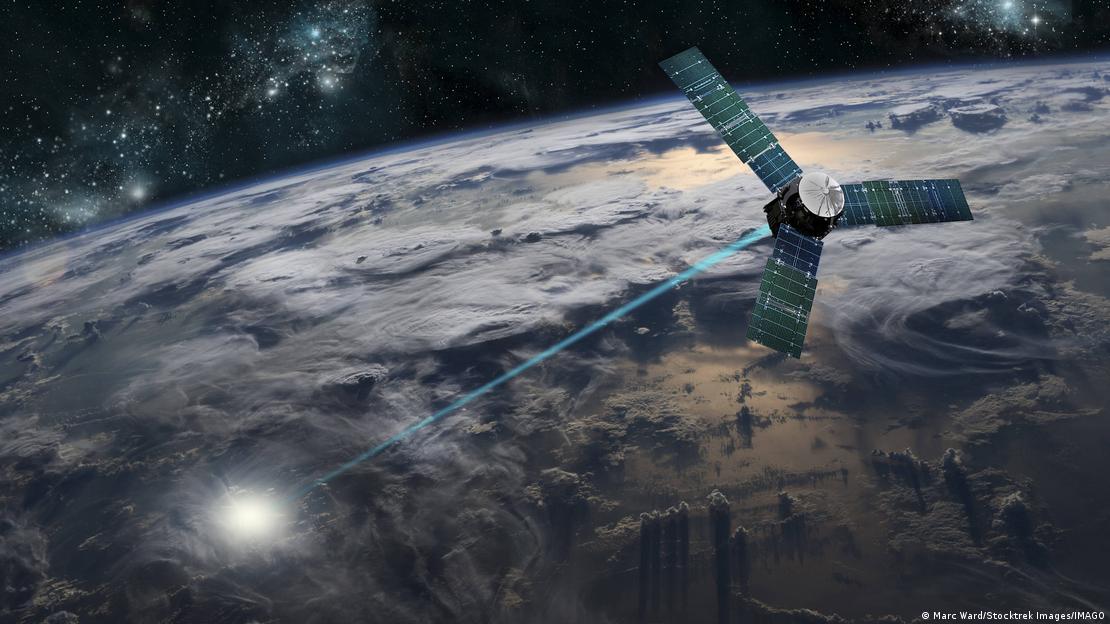
Space weapons could radically change the current power balance: simulation of a satellite firing a space weapon at a target on the Earth's surface
Image: Marc Ward/Stocktrek Images/IMAGO

What is crucial for successful deterrence, Süß said, is above all credibility.

"To what extent such an ambitious and oversized project as this space carrier is actually credible is an entirely different question."

It is precisely in this gray zone that Luanniao aims to strike — an outsized threat that is politically useful long before any metal parts are ever assembled.

Kreft calls the project "humbug, psychological warfare," while at the same time sounding a warning against being deceived by it.

China, he says, is working "on all conceivable future projects and weapons systems," for example in the field of lasers, where Beijing "appears to be further ahead than anyone else."

This article was originally published in German.

Alexander Freund Science editor with a focus on archaeology, history and health@AlexxxFreund

An undying trend: How vampires hold a mirror to society

Sarah Hucal
DW
January 31, 2026

As the horror movie "Sinners" stands poised to sweep the Oscars, we take a look at how and why the vampire genre has long captivated audiences — from folklore to film. Is this trend truly immortal?

The vampires in 'Sinners' highlight the social and racial violence in the 1930s US
Image: Collection Christophel/picture alliance

In the run-up to the Oscars on March 15, all eyes are on Ryan Coogler's "Sinners," nominated for a record-breaking 16 Academy Awards.

The horror film, set in the early 1930s southern United States, follows twin brothers who return to their hometown, hoping to start over by opening a place for the African American community amid the pressures of Jim Crow-era life.

As the opening night unfolds, the celebration reveals that the brothers and their community are being targeted by vampires.


Alongside the monsters, the story highlights the social and racial violence of the period, suggesting that the supernatural horror mirrors very real historical fears.

That's exactly what the vampire has been doing for years: The figure represents the concerns of any given society. This role is crucial to understanding why the vampire holds an undying role in pop culture.

A popular folkloric figure


Vampire-like figures have long existed in myth, folklore and religion. There were stories of blood-drinking demons in Mesopotamia. In ancient Greek and Roman mythology, the "strix" was a bird of ill omen associated with feeding on blood. Hindu mythology described the "vetala," a spirit inhabiting corpses.

Later, vampires appeared in Slavic and Balkan folklore, featuring some of the characteristics we have come to associate with the blood-thirsty monster nowadays: reanimated corpses that easily fell prey to stakes, sunlight and, of course, garlic.

The first vampire to make an appearance in English literature was in John Polidori's 1819 short story "The Vampyre," embodied by the aristocratic Lord Ruthven.

It was then followed by the most famous vampire in literature, via Bram Stoker's 1897 novel "Dracula," which solidified the vampire's place as a true Gothic-era monster.

Vampires hit the big screen

The vampire craze reached new levels with the advent of film. There have been hundreds of movies featuring the bloodsucking count, making him, according to some sources, the most portrayed literary character in films after Sherlock Holmes.

The reasons for this are manifold, spanning from our obsession with achieving the impossible — immortality — to something perhaps even more disconcerting.

"Vampires endure because they're the monsters that look most like us. They act most like us — they're greedy and destructive," says Sorcha Ni Fhlainn, a professor of film studies at Manchester Metropolitan University in the UK, who has focused extensively on vampires in cinema and literature.

"Although we know roughly what they look like, they're always changing, depending on the story they're serving and sometimes the national mood in which we find the film has been released," she told DW.

Werner Herzog's 1979 "Nosferatu" is an example of film meditating on the national mood in Germany at the time, the scholar points out. The Herzog film — which features a vampire who moves to a rural village to buy real estate — is a reflection on the postwar period and the horror of the Holocaust in Germany.

Werner Herzog's 1979 remake of the 1922 film 'Nosferatu' is a meditation on the state of postwar Germany
Image: Everett Collection/Everett Collection/picture alliance


Vampires take over the US


In the current context of political and societal upheaval in the United States, it's not difficult to see why these creatures might strike a chord at the moment — and it's not the only period in history.

The 1970s, says Ni Fhlainn, were "a very Dracula-heavy decade — the one where we have the most condensed versions of Dracula — Dracula on stage and many Dracula films."

It was also a decade of extreme social upheaval. The US was rocked by the Watergate scandal and constitutional crises, while nationalist parties were on the rise in Europe. Meanwhile, vampires were seemingly everywhere in pop culture, their characters changing to reflect the zeitgeist.

'Dracula A.D. 1972' updated the myth by bringing Count Dracula to London's hippy scene
Image: TBM/United Archives/picture alliance

In the early 1970s, the scholar says, Dracula was typically played by an older man, "representing this order of elder businessmen and powerful people; an older way of looking at the world," as in films like "Dracula A.D. 1972."

By the end of the decade, a younger, sexier Dracula emerges, such as in Anne Rice's 1976 novel "Interview with the Vampire."

The figure of the vampire then becomes explicitly sexualized in the novel's film adaptation, starring Tom Cruise, and the "True Blood" series, for example.

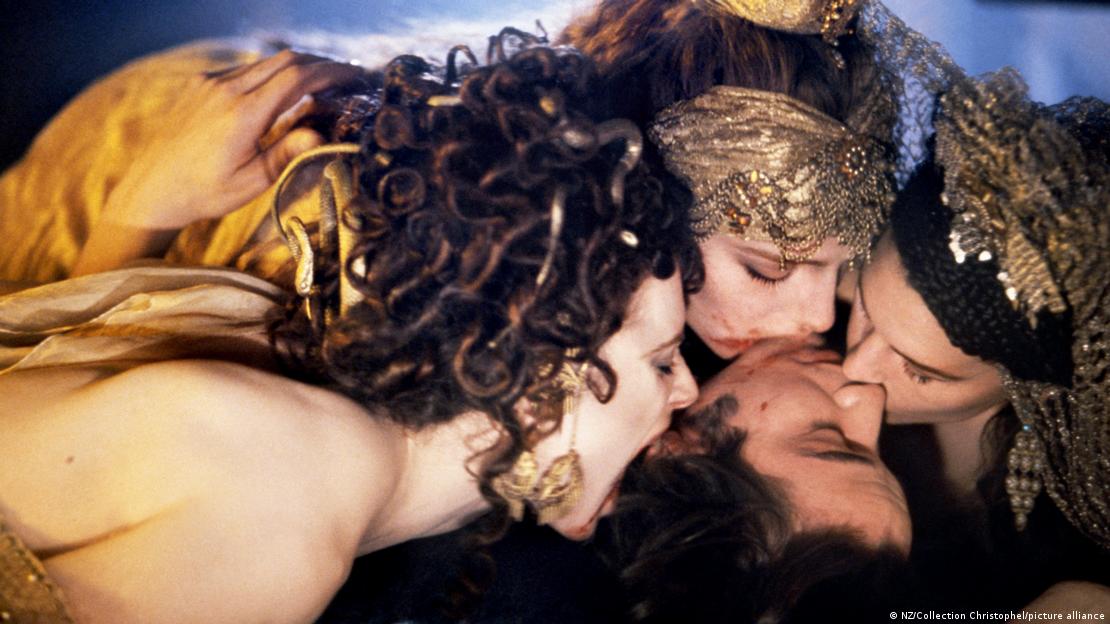
Vampires and sexuality go hand in hand in many films and series, such as in Francis Ford Coppola's 1992 'Dracula'
Image: NZ/Collection Christophel/picture alliance

The introspective vampire

The trend of the vampire as a seductive figure — and one which is fallible, introspective and even seeking to hide his true identity from the outside world — becomes increasingly apparent in the post-Cold War period.

"Vampires tended to go inward and look at their society, their group — almost like a national context of reexamination of who we are, where we're going," points out Ni Fhlainn.

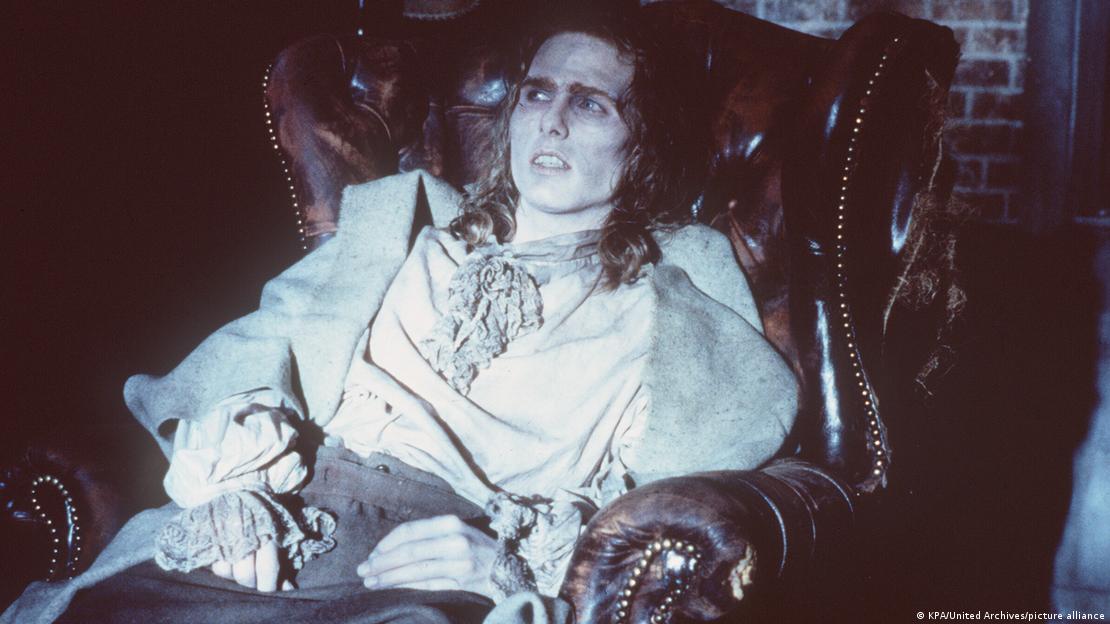
Catholic guilt is one of the themes behind the 1994 film 'Interview with the Vampire,' starring Tom Cruise as an introspective vampire
Image: KPA/United Archives/picture alliance

Vampire stories give us a way to touch on aspects of power dynamics and inequality, giving opportunities to discuss those topics through the language of symbolism and fantasy, adds the scholar.

"I think sometimes we can't approach things head on; we have to be a little bit oblique in order to actually talk about the serious stuff that happens in our world because it's too heavy otherwise," she says. "Vampires give us that lovely opportunity to unpack it all."

Edited by: Elizabeth Grenier


Sarah Hucal Freelance Multimedia Journalist
Turkey's textile industry in crisis

Elmas Topcu
DW
February 1, 2026

Shuttered factories and lost jobs: Turkey's textile industry is fighting for its life. Exports are dwindling as China and Bangladesh conquer EU markets. Those affected say they don't have much hope for the future.

The textile and clothing industries are key to the Turkish economy, but 4,500 businesses in the sector ceased operations in 2025
Image: Ozan Kose/AFP/Getty Images

It is a bitterly cold winter's day in the central Anatolian Turkish city of Tokat. The thermometer says it's -3 degrees Celsius (27 degrees Fahrenheit).

Sunduz Akkan, a mother of three, bundles up and heads to the Sik Makas factory where she worked until October.

The plant's roughly 1,700 employees stopped getting their paychecks in mid-2025. On October 7, workers went on strike. But that resulted in shock, not resolution: The very next day, 1,000 Sik Makas employees received text messages informing them that they had been fired.

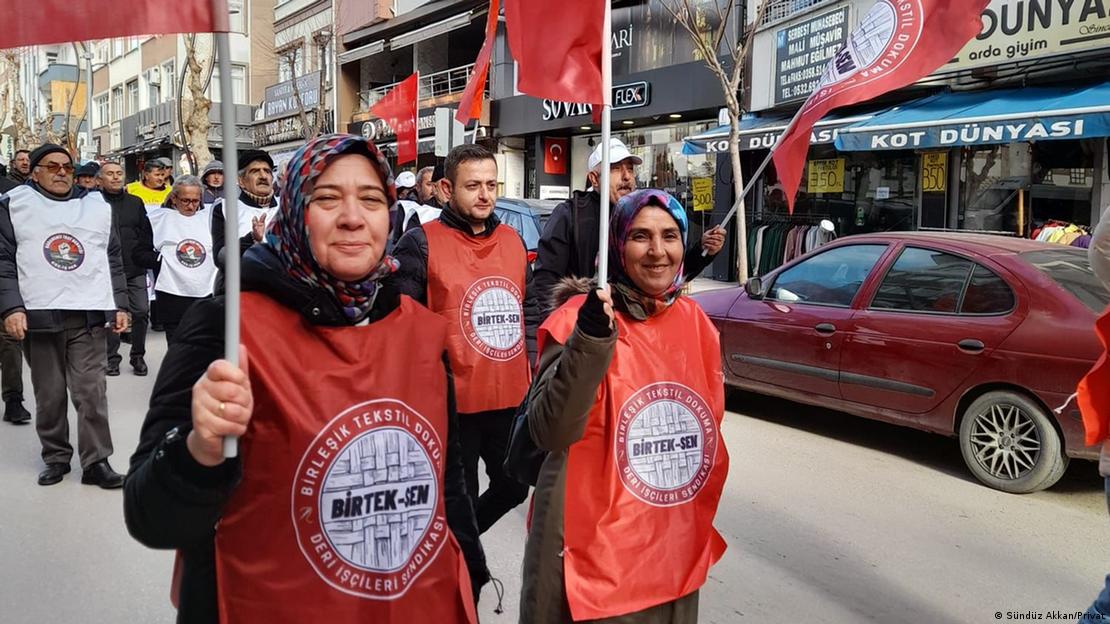
Sunduz Akkan and her colleagues have been protesting at the gates of their former employer ever since. In a solidarity tent at the site, they attempt to draw attention to their precarious situation.

Their tenacity has paid off in part. In January, they finally received their back pay.

Moreover, they have won the right to corrections that remove the remark "Code 22" as the reason for their termination in work records.

Code 22 stands for "other reasons," and employees fired under this code are ineligible to receive unemployment or severance pay. Now, the dreaded distinction has been wiped away thanks to pressure from protesters.

But the fight goes on: Ex-employees are still fighting for their severance pay.

"I worked here for over three years," says Akkan. "Now we're being treated like beggars, even though we're just asking for what we're entitled to."


Sunduz Akkan and her fired colleagues are now fighting for severance pay
Image: Sündüz Akkan/Privat


Pressure to perform in precarious workplace conditions

Buse Kara, the group's spokesperson, was one of those fired in October. Shortly after than, she was put under investigation for allegedly insulting Turkish President Recep Tayyip Erdogan.

After 16 days under house arrest, she is now once again at the protest's front line.

When describing the company, Kara speaks of a climate of workplace harassment and intense pressure to increase productivity. Recently, the company decided to limit toilet breaks to five minutes and prayer breaks to 10.

"We weren't allowed to see a nurse unless we were passed out or writhing in pain," she says.

Sik Makas denied the accusations in a reply to a DW request for comment. The company's written response explained that all of its actions were in compliance with Turkish law as well as with labor union regulations.

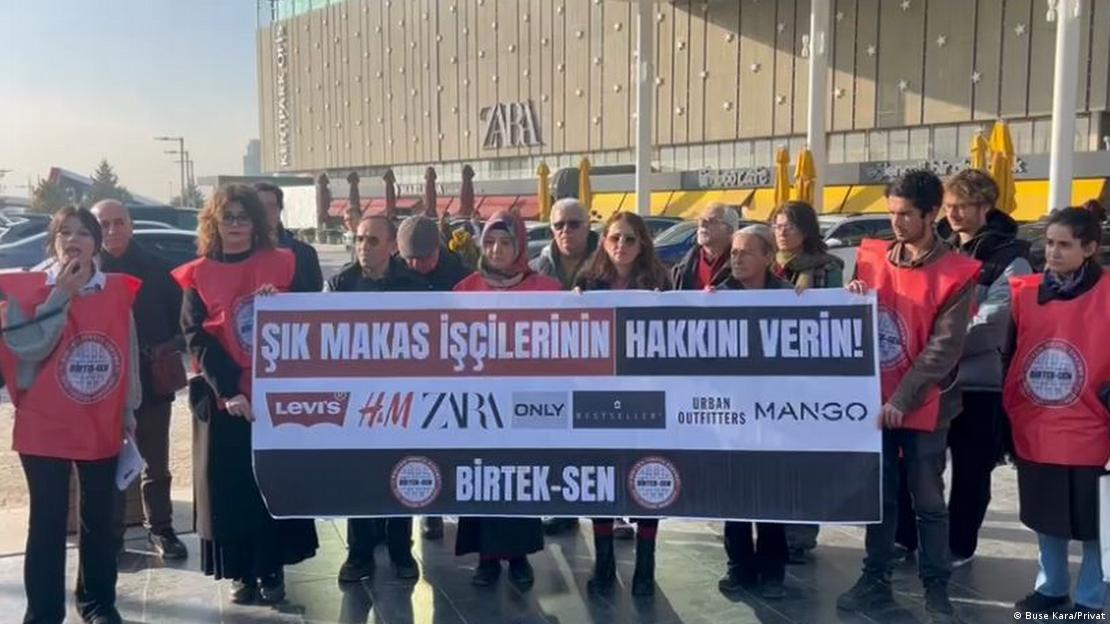
Calling out companies: Fired workers who produced for major brands such as Zara are demanding the terms of their contracts be honored
Image: Buse Kara/Privat

Founded in 1939, Sik Makas is one of Turkey's 500 largest industrial businesses. The company says it exports some 20 million denim products each year, mainly to Europe.

Brands like H&M, Jack & Jones, Levi's, Only and Zara have their products made here. Moreover, the company produces its own in-house brand, Cross Jeans, which it sells in Germany, Poland, the Czech Republic and other countries.

Despite that heft, Turkey's raging inflation and high interest rates have put Sik Makas under pressure. That's why the company, like many of its competitors, has moved some operations to Egypt, where it is cheaper to produce.

Structural crisis in a key industry

Traditionally, the textile and clothing industry has been one of the pillars of the Turkish economy and a source of income for hundreds of thousands of families.

Official statistics say about 1.1 million people work in the sector. But unions say the number is actually far higher because it doesn't include the many refugees, women and children working off the books.


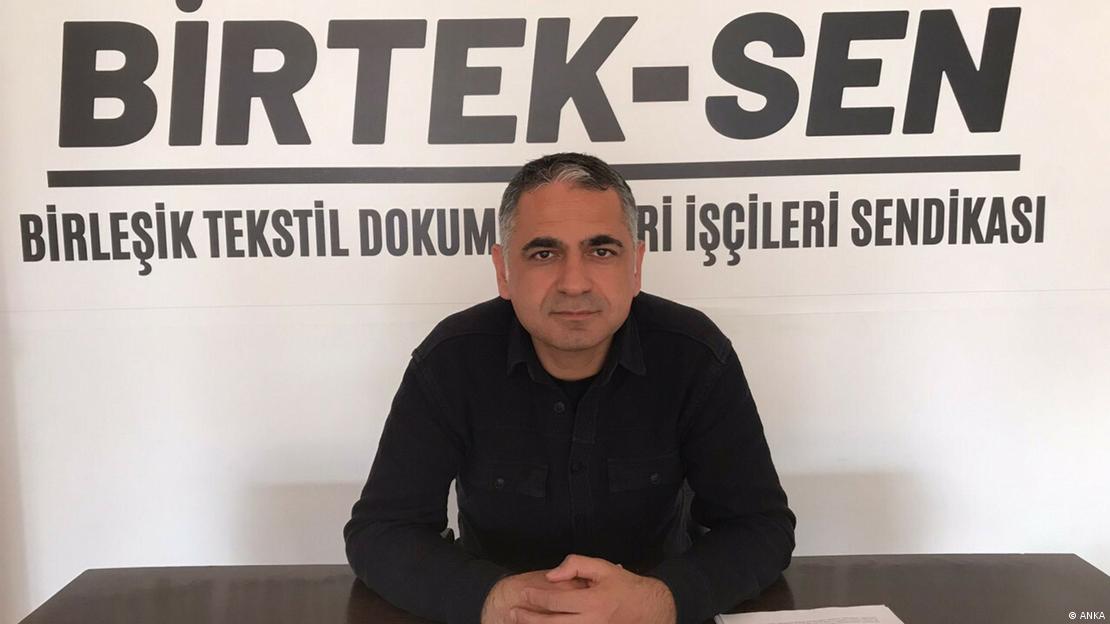
Mehmet Turkmen, leader of the BIRTEK-SEN union, criticizes companies' strategies to save money
Image: ANKA

Mehmet Turkmen, leader of the BIRTEK-SEN union, stresses that jobs in the industry are already almost exclusively minimum wage, which means workers' monthly wages are currently below the poverty line for a family of four (€650, $776). Unpaid overtime and holiday shifts are standard.

Turkmen is also critical of the fact that a growing number of companies are moving into rural parts of the country in order to cash in on government largesse. The union boss says moving allows them to push down wages further still because of high unemployment in such regions.

Massive market share loss in the EU

While companies complain about the high cost of raw materials and rising production costs, raw numbers illustrate the scale of the crisis: 380,000 jobs have been lost over the past three years and 4,500 companies shut down in 2025 alone.

The most alarming developments are happening on the sector's most important market: The European Union's single market.

Turkish exports to the EU collapsed as imports of goods from China and Bangladesh exploded.

According to the Istanbul Textile and Raw Materials Exporters Association (ITHIB), EU imports of Chinese goods rose 21.8% between January and May of 2025, while imports from Bangladesh rose by 17.9%.

At the same time, imports from Turkey — the third-largest exporter to the bloc after China and Bangladesh — sank by 5.1%.

Of the EU's 10 biggest suppliers, only Turkey and Tunisia lost market share. With more than 60% of Turkish clothing production destined for the EU single market, that kind of loss is existential.

2025 marked the first time in 30 years that Turkey's market share in the EU's clothing and textile sector fell below 5% and the first time in 35 years that their share on global markets fell below 3%.
Pessimistic outlook

Seref Fayat, head of apparel and ready-wear assembly at the Union of Chambers and Commodity Exchanges of Turkey (TOBB), forecasts a dark future. He sees no chance of improvement as long as the government continues its attempts to artificially prop up the lira by intervening in currency markets.

President Erdogan has promised to raise state subsidies in the sector to 3,500 lira per worker (about €69), as well as taking steps to freeze layoffs and foster hiring, but employers say that's not nearly enough.

Mustafa Pasahan, Vice President of the Istanbul Apparel Exporters Association (IHKIB) urgently warns: "We have hit bottom. Our strength has run out."

The chari of ITHIB, Jak Eskinazi, is even more blunt, criticizing the government's current political course as destructive to the industry.

"We no longer expect anything from them. We're just trying to save ourselves," he said.

This article was originally published in German.


Elmas Topcu Stories on Turkey, German-Turkish relations and political and religious groups linked to Turkey.

Philippines: Are terror laws being used to silence critics?


Chantal Eco in Tacloban City
DW
February 1, 2026

Journalist Frenchie Mae Cumpio's conviction on terror-financing charges has raised concerns over press freedoms in the Philippines, where activists warn that anti-terror laws are being wielded to clamp down on dissent.


The Committee to Protect Journalists (CPJ) slammed Cumpio's guilty verdict as 'absurd'
Image: Jam Sta Rosa/AFP

The recent conviction of community journalist Frenchie Mae Cumpio has intensified concerns in the Philippines about how counterterrorism laws are being applied, particularly their impact on critical journalism and civic dissent.

After nearly six years in detention awaiting trial, Cumpio was convicted on January 22 of financing terrorism and sentenced to 12 to 18 years in prison. She denies the charges.

Legal experts and activists say the decision illustrates how broadly framed terror laws are being weaponized against journalists, development workers and civil society groups.

"It's a travesty of justice that Frenchie was sentenced. This specific charge, financing terrorism, has been used to target activists and journalists like Frenchie," Aleksandra Bielakowska, advocacy officer at Reporters Without Borders (RSF), told DW.

Bielakowska said the ruling risks setting a worrying precedent for the wider use of terrorism financing charges, noting that other journalists in the Philippines are already facing similar accusations.

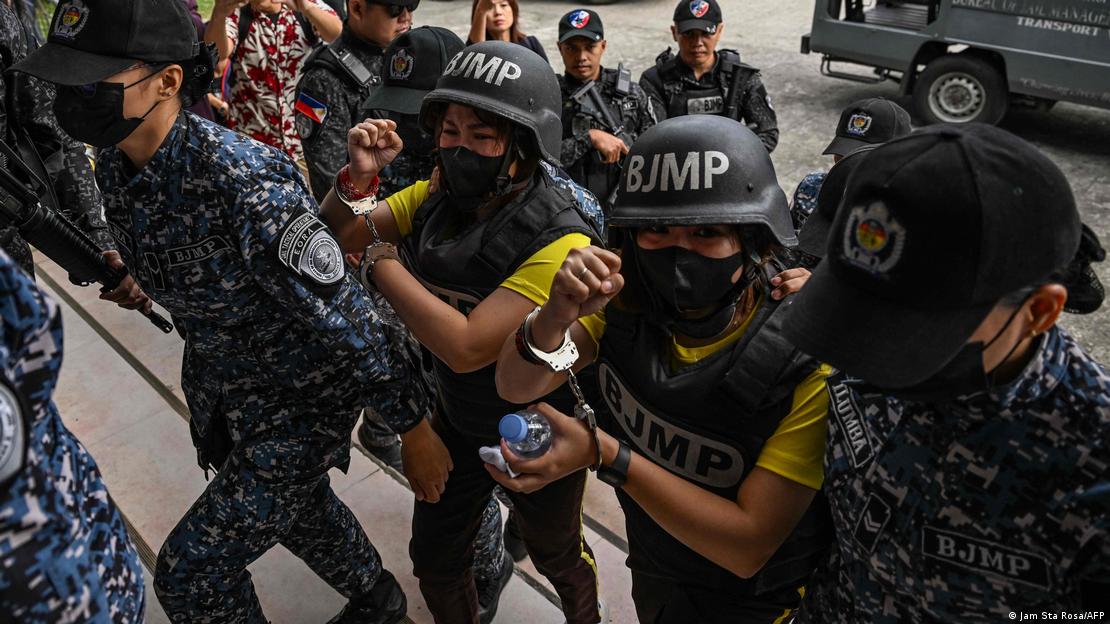
Cumpio and her former roommate Marielle Domequil were held for nearly 6 years without trial
Image: Jam Sta Rosa/AFP


A conviction built on testimony rather than evidence

In its ruling, the regional trial court in Tacloban City said it found Cumpio and her co-accused, lay worker Marielle Domequil, guilty of making funds and logistical support available to members of the New People's Army, the armed wing of the Communist Party of the Philippines, which was designated as a terrorist group by the local Anti-Terrorism Council.

The prosecution's case was built entirely on witness testimony.

"There was no other evidence presented by the prosecution against Frenchie and Marielle except testimonial evidence," said Julianne Agpalo, who is part of Cumpio's defense team.

"There is no documentary or photographic evidence. It's based on these self-serving testimonies of these military assets whose credibility in the first place should be questioned," Agpalo added.
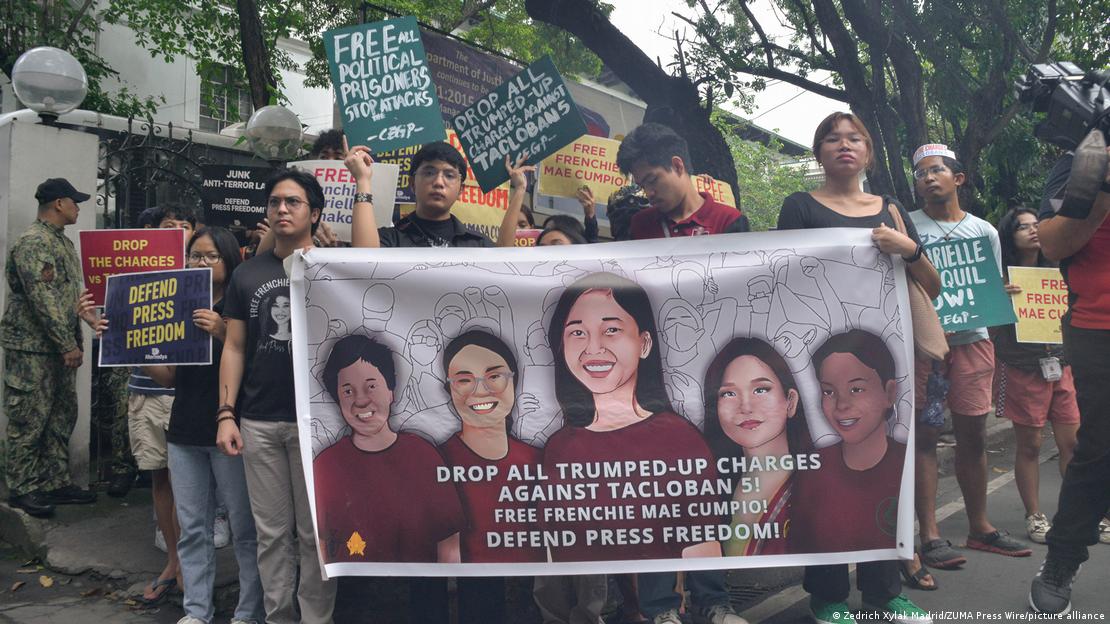
Cumpio and Domequil were arrested along with three others, who became known as 'The 'Tacloban five'
Image: Zedrich Xylak Madrid/ZUMA Press Wire/picture alliance


'A pattern that undermines due process'


Attorney Josalee Deinla, secretary-general of the National Union of Peoples' Lawyers (NUPL), told DW that such over-reliance on questionable witness testimony is not unique to Cumpio's case.

"What we are seeing is a pattern where terrorism financing cases are not built on financial trails at all, but almost entirely on testimonial evidence," she said.

"This reliance on testimonial evidence, especially from incentivized witnesses, seriously undermines due process," Deinla added.

She explained that these witness testimonies usually come from so-called "rebel returnees" — former members of armed groups who later surrendered to the military under government reintegration programs — who Deinla said function as military assets.

In the same region as Cumpio, development worker Jasmin Jerusalem is facing terrorism-financing charges linked to humanitarian work in Leyte and Samar provinces. Journalist Deo Montesclaros has also faced a terrorism-financing complaint tied to his reporting on armed conflict and community issues.


'Politically motivated prosecutions'


The frequency of such cases has spiked significantly in recent years.

Last year, the Department of Justice said it identified a total of 5,557 terrorism financing cases filed between 2020 and 2024, a period that coincided with the Philippines' push to be removed from the Financial Action Task Force (FATF) "grey list" — a goal the country achieved in February 2025.

For years before the grey-listing, there were very few prosecutions and convictions for terror financing offenses, despite the introduction of the Terrorism Financing Prevention and Suppression Act in 2012.

Human Rights Watch (HRW) says many of these cases rely on "flimsy" evidence from potentially compromised witnesses that the police and military in the Philippines have used for years in "politically motivated prosecutions" of journalists, religious workers and leftist defenders of human rights, environmental and indigenous causes.

HRW also alleges that successive national governments have been known to accuse people of being members or of sympathizing with communist insurgents, a tactic known as "red-tagging."

The NUPL, which has represented many alleged victims of red-tagging, accuses the Justice Department of the "weaponization of terror laws to unjustly target activists and civil society organizations" to meet the FATF's quotas.

"There is pressure on the government to show compliance with counter-terrorism financing standards and one way of doing that is by filing more terrorism-financing cases," Deinla told DW.

Deinla said this compliance-driven approach has encouraged the aggressive use of terrorism-financing laws, even in cases where evidence is thin or largely testimonial.


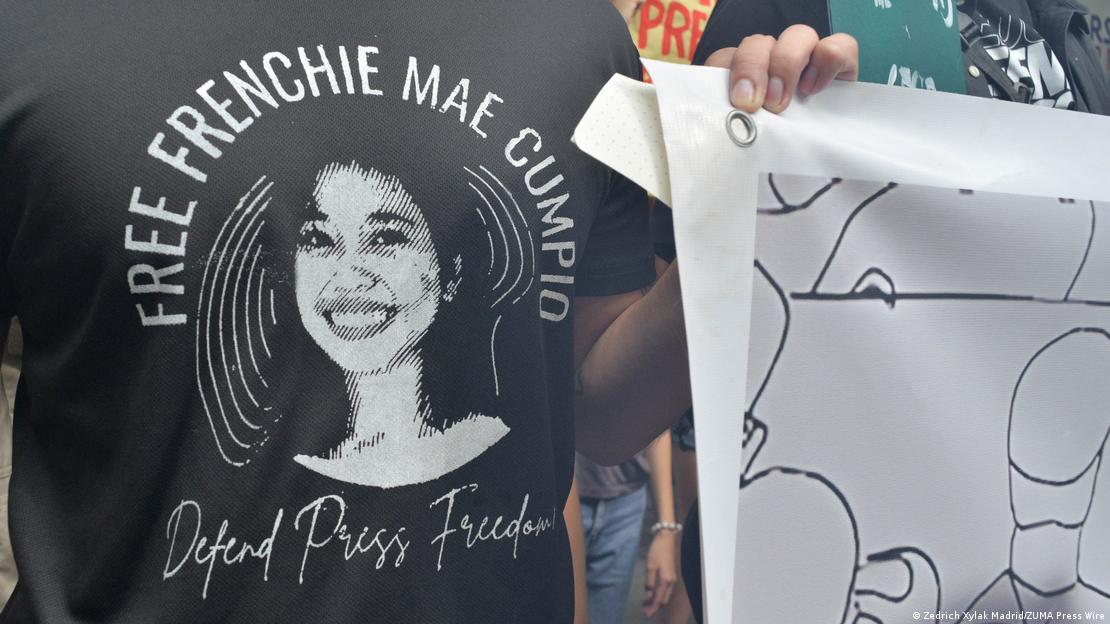
Activists and rights groups have been calling for Cumpio's release for years
Image: Zedrich Xylak Madrid/ZUMA Press Wire


Crackdown initiated under Duterte continues under Marcos Jr.

Cumpio and Domequil were arrested in February 2020, at the height of the administration of Rodrigo Duterte, a period marked by intensified red-tagging, surveillance, and arrests of activists, journalists and human rights defenders as part of the former president's notorious "war on drugs."

The crackdown coincided with the passage of the Anti-Terrorism Act of 2020 and the expanded use of terrorism-financing provisions.

According to Rochelle Porras, spokesperson for the Council for People's Development and Governance, a network of civil society organizations in the Philippines, there has been little indication that this approach has changed under Duterte's successor, Ferdinand Marcos Jr., despite official statements emphasizing press freedom and democratic reform.

"The same counterinsurgency framework is still in place. The institutions, the policies and the mindset that enabled these cases under Duterte remain largely intact," Porras told DW.

Porras added that this continuity helps explain why terrorism-financing cases continue to be filed years after the initial crackdown, even as the government has sought to rebrand its human rights record.


Climate of fear

For journalists and civil society groups, the impact of terrorism-financing cases is felt well beyond the courtroom.

At the University of the Philippines Tacloban College, the student publication UP Vista — where Cumpio once served as editor-in-chief — has operated under a climate of fear since her arrest.

"The fear was there, that they might come after our names because of what we release," current editor MJ Vediola told DW, adding that it stalled the publication of their activist-themed issue for a year.

The editor said recruiting new staffers has become harder due to the risks associated with the publication.

Vediola said that while Cumpio's conviction has forced them to rethink their approach to reporting, the case underscores the importance of continuing to document issues affecting their communities.

"It motivated us to publish beyond what we normally would, because if we don't write about cases like this, then silence wins," said Vediola.

Civil society organizations face similar constraints, according to Porras.

"The freezing of bank accounts is usually the first blow. It immediately paralyzes an organization's ability to function, even before any guilt is established," she said.

UN special rapporteur Irene Khan said the charges against Mae appeared to be a "retaliation for her work as a journalist"
Image: Jam Sta Rosa/AFP


What does this mean for democracy in the Philippines?

Beyond disrupted operations, Porras warned of broader consequences.

"When civil society groups are silenced, communities lose access to information and services," she added.

Deinla said cases like Cumpio's send a message that critical reporting can be treated as a security issue, affecting not just the accused journalist but the wider media community.

"The effect is not limited to one person. It changes how others assess risk," she said.

According to Deinla, such cases reduce civic space by discouraging scrutiny and participation, weakening accountability and, over time, affecting how democratic institutions function.

Edited by: Karl Sexton
The hidden money behind deep-sea mining

DW
January 31, 2026

A DW investigation traces the hidden financial web behind deep-sea mining — an industry scientists say remains poorly understood, yet capable of causing irreversible harm to oceans worldwide.


The deep sea is home to a vast number of unknown species but could also be a future source of critical minerals
Image: Kim Jens Bauer/PantherMedia/IMAGO


More than 20 financial institutions worldwide have publicly vowed not to finance deep-sea mining — an activity scientists say could cause irreversible harm to ocean ecosystems. However, a DW investigation has found that some have invested at least $684 million (€581 million) in companies linked to the industry.

Hundreds of millions of dollars are flowing into companies racing to extract nickel, cobalt, and copper for batteries and other industrial uses from deposits buried thousands of meters below the ocean surface — an environment where scientific knowledge remains limited. Less than 0.001% of the seafloor has been explored.

Among the investors are some of the world's largest financial institutions — including Deutsche Bank, UBS, Credit Suisse, Credit Agricole and BNP Paribas — according to DW's analysis of company filings compiled by Greenpeace Germany's investigation unit.

Banks invested in deep-sea mining industry

UBS AG

$164,777,396

$222,113,261

The Goldman Sachs Group, Inc

$161,166,771

$219,623,226

Credit Agricole Group

$99,639,890

$101,189,595

Deutsche Bank AG

$62,387,989

$67,610,238

BNP Paribas SA

$50,598,541

$58,663,438

Credit Suisse Group AG


The investments come as the United States pushes to advance deep-sea mining as a future source of critical minerals. At the same time, some 40 countries have already announced a moratorium on the practice, arguing the environmental risks for these critical ecosystems need to be properly assessed.

The deep sea is "home to incredible life that is fragile, yet essential to the planet," Diva Amon, a marine biologist and scientific advisor at the University of California, told DW. "We don't yet understand what we're planning to destroy, and once it's gone, we can't bring it back."

'It's greenwashing' — when pledges and investments diverge

When contacted by DW, Deutsche Bank and Credit Agricole said their commitments apply to financing specific projects, not to investments in companies. Critics argue this distinction allows banks to avoid directly funding individual seabed-mining operations while continuing to invest in companies preparing to mine — akin to refusing to finance an oil drilling site for climate reasons but still buying shares in the drilling company.

The other banks did not respond to DW's questions.

"It's greenwashing," said Mauricio Vargas, a former investment strategist turned financial expert at Greenpeace. "Banks want to avoid negative PR related to environmental controversies."

Vargas added that banks often rely on technicalities and small-print exceptions, counting on the public not fully understanding the implications of their investment policies.

Andy Whitmore of the Deep-Sea Mining Campaign said the gap between banks' public commitments and their investments often reflects internal incentives.

"Their policies are carefully worded," he said, adding any commitments are often made in good faith, "but there are pressures within banks to invest in areas deemed as potentially profitable, and/or mis-sold as profitable." Accordingly, commitments are not always applied uniformly across large institutions.

But some banks, such as one of Norway's largest financial groups, Storebrand, have managed it. DW found the group recently divested millions of dollars from companies linked to deep-sea mining.

A Storebrand spokesperson told DW the decision followed the precautionary principle, which prioritizes avoiding harm in the face of scientific uncertainty.

"Storebrand will not invest in companies involved in deep-sea mining until we have more scientific knowledge on the impacts of these activities," they said.
When green commitments contradict short-term incentives

Goldman Sachs, on the other hand, has no public policy opposing deep-sea mining. Still, the Wall Street giant markets itself as a leader in environmental, social and governance (ESG) investing.

DW found it holds €187 million in stakes across companies enabling deep-sea mining. The company did not respond to requests for comment.

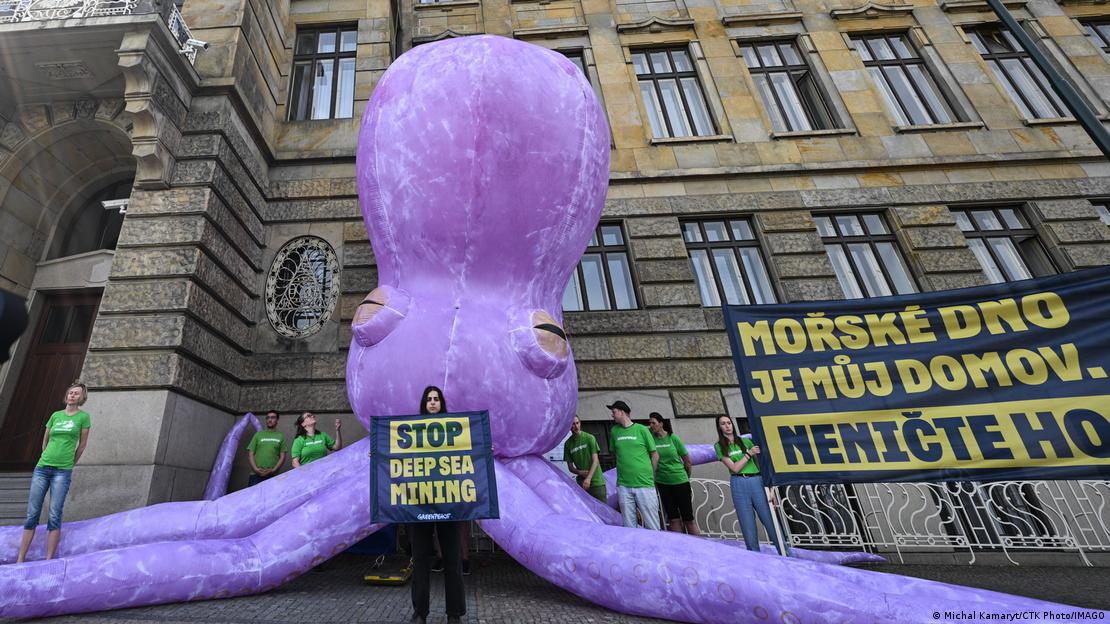
Experts say the public could pressure governments to divest pensions from companies linked to deep-sea mining
Image: Michal Kamaryt/CTK Photo/IMAGO

"Goldman Sachs is one of the biggest wealth managers in the world, and what it does matters," said Tariq Fancy, former chief investment officer for sustainable investing at BlackRock, which manages around $10 trillion in assets.

"It's much cheaper to paint yourself green than to actually be green," Fancy added. With time frames for high returns "the shortest they've been in decades," he said, many CEOs operate on five-year timelines, making it rational to "squeeze every last penny and then use philanthropy as reputation laundering."

While ESG can "make differences at the edges," Fancy said, "the real change has to come from political reform and stronger regulation."

Taxpayer money flowing to private deep-sea mining companies

DW also analyzed investment data compiled by a Washington-based nonprofit, the Anti-Corruption Data Collective (ACDC). The analysis found that taxpayer money from countries that officially support a precautionary pause on seabed mining was invested in companies linked to the industry.

Retirement savings are also on the hook. The Triton IV private-equity fund draws money from public pension funds across Europe and Canada, even as the governments behind it publicly oppose deep-sea mining. The fund managed subsea firms DeepOcean and Adepth Minerals until spring 2025 before selling the group to a new Triton-managed investment entity.


Public pension exposure to deep-sea mining despite moratoriums

Table with 3 columns and 8 rows. (column headers with buttons are sortable)
California Public Employees' Retirement SystemUS$101.11 million
California State Teachers' Retirement SystemUS$67.40 million
Greater Manchester Pension FundUK$19.76 million
Local Pensions PartnershipUKNot disclosed
Pensioenfonds PNO MediaFRNot disclosed
Industriens PensionsforsikringNRNot disclosed
Sjätte AP-fondenSWDNot disclosed
(divested in 2022)
CPP Investments (Canada Pension Plan Investment Board)$263 million
(divested in 2022)


Triton disputed the characterization, saying that DeepOcean is not a seabed-mining company and that its investment in Adepth Minerals is limited, regulated and not central to its strategy.

For Whitmore, accountability is the most effective way to push for change — especially for pension funds. "They invest on behalf of the public for the future," he said, adding that they must therefore take the potential environmental risks of deep-sea mining seriously.

"It is important for pension funds to join the growing number of financiers and insurers who are excluding deep-sea mining," he continued. So far, no pension funds have made such a pledge.

Some governments are drawing firmer lines, though. Norway, a country with several companies positioning themselves to mine the deep sea, has agreed not to issue mining licenses in its national waters until at least 2029. At the same time, 40 countries now support moratoriums or precautionary pauses on mining in international waters amid uncertainty about how it could affect marine life.

 Polymetallic nodules found on the ocean floor

Chemical composition in percentage


Most deep-sea species haven't yet been discovered


"The deep sea is one of the most biodiverse places on the planet," said marine biologist Diva Amon, who has led deep-sea research expeditions around the world. Far below the surface of the Pacific, Amon has seen sharks glowing in perpetual darkness and corals that are thousands of years old. But many deep-ocean species remain largely unknown to humans.


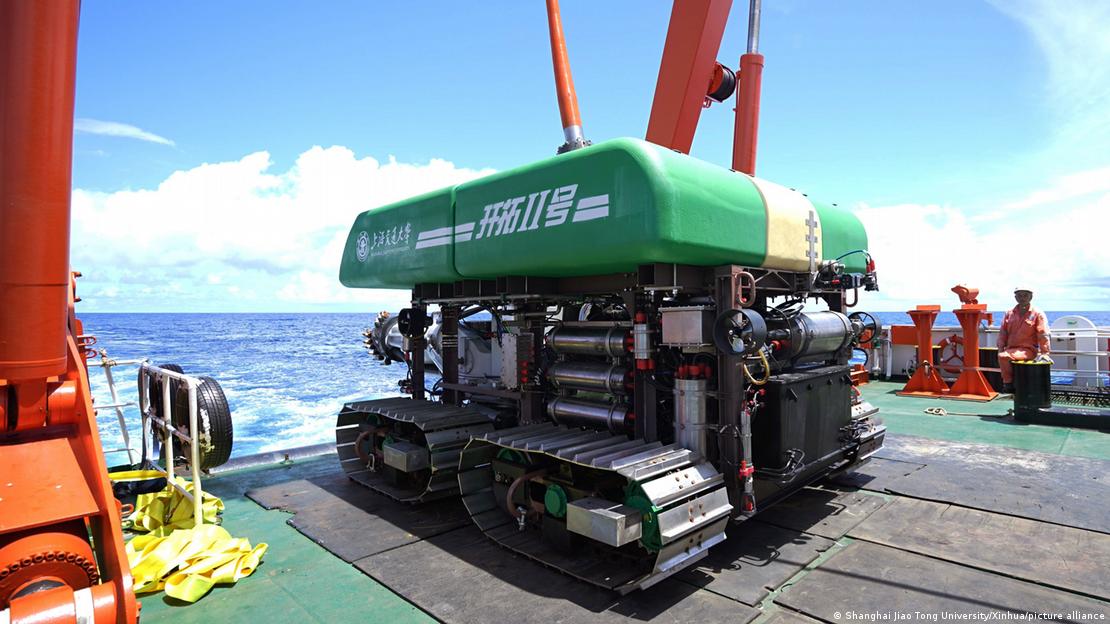
Millions of dollars are flowing into companies preparing to mine the deep sea despite the potential environmental risks
Image: Shanghai Jiao Tong University/Xinhua/picture alliance

"About 90% of deep-sea species still lack formal names," Amon said, adding that removing polymetallic nodules — potato-sized rocks containing many of the critical metals targeted by mining companies — could cause irreversible damage on million-year timescales.

Peter Thomson, UN Special Envoy for the Ocean, called for a 10-year moratorium on deep-sea mining to allow science to catch up and protect the "common heritage of humankind." The UN's finance initiative has also said there is "no foreseeable way" that financing the practice can align with the sustainable use of the ocean.

Early evidence from trial operations has reinforced those warnings. A recent study funded by leading deep-sea mining firm The Metals Company (TMC) found that test mining in the Pacific reduced seafloor abundance and biodiversity by more than a third.


But scientists say the risks extend beyond biodiversity loss. Some deep-sea microbes are already used in medicine, including enzymes for SARS-CoV-2 PCR tests and compounds now being studied in cancer trials. Mining could eliminate similar organisms before they are even identified.

"There is still so much the science doesn't know when it comes to the deep sea," Amon said. "If more people knew about its wonders, we wouldn't even be talking about mining it."

Edited by: Anke Rasper

The reporting for this investigation was supported by a grant from the Investigative Journalism for Europe (IJ4EU) fund.


Serdar Vardar Reporter working for DW's Environment desk.https://twitter.com/SerdarVardar_


China eyes reshaping global order as US influence wanes

Yuchen Li in Taipei
DW
February 1, 2026

As the Trump administration pulls the US back from international institutions, China is stepping up its diplomatic outreach while pursuing leadership roles in selected areas.


Beijing is seeking to portray itself as a responsible stabilizing power, especially contrasted with what it calls the US 'hegemonism'
Image: Wu Xiaoling/Xinhua/picture alliance


In January, the same month the United States announced its withdrawal from 66 multilateral organizations, China hosted leaders from Canada, Finland and Britain.

"The international order is under great strain," Chinese leader Xi Jinping told British Prime Minister Keir Starmer, calling for efforts to "build an equal and orderly multipolar world," as the two met in Beijing on January 29.

The message is not new in China's diplomatic rhetoric but has become more pronounced amid US disengagement from multilateral institutions.

The US is notably abandoning many initiatives focusing on climate change, labor and migration — areas President Donald Trump has characterized as "woke" initiatives "contrary to the interests" of the country.

At the same time, China remains a member of most of these multilateral organizations and is gaining broader global recognition.

A recent international survey found that respondents across 21 countries, including 10 European Union member states, expect China's global influence to grow over the next decade, according to the European Council on Foreign Relations.

"The power gap [between China and the US] was much clearer in the past… but now it's getting closer and closer," Claus Soong, an analyst at the Berlin-based Mercator Institute for China Studies (MERICS), told DW.

"The US is still the most powerful nation in the world, but China is catching up very quickly."

China's efforts to gather support from Global South

The Global South, which encompasses developing and emerging economies around the world, has long played a central role in China's global strategy. One of the most visible efforts is China's Belt and Road Initiative (BRI), launched in 2013 as a vast infrastructure investment program to expand the country's influence across Asia, Africa, Europe and Latin America.

"A leader needs followers to support or to justify its leadership," Soong said, adding that support from Global South is "the breaking point" for China in the face of Western containment.

Earlier this year, China released a series of data pointing to economic resilience despite growing pressure from the United States under the second Trump administration. The figures include 5% economic growth in 2025 and a record trade surplus in the same year. The positive numbers were reportedly driven in large part by exports to non-US markets, particularly across Southeast Asia.

But China's strategy also comes with risks and limitations. In recent years, China has scaled back the BRI from large, capital-intensive infrastructure projects to smaller, more targeted investments as financial risks rise and partner countries worry about taking on too much debt.

"[The] economy is a key question. How sustained was China's economy? What else is China ready to give in to other countries?" Soong said.

Authoritarian coordination on the global stage

China's close ties with Russia and North Korea have also raised concerns about the impact of deepening authoritarian partnerships on the world stage.

Xi met with Russian and North Korean leaders during a military parade in Beijing last year, underscoring China's political and security alignment with the two neighboring nations.

Sabine Mokry, a researcher at the Institute for Peace Research and Security Policy at the University of Hamburg, said each of China's authoritarian partners serves a different purpose.

"The Chinese government is trying to assess what it can get from each regime," she said.

One tangible outcome of such coordination can be seen during the United Nations General Assembly. China has increasingly voted in alignment with its allies, particularly on human rights and Ukraine-related resolutions.

Still, Mokry noted that the partnership remains largely transactional, driven more by shared opposition to the US rather than by a value-based alignment.

"If there's an opportunity to portray the fact that they work together, they will obviously take it. But on real substance, there is still deep-seated mistrust," she told DW.

China not rushing to replace the US

China has been emphasizing a narrative in recent years that it is a responsible stabilizing power, particularly in contrast to what it calls the US "hegemonism."

But analysts believe Beijing's ultimate goal is not to replace the US-led world order with a Chinese version. Instead, the primary goal of the Chinese government appears to be to ensure that the Chinese Communist Party remains in power.

"It's not a take-over-the-world kind of ambition," Mokry told DW, emphasizing that China's motive "always has to be seen from the lens of regime survival."

She used Trump's first presidency, from 2016 to 2020, as an example, during which the US also withdrew from several international organizations. At the time, despite expectations that China would step in to fill the leadership vacuum, China largely refrained from claiming those positions.

Soong, the MERICS researcher, shared a similar view, saying that China is unlikely to assume leadership across all institutions the United States has exited, except where doing so aligns directly with its national security interests.

One example is China's influence within the World Health Organization, where Taiwan, the island China claims as its own territory, remains excluded. The US has repeatedly cited the exclusion of Taiwan, especially during the COVID-19 pandemic, as part of the reason for its withdrawal from the UN agency.

Pushing US out of Asia

Analysts argue that this selective engagement underscores China's broader aim: not to dominate the global system, but to reduce US influence in regions it views as strategically vital, notably the Asia-Pacific.

In recent months, China has intensified military activity around Taiwan and in the South China Sea, where tensions have flared with the Philippines over territorial claims from both sides.

"Beijing would be extremely pleased if they could just do whatever they want in Asia," said Mokry, adding that the US engagement in the region remains so "fundamental" that "it's not that easy to change."

Edited by: Srinivas Mazumdaru

Yuchen Li East Asia correspondent covering China and Taiwan
Let them eat steak? Experts roast inverted US food pyramid
DW
February 1, 2026

The United States has introduced a new food pyramid with significantly more meat, dairy and fat. Health and sustainability experts are alarmed.


Cardiologists warn that the new pyramid could increase the consumption of saturated fats and salt
Image: H.LEITNER/Zoonar/picture alliance


The United States has turned its food pyramid upside down — sending a signal far beyond supermarket shelves. That's because the new composition of the country's guidelines form the basis for government nutrition programs, from school cafeterias to the military to hospital food services.

US Health Secretary Robert F. Kennedy Jr. presented the new guidelines in January. They are visualized as an upside-down pyramid, with steak, chicken, cheese and dairy now occupying the broad base once held by grains.


The recommended protein intake has increased from 0.8 grams per kilogram of body weight each day to 1.2-1.6 grams per kilogram of body weight. That's nearly double the amount recommended by German guidelines and the World Health Organization (WHO).

The new pyramid is intended to combat widespread diseases such as obesity and diabetes by placing greater restrictions on sugar, soft drinks and highly processed convenience foods and encouraging Americans to cook more with fresh ingredients.

The change was justified with hundreds of pages of appendices referring to studies on protein requirements and the harm caused by ultra-processed foods.

Meanwhile, some old cornerstones remain, with fruit and vegetables still explicitly recommended.

Eating less sugar and processed food sounds reasonable, but the visible break lies less in what has been removed than in what has been upgraded: red meat, butter, full-fat cheese and beef tallow are being rehabilitated as part of a "real food" diet. This increases the risk of cardiovascular disease, certain cancers (especially colon cancer), metabolic disorders such as type 2 diabetes and overall long-term mortality.

Protein offensive

In American school cafeterias and other public institutions, the proportion of highly processed products is likely to officially decline, which is generally a welcome change.

Kennedy wants to end the "war on protein" and is selling the changes as a fight for "real food."

But experts warn that reducing the consumption of highly processed convenience foods is merely a pretext.

Many institutions will struggle to meet the new requirements due to budget pressures, staff shortages and supply chain issues. Truly fresh cuisine without frozen and convenience foods is hardly feasible at that scale.

Researchers warn against too much fat

Cardiologists warn that the new pyramid could increase the consumption of saturated fats and salt, both of which are key risk factors for cardiovascular disease.

Additionally, the new pyramid has logical flaws. A marbled steak and several whole milk products alone can exceed the limits for saturated fatty acids specified in the US guidelines. Nutritional science organizations complain that although there has been talk of diversity in protein sources, meat clearly dominates the chart.

The WHO, often criticized by the US President Donald Trump's administration, has remained quiet. Critical comments have come mainly from independent nutritionists and professional associations, who are worried about higher saturated fat intake, industry influences and environmental consequences, among other things.

Scientific independence in question

The German Nutrition Society (DGE) has also questioned the scientific basis of the US shift, criticizing that the US committee responsible for the new guidelines has largely conducted its work behind closed doors, while transparent consultations have been scaled back.

The DGE pointed to evidence from studies that show no additional health benefits from a permanently increased protein intake above the previously recommended 0.8 grams per kilogram of body weight per day. It also underscored that the American model doesn't systematically consider sustainability, that is, the the environmental and climate impacts of nutrition.

Instead, the new US pyramid primarily benefits the agricultural lobby and producers of animal-based foods, the DGE said.

The criticism is clear: the more politics is geared towards attracting votes and steak fans, the further it moves away from providing health advice based on reliable data.

This article was originally published in German.

Alexander Freund Science editor with a focus on archaeology, history and health@AlexxxFreund