Monday, February 09, 2026


Trump, Extreme Wealth Concentration, and Our Societal Crisis


The US government simply has not done enough to ensure that the livelihoods of all Americans are protected or improved in this new Gilded Age. What it has done is made sure the rich get richer by the minute and more politically powerful year after year.


John Ripton
Feb 09, 2026
Common Dreams

The decline of Keynesian economic theory in the 1970s marked a tipping point in the evolution of capitalism in the United States. Beginning with the Great Depression, Keynesian economic policy facilitated the expansion of social welfare programs to mitigate the social inequities of the nation’s economic system. In the last quarter of the 20th century, however, rising political conservatism targeted public expenditures for social services. Cuts in education and health, including reductions in social welfare programs and the weakening of the social safety network for the poor, were then and continue today to be goals of political conservatives. Conservatives, furthermore, argue that cutting taxes for the wealthy and corporations promotes investment, economic growth and job creation; and that smaller government and less regulation of market forces distributes wealth the most equitably. These ideas are variously known as supply-side economics, neoliberal economics or simply “trickle-down theory.” Historically, though, trickle-down theory has failed to benefit American working families. In fact, during the course of the last several decades this market strategy has encouraged vast accumulation of private wealth and accelerated its concentration on both a national and global scale. Tragically, it has had deeply injurious social consequences. The societal crisis America finds itself in today relates directly to extreme concentration of wealth.

Absent effective public regulation of economic activities, government and law protect investors and corporations in their aggressive pursuit of wealth. The distribution of wealth in the U.S. is a primary indicator of who benefits most from the political and legal organization of American society. In the third quarter of 2025, according to Federal Reserve data, the top 1% of Americans held 31.7% of all wealth while the bottom 50% held 2.5% (Federal Reserve 2025). That is the highest concentration of wealth in the post-WWII era (Economic Inequality), greater than almost any other developed country. Another indicator of the government’s weak support for workers and their families is the federal minimum wage. It is $7.25/hour. At forty hours per week this represents a monthly income of $1160 and a yearly income of $13,920. In 2025, the federal poverty level for individuals was $15,650 and $32,150 for families of four (Poverty Level). These dismal figures show how dire wages are for many millions of Americans. In real terms (inflation-adjusted) the average wage of American workers peaked 48 years ago in 1978 (Wages Peaked).

If one takes a closer look at wealth concentration and the average American’s opportunity to accrue wealth since the 1970s and 1980s, it offers more evidence of how the last few decades of capitalism’s development have denied workers a fair share of the tremendous wealth that has been generated. Indeed, a 2023 Rand Corporation analysis revealed that, since 1975, $79 trillion in wealth had been transferred from the bottom 90% to the top 1%. (Massive Wealth Transfer ). This massive redistribution of wealth continues today. In 2023 alone, $3.9 trillion in wealth was siphoned from working Americans to the richest Americans, enough to give every full-time worker in the bottom 90% a $32,000 raise for the year (2023 Wealth Transfer). When it comes to gaining wealth for the average working American, owning a home is the principal path. Home ownership, however, is completely out of reach for the poor and millions more in today’s middle class find it unattainable. The median home price to annual income ratio was 5 in 2025. In other words, the median price of a home was equal to 5 years of salary. The ratio was 3.7 in 1985 when a median-price home was $82,800. Today a median-price home is $416,900. Not only is the distribution of wealth radically unequal, the pathway to increased wealth in home ownership has narrowed dramatically.

The political division and violence in America today stems in large measure from a political system whose policies have encouraged radical disparities in incomes and wealth.

These data amply illustrate the crisis poor and increasingly middle income people in the United States face. The poorest Americans, the bottom 20%, simply do not have enough money to meet their daily needs. Nearly a third of all households lives on less than $50,000 annual income (Household Income). In the richest country in the world 36.8 million Americans live in poverty (Poverty), including 9 million children without adequate access to food, shelter and healthcare (Children). At the same time, the more than 900 billionaires in the U.S. have a collective wealth of $6.9 trillion, their wealth increasing 18% in 2025 alone (Fortune). As reported in Forbes, Elon Musk, the richest man in the world, now has wealth of $778 billion (Elon Musk). It would take the average American worker 16 million years to make that much (Extrapolated).

The US government simply has not done enough to ensure that the livelihoods of all Americans are protected in this new Gilded Age. In fact, the government actually provides 40% more benefits to the wealthy than to the impoverished. In his 2023 book Poverty, By America, Pulitzer Prize-winning author Matthew Desmond draws attention to this fact. From recent government data “compiling spending on social insurance, means-tested programs, tax benefits, and financial aid for higher education,” Desmond calculates that the top 20% of income earners on average receives $35,363 in government benefits and individuals in the bottom 20% receive an average $25,733 (p. 99). This reality is a result of policies, policies that benefit wealthy Americans and corporations at the expense of working people. Public policy, in turn, is shaped by corporate lobbying and political contributions as well as professional research that supports goals of the wealthiest and most influential: smaller government, broad corporate deregulation, limited worker protections, and tax breaks favoring the wealthy over working Americans.

It has not always been this way. Between 1947 and 1979, the period when Keynesian economic theory and policies prevailed, “hourly wages grew 2.2 percent. From 1979 to the present, average growth in hourly wages fell to 0.7 percent per year, only one-third of the average rate in the earlier postwar period” (Economic Policy Institute). In the first three decades after WWII labor unions tripled weekly earnings of manufacturing workers across the nation. Collective bargaining gained “for union workers an unprecedented measure of security against old age, illness and unemployment, and, through contractual protections, greatly strengthening their right to fair treatment at the workplace” (Labor Unions). Significantly, one-third of workers (32.3% in 1959) were unionized in this post-war period (Bureau of Labor Statistics ). By 2024, the percentage of wage and salary workers in unions fell to 9.9 percent (Bureau of Labor Statistics). Concentrated wealth, particularly corporate wealth, and government failure to protect workers dampened wages. Also, in the 1950s the statutory taxes on U.S.corporate and personal wealth were much higher, though the effective tax rate was considerably lower due to corporate tax loopholes and rich taxpayers recategorizing income as derived from investments (Tax Rates). The statutory corporate income tax was over 50 percent (Economic Policy Institute). Today it is 21 percent (Corporate Tax). While it is difficult to determine the percentage of taxes actually paid by wealthy individuals and corporations in the early post-war era, it is clear that the statutory personal and corporate income tax is lower today than it was 70 years ago. Of course, enforcement of steeply progressive taxation would make billions of dollars, even trillions, available to fund social programs that distribute income and wealth more fairly.

The pro-democracy citizenry must organize around a political vision that emphasizes several political projects: a just, progressive taxation system; a guaranteed household income; universal healthcare; quality public education; free preschool education; and scientific and technological initiatives for a sustainable economy.

A society riven by such income and wealth inequality is inherently unstable. The political division and violence in America today stems in large measure from a political system whose policies have encouraged radical disparities in incomes and wealth. The loss of 6.5 million manufacturing jobs since 1979 (1979 and 2025), for example, has been facilitated by trade agreements that enable corporations to chase the cheapest wages throughout the world. Runaway companies have gutted industrial towns without consequence, leaving behind poorer communities of people with limited resources to rebuild their lives and neighborhoods. The federal government, moreover, has done virtually nothing to force corporations to pay reparations for the social disintegration left in their wake. As the coastal regions and large metropolitan centers of the nation were generally integrated into the surging commerce of unbridled globalization, distant rural regions experienced economic stagnation and decline. It is little wonder that an authoritarian political figure that exploits these divisions has risen to the presidency of the United States.

In his seminal book Capital in the Twenty-First Century, French economist Thomas Piketty provides an analysis of capitalism in which he notes that “the history of the distribution of wealth has always been deeply political” (p. 20). Reduction of taxes that favors the wealthy is one political determination reflecting the unstemmed power of concentrated wealth. While this political maneuver undermines a primary income and wealth distributive mechanism (taxation system), it further restricts the resources for funding other re-distributive projects such as social welfare, public education and healthcare. Smaller government and privatization of public services are corollary results.

A principal dynamic factor in the process of wealth accumulation and concentration over the last several decades is the growth of profits as the economic growth rate has slowed down. Put another way, the wealthy are taking a larger and larger slice of diminishing income and wealth production. As the vast inequalities in the distribution of income and wealth deny the provision of basic living necessities to tens of millions and circumscribe opportunity for most Americans, social instability and political division and violence escalate. In response, an authoritarian regime consolidates its power around armed force to repress those protesting its anti-democratic policies. Its armed repression inevitably leads to bloodshed.

The pro-democracy citizenry must organize around a political vision that emphasizes several political projects: a just, progressive taxation system; a guaranteed household income; universal healthcare; quality public education; free preschool education; and scientific and technological initiatives for a sustainable economy. These political goals stand in stark contrast to an authoritarian regime that advances the interests of the one percent. They offer a view of the future that is constructive and inspirational, one that generates broad social justice and appeals to the vast majority of Americans.


Our work is licensed under Creative Commons (CC BY-NC-ND 3.0). Feel free to republish and share widely.


John Ripton
John Ripton writes political essays and research articles. He holds a Master in International Affairs and PhD in History. His dissertation explores the historical impact of global capitalism on Salvadoran peasants and how it contributed to the revolutionary struggle against authoritarian and dictatorial regimes. John's articles and essays have been published in journals, magazines, newspapers and other publications in North America, Latin America, Europe and Asia.
Full Bio >
Trump-Heckling Auto Worker Keeps His Job and Faces No Discipline: UAW

“That’s a union brother who spoke up,” said UAW president Shawn Fain. “He put his constitutional rights to work. He put his union rights to work.”


President Donald Trump tours the assembly line at the Ford River Rouge Complex on January 13, 2026 in Dearborn, Michigan.
(Photo by Anna Moneymaker/Getty Images)

Brad Reed
Feb 09, 2026
COMMON DREAMS

TJ Sabula, the auto worker who called President Donald Trump a “pedophile protector” last month, is reportedly keeping his job.

According to a report from the Detroit News, United Auto Workers (UAW) vice president Laura Dickerson said on Monday that Sabula is not getting fired from his job at a Ford truck plant in Dearborn, Michigan, and he will not face any discipline for his heckling of the president.

Dickerson, who discussed Sabula’s case at the UAW’s annual Community Action Program conference in Washington, DC, also took a shot at Trump for giving Sabula the middle finger while appearing to mouth or yell “fuck you” back at the auto worker.

“In that moment, we saw what the president really thinks about working people,” Dickerson said. “As UAW members, we speak truth to power. We don’t just protect rights, we exercise them.”

UAW president Shawn Fain also took time during the conference to offer appreciation for Sabula, the Detroit News reported.

“That’s a union brother who spoke up,” said Fain. “He put his constitutional rights to work. He put his union rights to work.”

Sabula, who said he decided to called Trump a “pedophile protecter” for his attempts to block the release of files related to late billionaire sex offender Jeffrey Epstein, had been suspended from his job after the incident took place.

Critics of the president quickly rushed to Sabula’s aid, however, as two separate GoFundMe campaigns aimed at raising money for the auto worker raked in a total of over $800,000.

In an interview published last month by the Washington Post, Sabula said he had “no regrets whatsoever” about yelling at the president, even though it led to his suspension.

“I don’t feel as though fate looks upon you often, and when it does, you better be ready to seize the opportunity,” Sabula told the Post. “And today I think I did that.”
​Use of Ireland Airport for Trump Deportation Flights Denounced as ‘Absolutely Reprehensible’​

“The US Trump administration’s cruel and inhumane mass deportation campaign must be denied any form of facilitation... to the degree that is legally possible,” said the head of Amnesty International Ireland.


A Palestinian man with his hands bound steps off the private jet that deported him and seven other Palestinian men from the United States to Israel, January 21, 2026.
(Photo: screen grab of footage obtained by Haaretz)

Jessica Corbett
Feb 09, 2026
COMMON DREAMS

Amnesty International Ireland on Monday joined Irish politicians and other critics in condemning the use of Shannon Airport as a refueling stopover for some of US President Donald Trump’s deportation flights.

Outrage over the use of the Irish airport has mounted since an investigation published Thursday by the Guardian and +972 Magazine detailed how a private jet owned by Trump donor and business partner Gil Dezer was recently chartered by US Immigration and Customs Enforcement (ICE) through the company Journey Aviation to deport Palestinians to the Israeli-occupied West Bank..


“It is absolutely reprehensible that any ICE deportation flights would be allowed stop and refuel in Shannon,” said Duncan Smith, a Labour Party foreign affairs spokesperson.

Smith called on the prime minister, or taoiseach, Micheál Martin, and Minister for Transport Darragh O’Brien, both members of the party Fianna Fáil, to “intervene and ensure this ends.”

“Ireland cannot in any way be complicit in these ICE flights,” he added, according to the Irish Times.

The newspaper published a collection of other reactions from representatives for the country’s political parties:
Green Party leader Roderic O’Gorman said, “It is deeply disturbing to learn that Shannon is being used to facilitate the cruel actions of Donald Trump’s ICE.” He called for the government to clarify the matter.

Social Democrats foreign affairs spokeswoman Senator Patricia Stephenson also said it was deeply disturbing: “The coalition must make a statement on whether it knowingly facilitated these flights,” which she claimed were a violation of the human rights of the deportees.

Sinn Féin foreign affairs spokesman Donnchadh Ó Laoghaire said the matter “requires immediate clarification” as he questioned if the flights were compliant with international law.

People Before Profit-Solidarity TD Paul Murphy said, “The fact that these were flights deporting Palestinians just adds insult to injury.”

Weighing in with a Monday statement, Stephen Bowen, executive director, Amnesty International Ireland, similarly said that “we are deeply troubled at these reports of ICE deportation flights refueling at Shannon, including to states of which deportees are not even citizens.”

“The US Trump administration’s cruel and inhumane mass deportation campaign must be denied any form of facilitation by Ireland to the degree that is legally possible,” he argued. “Our government must do everything it can to refuse to allow such stopovers without first assessing if any individuals on board face a real risk of serious harm if transferred.”

Ireland’s Department of Transport has noted that “stops at Irish airports by private aircraft and commercial charters which are technical stops for non-traffic purposes (ie, not picking up or setting down passengers), do not require prior authorization from the Department of Transport.”

Bowen said that “whilst we understand the intricacies of aviation law, it is wholly unbecoming for states to hide behind these when such cruelty and rage is being deployed to weaponize immigration control. Ireland still has legal obligations under the international human rights treaties it has ratified. There can be no doubt that serious human rights violations are taking place during ICE deportations, with many detainees denied legal due process before being deported.”

“We are currently looking into this very worrying matter and will be writing to government soon,” he added. “However, the government should already be looking at all possible ways to stop Ireland being a link in a chain of suffering, fear, and systemic abuse.”

Separately on Monday, Seamus Culleton, an Irishman who is married to a US citizen and has been in an ICE detention facility in Texas since September despite having no criminal record, called on the taoiseach to raise his case with Trump during a White House visit planned for St. Patrick’s Day.


Culleton told the Irish Times that his message to politicians in his homeland is: “Just try to get me out of here and do all you can please. It’s an absolute torture, psychological and physical torture. I just want to get back to my wife. We’re so desperate to start a family.”

“I’d be so grateful if we could just end this,” he added. I’ve been detained now for five months. It’s just a torture, I don’t know how much more I can take.“

A spokesperson for Ireland’s Department of Foreign Affairs—led by Minister Helen McEntee of the Fine Gael party—confirmed that it was providing “consular assistance” through the consulate in Austin and “our embassy in Washington, DC is also engaging directly with the Department of Homeland Security at a senior level in relation to this case.”

Responding to Culleton’s description of his experience Smith of the Labour Party noted that “just last week I raised the concerning fact that data showed an increase in Irish citizens interacting with Immigration and Customs Enforcement detention and deportation procedures.”

MMr. Culleton’s testimony is absolutely harrowing, and marries with what immigration lawyers on the ground tell us about the very real and disturbing conditions that Irish citizens are facing inside ICE detention facilities,“ Smith said, urging McEntee to ”seek any and all information“ about everyone from Ireland now in US custody.
‘We Rely on Hispanic Labor’: ICE Raids Trigger Economic Alarm Bells in Trump States

“What happens if everyone who is Hispanic thinks they’re at risk?”


US Border Patrol teams take security measures at the border with Mexico against any illegal crossings in El Paso, Texas, on May 8, 2025.
(Photo by Can Hasasu/Anadolu via Getty Images)


Brad Reed
Feb 09, 2026
COMMON DREAMS


Communities in two red states that voted for President Donald Trump in the 2024 election have found themselves being unexpectedly hurt by his mass deportation agenda.

The Wall Street Journal reported on Monday that construction trade groups in southern Texas have been sounding the alarm about aggressive immigration raids on work sites that are leading to serious delays of projects, which in turn are raising prices for buyers and lowering profit margins for sellers.

Things have gotten so severe, wrote the Journal, that materials suppliers have started laying off workers and one concrete company filed for bankruptcy due to a drop off in sales that it blamed on the immigration raids.

Mario Guerrero, chief executive of the South Texas Builders Association, said that the raids were “terrorizing job sites,” and grinding economic activity to a halt.

“They are basically taking everyone in there working, whether they have proper documentation or not,” said Guerrero, who acknowledged backing Trump in the 2024 election.

Luis Rodriguez, a manager at a tile supplier called Materiales El Valle, confirmed to the Journal that immigration enforcement agents have started targeting all immigrants in the area, whereas in the past they would only detain specific people for whom they had an arrest warrant.

With workers afraid to come to their jobs, Rodriguez said he’s started trying to recruit employees at local community colleges, where he has offered classes on installing tiles.

So far, he said, “nobody is coming forward” to fill the gap left by immigrant workers.

A Monday report in the New York Times similarly found that Trump’s mass deportation policies have rocked the tiny town of Wilder, Idaho, which is still reeling from a federal raid that took place last year at a race track frequented by the local immigrant community.

As a result, 75 immigrants living in Wilder—just over 4% of its total population—have so far been deported.

Wilder resident David Lincoln told the Times that the raid “nearly destroyed” the community, and he said that it could have devastating impact on the town’s agricultural economy once planting season begins this year.

“What happens if everyone who is Hispanic thinks they’re at risk?” Lincoln told the Times. “There’s fear now that didn’t exist here before. I don’t know how you make that go away.”

Chris Gross, a farmer in the town, expressed shock that so many members of the community have simply vanished in such a short time.

“We rely on Hispanic labor,” said Gross. “Nobody thought something like this could happen here.”

Federal officials targeted Wilder for a raid after they were sent a tip from an informant about an alleged illegal gambling ring being operated at the local race track.

However, immigration attorney Neal Dougherty told the Times that the focus of the raid was clearly on immigration rather than trying to bust up an unlawful gambling operation.

“The one thing everyone got asked was, ‘Where were you born?’” Dougherty explained. “Not, ‘Did you see gambling?’ Not, ‘Did you participate in gambling?’ Just, ‘Where were you born?’”

The reporting came after a self-professed three-time Trump voter, identified only as “John in New Mexico, Republican,” called in to C-SPAN last week to apologize for previously supporting the president, whom he called a “rotten, rotten man,” citing his immigration operations and racist post about the Obamas.
Trump just proved he's a ghoul — or a moron


Sabrina Haake
February 8, 2026 
RAW STORY


On Thursday, Trump addressed the 2026 National Prayer Breakfast in Washington, D.C., a tradition President Dwight Eisenhower began in 1953 to solemnify the confluence of faith, gratitude, and public service. At Eisenhower’s ceremony, after he swore the oath of office, he delivered an unscripted and spontaneous prayer of humility, calling on God to “make full and complete our dedication to the service of the people.”

Seventy-odd years later, at this year’s breakfast, Trump met Eisenhower’s prayer of humility and raised him one.

Instead of somber reflection or words to soothe an anxious nation, Trump delivered a blasphemous meditation on Trump: 77 minutes of self-indulgence, grievance and hatred of others.


Making it political

Trump opened by maligning the press, complaining that he never gets “a fair break from the fake news, which is (points dismissively) back there.” By the third sentence he was referring to himself reverentially as “Sir” while calling everyone else by their first name.

Claiming he’d “done more for religion than any other president,” Trump announced that Democrats were anti-religion, and said anyone who votes for Democrats must be Godless.

Treating prayer like a stump ad, Trump claimed Democrats oppose voter identification because “they cheat,” and fondly reminisced over his election win like it was a good game.

“Beating these lunatics was incredible, right, what a great feeling, winning every swing state, winning the popular vote...”

Prayer to promote violence

Forgetting the prayer theme of the breakfast, Trump bantered about murdering people in fishing boats off the coast of Venezuela like it was locker room talk.

“I was just talking to a great leader from El Salvador and he said, man, that was some attack, I've never seen anything like that one. Right? Right?” Going in for the brag, Trump joked to the murderous Nayib Bukele from across the room, laughing, “That was good even by your high standard, right? That was a hell of an attack.”

Only ghouls or morons would think that was funny. In a rule of law world, Trump would be hauled into the International Criminal Court on multiple charges of murder.


He also used his remarks to admire El Salvador’s torture prison, CECOT, saying President Bukele (“so incredible, such a great ally”) operates “prisons so large you can't see from one side to the other.”

Trump said he’d sent CECOT “a lot of the people that we capture, the murderers, the drug dealers, the people that came into our country illegally and have already committed massive crimes… We had 11,888 murderers and many of them are in (Bukele’s) prisons right now.”

Eleven thousand murderers? Drug dealers?? Massive crimes??? Reports from CBS News and the Cato Institute found that under 12 percent of the 250 men illegally sent to CECOT had any prior criminal convictions, even minor. Meanwhile, Trump skipping due process to have innocent people tortured will go down as one of the worst abuses of government power in American history.

Demonizing immigrants

After lying about who he is having deported, and why, Trump continued his un-Christlike tirade against immigrants as "monsters" and "vicious people" who "only gave us the worst."

Encouraging Christians to fear immigrants, Trump said, “You can’t have people going to church and coming out and have criminals taking advantage, and doing things that nobody even wants to describe.” In response to calls from Pope Leo XIV for Trump to deal with immigrants “humanely” and with “dignity,” Trump reverted to, "we have to get the bad ones out."


On brand, he then segued to his ICE crackdown in Washington, D.C., claiming it removed more than 2,000 “monsters” from the streets. Federal arrest data show that over 80 percent of the immigrants arrested in D.C. under Trump’s “crime emergency” campaign had no prior criminal records. None at all, not even unpaid traffic tickets.
Thou shalt not lie

During Trump’s first term, one analyst counted more than 30,000 specific falsehoods. At least his National Prayer Breakfast remarks offered continuity. When he wasn’t lusting after violence and cruelty, every sentence out of Trump’s mouth was an easily disproved lie. In his national push to target law-abiding immigrants, Trump is bearing false witness.


The Bible doesn’t mince words about lying liars who lie.“You shall not bear false witness against your neighbor.“
“He who breathes out lies will perish.”
“No one who practices deceit shall dwell in my house.”

But Trump’s flock, lavishing him with praise at the prayer breakfast, willingly overlooks lies from their golden calf.

That Christo-nationalists continue to idolize Trump as “Chosen” while he governs by falsehood proves that Christianity in the time of Trump is not about Christ. It’s not about loving thy neighbor, helping the poor, or peace. It’s about power: God’s name appears in the Bible 4,000 times, while Trump’s name appears in the Epstein files more than 38,000 times. Trumpers don’t care. There could be videos of Trump raping children in those files, it wouldn’t matter to MAGA’s “Christians.”

After erecting golden statutes of himself, Trump is now planning to build a 250 foot arch that will dwarf the Lincoln Monument. Trump’s arch, by design, scale, and metaphor, will shrink American history. Next to Trump’s imposing arch (let’s name it “Sir”), sacred monuments to the world’s greatest experiment will be reduced to doll-like replicas.

Christianity under Trump has rotted into unadulterated power-cult worship. It won’t end well. Someone should remind MAGA that God executed the Israelites who worshipped a golden calf, then sent them a plague for good measure.


Sabrina Haake is a columnist and 25+ year federal trial attorney specializing in 1st and 14th A defense. Her Substack, The Haake Take, is free.
Bad Bunny brings Lady Gaga and Puerto Rico pride to Super Bowl, angering Trump

Bad Bunny delivered a vibrant homage to Puerto Rico during Sunday's Super Bowl halftime show, producing a high-energy journey through the island's culture complete with a surprise appearance by Lady Gaga and a tribute ​from reggaeton pioneer Daddy Yankee.


Issued on: 09/02/2026 
By: FRANCE 24

Puerto Rican singer Bad Bunny performs during the Super Bowl halftime show © Patrick T. Fallon / AFP

Puerto Rican superstar Bad Bunny on Sunday turned the Super Bowl into a giant street party, emphasizing unity over division in his groundbreaking Spanish-language set – but still earning President Donald Trump's scorn.

Anticipation was high for the 31-year-old's set, amid rampant speculation about whether he would use his platform to renew his criticism of the Trump administration's immigration crackdown in front of tens of millions of viewers.

But the wildly popular musician, whose real name is Benito Antonio Martinez Ocasio, instead made good on his pre-game promise to joyously share his culture – and largely avoided overt political statements in favor of subtle messaging through symbols.

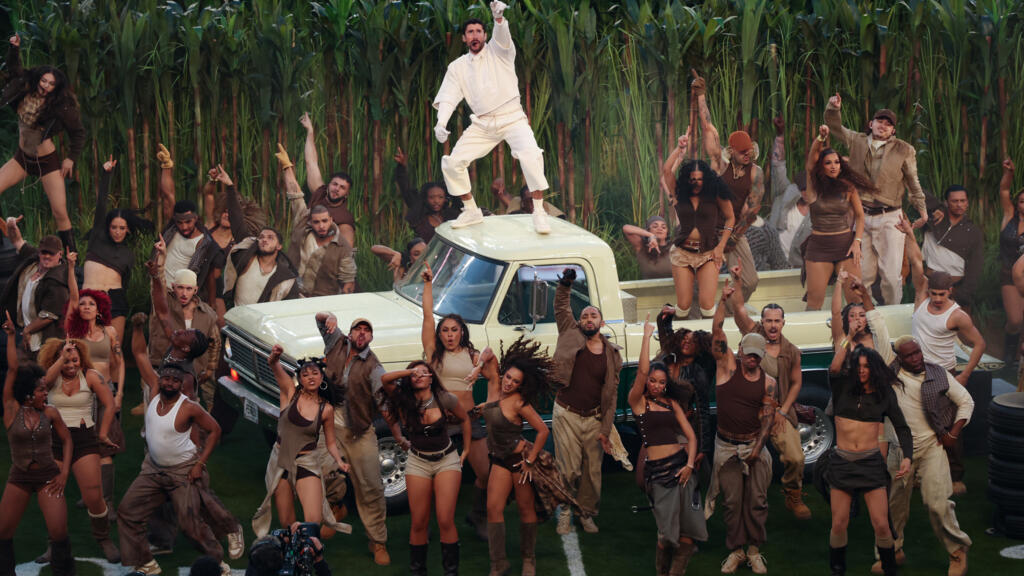
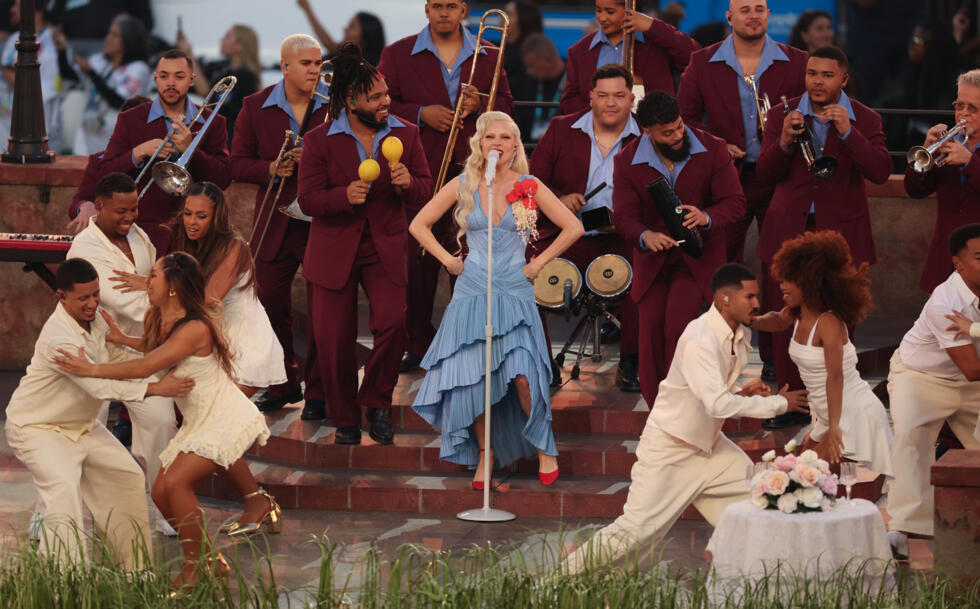
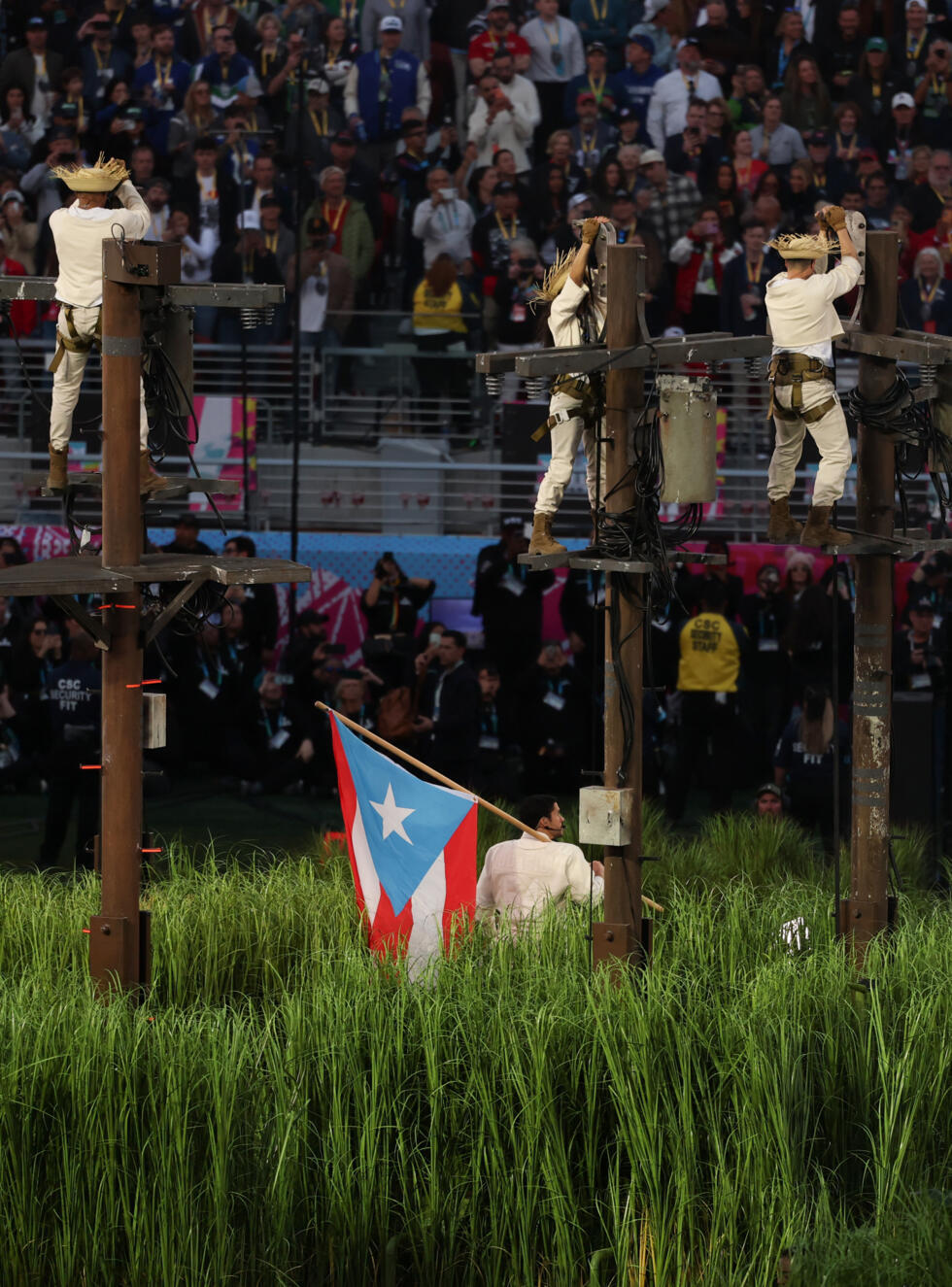
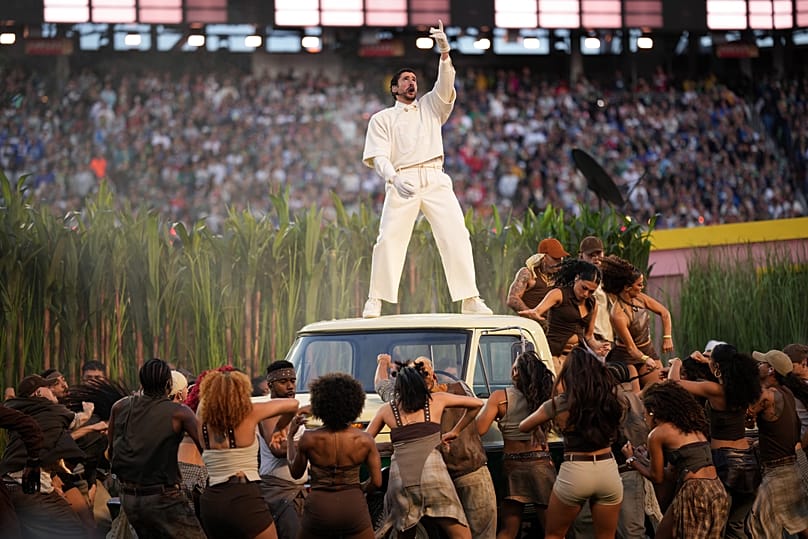
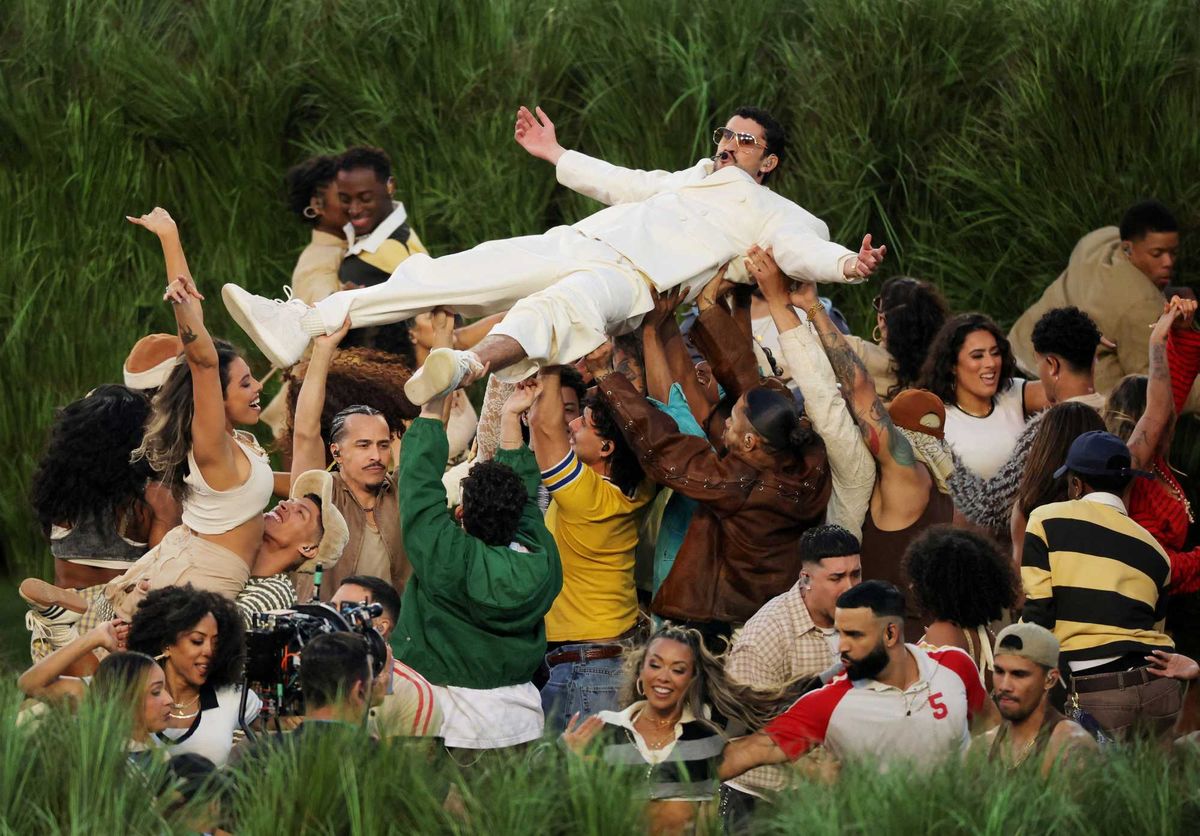
In a set featuring a sugar cane plantation, a traditional "piragua" cart selling treats, and even a wedding, he opened with "Titi Me Pregunto" and feminist anthem "Yo Perreo Sola," with a cast of dancers fueling the party atmosphere.

Actors Pedro Pascal and Jessica Alba, and rapper Cardi B were among the guest stars vibing in his familiar "La Casita" backdrop, representing a home in Puerto Rico.

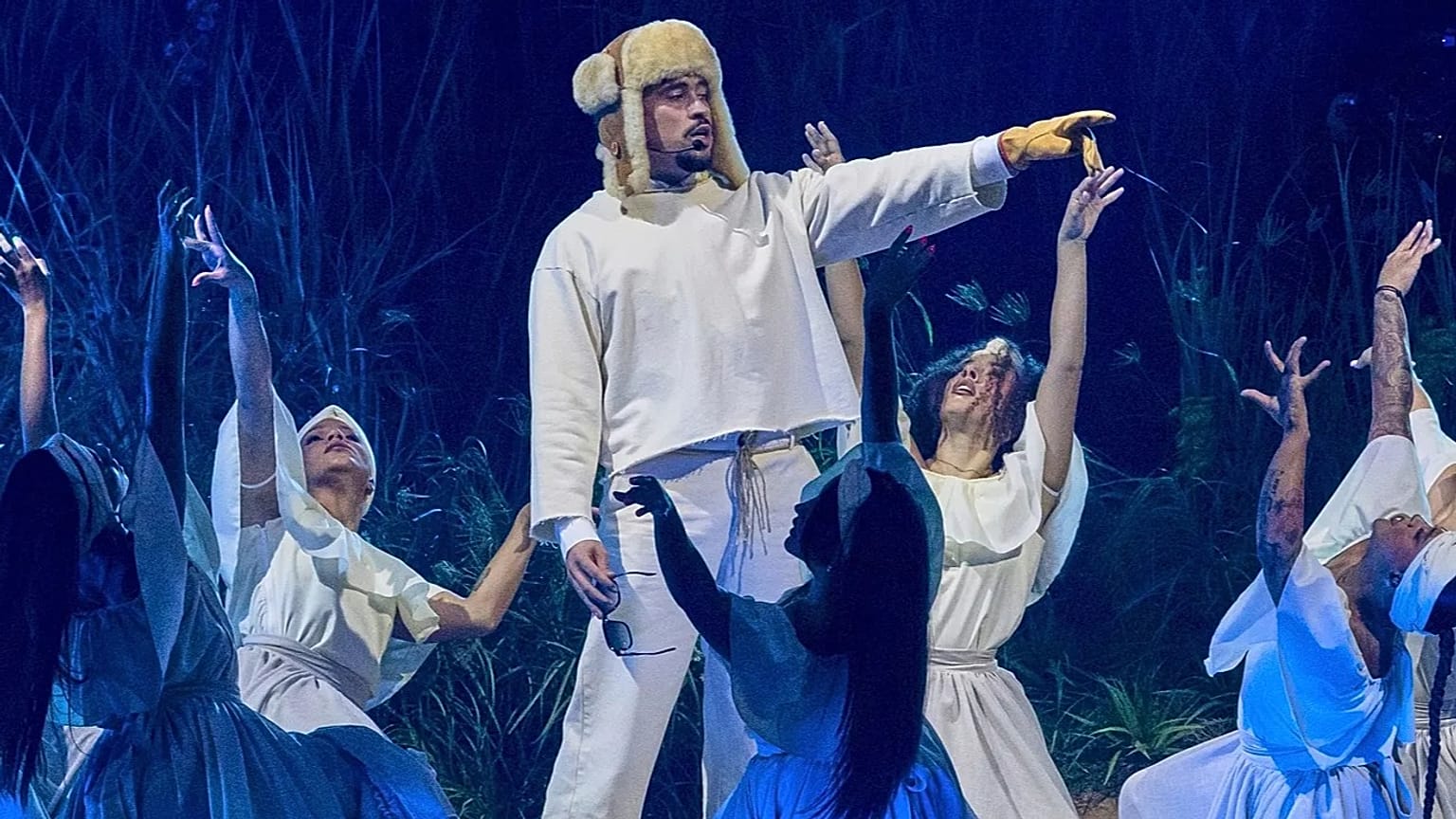
Bad Bunny wore an all-white ensemble, with a football jersey featuring the number "64" and "Ocasio," before donning a classy suit jacket.

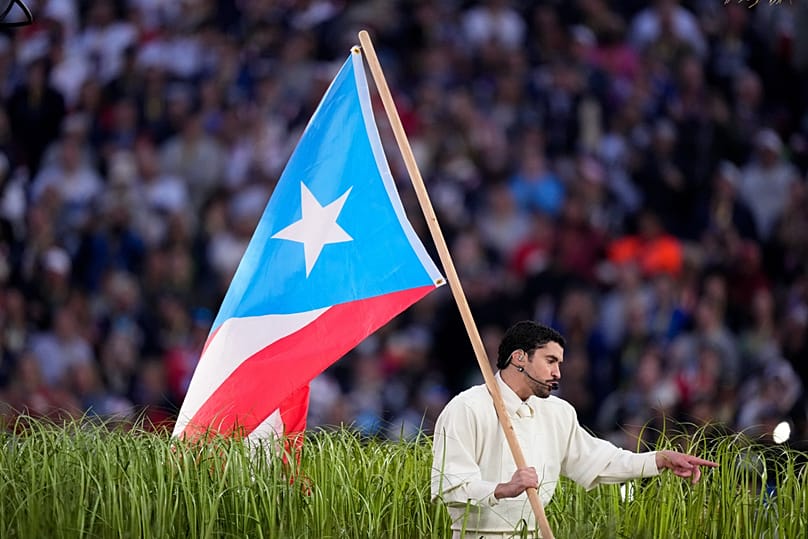
He delved into more political territory with "El Apagon" (Blackout), which touches on the displacement of Puerto Ricans on their own island, and the constant problems caused by the unreliable power grid. He carried a Puerto Rican flag at one point.

The performance also included a young boy watching the Grammys on an old television set. Bad Bunny, who won the Album of the Year prize a week ago, presented the child – perhaps a younger version of himself – with a golden gramophone.

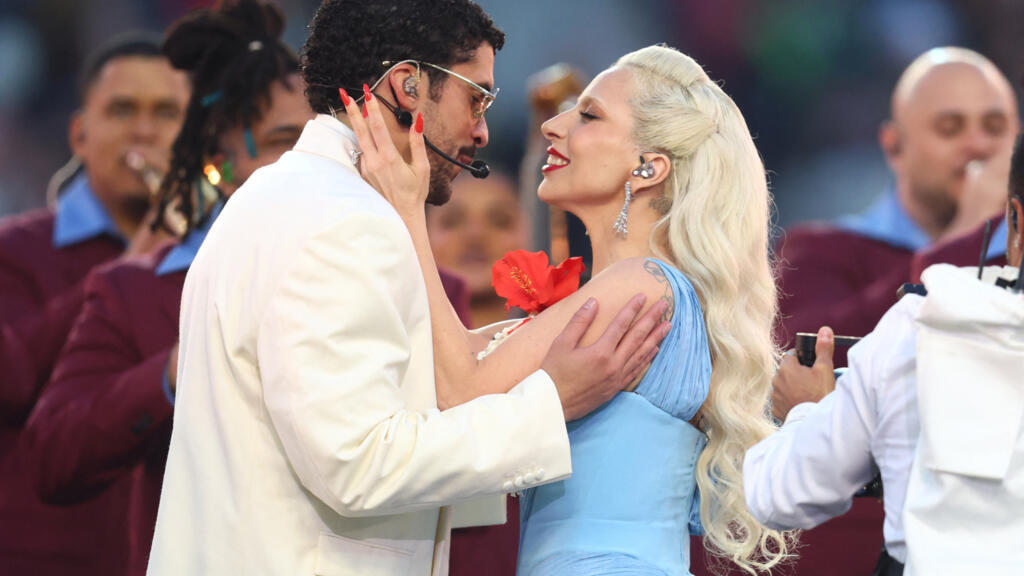
US singer-songwriter Lady Gaga was a surprise guest at the Super Bowl halftime show. 
© Patrick T. Fallon, AFP


The internet went wild with unverified rumors that the child was Liam Conejo Ramos, a five-year-old Ecuadoran boy recently detained by US immigration agents in Minnesota.

An NFL spokesman confirmed to AFP that the boy was an actor, and an Instagram post seemingly from the child in question, Lincoln Fox, was hashtagged #youngbadbunny.

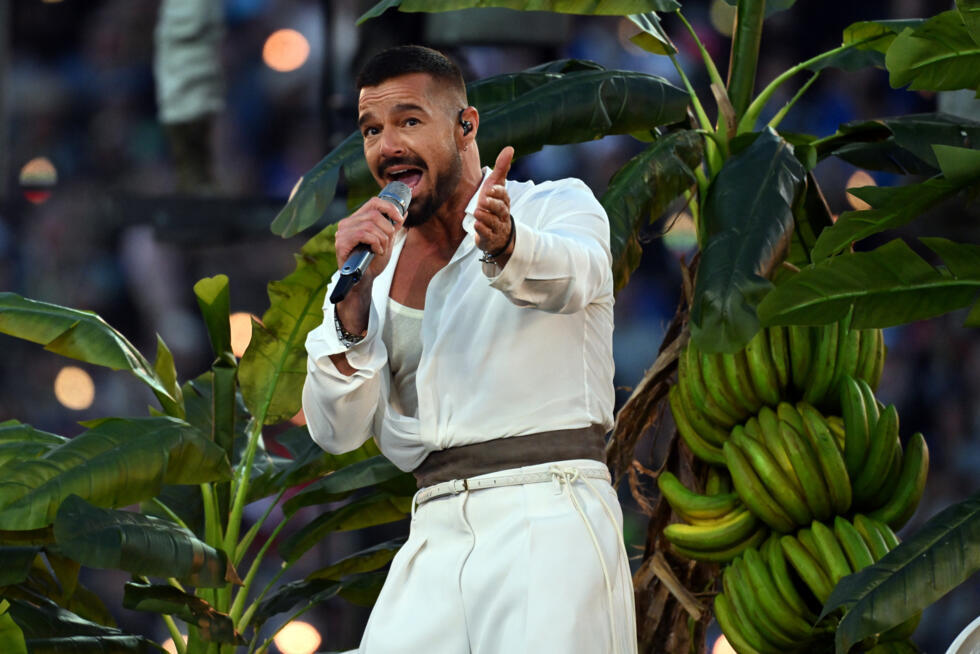
Surprise musical guests included Lady Gaga, who sang a Latin-inflected version of her hit "Die with a Smile" – the only English lyrics in the show – and Puerto Rican singer Ricky Martin.


'Affront'

At the Grammys, Bad Bunny made a searing statement about Trump's sweeping immigration crackdown, earning cheers for saying "ICE out" from the stage.

But on Sunday, he did not call out the Republican president.

At the end of the set, after listing Latin American countries, Puerto Rico, the United States and Canada, Bad Bunny spiked a football that said "Together, we are America."

A giant screen in the stadium read: "The only thing more powerful than hate is love."

Trump nevertheless quickly took issue with the performance, saying: "Nobody understands a word this guy is saying" – even though government data shows more than 41 million Americans speak Spanish.

Posting on his Truth Social account, he called the show "an affront to the Greatness of America."

Early backlash

Puerto Rican singer Ricky Martin performs during the Super Bowl halftime show. 
© Josh Edelson, AFP


Bad Bunny has been Spotify's most-streamed artist in the world four separate times, including last year, and won Album of the Year at the Grammys with "Debi Tirar Mas Fotos" – the first Spanish-language work to win music's highest accolade.

But the decision to showcase his work at the Super Bowl in California was met with conservative outrage – specifically about the idea that he would not sing in English.

The NFL entered into an agreement in 2019 with Jay-Z's entertainment company Roc Nation, which leads the league's entertainment strategy.

Since that time, the list of Super Bowl headliners included Jennifer Lopez and Shakira (with a guest spot for Bad Bunny), but the duo did not perform exclusively in Spanish, leaving Bad Bunny to set that benchmark.

From Vega Baja to Super Bowl

Bad Bunny grew up in Vega Baja, a small municipality near Puerto Rico's capital San Juan.

He was working at a supermarket bagging groceries when he got a call from a label over his viral plays on the DIY platform SoundCloud.

Thus began the reggaeton star's rapid explosion to the top of global music.

Late last year, Bad Bunny released "Debi Tirar Mas Fotos," a history lesson in Puerto Rican music that he promoted with a hometown concert residency in San Juan and a world tour.

In Puerto Rico, a US territory since 1898, there was nothing but pride for the island's native son.

"For someone from here to be at one of the most important events in the United States is a source of pride for every Puerto Rican," Olvin Reyes, 39, told AFP.

(FRANCE 24 with AFP)

Bad Bunny calls out ICE in historic Grammy-winning speech


Super Bowl 2026: Cultural takeaways and what it says about the USA today

America’s most-watched television event is not just about sports, it captures the zeitgeist of the nation every year. Here are the top picks of the 2026 Super Bowl entertainment acts and ads, reflecting some of the hopes and anxieties of the times.


Issued on: 09/02/2026 
By: FRANCE 24

Bad Bunny and Lady Gaga perform the halftime show at the 2026 Super Bowl February 8, 2026. © Mark J. Rebilas, Reuters

Super Bowl, the USA’s biggest annual sporting event, kicked off to a boring start, with NFL fans moaning about a defensive struggle between the Seattle Seahawks and New England Patriots, which saw not a single touchdown in the first half of the game.

But if there was little excitement in the game, there were plenty outside the playing field. America’s most-watched television event is not just about sports, it’s about culture, and the 2026 Super Bowl once again captured the country’s zeitgeist.

Here are some of the non-sporting highlights of the world superpower’s one-night ode to competition, capitalism and entertainment.

Bad Bunny proves not so bad

The top Super Bowl cultural moment is never a rabbit-out-of-a-hat act, and this year, it was a pre-announced big bunny.

Puerto Rican superstar Benito Antonio Martinez Ocasio, aka “Bad Bunny”, took the stage at the Levi’s Stadium on Sunday exactly a week after he delivered his searing Grammy-winning speech blasting ICE and the Trump administration’s immigration policies.

READ MORE Bad Bunny’s 2026 Grammy Awards triumph becomes protest against ICE

But at the Super Bowl, the 31-year-old superstar opted for far more subtle messaging. Instead of calling out the Republican president’s xenophobia, Bad Bunny delivered a triumphant celebration of diversity, love and above all, a tribute to his self-governed Caribbean home that is part of US “commonwealth” territory.

Politics of subtility was on full display as Bad Bunny belted out "El Apagon" (Blackout), a song that underscored the hypocrisy of the term “commonwealth” since Puerto Ricans still face Third World problems of an unreliable energy grid – which powers their displacement to the mainland.

Bad Bunny holds a Puerto Rican flag during the Super Bowl halftime show © Patrick T. Fallon, AFP


On Sunday, Bad Bunny’s surprise star guests included Lady Gaga, whose Latin-inflected version of her hit "Die with a Smile" featured the only English lyrics in the show.

READ MOREBad Bunny brings Puerto Rico pride to Super Bowl, angering Trump

The historic all-Spanish act earned President Donald Trump’s ire. "Nobody understands a word this guy is saying," said Trump on his Truth Social account, putting himself at odds with more than 41 million Americans who speak Spanish. The show, he noted, was “an affront to the Greatness of America".
Green Day has had its day politically

California punk-pop vets Green Day took the pre-game stage this year to render a tribute to the Super Bowl's 60th edition.

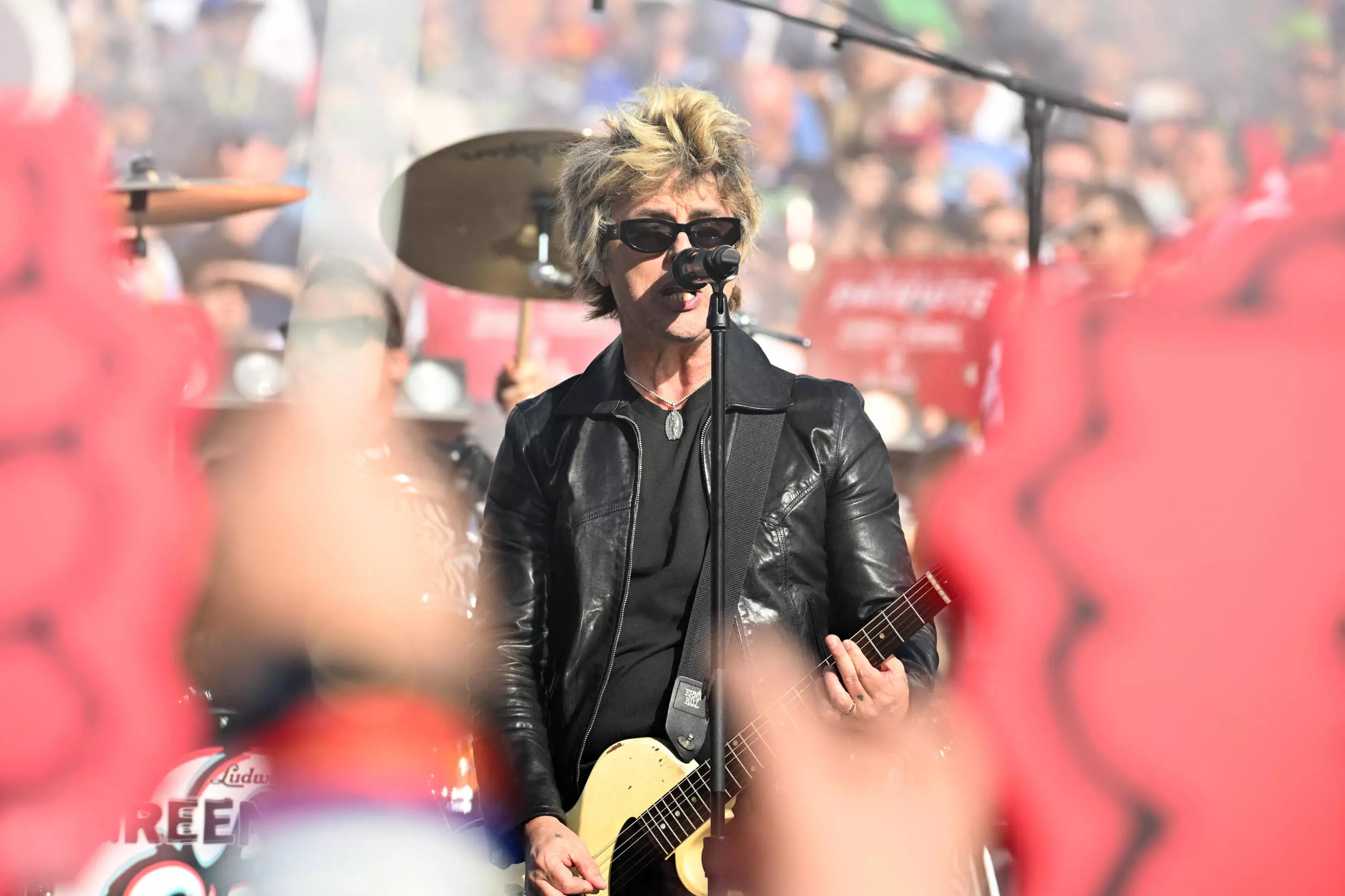
Green Day lead singer and guitarist Billie Joe Armstrong has been around since the 1980s and is not one to mince his political words. The expectations were high, particularly since Armstrong, at a San Francisco event just days before the Super Bowl, called on ICE agents to “quit their shitty jobs”.

But on Sunday, Green Day opted to omit their political hard-hitters – much to the delight of Fox News. “Trump critics take issue with Green Day's Super Bowl LX performance,” read a Fox headline above an explanatory, “Trump critics wanted Green Day to criticize the president on the Super Bowl stage".

Green Day's Billie Joe Armstrong performs at Super Bowl LX. © Josh Edelson, AFP

When the group launched into “Holiday”, Trump opponents were on alert for the group’s most political bridge, which begins with the line “Sieg Heil to the President Gasman”, a dig at former President George W. Bush, who was president when the song was released in 2004.

But on Sunday, the band just skipped the controversial bridge and wrapped up the song.

“Disappointing show,” said one fan on X. “Pretty cowardly if you ask me. I expected real protest from them.”

For those outside the US awaiting a mass national mobilisation against Trump – and watching the rollover of much of corporate America instead – it was a fitting statement of the current times in the land of the free.
Mad for the ads

The second Sunday of February draws millions of Americans to their TV sets to watch the ads, an important part of the Super Bowl cultural package. In 2025, a record 127.7 million US viewers watched the game across television and streaming platforms, which means advertisers are willing to cough up millions for a Super Bowl spot.

This year's Super Bowl ads cost an average of $8 million per 30-second unit, but a handful of spots sold for a record $10 million-plus, Peter Lazarus, who leads advertising and partnerships for NBC Sports, told AP.

Super Bowl ads generate headlines, data, expert commentary as well as debates about what they say about consumers and markets today.
AI vs. AI

The business pundits were in agreement even before kick-off on Sunday: Artificial Intelligence (AI) would dominate this year’s Super Bowl.

They were not wrong.

Super Bowl 2026 sparked an AI advertising war when Anthropic aired a pair of commercials pointing out that Claude, its chatbot, doesn't have ads.

Humour and wit are important components of American ads and the Anthropic commercial ticked all the boxes in its 30-second spot. The ad features a nerdy young man struggling with pull-ups while a muscular bystander watches. The sweating young man asks the brawny man about achieving “six-pack abs”. But the bystander instead delivers a plug for a product – delivered in soulless, robotic style and content.

The skinny man looks disappointed with the reply before the kicker line fills the screen: “Ads are coming to AI. But not to Claude”.


OpenAI CEO Sam Altman, the whiz behind ChatGPT, hit back at his competitor. In a long post on X, Altman said Anthropic was "clearly dishonest" and employed “doublespeak to use a deceptive ad to critique theoretical deceptive ads”.

Altman’s objections, alas, were not well received, with commentators on X noting that the Anthropic boss didn’t like the taste of his “own medicine” and that his reaction was “the digital equivalent of a toddler throwing a tantrum".


Who’s afraid of…Amazon

Amazon this year struck a nerve with an ad starring actor Chris Hemsworth that pokes fun of people's fears of AI. The ad ticked all the Super Bowl boxes, including a celebrity poking fun at technological anxiety.


But it didn’t go down well since it came days after Amazon founder Jeff Bezos fired journalists at the Washington Post, which he also owns, in addition to laying off 16,000 corporate workers, some of whom may be replaced with AI.

“I suspect this is meant to be funny,” Tim Calkins, a clinical professor of marketing at Northwestern University, told AP. “But it might reinforce some people’s very real concerns about AI.”


Donald Trump slams Bad Bunny's Super Bowl halftime show: “An affront to the Greatness of America”


By David Mouriquand
Published on 

Bad Bunny made history on one of the world’s most coveted stages, while Donald Trump ranted about the artist’s message of unity being “an affront to the Greatness of America”.

Puerto Rican superstar Bad Bunny made history a few hours ago as the first male solo Latin artist to perform the Super Bowl halftime show.

His performance, entirely in Spanish, was an energetic celebration of various musical styles – from reggaeton and salsa to Latin trap – featuring guest spots from Lady Gaga, Ricky Martin, and even cameos from Pedro Pascal, Karol G, Cardi B and Jessica Alba.

Bad Bunny, one of the world’s most streamed artists – went on to expand the meaning of “God Bless America” to include all the nations of the Americas.

“God bless America, whether it’s Chile, Argentina,” Bad Bunny said as he listed more than 20 nations in North and South America.

He ended the show on a message of unity, with “Together, we are America” written on a ball and a huge screen reading: “The only thing more powerful than hate is love.”

Hard sentiments to counter, but that didn’t stop Donald Trump.

Trump and his MAGA crowd have been up in arms about the choice of headliner for months, calling the decision “crazy”, “un-American” and “terrible”. His base also slammed Bad Bunny for being a “massive Trump hater”, an “anti-ICE activist”, and many bemoaned the fact that the artist has “no songs in English.”

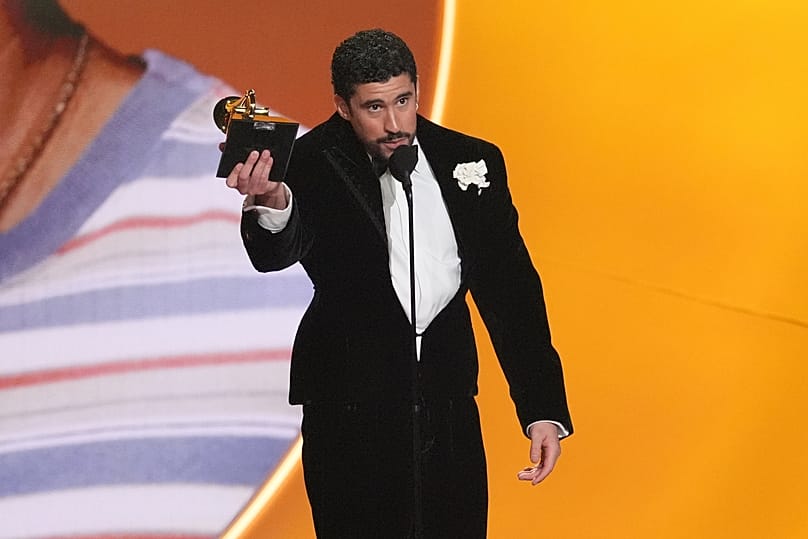
Trump’s animosity only grew after Bad Bunny triumphed at the Grammys, with Bad Bunny delivering a message in protest of recent actions of Immigration and Customs Enforcement (ICE): “Before I say thanks to God, I’m gonna say: ICE out! We’re not savage, we’re not animals, we’re not aliens. We are humans and we are Americans.”

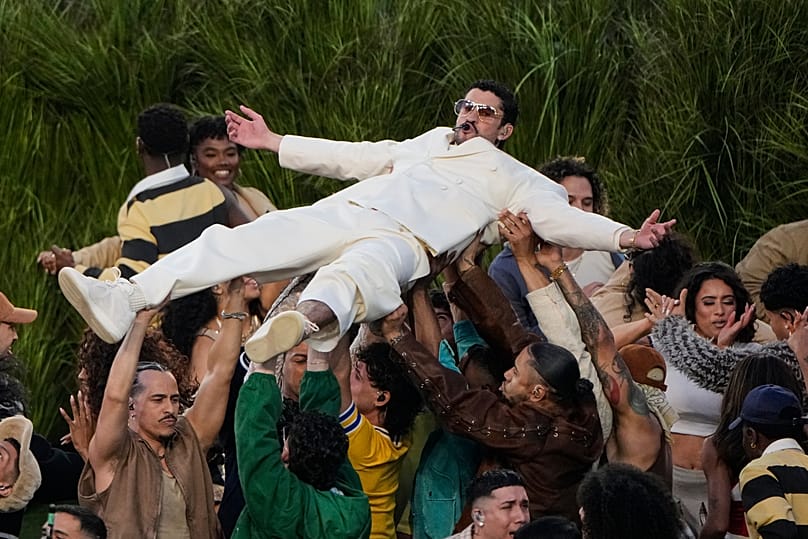
Bad Bunny's Super Bowl halftime show AP Photo

Unsurprisingly, Trump - who was not at the show and attended a watch party in Florida - slammed Bad Bunny’s performance, calling it an “an affront to the Greatness of America” in a lengthy rant on Truth Social.

“The Super Bowl Halftime Show is absolutely terrible, one of the worst, EVER! It makes no sense, is an affront to the Greatness of America, and doesn’t represent our standards of Success, Creativity, or Excellence,” Trump wrote.

“Nobody understands a word this guy is saying, and the dancing is disgusting, especially for young children that are watching from throughout the U.S.A., and all over the World,” he fumed. “This “Show” is just a “slap in the face” to our Country, which is setting new standards and records every single day - including the Best Stock Market and 401(k)s in History! There is nothing inspirational about this mess of a Halftime Show and watch, it will get great reviews from the Fake News Media, because they haven’t got a clue of what is going on in the REAL WORLD.”

Bad Bunny at the Super Bowl halftime show AP Photo

It’s unclear whether Trump was watching the alternative MAGA show, Turning Point USA’s “All American” halftime show, headlined by Kid Rock and brimming with imagery of Charlie Kirk.

The counterprogramming, which streamed online, garnered roughly four million views - at one point as many as 6 million concurrent views on YouTube.

Meanwhile, every Super Bowl typically pulls in an average of around 127 million – with last year’s set by Kendrick Lamar setting a record with 133.5 million.

Official viewership numbers for Bad Bunny’s show are not out at the time of writing, but will be revealed later today. Preliminary estimates seem to suggest that Bad Bunny may have bested Kendrick Lamar’s numbers last year. Whatever the official numbers are, it’s a done deal that the 2026 Super Bowl halftime show reached a significantly larger audience than the “All American” show.

Bad Bunny at the Super Bowl halftime show AP Photo

Shortly after Bad Bunny’s set concluded, California Governor and vcal Trump opponent Gavin Newsom posted: “America, the beautiful. THANK YOU, BAD BUNNY.”

Elsewhere, Green Day, which were opening for Bad Bunny and have never shied away from taking swipes at Trump, kept their show in the same spirit, staying away from overt political statements.

While in keeping with the message of unity, many were disappointed that the band did not make any provocative statements. Frontman Billie Joe Armstrong even refrained from singing the tweaked lyric “I’m not part of the MAGA agenda” when performing the band’s hit song ‘American Idiot’.

Official broadcaster NBC did mute Armstrong when he sang the lyric “The subliminal mindfuck America” during the song, and while some fans were disappointed by the lack of punk spirit, others were more supportive of the band’s performance.


The Spanish Super Bowl: Bad Bunny, language and identity crisis set for collision

Bad Bunny performs during his first show of his 30-date concert residency at the Coliseo de Puerto Rico José Miguel Agrelot on July 11, 2025.
Copyright Invision

By Cristian Caraballo & Tokunbo Salako
Published on 

Bad Bunny's  all-Spanish performance at the 2026 Super Bowl coincides with a US immigration crackdown and the resurgence of debates over Puerto Rico's sovereignty and possible reintegration into the Spanish kingdom.

The Levi's Stadium in Santa Clara, California, will not only be hosting tonight's Super Bowl, the conclusion of America's NFL season.

The all or nothing match is also the centre of one of the biggest cultural statements of the decade with the Puerto Rican rapper Bad Bunny headlining the world famous half-time show.

He's already ripped up the musical milestone book by becoming the first artist to win Album of the Year at the Grammys with a Spanish-language album.

We know his performance will be entirely in Spanish, and that's no small feat. Never before has anything like this happened in the history of the Super Bowl. It's not just an artistic act. It's a key moment in the midst of a period of US history filled with political and demographic tension.

Right now, speaking Spanish has become a symbol of identity, almost an act of resistance. It is the language that the population uses to challenge border control policies and demand solutions to Puerto Rico's status.

Spanish: a language of power on US soil

With more than 65 million Hispanics, the United States now ranks second in the world to Mexico as the country with the largest number of Spanish speakers. Evidence of the language is everywhere, from billboards, big brand advertising, bilingual schools, and of course in what people can watch or listen to via streaming sites.

The Super Bowl is America's biggest television event - an enormous cultural moment that echoes around the world, attracting an audience of hundreds of millions.

Yes, Hispanic and Latino artists such as Shakira and Jennifer López have already performed on that stage, but none have ever decided to only sing in Spanish at the event that epitomises the pinnacle of American culture and where English has been the norm. Donald Trump has already made clear that he will not attend the match. A counter protest event has also been announced this week with MAGA supporting acts getting together to make noise in celebration of "American faith, family and freedom."

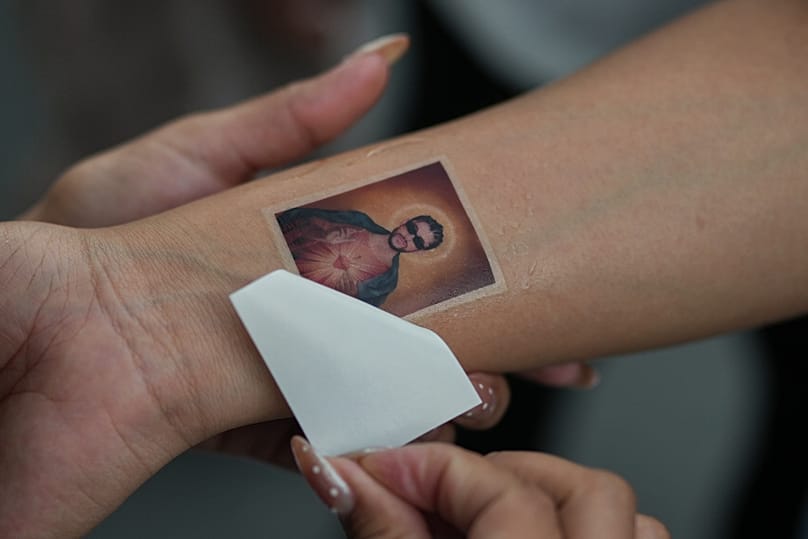
 A person gets a temporary tattoo during one of the artist's concerts. AP Photo

Of course, Spanish taking that space also generates rejection from those who defend 'English Only' as if it were the backbone of the country.

For some, this is the validation they have been waiting decades for. For others, it is a threat, a sign that the country is 'losing' its linguistic identity.

But the figure of Bad Bunny goes beyond music. His voice represents millions of people who have been working and contributing culture for years, even if they're regarded by some as second-class citizens and therefore not a real part of the nation.

The contradiction of visibility: music versus raids

Music connects. It is a way for people to express what they feel, what they think, what hurts or excites them. Many artists use music to protest, to say what others are silent about. Now some musicians are dealing with the harsh reality of immigration raids and police operations that can put an end to both their work and freedom of expression.

The expectation surrounding Bad Bunny's performance coexists with a reality marked by fear, the separation of families and thecriminalisation of undocumented people, many of them part of the same audience that celebrates Latino visibility on global stages.

In contrast, Bad Bunny's presence in one of the most influential media spaces in the world acquires a particular symbolic charge; while Latino culture is exalted and massively consumed, immigration policies continue to put at risk those who sustain it on a daily basis.

The country that idolises an artist who sings in Spanish, that turns him into its pop superstar, is the same country where the authorities have imposed a harsh and violent crackdown on immigration controls.

In the last year, Immigration and Customs Enforcement conducted more operations than ever before, hitting mostly Latino communities in key states. Organisations have reported raids on factories, warehouses and entire neighbourhoods. Fear is spreading, even among legal citizens and families with mixed immigration status. All of this is evidence of a deep problem.

Although millions watch games and programmes in Spanish, there is still a lot of mistrust of the language outside of television, for example in job interviews or at police checkpoints. For many, the fact that Bad Bunny does not translate his songs is a way of protesting, of making clear their disagreement with the treatment of migrants.

As the government tightens laws and closes borders, Caribbean music continues to be heard in every corner of the United States. In politics, the tendency is to divide. Music does just the opposite: it unites. Where politicians put up walls, Caribbean music builds bridges.

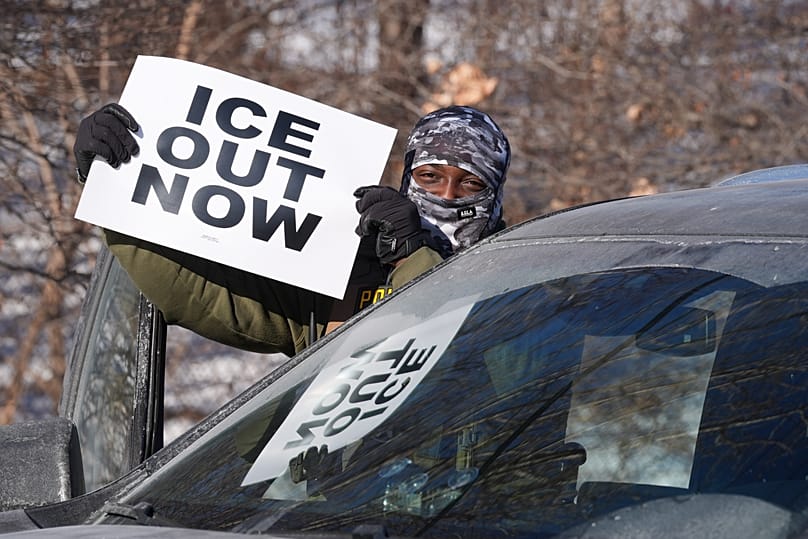
 A federal officer holds up a sign reading "ICE Out Now" during a traffic stop, 27 January 2026 AP Photo/Adam Gray

Puerto Rico's legal and political limbo

Bad Bunny has always had Puerto Rico in his heart. The island has been a commonwealth for decades, and that leaves it in a state of limbo. Puerto Ricans are born US citizens, hold US passports and comply with federal laws, and may even end up in the military.

But, incredible as it sounds, they cannot vote in presidential elections and their representatives in Congress do not even have the right to vote. Puerto Rico is there, forced to comply, but unable to decide. It is a contradiction that weighs heavily.

The reality on the island is complicated, and it doesn't look like it will get better any time soon. Puerto Rico cannot make the most important decisions about its future. This only worsens the economic and infrastructure problems, which were already bad enough. After every hurricane or earthquake, it is clear how vulnerable the island is.

People are tired, they feel used. That contradiction fuels the anger and discourse of artists like Benito, who use their fame to remind people that, in many ways, Puerto Rico is still a colony, even if it flies the US flag.

The historical alternative: the movement for reunification with Spain

In recent years, an idea has emerged that sounds far-fetched to some and logical to others: What if Puerto Rico were once again part of Spain? This is what the Spanish Reunification Movement proposes. It argues that in 1898, when the United States took over the island after the war with Spain, they ignored the will of the Puerto Ricans.

Spain, in fact, had already given them some autonomy in 1897. This movement wants Puerto Rico to return as an autonomous community, like those that already exist in Spain. Their arguments are increasingly appearing in international forums. They argue that the cultural and linguistic connection with Spain would help protect Spanish and prevent it from being diluted by US influence.

Moreover, if Puerto Rico were Spanish, its citizens would gain the rights of any European: mobility, services and labour rights that they cannot even dream of under the American system. Supporters of this plan see an opportunity to right historical wrongs and give Puerto Rico the full political representation it deserves, without sacrificing its Hispanic identity.

Of course, there are those who see it as a nostalgic and unrealistic idea, something impossible to implement. But, one way or another, the movement managed to get the issue onto the UN decolonisation agenda. They insist: Puerto Rico has always been part of the Hispanic family, both legally and spiritually.

A stage that concentrates all tensions

Now, the halftime show must shoulder extra significant weight. When Bad Bunny takes the stage at Levi's Stadium, many people will see more than a show. They will see a symbol of that Puerto Rican identity crisis, a wound that is still raw. The 2026 Super Bowl will be the stage where big issues intersect: the rise of Hispanic culture, the immigration debate and Puerto Rico's political situation.

For many, the moment will provide a moment to think about issues of representation and belonging that are rarely discussed openly. And the simple gesture of singing in Spanish, in front of millions of people, is not just a celebration of an artist's success. It is a declaration: language is a territory that cannot be deported or silenced, regardless of borders or laws.


'Hypocrites': GOP lambasted as video shows halftime show played at Trump Super Bowl party


Alexander Willis
February 9, 2026 
RAW STORY


Super Bowl LX - Half-Time Show - New England Patriots v Seattle Seahawks - Levi's Stadium, Santa Clara, California, United States - February 8, 2026 Bad Bunny performs during the halftime show REUTERS/Carlos Barria TPX IMAGES OF THE DAY

Despite the White House insisting that President Donald Trump would “much prefer” to watch the “All American” alternative Super Bowl halftime show, video suggests that the official performance by Puerto Rican artist and Trump critic Bad Bunny was aired “on the big screens” at Trump’s private watch party in Florida on Sunday.

Bad Bunny, whose real name is Benito Antonio Martinez Ocasio, has been the target of MAGA scorn since being announced as the headliner for Super Bowl LX’s halftime show.

In protest, the conservative advocacy organization Turning Point USA revealed that it would be airing its own alternative half-time show starring artist and Trump ally Kid Rock, a performance that White House Press Secretary Karoline Leavitt told reporters last week that Trump would “much prefer” to watch over the official show.

And yet, video has emerged that appears to show Trump, Sen. Lindsey Graham (R-SC) and other attendees at the president's private Super Bowl watch party watching Bad Bunny’s performance on the big screens, sparking widespread ridicule, Pro Football & Sports Network reported.

“Footage from inside Trump’s golf club Super Bowl party reveals the Bad Bunny half-time show played on the big screens,” wrote X user “Patriot Takes,” a popular political commentary account with more than 460,000 followers. “What a bunch of hypocrites.”

Trump apparently took time away from watching the Super Bowl to rage on social media about Bad Bunny’s halftime show performance, calling it “absolutely terrible” and “one of the worst, ever!”

Meanwhile, the “All American” halftime show alternative with Kid Rock was widely mocked for both its content and technical difficulties, being unable to be streamed on the popular social media platform X — owned by Trump ally Elon Musk — due to “licensing restrictions.”“Not even Trump wanted to watch the lip sync extravaganza from [Turning Point USA],” wrote journalist Jeff Benjamin in a social media post on X Monday.


'Existential crisis' hits MAGA as Super Bowl


show leaves Trump scrambling: analysis


Ewan Gleadow
February 9, 2026 
RAW STORY


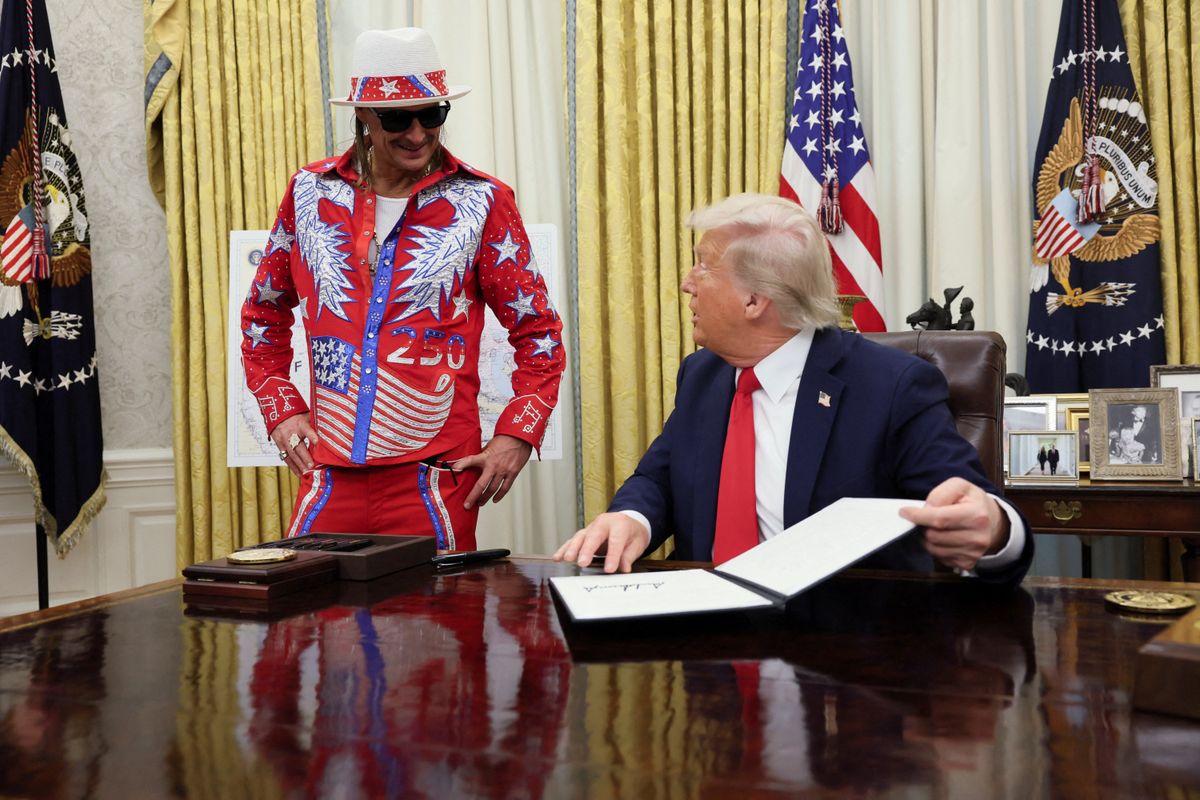
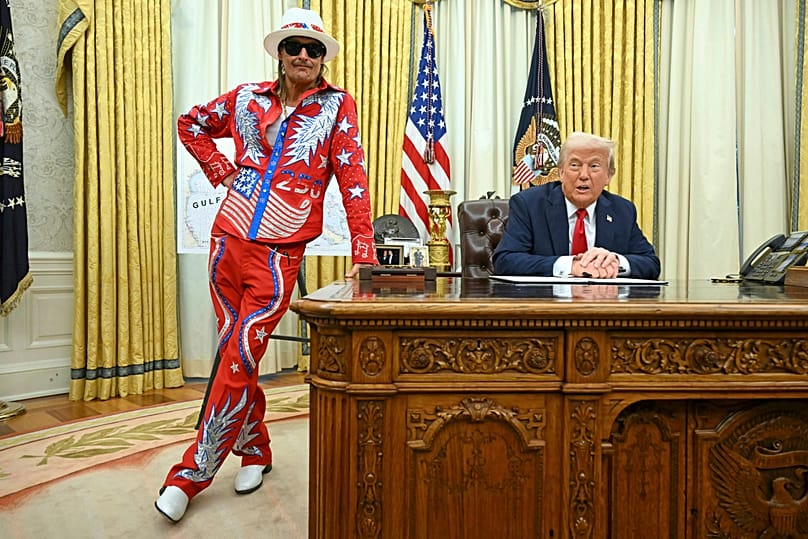
U.S. President Donald Trump speaks with Kid Rock after signing an executive order related to the U.S. live entertainment ticketing industry in the Oval Office at the White House in Washington, D.C., March 31, 2025. REUTERS/Leah Millis

President Donald Trump's reaction to Bad Bunny's Super Bowl halftime show has left MAGA facing an uncomfortable truth about its own movement, a political analyst claimed.

While Bad Bunny drew a staggering 113 million viewers, those in the MAGA sphere sought entertainment elsewhere. Kid Rock performed at Turning Point USA, providing an alternative to the Grammy Award-winning artist performing during the Super Bowl break.

The performance from Bad Bunny is enough for MAGA members to reconsider what the public wants — and it was made worse by Trump's rambling response to the ceremony, according to Christopher Bucktin, writing in The Mirror.

He suggested the show had been a stress test MAGA may not survive.

He wrote, "For most viewers, Bad Bunny’s show was exactly what the Super Bowl has long claimed to celebrate — scale, swagger and culture. For MAGA, it was an existential crisis. Spanish lyrics. Brown bodies. Dancing that didn’t look like it came from an Arkansas country bar in 1987. Clearly, civilization was under threat."

Trump's response to Bad Bunny's show fueled the MAGA fire further, Bucktin suggested. He added, "It was less cultural critique than an unhinged aging uncle shouting at the television — except the television was winning.

"What made the outburst even more revealing was Trump’s apparent failure to grasp a basic fact: Bad Bunny is from Puerto Rico. Puerto Rico is American. Its people are American citizens. The president of the United States attacking an American artist as foreign is not irony; it is Trumpism in its purest form. If it doesn’t look or sound like his America, it doesn’t count.

"MAGA’s solution, as ever, was to retreat into a parallel reality. Rather than engage with the halftime show the rest of the world was watching, Trump-aligned groups promoted an “alternative” performance headlined by Kid Rock — marketed as a wholesome, values-driven counterweight to the NFL’s spectacle."

Bucktin also noted Trump had abandoned the MAGA showcase Kid Rock had put on and instead voiced his distaste for the Super Bowl halftime show.

He wrote, "Even Trump, a man famous for inflating crowd sizes, didn’t bother watching. Instead, he tuned in to Bad Bunny like everyone else, before angrily informing the world that he hated every second of it. And then came the awkward part MAGA would rather forget."


Mockery abounds as 'All-American Halftime Show' faces technical difficulties


Robert Davis
February 8, 2026 
RAW STORY


Republican presidential nominee and former U.S. President Donald Trump gestures as he speaks during his rally in Saginaw, Michigan, U.S., October 3, 2024. REUTERS/Brendan McDermid

Mockery abounded on Sunday night after a conservative advocacy organization announced its "All-American Halftime Show" was facing technical difficulties ahead of airtime.

Turning Point USA, the group founded by the late activist Charlie Kirk, announced that "licensing restrictions" were preventing its halftime show featuring Kid Rock from appearing on X, which is owned by President Donald Trump's ally Elon Musk. The show was organized in response to the Super Bowl LX halftime show featuring Bad Bunny, a Puerto Rican artist who will perform entirely in Spanish.

"Due to licensing restrictions, we are unable to stream The All-American Halftime Show on X," the organization posted on X. "Head on over to our YouTube channel tonight around 8PM ET to watch the full show."

Political analysts and observers didn't hold back in their reactions.

"No one is watching that s---," political commentator Tony Tony Posnanski posted on X.


"Hahaha," Rep. Malcom Kenyatta, a Democratic state representative in Pennsylvania, posted on X.


"OH GOD IT'S PERFECT," writer Alheli Picazo posted on X.

"AHAHAHAHAHAHAHAHAAHAHA," political analyst Matt Corridoni posted on X.

'All American': Everything we know about MAGA's protest Super Bowl Halftime Show

Everything we know about the right-wing protest Super Bowl Halftime Show
Copyright AP Photo - X screenshot

By David Mouriquand
Published on 

MAGA is preparing to hold the All-American Halftime Show in protest of the NFL’s 2026 Super Bowl music acts. Prepare to be underwhelmed.

The NFL's Super Bowl LX takes place this weekend, with multi-Grammy Award winning Puerto Rican rapper Bad Bunny headlining the US' most-watched television event, which attracts more than 100 million viewers every year.

The Halftime Show is a huge and coveted gig, which has a long history of reflecting and influencing cultural trends.

Last year, Kendrick Lamar’s headlining performance shattered all records with 133.5 million viewers tuning in. Bad Bunny is expected to match if not surpass that record, but no thanks to the MAGA crowd.

Diversity-averse rightwing media has been up in arms over the choice of headliner for months now, with many saying that Bad Bunny’s music is "un-American" and “woke”, handily forgetting for the sake of barely concealed racism that the singer is an American citizen, since Puerto Rico is part of the US.

Funny how no one was complaining when Canadian singer Shania Twain or the UK’s The Rolling Stones were headlining...

Bad Bunny was recently described by Donald Trump as a “terrible choice” for the Super Bowl headline slot, with one of his advisors even confirming that ICE would be present at the “shameful” concert.

Despite criticism and plenty of complaining about American football’s biggest night being hijacked by a “left-wing conspiracy”, the NFL did not drop(kick) Bad Bunny. The organisation even appeared to double down in defying Trump, as they added rock band Green Day, who are vocal Trump critics, to the Super Bowl line-up.

There was renewed MAGA outrage when the Puerto Rican superstar blasted the Trump administration and ICE while accepting the top award at this year’s Grammys, saying: “Before I say thanks to God, I’m gonna say: ICE out”, adding, “We’re not savages, we’re not animals, we’re not aliens. We are humans and we are Americans.”

Bad Bunny at the 2026 Grammys AP Photo

The MAGA response? Counterprogramming.

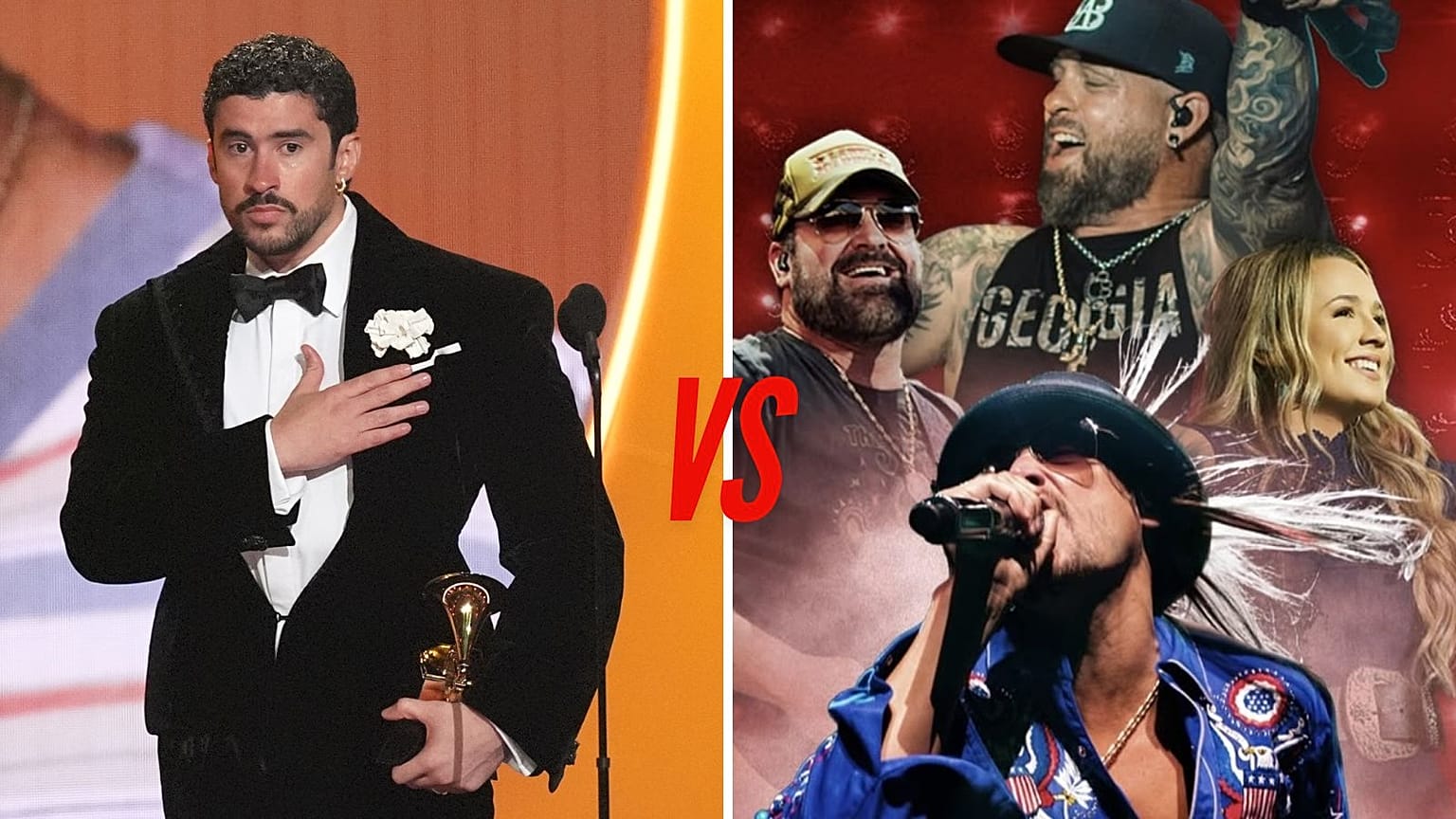
Turning Point USA – the conservative group founded by Charlie Kirk and now helmed by his widow Erika Kirk - has organised an alternative, competing halftime show titled the “All American Halftime Show”.

It will celebrate “American faith, family, and freedom,” the organization said.

So, who’s on the powerhouse and not-at-all-underwhelming line-up?

Trump supporter Kid Rock is headlining, and he will be joined by country singers Brantley Gilbert, Lee Brice, Gabby Barrett.

It’s a veritable Who’s WHO?

“We’re approaching this show like David and Goliath,” Kid Rock said in a statement issued through Turning Point USA. “Competing with the pro football machine and a global pop superstar is almost impossible…or is it?”

The singer, who hasn’t had a hit song since the dire Lynyrd Skynyrd-pilfering ‘All Summer Long’ in 2008, added: “He’s said he’s having a dance party, wearing a dress, and singing in Spanish? Cool. We plan to play great songs for folks who love America.”

Best of luck with that, as the Goliath he mentions dethroned Taylor Swift to become Spotify’s most-streamed artist of 2025 and made history last weekend as the first Spanish-language artist to win the Grammy’s Album of the Year with 'DeBÍ TiRAR MáS FOToS'.

Kid Rock at the White House AP Photo

The All-American Halftime Show is scheduled to take place the same night as the 2026 Super Bowl – Sunday 8 February – at a location that is still unknown. It will broadcast across four conservative networks: DailyWire+, TBN, Charge!, and Real America’s Voice. It will also stream on Turning Point USA’s social media channels.

We’re betting that Bad Bunny won't lose sleep over it – especially since those supposed All-American values Turning Point USA are trumpeting apparently don’t concern themselves with Kid Rock’s unsavoury lyrics.

Indeed, there has been fresh scrutiny online over Mr. Rock’s song ‘Cool, Daddy Cool’ in the lead up to the protest show, with the song’s lyrics featuring the lines: “Young ladies, young ladies / I like 'em underage / See, some say that's statutory / But I say it's mandatory.”

Maybe that’s what “American faith, family, and freedom” sounds like.

The NFL's Super Bowl LX will take place on Sunday 8 February. The NFL chief security officer Cathy Lanier recently said at a security briefing that despite previous comments made by the Trump administration, ICE officers will not be among the federal agencies present at Levi’s Stadium in Santa Clara, California.


Trump ally blasts Republican's $3M Super Bowl 'gimmick' as massive waste of money


Erik De La Garza
February 6, 2026
RAW STORY


FILE PHOTO: Feb 5, 2026; San Francisco, CA, USA; A NFL shield logo at the NFL Honors Red Carpet before Super Bowl LX at Palace of Fine Arts. Mandatory Credit: Kirby Lee-Imagn Images/File Photo


A Republican strategist dismissed Republican efforts to politicize Sunday’s Super Bowl as a waste of money, ripping a $3 million ad as "a gimmick."

The moment unfolded on Friday on CNN’s “The Lead” when host Jake Tapper highlighted a $3 million Super Bowl ad buy from Michigan GOP gubernatorial candidate Perry Johnson. The ad urges viewers to skip the halftime show because it features international superstar Bad Bunny as the performer.

“I don't think it's money well spent,” Lanza, a former senior advisor to President Donald Trump’s 2024 campaign, said. “You know how hard resources should be spent on political campaigns. That's a gimmick.”

Lanza argued the strategy may generate attention but won’t deliver real value.

“He'll get a lot of support. I don't think he'll be able to make the money back,” he said. “But at the end of the day, people just want to watch football, and they want to be entertained. Whether it's Bad Bunny.”


The GOP strategist pushed back on the effort to turn the halftime show into a culture war.


“I just want politics out of my football,” Lanza said Friday. “I just want to enjoy football. I want to enjoy the halftime show.”

Lanza said during the interview that “he’ll be watching Bad Bunny” when the Seattle Seahawks and New England Patriots square off for Super Bowl LX.