Saturday, February 21, 2026


Source: Originally published by Z. Feel free to share widely.

The march of the Ultra-Right in the Global South continues on, but unlike their Global North counterparts like Trump, Le Penn & Farage, as bleak as the future may seem, there are green shoots amongst the concrete.

On 8 February 2026 following the Thai general election, there was a paradigm shift ushering in a new era of Southeast Asian politics as the ultra-right Bumjaithai Party took control of every organ of Thai state power, democratically or otherwise. The party are relatively new comers to Thai politics but are the clear successor of a long line of monachal-military-capitalist-ultra-nationalists who have long served as a vanguardist nexus of deep state power. They had already allegedly rigged senate elections in the upper-house in 2024 winning a super majority in the supposedly party neutral chamber- an investigation into these charges of vote rigging are now certain to go nowhere. The judiciary, which have long been in the pocket of the aforementioned monachal-military-ultra-nationalists, are also firmly on team Bhumjaithai (BJT), and due to the kingdom’s centralised government structure little to no opposition remains in any state institutional form.

For the past two decades, and even going back to the 1960s, Thailand has had a relatively well organised peasant and workers movement, particularly given the highly reactionary nature of the state, which has been a US vassal ever since their war on Vietnam. Up until the 2000s this movement was largely extra-parliamentary, with the poor organising around the Farmers Federation (1970s), the insurgent Communist Party (1960s-80s) and subsequently a web of trade unions and localised peasant groups. In 2001, however, the left-agrarian-populist Thai-Rak-Thai party (today Phue Thai) emerged as the parliamentary representative of the poor, winning landslide elections, countless policy victories and experiencing mass state repression in the form of military and judiciary coups, extrajudicial killings, arrests and disappearances. Despite Phue Thai’s successes, over the past two decades, the reactionary state has developed a complex system of weaponised lawfare, as documented by researcher Tyrell Haberkorn in her book Dictatorship on Trial. In short, the reactionary elite learnt how to bar the poor from parliament, and at the time of writing, appear to have successfully neutralised the threat for the indefinite future.

In the aftermath of the 8 February election, many of those on the left are nervously looking to a future that resembles Hun Sen’s Cambodia (CPP) or Modi’s India (BJP). While these examples operate in vastly different political landscapes, they share striking tactical similarities in neutralising opposition through legal, administrative, patronage network, and state institutional means. A new reactionary playbook is rapidly being developed and exported across the region. One by which the ultra-right are able to capture state institutions, weaponize ultra-nationalist grievances outwards, and crush opposition. The much touted “rule of law” is stripped of its liberal pretences to serve as a naked instrument of class rule and state capital. Which brings us to the question of what the opposition—what the poor—can do to recognise and challenge this.

The repeated playbook in all of these cases rely on three basic pillars, judicial neutralisation, opposition absorption & ethno-nationalist redirection:

Judicial Neutralisation

In these cases, the state was built on Western ideas of liberal democracy. The judiciary, once framed in liberal theory as an independent check on power, has been effectively hollowed out and repurposed. It functions as an open and concentrated administrative force dedicated to safeguarding the interests of the dominant economic class, operating as a tactical instrument for enforcement of economic and political monopolies, ensuring that the legal system actively facilitates the accumulation of wealth and power for the ruling elite rather than providing a check on state power.

The Bharatiya Janata Party (BJP), India: Have repeatedly used law enforcement agencies (Enforcement Directorate, Central Bureau of Investigation) to file corruption or money laundering cases against the opposition, often leading to pre-trial detentions that paralyses opposition leadership during elections, bogging them down in judicial procedure.

The Bhumjaithai Party (BJT), Thailand: Benefits from a “Judicial Coup” model where the courts protect the interests of the aforementioned reactionary vanguardist nexus. They benefit from a judiciary that dissolves major rivals and removes opposition leaders, like the judicial coups against Phue Thai Prime ministers and the dissolution of the Move Forward Party, on constitutional grounds. BJT itself rarely initiates these cases but relies on their dependable ultra-nationalist allies to press the charges.

The Cambodian People’s Party (CPP), Cambodia:  Perhaps the most ‘advanced’ form, where the distinction between the party and the state has completely withered away. This is the closest we have to Caesarism, in that the judiciary is simply a department of the CPP used to liquidate the political competition, ensuring that the means of production (land, timber, and factories) remain in the hands of the elite class loyal to the CPP project.

Absorbing Opposition

In India, the “BJP Washing Machine” is a mechanism for the centralisation of political rent. Localised political/landowning elites with their existing patronage networks join the BJP to protect their accumulated capital from state seizure and further cement their position locally, while strengthening party hegemony nationally. Former opposition figures become allies and any investigations into their past wrongdoing are washed away by the power of the BJP “Washing Machine”.

In Thailand, the BJT’s absorption of existing “Baan Ya” (local elites) into the party allows for the consolidation of provincial capital and votes. When the judiciary threatens to investigate non-BJT elites, they simply move their assets (votes and influence) to join BJT, moving from a position of weakness to strength and allowing them greater access to state contracts, legal protections and a seat at the table in Bangkok.

In Cambodia, the CPP’s “Golden Handcuffs” are a form of patronage-based feudalism. For opposition figures, or those who wish to challenge CPP hegemony, instead of challenging the party, joining the CPP is the only way to access markets, votes, state contracts, etc., and avoid liquidation. Once tied or ‘handcuffed’ to the CPP they are richly rewarded and protected, providing they adhere to the party’s hegemony.

Ethno-nationalist Redirection

So as to most effectively legitimise their regimes and justify their extraordinary use of heavy handed judiciary, all three cases have relied on stoking ethno-nationalist grievances against outside forces. Ironically, Thailand and Cambodia are mutually dependent on this, given the recent border war, which was instigated by both sides, so as to create this very outcome. As we wrote at the outbreak of the fighting, it was a war of elite consensus on both sides of the border, which served only to strengthen the elites on either side, to justify their militaristic policies, which ultimately are vested in domestic interests, using the military as an internal repressive state apparatus rather than an external—as is the case with the US and Great Britain for example. The same is also true of the BJP, who have used the longstanding conflict with Pakistan to justify crackdowns on domestic opposition who fail to show sufficient fealty towards India’s army in its conflict with Pakistan. In Thailand too, this tactic was used against the left opposition as a means of discipline and control, forcing them to back the reactionary consensus of the ultra-nationalists like BJT or face charges of treason, as was the case with the aforementioned left populist PM Paetongtarn Shinawatra who was evicted from office for this very reason.

The Way Out

The election of Bhumjaithai this month is the most recent country in the region to fall to an ultra-right government using the very same playbook mentioned above. Reactionary forces across Asia are watching closely, taking notes, learning and adapting. It is at this moment that those of us on the left, the poor, must do the same, take time to analyse how reactionary powers operate and where their weaknesses are.

The answer, is of course, not the liberal politics that have been sold by the Western funded NGO’s and think tanks that for decades have portrayed themselves as the vanguards of democracy against fascism. Indeed, they are, in the best case, completely ineffective,as is the case with the Cambodia National Rescue Party, and in the worst case actively harmful, as is the case with The Peoples Party Thailand.

As bleak as the situation may feel in Thailand today in the aftermath of this defeat, there are lessons and examples we can look to as means of resistance, as well as recent moments of such reactionary consensuses breaking—the case of Sri Lanka and Bangladesh, albeit currently in a state of flux. Even within the reactionary consensus, liberatory spaces can be created like the incredible achievements of the left coalition in Kerala.

For the poor of Thailand, we are in the first days of a new paradigm, a new reactionary consensus, where parliamentary political organizing may need to be abandoned for several years. While this particular paradigm is fresh, it is one that the poor have faced many times before. We have seen our comrades dead in the street, we still live with their empty bedrooms in our homes. We heard these stories from our grandparents, who in turn heard them from theirs. We have bounced back before and we inevitably bounce back again, as will the poor of India and Cambodia, such is the nature of class struggle. Email

Kay Young is a writer and editor at DinDeng journal (Thailand). He has a forthcoming book on Thai revolutionary history with LeftWord Books (India).


Source: Ojalá

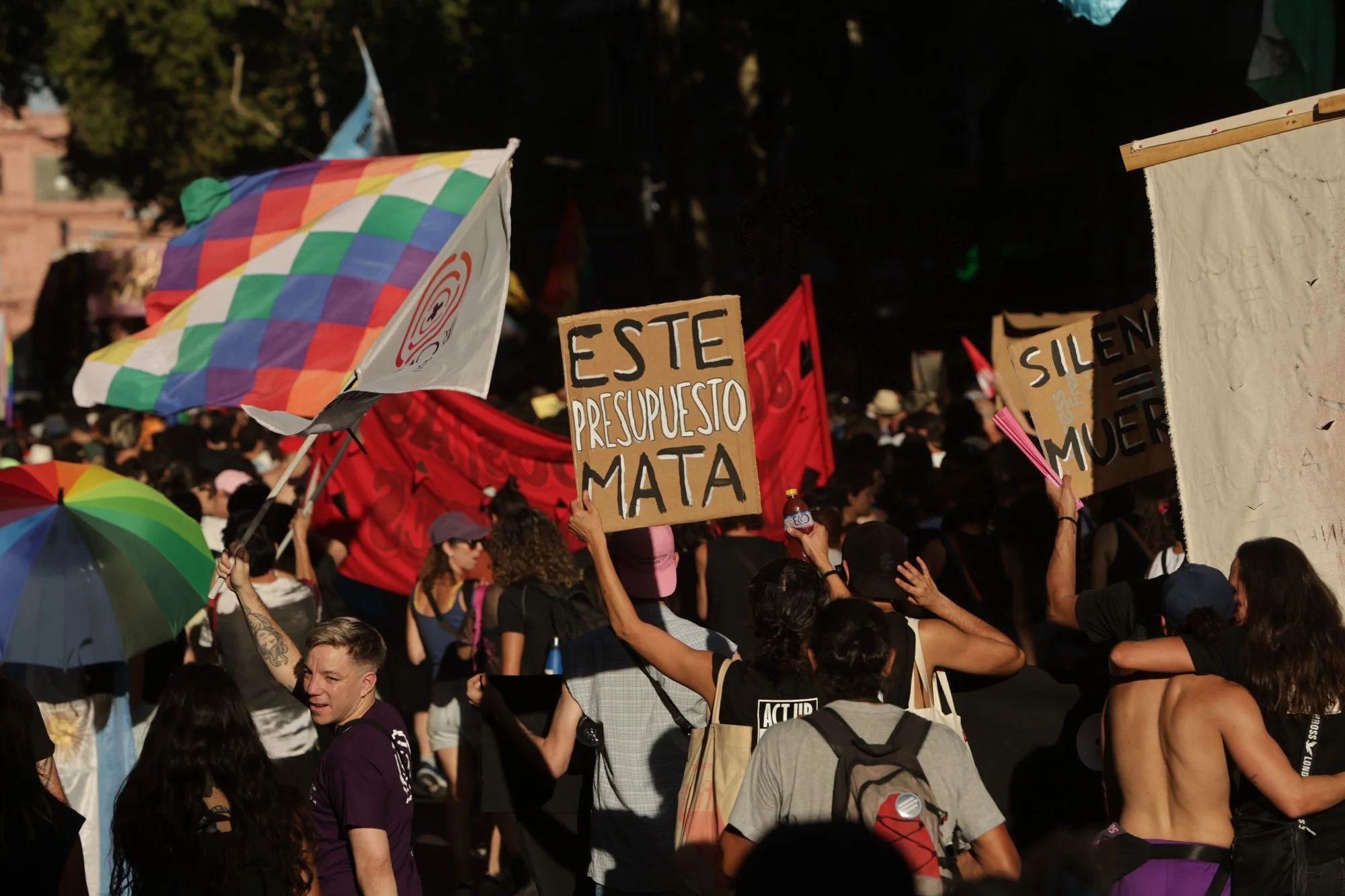
The transfeminist movement in Argentina demonstrated the power that comes from uniting struggles during the second Anti-Fascist and Anti-Racist LGBTIQNB+ Pride March, which took place on February 7. The march was held days before a controversial labor reform proposed by Javier Milei was approved by the Senate this week amid further protests.

On Saturday, at least 200,000 people—including members of the LGBTIQNB+ community, people with disabilities, retirees, migrants, and informal workers—took to the streets in at least 26 locations around the country. The epicenter was downtown Buenos Aires, where a mass of protesters snaked 10 blocks from the National Congress to Plaza de Mayo under sunny skies.

“Nobody is expendable. No life is disposable,” was the rallying cry that brought participants together in Argentina’s first large-scale protest of this year. The aim was to highlight rising levels of poverty, hunger, and institutional violence against the most vulnerable in society.

“Our message addresses how retired people are being discarded as they bear the brunt of this historic austerity,” said Marta Dillon, a journalist, lesbian transfeminist activist, and member of Columna Mostri, one of the march organizers, in an interview with Ojalá. “It also addresses how people with disabilities have been targeted throughout the year, how public health is being defunded, and how these austerity measures impact our lives.”

Return to the streets

Saturday’s march was the second iteration of a mass protest that kicked off last year in response to President Javier Milei’s comments at the World Economic Forum in Davos.

In his speech on January 23, 2025, Milei targeted LGBTIQNB+ rights and feminism and compared homosexuality to pedophilia. The response was swift: on February first (1F), hundreds of thousands of people marched in Buenos Aires as well as cities inside and outside the country. It is estimated around 1.5 million people took part in the protests. 

This year’s march was organized by groups who held local assemblies and virtual meetings with their supporters from around the country. There was agreement that the national government has reined in its rhetoric against diversity over the past year, but it has stepped up austerity policies and measures that curtail rights that hurt marginalized communities the most.

The protest was marked by widespread opposition to the government’s proposed “Labor Modernization Law.” The Senate approved the bill on February 11, which turned into a day of resistance in which dozens were arrested in a fierce police crackdown. Over the coming days, the lower house will decide whether the bill becomes law.

The bill was harshly criticized by centrist and left-wing political sectors, who say it weakens labor protections and increases precarity. Among other things, the bill lowers severance pay, limits the right to strike, increases the workday from eight to 12 hours, and prioritizes direct contracts between employers and employees over collective bargaining agreements.

Anti-fascism, anti-hatred

With the pink, light blue, and white trans flag draped over his shoulders, 10-year-old Martín stood on Avenida de Mayo alongside a friend of his mother’s. “I wanted to come and have a good time and also to stand up for our rights. No one should get to tell us what we can and can’t do,” he told Ojalá. “I’m happy with who I am.”

The travesti-trans community, particularly children and teens, has been repeatedly targeted by the current administration’s policies. After last year’s 1F march, Milei signed Decree 62/2025, which modified the Gender Identity Law, the first in the world to allow people to change their registered gender without pathologizing trans identities. The new decree prohibits trans youth from pursuing gender affirming care.

The national government has also failed to implement the Travesti-Trans Job Quota Law, which establishes a minimum of one percent of jobs in the national public sector for travestis, trans, and non-binary people. Instead, it went in the other direction, firing at least 150 people who had entered public administration under the law’s provisions.

Natasha Narmona was the first trans woman to join the Ministry of Economy. After experiencing repeated harassment and discrimination, she was fired in November of last year.

“I am not the only one going through this, there are many more of us,” Narmona told Ojalá. “Transgender people have no representation, and the little representation we do have—the employment quota—is being taken from us.”

Hate crimes targeting people for their sexual orientation, gender identity, or gender expression have increased since the Milei administration took office in December of 2023. According to the latest report from the National Observatory on LGBT+ Hate Crimes, there were 102 such crimes and attacks in the first half of 2025, a 70 percent increase compared to the same period last year.

“This government’s policy of repression has a real-world impact in terms of the violence suffered by trans people and travestis. Hate speech is more than just talk; it has real consequences,” said Quimey Ramos, a teacher and travesti activist, in an interview with Ojalá. “The situation reflects the desperation of people who, forced into a state of daily survival, hear the government’s messages of hatred and contempt toward those who are different—against people you encounter day to day, but whose identity differs in some way from your own.”

The national government’s “cultural battle” against the LGBTIQNB+ community is compounded by a policy of severe austerity and the latest attempt to change Argentina’s economic and labor structure. 

“The destruction of long-standing labor protections will not only affect trans people and travestis who accessed formal employment through the trans employment quota,” said Ramos. “The labor reform is against workers, and LGBTIQNB+ people are part of the working class.”

The intersectional working class 

Remigia Cáceres, national secretary for disability at the Argentine Workers’ Central Union, was at the head of the march in her wheelchair.

“The disability community needs to be able to come out and protest again,” said Cáceres. “This government has decided to attack the most vulnerable: the LGBT community, people with disabilities, and retirees.”

Migrant rights groups involved in the February 7 march condemned the persecution and criminalization the community has faced since Decree 366/25 modified the Migration Law.

“It’s like in the United States, where they’re hunting down migrants to deport them,” said Sandra Chagas, an Afro-Uruguayan LGBT activist. “That’s this government’s goal, and we won’t allow it.”

Over the past year, Argentina’s Congress passed laws to improve conditions for people with disabilities, pediatric health, public universities, and pensions. They were all vetoed by the president, who claimed “there’s no money.” Later, Congress reviewed the vetoes and rejected most of them via a two-thirds majority in both houses, upholding the new legislation except for the pension increase. Legislators endorsed the presidential veto on the latter.

Zulema Palavecino is a member of Insurgent Retirees who worked for most of her life as a bilingual operator in a telephone union. Every Wednesday, she joins the retirees’ rally in front of the National Congress to demand higher pensions. Many of these demonstrations are repressed by city police. 

“Fascism is a consequence of capitalism,” Palavecino said in an interview with Ojalá, while holding her group’s banner. “The discrimination against us stems from capitalism’s need to divide us. That is why we support all struggles and seek unity.” 

While the world watches as rights are rolled back in Argentina, hubs of resistance are emerging in different parts of the country with distinct sets of demands, united in a shared rallying cry: “In the face of fascism, struggle and solidarity.”

“We believe that this is a year in which this government and others around the world will try to radicalize cruelty,” said transmasculine activist Ese Montenegro. “We have to be interconnected enough that we can give each other the support we need to defeat the global rise of fascism and neoconservatism.”


Source: Originally published by Z. Feel free to share widely.

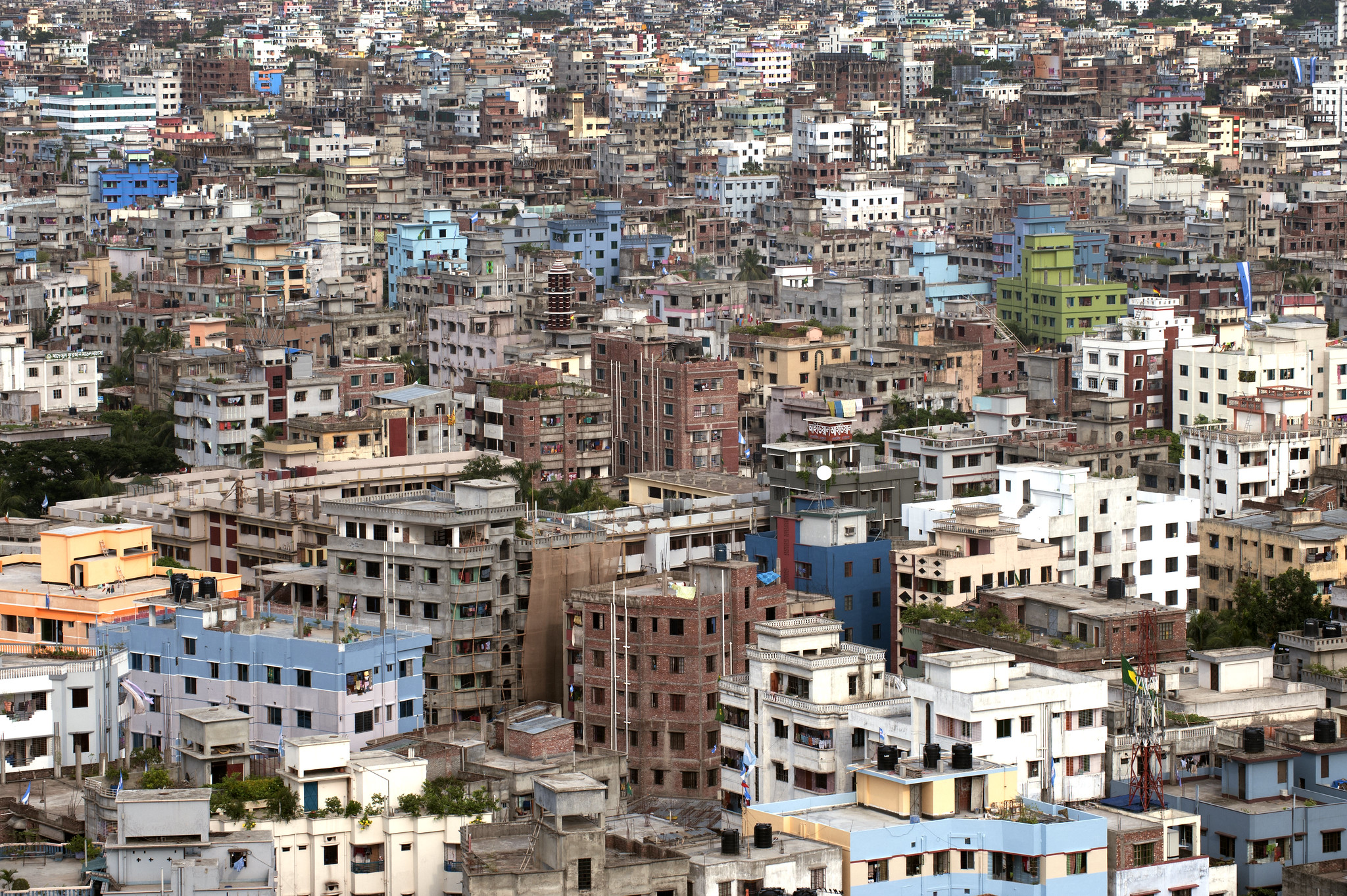
The Bangladesh Nationalist Party (BNP) won a sweeping victory in the 12 February 2026 elections, securing 212 of 300 parliamentary seats. This victory represents not merely a change of government. It is the culmination of a political process that began not with the spontaneous anger of students on the streets of Dhaka in 2024, but much earlier, in the strategic calculations of sections of the Bangladeshi oligarchy and their patrons in the Global North. The Awami League, which had been overthrown in 2024, was banned from the elections. The two major blocs came from the right. Only seven women will sit in the parliament of 350. Only one explicitly left candidate (Zonayed Saki) won.

To understand what has happened in Bangladesh, we must situate this transition within the broader production of a new political geography in Southern and Eastern Asia. The United States, which has sought to reassert control over the Western Hemisphere, is trying with all its instruments to prevent the growth of sovereignty across Africa and Asia as well. Bangladesh’s transition is part of that process.

US policy is not built on a house of sand. The uprising that overthrew the government of Sheikh Hasina in 2024 was real. According to the Labour Force Survey (LFS) conducted by the Bangladesh Bureau of Statistics (BBS) in 2024, there is a significant number of unemployed youths with degrees in Bangladesh. Youth unemployment among graduates at 13.5 percent, informal employment accounting for over 84 percent of the labour force, the suffocating weight of the Digital Security Act and systematic political repression: these are structural contradictions produced by Bangladesh’s export-dependent growth model. But the existence of grievances and the political operationalisation of those grievances are two entirely different matters. The history of foreign political interference, from Georgia and Ukraine to Egypt, teaches a consistent lesson: US hyper-imperialism does not manufacture discontent from nothing; it identifies existing fault lines, funds and channels opposition movements, and orchestrates the escalation from reform demands to regime change at moments of strategic opportunity.

Bangladesh in 2024 followed this textbook with striking fidelity. The quota protests escalated into a wholesale rejection of the Hasina government with a speed and coordination that spontaneous democratic upsurge alone cannot explain. As previously argued, the pattern mirrors Egypt 2011: real suffering, but a political trajectory shaped by forces far removed from the streets. The military-intelligence establishment’s decision to facilitate, rather than suppress, Hasina’s departure is the classic state mechanism through which externally-driven interventions are consummated. When the security apparatus chooses not to defend the sitting government, it is because a decision has already been made, often in coordination with external powers, that the existing regime has outlived its usefulness. The Awami League’s primary offence, from Washington’s perspective, was not its authoritarianism but its strategic autonomy: its balancing act between Beijing and Washington, its acceptance of Chinese infrastructure investment, and its resistance to full integration into the US-led Indo-Pacific architecture. Authoritarianism in US allies, from Saudi Arabia to the Philippines under Marcos, occasions no such transformation. It is sovereignty, not repression, that triggers the interventionist playbook.

Muhammad Yunus and the Neoliberal Fait Accompli

The interim government fronted by Nobel laureate Muhammad Yunus was not a passive caretaker. Much like Mohamed ElBaradei in Egypt, also a Nobel Prize winner, Yunus was the internationally palatable face of a transition whose content was determined by far less visible forces. But unlike ElBaradei, Yunus had deep relationships with Global North financial institutions, alongside his global microfinance network, to implement a comprehensive economic programme before a single vote was cast.

The centrepiece was a $6.4 billion IMF package carrying the standard conditionalities: elimination of fuel subsidies, monetary tightening, banking sector “restructuring,” and fiscal consolidation. Bangladesh’s external debt, already exceeding $100 billion, was further leveraged to enforce compliance with a programme benefiting international creditors and domestic financial elites. Despite his ‘banker to the poor’ reputation, Yunus oversaw stagnating real wages in the garment sector while inflation approached 9 percent. For approximately four million garment workers, overwhelmingly women, the democratic transition was measured in lost purchasing power

This is how such transformations deliver their real payload: not through regime change itself, but through restructuring the economic terrain during the “transition,” ensuring that whoever wins the subsequent election inherits a fait accompli. By 12 February, the parameters of economic policy had been locked in. Democracy was reduced to choosing which faction would administer austerity.

BNP, Washington’s Strategic Reward, and the Fracturing of Bangladesh’s Political Landscape

The BNP’s super-majority is less a democratic verdict than the intended outcome of a two-year political engineering process. For Washington, Bangladesh is a critical node in the containment geography being constructed around China, linking the Indian Ocean to Southeast Asian maritime chokepoints. Under Hasina, Bangladesh accepted Chinese infrastructure investment in projects like the Payra deep-sea port while resisting pressure on military basing and alignment within the Quad-adjacent framework. The BNP, rooted in the military-bureaucratic establishment rather than the Awami League’s secular-nationalist tradition, has historically been amenable to US preferences on market liberalization and security cooperation. Its return signals the strategic recalibration the entire process was designed to produce: deeper integration into US-led frameworks, cooling relations with Beijing, and a permissive posture toward the Western financial conditionalities Yunus had already locked in.

For South Asia, the implications are severe. A Bangladesh oriented toward Washington weakens autonomous regional cooperation, undermines the space for non-aligned development that BRICS and other multilateral platforms have sought to construct, and introduces new instability into an already fractured subcontinent.

Yet the domestic landscape this engineered transition has produced is more volatile than its architects likely intended. Contrary to the 2001-2006 era, BNP and Jamaat-e-Islami contested the elections as bitter rivals. Jamaat led its own 11-Party Alliance, winning 77 seats, with the campaign marked by open hostility and direct BNP-Jamaat clashes in constituencies like Dhaka-3. The rupture carries a historically unprecedented consequence: Jamaat-e-Islami now occupies the position of principal opposition, a status it has never held in Bangladeshi history. An alliance with the National Citizens Party, the group led by the students of 2024, gives the Jamaat extraordinary legitimacy.

The Jamaat is a party whose leadership was implicated in collaboration with the Pakistani military during the 1971 Liberation War and whose senior figures were convicted of war crimes. Freed from coalition constraints, Jamaat can now build hegemonic influence in universities, professional associations, and civil society from the opposition benches, setting ideological terms without bearing governmental responsibility. This is an advantageous position for long-term societal transformation.

The most tragic dimension is what happened to the forces instrumentalised to make the 2024 transformation possible. The National Citizen Party, the political wing of the Gen Z protest movement, failed to translate street power into electoral results.Many student leaders, including figures like Nahid Islam, aligned with Jamaat’s 11-Party Alliance rather than the BNP, viewing the latter as just another dynastic party. The result: youth revolutionaries who toppled a regime ended up in a camp with hardline Islamists, united only by opposition to BNP’s “return to business as usual.” The structural logic mirrors Egypt precisely: without an organised left with a coherent class programme, popular energy is captured by whichever force can most effectively present itself as anti-establishment. Meanwhile, targeted arrests of Awami League members and allied left forces, including the Workers Party of Bangladesh, have continued; media outlets have been shut down and opponents charged with serious offences. The custodians of repression change; repression itself is a structural feature of the state.

Bangladesh now faces a compounded crisis: a BNP government administering IMF-mandated austerity with unchecked parliamentary power; a Jamaat building hegemonic influence with unprecedented institutional recognition; a betrayed generation dispersed across incompatible political vehicles; and an economy pre-configured by neoliberal consolidation with no fiscal space for redistribution. The Indo-Pacific is being reorganised by the political engineering of state orientations. Bangladesh is the latest territory in this new geography. The task for the forces of labour and anti-imperialist solidarity is not merely to document what has been done, but to organise the response.Email

avatar

Vijay Prashad is an Indian historian, editor, and journalist. He is a writing fellow and chief correspondent at Globetrotter. He is an editor of LeftWord Books and the director of Tricontinental: Institute for Social Research. He is a senior non-resident fellow at Chongyang Institute for Financial Studies, Renmin University of China. He has written more than 20 books, including The Darker Nations and The Poorer Nations. His latest books are Struggle Makes Us Human: Learning from Movements for Socialism and (with Noam Chomsky) The Withdrawal: Iraq, Libya, Afghanistan, and the Fragility of U.S. Power. Tings Chak is the art director and a researcher at Tricontinental: Institute for Social Research and lead author of the study “Serve the People: The Eradication of Extreme Poverty in China.” She is also a member of Dongsheng, an international collective of researchers interested in Chinese politics and society.