
The decision to hold the first Jewish Anti-Zionist Congress in Vienna was significant for historical reasons – being where Theodore Herzl formed the ideology that became modern Zionism, as well as Adolf Hitler’s birthplace – and for modern reasons – Austria, alongside Germany, provides unconditional support for Israel, a symptom of its guilt over the Holocaust.
Western nations’ complicity in Israel’s ongoing genocide in Gaza has left the supposed ‘rules-based’ order they claim to represent in ruins. The U.S., UK, Europe, and their allies have provided Israel with the means to act with impunity through weapons, which flow freely, and information, which certainly does not.
The Congress began just as Israel was bombing Iran, a reminder of the threat Zionism poses to global stability. Against this backdrop, over 1,000 anti-Zionist Jews and their allies from across the globe met in the Favoriten District in Vienna, June 13-15, 2025, at a time when the tide is turning, too slowly, but turning, against the settler-colonial ethnostate of Israel.
Israel still has its well-funded lobby groups, and far too many people still believe its hasbara. It seems it’s up to a plucky group of not-so-well-funded anti-fascist dissidents in keffiyehs to turn the tide. While we have the truth and international law on our side, at times our goals seem insurmountable. But as several speakers highlighted, we must keep going, and we do not have the luxury of despondency.

I was there representing South African Jews for a Free Palestine (SAJFP) alongside Roshan Dadoo, the conference’s only South African speaker and coordinator of the South African Boycott, Divestment, and Sanctions (BDS) coalition.
SAJFP sent me to Austria to advocate for a united, Jewish Anti-Zionist movement that is inclusive rather than Eurocentric. Our experience in fighting apartheid as South Africans is also significant, in terms of both our successes and our failures. As United Nations Special Rapporteur Francesca Albanese pointed out via live stream: While the political system underpinning apartheid was defeated in South Africa, the economic and social systems that enabled it remained in place.

While the First Congress did not definitively represent the entirety of global anti-Zionism – hopefully, in time it will, as the follow-up Congress is already being planned for 2026 and is rumored to be taking place in Ireland – the turnout showed the movement is alive, well, and growing. Leading Jewish anti-Zionists in attendance included Israeli-born historian Ilan Pappe, U.S. journalist and filmmaker Katie Halper, and Hungarian/British Holocaust survivor Stephen Kapos.
The voice of Palestinians, crucially, was heard there too, through the presence of people such as Gazan journalist and author Ramzy Baroud, who argued that his people should become a model of resistance against imperialism worldwide. Palestinian physician, academic, and writer Dr. Ghada Karmi was there to emphasize the right of return and Europe’s role in having “created the monster” that is Israel, as was politician Awad Abdelfatah, who has worked from within the Israeli political system, advocating for one, democratic state with equal rights for all who live in it.

The need to reclaim Judaism from Zionism – once seen as a fringe movement within global Jewry as UK writer and activist Tony Greenstein reminded us during a discussion – was a constant theme at the Congress, as was the need to embrace the Yiddish concept of doikayt, or hereness, the idea that Jewish people can, have and will live peacefully with their neighbors in countries across the globe, rather than needing to escape to a physical homeland.
We were also reminded that we were there not just as Jews, but as human beings, and that there is no place for exceptionalism of any kind in this struggle. We must join forces with anti-Zionists across the globe, and our primary duty is to the Palestinian people. Their suffering was highlighted through a video that made many in attendance emotional, in which a surgeon from Gaza detailed his attempts to keep going amid Israel’s systematic dismantling of the enclave’s entire medical system.
The Congress demonstrated that some of the most effective opposition to the Zionist state comes from those born into it. Together with Pappe, others who were born in Israel or have lived there were heard. These included dissident activist Ronnie Barkan, filmmaker and academic Professor Haim Bresheeth-Žabner, and academic and activist Dalia Sarig. These voices provide hope that it’s possible to resist the propaganda that keeps most Israelis loyal to their state, regardless of its actions.
Some speakers were not Jewish or Palestinian but simply anti-Zionists, reaffirming that this is an issue of common humanity. Alongside Albanese was Egyptian journalist Rahma Zein, providing another much-needed African perspective, and French/Palestinian juror and politician Rima Hassan, who managed to join the Congress virtually, despite having just been released from detention after Israel abducted her and other activists on the Madleen Flotilla.

A declaration written with input from all speakers at The Congress seeks to capture the collective positions that were reached during the three days. The declaration condemns the genocide as well as Israel’s apartheid-driven policies, rooted in ethnic cleansing. The document documents Israel’s systematic war crimes in Gaza, “including ethnic cleansing, militarised apartheid, urbicide, scholasticide, medicide, mass starvation”, and condemns Western governments, particularly the U.S., UK, EU, Canada, Australia, and New Zealand, for enabling these actions through military and diplomatic support.
It calls for immediate sanctions, Israel’s suspension from the UN, adherence to BDS (Boycott, Divestment, Sanctions), and nuclear disarmament under IAEA oversight. The declaration also affirms Palestinians’ right to resist occupation and demands an end to Zionist claims of representing global Jewry, urging Jews worldwide to reject Zionism and stand in solidarity with Palestinian liberation.
The signatories reject Israel’s legitimacy as a Jewish state, and note that Zionism is a racist ideology that endangers both Palestinians and Jews. They call for decolonization, the right of return for Palestinian refugees (per UN Resolution 194), and the withdrawal of Israeli forces from all occupied territory since 1948.
The Congress could prove important only if all who attended absorb its message, take it back to our communities, and work hard to grow the movement. The need for greater collaboration between global anti-Zionist groups was evident, as was the need for anti-Zionist Jews to unite as one cohesive movement. Zionism is a highly funded, meticulously organized, and well-oiled machine, and we only have a chance of defeating it together.
To me, more important than anything that came out of the Congress is that it happened, that we united to continue our work, and that it symbolized a return to the roots of Judaism as a religion of peace. Despite all the damage that has been done in our name, Jews can and must be part of building a better world. I believe deep down that a day will come when we truly can celebrate our achievements as anti-Zionists, Jewish or otherwise. But who knows how long that will take? For now, all I really know is that our work has just begun.
Zionism. Is it Good for Jews?
“Zionism, the national liberation movement of the Jewish people.” This is the official definition given by the State of Israel on its website. It is accepted without reservation by all Jewish Israelis, including supporters of “Peace Now.” Except that the Jews are not a nation. If they were, no one could not acquire Jewish status other than through naturalization in the State of Israel. Yet it is entirely possible to become a Jew in the countries of the Diaspora through rabbinical conversion, a procedure which is increasingly frequent. Conversely, non-Jews who obtain Israeli nationality by naturalization do not thereby become Jewish.
Israel, the Zionists tell us, has a right to exist as a Jewish state. In fact it never claimed to be a Jewish state, one among others. The Basic Law, voted by the Knesset in 2018, defines Israel as the nation-state of the Jewish people. This means that all Jews, no matter where they live, owe it their undivided loyalty. And they usually do, at least among older, wealthier Jews, those who wield power and influence. In France, the CRIF, the umbrella organization of all Jewish institutions, proclaims in its charter that “the Jewish community of France recognizes in Israel the privileged expression of Jewish existence.” The Jewish establishment in France, like those of other democracies, is perfectly content to take its lead from Israel.
Zionists claim that they must defend Israel’s legitimacy. In practice, they defend the legitimacy of everything it does. In 1998, a new text appeared in the authorized daily prayer book of the United Synagogue in Britain: “Heavenly Father: Remember the Israel Defence Forces, guardians of our Holy Land. Protect them from all distress and anguish and send blessing and prosperity upon all the work of their hands.” All the work, that is, including the destruction of the Gaza Strip and the indiscriminate killing of unarmed civilians waiting for food. Thus does Zionism contaminate and corrupt Judaism.
The moral bankruptcy of Israel can be seen in the popularity of a book published in 2009 and entitled Torat Ha’Melech (The King’s Torah). The authors, two rabbis who live in the occupied West Bank, justify the killing of Palestinian children who might eventually become terrorists when they grow up. This was too much for even the normally pro-Israel Anti-defamation League, which issued a press release condemning the book. Rabbi Dov Lior, who had been spiritual advisor to Baruch Goldstein and Yigal Amir, nonetheless recommended it to Israeli soldiers in his many sermons.
Zionists in the Diaspora routinely excuse Israel’s crimes against humanity. Israel is not committing genocide, they say. So what is it committing? They also claim that however the Palestinians may suffer, Hamas is solely at fault. This is to forget the statement of Israel’s president, Isaac Herzog, in English, to the press on October 13, 2021: “It’s an entire nation out there that is responsible. . . . We will break their backbone.” And Israel is doing just that – not only in the Gaza Strip, but also in the occupied West Bank, where Hamas has no power.
This callous indifference to the sufferings of others is contrary to Judaism, and in particular to the admonition in Exodus 23, 9: “And a stranger shalt thou not oppress. Ye know the heart of the stranger, seeing as ye were strangers in the land of Egypt.” Alas, not any more. Zionism has robbed most Jews of their moral and ethical heritage. Fortunately a growing minority, consisting mainly of young people, seeks to reclaim it.
The Rise of the Jewish Dual State
Ever since the Six-Day-War (1967) and the occupation of Palestinian territories, Israel has witnessed the rise of the Messianic far-right settler Jews. In my The Fall of Israel, I describe in detail this process, which entered a new stage after the assassination of Prime Minister Yitzhak Rabin and the effective demise of the “peace process.”
The process also intensified the march of the settlers and their proponents into the Israeli institutions, while openly advocating the overthrow of Israel’s secular democracy, the Judeazation of the occupied territories (West Bank, Gaza), Jewish supremacy and racist violence, particularly against Palestinians.
What made this quasi-legal infiltration of the democratic institutions possible was the continuous US military and diplomatic support, coupled with arms transfers and financing, and Europe’s effective indifference.
One way to look at the progression of the quasi-official state violence in Israel is the narrative describing the rise of the Messianic far-right as the march of lawlessness. Yet, such narratives do not adequately explain the existing tensions between the civil bureaucracies and the apocalyptic reformers in Israel.
In The Fall of Israel, I present an alternative way to depict that progression, based on the idea of a “dual state.” This is the notion that the famous German-Jewish lawyer Ernst Fraenkel used to explain how the Nazi party exploited democratic institutions, which it then undermined.
Emergency powers to undermine democracy
At the eve of World War II, Ernst Fraenkel fled from Nazi Germany to the United States, where he published his master treatise, The Dual State (1941). Fraenkel saw the analysis of the political system of the Nazi state as “a contribution to the theory of dictatorship.”
Fraenkel knew the system intimately. In the Weimar Republic, he had been a leading socialist jurist. And as a lawyer he had represented political defendants in court, mainly Jews targeted by the Nazi regime. Eventually, as a dissident, he worked in the underground with several resistance groups until his immigration to America in the late 1930s.
What worried Fraenkel was the gradual perversion of the democratic institutions of the Weimar Republic from 1918 to 1933. During that period, the Nazi Party took power as Hitler was able to use emergency powers to undermine constitutional governance and suspend civil liberties.
How could it happen? How could democracy collapse and Germany end up under a one-party dictatorship? Fraenkel’s simple response was: the dual state. Democratic institutions remained, but mainly as pale shadows. In particular, he showed how the decisions of the courts – as façades rather than effective institutions – precipitated the progress of Nazism in Germany.
Ernst Fraenkel: The Analyst of the “Dual State”

Certificate of Alien Registration issued to Ernst Fraenkel, stamped 21 August 1939. Creator: Wiener Holocaust Library Collections
Rise of the “Dual State” in Nazi Germany
In Fraenkel’s view, the Nazi state had two sides. One featured the normative state, which was “an administrative body endowed with elaborate powers for safeguarding the legal order as expressed in statutes, decisions of the courts, and activities of the administrative agencies.” It represented the rule of law, or what was left of it.
The other side of the dual state referred to the prerogative state; that is, a “governmental system which exercises unlimited arbitrariness and violence unchecked by any legal guarantees.” It excelled in unrestrained artificiality, including violence, unimpeded by any rule of law.
Fraenkel highlighted the constant friction between the traditional judicial bodies representing the normative state, and the agencies of the prerogative state, the instruments of the dictatorship. It was not the courts’ purpose to foster extremist radicalism, but as they did tolerate such legal revisionism, the courts were virtually digging their own graves.
In the postwar era, the idea of the dual state influenced the postwar debates about the Third Reich. But Fraenkel’s theory was not just about Nazi Germany. It was about the potential of political regression in industrialized democracies and thereby about Israel as well.
Contemporary Israel is not Nazi Germany and the early 2020s aren’t the early 1930s. Nor has Israel’s constitutional framework been replaced by the “leader principle” (Führerprinzip) as the basis of executive authority, as of yet. Yet, there are distressing parallels.
Persecuted “aliens” from Weimar Germany to Israel
Emerging first as a fringe movement in the 1970s, the rise of the Messianic far-right was accelerated by the right-wing Likud coalitions since the 1980s. After the failure of underground violence, these groups chose to march into and infiltrate the very democratic institutions they despised, particularly after the Oslo Accords in the 1990s. Through these decades, their clout was reinforced by massive U.S. military aid and Jewish-American financiers, particularly donors representing revisionist Zionism, as evidenced by the many examples underscored in The Fall of Israel.
In Germany, Nazis benefited from the Völkisch ideology, the German ethnic nationalist movement, served as a glue tying together different social and economic groups. In Israel, Jewish ethnonationalism, in varying degrees, has had a similar role cementing political, social and cultural cohesion.
In Germany, the Völkisch nationalists saw the Jews as “aliens” who thus had no business in the new Germany. In Israel, the Jewish far-right perceives the Arabs as aliens in the Jewish state thus favoring the expulsion of the Palestinians but tolerating a minority of Israeli Arabs, to preserve a semblance of a democracy.
German expansionism was legitimized with notions like Lebensraum that, in practice, translated to the ethnic cleansing and genocidal atrocities of Generalplan Ost, which sought to enslave and starve much of Eastern Europe. In Jewish ethnonationalism, “Greater Israel” is the apocalyptic ideology fueling the settlements and efforts to expand Israel’s boundaries, resulting in ethnic expulsions and atrocities, all in the name of “national security.”
With the Gaza War, the Strip has been devastated so thoroughly that most of it will be uninhabitable after hostilities. With the fog of the war, the occupation in the West Bank has effectively shifted from a de facto toward a de jure annexation. Hence, the dramatic increase in settler violence with the tacit support by military and security authorities.
Explosion of Settler Violence Incidents
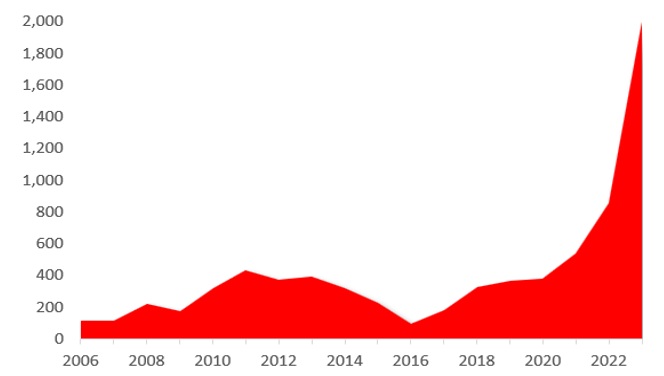
* Includes Palestinian property damage and/or casualties in settler-initiated incidents
Source: Data from OCHA, author.
Mythologies of ”blood and soil”
The Völkisch precedent had relied on the idea of “blood and soil,” fueled by the organicist metaphors of a singular, unified and racially pure social body. It was essentially a frustrated rebellion of lower-middle-class Germans who were sidelined and ignored by the ruling elite of German junkers, industrialists and military, and laboring poor whose socialist leaders had been taken down. The values of romantic nationalism and idealized agrarianism were typical to Germany where industrialization and urbanization, which had uprooted an entire generation of Germans, was still relatively recent.
In Jewish ethno-nationalism, it is the mythologized God-given Eretz Israel, the Land of Israel, that ensures collective singularity and racial purity.
For all practical purposes, this ideology relies on the longstanding resentment by poorer Jews from Arab countries, assertive religious Jews and the ultra-orthodox, the Messianic far-right, coupled with free-market conservatives, ideological Likudniks and the settler zealots.
Among the Messianic far-right, the parallel of the Völkisch “blood and soil” means Jewish supremacy coupled with the Eretz (Land) of Israel. In the 1930s Germany, peasants were celebrated as Nazi cultural heroes and forces of German racial stock and history. In Israel, the champions of the settlers portray them similarly in quasi-mystical terms as pioneers of a glorious future.
For years, historians of Nazi Germany like Moshe Zimmermann have drawn upon the legacy of Weimar Germany to understand the endangerment of Israeli democracy by authoritarian, nationalist and racist forces, “to determine where on the chronological calendar of the Weimar Republic we in Israel were situated. Now, in 2023 we are wondering: Are there not features of the regime in Israel that are familiar from German history after 1933?”
In this trajectory, the Israel of the Messianic far-right has the most prominent role as the romanticism of blood and soil is replaced with apocalyptic eschatology.
Messianic pretext for Jewish autocracy
Following its election triumph in fall 2022, the Messianic far-right saw the Israeli normative state as an unwarranted obstacle to more effective, autocratic governance. The administrative body of the state was all nice and fine, but these elaborate powers that were designed to safeguard the legal order were ill-suited to the national security contingencies that were posing existential threats to Israel. The Jewish state required institutions that served the Jewish people, not its enemies.
With the 2018 Jewish nation-state bill, the prerogative state began to play an ever-greater role in Israel at the expense of the normative state. Responding to this effort at a “judicial regime coup,” hundreds of thousands of Israelis stormed the streets protesting it, a protest which eventually was diluted by demonstrations related to Israeli hostages and the Gaza War.
Yet, most Israelis had voted for the coalition parties that made up the Messianic far-right, which is now subverting the normative state by the exercise of “unlimited arbitrariness and violence unchecked by any legal guarantees.”
As long as the dual state prevailed, the civil servants of the normative state were still able to keep the Messianic far-right of the prerogative state at bay. But to the latter, the Gaza War was a historical, divinely-ordered opportunity not just to take over and annex the occupied territories but also to dominate the government and its vital bureaucracies.
So, when Prime Minister Netanyahu opened the doors of his government to these far-right Messianic extremists in order to achieve a majority coalition, he let the foxes into the henhouse, for a purpose. It paved the way not just to a rising tension between state bureaucracies and state violence, but to the integration of these dual realities.
“Death to the Arabs!”
These shifts have come with a price: the rise of the Israeli internally conflicted dual state, facing an attendant shrinkage of the rule of law in the normative state and the increasing legal arbitrariness and sanctioned violence by the prerogative state.
“There is no police in Israel”
The Messianic far-right has seized central elements of the bureaucratic apparatus and its administrative procedures. Hence, too, national security minister Ben-Gvir’s effort to fill the key positions of national police, security and military with like-minded authorities, even at the risk of incompetence, insecurity and escalation.
At the eve of fall 2024, Ronen Bar, the head of Israel’s security service Shin Bet, wrote an “emergency letter” addressed to PM Netanyahu, the cabinet and the attorney general, warning that “the Jewish terror leaders want to make the system lose control, the damage to Israel is indescribable.” Police incompetence and public legitimacy have led to the expansion of Jewish terrorism, emboldened by “a sense of secret backing” from police. The letter sparked a fiery exchange between Netanyahu and Bar during a prior security cabinet meeting that touched on the deadly settler pogrom in Jit, a Palestinian town west of Nablus:
Netanyahu: “Have we made any arrests?”
Bar: “Two.”
Netanyahu: “Why only two? Why not more?”
Bar: “That’s the role of the police. There’s no police in Israel.”
It was a stunning admission and appeal by the head of Israel’s internal security. Jewish terror, Bar warned, was jeopardizing Israel’s existence, both in the occupied territories and in the volatile border areas.
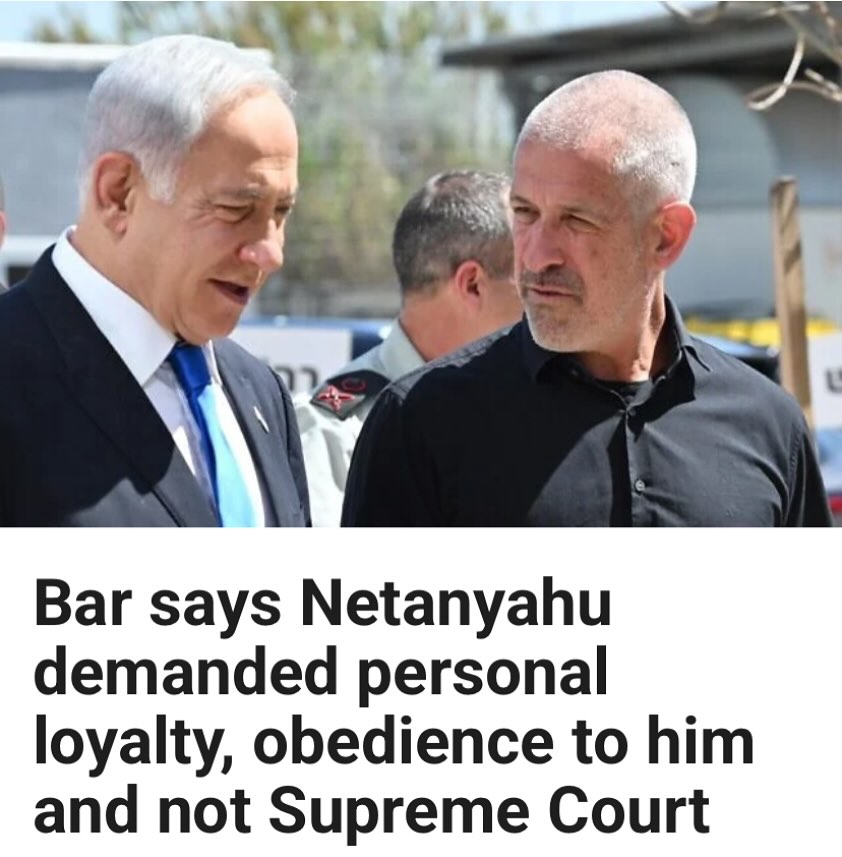
Source: Facebook screen capture (Times of Israel, Apr 21, 2025)
Initially, Bar was expected to serve as director until 2026. Yet, in March 2025 PM Netanyahu fired him claiming to have “lost trust” in him. In reality, Bar was fired after he started to investigate the so-called “Qatari Connection Affair”; that is, the Qatari involvement and influence in the Prime Minister’s Office. Refusing to leave without a fight, Bar submitted an affidavit to the court arguing that Netanyahu was demanding a personal loyalty, while expecting his Shin Bet to act against anti-government protesters and the Supreme Court.
Two weeks after the SC declared Bar’s dismissal “unlawful,” Netanyahu forced the premature end of Bar’s term in mid-June.
The Pyrrhic triumph
Step by step, Israel’s prerogative state is surpassing and suppressing its normative state. And given a unitary Jewish state – the ultimate objective of the Messianic far-right – it would effectively overwhelm the normative state.
Indeed, Israel is on the threshold of a significant, reality-changing process that will deliver indescribable damage to itself and likely world delegitimization. Shin Bet expected revenge attacks to ignite “another front in the multifront war we’re in, bringing more people into the terror circle to carry out their revenge.”
But the price of these steps is the expansion of the prerogative state, which will eventually undermine the state of Israel itself.
The author of The Fall of Israel (2024) and The Obliteration Doctrine (2025), his new book, Dr. Dan Steinbock is an internationally-renowned visionary of the multipolar world and the founder of Difference Group. He has served at the India, China and America Institute (US), Shanghai Institutes for International Studies (China) and the EU Center (Singapore). For more, see https://www.differencegroup.net
Building on my The Fall of Israel, this commentary is the second of a series on Israel’s path from democracy to autocracy. For the first one, see “From Secular Jewish State to a Jewish Herrenvolk Democracy” and the second one, see “Israel’s Conservative Counter-Revolution.”
Israel’s Conservative Counter-Revolution
After its far-right election victory in late 2022, the Netanyahu cabinet’s newly-appointed justice minister, Yariv Levin, claimed that “judicial activism” had ruined public trust in the legal system and made it impossible for the government to rule effectively. Sensing a historical opportunity to remake the Israeli legal system, the new government would seek to “reform” Israel’s judiciary.
And so began Israel’s conservative counter-revolution.
Judicial reforms as a “political coup”
Levin’s draft proposal pushed for sweeping changes in the judiciary, executive and legislative processes and functions. It sought to change the process for choosing judges by giving the government control over the selection and dismissal of all judges, including those in the Supreme Court.
It tried to restrict the Supreme Court’s capacity to strike down laws and government decisions by requiring an enlarged panel of the court’s judges and a “special majority” in order to do so.
It would allow the Israeli parliament Knesset to overrule the Supreme Court by a majority voting against the Court, and had an “override clause” that would enable the Knesset to re-legislate laws unless all justices agreed unanimously to strike them down.
It would allow ministers to select and fire justices’ legal advisors and decide whether or not to adhere to legal advice.
It would prevent the court from using a test of “reasonableness,” which precluded the courts from hearing petitions or appeals against governmental and administrative decisions perceived as “unreasonable.”
Opposition leader Yair Lapid called Levin’s reform draft “a letter of intimidation,” contending that the Netanyahu cabinet threatened to “destroy the entire constitutional structure of the State of Israel.”
Speaking against the proposed reforms, Lapid warned of an impending “political coup.”
From constitutional revolution…
Along with New Zealand, San Marino, Saudi Arabia, and the United Kingdom, Israel is one of few countries operating according to an uncodified constitution. In the 1950 Harari Decision following Israeli independence, the Knesset, dominated by Labor governments, opted to legislate the constitution in a piecemeal fashion.
Between the 1950s and late 1980s, it passed nine Basic Laws. Many of these laws center on individual liberties, but also on the principal state institutions and civil rights. Some were earlier protected by the Supreme Court. In particular, The Basic Law: Human Dignity and Liberty ensured the Supreme Court had the authority to disqualify any law contradicting it, and protection from Emergency Regulations. These rights are critical to dissidents in Israel, Israeli Arabs and civil rights in the occupied territories.
Until the proposed judicial reforms, all legislation, government orders and administrative actions of state bodies in Israel were subject to judicial review by the Supreme Court. Between 1992 and 1999 – that is, in parallel with the peace process – Supreme Court Justice Aharon Barak, in a series of rulings, developed something of a doctrine, or “Constitutional Revolution,” as he called it. This transformation, he argued, came about with the adoption of the Basic Laws focused on human rights in the Knesset and by the Supreme Court.
The Constitutional Revolution elevated these laws – including the right to equality, freedom of employment and freedom of speech – to a position of normative supremacy, thus granting the courts rather than just the Supreme Court the ability to strike down legislation deemed inconsistent with the rights embodied in the Basic Laws. As the net effect, Israel morphed from a parliamentary democracy to a constitutional parliamentary democracy, in which the Basic Laws were seen as its constitution.

Aharon Barak (sitting; left) at a meeting at Camp David with (l-r) PM Menachem Begin, President Anwar Sadat, and Defense Minister Ezer Weizmann, Sept. 17, 1978. Author: CIA
Source: Wikipedia
… To conservative counter-revolution
Over a decade later, in parallel with the failure of the peace process, the proponents of judicial reform wanted to bury Barak’s “constitutional revolution.” Hence, the Netanyahu cabinets’ counter-revolution.
The separation between the legislative and executive branches is relatively weak in Israel since the government tends to hold a majority – however fragile – in the Knesset. Consequently, the Supreme Court is effectively the last institution having the power to limit government actions and legislation passed by a parliamentary majority. That’s why Levin and the Netanyahu cabinet hoped to shift that power from the judiciary to the government. To succeed, they first had to subvert Justice Aharon Barak’s constitutional revolution.
Due to the absence of such a constitution in Israel, the Likud governments have sought to surpass it via a body of rulings serving the same purpose. This is, in effect, a legal counter-revolution, aiming to protect the economic interests of those forces that finance Likud’s conservative leaders, the Messianic far-right and the settlers in the occupied Palestinian territories.
In this view, the proposed judicial reforms are an attempt to hammer out a Jewish democracy at the expense of secular civil rights, while turning the de facto apartheid practices in the occupied territories into a de jure rule.
Interestingly, the draft of the proposed judicial reforms came from the Misgav Institute for Zionist Strategies, a think tank with many American-Jewish members and Israeli settler hawks. As its first major project, the think tank drafted the versions of reforms first submitted to the Knesset in the 2000s.
Even more intriguingly, Misgav also advised the Israeli government on Gaza, arguing right after the Hamas offensive of October 7, 2023, that the war offered a “rare opportunity to evacuate the entire Gaza Strip” and ethnically cleanse Gaza.
Judicial reforms as a Jewish civil war déjà vu
After the electoral triumph of the Israeli far-right, the Netanyahu cabinet could finally begin to push the highly controversial judicial reforms in January 2023. The effort was led by Netanyahu’s deputy PM and minister of justice, Yariv Levin, and the chair of the Knesset’s constitution committee, Simcha Rothman.
Like Netanyahu, Levin is a veteran Likud politician, a scion of a far-right family. His maternal uncle was a conservative member of the first Knesset and the commander of the cargo ship Altalena. In June 1948, that ship was loaded with fighters of the far-right terrorist group Irgun and a huge cache of military equipment. A violent confrontation ensued between the newly created Israeli Defense Force (IDF) led by Ben-Gurion, and the Irgun headed by Menachem Begin’s revisionist Zionist who prioritized terror and violence.
It was a clash the revisionists never forgave and it almost unleashed a civil war between the two groups eager to take over the Jewish state.
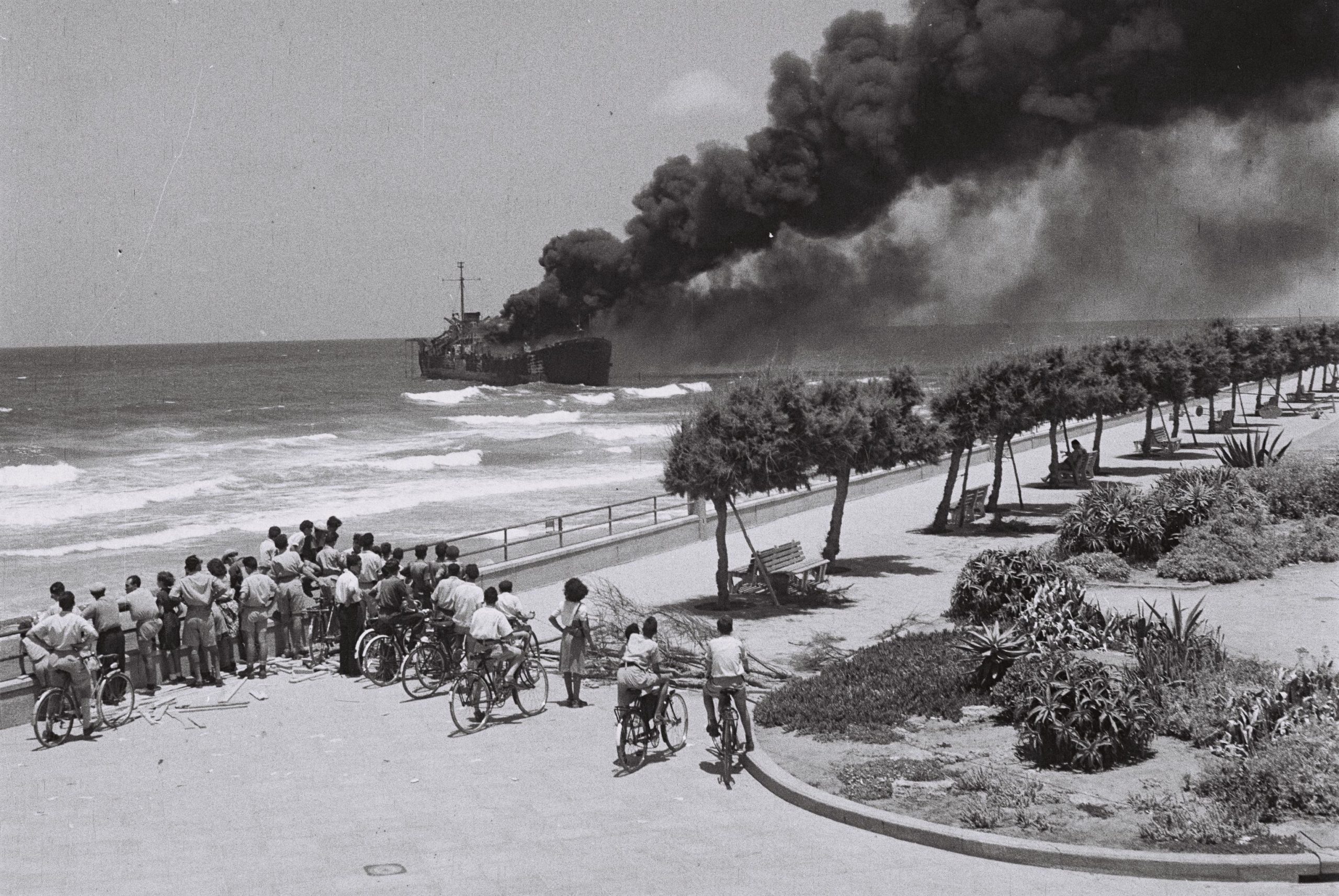
The ship Altalena on fire after being shelled near Tel-Aviv.
Source: Wikipedia
The Levins were on the defeated Irgun’s side, and decades later Begin served as the honorary guest holding the baby, Yariv, at his circumcision ceremony. As a rising Likud star, Levin fought against Israeli withdrawal from Gaza in 2005. He opposes the creation of a Palestinian state and the two-state solution, supports settlers and believes Jews have the right to remain in all parts of the land of Israel.
Simcha Rothman is Levin’s mirror image on the side of the religious militants. He is a Knesset member of the far-right Religious Zionist Party and the chair of its constitutional committee. Born into a Jewish-American family from Cleveland, Ohio, he lived in Bnei Brak, the center of orthodox and haredi Judaism east of Tel Aviv. A critic of Netanyahu’s corruption trial, Rothman represented the militant, anti-Arab party promoting far-right Kahanism and Jewish supremacy supporting the annexation of the occupied territories to Israel. In late 2023, he called for “resettling” Gaza’s refugees; that is, for ethnic cleansing in the Strip.
When the dynamic duo, Levin and Rothman, unveiled the government plan for a legislative overhaul of the country’s judicial system, all hell broke loose.
Mass protests against judicial reforms and the apartheid system
The champions of Israel’s often-controversial policies like to say that Israel is the only democracy in the Middle East, discounting elections being held in countries such as Türkiye and Iran. In reality, Israel’s democracy ranking has eroded in the past decades.
According to popular democracy indices, the Middle Eastern and North African countries with highest scores feature Israel, Tunisia and Iraq. Nonetheless, given its role as an occupying state, Israel is seen as a “flawed democracy” ranking behind almost half a hundred countries and at par with Panama, Colombia and South Korea, another U.S. client state.
Israeli voters are painfully aware of Israel’s democratic erosion. The proposed judicial reforms were opposed by most Israelis in massive protests, which began soon as the cabinet introduced the reform package. Starting in Tel Aviv’s Habima Square, the site of the huge 2011 cost-of-living protests, the anti-reform demonstrations garnered some 20,000 protesters, with smaller rallies of thousands in Jerusalem and elsewhere.
Typically, the first protest was organized by “Standing Together,” a grassroots Arab-Jewish movement, though it did not address Palestinian interests. In just a week, the number of the protesters grew eight-fold to some 150,000 people while demonstrations spread in Israeli cities. By mid-March – half a year before the Gaza War – up to 260,000 people were demonstrating in Tel Aviv.

Israeli mass protests against the proposed “judicial reforms” in Tel Aviv, March 4, 2023. (photo by Amir Terkel)
Source: Wikimedia
By mid-June 2023 – just four months before the Gaza War – massive nationwide protests were the new norm. In the past, Israel’s judiciary had regularly upheld policies, practices and laws that helped enforce the “system of apartheid against Palestinians,” including upholding administrative detentions, green lighting the destruction of villages and imposing restrictions on family reunification. But on some occasions, the Supreme Court had intervened to protect Palestinian rights.
With the judicial reforms, even this “slim and inconsistent” protection was expected to disappear. The proposed overhaul had chilling implications for Palestinian rights.
A month before October 7, 2023, the Supreme Court heard the case. But then, just as the protests were about to collapse the Netanyahu cabinet and result in new elections, the Hamas offensive ensued – followed by Israel’s massive retribution war.
Toward an autocratic, ethnically cleansed judiciary
Given that the far-right cabinet held a 64-seat majority in the 120-seat Knesset prior to the Gaza War, opposition parties could do little within the legislature to stop the judicial reforms.
Following a year of protests against these reforms and three months of anti-government demonstrations amid the Gaza War, the Supreme Court struck down the bill on January 1, 2024. Though celebrated as a triumph for democracy in Israel and abroad, the vote was tight (8-7) at the historic 13-hour hearing. Moreover, the justices also ruled that the Supreme Court has the power to overturn the Basic Laws (12-3). In other words, the tight vote reflected significant support for the judicial reforms even in the High Court of Justice itself.
As far as the Netanyahu cabinet was concerned, it was unable to implement its judicial reforms in the fog of the war, but it would continue its two-decade long struggle for its bill.
The first step was taken in late March 2025, when the Knesset passed a bill to change the makeup of the Judicial Selection Committee. It is set to go into effect after the next general election. Concurrently, Justice Minister Yariv Levin will prevent the committee from naming new judges, thus effectively paralyzing the Supreme Court which will have only 11 justices, instead of the full complement of 15.
Not only does the bill mark the first time in Israeli history that the process of choosing judges will come under the control of politicians. It will undermine what is left of the democratic due process. In the name of “diversity of the courts,” it is also likely to undermine the representation of Arab judges on both the Supreme Court and lower courts, thus effectively ensuring apartheid system in judicial practices – ethnically cleansed courts, if you will.
The 20-year transformation
And so, in June over 10,000 right-wing Likud and far-right Messianic Jews protested against Israel’s Supreme Court in Jerusalem. The demonstration featured speeches by several of Prime Minister Netanyahu’s senior ministers, including Finance Minister Bezalel Smotrich, a self-proclaimed fascist who has been pushing for ethnic cleansing in Gaza; Justice Minister Yariv Levin, the architect of judicial reforms and proponent of Greater Israel; National Security Minister Itamar Ben-Gvir, the far-right champion of ethnic cleansing in the West Bank by any means necessary, and Heritage Minister Amichai Eliyahu who has promoted the “nuking of Gaza.”
How to “Weimarize” Israeli Democracy
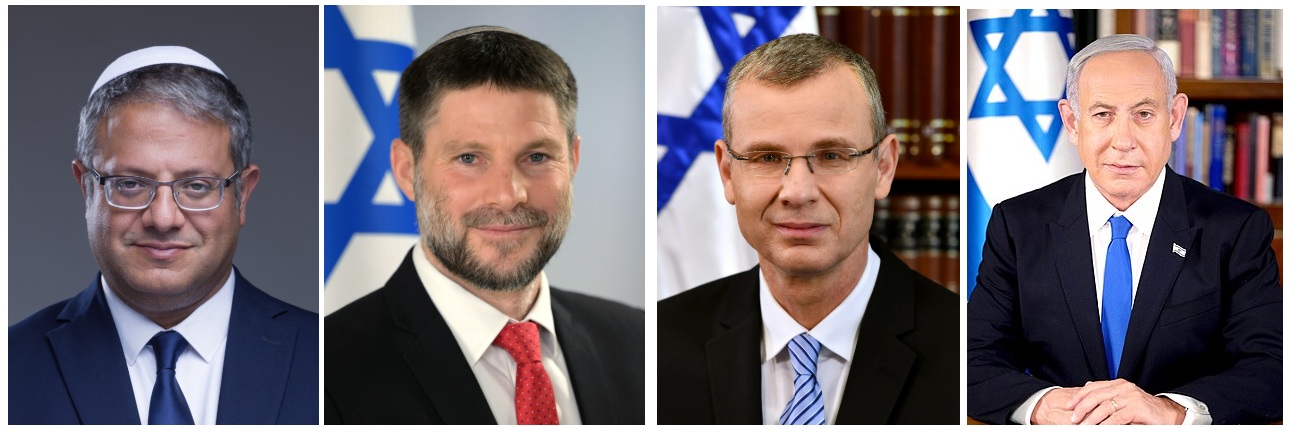
From the Kahanite Ben-Gvir and self-proclaimed fascist Smotrich to Likud’s Yariv and Netanyahu
Source: Wikipedia
Emboldened by the incessant arms flows and financing by the United States, the triumphant far-right leaders were effectively celebrating Israel’s 20-year transformation from secular democracy to Jewish autocracy.
Such events make many uncomfortable in Israel. Recently, former Attorney General Avichai Mendelblit warned that the direction “we’re heading in is toward the end of democracy in Israel.” He described the government’s agenda as “undermining the gatekeepers and the protective mechanisms” of the democratic system. Just days ago, the Netanyahu cabinet dismissed Attorney General Gali Baharav-Miara. It is undermining the Supreme Court. It is suppressing the free press, which is also haunted by elevated military censorship whose concern is not so much “national security” than the impunity of the most far-right cabinet in Israeli history.
Worse, the Netanyahu government is only beginning its purges and show trials.
From Weimar Republic to Israeli democracy
Over a century ago, it was the fall of the Weimar democracy that paved the way to the darkest chapter in the German history. It is the subversion of the Israeli state institutions that paved the way to the genocidal atrocities in Gaza – and that are now setting the stage for the dramatic fall of Israel.
In early July, the Ministerial Committee for Legislation approved a bill that would permit the next government to terminate the tenure of senior officials in the defense, justice and finance ministries.
Currently, there is a bill advancing through the Knesset that would allow any incoming government to remove top figures in the legal, defense, and financial establishments, including budget director, and CEOs of government companies – as well as the attorney general, military chief of staff, Israeli prison service commissioner, and the directors of Shin Bet and Mossad – within 100 days of taking office.
The legislation is a dictator’s delight; a legal weapon of democracy’s mass destruction. It is vital to the far-right government to complete the rise of the Israeli dual state.
The author of The Fall of Israel (2024) and The Obliteration Doctrine (2025), his new book, Dr. Dan Steinbock is an internationally-renowned visionary of the multipolar world and the founder of Difference Group. He has served at the India, China and America Institute (US), Shanghai Institutes for International Studies (China) and the EU Center (Singapore). For more, see https://www.differencegroup.net
Building on my The Fall of Israel, this commentary is the second of a series on Israel’s path from democracy to autocracy. For the first one, “From Secular Jewish State to a Jewish Herrenvolk Democracy,” click here.
European Union/Israel: Time to choose on trade agreements
Monday 21 July 2025, by Manue Ouzo
On 20 May 2025, the Foreign Affairs Council of the EU (European Union) decided to revise the Association Agreement with Israel. On 23 June, a damning report confirming the accusations against Israel of several international crimes was presented calling into question these agreements.
Trade treaties with Israel are not recent and began as early as the 1970s with the GATT (General Agreement on Tariffs and Trade) agreements, when the EU sought to expand new trade partnerships to countries outside Europe (this was the case with Turkey as well, despite the military regime and the repression of the Kurdish people).
The state of Israel is even an associated state with the EU, governed by the European Neighbourhood Policy, the Euro-Mediterranean Partnership and the Union for the Mediterranean.
Tax exemption and colonialism
An agreement, which came into force on 1 June 2000, means that Israeli products benefit from the same tax advantage as an EU product. Nevertheless, in December 2008, following the mobilisation of civil society, the EU blocked exports from the settlements – whereas in December 1996, oranges “originating” in Israel had been given a special agreement to compete with oranges from southern Europe. These products always have an unclear origin and can still come from settlements when it comes to products from the West Bank.
A first campaign for the suspension of this agreement had led to the European Parliament’s vote in 2002 to suspend the agreement, but this was never ratified by the Council of Europe. According to the BDS website, a third of Israeli exports come from the settlements ($2 billion), despite Article 2 of the cooperation agreements which stipulates that relations between the EU and Israel “are based on respect for human rights and democratic principles”.
The various governments of Ehud Barak, Ariel Sharon and Netanyahu have never respected this article. However, the agreements have not stopped.
A privileged partnership
The European Union is Israel’s largest trading partner. It is not ready to be deprived of more than €20 billion in resources, scientific exchanges around the Galileo satellite positioning system, technological innovations in telephony and, above all, the gas pipeline project under the Mediterranean.
What is exceptional is not that the EU is revising its agreement, but that it did not do so as early as 2003 and the first massacres of civilians in Jenin after the implementation of these agreements in 2000. Israel does not recognise either international or European law, but we can also see that the EU itself does not respect its own texts.
The Spanish state, whose Prime Minister Sanchez has announced that he “does not do business with a genocidal state,” nevertheless continues to have more than 40 contracts in force, whether via the state itself or via private companies.
The 27 EU member states have somewhat hardened their position in the face of the worsening situation in Gaza in recent months, but the review concludes that there are “indications of violations” of human rights commitments. A minimal and highly cautious analysis, carried out by the EEAS (European External Action Service).
Continuing the mobilization
To be clear, even if it is a step forward, the position of the EU foreign ministers is not a guarantee. Israel’s ambassador to the EU, Haim Regev, said that the Foreign Ministry was “working and conducting an intensive diplomatic campaign” to ensure that the agreement is not suspended but re-examined with the support of 10 of the 27 member states. The total suspension would require the unanimity of the 27. However, some aspects can be suspended by qualified majority, such as trade or energy exchanges.
While continuing the pressure on MEPs, like the BDS campaign, it is through mobilizations, boycotts, denunciations, that we can affect the Israeli economy.
16 July 2025
Translated by International Viewpoint from l’Anticapitaliste.
Attached documentseuropean-union-israel-time-to-choose-on-trade-agreements_a9096.pdf (PDF - 906.4 KiB)
Extraction PDF [->article9096]
Manue Ouzo is an activist of the NPA-A in France.
International Viewpoint is published under the responsibility of the Bureau of the Fourth International. Signed articles do not necessarily reflect editorial policy. Articles can be reprinted with acknowledgement, and a live link if possible.

No comments:
Post a Comment