
The question is not whether a particular president’s motives are sincere, nor whether a foreign government is flawed. The question is whether the United States will remain governed by law―or by precedent accumulated through silence.
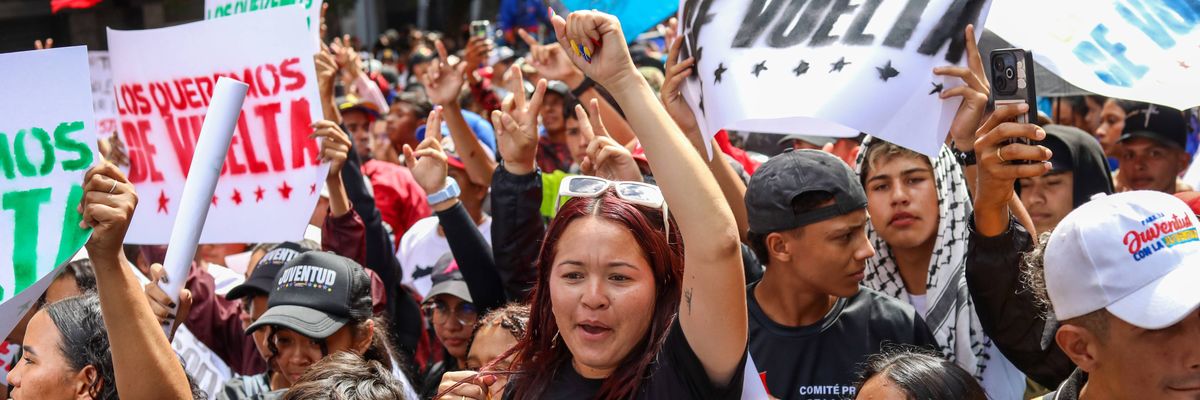
Supporters of Venezuelan President Nicolas Maduro and his wife, Cilia Flores, gather during a demonstration, expressing solidarity with the government, in Caracas, Venezuela, on January 8, 2026.
(Photo by Ivan McGregor/Anadolu via Getty Images)
Angel Gomez
Jan 09, 2026
Common Dreams
The recent Senate debate over U.S. military action in Venezuela exposes a fundamental rupture in American constitutional governance: who has the authority to initiate war. The Constitution answers that question plainly. Yet modern practice―and the arguments advanced in defense of it―have drifted dangerously far from that design. Alongside this constitutional crisis stands a second, inseparable issue: whether the United States may lawfully claim control over the natural resources of another sovereign nation, specifically Venezuela’s oil, under the threat of force.
These questions are not abstract. They determine whether the United States remains governed by law or by precedent accumulated through executive action and congressional silence.
‘This is About Oil and Regime Change’: GOP Lawmaker Speaks Out Against Push for War in Venezuela
‘Get the Oil Flowing’: Trump’s Own Words Make His War Aims in Venezuela Clear
At the center of the debate are two sharply opposed views articulated on the Senate floor. One asserts that the President, as Commander in Chief, may unilaterally use military force whenever he deems it necessary to advance national interests, with Congress relegated to the limited roles of funding restriction or impeachment after the fact. The other insists that the power to initiate war belongs exclusively to Congress, not as a technicality, but as a deliberate constitutional safeguard against impulsive, personalized, or imperial war-making.
Constitutional design and deliberate restraint lie at the heart of the Framers’ intent. Article I of the Constitution vests in Congress―not the President―the power to declare war. Article II assigns the President the authority to command the armed forces once war is authorized and to repel sudden attacks. This division was not accidental. It reflected deep skepticism, shared across the Founding generation, that executives are structurally inclined toward war. James Madison warned that the executive branch is “most prone to it,” driven by secrecy, ambition, and the temptation of unilateral action.
Bombing a foreign capital, removing a sitting head of state, and threatening prolonged military occupation are acts of war by any ordinary, historical, or legal definition. The Constitution does not permit semantic evasions to substitute for authorization.
The Framers, therefore, made war intentionally difficult to launch. They placed the decision in a deliberative body accountable to the people, requiring public debate, recorded votes, and political responsibility. That Congress has too often failed to exercise this duty does not diminish the Constitution’s command. Repeated violations do not convert usurpation into legality. Historical drift explains how power migrated; it does not justify why it should remain there.
Attempts to rebrand large-scale military operations as “law enforcement,” “arrest warrants,” or “limited actions” do not change their substance. Bombing a foreign capital, removing a sitting head of state, and threatening prolonged military occupation are acts of war by any ordinary, historical, or legal definition. The Constitution does not permit semantic evasions to substitute for authorization.
The War Powers Resolution―and the myth of congressional overreach is often invoked as the supposed villain. Critics claim that the 1973 War Powers Resolution is unconstitutional because it allegedly transforms Congress into “535 commanders-in-chief.” This argument inverts constitutional logic. The Resolution does not empower Congress to command troops; it reasserts Congress’s authority to decide whether hostilities initiated by the executive may lawfully continue. It exists precisely because Congress had been sidelined, not because it had seized power.
The statute’s reporting requirements and time limits are accountability mechanisms, not vetoes of military command. Congress’s true failure has not been excessive interference but persistent abdication―avoiding the political responsibility of authorizing war while permitting presidents to act first and justify later. That abdication corrodes checks and balances and transfers the gravest decision a democracy can make into the hands of one person.
Sovereignty, coercion, and Venezuela’s oil bring the constitutional crisis into sharp international focus. The claim that the United States may seize, sell, or administer Venezuelan oil for “mutual benefit” or reconstruction collapses under legal scrutiny. As reaffirmed by the United Nations Secretary-General, Venezuela’s oil belongs to the Venezuelan people. This is not rhetoric; it is a cornerstone principle of international law grounded in state sovereignty and permanent sovereignty over natural resources.
Any alleged “agreement” cited by the Trump administration with a Venezuelan interim authority cannot be credibly described as a genuine agreement at all. Consent extracted under duress is not consent. When a population faces a clear and present threat of escalating military force―further ground operations, hundreds more civilian deaths, and a highly probable invasion―what follows is not agreement but coerced acquiescence. Allowing foreign control of national resources under the shadow of overwhelming military power is not voluntary cooperation; it is survival under threat.
The decision to go to war is not merely strategic. It is moral, constitutional, and irrevocable.
International law does not recognize resource transfers imposed by force or intimidation as legitimate. To do so would resurrect a doctrine of conquest the modern international order was built to reject. If oil may be seized in Venezuela today because military pressure makes resistance impossible, it may be seized anywhere tomorrow by any power willing to invoke its own version of “national interest.”
Such actions erode not only international norms but the United States’ own legal and moral standing. They convert foreign policy from diplomacy into extraction and military power from defense into appropriation.
Democratic accountability and the cost of war demand a return to constitutional first principles. The decision to go to war is not merely strategic. It is moral, constitutional, and irrevocable. It places citizens in harm’s way, reshapes international relations, and unleashes consequences that last generations. That is precisely why the Constitution assigns the initiation of war to Congress.
Congressional authorization does not weaken national security; it strengthens it by conferring legitimacy, public consent, and strategic clarity. History shows that when the United States has truly been attacked, Congress has acted swiftly and decisively. What the Framers sought to prevent was not defense, but adventurism―wars launched without deliberation, accountability, or consent.
Allowing one individual to initiate war, seize foreign leaders, and appropriate another nation’s resources without congressional approval collapses the separation of powers and invites abuse. It replaces law with discretion, deliberation with impulse, and sovereignty with force.
In the end, the question is not whether a particular president’s motives are sincere, nor whether a foreign government is flawed. The question is whether the United States will remain governed by law―or by precedent accumulated through silence. On that question, the Constitution is unambiguous.
War begins with Congress.
And Venezuela’s oil belongs to Venezuelans.
Our work is licensed under Creative Commons (CC BY-NC-ND 3.0). Feel free to republish and share widely.
Angel Gomez
Mr. Angel Gomez is a researcher specializing in the societal impact of government policies. He has a background in psychoanalytical anthropology and general sciences.
Full Bio >
The recent Senate debate over U.S. military action in Venezuela exposes a fundamental rupture in American constitutional governance: who has the authority to initiate war. The Constitution answers that question plainly. Yet modern practice―and the arguments advanced in defense of it―have drifted dangerously far from that design. Alongside this constitutional crisis stands a second, inseparable issue: whether the United States may lawfully claim control over the natural resources of another sovereign nation, specifically Venezuela’s oil, under the threat of force.
These questions are not abstract. They determine whether the United States remains governed by law or by precedent accumulated through executive action and congressional silence.
‘This is About Oil and Regime Change’: GOP Lawmaker Speaks Out Against Push for War in Venezuela
‘Get the Oil Flowing’: Trump’s Own Words Make His War Aims in Venezuela Clear
At the center of the debate are two sharply opposed views articulated on the Senate floor. One asserts that the President, as Commander in Chief, may unilaterally use military force whenever he deems it necessary to advance national interests, with Congress relegated to the limited roles of funding restriction or impeachment after the fact. The other insists that the power to initiate war belongs exclusively to Congress, not as a technicality, but as a deliberate constitutional safeguard against impulsive, personalized, or imperial war-making.
Constitutional design and deliberate restraint lie at the heart of the Framers’ intent. Article I of the Constitution vests in Congress―not the President―the power to declare war. Article II assigns the President the authority to command the armed forces once war is authorized and to repel sudden attacks. This division was not accidental. It reflected deep skepticism, shared across the Founding generation, that executives are structurally inclined toward war. James Madison warned that the executive branch is “most prone to it,” driven by secrecy, ambition, and the temptation of unilateral action.
Bombing a foreign capital, removing a sitting head of state, and threatening prolonged military occupation are acts of war by any ordinary, historical, or legal definition. The Constitution does not permit semantic evasions to substitute for authorization.
The Framers, therefore, made war intentionally difficult to launch. They placed the decision in a deliberative body accountable to the people, requiring public debate, recorded votes, and political responsibility. That Congress has too often failed to exercise this duty does not diminish the Constitution’s command. Repeated violations do not convert usurpation into legality. Historical drift explains how power migrated; it does not justify why it should remain there.
Attempts to rebrand large-scale military operations as “law enforcement,” “arrest warrants,” or “limited actions” do not change their substance. Bombing a foreign capital, removing a sitting head of state, and threatening prolonged military occupation are acts of war by any ordinary, historical, or legal definition. The Constitution does not permit semantic evasions to substitute for authorization.
The War Powers Resolution―and the myth of congressional overreach is often invoked as the supposed villain. Critics claim that the 1973 War Powers Resolution is unconstitutional because it allegedly transforms Congress into “535 commanders-in-chief.” This argument inverts constitutional logic. The Resolution does not empower Congress to command troops; it reasserts Congress’s authority to decide whether hostilities initiated by the executive may lawfully continue. It exists precisely because Congress had been sidelined, not because it had seized power.
The statute’s reporting requirements and time limits are accountability mechanisms, not vetoes of military command. Congress’s true failure has not been excessive interference but persistent abdication―avoiding the political responsibility of authorizing war while permitting presidents to act first and justify later. That abdication corrodes checks and balances and transfers the gravest decision a democracy can make into the hands of one person.
Sovereignty, coercion, and Venezuela’s oil bring the constitutional crisis into sharp international focus. The claim that the United States may seize, sell, or administer Venezuelan oil for “mutual benefit” or reconstruction collapses under legal scrutiny. As reaffirmed by the United Nations Secretary-General, Venezuela’s oil belongs to the Venezuelan people. This is not rhetoric; it is a cornerstone principle of international law grounded in state sovereignty and permanent sovereignty over natural resources.
Any alleged “agreement” cited by the Trump administration with a Venezuelan interim authority cannot be credibly described as a genuine agreement at all. Consent extracted under duress is not consent. When a population faces a clear and present threat of escalating military force―further ground operations, hundreds more civilian deaths, and a highly probable invasion―what follows is not agreement but coerced acquiescence. Allowing foreign control of national resources under the shadow of overwhelming military power is not voluntary cooperation; it is survival under threat.
The decision to go to war is not merely strategic. It is moral, constitutional, and irrevocable.
International law does not recognize resource transfers imposed by force or intimidation as legitimate. To do so would resurrect a doctrine of conquest the modern international order was built to reject. If oil may be seized in Venezuela today because military pressure makes resistance impossible, it may be seized anywhere tomorrow by any power willing to invoke its own version of “national interest.”
Such actions erode not only international norms but the United States’ own legal and moral standing. They convert foreign policy from diplomacy into extraction and military power from defense into appropriation.
Democratic accountability and the cost of war demand a return to constitutional first principles. The decision to go to war is not merely strategic. It is moral, constitutional, and irrevocable. It places citizens in harm’s way, reshapes international relations, and unleashes consequences that last generations. That is precisely why the Constitution assigns the initiation of war to Congress.
Congressional authorization does not weaken national security; it strengthens it by conferring legitimacy, public consent, and strategic clarity. History shows that when the United States has truly been attacked, Congress has acted swiftly and decisively. What the Framers sought to prevent was not defense, but adventurism―wars launched without deliberation, accountability, or consent.
Allowing one individual to initiate war, seize foreign leaders, and appropriate another nation’s resources without congressional approval collapses the separation of powers and invites abuse. It replaces law with discretion, deliberation with impulse, and sovereignty with force.
In the end, the question is not whether a particular president’s motives are sincere, nor whether a foreign government is flawed. The question is whether the United States will remain governed by law―or by precedent accumulated through silence. On that question, the Constitution is unambiguous.
War begins with Congress.
And Venezuela’s oil belongs to Venezuelans.
Our work is licensed under Creative Commons (CC BY-NC-ND 3.0). Feel free to republish and share widely.
Angel Gomez
Mr. Angel Gomez is a researcher specializing in the societal impact of government policies. He has a background in psychoanalytical anthropology and general sciences.
Full Bio >
Progressives Say ‘No Taxpayer Subsidies’ as Big Oil Balks at Trump’s Call to Invest in Venezuela
“Trump must not give these companies billions in handouts and stick American taxpayers with the bill,” implored Sen. Elizabeth Warren.
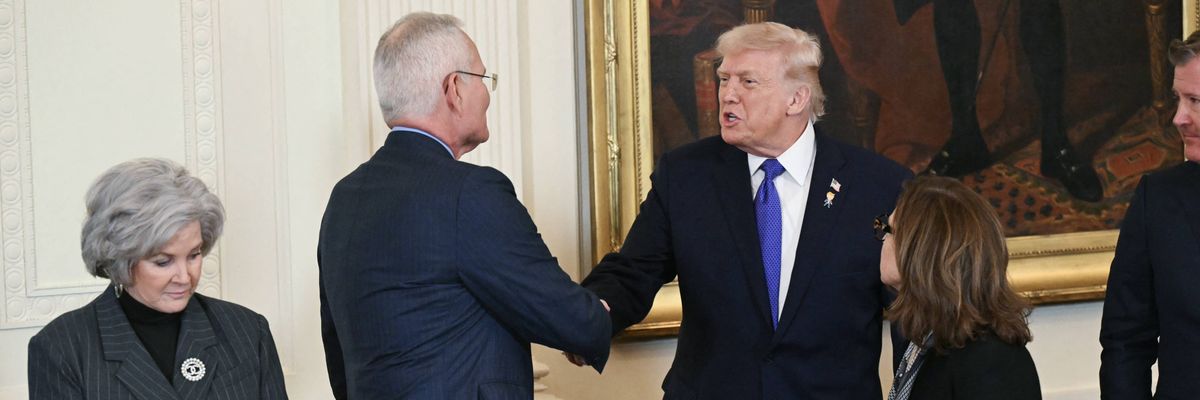
President Donald Trump shakes hands with ExxonMobil CEO Darren Woods during a meeting with US oil companies executives at the White House in Washington, DC on January 9, 2026.
(Photo by Saul Loeb/AFP via Getty Images)
Brett Wilkins
Jan 09, 2026
“Trump must not give these companies billions in handouts and stick American taxpayers with the bill,” implored Sen. Elizabeth Warren.
President Donald Trump shakes hands with ExxonMobil CEO Darren Woods during a meeting with US oil companies executives at the White House in Washington, DC on January 9, 2026.
(Photo by Saul Loeb/AFP via Getty Images)
Brett Wilkins
Jan 09, 2026
COMMON DREAMS
ExxonMobil’s CEO told President Donald Trump during a Friday meeting that Venezuela is currently “uninvestible” following the US invasion and kidnapping of President Nicolás Maduro, underscoring fears that American taxpayers will be left footing the bill for the administration’s goal of exploiting the South American nation’s vast petroleum resources.
Trump had hoped to convince executives from around two dozen oil companies to invest in Venezuela after the president claimed US firms pledged to spend at least $100 billion in the country. However, Trump got a reality check during Friday’s White House meeting, as at least one Big Oil CEO balked at committing financial and other resources in an uncertain political, legal, and security environment.
.

Even as Trump Suggests US Taxpayers May Foot the Bill, How Bullish Is Big Oil on Venezuela?
House Dems Unveil Bill to Prohibit Taxpayer Funding for Trump Occupation, Plunder of Venezuela
“If we look at the legal and commercial constructs and frameworks in place today in Venezuela today, it’s uninvestable,” ExxonMobil CEO Darren Woods told Trump during the meeting. “Significant changes have to be made to those commercial frameworks, the legal system. There has to be durable investment protections, and there has to be a change to the hydrocarbon laws in the country.”
ExxonMobil’s CEO told President Donald Trump during a Friday meeting that Venezuela is currently “uninvestible” following the US invasion and kidnapping of President Nicolás Maduro, underscoring fears that American taxpayers will be left footing the bill for the administration’s goal of exploiting the South American nation’s vast petroleum resources.
Trump had hoped to convince executives from around two dozen oil companies to invest in Venezuela after the president claimed US firms pledged to spend at least $100 billion in the country. However, Trump got a reality check during Friday’s White House meeting, as at least one Big Oil CEO balked at committing financial and other resources in an uncertain political, legal, and security environment.
.
Even as Trump Suggests US Taxpayers May Foot the Bill, How Bullish Is Big Oil on Venezuela?
House Dems Unveil Bill to Prohibit Taxpayer Funding for Trump Occupation, Plunder of Venezuela
“If we look at the legal and commercial constructs and frameworks in place today in Venezuela today, it’s uninvestable,” ExxonMobil CEO Darren Woods told Trump during the meeting. “Significant changes have to be made to those commercial frameworks, the legal system. There has to be durable investment protections, and there has to be a change to the hydrocarbon laws in the country.”
There is also skepticism regarding Trump’s promise of “total safety” for investors in Venezuela amid deadly US military aggression and regime change.
However, many of the executives—who stand to make billions of dollars from the invasion—told Trump that they remain eager to eventually reap the rewards of any potential US takeover of Venezuela’s vast oil resources.
The oil executives’ apparent aversion to immediate investment in Venezuela—and Trump’s own admission that the American people might end up reimbursing Big Oil for its efforts—prompted backlash from taxpayer advocates.
“Trump must not give these companies billions in handouts and stick American taxpayers with the bill,” Sen. Elizabeth Warren (D-Mass.) said on social media Friday. “And oil execs should commit now: no taxpayer subsidies, no special favors from the White House.”
Sam Ratner, policy director at the group Win Without War, said Wednesday that “already today, Trump was saying that US taxpayers should front the money to rebuild Venezuelan oil infrastructure, all while oil companies keep the proceeds from the oil.”
“This is not just a war for oil, but a war for oil executives,” Ratner added.
Noting that “Big Oil spent nearly $100 million to get Trump elected in 2024,” former US Labor Secretary Robert Reich—who served during the Clinton administration—described Friday’s meeting as “returning the favor” and “oligarchy in action.”
According to an analysis by the advocacy group Climate Power, fossil fuel industry interests spent nearly $450 million during the 2024 election cycle in support of Trump and other Republican candidates and initiatives.
However, many of the executives—who stand to make billions of dollars from the invasion—told Trump that they remain eager to eventually reap the rewards of any potential US takeover of Venezuela’s vast oil resources.
The oil executives’ apparent aversion to immediate investment in Venezuela—and Trump’s own admission that the American people might end up reimbursing Big Oil for its efforts—prompted backlash from taxpayer advocates.
“Trump must not give these companies billions in handouts and stick American taxpayers with the bill,” Sen. Elizabeth Warren (D-Mass.) said on social media Friday. “And oil execs should commit now: no taxpayer subsidies, no special favors from the White House.”
Sam Ratner, policy director at the group Win Without War, said Wednesday that “already today, Trump was saying that US taxpayers should front the money to rebuild Venezuelan oil infrastructure, all while oil companies keep the proceeds from the oil.”
“This is not just a war for oil, but a war for oil executives,” Ratner added.
Noting that “Big Oil spent nearly $100 million to get Trump elected in 2024,” former US Labor Secretary Robert Reich—who served during the Clinton administration—described Friday’s meeting as “returning the favor” and “oligarchy in action.”
According to an analysis by the advocacy group Climate Power, fossil fuel industry interests spent nearly $450 million during the 2024 election cycle in support of Trump and other Republican candidates and initiatives.
Reich and others also noted that Trump informed oil executives about the Venezuelan invasion even before he notified members of Congress.
“That tells you everything you need to know: It was never about ‘narcoterrorism’ and always about oil,” Rep. Dan Goldman (D-NY) said on Bluesky.
The legal watchdog Democracy Forward this week filed a Freedom of Information Act request demanding information about any possible Trump administration collusion with Big Oil in the lead-up to the Venezuela invasion.
Other observers shot down assertions by Trump and members of his administration that the attack on Venezuela and Maduro’s ouster are ultimately about restoring democracy.
“Want to know who’s meeting with Trump this morning about Venezuela’s future?” Rep. Adelita Grijalva (D-Ariz.) asked on X.
“Not pro-democracy leaders,” she said. “Oil and gas executives.”
“That tells you everything you need to know: It was never about ‘narcoterrorism’ and always about oil,” Rep. Dan Goldman (D-NY) said on Bluesky.
The legal watchdog Democracy Forward this week filed a Freedom of Information Act request demanding information about any possible Trump administration collusion with Big Oil in the lead-up to the Venezuela invasion.
Other observers shot down assertions by Trump and members of his administration that the attack on Venezuela and Maduro’s ouster are ultimately about restoring democracy.
“Want to know who’s meeting with Trump this morning about Venezuela’s future?” Rep. Adelita Grijalva (D-Ariz.) asked on X.
“Not pro-democracy leaders,” she said. “Oil and gas executives.”
Will Delcy Rodriguez govern the country as a compliant and coerced US puppet, or as the leader of an undefeated and independent Venezuela?
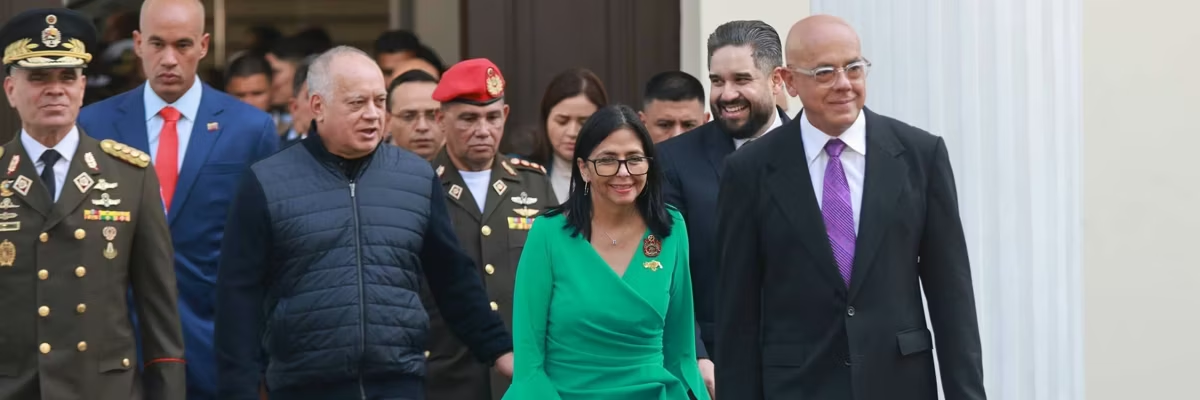
At the opening session of the National Assemblyâs new legislative term, Delcy Rodriguez (2nd R) is sworn in as acting president of Venezuela, pledging loyalty to Maduro and to Chavez in Caracas on January 5, 2026.
(Photo by Venezuelan National Assembly/Anadolu via Getty Images)
Nicolas J.S. Davies
Jan 09, 2026
Jan 09, 2026
Common Dreams
As the Senate voted to advance a War Powers Resolution on Venezuela on January 8th, Republican Senator Susan Collins declared that she did not agree with “a sustained engagement ‘running’ Venezuela.”
The world was mystified when President Donald Trump first said that the United States would “run” Venezuela. He has since made it clear that he wants to control Venezuela by imposing a US monopoly on selling its oil to the rest of the world, to trap the Venezuelan government in a subservient relationship with the United States.
The US Energy Department has published a plan to sell Venezuelan oil already seized by the United States and then to use the same system for all future Venezuelan oil exports. The US would dictate how the revenues are divided between the US and Venezuela, and continue this form of control indefinitely. Trump is planning to meet with US oil company executives on Friday, January 9th, to discuss his plan.
Trump’s plan would cut off Venezuela’s trade with China, Russia, Iran and other countries, and force it to spend its oil revenues on goods and services from the United States. This new form of economic colonialism would also prevent Venezuela from continuing to spend the bulk of its oil revenues on its generous system of social spending, which has lifted millions of Venezuelans out of poverty.
However, on January 7th, the New York Times reported that Venezuela has other plans. “Venezuela’s state-run oil company, Petróleos de Venezuela, confirmed for the first time that it was negotiating the ‘sale’ of crude oil to the United States,” the Times reported. “It said in a statement on social media that it was using ‘frameworks similar to those currently in effect with international companies, such as Chevron, and is based on a strictly commercial transaction.’”
Dealing with Trump is a difficult challenge for Delcy Rodriguez and other Latin American leaders, but they should all understand by now that caving to Trump or letting him pick them off one by one is a path to ruin.
Trump has threatened further military action to remove acting president Delcy Rodriguez from office if she does not comply with US plans for Venezuela. But Trump has already bowed to reality in his decision to cooperate with Rodriguez, recognizing that Maria Corina Machado, the previous US favorite, does not have popular support in Venezuela. The very presence of Delcy Rodriguez as acting president exposes the failure of Trump’s regime change operation and his well-grounded reluctance to unleash yet another unwinnable US war.
After the US invasion and abduction of President Maduro on January 3rd, Delcy Rodriguez was sworn in as Acting President, reaffirming her loyalty to President Maduro and taking charge of running the country in his absence. But who is Delcy Rodriguez, and how is she likely to govern Venezuela? As a compliant and coerced US puppet, or as the leader of an undefeated and independent Venezuela?
Delcy Rodriguez was seven years old in 1976, when her father was tortured and beaten to death as a political prisoner in Venezuela. Jorge Antonio Rodriguez was the 34-year-old co-founder of the Socialist League, a leftist political party, whom the government accused of a leading role in the kidnapping of William Niehous, a suspected CIA officer working under cover as an Owens Corning executive.
Jorge Rodríguez was arrested and died in state custody after interrogation by Venezuelan intelligence agents. While the official cause of death was listed as a heart attack, his autopsy found that he had suffered severe injuries consistent with torture, including seven broken ribs, a collapsed chest, and a detached liver.
Delcy studied law in Caracas and Paris and became a labor lawyer, while her older brother Jorge became a psychiatrist. Delcy and her mother, Delcy Gomez, were in London during the failed US-backed coup in Venezuela in 2003, and they denounced the coup from the Venezuelan embassy in interviews with the BBC and CNN.
Delcy and her older brother Jorge soon joined Hugo Chavez’s Bolivarian government, and rose to a series of senior positions under Chavez and then Maduro: Delcy served as Foreign Minister from 2014 to 2017, and Economy and Finance Minister from 2020 to 2024, as well as Oil Minister and Vice President; Jorge was Vice President for a year under Chavez and then Mayor of Caracas for 8 years.
On January 5th 2026, it fell to Jorge, now the president of the National Assembly, to swear in his sister as acting president, after the illegal US invasion and abduction of President Maduro. Delcy Rodriguez told her people and the world,
“I come as the executive vice president of the constitutional president of the Bolivarian Republic of Venezuela, Nicolas Maduro Moros, to take the oath of office. I come with pain for the suffering that has been caused to the Venezuelan people after an illegitimate military aggression against our homeland. I come with pain for the kidnapping of two heroes who are being held hostage in the United States of America, President Nicolas Maduro and the first combatant, first lady of our country, Cilia Flores. I come with pain, but I must say that I also come with honor to swear in the name of all Venezuelans. I come to swear by our father, liberator Simon Bolivar.”
In other public statements, acting president Rodriguez has struck a fine balance between fierce assertions of Venezuela’s independence and a pragmatic readiness to cooperate peacefully with the United States.
On January 3rd, Delcy Rodriguez declared that Venezuela would “never again be anyone’s colony.” However, after chairing her first cabinet meeting the next day, she said that Venezuela was looking for a “balanced and respectful” relationship with the United States. She went on to say, “We extend an invitation to the government of the US to work jointly on an agenda of cooperation, aimed at shared development, within the framework of international law, and that strengthens lasting peaceful coexistence,”
In a direct message to Trump, Rodriguez wrote, “President Donald Trump: our peoples and our region deserve peace and dialogue, not war. That has always been President Nicolás Maduro’s conviction and it is that of all Venezuela at this moment. This is the Venezuela I believe in and to which I have dedicated my life. My dream is for Venezuela to become a great power where all decent Venezuelans can come together. Venezuela has the right to peace, development, sovereignty and a future.”
Alan McPherson, who chairs the Center for the Study of Force and Diplomacy at Temple University in the US, calls Delcy Rodriguez “a pragmatist who helped stabilize the Venezuelan economy in recent times.” However, speaking to Al Jazeera, he cautioned that any perceived humiliation by the Trump administration or demands seen as excessive could “backfire and end the cooperation,” making the relationship a “difficult balance to achieve.”
After the US invasion on January 3rd, at least a dozen oil tankers set sail from Venezuela with their location transponders turned off, carrying 12 million barrels of oil, mostly to China, effectively breaking the US blockade. But then, on January 7th, US forces boarded and seized two more oil tankers with links to Venezuela, one in the Caribbean and a Russian one in the north Atlantic that they had been tracking for some time, making it clear that Trump is still intent on selectively enforcing the US blockade.
Chevron has recalled American employees to work in Venezuela and resumed normal shipments to US refineries after a four-day pause. But other US oil companies are not eager to charge into Venezuela, where Trump’s actions have so far only increased the political risks for any new US investments, amid a global surplus of oil supplies, low prices, and a world transitioning to cleaner, renewable energy.
Meanwhile, the US Department of Justice is scrambling to make a case against President Maduro, after Trump’s lawless war plan led to Maduro’s illegal arrest as the leader of a non-existent drug cartel in a foreign country where US domestic law does not apply. In his first court appearance in New York, Maduro identified himself as the president of Venezuela and a prisoner of war.
Continuing to seize ships at sea and trying to shake down Venezuela for control of its oil revenues are not the “balanced and respectful” relationship that Delcy Rodriguez and the government of Venezuela are looking for, and the US position is not as strong as Trump and Rubio’s threats suggest. Under the influence of neocons like Marco Rubio and Lindsey Graham, Trump has marched the US to the brink of a war in Latin America that very few Americans support and that most of the world is united against.
Mutual respect and cooperation with Rodriguez and other progressive Latin American leaders, like Lula in Brazil, Gustavo Petro in Colombia, and Mexico’s Claudia Scheinbaum, offer Trump face-saving ways out of the ever-escalating crisis that he and his clueless advisers have blundered into.
Trump has an eminently viable alternative to being manipulated into war by Marco Rubio: what the Chinese like to call “win-win cooperation.” Most Americans would favor that over the zero-sum game of hegemonic imperialism into which Rubio and Trump are draining our hard-earned tax dollars.
The main obstacle to the peaceful cooperation that Trump says he wants is his own blind belief in US militarism and military supremacy. He wants to redirect US imperialism away from Europe, Asia, and Africa toward Latin America, but this is no more winnable or any more legitimate under international law, and it’s just as unpopular with the American people.
If anything, there is greater public opposition to US aggression “in our backyard” than to US wars 10,000 miles away. Cuba, Venezuela, and Colombia are our close neighbors, and the consequences of plunging them into violence and chaos are more obvious to most Americans than the equally appalling human costs of more distant US wars.
Trump understands that endless war is unpopular, but he still seems to believe that he can get away with “one and done” operations like bombing Iran and kidnapping President Maduro and his first lady. These attacks, however, have only solved imaginary problems—Iran’s non-existent nuclear weapons and Maduro’s non-existent drug cartel—while exacerbating long-standing regional crises that US policy is largely responsible for, and which have no military solutions.
Dealing with Trump is a difficult challenge for Delcy Rodriguez and other Latin American leaders, but they should all understand by now that caving to Trump or letting him pick them off one by one is a path to ruin. The world must stand together to deter aggression and defend the basic principles and rules of the UN Charter, under which all countries agree to settle disputes peacefully and not to threaten or use military force against each other. Any chance for a more peaceful world depends on finally starting to take those commitments seriously, as Trump’s predecessors also failed to do.
There is a growing movement organizing nationwide protests to tell Trump that the American people reject his wars and threats of war against our neighbors in Latin America and around the world. This is a critical moment to raise your voice and help to turn the tide against endless war.
Our work is licensed under Creative Commons (CC BY-NC-ND 3.0). Feel free to republish and share widely.
Medea Benjamin
Medea Benjamin is co-founder of Global Exchange and CODEPINK: Women for Peace. She is the co-author, with Nicolas J.S. Davies, of War in Ukraine: Making Sense of a Senseless Conflict, available from OR Books in November 2022. Other books include, "Inside Iran: The Real History and Politics of the Islamic Republic of Iran" (2018); "Kingdom of the Unjust: Behind the U.S.-Saudi Connection" (2016); "Drone Warfare: Killing by Remote Control" (2013); "Don't Be Afraid Gringo: A Honduran Woman Speaks from the Heart" (1989), and (with Jodie Evans) "Stop the Next War Now" (2005).
Full Bio >
As the Senate voted to advance a War Powers Resolution on Venezuela on January 8th, Republican Senator Susan Collins declared that she did not agree with “a sustained engagement ‘running’ Venezuela.”
The world was mystified when President Donald Trump first said that the United States would “run” Venezuela. He has since made it clear that he wants to control Venezuela by imposing a US monopoly on selling its oil to the rest of the world, to trap the Venezuelan government in a subservient relationship with the United States.
The US Energy Department has published a plan to sell Venezuelan oil already seized by the United States and then to use the same system for all future Venezuelan oil exports. The US would dictate how the revenues are divided between the US and Venezuela, and continue this form of control indefinitely. Trump is planning to meet with US oil company executives on Friday, January 9th, to discuss his plan.
Trump’s plan would cut off Venezuela’s trade with China, Russia, Iran and other countries, and force it to spend its oil revenues on goods and services from the United States. This new form of economic colonialism would also prevent Venezuela from continuing to spend the bulk of its oil revenues on its generous system of social spending, which has lifted millions of Venezuelans out of poverty.
However, on January 7th, the New York Times reported that Venezuela has other plans. “Venezuela’s state-run oil company, Petróleos de Venezuela, confirmed for the first time that it was negotiating the ‘sale’ of crude oil to the United States,” the Times reported. “It said in a statement on social media that it was using ‘frameworks similar to those currently in effect with international companies, such as Chevron, and is based on a strictly commercial transaction.’”
Dealing with Trump is a difficult challenge for Delcy Rodriguez and other Latin American leaders, but they should all understand by now that caving to Trump or letting him pick them off one by one is a path to ruin.
Trump has threatened further military action to remove acting president Delcy Rodriguez from office if she does not comply with US plans for Venezuela. But Trump has already bowed to reality in his decision to cooperate with Rodriguez, recognizing that Maria Corina Machado, the previous US favorite, does not have popular support in Venezuela. The very presence of Delcy Rodriguez as acting president exposes the failure of Trump’s regime change operation and his well-grounded reluctance to unleash yet another unwinnable US war.
After the US invasion and abduction of President Maduro on January 3rd, Delcy Rodriguez was sworn in as Acting President, reaffirming her loyalty to President Maduro and taking charge of running the country in his absence. But who is Delcy Rodriguez, and how is she likely to govern Venezuela? As a compliant and coerced US puppet, or as the leader of an undefeated and independent Venezuela?
Delcy Rodriguez was seven years old in 1976, when her father was tortured and beaten to death as a political prisoner in Venezuela. Jorge Antonio Rodriguez was the 34-year-old co-founder of the Socialist League, a leftist political party, whom the government accused of a leading role in the kidnapping of William Niehous, a suspected CIA officer working under cover as an Owens Corning executive.
Jorge Rodríguez was arrested and died in state custody after interrogation by Venezuelan intelligence agents. While the official cause of death was listed as a heart attack, his autopsy found that he had suffered severe injuries consistent with torture, including seven broken ribs, a collapsed chest, and a detached liver.
Delcy studied law in Caracas and Paris and became a labor lawyer, while her older brother Jorge became a psychiatrist. Delcy and her mother, Delcy Gomez, were in London during the failed US-backed coup in Venezuela in 2003, and they denounced the coup from the Venezuelan embassy in interviews with the BBC and CNN.
Delcy and her older brother Jorge soon joined Hugo Chavez’s Bolivarian government, and rose to a series of senior positions under Chavez and then Maduro: Delcy served as Foreign Minister from 2014 to 2017, and Economy and Finance Minister from 2020 to 2024, as well as Oil Minister and Vice President; Jorge was Vice President for a year under Chavez and then Mayor of Caracas for 8 years.
On January 5th 2026, it fell to Jorge, now the president of the National Assembly, to swear in his sister as acting president, after the illegal US invasion and abduction of President Maduro. Delcy Rodriguez told her people and the world,
“I come as the executive vice president of the constitutional president of the Bolivarian Republic of Venezuela, Nicolas Maduro Moros, to take the oath of office. I come with pain for the suffering that has been caused to the Venezuelan people after an illegitimate military aggression against our homeland. I come with pain for the kidnapping of two heroes who are being held hostage in the United States of America, President Nicolas Maduro and the first combatant, first lady of our country, Cilia Flores. I come with pain, but I must say that I also come with honor to swear in the name of all Venezuelans. I come to swear by our father, liberator Simon Bolivar.”
In other public statements, acting president Rodriguez has struck a fine balance between fierce assertions of Venezuela’s independence and a pragmatic readiness to cooperate peacefully with the United States.
On January 3rd, Delcy Rodriguez declared that Venezuela would “never again be anyone’s colony.” However, after chairing her first cabinet meeting the next day, she said that Venezuela was looking for a “balanced and respectful” relationship with the United States. She went on to say, “We extend an invitation to the government of the US to work jointly on an agenda of cooperation, aimed at shared development, within the framework of international law, and that strengthens lasting peaceful coexistence,”
In a direct message to Trump, Rodriguez wrote, “President Donald Trump: our peoples and our region deserve peace and dialogue, not war. That has always been President Nicolás Maduro’s conviction and it is that of all Venezuela at this moment. This is the Venezuela I believe in and to which I have dedicated my life. My dream is for Venezuela to become a great power where all decent Venezuelans can come together. Venezuela has the right to peace, development, sovereignty and a future.”
Alan McPherson, who chairs the Center for the Study of Force and Diplomacy at Temple University in the US, calls Delcy Rodriguez “a pragmatist who helped stabilize the Venezuelan economy in recent times.” However, speaking to Al Jazeera, he cautioned that any perceived humiliation by the Trump administration or demands seen as excessive could “backfire and end the cooperation,” making the relationship a “difficult balance to achieve.”
After the US invasion on January 3rd, at least a dozen oil tankers set sail from Venezuela with their location transponders turned off, carrying 12 million barrels of oil, mostly to China, effectively breaking the US blockade. But then, on January 7th, US forces boarded and seized two more oil tankers with links to Venezuela, one in the Caribbean and a Russian one in the north Atlantic that they had been tracking for some time, making it clear that Trump is still intent on selectively enforcing the US blockade.
Chevron has recalled American employees to work in Venezuela and resumed normal shipments to US refineries after a four-day pause. But other US oil companies are not eager to charge into Venezuela, where Trump’s actions have so far only increased the political risks for any new US investments, amid a global surplus of oil supplies, low prices, and a world transitioning to cleaner, renewable energy.
Meanwhile, the US Department of Justice is scrambling to make a case against President Maduro, after Trump’s lawless war plan led to Maduro’s illegal arrest as the leader of a non-existent drug cartel in a foreign country where US domestic law does not apply. In his first court appearance in New York, Maduro identified himself as the president of Venezuela and a prisoner of war.
Continuing to seize ships at sea and trying to shake down Venezuela for control of its oil revenues are not the “balanced and respectful” relationship that Delcy Rodriguez and the government of Venezuela are looking for, and the US position is not as strong as Trump and Rubio’s threats suggest. Under the influence of neocons like Marco Rubio and Lindsey Graham, Trump has marched the US to the brink of a war in Latin America that very few Americans support and that most of the world is united against.
Mutual respect and cooperation with Rodriguez and other progressive Latin American leaders, like Lula in Brazil, Gustavo Petro in Colombia, and Mexico’s Claudia Scheinbaum, offer Trump face-saving ways out of the ever-escalating crisis that he and his clueless advisers have blundered into.
Trump has an eminently viable alternative to being manipulated into war by Marco Rubio: what the Chinese like to call “win-win cooperation.” Most Americans would favor that over the zero-sum game of hegemonic imperialism into which Rubio and Trump are draining our hard-earned tax dollars.
The main obstacle to the peaceful cooperation that Trump says he wants is his own blind belief in US militarism and military supremacy. He wants to redirect US imperialism away from Europe, Asia, and Africa toward Latin America, but this is no more winnable or any more legitimate under international law, and it’s just as unpopular with the American people.
If anything, there is greater public opposition to US aggression “in our backyard” than to US wars 10,000 miles away. Cuba, Venezuela, and Colombia are our close neighbors, and the consequences of plunging them into violence and chaos are more obvious to most Americans than the equally appalling human costs of more distant US wars.
Trump understands that endless war is unpopular, but he still seems to believe that he can get away with “one and done” operations like bombing Iran and kidnapping President Maduro and his first lady. These attacks, however, have only solved imaginary problems—Iran’s non-existent nuclear weapons and Maduro’s non-existent drug cartel—while exacerbating long-standing regional crises that US policy is largely responsible for, and which have no military solutions.
Dealing with Trump is a difficult challenge for Delcy Rodriguez and other Latin American leaders, but they should all understand by now that caving to Trump or letting him pick them off one by one is a path to ruin. The world must stand together to deter aggression and defend the basic principles and rules of the UN Charter, under which all countries agree to settle disputes peacefully and not to threaten or use military force against each other. Any chance for a more peaceful world depends on finally starting to take those commitments seriously, as Trump’s predecessors also failed to do.
There is a growing movement organizing nationwide protests to tell Trump that the American people reject his wars and threats of war against our neighbors in Latin America and around the world. This is a critical moment to raise your voice and help to turn the tide against endless war.
Our work is licensed under Creative Commons (CC BY-NC-ND 3.0). Feel free to republish and share widely.
Medea Benjamin
Medea Benjamin is co-founder of Global Exchange and CODEPINK: Women for Peace. She is the co-author, with Nicolas J.S. Davies, of War in Ukraine: Making Sense of a Senseless Conflict, available from OR Books in November 2022. Other books include, "Inside Iran: The Real History and Politics of the Islamic Republic of Iran" (2018); "Kingdom of the Unjust: Behind the U.S.-Saudi Connection" (2016); "Drone Warfare: Killing by Remote Control" (2013); "Don't Be Afraid Gringo: A Honduran Woman Speaks from the Heart" (1989), and (with Jodie Evans) "Stop the Next War Now" (2005).
Full Bio >
Nicolas J.S. Davies
Nicolas J. S. Davies is an independent journalist and a researcher with CODEPINK. He is the co-author, with Medea Benjamin, of War in Ukraine: Making Sense of a Senseless Conflict, available from OR Books in November 2022, and the author of Blood On Our Hands: the American Invasion and Destruction of Iraq.
Full Bio >
Nicolas J. S. Davies is an independent journalist and a researcher with CODEPINK. He is the co-author, with Medea Benjamin, of War in Ukraine: Making Sense of a Senseless Conflict, available from OR Books in November 2022, and the author of Blood On Our Hands: the American Invasion and Destruction of Iraq.
Full Bio >

No comments:
Post a Comment