Showing posts sorted by relevance for query AGA KHAN. Sort by date Show all posts

Sunday, February 09, 2025

LIBERAL MUSLIMS
Aga Khan, late leader of Ismailis, to be buried in Egypt today
DAWN
February 9, 2025 

Prince Rahim Al-Hussaini Aga Khan V (C), accompanied by his sons, Prince Irfan and Prince Sinan, looks at the coffin with the remains of his father Aga Khan IV, the spiritual leader of Shia Ismaili Muslims, during his funeral at the Ismaili community centre in central Lisbon on Feb 8, 2025. — AFP

A coffin of Prince Karim Al-Hussaini Aga Khan IV, the spiritual leader of Ismaili Muslims, is carried into the hearse from the Ismaili Centre during his funeral in Lisbon, Portugal on Feb 8, 2025. — Reuters/Pedro Nunes


GILGIT: Prince Karim Aga Khan Al Hussaini, the 49th imam of Ismaili Muslims, will be buried in the Egyptian city of Aswan on Sunday.

His funeral at the Ismaili Centre in Lisbon was attended by more than 300 guests, including Canadian Prime Minister Justin Trudeau, Portuguese President Marcelo Rebelo de Sousa and former Spanish king Juan Carlos I, leaders of the Ismaili community and other dignitaries on Saturday.

In Gilgit-Baltistan and other parts of Pakistan, thousands of followers of the late spiritual leader gathered at their community centres and Jamaat Khanas to view the funeral ceremony broadcast from Lisbon.

In Gilgit, Hunza and Nagar, shops and businesses remained closed to mourn the death of Prince Karim, who died on Tuesday in Lisbon after nearly seven decades as the spiritual leader of the Ismaili Muslims.


Finance minister, global dignitaries attend funeral in Lisbon

According to a statement by the Ismaili Imamat, the funeral was a closed event attended only by invited guests. The Ismaili community was represented by the 22 National Council presidents from around the world, including Pakistan.

Finance Minister Muhammad Aurangzeb also represented Pakistan.

The ceremony was televised live on Ismaili TV and arrangements were made at community centres and Jamaat Khanas for the late leader’s followers to witness the funeral.

In Gilgit-Baltistan, members of the Ismaili community congregated in Gilgit, Hunza, and Ghizer districts to witness the ceremony.

A large number of people witnessed the funeral across GB despite harsh weather.


ALIABAD Bazaar, in Hunza, is closed, on Saturday. Markets remained shut in several parts of Gilgit-Baltistan on the occasion of the funeral of Aga Khan.—Dawn

Condolences

Prince Karim was regarded as a direct descendent of the Holy Prophet Muhammad (Peace be upon him) and enjoyed near-divine status as the 49th hereditary imam of Ismaili Muslims. He held British and Portuguese nationalities, as well as honorary Canadian citizenship, a distinction rarely given.

Prince Karim’s burial on Sunday would be a private ceremony, to be followed by a special homage ceremony in Lisbon on Tuesday.

His son and successor, Prince Rahim Al-Hussaini, who was named the 50th hereditary Imam, or spiritual leader, according to his father’s will, would also attend Tuesday’s ceremony.

He will grant an audience to senior leaders of the community, who will pledge their allegiance to him on behalf of Ismailis all over the world.

It is expected that Prince Rahim will ordain an update to the Ismaili constitution and bless the community.

On Saturday, Finance Minister Aurangzeb met Prince Rahim and expressed condolences on behalf of the president, the prime minister and the people of Pakistan, according to a statement issued by the finance ministry.


Finance Minister Aurangzeb meets with Prince Rahim Al-Hussaini after attending the funeral of Prince Karim Aga Khan Al Hussaini in Lisbon, Portugal on February 8. — PID


The minister lauded the services of Prince Karim and the Aga Khan Development Network for the socio-economic well-being of people and honouring cultural heritage.

He called Prince Karim’s demise a “monumental loss” not only for his family, friends and followers but also for the underprivileged and destitute people of the world. He recalled the late leader’s special attachment to Pakistan and its people.

Special prayers were also held for the late leader at Ismaili community centres across Pakistan.

Delegations representing various sects, political parties, social organisations, civil society and officials have been visiting Ismaili Council Centres in Gilgit, Ghizer, and Hunza for condolences.

They paid tribute to the late leader for his contribution to the region’s socio-economic development.

day of mourning was observed across Pakistan on Saturday over the demise of Prince Karim.

National flags on important government buildings remained at half-mast across the country.

As Aga Khan, Al-Hussaini expanded the work of his grandfather, who created hospitals, housing and banking cooperatives in developing countries.

He invested part of the immense family fortune in the most deprived countries, combining philanthropy with business acumen.

To this end, he founded the Aga Khan Development Network, a gigantic foundation which is thought to have 96,000 employees worldwide and which funds development programmes, mainly in Asia and Africa.

A keen racehorse owner, he continued the family tradition of breeding thoroughbreds in his eight stables in France and Ireland. His horses won many of the most prestigious races.

With input from Agencies

Published in Dawn, February 9th, 2025


Understanding the Aga Khan, leader of Ismaili Muslims

(RNS) — The Aga Khan IV was often referred to as a philanthropist, but the description ignores the spiritual impetus for his work.
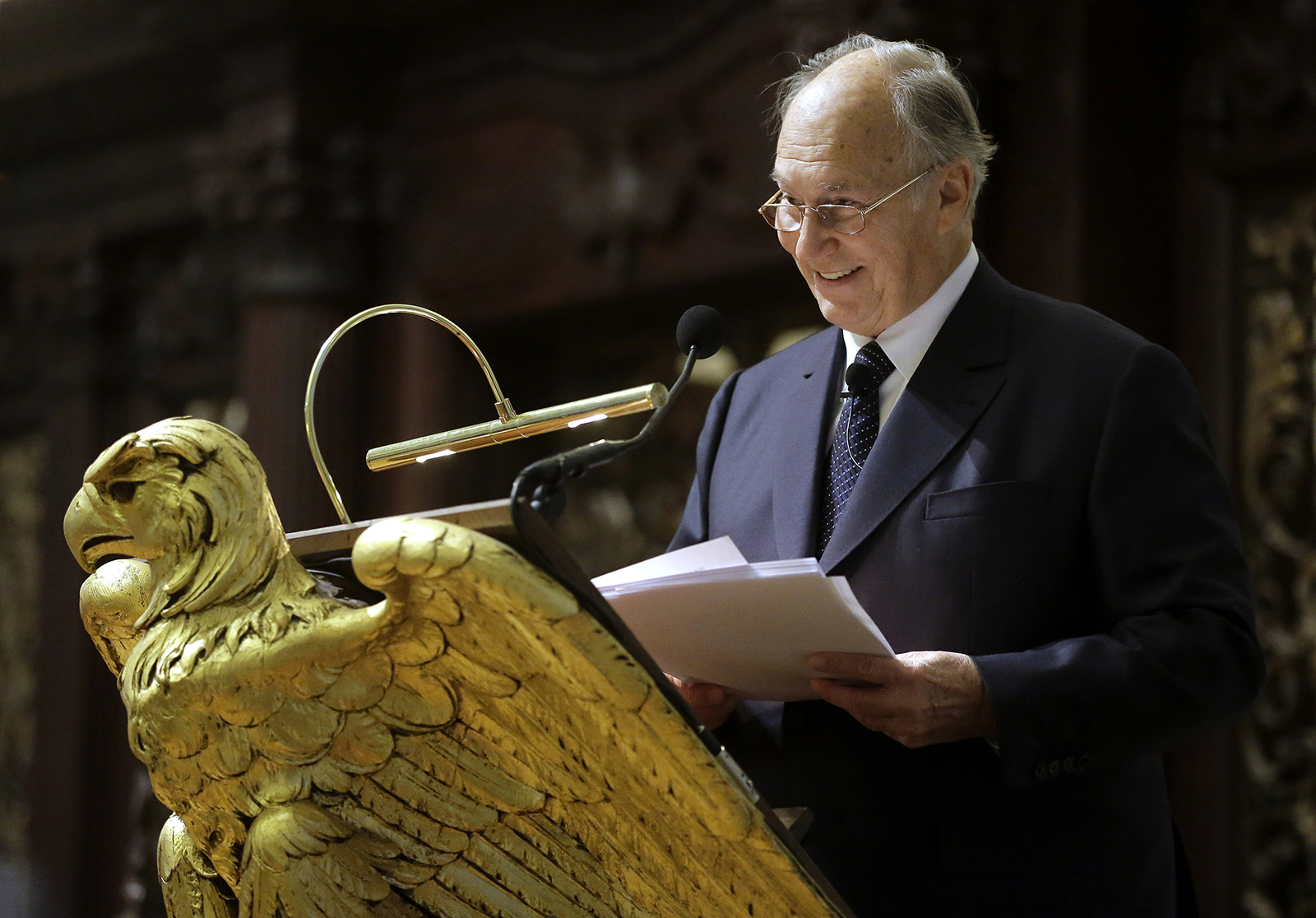

FILE - The Aga Khan, spiritual leader to millions of Ismaili Muslims, addresses an audience, Thursday, Nov. 12, 2015, at the Memorial Church on the campus of Harvard University in Cambridge, Mass. (AP Photo/Steven Senne, File)
RNS
February 7, 2025

(RNS) — On Tuesday (Feb. 4), Shah Karim al-Hussaini, Aga Khan IV, passed away in Lisbon, at age 88. For most Americans, this name has little meaning. People with a particular historical awareness may remember his grandfather, Sir Sultan Mahomed Shah, Aga Khan III, as one of the founders of the League of Nations and international statesman. But even those who know the lineage of the Aga Khans, a title that goes back to the British Raj in India, don’t understand who Shah Karim was.

Both men were Imams, or spiritual leaders, of a Muslim community known as the Ismailis. This community is a Shi’ah community that believes the Prophet Muhammad named his cousin and son-in-law Ali as the first Imam. This figure of the Imam is designated in the Quran, the revealed word of God, according to Muslims, and is guaranteed by God to guide the community of believers. The Aga Khans are descended from Prophet Muhammad through Imam Ali and his wife Fatima.

Shah Karim, the 49th Imam in the lineage, took his title as Aga Khan in 1954, when he was 20, after the death of his grandfather.

The Aga Khan IV, who headed the Aga Khan Development Network, was often referred to as a philanthropist, a label that he himself called deeply inaccurate. According to broader Shi’ah belief, three interrelated elements are believed to elevate one another: faith, knowledge, and action. To increase in any one area, you must increase in the other areas as well, and together each amplifies the other. Most importantly, faith and knowledge without action is selfish and a denial of God’s blessings.

RELATED: The Aga Khan, spiritual leader of Ismaili Muslims and a philanthropist, dies at 88

In May 2006, in accepting the Tolerance Award from the Evangelical Academy of Tutzing, in Germany, the Aga Khan said, “I am fascinated and somewhat frustrated when representatives of the Western world … try to describe the work of our Aga Khan Development Network … they often describe it either as philanthropy or entrepreneurship.” He attributed the misconception to a false dichotomy made between secular and religious and explained that his work is in fact an expression of this relationship among faith, knowledge and action.

In the speech, he emphasized that he aimed “to improve the quality of worldly life for the concerned communities,” offering two exemplar inspirations. The first is the first verse of the Quran’s fourth chapter, which says “O mankind! Be careful of your duty to your Lord, Who created you from a single soul and from it created its mate and from the twain hath spread abroad a multitude of men and women.” The verse, the Aga Khan said, says that we are all connected, coming from the same origin, and that we are also diverse, and this is a sign of God’s blessings.

The second piece of inspiration he gave was a teaching of Imam Ali, which speaks of ideal virtues, including faith, knowledge and action and the ability to have humility and seek consultation.

The Aga Khan was a historical figure, a man of the world who skied in the Olympics on the Iranian team, received numerous honorary degrees and worked as an international peacemaker. But it is important to understand what drove him to achieve these things. The Tutzing speech is a window into that impetus: He didn’t act out of a wish for worldly acclaim or the disbursement of worldly wealth. Rather, his course in life was an expression of faith and knowledge, an essential part of what it means to be a believer, to be human.

A person of integrity, the Aga Khan did everything as part of a comprehensive whole. There was not a part that was separate from another part. For his community, he was the living exemplar of what it meant to embody the ethics of religion in its most complete form. His passing is a loss to the community and a reminder that God has promised them continual guidance, in the line of Imams that continues with his son, Prince Rahim al-Hussaini, Aga Khan V.


(Hussein Rashid, Ph.D., is an independent scholar based in New York and an Ismaili Muslim. The views in this commentary do not necessarily reflect those of RNS.)


THE RUBIYAT OF OMAR KHAYYAM


PANNIER: Prince Karim Aga Khan IV obituary


A philanthropist, Aga Khan IV was devoted to his people, the Ismailis, many of whom live in remote areas of some of the world’s poorest countries. / AKDNFacebook
By Bruce Pannier February 7, 2025

Prince Karim Aga Khan IV, the spiritual leader of some 15 million Ismaili Muslims worldwide, died in Portugal on February 4 aged 88.

The Aga Khan Development Network (AKDN) announced the passing of the “49th hereditary Imam of the Shia Ismaili Muslims and direct descendant of the Prophet Muhammad” on their website.

The Aga Khan was born into a wealthy family. He lived what most people would call a lavish life, mingling with heads of state and royalty, and devoted much time to his passion of horse-breeding and horse racing.

His horses won the Derby Stakes five times. One of the horses, Shergar, won in 1981 by the widest margin in Derby history, only to be kidnapped two years later. The horse was never found, and no suspects were ever apprehended.

But the Aga Khan was also a philanthropist, and impact investor, who was always devoted to his people, the Ismailis, many of whom live in remote areas of some of the world’s poorest countries.

Aga Khan IV's grandfather, Sultan Mahomed Shah Aga Khan III, who died in 1957, chose his successor as a person of the world for the post-World War II times (Credit: AKDN).

For these people in particular, the Aga Khan was not only their spiritual leader, but also the source of better education, the builder of needed infrastructure, and in some cases, their saviour in desperate times.

Matt Reed, the global director of Institutional Partnerships for the Aga Khan Foundation, told bne IntelliNews that the Aga Khan was “a spiritual leader who felt an obligation to humanity to improve the quality of life for all people living in countries where he or his community were present.”

Prince Karim Al-Hussaini was born in Geneva, Switzerland on December 13, 1936. His father was Prince Aly Salomone Khan, while his mother was Joan Yarde-Buller, a British socialite. After the two divorced in 1949, Prince Aly Khan married movie star Rita Hayworth.

As a small child, Prince Karim lived in Kenya, but he moved to Switzerland to attend school. Afterwards, he majored in Islamic history at Harvard University. His grandfather, Sultan Mahomed Shah Aga Khan III, died in 1957 having directed that Prince Karim, rather than Karim’s father or uncle, should be the next Aga Khan.

Aga Khan III gave this instruction because he felt it was important that the new Aga Khan was a person of the world in atomic physics and other post-World War II technologies and inventions.

Prince Karim was 20 years-old when he became the Aga Khan. Despite his position, he returned to Harvard with an entourage and completed his studies, graduating in 1959.

Aga Khan IV established the Aga Khan Foundation in 1967 “to address the root causes of poverty and support community institutions to carry out sustainable, locally-driven initiatives that improve the quality of life.”

When Ismaili communities in several African countries were expelled or displaced, along with other South Asians, in the early 1970s, the Aga Khan helped to resettle them in Asia, Europe and North America.

Children in Osh, the Kyrgyz Republic, at an Aga Khan Foundation teacher training class on latest early childhood development pedagogies and techniques (Credit: AKDN).

The Aga Khan’s work expanded over the years. Hundreds of schools, two universities and dozens of hospitals and clinics were built.

He also sponsored thousands of agricultural projects, including research into hybrid crops that can grow at high altitudes, as well as the building of large-scale energy infrastructure. Moreover, he helped with the construction of small hydropower plants that serve remote communities, invested in telecommunications, organised microfinancing, and more.

In 2008, all of these projects were grouped under a common umbrella, and the Aga Khan Development Network was created.

The AKDN now works in more than 30 countries, but one of the most important areas the organisation works in is the Pamir Mountains, where Ismaili communities of Afghanistan, Pakistan and Tajikistan are found.

There are some 500,000 Ismailis living in Pakistan. The Aga Khans have kept close connections with the country and have been doing philanthropic work in its Ismaili region for more than a century. The father of Aga Khan IV served as Pakistan’s ambassador to the United Nations in the late 1950s.

The AKDN started work in Afghanistan and Tajikistan in the 1990s, a time when there was civil war in both countries.

The Aga Khan is credited by many with saving many of the more than 200,000 Ismailis in mountainous, remote Gorno-Badakhshan Autonomous Oblast (GBAO) of eastern Tajikistan from starvation during the Central Asian country’s 1992-1997 civil war.

In the years after the war, the cash-strapped Tajik government was unable to spend money on GBAO, a region that the government’s civil war opponents used for bases because of its nearly inaccessible terrain.

The AKDN stepped in to assist and helped the government develop educational facilities, businesses and infrastructure in GBAO. It also built several bridges to connect the region to Badakhshan Province in neighbouring Afghanistan, where Ismaili communities are present.

The organisation helped establish the University of Central Asia in the GBAO regional capital Khorog (and later another UCA in Naryn, Kyrgyzstan), providing opportunities for local young people to obtain higher education without leaving GBAO.

Over the course of some 30 years, the Aga Khan spent some $1bn on projects in GBAO.

Condolences over the death of Aga Khan IV were expressed by many world leaders, past and present. King Charles III said he was "deeply saddened" on the passing away of his "personal friend of many years" (Credit: AKDN).

Since it started work in Afghanistan during the mid-1990s, the AKDN has never left the country. Some 200,000 Ismailis live in Afghanistan.

The AKDN is currently working in 26 Afghan provinces, 11 directly and 15 in partnership with other organisations, benefitting some 12mn people. The AKDN has actually expanded its Afghanistan operations in the years since the Taliban returned to power in August 2021.

The network has proved more than a lifeline to the communities it has assisted. It has helped all of them to improve their living situations and prospects, not only in the Pamir Mountains, but in other parts of Asia, Africa and the Middle East.

Reed, of the Aga Khan Foundation, said Aga Khan IV had three principles for the AKDN’s work, namely “Absolute commitment” to working with all the people in the communities where it operates, regardless of faith or background; establishing institutions that would endure long after his death, whether the governments of these countries were weak or strong; and community ownership of all the projects so that everything the AKDN built or helped establish, either belonged to, or was managed by, the communities or local people.

Aga Khan IV has been described in the media as a “socialite” or “playboy,” and that was part of his life. But the work he did for not only his Ismaili communities, but also for the people living with or near these communities, was so often invaluable.

The schools and universities, hospitals, power plants, rural projects, hotels, parks and local financing institutions Aga Khan IV leaves behind will benefit the people of these regions for generations to come.

It is therefore not surprising that among those expressing their condolences on the Aga Khan’s death and praise for his work were Pakistani President Asif Ai Zardari, Indian Prime Minister Narendra Modi, former Afghan president Hamid Karzai, Tajik President Emomali Rahmon, Canadian Prime Minister Justin Trudeau, French President Emmanuel Macron, UN Secretary General Antonio Guterres and King Charles III.

(Credit: AKDN).

It is a proud legacy, and it now falls to his son, Prince Rahim (pictured above), to carry on the work as Aga Khan V.

Monday, September 26, 2022

THE OLD MAN OF THE MOUNTAIN

Toronto gives spiritual leader, the Aga Khan, key to the city

Award celebrates contributions made to local Ismaili

Muslim heritage and culture

Toronto Mayor John Tory awarded Prince Karim Aga Khan IV, the spiritual leader of Ismaili Muslims around the world, a key to the city Sunday. It was accepted by the Aga Khan's brother, Prince Amyn Aga Khan. (Doug Husby/CBC)

The City of Toronto gave the head of the world's Ismaili Muslim community a key to the city Sunday, in light of years of "remarkable contributions" made to celebrate Ismaili culture and heritage.

In a ceremony at the Ismaili Centre attended by politicians from all levels of government, Toronto Mayor John Tory presented the family of Prince Karim Aga Khan IV the award, which is only given to individuals who "embody the spirit and potential of Toronto and who have contributed significantly to civic life."

"It is the least we can do for His Highness," Tory said at the ceremony.

In Toronto, the Aga Khan opened the Aga Khan Museum, the only museum in North America dedicated to Islamic arts, and the Ismaili Centre, a place of congregation, prayer and friendship for the Ismaili community, in 2014. He also established the cultural landmark Aga Khan Park, which officially opened in 2015. 

The city also renamed the portion of Wynford Drive, between Don Mills Road and the east side of the Don Valley Parkway overpass, to Aga Khan Boulevard, to commemorate the 65th anniversary of the Aga Khan's accession as the 49th hereditary Imam of Shia Ismaili Muslims and mark 50 years of the Ismaili Muslim community's establishment  in Canada.

The City of Toronto has renamed a portion of Wynford Drive to Aga Khan Boulevard in recognition of the Aga Khan's contributions to the city. (Doug Husby/CBC)

"The community presence here would not have been possible if not for Toronto and Canada's commitment to embracing and celebrating diversity," said Prince Amyn Aga Khan, the Aga Khan IV's brother, who accepted the award on his behalf.

"For many years now, His Highness has looked to Canada as a model of pluralism, one that is ever more critically, more urgently needed in our increasingly divisive and fragmented world."

According to a press release from the Ismaili Council of Canada, the Sunday award is one of a number of events taking place across the country this week to celebrate the Ismaili community's settlement in Canada. 

This includes another appearance in Toronto by Prince Amyn Aga Khan on Monday to the ground breaking of Generations, a not-for-profit community housing initiative to support vulnerable individuals, families, and seniors, the organization states.

Outside of Toronto, the Aga Khan, a billionaire and a believed descendant of the Prophet Mohammed, is known for his philanthropy.

The Aga Khan Developmental Network operates in more than 30 countries around the world, contributing to more than 1,000 programs and institutions and employing almost 100,000 people, who are primarily based in developing countries, the city says.

With files from Doug Husby

Thursday, February 06, 2025

The Aga Khan, spiritual leader of Ismaili Muslims and a philanthropist, dies at 88

SCION OF THE OLD MAN OF THE MOUNTAIN HASAN ibn SABAH

Issued on: 05/02/2025 -

The Aga Khan, who became the spiritual leader of the world’s millions of Ismaili Muslims at age 20 as a Harvard undergraduate and poured a material empire built on billions of dollars in tithes into building homes, hospitals and schools in developing countries, died Tuesday. He was 88.

ISMALI MUSLIMS ARE CONSIDERED  HERETICS!


LA REVUE GAUCHE - Left Comment


New Aga Khan takes helm of Ismaili Shi'ite Muslims

New Aga Khan takes helm of Ismaili Shi'ite Muslims
A new Aga Khan has taken the helm as the spiritual leader of the Ismaili Muslims following the death of his father aged 88.

Prince Rahim al-Hussaini has been named the new Aga Khan, becoming the spiritual leader of around 15mn Ismaili Muslims worldwide following the death of his father in Lisbon aged 88.

The 53-year-old was appointed in his father's will, unsealed on February 5, as the fifth Aga Khan and 50th imam of the Nizari Ismaili branch of Shia Islam, continuing a 1,300-year dynasty that claims direct descent from the Prophet Muhammad. Ismailism shares its beginnings with other early Shi’ite Muslim sects that emerged during the succession crisis that spread throughout the early years of Islam. Prior to the collapse of the Pahlavi monarchy in Iran in 1979, the Ismailis held a royal title second only to the Shah of Iran Mohammad Reza Pahlavi. 

Through the Aga Khan Development Network (AKDN), Prince Rahim has focused on climate issues and will now oversee a vast portfolio of humanitarian institutions and business interests estimated to be worth between $1bn-$13bn, spanning airlines, real estate and media.

"My expectation would be that there is a continuation of that legacy, because it is ingrained in Islam and it is substantiated in these institutions," said Eboo Patel, founder of Interfaith America, who studied Ismaili institutions at Oxford University.

The late Aga Khan, who was given the title "His Highness" by Queen Elizabeth II in 1957, built the AKDN into a global force for development. it was particularly active in Asia and Africa through hospitals, schools and universities.

"We have no notion of the accumulation of wealth being evil," he told Vanity Fair in 2012. "The Islamic ethic is that if God has given you the capacity or good fortune to be a privileged individual in society, you have a moral responsibility to society."

Prince Rahim, educated at Phillips Academy and Brown University, inherits the leadership of a community known for pluralism and humanitarian work.

The AKDN has invested more than $1bn in Tajikistan alone since 1995, though recent tensions have seen Tajik authorities nationalise some properties amid separatism accusations.

In November, Central Asia specialist Bruce Pannier reported for bne IntelliNews on how the former imam of the Ismaili community served as the chief beneficiary to the Pamiri—but in a grievous blow to the minority, was being cut off from further cooperation by Tajikistan’s Rahmon regime.

"They have really been at the forefront of relief efforts and humanitarianism on behalf not only of Ismailis, but of all the people affected in the communities where they work," said Jonah Steinberg, associate professor at the University of South Carolina.

The succession marks a return to tradition after the late Aga Khan's own unexpected appointment.

In 1957, his grandfather bypassed other heirs to name the then 20-year-old Harvard student as successor, citing the need for youthful leadership in a rapidly changing world.

The late Aga Khan is survived by three sons and a daughter.


Sunday, August 10, 2025

HISTORY: CRICKET AND THE COLD WAR

August 10, 2025
EOS / DAWN


Earle Chesney (holding bat), aide to US President Dwight D. Eisenhower, being presented with a cricket bat during the Pakistan team’s visit to the White House in Washington on their brief visit to the US in 1958. (From left to right, back row) Nasim-ul-Ghani, Saeed Ahmed, Zulfiqar Ahmed, Mahmood Hussain, Saeed Ahmed Khan (Manager), Chesney, Abdul Hafeez Kardar, Ikram Elahi (partly hidden behind Kardar), Imtiaz Ahmed, Ijaz Butt, Wazir Muhammad, Waqar Hassan, (Sitting, from left to right) Khan Mohammad, Mohammad Munaf, Alimuddin, S.F. Rehman, Haseeb Ahsan and Wallis Mathias | For Cricket and Cou


Formed in 1953, the United States Information Agency (USIA) was, for nearly half a century, the nation’s federally funded propaganda machine to repel the influence of Soviet communism. Three years after forming the agency, President Dwight D. Eisenhower launched its “people-to-people” programme, an extension of the USIA’s activities, for which the president himself served as honorary chairperson.

To run the sports committee that the programme established, Eisenhower had fellow military man Edward (Eddie) P.F. Eagan run the show. Col Eagan was one of those extraordinary individuals who became the first person in history to win gold medals in both the summer and winter Olympics, fought in both World Wars, and studied at Yale, Harvard and Oxford. Other members of the committee included sporting legends such as athlete Jesse Owens, baseballer Joe DiMaggio, boxer Jack Dempsey and golfer Ben Hogan.

In the backdrop of the USIA and Soviet communism was Pakistan, forging its own legacy from a tumultuous start to its story as a new nation state following World War II. This was inculcating a sense of ownership for those who represented Pakistan on any global stage and, with one of the nation’s major exports being its brand of cricket, captain Abdul Hafeez Kardar was adamant that Pakistan’s young cricket team tour the United States as well.

KARDAR’S PERSISTENCE, HANIF’S EXPLOITS


In his later years, Kardar was Pakistan’s envoy to Switzerland and the food minister for Punjab. While captaining the Pakistan side, he was an assistant adviser in the federal education ministry. However, his initial political skills were already evident, as he recounts in Green Shadows, his diary of the tours to the West Indies and the United States.

At the height of the Cold War, cricket became an unlikely weapon in Pakistan’s diplomatic arsenal. This is the forgotten story of Pakistan’s 1958 US tour, backed by Eisenhower’s propaganda machine and spearheaded by a captain of some political nous…

Kardar had started thinking of a visit to the US in 1957, when Pakistan’s maiden tour of the West Indies was confirmed, and approached the American ambassador to Pakistan, Horace Hildreth, to discuss this possibility. Hildreth felt that there would not be enough cricketers available in the US, but Kardar mentioned a number of clubs in Philadelphia, New York and California.

However, when no response was received by November 1957, Kardar wrote to Mohammad Ali Bogra, who was in his second stint of serving as Pakistan’s ambassador to the US, having served as Pakistan’s third prime minister in between. Bogra was initially dismissive of the request, but Kardar pointed out that a team could be raised even with the staff from the Commonwealth embassies in Washington and also from the Commonwealth representatives at the United Nations.


US President Dwight D. Eisenhower shakes the hand of Hanif Mohammed and meets the Pakistan cricket team on day four of the third Test between Pakistan and Australia at the National Stadium in Karachi on December 8, 1959 | White Star Archives

Bogra discussed this possibility with his aides, Pakistan’s Consul General in New York Khwaja M. Kaiser and young diplomat Agha Shahi, who were instrumental in giving practical shape to the idea. The tour to the US was confirmed while Pakistan was playing its fourth match against the West Indies in Georgetown, British Guyana. This was considerably better news than the eight-wicket loss Pakistan suffered in the Test itself, which also lost them the series 3-1.

Meanwhile, news of the exploits of Hanif Mohammed scoring 337 had reached the US. The Washington Post reported “Cricket Star Bats 16 Hours, 13 Minutes”, though for most readers, perhaps, it might have been confusing how this superhero effort “could only earn Pakistan a tie [sic] with the West Indies in their first Test match.”

Pakistan’s team manager, Saeed Ahmed Khan, flew a week ahead of the team to make arrangements. The people-to-people programme put aside $15,000 for the tour and set tickets at $1.50, hoping to finance the tour through ticket sales. Hanif Mohammed, perhaps regrettably for those who had read about him, and pacer Fazal Mahmood did not join the team.

‘COSMOPOLITAN TEA-SIPPERS’


Pakistan arrived at Idlewild Airport (now known as John F. Kennedy International Airport) on April 29, 1958. Members of the people-to-people sports committee welcomed the team, alongside the executive officer of New York City mayor Robert F. Wagner. Kardar writes that, after supper, the team went around Times Square and Broadway. “I do not believe any of the players slept till two or three o’clock in the morning,” he noted in his tour diary.


Cover page of the December 21 edition of the American news magazine Life, featuring US President Eisenhower waving to the crowd alongside President Gen Ayub Khan upon his arrival in Karachi in December 1959 | Life

The next morning came a visit to City Hall. The 16-member Pakistan squad — described by The New York Times as “cosmopolitan tea-sippers” — was welcomed by Mayor Wagner. A photo published in the next day’s paper showed Wagner swinging a bat gifted by the team, along with a green tie.

That afternoon, the team went to Washington DC and, the next morning, they were hosted by Commander McCormick-Goodhart, a retired British naval officer who had a cricket ground on his estate. Though Pakistan were supposed to play, Kardar notes: “Washington produced real English cricket weather and the organisers were very happy that they had not really arranged a match.”

The team then went around Washington and, later that evening, attended a reception at Ambassador Bogra’s official residence. Gen Ayub Khan was also present, who in May 1958 was serving as the commander-in-chief of the Pakistan army. However, since Green Shadows was published later, Kardar refers to him as the President of Pakistan.

The following morning, the team visited the White House and were received by Earle Chesney, an Eisenhower aide who had gained fame as a political cartoonist and would arrange tours for VIPs visiting the president’s home and offices. Eisenhower himself was unavailable, due to world events — as Richard Heller and Peter Oborne also note in White on Green: Celebrating the Drama of Pakistan Cricket. Vice President Richard Nixon had been attacked in Venezuela, with protestors ultimately breaking the windows of his motorcade.


The logo of the People to People programme on a memorandum ahead of Pakistan cricket team's visit to the US | Eisenhower Presidential Library


PRESS MEETS AND PRIVATE RECEPTIONS


The next stop was Philadelphia, where another match was scheduled, but it was washed out due to rain. The team then returned to New York for the longest leg of their tour, which included a litany of media commitments.

In his diary, Kardar wrote that in all the radio appearances and talks shows that he or the Pakistan team appeared on, 20 million Americans tuned in. From the Ed Sullivan Show alone, 10 million people watched the Pakistani cricket team. Kardar also appeared on the CBS show To Tell the Truth, a clip of which goes viral from time to time on social media.

The team also visited the Yankee Stadium to watch a charity match. The authors Heller and Oborne learned from Sheikh Fazlur Rehman — a member of the touring party who played one Test match for Pakistan — that he received a bat from Yankees superstar Mickey Mantle, but Rehman had since misplaced it.

Another reception held in honour of the team was by Aly Khan, the son of Sir Sultan Mohammad Aga Khan (Aga Khan III) and father of the recently deceased Prince Karim Aga Khan (Aga Khan IV). He had been given the role of Pakistan’s ambassador and Permanent Representative to the United Nations. Khan’s new sport of “pen-pushing” was much different from his usual horse-riding, racing and skiing exploits, but the new ambassador’s office was described as “a nerve centre of disparate activities”, with endless visitors and phone calls.

Aly Khan’s popularity was evident by how Kardar was tired of shaking hands and seeing off the three to four hundred guests who arrived at the reception. “I must confess that, at the end of the day, my feet ached and my hands had cramps,” he remarked in his tour diary.

Though Aly Khan did not play cricket, he advocated for its popularity in the US, also bowling the first ball between the Pakistan and Joint League of New York match, a practice similar to the “first pitch” before baseball games, where celebrities come out to fanfare for the event.

Throughout the tour however, the cricket was proving to be an afterthought. Kardar does not note much on the matches and lists only three games that were played by the Pakistan team, instead of the six that were reportedly planned. However, interest (perhaps curiosity) in the sport was keen, with 1,500 people turning up to see Pakistan in the first match.

The reporting for the matches and tour at large had to take the tone of explaining the sport to the hosts. For example, this is from The New York Times on one of the matches:

“An hour and twenty minutes after the beginning of the cricket match at Downing Stadium on Randalls Island yesterday, Alim-Ud-Din was looking for the out-spin and, instead, received a ball that spun in. He missed the ball with the paddle and was thus bowled by Leslie Russell, whose delivery struck the wicket for an out. Put in more familiar terms, Alim-Ud-Din was expecting the curve. He was crossed up by Russell, who pitched a screw-ball, thus gaining the first out of the game. Put in any words, it was cricket.”

CAPITALISING ON THE CANADIAN CONNECTION


The team then crossed over to Canada, for which Kardar had written to his Oxford varsity teammate Basil Robinson, who later led a Canadian side on a tour of England in 1954. Robinson was also working in the Canadian External Affairs Office and Kardar was confident that the tour would be confirmed, which it was in March 1958.

Pakistan arrived in Toronto on May 15 and the players stayed with Canadian families throughout the tour, in an effort to “see their way of life from close range.” However, Kardar had also written to Robinson saying that the team “were willing to accept the barest minimum expenses.”

The team played three matches in Toronto, one in Ottawa and an unspecified number in Montreal. In Ottawa, the players also got to visit the House of Commons and see Prime Minister John Diefenbaker.

After four days in Montreal, the team then got on the Empress of France to sail to Liverpool, from where they then flew to Pakistan. The team arrived in Karachi on June 6, after six months of travels across the Caribbean, North America and Europe.

IKE TAKES STRIKE

Meanwhile, Gen Ayub Khan had been eager to maintain cordial diplomatic relations with the US during the early part of his tenure. Pakistan’s neighbours, India and Afghanistan, were leaning towards the Soviet Union in Cold War politics, but Pakistan was increasingly known as a US-backed country in Asia, particularly after joining the (short-lived) Central Treaty Organisation (CENTO), a military alliance made to deter Soviet expansion in the Middle East.

After Ayub’s installation as President of Pakistan in October 1958, President Eisenhower visited Karachi in December 1959. Such was the fanfare of the visit, Life magazine’s cover on December 21, 1959, shows a beaming Eisenhower waving to a crowd with Ayub beside him. The headline: “Triumph in Pakistan: Ike and President Ayub.”

Ayub had officially made Rawalpindi the capital of Pakistan just six weeks before Eisenhower’s visit, but the garrison city was reportedly not equipped to host such a high-level visit. Therefore, Karachi was to be where the US president would visit.

Hundreds of thousands are said to have lined the streets of Karachi as Eisenhower made his way from the Mauripur landing strip in Karachi on December 7, becoming the first US President to visit Pakistan — notably during a dictatorship. Incidentally, no US President has visited Pakistan during a civilian government.

Writing for The New York Times, Paul Grimes reported that Ayub had ordered the removal of 500,000 refugees in the city and moved them to Korangi early in 1959. On December 8, Eisenhower visited the Quaid-i-Azam’s mausoleum to lay a wreath and then was at the National Stadium Karachi, slated to watch half an hour of cricket.

Meanwhile, Fazal Mahmood had learned during the third and final Test against Australia that Eisenhower would be coming to watch the match. Fazal writes in From Dusk to Dawn that he was sitting at the stadium with the secretary of the national cricket board, when they learned the news over telephone. Both men then decided to ring the Pakistani Embassy in Washington DC to have Eisenhower’s tailor make a bottle-green jacket and dispatch it on the first flight to Karachi.

Time was also on their side. The Test began on December 4 and, after three days of play, there was one rest day. Eisenhower’s visit was scheduled for the fourth day of the Test, on December 8. Once the jacket was received, a monogram of the Pakistani team was placed on its front pocket.

When the team was being presented to the US president, Fazal gifted the blazer to Eisenhower who, according to Fazal, remarked to Ayub at how well it fit him and he watched the match wearing the green blazer.

While Australian captain Richie Benaud quipped to Eisenhower how the latter had joined the Pakistan camp, in a private meeting with Ayub earlier, he had remarked how the Test at Karachi needed to be the last played on a matting wicket. In dictator-like fashion, Ayub issued an edict for matting to end across cricket in Pakistan.

The cricket itself, unfortunately, was not much to write about. The close of the day’s play had Karachi hero Hanif Mohammad score 40; he would later go on to make an unbeaten 101. Pakistan would end the day at 104-5 in their second innings, after having gained a lead of 30 runs from the first innings.

Eisenhower is noted to have not understood the game of cricket much, but was thunderous with his applause for the (few) scoring shots and good fielding. However, his memoir Waging Peace did not mention the match.

Fazal also might not have been pleased to learn that when Heller and Oborne inquired about the jacket from the Eisenhower Presidential Library, they found out it had been lost and was not included in a list of gifts that Eisenhower had received in Pakistan. Pakistan also lost the three-match series 2-0.

The writer is Managing Editor of Folio Books.

He can be contacted at saeedhusain72@gmail.com


Published in Dawn, EOS, August 10th, 2025

Wednesday, November 13, 2024


Aga Khan emerald fetches record $9 mn in Geneva auction


By AFP
November 12, 2024


A Christie's employee poses with The Aga Khan Emerald - Copyright AFP Fabrice COFFRINI

A rare square 37-carat emerald owned by the Aga Khan fetched nearly nine million dollars at auction in Geneva on Tuesday, making it the world’s most expensive green stone.

Sold by Christie’s, the Cartier diamond and emerald brooch, which can also be worn as a pendant, dethrones a piece of jewellery made by the fashion house Bulgari, which Richard Burton gave as a wedding gift to fellow actor Elizabeth Taylor, as the most precious emerald.

In 1960, Prince Sadruddin Aga Khan commissioned Cartier to set the emerald in a brooch with 20 marquise-cut diamonds for British socialite Nina Dyer, to whom he was briefly married.

Dyer then auctioned off the emerald to raise money for animals in 1969.

By chance that was at Christie’s very first such sale in Switzerland on the shores of Lake Geneva, with the emerald finding its way back to the 110th edition this year.

It was bought by jeweller Van Cleef & Arpels before passing a few years later into the hands of the United States’ Harry Winston, nicknamed the “King of Diamonds”.

“Emeralds are hot right now, and this one ticks all the boxes,” said Christie’s EMEA Head of Jewellery Max Fawcett.

“We might see an emerald of this quality come up for sale once every five or six years.”

Also set with diamonds, the previous record-holder fetched $6.5 million at an auction of part of Hollywood legend Elizabeth Taylor’s renowned jewellery collection in New York.


Mysterious diamond-laden necklace fetches $4.8 mn in Geneva auction


By AFP
November 13, 2024


The mysterious necklace contained around 300 carats of diamonds
 - Copyright AFP SAUL LOEB

Elodie LE MAOU

A mysterious diamond-laden necklace with possible links to a scandal that contributed to the downfall of Marie Antoinette, sold for $4.8 million at an auction in Geneva Wednesday.

The 18th century jewel containing around 300 carats of diamonds had been estimated to sell at the Sotheby’s Royal and Noble Jewels sale for $1.8-2.8 million.

But after energetic bidding, the hammer price ticked in at 3.55 million Swiss francs ($4 million), and Sotheby’s listed the final price after taxes and commissions at 4.26 million francs ($4.81 million).

The unidentified buyer, who put in her bid over the phone, was “ecstatic”, Andres White Correal, chairman of the Sotheby’s jewellery department, told AFP.

“She was ready to fight and she did,” he said, adding that it had been “an electric night”.

“There is obviously a niche in the market for historical jewels with fabulous provenances… People are not only buying the object, but they’re buying all the history that is attached to it,” he said.


– ‘Survivor of history’ –


Some of the diamonds in the piece are believed to stem from the jewel at the centre of the “Diamond Necklace Affair” — a scandal in the 1780s that further tarnished the reputation of France’s last queen, Marie Antoinette, and boosted support for the coming French Revolution.

The auction house said the necklace, composed of three rows of diamonds finished with a diamond tassel at each end, had emerged “miraculously intact” from a private Asian collection to make its first public appearance in 50 years.

“This spectacular antique jewel is an incredible survivor of history,” it said in a statement prior to the sale.

Describing the massive Georgian-era piece as “rare and highly important”, Sotheby’s said it had likely been created in the decade preceding the French Revolution.

“The jewel has passed from families to families. We can start at the early 20th century when it was part of the collection of the Marquesses of Anglesey,” White Correal said.

Members of this aristocratic family are believed to have worn the necklace twice in public: once at the 1937 coronation of King George VI and once at his daughter Queen Elizabeth II’s coronation in 1953.

– ‘Spectacular’ –

Beyond that, little is known of the necklace, including who designed it and for whom it was commissioned, although the auction house believes that such an impressive antique jewel could only have been created for a royal family.

Sotheby’s said it was likely that some of the diamonds featured in the piece came from the famous necklace from the scandal that engulfed Marie Antoinette just a few years before she was guillotined.

That scandal involved a hard-up noblewoman named Jeanne de la Motte who pretended to be a confidante of the queen, and managed to acquire a lavish diamond-studded necklace in her name, against a promise of a later payment.

While the queen was later found to be blameless in the affair, the scandal still deepened the perception of her careless extravagance, adding to the anger that would unleash the revolution.

Sotheby’s said the diamonds in the necklace sold Wednesday were likely sourced from “the legendary Golconda mines in India” — considered to produce the purest and most dazzling diamonds.

“The fortunate buyer has walked away with a spectacular piece of history,” Tobias Kormind, head of Europe’s largest online diamond jeweller 77 Diamonds, said in a statement.

“With exceptional quality diamonds from the legendary, now extinct Indian Golconda mines, the history of a possible link to Marie Antoinette along with the fact that it was worn to two coronations, all make this 18th Century necklace truly special.”

Friday, July 15, 2022

Toronto filmmaker receives backlash, death threats over Hindu goddess poster

Lisa Xing - Yesterday 
This story contains an image of the film poster.


A Toronto-based filmmaker from India is facing death threats and police investigations after sharing a poster for her documentary on Twitter that depicts the Hindu goddess Kali holding a Pride flag and smoking a cigarette.

Earlier this month, filmmaker and York University international graduate student Leena Manimekalai shared the poster to promote a screening of her film Kaali at the Aga Khan Museum in Toronto.

She told CBC News she never expected the poster for the film — which uses an alternate spelling of the goddess's name — to garner this much attention.

"Any artist would expect a discussion, a discourse post her work being exhibited. But I never thought I would be attacked by this type of organized violence," she said.

The post sparked heated debate among politicians and religious leaders in India, including those who support Prime Minister Narendra Modi's governing Bharatiya Janata Party (BJP) and Hindutva, a right-wing ideology that seeks to transform India from a secular democracy into an ethno-religious country.

Some researchers and groups, including Human Rights Watch, say the ideology has led to discrimination and violence against minority groups in India, like Muslims and Christians. They say it is also used to silence academic criticism of Indian politics in Canada.

In less than two weeks, Manimekalai said she and her family have received thousands of messages of hate through her social media pages, including rape and death threats.

She wrote on Twitter that she was thrilled to share the launch of her film, which was hosted by Toronto Metropolitan University and presented at the Aga Khan Museum as part of a larger screening of films on multiculturalism.

The tweet received immediate backlash, prompting the Indian High Commission in Ottawa to urge Canadian authorities to "take action" against what it called a "disrespectful depiction of Hindu gods" after it said it received complaints from leaders of the Hindu community in Canada.

The Aga Khan Museum apologized for screening the film, saying the presentation is "no longer being shown" and it "deeply regrets" that one of the short videos and "accompanying social media post have inadvertently caused offence."

Toronto Metropolitan University distanced itself from Manimekalai as well.

When asked whether it received any correspondence from the Indian High Commission about its concerns with the film and poster, Global Affairs Canada would only say in a statement that "diplomatic correspondences are confidential" and "Canada will always uphold freedom of expression."

Laura Scaffidi, press secretary for Heritage Minister Pablo Rodriguez, also responded in a statement: "Threatening to commits acts of violence or rape against someone online is unacceptable and should never happen. We know that what happens online doesn't stay online.… Canadians want social media companies to do more to fix this."

According to local reports in India, there are several police cases against Manimekalai in various states for her depiction of Kali and a lawyer in New Delhi filed a court case, asking the filmmaker and her company be stopped from promoting the poster or videos from the film. The New Delhi court issued a summons to the director and her company, which Manimekalai said she will respond to.

Chandra Arya, a Liberal MP representing the Ottawa-area riding of Nepean, also weighed in. He said it was "painful" to see the poster and welcomed the apology from the Aga Khan Museum. In the past few years, "traditional anti-Hindu and anti-India groups in Canada have joined forces," he wrote, "resulting in Hinduphobic articles" and "attacks on our Hindu temples."

Manimekalai disputes that characterization. "I have a right to claim my text, my cultures, my gods, my sexuality and my knowledge from the fundamentalists."

The filmmaker said the version of Kali in the film is based on the Kali in her southern state of Tamil Nadu — an Indigenous feminist spirit that renounces patriarchy and accepts meat, alcohol and smokes from villagers.

In the short film, Manimekalai embodies Kali herself, as she wanders the streets of Toronto at night searching for belonging. At one point, she accepts a cigarette from a man on a park bench.

It is her take on multiculturalism in Canada and a celebration of its diversity, she said.

"It is my ode to Kali," said Manimekalai.

"I also feel the gaze of brown skin being constantly exoticized, so [the film] is a parallel commentary on what I feel as a brown, queer person living in Toronto and what other people from various cultures feel seeing a person like this."
A sacred figure

While supporters say Manimekalai has every right to her artistic freedom, critics argue the director's portrayal of Kali is disrespecting a sacred figure.

For Arti Dhand, an associate professor at the University of Toronto's religious studies department, specializing in South Asian religions, including Hinduism, seeing the poster was "a little bit personally jarring, but not in a terribly offensive way," because she said she hasn't seen the goddess depicted smoking before.

But, she said, she also doesn't have a problem with the representation, because Kali is a "counter-normative figure" who drinks alcohol and dances naked in the streets.

Hinduism has historically allowed for a considerable amount of flexibility on the images of deities and has been inclusive of various representations, Dhand said. People taking offence is a recent trend.

"There are people more sensitive now about this kind of thing than they would be in the past," she said, adding there are different standards for what deities can do in mythology compared with real women.

"Things like [women] smoking are still shocking in some circles in Indian society."

According to some cultural experts, many of those critical voices are part of an organized political movement that's eroding people's freedom of expression, even beyond India's borders.

"The government in power … uses all kinds of mechanisms — whether it's law, whether it's censorship — to stop any kind of conversation," said Chandrima Chakraborty, an English and cultural studies professor at McMaster University in Hamilton.

Chakraborty said she understands some of the backlash to the film and adds "creative choices have consequences."

However, she said, the political pressure and the calls for violence are a concerning trend. "It is ironic that you are so concerned about protecting the sanctity of goddesses, but you are not protecting the sanctity of living, breathing women."

Chakraborty said the appropriation of Hindu gods to drive a political agenda has become the norm in recent years.

"A number of gods have been remade in order to meet the agenda … the manifest of this majoritarian Hinduism. It's a huge concern," she said. "There does not seem to be a space where you can be a nationalist, but you can also critique."
'Deeply troubling'

Since the controversy erupted, several Hindu groups have also come out in support of Manimekalai. including U.S.-based Hindus for Human Rights, which issued a statement Monday saying the filmmaker has "every right to explore these [Hindu] traditions through her art."

It called the apologies by Toronto Metropolitan University and the Aga Khan Museum "deeply troubling." The organization wrote a letter to the museum, urging it to consider the "broader social and political context" and explained how the apology feeds into the "Hindu far-right's disturbing and utterly false narrative of a homogenized, monolithic Hindu identity."

Despite the support, Manimekalai said she doesn't feel safe returning home to India until her legal battles are resolved.

However, she said this experience won't stop her from making art.

"I will die if I don't make films I believe in. I will die if I can't defend my films."