Showing posts sorted by relevance for query Polisario Front. Sort by date Show all posts

Tuesday, December 19, 2023

 UNCOVERING U$ IMPERIALISM'S NEXT FRONT IN AFRICAFile photo of US and Moroccan troops in a training exercise. Photo Credit: U.S. Marine Corps photo by Lance Cpl. Joseph Atiyeh

Attack In Western Sahara Complicates US Regional Strategy – Analysis


By 

By Michael Walsh


(FPRI) — Over the last few months, a new discourse has emerged on Western Sahara. Following the Polisario attack on Smara, novel concerns have been raised that the Polisario Front and its state supporters (e.g., Algeria and South Africa) are undermining US interests. Some analysts have argued that recent events demand the designation of the Polisario Front as a terrorist organization and Algeria as a state sponsor of terrorism. These claims are strongly disputed by the Polisario Front and its supporters.

To make sense of these developments, it is important to understand what is happening behind the scenes in US-Algeria and US-South Africa relations. When viewed through that lens, new competitive reasons come into focus for the US government and its allies to support the consolidation of Moroccan sovereignty over Western Sahara. These contextual shifts not only threaten the existence of the Polisario Front and the independence of the Sahrawi people: They could create tensions in US-Algeria and US-South Africa relations that other state actors, like China, Iran, or Russia, could exploit. At the same time, there are also contextual shifts pulling in the opposite direction. The most important is a recent improvement in US-Algeria relations. This is being spearheaded by the United States Embassy Algiers and the National Security Council.

The White House recognizes that this presents a challenging strategic landscape. It accepts that there is a need for a change in the status quo and views the intensification of the United Nations political process in the Western Sahara as the best possible option for trying to do so. This is despite the fact that it will create tensions in US-Morocco relations.

Background

There have been significant shifts in the regional context of the longstanding conflict between Morocco and the Polisario Front, all of which have increased concerns in Washington. First, there is a widespread perception that Russia’s relations with Algeria and South Africa have grown stronger since the invasion of Ukraine. Combined with the expansion of BRICS’s framework, this has raised questions about the shared preference of the two countries for a new world order. There are concerns about the role that both governments are believed to have played in the suspension of Israel’s observer status at the African Union and their relations with Iran and Palestinian militant groups, especially in the aftermath of the Hamas attack on Israel. In Western Sahara, the Polisario attack on Smara has heightened concerns about their sponsorship of the Polisario Front in an escalating conflict with an American ally that is resulting in civilian casualties on both sides.

As a consequence, there is a perception among some analysts that Algeria and South Africa are undermining US interests. The White House is working hard to change those perceptions. US Embassy Algiers sees cracks in the strategic relationship between Algeria and Russia that it wishes to exploit. It also recognizes the risk of pushing Algiers closer to China, Iran, and Russia if it overtly supports the consolidation of Moroccan sovereignty over Western Sahara. The Biden Administration is therefore searching for an approach that maximizes U.S. interests. The Moroccan government fears that will come at the expense of its own interests.

Assessment of Key Players

For the Polisario Front, this shift in the background context carries important implications for the future of their armed struggle for an independent state in Western Sahara. Among members of Congress, there has at times been a desire to impose costs on Algeria and South Africa for undermining US regional interests. For Algeria and South Africa, Sahrawi nationalism provides a valuable platform to demonstrate global leadership on anti-colonialism and anti-apartheid politics. 

For the US government, consolidating Moroccan sovereignty would deprive Algeria and South Africa of a foreign policy priority. However, it would also risk pushing Algiers and Pretoria toward major power competitors. Consequently, the Biden Administration is trying to resist the pressure to use Western Sahara as a platform to impose consequences on Algeria and South Africa. 

Policy Options

For Washington, there exists a non-exclusive set of policy interventions that might prove useful in the pursuit of the consolidation of Moroccan sovereignty over Western Sahara. It could designate the Polisario Front as a terrorist organization, and then consider state-sponsor designations for Algeria and South Africa. The United States and its allies could increase intelligence sharing regarding the Polisario Front with Morocco, and transfer more advanced counter-insurgency capabilities to them. The US government could pressure African partner countries to withdraw diplomatic recognition of the Sahrawi Democratic Republic. It could even terminate South Africa’s beneficiary status under the African Growth and Opportunity Act.

Beltway analysts have already expressed support for the designation of the Polisario Front as a terrorist organization in the aftermath of the Hamas and Smara attacks. This stands in sharp contrast to the Biden administration’s preferred approach: the intensification of the United Nations political process “to achieve an enduring and dignified solution” in Western Sahara.  

Americans Calculations

For the Biden administration, decision-making on Western Sahara requires the careful consideration of political realities that pull in multiple directions. For example, the consolidation of Moroccan sovereignty over Western Sahara would advance the perceived national interests of Morocco and Israel, and a large number of Americans believe that the US government “should take the interests of allies into account, even if it means making compromises.”

President Joe Biden made a commitment to protect the liberal international order during his campaign for office. The liberal international order demands that “international law constrains the action of states.” The international law position is that Western Sahara is a non-decolonized territory under the military occupation of Morocco, and the Polisario Front is the legitimate representative of the Sahrawi people. However, Biden also made a commitment to “standing shoulder to shoulder with our allies and key partners once more.” Moreover, there is a widely held perception that the maintenance of the liberal international order depends on “America’s system of alliances.”

While some members of Congress may desire to impose serious consequences on Algeria and South Africa, some also appear to have a desire to “recommit the United States to the pursuit of a referendum on self-determination for the Sahrawi people of Western Sahara.” Earlier this year, the White House signaled a pragmatic shift toward engaging with “the region in ways consistent with our laws so that we can continue to make sure that the region is safe.” As a consequence, any foreign policy decision-making on Western Sahara will almost certainly take into consideration the impact on national security priority missions, including major-power competition, and the protection of the overseas military posture of the United States and its allies in North Africa and the Sahel.

It’s difficult to say whether the Biden administration will make a radical move to support the consolidation of Moroccan sovereignty over Western Sahara. It prefers to achieve a negotiated settlement through the United Nations political process instead. That reality will weigh heavy on the minds of the Polisario Front, its state sponsors, and the Sahrawi people.

Perceptions Abroad

A number of states benefit from an American policy intervention to support the consolidation of Moroccan sovereignty over Western Sahara—specially Morocco. Relatedly, Israel considers the normalization of relations with Morocco to be in the national interest. The consolidation of Moroccan sovereignty over Western Sahara would remove a significant tension that exists in US-Morocco relations. That, in turn, mitigates the risk that the US government would withdraw its recognition of Moroccan sovereignty over Western Sahara, which was a precondition of the normalization of Morocco-Israel relations.

Israel considers observer status in the African Union to be in its national interest. The termination of the African Union membership of the Sahrawi Arab Democratic Republic would reduce the number of African Union members opposed to the restoration of that status. It also would serve as a retaliation for prior actions taken against its national interests by Algeria and South Africa.

China, Iran, and Russia likely would consider an American policy intervention to support the consolidation of Moroccan sovereignty over Western Sahara as a valuable opportunity to try to drive a wedge into US-Algeria and US-South Africa relations, among others.

Whether they would be beneficiaries is another matter. In a world of great-power competition, overlapping contingencies, and shifting global norms, some state actors who would expect themselves to be beneficiaries probably would, in fact, become casualties. That includes the US government, which would sacrifice considerable moral power in the process of implementing such a policy intervention. That will weigh heavy on the minds of the Biden administration and members of Congress.

File photo of US and Moroccan troops in a training exercise. Photo Credit: U.S. Marine Corps photo by Lance Cpl. Joseph Atiyeh

The views expressed in this article are those of the author alone and do not necessarily reflect the position of the Foreign Policy Research Institute, a non-partisan organization that seeks to publish well-argued, policy-oriented articles on American foreign policy and national security priorities.

  • About the author: Michael Walsh is a Senior Fellow in the Foreign Policy Research Institute’s Africa Program.
  • Source: This article was published by FPRI


Founded in 1955, FPRI (http://www.fpri.org/) is a 501(c)(3) non-profit organization devoted to bringing the insights of scholarship to bear on the development of policies that advance U.S. national interests and seeks to add perspective to events by fitting them into the larger historical and cultural context of international politics.

Saturday, November 28, 2020

WW3.0

The Latin American Parliament (Parlatino)
 Addresses Armed Conflict in Western Sahara

Polisario Front's soldiers, Western Sahara, Nov. 19, 2020 | 
Photo: Twitter/ @ed_peninsula

Published 27 November 20

"We join the concerns expressed by the international community and offer our vocation of dialogue and good offices," the Latin American Parliament said.

The Latin American Parliament (Parlatino) supported Friday international calls for a "political, lasting and just" solution to the conflict between Morocco and the Sahrawi Arab Democratic Republic (SADR), following weeks of military encounters.

Polisario Front Declares War on Morocco

"We hope that the work of the United Nations Mission for the Referendum in Western Sahara (MINURSO), and the commitment of the Kingdom of Morocco, and other actors such as the Polisario Front, Algeria, and Mauritania, will continue in the search for an agreement that implies a realistic, viable and lasting political solution to the situation in Western Sahara." Parlatino representatives stressed.

"From the Latin American and Caribbean Parliament, we join the concerns expressed by the international community and offer our vocation of dialogue and good offices,"

SADR declared "a state of war" early this month after the Moroccan government repressed a demonstration of Sahrawi activists in the bordering zone of Guerguerat.

SAHARA LIBRE ���� �� ✊�� We will not be silenced. My people, the Saharawi people of Western Sahara WILL be liberated from the occupation and colonial archaic actions of the Moroccan regime. ENOUGH IS ENOUGH!!!!! #FreeWesternSahara #AfricasLastColony #WesternSahara #BoycottMorocco pic.twitter.com/AOUdxXOFR3— Sahara trending (@TrendingSahara) November 27, 2020

SADR ambassador to Panama Sidahmed Darbal declared that the Moroccan army invaded the Guerguerat strip to unblock the road it illegally uses for land communication with Mauritania, thus violating the agreement to demilitarize the area and provoking an immediate military response from the Polisario Front.

Meanwhile, countries such as Russia, Algeria, South Africa, Germany, Turkey, Italy, and Cuba demand the application of UN resolutions that call for the right to self-determination of the Saharawi people.

Morocco is a permanent observer member of Parlatino since April 25, 2018.


Sahrawis determined to embark on new stage in their sacred struggle

SPS 28/11/2020 - 


Havana (Cuba), 28 November 2020 (SPS) - The president of the Sahrawi Arab Democratic Republic (SADR), Brahim Ghali, participated, at the invitation of Cuba's Communist Youth Union, in the "Pioneering Ideas" event held Havana, where he put forward the determination of Western Sahara people to enter into a new stage of their sacred and legitimate fight.

The president of the Sahrawi Arab Democratic Republic and secretary general of the Polisario Front, Brahim Ghali, was invited by the Communist Youth Union of Cuba to participate by videoconference at the "Pioneering Ideas" event organized in Havana, said the Saharawi news agency SPS.

At this event dedicated to both Africa and the Middle East and to the historic leader of the Cuban Revolution, Fidel Castro Ruz, marking the 4th anniversary of his death, President Ghali expressed his thanks to the Cuban youth and to all those who stand in solidarity with the legitimate struggle of the Saharawi people.

The Saharawi President informed the participants of the aggression launched by Morocco on 13 November against defenseless Saharawi civilians, who were peacefully demonstrating in front of the El-Guerguerat illegal breach.

"This is a violation of the international law and the ceasefire agreement signed with the Polisario Front under the auspices of the United Nations."

Western Sahara's leader added that "this irresponsible position left the Saharawi people no choice but to resume the armed struggle against Moroccan occupation forces." 


Solidarity with Sahrawi people: Algerian Journalists’ Association created in Algiers


SPS 28/11/2020 - 08:26


Algiers, 28 November 2020 (SPS) - The Solidarity National Association of Algerian Journalists with Sahrawi people’s struggle for independence was created Wednesday in Algiers.

Operated under the name of "Network of Algerian journalists in solidarity with the Sahrawi people," the association aims to fight against media blackout imposed by Morocco on the situation in Western Sahara, particularly after the resumption of armed actions last November 13 because of the aggressions by the Moroccan occupation army.

The association also seeks to supervise and direct the efforts of Algerian journalists in solidarity with the Sahrawi cause.

The strategy of the said association also includes the organization of conferences and symposiums to publicize the rights of the Sahrawi people, the establishment of relations with other associations for the development of content to support the struggle of the Sahrawi people, in addition to cooperative relations between the Algerian and Sahrawi media.

Aimed at enlightening world public opinion on the legitimacy of the rights of the Sahrawi people, the relations between Algerian journalists and their foreign colleagues in solidarity with the Saharawi cause, the association's action plan also includes "the creation of a non-governmental organization to advocate for the Sahrawi people's right to self-determination and independence." (SPS)

062/SPS/APS

French MP holds his country responsible for military tension in Western Sahara

SPS 27/11/2020 


Paris (France) November 26, 2020 (SAPS) - French deputy and the chairman of Western Sahara Study Group at French National Assembly, Mr. Jean-Paul Lecoq, has called the attention of his country’s foreign minister about the ongoing tension in Western Sahara, after Morocco violated the ceasefire agreement.

Questioning French foreign minister, MP Locoq held his country’s government responsible for the ongoing escalation in Western Sahara, criticizing France’s inaction to push for the referendum on self-determination, as being a permanent member of the UN Security Council and a friend of Morocco.

The French deputy denounced France’s silence on the ongoing human rights violations committed by the Moroccan Kingdom in occupied Western Sahara, including of which the cases of torture against the Saharawi political prisoners.

He, in the same context, criticized France for ignoring the repeated calls for allowing the MINURSO to monitor human rights situation in the occupied territories of Western Sahara. (SPS)

089/090/T

https://www.spsrasd.info/news/en


A Conflict That Time Forgot

INTISSAR FAKIR
Rising tensions between Morocco and the Polisario Front come at the worst time for parties to the Western Sahara conflict.

November 24, 2020


On November 13, a standoff over access to the Guergarat border crossing between the Western Sahara* and Mauritania broke a nearly three-decade ceasefire in the Western Sahara conflict between Rabat and the Polisario Front. Morocco says it fired on Polisario fighters in retaliation for what Rabat called their days-long blockade of the road, holding up some 200 trucks and threatening trade with Mauritania. Polisario, in turn, characterized the situation before the incident as locals peacefully protesting against Morocco’s presence in the area.

Parts of the road toward the crossing are under Morocco’s de facto control, while others fall in the thin buffer zone controlled by the United Nations Mission for the Referendum in Western Sahara. There is concern that the episode could reignite armed conflict between Morocco and Polisario. This would add to instability in North Africa and the Sahel after the war in Libya and the insurgency in Mali.

Following the skirmish, Polisario pointed out that Morocco’s actions violated the ceasefire and the group’s secretary general, Ibrahim Gali, declared war on the kingdom. Meanwhile, Morocco has given no sign that it seeks to escalate the situation. The Moroccan government framed its intervention as necessary to guarantee the movement of people and goods across the only access road to Mauritania. In that regard, Morocco received support from many traditional allies, including the Gulf monarchies. However, European partners, France, and the European Union have been cautious, indicating only tacit support for Morocco’s actions. That was likely to avoid alienating Algeria, the Polisario’s main backer, and to not antagonize activist groups in Europe that have grown more vocal about Morocco’s occupation of, and human rights violations in, the Western Sahara.

While the Guergarat crossing has long been a source of tension between the two sides, the strategically important road is not under complete Moroccan control, something that Rabat would like to change. But for many Sahrawis, what took place was a consequence of their broader disappointment over the failure of Morocco and Polisario, as well as the international community, to resolve the long-running Western Sahara conflict. The dispute over the former Spanish colony has been ongoing since 1975, when Morocco annexed the area ahead of Spain’s withdrawal.

Morocco and Polisario engaged in armed conflict between 1976 and 1991, when the United Nations brokered a peace agreement. This was based on the promise that a political process would follow—an integral part of which was a referendum of the Saharawi people to determine the territory’s fate. However, disagreements over who should be polled and from where provoked an impasse. In recent years, Morocco has abandoned the agreement to hold a referendum and instead pushed forward a plan that would allow greater autonomy for the provinces that make up the Western Sahara.

Morocco has tended to portray the issue as being frozen, with the two sides remaining far apart. Rabat will only accept autonomy under Moroccan rule, while Polisario will only consent to full independence. Such entrenched views harden the status quo, which for Morocco represents an acceptable solution.

Algeria’s support for Polisario has had both philosophical and practical benefits, and makes it an indirect party to the conflict, with an important role. For decades, Algeria’s anti-colonial stance predisposed it to sympathize with the Sahrawis’ cause and it views the Western Sahara as a decolonization issue. But for Algiers, Polisario has also functioned as useful leverage in the tense Algerian relationship with Morocco. Morocco’s monarchy, on the other hand, continues to present the Western Sahara conflict as source of legitimacy and popularity—the great struggle uniting Moroccans. Furthermore, the dispute has not prevented it from developing the area as it would any other part of its territory, in fact more so.

Polisario’s willingness to declare a war against Morocco now probably indicates a desire to create momentum to resolve the Western Sahara issue due to the front’s own internal challenges and changes in Algeria. Polisario’s leadership is facing dissatisfaction inside and outside the refugee camps it controls in Algeria. The population that Polisario governs in Sahrawi camps and those supporting it within Moroccan-controlled territory have faced years of hardship waiting for a political resolution, but nothing that Polisario has done has brought this any closer. In addition, Algeria’s domestic circumstances have changed substantially over the past year and it is difficult to assess if its support for Polisario will remain the same indefinitely.

Morocco, likewise, might see a moment of opportunity to gain a greater advantage in the conflict. Already the country has moved to secure control over the Guergarat crossing, and to build a barrier through the narrow corridor that connects Morocco to Mauritania—an extension of the sand berm it had built to separate Moroccan-controlled areas from those under Polisario’s authority.

Whether Morocco’s action is legal is a daunting question on which the UN has yet to publicly speak. With the international community focused on combating the Covid-19 pandemic, general fatigue over the long-running Western Sahara conflict, and a rocky political transition taking place in the United States, Morocco may see an opening to pursue its agenda. If the Trump administration pushes for agreements between Arab states and Israel before leaving office, for example, Morocco might be tempted to go along with this if it leads to U.S. recognition of Moroccan control over the Western Sahara.

While armed conflict threatens to resume between the two sides, the region continues to struggle with the impact of Covid-19, the economic pressures it has generated for already ailing economies, and the social and political weaknesses it has highlighted. Morocco faces its own social and economic challenges that would make a conflict less than ideal. The Algerian government, in turn, is facing significant economic pressures because of diminishing oil and gas revenues, and a lack of legitimacy among a population calling for widespread reform. While in certain cases such problems could make conflict more probable, for Morocco and Algeria today the costs would outweigh the benefits—especially since both gain from the status quo. Meanwhile, the fate of the Sahrawi people remains in limbo.

So far, the situation is looking increasingly like the sort of low-level conflict that it was during the 1970s and 1980s. On November 15, gunfire was reported in a few spots along the sand berm. However, there has been little information from the Moroccan Army about the attacks. A Polisario spokesman, Ould Salek, announced that his group was mobilizing “thousands of volunteers.” Morocco has indicated that it would not shy away from responding. Meanwhile, the Algerian military released a statement last week urging both sides to show restraint, a fairly subdued response compared to past statements.

Still, the border incident—and the whole conflict—is a reminder of the dangers of the unresolved problem in the Western Sahara. It also highlights the extent of the dysfunction in the relationship between Morocco and Algeria, and the lack of security or political coordination among states across North Africa.

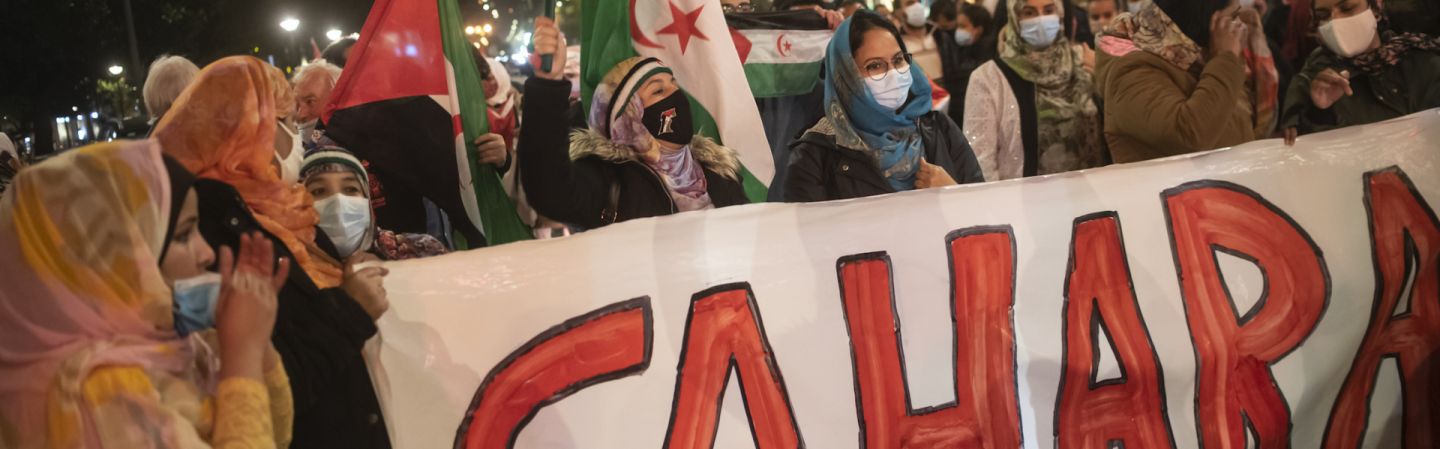
Women carrying Saharan flags take part in a demonstration in San Sebastian, Spain, to demand the end of Morocco's occupation in Western Sahara on Nov. 16, 2020.

(Gari Garaialde/Getty Images)

The Polisario Front announces the end of the ceasefire with Morocco
INTERNATIONAL 14 days ago REPORT

The Moroccan fence in the Guerguerat region, which sparked a severe crisis between Morocco and the Polisario


The leader of the Polisario Front, Ibrahim Ghali, issued a decree ending the commitment to the 1991 ceasefire agreement with Morocco, which could pave the way for a military confrontation between the two sides in the disputed Western Sahara.


In a statement carried by the Polisarios Sahara News Agency, today, Saturday, Ghali said that this comes in response to “Moroccos violation of the ceasefire and attacking civilian protesters in front of the buffer zone (Guerguerat).”


The statement called for “taking measures and measures related to implementing the requirements of a state of war,” and opening the door to “resuming fighting in defense of the legitimate rights of our people.”


The Polisario leader also condemned Morocco for “opening three other buffer zones on the Moroccan military fence,” considering that a “serious violation” of the military agreement sponsored by the United Nations between Rabat and the front calling for the independence of Western Sahara.


This comes one day after the Polisario government also described Moroccos move as a violation of the ceasefire.


Earlier in the day, Morocco said it had deployed forces in the buffer zone in response to the “provocation” of Polisario fighters, who had cut off the road to Guergarat, a gateway to neighboring Mauritania, since last October 21.


Morocco later announced that it had succeeded in securing the entire buffer zone.


Tensions have escalated in the region since 2016. The Front warned that the deployment of Moroccan forces would threaten the truce brokered by the United Nations in 1991.


The Polisario Front announced ending the peace agreement and preparing for war with Morocco

For three decades, the UN-monitored ceasefire has maintained a fragile peace in the disputed Western Sahara.


The situation worsened after Morocco deployed military engineers to expand its network of defensive walls to include the last stretch of the road across the Sahara to neighboring Mauritania.


Dozens of truck drivers were stranded for several days in Guergarat, the last stop currently controlled by Morocco on the road heading to the buffer zone guarded by the United Nations peacekeeping force (MINURSO), where the Polisario maintained a presence there.


The referendum on the future of the Sahara region has been postponed several times before, amid disagreements over the voter lists and the content of the referendum, and whether the referendum paper should include the word independence or only autonomy inside Morocco.


Why dispute about Carrots؟


Polisario spokesman Mohamed Salem Ould Salek said, “The road was not there when the peace agreement was signed in 1991. For the past three weeks, the Sahrawis have been organizing peaceful sit-ins to demand the closure of the illegal border crossing in Guergarat, in accordance with UN resolutions. And the pressure for the self-determination referendum, which was planned by the United Nations but has been repeatedly postponed. “


Hamdi Ould Errachid, mayor of the city of El-Ayoun, one of two regions established to administer the Moroccan-controlled areas of the region, replies, “Since the end of the eighties, Morocco has built a wall, which is a defensive measure protecting the Moroccan Sahara (from the infiltration of Polisario fighters).


“The entire area is closed, except for a loophole near Guerguerat that was not secured and that the Polisario took advantage of it by passing through Mauritanian territory,” he added.


“Morocco will fill this gap, making access to the region impossible.”


Do you is over cease-fire?


Polisario spokesman Mohamed Salem Ould Salek says, “Guerguerat is the last straw … it represents our aggression.”


He adds, “Sahrawi forces are engaged in legitimate self-defense and are responding to Moroccan forces that are trying to push the defensive wall that represents the line of contact” under the 1991 ceasefire.


And he declared it explicit: “The war has started, and the Moroccan side annihilated the ceasefire.”


The official of the Moroccan government in the region, Ould Errachid, said, “The actions of the Polisario are the real threat to the ceasefire. They are not new, but they are dangerous.”


He added: “What is happening is a threat. When you send civilians and armed people to a buffer zone, when the United Nations mission annoys MINURSO, and when it searches vehicles and prevents traffic, this is a threat.”


He stressed that Moroccos goal is “to maintain the ceasefire by preventing illegal interference” and “putting an end to provocations.”

These were the details of the news The Polisario Front announces the end of the ceasefire with Morocco for this day. We hope that we have succeeded by giving you the full details and information. To follow all our news, you can subscribe to the alerts system or to one of our different systems to provide you with all that is new.

It is also worth noting that the original news has been published and is available at eg24.news and the editorial team at AlKhaleej Today has confirmed it and it has been modified, and it may have been completely transferred or quoted from it and you can read and follow this news from its main source.

Thursday, April 03, 2025


The Struggle for Western Sahara


The struggle for Western Sahara stands as one of Africa’s longest-running battles against colonialism and neocolonial occupation. Since Spain’s withdrawal in 1975, the Sahrawi people have resisted Moroccan annexation, enduring forced displacement, repression, and the theft of their land and resources. Today, as Morocco consolidates its illegal occupation with U.S., French, and Israeli backing, including through AFRICOM-linked military exercises, the Polisario Front has reignited armed resistance, refusing to let Western Sahara remain the last colony in Africa.

This fight is not isolated. It mirrors the broader contradictions of imperialism on the continent, where puppet regimes collaborate with foreign powers to suppress liberation movements while looting Africa’s wealth. The Sahrawi Arab Democratic Republic (SADR), recognized by the African Union, embodies Pan-African resistance, drawing solidarity from socialist and anti-imperialist forces worldwide. Yet, Western powers continue to prop up Morocco’s occupation, just as they back Israel’s genocide in Palestine, exposing the shared enemy faced by oppressed peoples globally.

The Sahrawi struggle is a litmus test for anti-imperialists. As they reclaim their land through armed resistance, their fight echoes a universal truth: liberation is never given. It is taken.

U.S. Out of Africa: Voices from the Struggle

AFRICOM Watch Bulletin spoke with India Pitts, who is an artist and organiser with the All-African People’s Revolutionary Party and its women’s wing, All-African Women’s Revolutionary Union, based in occupied North Carolina.

AFRICOM Watch Bulletin: The Sahrawi people have been struggling politically for independence from first Spain and then subsequently Mauritania and Morocco since at least the late 1960s.   For those who are just coming to be aware of your fight, who are the Sahrawi people and what is the Sahrawi Arab Democratic Republic’s (SADR) national liberation struggle?

India Pitts: The Sahrawi people are made up of strong, beautiful, courageous, and determined Africans and Arabs who are waging a legitimate struggle for our land, in the Western Sahara territory. Being there on the ground, we identify politically as Africans, understanding the overall struggle for a United States of Africa.  Similarly to other African countries, the Sahawari people have defeated colonialism and now are struggling against neocolonialism and the puppets who take on traits of the enemy.  After the struggle for independence from Spain the Europeans, always choosing to be delusional,  gave Western Sahara to Mauritania and Morocco.  Like it was ever their legitimate land to give away!  In 1979 Mauritania withdrew, leaving France/Spain/US/Israel backed Morocco to illegitimately occupy 70% of the Western Sahara territory.  After showing three decades of patience waiting for Morocco to abide by the UN resolution to recognize Western Sahara’s sovereignty, the Sahrawi people were forced back into armed struggle in 2020. That brings us to the present day, where the armed struggle continues, as they gain more and more of our land back from western neocolonialist puppets and patriarchal governments like the Kingdom of Morocco.

In 1976 The Sahrawi Arab Democratic Republic was established by the Polisario Front as an independent state. The masses of Western Sahara chose the Polisario Front to represent us in the struggle for sovereignty in Western Sahara.

In character, the SADR, the Polisario Front, and overall Western Sahara’s evolution is Pan-African. The Polisario Front was established in 1973, and three years later proclaimed the Sahrawi Arab Democratic Republic.  Between those years, in 1975, the honorable El-Ouali Mustapha Sayed and other revolutionaries from the Polisario Front gathered the leaders of the Sahawari Tribes to unite them in a national council and move them from a tribal bonding to national bonding.  The tribal leaders responded and declared that they chose national unity under the leadership of the Polisario Front with Kwame Nkrumah’s (the founder of the All African People’s Revolutionary Party) understanding that independence is meaningless without African Unity.

At this time we would like to remind everyone that the Polisario Front is a revolutionary movement, a socialist national liberation movement, anti-colonial, anti-zionist, anti-capitalist, and pan-African in orientation. The Polisario Front is not a political party,

AFRICOM Watch Bulletin: We were surprised on January 7 with the announced suspension of relations between the Republic of Ghana and the SADR.  Could you shed some light on this development please and also speak on the SADR’s relationship with other fresh political developments in the sub-region?

India Pitts: Similarly to Palestine, the Western Sahara struggle is a litmus test where neo-colonist puppets can’t hide their true colors. Ghana’s decision did not surprise us at all given Nana Akufo-Addo’s legacy. This is the same person who saddled Ghana with loans from the IMF up to 1.92 billion dollars, and commended western puppet William Ruto for sending police officers into Haiti, one of Africa’s 1st republics.

We are disappointed that many see this as representing the whole of Ghana. The masses of Ghana see this as a betrayal not only to the Pan-African movement, but to Kwame Nkrumah’s legacy of recognizing SADR since 1979 which reaffirmed Ghana’s commitment to justice and decolonization. We know Ghana has historically held a torch for the causes of anti-colonialism and sovereignty, extending support to movements in Africa and beyond.  In the 2000s we saw this same trend of western puppets backing out on their support of SADR.  This political development in Ghana is no different.

SADR in the present day continues to maintain relations with Cuba, Venezuela, Nicaragua, Yemen, North Korea, occupied Azania, Iran, Mali, Tanzania, Vietnam and Zimbabwe. Additionally Algeria has been a vital brother and sister to Western Sahara, providing aid, land and education to the Sahrawi people.  Even with the US blockade and the occupation of Guantanamo Bay, Cuba still manages to provide doctors, medical supplies, and education to the Sahawari people, and many have attended university in Cuba as well.

Also we must mention that during the late 60’s, even before Algeria was backing Western Sahara, Pan-Africanist Gaddafi’s Libya supported our legitimate struggle in Western Sahara, including with tents which still stand today in our refugee camps in Algeria.  Support also came from Pan-African, socialist, and anti-imperialist movements like those of Cuba, Vietnam, Burkina Faso, Tanzania, Venezuela, Columbia, Ghana, and Kenya.

AFRICOM Watch Bulletin: Can you please speak to the analogies between your struggles and those of the Palestinian people and discuss the impacts of Operation Al Aqsa Flood and the subsequent genocide in Palestine for your people?

India Pitts: The relationship between the Sahrawi and Palestinian causes dates back to the last century when the Polisario Front began coordinating with liberation forces in the region and across the Global South.  Upon its establishment, the Polisario Front declared that the strength and continuity of the revolution depended on building relationships and establishing a joint struggle among peoples to confront imperialism and capitalist colonialism.

The Polisario Front implemented this revolutionary methodology immediately after its formation. The leader and martyr El Wali Mustapha Sayed made sure to visit Libya, Vietnam, Algeria, and Cuba, and coordinated with African leaders from various liberation movements. He also visited Beirut where he met with the Palestinian leader George Habash, alongside leaders and members of the Palestinian Liberation Front. This meeting marked the beginning of a long-standing relationship that continues to this day between the Palestinian and Sahrawi causes.  George Habash visited Sahrawi refugee camps a year after the martyrdom of El Wali Mustapha Sayed in 1976.  During his visit, George Habash emphasized that the fate of the two peoples are interconnected not only in fighting imperialism, but also in combating puppet regimes that represent colonial interests and perpetuate colonialism in the region.  Of course foremost among them was the Moroccan regime.  During that visit George Habash praised the struggle of the Sahrawi people and thanked them for fighting the Moroccan regime which poses a threat to the Palestinian cause.  He also recalled the history of conspiracy and normalization initiated by Morocco with the Zionist entity against the Palestinian people. This relationship continues into the current phase where the Al-Aqsa Flood marks a new beginning for all struggling peoples living under the oppression of imperialism and colonialism.  This phase is not merely a legendary armed struggle against a deeply entrenched colonial entity fortified with technology and the generous support of the U.S. empire.  Rather it is a rewriting of revolutionary history and the decriminalization of armed resistance.

Since the 1980s American and European imperialism have pursued a strategy of ideological warfare by controlling the media, spreading the toxins of liberalism, and portraying liberation as an internal issue with dictatorial regimes that can be resolved through concepts of human rights and democracy delivered on the back of U.S. tanks, World Bank and IMF loans, blockades, and sanctions.

This approach contributed to the draining of the revolutionary spirit that accompanied national liberation wars.  By funding movements and social justice organizations in the Global South, as well as criminalizing armed struggle and linking it to terrorism, imperialism ended decades of revolutionary work, political organization, and education that clarified to people their true enemy and equipped them with the necessary tools to confront it.

The Al-Aqsa Flood operation removed this veil and contributed to strengthening and enhancing the resistance of entire peoples, including the Sahrawi people who had resumed armed struggle against the Moroccan monarchy, a puppet of colonialism, on November 13, 2020.  The Al-Aqsa Flood reinforced this path and marked the end of a phase in which our peoples were enslaved under the ideology of colonialism.  The Zionist genocide in Gaza also exposed colonial conspiracies and the hypocrisy of the slogans they raised, revealing that the only lives that matter are those of the colonizers.  The masks have been removed from the international community, the United Nations, and humanitarian organizations.  It has become a firm conviction among the Sahrawi people, the Palestinian people, and oppressed peoples across Africa and the world, that the path to liberation lies in adhering to the option of armed resistance, allying with the peoples of the Global South, and strengthening revolutionary ties among all movements fighting against the U.S. empire of colonialism and European imperialism.

AFRICOM Watch Bulletin: There have been sporadic bursts of support for SADR positions from unlikely voices such as Condoleeza Rice or Robert F. Kennedy Jr.  What do you make of these oscillations and how do they impact your assessment of what to expect from a new administration that contains both tendencies?

India Pitts: This question is closely related to a point mentioned in the previous question regarding the colonial conspiracy carried out by imperialism since the 1980s.  When imperialism failed to defeat the revolutions against colonialism in the Global South and when oppressed peoples organized themselves under a socialist and revolutionary ideology that raised arms, theory, and practice, to repel capitalist imperialism (gaining popular support and engagement from all segments of society,) and when it failed to break the resolve of these peoples, it resorted to the most cunning forms of circumvention.  It spread the toxins of liberalism and wielded the weapon of terrorism accusations and sanctions.  It attempted to resurrect clownish figures and agents representing the U.S. system to deceive struggling peoples and movements into believing that it had changed its nature and was now concerned with their problems—problems that the U.S. itself had created.  However it became clear to everyone that what the U.S. had changed was merely the snake’s skin, while its venom, fangs, and tail remained intact, waiting for the right moment to strike.

Approaching the Sahrawi cause was a malicious U.S. strategy after the United Nations falsely promised the Sahrawi people a self-determination referendum once they laid down their arms against the Moroccan occupation and signed a ceasefire agreement.

The aim of this agreement was to exhaust the liberation movement, cut off its fighters’ breath, corner it, and prevent it from liberating the remaining parts of its land.  To achieve this strategy the U.S. beast oversaw the negotiations and played the role of a concerned party seeking to end this conflict, which it had created, making Morocco the occupying proxy on behalf of imperialism to retaliate against the Sahrawi revolution.

The revolution had declared war on Spain and France and announced itself as an anti-colonial, socialist revolution with a unifying orientation toward the peoples of the continent, which was a declaration of war on the U.S.

The U.S. intervened in 1975 through Henry Kissinger to engineer the Madrid Accords which divided the Western Sahara between Morocco and Mauritania as retaliation against this revolution.  Subsequently the U.S. armed Morocco, its loyal ally in North Africa, and has continued to support it with weapons and political backing to this day.  Therefore we always say that the truth of the Moroccan occupation is revealed by who supports it.  Morocco is supported by France, the U.S., the Zionist entity, Spain, and European imperialism, while the Sahrawi people are supported by liberation movements in Africa, Asia, South America, the Caribbean, and all oppressed peoples and revolutionary consciences worldwide.

What these malicious U.S. figures did to the Sahrawi cause, they also did to the Palestinian cause.  The U.S. consistently attempted, through the faces of its puppets, to project an image of neutrality while simultaneously arming and supporting Israel.  The same applies to its limited stances on the Sahrawi issue.

As for the Sahrawi people and the Polisario Front, they were never deceived regarding the U.S.’s true nature. There was always a sense of wariness towards these maneuvers even though some individuals associated with the movement engaged in relationships with U.S. organizations as is the case in most African countries.

The decisive response to the reality of the conflict with the U.S. came in 2020 when Donald Trump, before the end of his term, recognized the sovereignty of the Moroccan occupation over Western Sahara through a Twitter post.  Subsequently the Biden administration continued to silently support Morocco as had been the case before.  Therefore the Sahrawi people expect no good from the U.S. colonial system, neither from the face that wears a mask to hide its true nature nor from the current fascist face led by Trump.  The Sahrawi people have always known their friends and allies:  the revolutionaries against colonialism, the free, and all those who fight against the U.S., Europe, and their agents.

AFRICOM Watch Bulletin: From a popular uprising standpoint, the Sahrawi self-determination struggle has been widely regarded as not only legitimate but inspiring.  Also it is worth noting that the Black Alliance for Peace has a Shutdown AFRICOM campaign that is ironically implicated as both the United States and Morocco have used the Moroccan location of the annual African Lion Exercise (the largest AFRICOM exercise) as a bargaining chip to attempt to strongarm concessions in one direction or another.  While we are clear in our U.S. Out of Africa perspective, do you have any thoughts on these relativities and any message or requests to the grassroots?

India Pitts: We encourage everyone to educate themselves on international affairs.  There you will see the interconnectedness of our enemies.  Not only is Morocco allowing the U.S. to host the annual African Lion Exercise but Morocco has Israel drone companies in the Western Sahara occupied territory.

Each company and government cooperating with Morocco, including in the integrated waters off the coast of Western Sahara that Morocco put into its maritime territory, have not tried to obtain permission to do so from the people of the Western Sahara.  Instead they make agreements with these illegitimate settlers.  This violates our right to self-determination in the Western Sahara occupied region.

Our enemies work together, historically and in the present day, similar to the US backing Israel in occupied Palestine.  We saw this with our own eyes when we were commemorating the 50th Anniversary of the National Union of Sahrawi Women in the refugee camps. There we saw the army resources that Spain, the US, and France had provided for Morocco to continue to occupy the Western Sahara territory that the Polisario Front captured during our armed struggle.

We want the grassroots including the organizers everywhere to understand their responsibility to the international struggle against imperialism because our enemies and the enemies of nature, organize together to destroy humanity.   Africans, everywhere, must understand our responsibility to Africa because our destiny is tied to Africa.  We cannot continue to commemorate these flag independence days with Western Sahara occupied and Africa’s islands still being colonized.  It is imperative that we organize against neocolonialism governments, all occupations, and European settlers! 

The Black Alliance for Peace (BAP) seeks to recapture and redevelop the historic anti-war, anti-imperialist, and pro-peace positions of the radical black movement. Read other articles by Black Alliance for Peace, or visit Black Alliance for Peace's website.