In pictures: Second Hinkley Point C unit gets its polar crane
_29980.jpg)
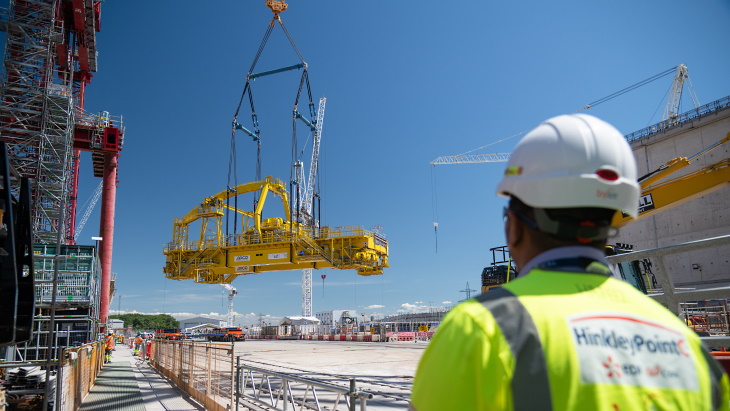
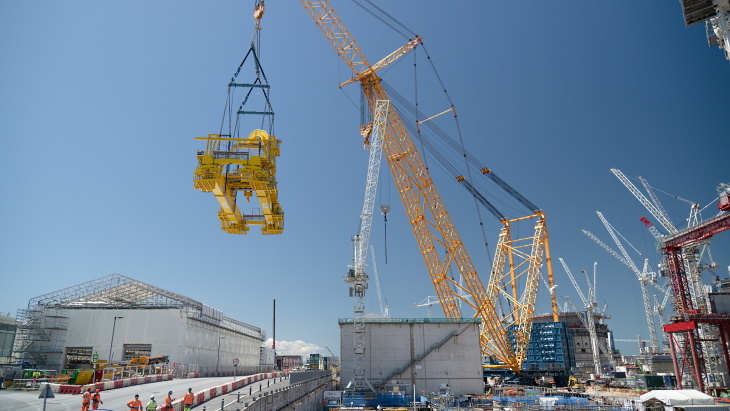
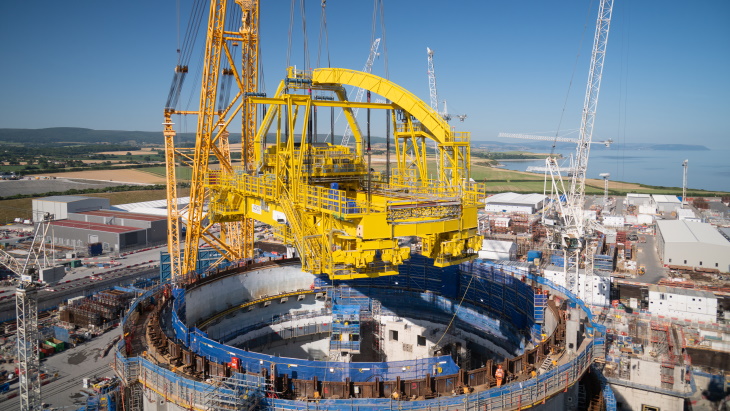
The 750-tonne polar crane was hoisted into position in a two-day operation using Big Carl, the world's largest crane.
The polar crane is able to rotate 360 degrees around the top of the reactor building and will be used to install heavy equipment during construction, such as the reactor and steam generators. It will also be used when the power station is operational for refuelling and maintenance.
(Image: EDF Energy)
It is one of the last pieces of equipment to be installed in the reactor building before the 245-tonne dome is lifted into place, which EDF Energy said is scheduled "later this week".
(Image: EDF Energy)
Construction of Hinkley Point C - composed of two EPR pressurised water reactors of 1630 MWe each - began in December 2018, with unit 1 of the plant originally scheduled to start up by the end of 2025, before that was revised to 2027 in May 2022. Last year, EDF announced that the "base case" was now for unit 1 being operational in 2030, with the cost revised from GBP26 billion (USD32.8 billion) to between GBP31-34 billion, in 2015 prices.
When complete, the two EPR reactors will produce about 10% of the UK's electricity, and are expected to operate for as long as 80 years.
(Image: EDF Energy)
The polar crane of the first Hinkley Point C reactor was hoisted into place in early December 2023, with the dome of the unit installed a couple of weeks later.
"Thanks to experience gained from unit 1, the second polar crane was assembled 40% faster, showing the big benefits of building and repeating an identical design with the same people," EDF Energy said.
The planned Sizewell C plant in Suffolk would be a similar design to the two-unit plant being built at Hinkley Point C in Somerset, with the aim of building it more quickly and at lower cost as a result of the experience gained from what is the first new nuclear construction project in the UK for about three decades.
PEJ seeks European Commission approval for nuclear project
_43506_81960.jpg)
Notification under the Euratom Treaty is a legal requirement for nuclear projects in European Union member states. Its purpose is to allow the European Commission to evaluate a project for its compatibility with the objectives of the Euratom Treaty, including security, sustainable development and efficient use of resources.
The outcome of the notification procedure will be an opinion from the European Commission on the project, which is necessary, among other things, to obtain a construction licence issued by the President of the National Atomic Energy Agency (PAA).
"The investor's notification of the project to the European Commission in accordance with the Euratom Treaty is an important milestone in the delivery of Poland's first nuclear power plant," said Wojciech Wrochna, Government Plenipotentiary for Strategic Energy Infrastructure. "The progress being made in delivering Poland's first nuclear power plant project reflects our determination to ensure that Poland has a safe and stable source of energy for decades."
Marek Woszczyk, President of the Management Board of Polskie Elektrownie Jądrowe (PEJ) added: "Notification under Article 41 of the Euratom Treaty is one of the key stages in the preparation of the investment project. It is also an expression of our commitment to deliver the project in accordance with the highest standards of the European Union. By notifying the project, we are confirming the progress already made in the project delivery and our proactive approach to further activities."
Notification by the investor of an investment project under the Euratom Treaty is a separate process from the state aid notification procedure for the project conducted at the state's initiative.
In December 2024, the European Commission launched an investigation into whether the planned public support for Poland's first nuclear power plant complies with EU rules on state aid. It has yet to give its approval.
Under EU state aid rules, the European Commission analyses the compatibility of the measure under Article 107(3)(c) of the Treaty on the Functioning of the European Union, which enables Member States to support the development of certain economic activities under certain conditions. The support should remain necessary and proportionate and not adversely affect trading conditions to an extent contrary to the common interest.
In November 2022, the then Polish government selected Westinghouse AP1000 reactor technology for construction at the Lubiatowo-Kopalino site in the Choczewo municipality in Pomerania in northern Poland. In September 2023, Westinghouse, PEJ - a special-purpose vehicle 100% owned by Poland's State Treasury - signed an 18-month Engineering Services Contract under which Westinghouse and Bechtel will finalise a site-specific design for a plant featuring three AP1000 reactors. The aim is for Poland's first AP1000 reactor to enter commercial operation in 2033. The total investment costs of the project are estimated to be about PLN192 billion (USD49 billion).
Chinese regulator must keep up with nuclear expansion, says IAEA
_25577.jpg)
An Integrated Regulatory Review Service (IRRS) team concluded a 12-day mission to China on 11 July, a full-scope review covering all facilities, activities and exposure situations. The 24-member expert mission was conducted at the request of the government and hosted by the Ministry of Ecology and Environment (the National Nuclear Safety Administration (NNSA)), which regulates nuclear safety in China.
IRRS missions are designed to strengthen the effectiveness of the national nuclear and radiation safety regulatory infrastructure, based on IAEA safety standards and international good practices, while recognising the responsibility of each country to ensure nuclear and radiation safety.
The previous IRRS mission to China – a follow-up review – was carried out in 2016, when it had 32 nuclear power reactors in operation. China is currently operating 59 reactors generating around 5% of its electricity. In addition, it is constructing 32 reactors and planning to build another 21 units.
The IRRS team reviewed areas including: responsibilities and functions of the government and the regulatory body; the activities of the regulatory body including authorisation, inspection and enforcement processes; development and content of regulations and guides; emergency preparedness and response; radiation sources; research reactors; nuclear power plants; fuel cycle facilities; radioactive waste management facilities; transport of radioactive material; decommissioning; occupational exposure; control of medical exposure and public exposure; and interfaces with nuclear security.
Two policy issues were discussed during the mission: the impact of the rapid development of artificial intelligence on regulation and the shortage of human resources due to the surge in the number of operating reactor units in China.
While identifying several good practices by the NSSA, the team made a number of recommendations and suggestions for further improvement of the overall effectiveness of China's regulatory system, These include: clarifying protection strategies in the case of a nuclear or radiological emergency; providing a documented process for developing inspection plans for nuclear facilities; establishing and implementing a comprehensive safety culture oversight programme; and enhancing its processes to ensure that updates to department rules, guides, and standards are completed to appropriately align with the latest IAEA safety standards.
"Over the past decade, China has made impressive headway in establishing a capable and independent regulatory body and promoting a healthy nuclear safety culture," said IRRS team leader Mark Foy, former Chief Executive and Chief Nuclear Inspector of the UK's Office for Nuclear Regulation. "China has a strong, competent and trusted national regulator that works effectively to ensure the safety of the public and environment.
"The fast growth in China's nuclear power programme will require the recruitment and training of a significant number of additional nuclear professionals in the regulatory field in the coming years. Its use of technology to support the effectiveness of its national regulator is an exemplar for all of us to learn from."
Baotong Dong, Ministry of Ecology and Environment Vice Minister and NNSA Administrator, said: "China has established a regulatory system that aligns with international standards while meeting national conditions. The government will further enhance its regulatory capabilities, accelerate the development of a modern nuclear safety regulatory system, and promote a virtuous cycle of high-level nuclear safety and high-quality development in the nuclear sector. China stands ready to contribute to strengthening global nuclear safety governance and elevating worldwide nuclear safety standards."
The final mission report will be provided to the Chinese government in about three months. The government plans to make the report public. China will consider inviting an IRRS follow-up mission at a later stage.
IAEA warning after gunfire near Zaporizhzhia nuclear plant
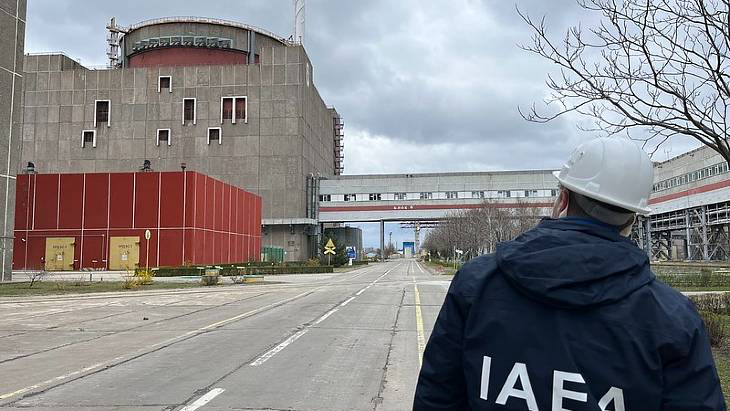
The latest update from the IAEA says that when they conducted a site walkdown on Sunday morning "they saw numerous small calibre casings lying scattered on the ground near reactor units 5 and 6. There was no sign of broken windows or other physical damage. The IAEA team at the ZNPP is seeking further information about the incident".
It said that the large number of shots, repeatedly fired from about 22:00 on Saturday, "was unusual, the team members reported".
Grossi said: "Such military activity at or near a major nuclear power plant is clearly unacceptable."
It follows the "apparent increased use of drones near nuclear power plants" in Ukraine and the report of a strike on the city of Energodar, where most of the Zaporizhzhia plant's staff live.
"We are seeing a clear escalation in drone strikes during this war, also affecting Ukraine’s nuclear power plants and potentially putting them in further danger. As I have repeatedly stated, any military attack on a nuclear site - with or without drones - jeopardises nuclear safety and must stop immediately," Grossi said.
Zaporizhzhia Nuclear Power Plant has been under Russian military control since early March 2022. It is located on the frontline of Russian and Ukrainian forces. The IAEA has had experts stationed at the plant since September 2022 as part of safety and security efforts.
Hitachi platform aims to enhance nuclear plant operations
_27524.jpg)
In the installation of new equipment or modification in nuclear power plants, precise planning and reliable execution are essential to complete on-site work within the shortest possible timeframe, Hitachi says. However, access to nuclear power plants is often restricted by regulations, limiting the frequency and duration of site surveys. In some cases, controlled zones are not accessible during operation, restricting on-site surveys. These constraints require extensive coordination among stakeholders, with electric utilities playing a central role in sharing information and revising work plans.
In response, Hitachi has developed the Metaverse Platform for Nuclear Power Plants to further enhance productivity by enabling accurate understanding and seamless sharing of site conditions among stakeholders, real-time schedule coordination, and reduction of rework.
The platform recreates nuclear power plants in a metaverse using high-precision point cloud data and 3D CAD data, and aims to enhance productivity in information sharing, schedule coordination, and asset management among stakeholders by utilising it with partners such as electric utilities and contractors.
It is also designed to serve as the foundation of a Data-Driven Power Plant, which Hitachi aims to establish to address the diverse needs and challenges faced by electric utilities –such as improving equipment reliability, enhancing work management, and increasing operational efficiency – through data-driven value creation and problem-solving.
This new platform embodies Lumada 3.0, which uses Hitachi's domain knowledge and AI to convert data into value to solve challenges faced by customers and society, and was developed together with GlobalLogic as One Hitachi, integrating Hitachi's decades-long expertise in the nuclear energy business with its group-wide advanced digital technologies.
Hitachi says the platform facilitates the collection, aggregation, and analysis of on-site data, thereby supporting optimal investment planning and plant maintenance through data-driven insights.
Modernisation of Zelenogorsk uranium enrichment production completed
_65383.jpg)
The project was part of TVEL, Rosatom’s fuel division’s, separation equipment modernisation programme and took place with a phased replacement of previous generation gas centrifuges with generation 9+ ones, it said.
Sergey Filimonov, Director General, said: "It is symbolic that a significant historical milestone in the modernisation of the main equipment was reached in the year of the 80th anniversary of the nuclear industry. The technical re-equipment of our enterprise is significant for the successful implementation of the production programme of the Fuel Division of Rosatom in the coming years, including for providing nuclear fuel for new nuclear power units of Russian design in the country and abroad."
Backgound
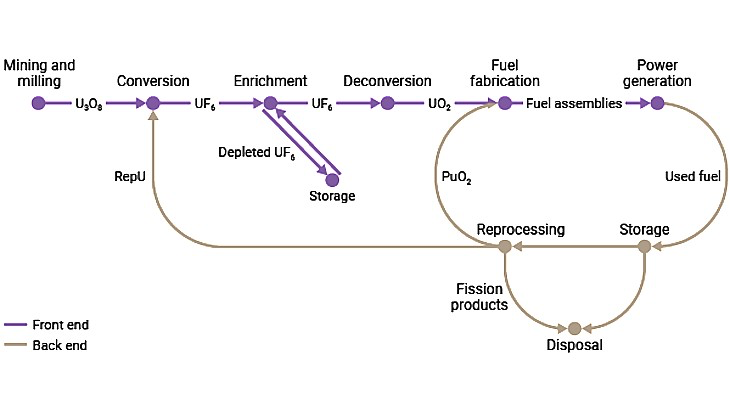
Unenriched, or natural, uranium contains about 0.7% of the fissile uranium-235 (U-235) isotope. ("Fissile" means it's capable of undergoing the fission process by which energy is produced in a nuclear reactor). The rest is the non-fissile uranium-238 isotope. Most nuclear reactors need fuel containing between 3.5% and 5% U-235. This is also known as low-enriched uranium, or LEU. Advanced reactor designs that are now being developed - and many small modular reactors - will require higher enrichments still. This material, containing between 5% and 20% U-235 - is known as high-assay low-enriched uranium, or HALEU. And some reactors - for example the Canadian-designed Candu - use natural uranium as their fuel and don’t require enrichment services.
Enrichment increases the concentration of the fissile isotope by passing the gaseous UF6 through gas centrifuges, in which a fast spinning rotor inside a vacuum casing makes use of the very slight difference in mass between the fissile and non-fissile isotopes to separate them. As the rotor spins, the concentration of molecules containing heavier, non-fissile, isotopes near the outer wall of the cylinder increases, with a corresponding increase in the concentration of molecules containing the lighter U-235 isotope towards the centre. For more detail: A guide: Uranium and the nuclear fuel cycle

No comments:
Post a Comment