Trump Moves to Supercharge U.S. LNG as Exports Hit New Highs
- U.S. LNG exports and feedgas flows hit record highs.
- Europe remains the top buyer, pushing U.S. exports above 10 million tons per month as new capacity ramps up from Cheniere, Venture Global, and other Gulf Coast terminals.
- Rising exports are tightening domestic supply, driving U.S. natural gas prices sharply higher as winter demand surges.
The U.S. federal government is considering further steps to speed up the buildout of liquefied natural gas export infrastructure as flows of natural gas to LNG plants hit a record high. Exports, as it happens, are also running at all-time highs.
The Federal Energy Regulatory Commission’s chairwoman announced the coming changes in a statement that said, “Energy infrastructure needs to be built now, and existing projects need to be maintained efficiently to ensure grid reliability today and in the future. We are taking a hard look at our processes and ways we can simplify certain activities.”
To speed up new infrastructure construction, the commission is considering a blanket permit regime rather than assessing each new project individually before granting approval for its construction. The same changes are being considered for hydropower plants as well, with a view to strengthening the grid.
A couple of days after the FERC statement, Bloomberg reported that natural gas flows to the liquefaction trains along the Gulf Coast had reached an all-time high of 19 billion cu ft daily this last Friday. Of this total, two companies took about half, with Cheniere Energy drawing in 5.1 billion cu ft for its plant in Sabine Pass, and Venture Global taking in 4.5 billion cu ft as it continued to expand production at its second LNG export facility, Plaquemines. The two accounted for 72% of total U.S. LNG exports in October.
The news coincided with data suggesting the United States was on track to post another record month for LNG exports as Europe soaks in whatever volumes are available to stock up on gas ahead of winter. The data, from energy analytics firm Kpler, showed that the monthly total for November was on track to reach 10.7 million tons, which would represent a 40% increase on November 2024 and the highest ever exported by a single LNG-producing country.
The United States is already the biggest exporter of liquefied gas in the world. The Trump administration is working to ensure it stays this way, with the U.S. president making energy imports a mandatory part of his trade deal with the European Union—the largest market for American LNG right now.
If the Federal Energy Regulatory Commission goes ahead with the planned changes, it could encourage even faster growth in LNG export capacity as global energy demand forecasts see consistent growth in demand for liquefied gas specifically.
Already, the Energy Information Administration projects that if all currently planned LNG facilities get built, this would boost the United States’ liquefaction capacity more than twofold, by some 13.9 billion cu ft daily between this year and 2029. Interestingly, the EIA made that projection last month, citing average daily flows to LNG plants of 15.4 billion cu ft.
Last month, Reuters reported that the United States had become the first country to export 10 million tons of liquefied natural gas in a single month. Citing data from LSEG, the publication reported that U.S. LNG exports in October had hit 10.1 million tons, of which 6.9 million tons went to Europe, and another 1.96 million tons went to Asia. Europe accounted for 69% of total U.S. exports of liquefied gas, cementing the continent’s top spot among U.S. LNG clients.
With winter setting in across the Northern hemisphere, chances are that U.S. LNG export rates will remain elevated in the coming months as withdrawals from storage in Europe accelerate amid peak heating demand season. This fits into the Trump administration’s energy dominance agenda—but it also raises gas prices for the average American.
Three months ago, natural gas futures were trading at below 43 per million British thermal units. Last week, the U.S. benchmark hit $4.85 per mmBtu. The price jump reflects strong global demand for liquefied gas amid a colder start to the winter than last year’s. Also, the EIA has reported two consecutive weekly inventory draws in natural gas, reinforcing the perception of tightening supply. This highlights the flip side of the energy dominance agenda: tighter supply at home.
U.S. energy industry insiders argue that there is plenty of natural gas to go around both at home and abroad, and while this may well be true, this supply is by no means unlimited. If all the planned new LNG export terminals get built, exports could increase by as much as 75% by 2030, according to analysts. This would mean daily flows into liquefaction trains of 30 billion cu ft daily by that year.
This, in turn, would necessitate higher production—and indeed, the EIA has projected a record-breaking 2025 for gas production, at 107.1 billion cu ft daily, followed by another record-breaking year in 2026, with output rising to 107.4 billion cu ft. Add to this demand from data centers and higher gas prices become inevitable. The question is just how high they would go.
By Irina Slav for Oilprice.com
Delays in Egyptian LNG Unloadings Are Disrupting Gas and Shipping Markets
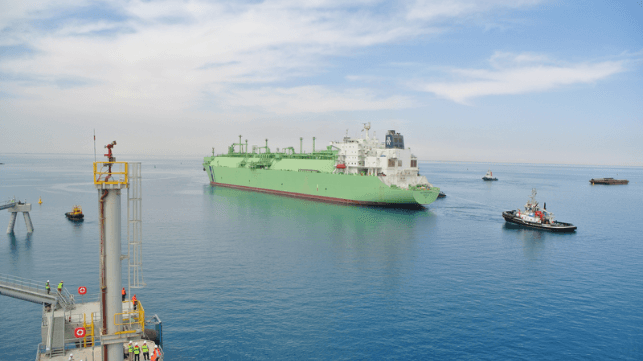
Delays in unloading LNG cargos at Ain Sokhna in Egypt are exacerbating the shortage of LNG tankers in the Atlantic.
Ain Sokhna lies on the western coast of the Red Sea, 30 miles south of Suez. Besides its LNG facilities, Ain Sokhna has container, bulk, and general cargo terminals. There is also a logistics park developed by DP World.
Historically, Egypt has been a net exporter of LNG, although it began importing some LNG in 2015. But from 2024 onwards, imports of LNG rose substantially, as output from existing fields declined and domestic consumption rose. In the first nine months of 2025, Egyptian LNG imports were up over 50 percent in comparison with the previous year. In 2025, Egypt plans to import up to 160 shipments, and last week signed an agreement with Hartree Partners for 80 shipments to be delivered from January 2026 onwards. These level of imports makes Egypt the biggest importer of LNG in the Middle East, surpassing Kuwait.
Egypt’s Minister of Petroleum and Mineral Resources Karim Badawy has said that Egypt intends to increase natural gas production to 6.6 billion cubic feet per day by 2030, a 58 percent increase from the current rate of 4.2 billion cubic feet. The investment program involves drilling 14 offshore exploratory wells in the Mediterranean next year.
But in the meantime, delays in unloading at the Ain Sokhna terminal in recent weeks have seen tankers waiting at anchor off the terminal for berthing spaces for between 10 to 15 days, industry sources report. With Atlantic LNG freight rates peaking at $146,750 per day on November 28, the highest for the year to date, the cost of extended ship chartering time clearly impacts gas prices. But the delays also have a knock-on effect, increasing shipping rates and reducing tanker availability in the Atlantic. This is compounding the pressures also created by increased LNG production and exports from both Nigeria and the United States.
Coping with the temporary switch from export to import profile, the Ain Sokhna terminal employs three Floating Storage and Regasification Units (FSRUs), Energos Eskimo, Energos Power, and Hoegh Galleon. The delays are associated with both the unloading capacity available but also local operational difficulties, in the face of rising import requirements. As the Egyptian government's investment plans are focused on expanding domestic exploration and production rather than the construction of permanent regasification import facilities, the delays are likely to persist.
In a reflection of a rise in the Atlantic rates. Pacific rates also climbed to $89,250 per day, the highest level since December 2023, according to Spark Commodities.

No comments:
Post a Comment