By supporting agroecology, multilateral development banks can stop fueling harm and start financing a just and sustainable food systems transition.
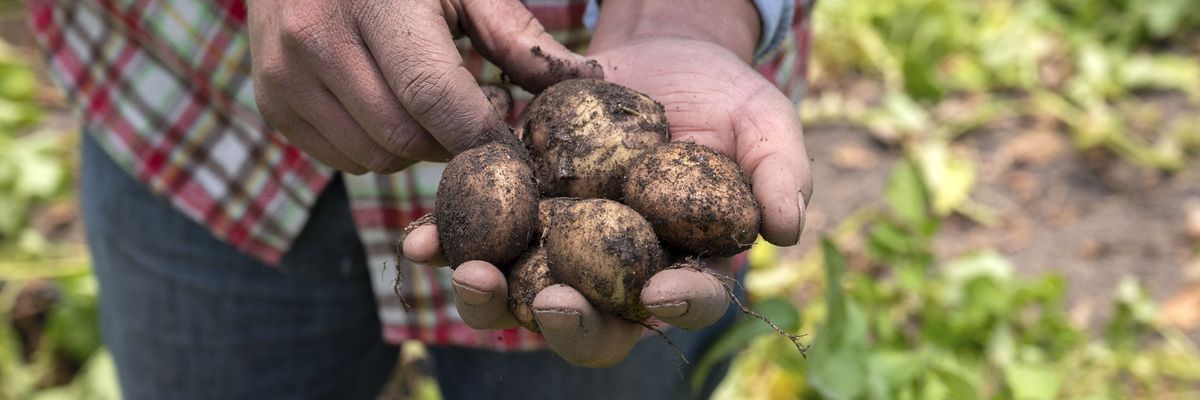
Agroecology technician Yin Rangel, 49, checks seed and potato crops in one of PROINPA (Productores Integrales del Paramo) greenhouses in Mucuchies in Merida State, Venezuela, on August 4, 2023.
(Photo by Miguel Zambrano / AFP via Getty Images)
Dec 03, 2025
Agriculture is essential to human life. How we feed ourselves matters for nutrition, health, climate, biodiversity, and livelihoods. Nearly 928 million people are employed in farming globally, and food systems are responsible for one-third of global greenhouse gas emissions and most new deforestation.
Multilateral development banks (MDBs), like the World Bank Group (WBG), play a critical role. The WBG has committed to double its agricultural financing to $9 billion a year by 2030. In October it launched AgriConnect, an initiative seeking to transform small-scale farming into an engine of sustainable growth, jobs, and food security.
However, while some MDB investments support equitable and sustainable transformation, too many still fuel environmental destruction and inequity. The World Bank’s private sector arm, IFC, recently invested $47 million in a multi-story pig factory farm in China, for example.
A new report from the University of Vermont Institute for Agroecology analyses MDB agricultural investments and sets out a road map for how banks can support, rather than hinder, sustainable farming. The research finds that the World Bank and other public-sector lenders can drive systemic change by supporting governments with policy reforms, rural extension services, and enabling environments. For example, a $70 million Inter-American Development Bank project in Paraíba, Brazil is promoting inclusive, low-carbon agriculture, and strengthening family farmers and traditional communities through technical assistance and climate-resilient infrastructure.
MDBs’ private sector operations must reform their lending criteria and stop financing destructive projects.
MDBs are better placed than other financial institutions to take long-term, lower-return investments aligned with climate and food security goals. Agroecological farming, a holistic, community-based approach to food systems that applies ecological and social food sovereignty concepts, along with long-term productivity, provides a channel for public sector arms of MDBs to support needed agricultural transformation. MDBs and other public banks therefore, should seek to become the enablers of agroecology. The International Fund for Agricultural Development (IFAD) and the Agence Française de Développement (AFD) are already leading efforts in this direction.
MDB Private Sector Operations: Profit-Driven Harms
In contrast to the IFAD and AFD models, the University of Vermont’s Institute for Agroecology’s report found that the majority of private-focused MDBs prioritize “bankable” projects—typically large-scale, industrial, profit-driven agribusiness. This model steers money toward factory farms that use human-edible food as feed, pollute nearby communities, raise the risks of zoonotic disease and antimicrobial resistance, and engage in animal cruelty. In 2023, a report by Stop Financing Factory Farming found that public finance institutions invested US$2.27 billion in factory farming, 68% of the total investment in animal agriculture projects that year.
As evidenced by multiple complaints from impacted communities, these investments undermine poverty reduction, Sustainable Development Goals (SDGs), and Paris Agreement climate goals. MDBs’ private sector operations must reform their lending criteria and stop financing destructive projects.
The opportunity: Public Sector Banks Can Pave the Way for Private-Sector Transformation
Rich country governments currently subsidize agriculture, mostly industrial, at a level of $842 billion per year. According to the IMF, only a quarter is dedicated to support for public goods in the sector. Shifting this support to incentivize investments in agroecology is crucial to sustain the agricultural transformation that public banks themselves have called for.
Public banks have the opportunity to join a growing number of organisations already advancing an ecological approach to meet the SDGs and wider social, cultural, and economic, and environmental objectives. To do so, they must shift from treating agroecology as merely a niche solution and instead invest in it as a priority means for achieving food systems transformation.
Agroecology puts an end to costly and harmful practices, replacing animal cruelty with humane, safe, and fair standards.
By taking this approach, public banks can better support just transitions in food systems, something that is already beginning to take shape. Earlier this year, for example, the World Bank backed an $800 million loan to the Colombian government to advance a greener and more resilient economic transformation.
The private-sector arms of MDBs, such as IFC and IDB Invest, also have a role to play in aligning with the transition. Most importantly, they can support governments with policy advice and financing criteria that break from entrenched models and exclude industrial animal agriculture from eligibility for finance.
While MDBs have taken steps to make agricultural production and rural incomes less vulnerable to climate change, they have yet to commit to agroecological farming as the most effective pathway. In contrast, IFAD is already demonstrating what this can look like, driving agroecological transitions through private-sector incentives in Ethiopia, Peru, and Vietnam. Similarly, AFD is applying agroecology to support family farming in Ethiopia, Haiti, Madagascar, Malawi, and Sierra Leone.
Agroecology as the Future of Sustainable Farming—and Public Agricultural Finance?
If MDBs are looking to advance the SDGs and solve the polycrisis (climate, biodiversity, pandemic risk, and food security), one of the most effective ways in which this can be done is for the public sector to mobilize policy support and significant capital investment into agroecology. Meanwhile, MDB private sector arms can enable this transition by providing policy advice and finance for interventions that break from entrenched models.
Agroecology puts an end to costly and harmful practices, replacing animal cruelty with humane, safe, and fair standards. But it’s not just about farming practices. It also helps transform food systems, building resilient, reparative, low-emission economies and improves livelihoods in line with the 2030 SDGs.
By supporting agroecology, MDBs can stop fueling harm and start financing a just and sustainable food systems transition. If they are serious about the SDGs, food security, and climate goals, the road map is clear—MDBs’ public sector operations must enable, their private sector operations must reform, and both must support a transition away from industrial agriculture toward a more just and sustainable food system.
Our work is licensed under Creative Commons (CC BY-NC-ND 3.0). Feel free to republish and share widely.
Lizah Makombore
Lizah Makombore is a PhD candidate at the University of Vermont Institute for Agroecology.
Full Bio >
Ladd Connell
Ladd Connell is a multilateral finance consultant at Friends of the Earth.
Full Bio >
Study: Family grocery purchases improved when online grocery carts were preloaded with healthy ingredients
UB-Instacart pilot study increased nutritional quality of groceries of families with young children without increasing grocery costs
University at Buffalo
image:
Stephanie Anzman-Frasca and her UB colleagues have done pioneering work in behavioral medicine and nutrition, including prior research on optimal defaults; in this study, they wanted to see how the preloaded default grocery carts would work in families with young children at risk for obesity.
view moreCredit: Sandra Kicman/University at Buffalo
BUFFALO, N.Y. — University at Buffalo researchers have shown that preloading Instacart online grocery carts with healthy ingredients could be a useful tool for improving the diets of families with young kids at risk for obesity.
Published on December 3 in Appetite, the randomized, controlled pilot study found that providing families with healthy recipes and then preloading online grocery carts via Instacart with the ingredients needed to make those recipes resulted in families making purchases that were significantly more nutritious compared to a group that received only the recipes. Families paid for their grocery purchases as usual and were free to switch out pre-loaded cart ingredients if they wanted to.
“The findings support the idea that healthier choices can be supported by making them easier and more automatic,” says Stephanie Anzman-Frasca, PhD, corresponding author on the paper and an associate professor of pediatrics and director of the Child Health and Behavior Lab in the Jacobs School of Medicine and Biomedical Sciences at UB.
PHOTO: https://www.buffalo.edu/news/releases/2025/12/UB-Instacart-study-family-nutrition-default.html
Research shows that children who are overweight by age 5 are more likely to have obesity later in life, putting them at risk for cardiovascular and other diet-related diseases.
“Since experience with foods and flavors early in life can influence children’s later food preferences, eating behavior and health, it’s important to make healthy choices easier for families with young children,” Anzman-Frasca says.
A ‘real-world’ family shopping intervention
The study was the first time that a default grocery shopping intervention for families with young children was conducted in a real-world scenario, where families were purchasing the actual groceries they would be eating during the four-week study. The goal was to test in a real-world shopping situation the impact of “optimal defaults,” the idea that preselected options can be helpful in guiding people toward healthy behaviors.
Anzman-Frasca and her colleagues in the Division of Behavioral Medicine have done pioneering work in behavioral medicine and nutrition, including prior research on optimal defaults; in this study, they wanted to see how the preloaded default grocery carts would work in families with young children at risk for obesity.
Eligible families had to do at least 75% of their grocery shopping online, and one parent had to have a body mass index of at least 25, classifying them as overweight. A diverse group of 69 families, nearly half of whom were living with lower incomes, participated.
All families received healthy recipes for two weeks, and a sample recipe bundle is included in the published paper. Each weekly bundle included recipes for three dinners, plus a “bonus” recipe, such as a snack, that used leftover ingredients from the dinner meals. While all participating families received the recipes, half of the families had their Instacart online grocery carts preloaded with the ingredients to make those dishes, while the other half did not.
“When faced with making a choice, most people will take the default option unless they’re highly motivated to choose an alternative,” says Mackenzie Ferrante, PhD, a co-author and assistant professor at Rutgers University, who did postdoctoral work at UB. “These days, the easy, or default, choice with food is rarely the healthy option. We wanted to see what would happen if the default option for families was the healthy choice.”
“This real-world study shows how Instacart’s technology can make it easier for families to fill their tables with healthier foods,” says Beatrice Abiero, PhD, senior manager of policy research at Instacart. “By examining how our platform can inspire more nutritious choices, we’re seeing how online grocery can support healthier habits — without adding cost — at scale. We’ll continue to use Instacart Health tools to support research and nutrition programs that help make the healthy choice the easy choice.”
The researchers note that children between the ages of 2 and 5 are frequently afraid of, and resistant to, trying new foods, which can pose a challenge. In this study, recipes were selected for families based on information that they provided about their family’s food preferences at the beginning of the study. Results showed that there was a significantly greater improvement in nutritional quality of families’ grocery purchases in the group that received the preloaded carts compared to the group receiving only the recipes.
‘Eye-opening’ to see what they were spending
Across both groups, families’ spending on groceries decreased over the course of the study. While this wasn’t a main goal of the study, and more research needs to be done, the researchers say it’s possible that the requirement to fill out forms about what they purchased might have made families more aware of superfluous items they were buying. Some participants noted it was eye-opening to see how much they were spending.
In the future, the researchers want to extend the work to examine how the preloaded online grocery carts affect family grocery purchases over a longer time period and corresponding impacts on dietary intake and health. In the meantime, Anzman-Frasca says, families can use the “Buy It Again” feature on Instacart to repurchase healthy ingredients they have enjoyed in the past, which can be used to easily reload those ingredients into future shopping carts.
When this study began in 2023, the White House cited it as an example of how to combat nutrition insecurity and diet-related disease. The project was supported by Instacart and leveraged Instacart Health tools. The support from Instacart complemented an initial investment from the UB Office of the Vice President for Research and Economic Development. UB’s Clinical and Translational Science Institute provided seed funding for prior pilot research that set the stage for the current project.
Additional co-authors include Juliana Goldsmith, Adrianna Calabro, Karlie Gambino and Leonard H. Epstein, PhD, of the Jacobs School; Lucia A. Leone, PhD, and Gregory E. Wilding, PhD, of the UB School of Public Health and Health Professions; and Brianna Wallenhorst of the Independent Health Foundation.
Journal
Appetite
Method of Research
Randomized controlled/clinical trial
Subject of Research
People
Article Title
Effects of an optimal defaults grocery shopping intervention on household grocery purchases of families with young children
Article Publication Date
3-Dec-2025

No comments:
Post a Comment