Friday, May 08, 2026

French supermarkets still hooked on plastic despite waste goals: report

French supermarkets are still relying heavily on plastic packaging despite laws requiring them to cut single-use plastic waste – with bottled water, wrapped fruit and vegetables and ready-to-cook produce sold in plastic remaining common on shelves across the country, an investigation published Wednesday found.


Issued on: 06/05/2026 - RFI

Single-use plastic packaging remains widespread in French supermarkets despite laws aimed at phasing it out by 2040, with bottled drinks accounting for nearly 40 percent of the sector’s plastic waste. AFP - OLIVIER MORIN

Most major retailers have made little progress towards targets set under France’s anti-waste laws, the survey by consumer group Que Choisir Ensemble and NGO No Plastic In My Sea said.

Volunteers visited 1,659 stores from 11 major chains including Carrefour, Lidl, E.Leclerc, Intermarché and Auchan between 7 and 21 February.

France’s AGEC anti-waste law, adopted in 2020, requires single-use plastics to be phased out by 2040. A second law passed in 2021 aims for 20 percent of supermarket products to be sold without packaging by 2030.

“There is a gap between the commitments being displayed and the reality on supermarket shelves,” Lucile Buisson, environment officer at Que Choisir Ensemble, said. “Plastic remains omnipresent.


Bottled water boom

The water and drinks section accounts for nearly 40 percent of all single-use plastic in supermarkets, the survey found. Sales of bottled water rose by 3.3 percent in 2025.

“No retailer has put in place a real strategy to reach the legal target of cutting plastic bottles by 50 percent by 2030,” the report said.

Mini-format bottles were singled out as one of the worst examples.

Evian sells packs of 24 bottles of 33 centilitres while Hépar sells packs of eight. The groups said the products use large amounts of plastic for small quantities of water. Mini-format bottles were found in 81 percent of stores surveyed.

“Numerous alternatives exist,” Muriel Papin from No Plastic In My Sea said, pointing to reusable glass bottles along with filtration and carbonation systems for tap water.

Only Biocoop was praised in the report after ending sales of still bottled water in 2017.

“It’s an issue we have been aware of for a long time,” Philippe Joguet from the Federation of Commerce and Distribution, a retail industry body, said.

Reducing plastic use requires action from everyone involved, from packaging makers to consumers, he added.


'Economy of laziness'

Fruit and vegetables also remain heavily packaged despite rules designed to reduce plastic waste. Of five common fruit and vegetables surveyed, 60 percent were sold packaged in conventional supermarkets.

Organic produce was even more likely to be wrapped. The survey found only 9 percent of organic fruit and vegetables were sold loose, while nearly half were packaged in plastic.

Another growing trend identified by the groups was the sale of peeled and chopped vegetables wrapped in plastic. Nearly one supermarket in two now offers ready-to-cook vegetables packaged in plastic.

“After cut fruit and vegetables packaged for snacking, we are now seeing mushrooms or courgettes ready to cook, sliced and peeled under ever more plastic wrapping,” Buisson said.

“It costs much more and benefits the consumer very little.”

The report described the trend as an “economy of laziness” that runs against waste reduction efforts.


Bulk sections in retreat

The proportion of supermarkets with dedicated bulk sections fell from 57 percent in 2023 to 38 percent in 2026, the survey found. The average number of bulk items available also dropped sharply.

Discount chains Aldi and Lidl offered almost no bulk options, while organic retailers maintained stronger bulk ranges.

Bertrand Swiderski from Carrefour said the retailer had already reduced its packaging by 10 percent, equal to 20,000 tonnes over three years, and planned to remove another 15,000 tonnes by 2030.

The two organisations called on retailers to introduce clear timetables for reducing single-use plastics and abandon what they described as the most wasteful practices, including wrapped produce and mini-format bottles.

They also urged the French government to maintain the reduction targets set out under the AGEC law.

(with newswires)
West Bank settlements prompt call for sanctions from European political figures

Hundreds of former diplomats, ministers and senior officials have urged the European Union to take immediate action against Israeli settlements in the occupied West Bank, warning that a controversial new construction project could further undermine prospects for a future Palestinian state.


Issued on: 07/05/2026 - RFI

Israeli Finance Minister Bezalel Smotrich displays a map of an area near the settlement of Maale Adumim, a land corridor known as E1, outside Jerusalem in the occupied West Bank, 14 August, 2025. AFP - MENAHEM KAHANA

By: David Coffey with RFI


In an open letter published on Wednesday, 448 signatories – including former EU foreign policy chief Josep Borrell and former Belgian prime minister Guy Verhofstadt – called on the EU and its member states to impose targeted sanctions on individuals and entities involved in Israeli settlement expansion.

The appeal comes as Israel prepares to move ahead with the E1 settlement project, a plan covering around 12 square kilometres east of Jerusalem that includes roughly 3,400 housing units.

Critics say the development would effectively split the occupied West Bank in two, further isolating east Jerusalem from the Palestinian territories.

According to the letter, the Israeli government intends to publish detailed tenders for the project on 1 June.


“The EU and its member states must take immediate measures,” the signatories wrote, “to deter Israel from pursuing its illegal annexation of Palestinian land in the West Bank.”

'Violation of our values'

The former officials are urging Brussels to adopt targeted sanctions including visa bans and business restrictions against those linked to settlement activity, and the E1 project specifically.

Potential targets mentioned in the letter include political figures, settlement leaders, the Israeli Land Authority, local officials, urban planners, architects, engineers, developers, contractors and financial institutions involved in the scheme.

The signatories also pressed the EU to act ahead of the bloc’s Foreign Affairs Council meeting on 11 May, arguing that delaying action would weaken Europe’s commitment to international law.

Sven Kühn von Burgsdorff, who served as the EU’s ambassador to the Palestinian territories and Gaza between 2020 and 2023, said support for the initiative had grown significantly over the past year.

“It’s the eighth time we’ve launched an open declaration,” he told RFI. “We started in July last year with around 20 signatories. Today, we have 450, which is quite impressive.”

He said the growing number reflected mounting concern among former European officials that the EU is risking abandoning its principles.

“There is a growing concern among former officials like myself who believe the European Union is founded on values and principles of international law and human rights,” he said. “A failure to act would be a blatant violation of our own values and interests.”


Settler violence

The E1 project was approved by Israel in August 2025 and has drawn strong international criticism.

United Nations secretary-general António Guterres, through a spokesman, warned that the plan would pose an “existential threat” to the viability of a contiguous Palestinian state.

Israel has occupied the West Bank since 1967. Excluding annexed east Jerusalem, more than 500,000 Israeli settlers now live in the territory alongside 3 million Palestinians. The settlements are considered illegal under international law by the United Nations.

According to a recent UN report, the expansion of Israeli settlements in the occupied West Bank reached its highest recorded level in 2025 since the organisation began tracking the data in 2017.

Settlement growth has accelerated sharply under Israel’s current government, particularly since the outbreak of the Gaza war following Hamas’s 7 October, 2023 attack on Israel.

Violence in the West Bank has also intensified. Palestinian officials and the UN say attacks by Israeli settlers have surged in recent months, with clashes involving settlers, Palestinian residents and Israeli forces becoming increasingly frequent and, at times, deadly.

(with newswires)

Tennis stars raise French Open boycott threat in fight for more prize money

Tennis stars campaigning for more prize money at the Grand Slam tournaments in Melbourne, Paris, London and New York raised the prospect of boycotting the French Open to force organisers to share more of the money generated by the international circuit's most prestigious competitions.


Issued on: 07/05/2026 - RFI

Coco Gauff received €2.55 million for winning the 2025 French Open women's singles event. The 2026 women's champion will brandish the Coupe Suzanne Lenglen and a pocket a cheque for €2.8 million. © Pierre René-Worms / RFI

By: Paul Myers

"When you see the number and you see the amount the players are receiving ... I feel like the show is on us," said women's world number one Aryna Sabalenka as she prepared for her second-round match on Thursday against Barbora Krejcikova at the Italian Open in Rome.

"I feel like without us there wouldn't be a tournament and there wouldn't be that entertainment," Sabalenka added. "I feel like definitely we deserve to be paid more percentage. What can I say?"

Bosses at the French Open announced a 9.53 percent increase in the 2026 purse to €61.273 million compared to €56.352 in 2025 when outlining details of the tournament which starts at the Stade Roland Garros in western Paris on 18 May.


Prize money dispute

A player losing in this year's first round of the main draw will receive €87,000. In 2025, they went away with €78,000.

The 2026 men's and women's singles champions will pocket €2.8 million, a 10 percent increase on the €2.55 million handed to Carlos Alcaraz and Coco Gauff following their wins over Jannik Sinner and Sabalenka respectively in the 2025 finals.

Alcaraz, Sinner, Sabalenka and Gauff were among the world's 20 best players who signed an open letter that was sent on Monday to the French Tennis Federation (FFT) which stages the French Open.

In it, they said they were collectively disappointed with the prize money offered by the French Open, which is nicknamed Roland Garros.

“Roland Garros generated €395m in revenue in 2025, a 14 percent year-on-year increase, yet prize money rose by only 5.4 percent, reducing players’ share of revenue to 14.3 per cent,” the statement read.

“With estimated revenues of more than €400 million for this year’s tournament, prize money as a percentage of revenue will likely still be less than 15 percent, far short of the 22 percent that players have requested to bring the Grand Slams into line with the ATP and WTA tours.

"As Roland Garros looks to post record revenues, players are therefore receiving a declining share of the value they help create."

Growing solidarity

During a press conference to present innovations at the 2026 French Open, tournament director Amélie Mauresmo said FFT officials wanted to give more prize money to players who come through three rounds of qualifying and those who lose in the early rounds of the main draw.

In 2026, a first-round loser in the qualifying tournament will get €24,000 and there will be €33,000 and €48,000 for losses in the second and third rounds respectively.

In 2025, the sums for the three qualifying rounds were €21,000, €29,500 and €43,000.

"A particular effort has been made for the first three rounds of the singles draw in the main tournament with an increase of between 11.11 and 11.54 percent," an FFT statement said.

"As for the prize money for the doubles events – women’s, men’s and mixed – it has increased by 3.90 percent compared to last year."

The FFT said prize money allocated to this year’s wheelchair and quad tennis competitions would rise to €1,018,500 – a 14.55 percent increase.

Gauff said there was growing solidarity among players over demands for a larger share of tournament revenues.

"I definitely agree with her on that standpoint,” Gauff said. “I think a few other players agree, too.”

The 22-year-old American highlighted the campaign by women basketball players in the United States who fought WNBA administrators for more than a year before eventually signing a new collective bargaining agreement that brought them nearly 20 percent of league revenue.

“If everyone were to move as one and collaborate, I can 100 percent see that,” Gauff added. “It’s not about me.

"It’s about the future of our sport and the current players who aren’t getting as much benefits as even some of the top players are getting, when it comes to sponsorship and things like that. We’re making money off court."


Slam comparisons

Gauff said it was unfortunate that players between 100 and 200 in the world rankings were often struggling financially.

“If we all collectively agree, then yes … I think that a boycott is something us as players have to talk amongst ourselves and do it, and talk within each other and decide what’s best."

The Australian Open offered prize money of A$111.5 million in 2026, up from A$96.5 million, while the US Open paid out $90 million in 2025 and Wimbledon Championships gave players a total of £53.5 million in 2025.

Wimbledon, which starts on 29 June in south-west London, has yet to announce prize money for the 2026 championships.


Police raids across 90 countries seize fake and illegal medicines worth €14m


Interpol says nearly 270 people suspected of drug trafficking have been arrested and 66 criminal groups dismantled following a major international police operation spanning 90 countries.


Issued on: 07/05/2026 - RFI

Nearly 270 suspected drug traffickers were arrested during a global Interpol operation targeting counterfeit and illicit medicines across 90 countries in March 2026. AFP - OLIVIER CHASSIGNOLE

The operation, known as “Pangea XVIII”, was carried out in March across every continent and resulted in the seizure of more than six million illicit medicines worth over €14 million, the Lyon-based international police organisation announced on Thursday.

Among the counterfeit or unlicensed medicines confiscated were drugs for erectile dysfunction, sedatives, painkillers, antibiotics and smoking-cessation products.

The scale of the haul showed the continued expansion of illegal pharmaceutical markets, particularly online, Interpol said.

“Thanks to online markets and informal supply chains, criminals can exploit loopholes in controls and target people seeking quick or affordable treatments,” Interpol Secretary General Valdecy Urquiza said in a statement. He warned that such products could have “serious, even fatal” consequences for consumers.


Veterinary medicines


Interpol expressed particular concern over what it described as a sharp rise in the seizure of anti-parasitic medicines, especially deworming products authorised only for veterinary use.

The organisation said these products are increasingly being marketed online as “dietary supplements” or promoted as part of so-called alternative cancer therapies, despite there being no scientific evidence to support such claims.

Interpol noted that misuse of anti-parasitic drugs had already become visible during the Covid-19 pandemic, when certain unproven treatments gained traction on social media and alternative health forums.

Authorities also said demand for “performance-enhancing” and “lifestyle” pharmaceuticals – including steroids and peptides – continued to rise, driven in part by bodybuilding and fitness communities.

Factory raids

The operation led to major seizures in several countries. In Bulgaria, police dismantled an illicit drug manufacturing facility where millions of tablets, ampoules and injectable products were recovered.

In Burkina Faso, authorities confiscated 384,000 antibiotic capsules, while in Côte d’Ivoire investigators discovered a tonne of counterfeit ibuprofen hidden inside a vehicle.

Interpol said the success of the operation reflected growing international co-operation against pharmaceutical crime, but warned that counterfeit medicines remain a fast-moving and highly profitable global trade.

(with newswires)
FASCIST KLEPTOCRAT

EU prosecutors probe alleged misuse of funds linked to France's Bardella

Paris (France) (AFP) – European Union prosecutors have launched a probe into a possible misappropriation of EU funds, after a complaint alleged France's far-right National Rally had used European grants to benefit its leader Jordan Bardella, a source close to the case told AFP Thursday.


Issued on: 07/05/2026 - RFI

Bardella dismisses the allegations against him, said the National Rally. © SEBASTIEN BOZON / AFP

The complaint, filed in Paris last December by anti-graft association AC!!Anti-Corruption, was forwarded by the National Financial Prosecutor's Office (PNF) to the European Public Prosecutor's Office for assessment.

"Following a preliminary review, an investigation has been opened on suspicion of fraud," said the source.

The launch of the probe comes as Bardella's mentor, Marine Le Pen, is seeking to overturn a court ruling that convicted her of embezzlement in 2025 and could derail her presidential bid next year.

If an appeals court in July bars the 57-year-old from public office over an alleged fake jobs scam in European Parliament, Bardella, 30, is expected to run in her place.

Bardella is head of the Patriots for Europe group, the EU legislature's third-largest bloc that was co-founded by former Hungarian prime minister Viktor Orban.

Contacted by AFP, a spokesman for the Luxembourg-based EPPO said: "It is the European Public Prosecutor's Office's policy not to comment on ongoing investigations."

'Defamation'

A representative of the RN party told AFP: "Jordan Bardella naturally denies these accusations levelled against him in the current political climate, and reserves the right to take legal action for defamation and slander."

The anti-corruption association had filed a complaint in December 2025 over the misappropriation of public funds, following an article in French investigative weekly Le Canard Enchaine.

The association suspects the RN of having used European funds to train its members, and in particular its current president Bardella, to address the media during the 2022 French presidential election campaign.

Le Pen made it to the second round of the presidential election in 2022 but was defeated by Emmanuel Macron, who won five more years as president.

Bardella was then acting leader of the far-right party.

Funds held by members of the National Rally in their capacity as MEPs were allegedly used "for purposes other than those for which they were allocated", said the complaint seen by AFP.

The media training coach had been hired to "prepare National Rally MEPs for media appearances", the anti-corruption group said in its complaint to the PNF, the French judicial authority specialising in tax fraud and serious economic and financial crime.

The coach was "paid by the European Parliament from the budget allocated to MEPs", the complaint added.

The association cites an article in Le Canard Enchaine which "reveals that from September 2021" the coach was tasked with assisting Bardella "not with regard to his knowledge of European current affairs but with a view to preparing for the French presidential election in 2022".

Officially established in 2021, the European Public Prosecutor's Office is an independent EU body responsible for combating fraud against the Union's funds and any other offences affecting its financial interests.
Inside Iran’s new two-tier internet access, as blackout drags on

Iran is giving privileged internet access to a small group of approved users, while most of the population remains offline during a prolonged nationwide blackout. More than 60 days into one of the longest shutdowns in its history, authorities are moving from blanket censorship to a system that selects who can connect – raising concerns over inequality, economic damage and tighter control of dissent.


Issued on: 07/05/2026 - RFI

Two women use a smartphone in northern Tehran, Iran. Authorities have introduced a system that gives fuller internet access to selected users while much of the population remains under heavy restrictions. AP - Vahid Salemi

That control has now reached an unprecedented level. The current shutdown has lasted more than 60 days, making it the longest internet cut since Libya lost access for nearly six months during the Arab Spring.

It follows years of increasing control by the authorities after repeated unrest. Iran clamped down on communications during the Green Movement in 2009, the fuel price protests in 2019 and the demonstrations after the death of Mahsa Amini in custody in 2022.

This repression increased again after American strikes in June 2025, protests at the end of that year and a deadly crackdown in early 2026.

Foreign Minister Abbas Aragchi told news channel Al Jazeera in January that the shutdown was a response to “terrorist operations” launched “from abroad”. The war declared by the United States and Israel on 28 February compounded the controls.


However, monitoring group NetBlocks noted in mid-April that regime figures and approved influencers were still posting freely on social media, while a population of 90 million people had effectively been silenced.

Alongside this unpublished whitelist, authorities have introduced a system known as “Internet Pro”. Tehran has not denied that selected users are being allowed online, but the number of people involved is not known.

Whitelist access


Internet Pro is a paid service with several levels of priority, offering faster and more stable connections to those who qualify. Both the paid system and the whitelist amount to a selection of users, allowing some to access the web.

The system relies on tight control of internet traffic across the country. Access can be cut on one side of a street and maintained on the other, or limited to specific categories of users.

“Very often, this strategy is applied at an economic level: if you pay more, you get a higher speed and access to services others do not have,” Kavé Salamatian, a computer science professor at Université Savoie Mont-Blanc and a specialist in Iran, told RFI.

“Doing this at the scale of a country, and not at the scale of a company or a single operator, is more or less new. The main question is how the Iranian regime can implement it. The authorities have put in place a very precise system to control internet traffic.”

Applicants for Internet Pro must present identity documents, as well as proof of their profession or recommendations. Business leaders, shopkeepers, doctors, academics and teachers are among those eligible.

The Iranian news agency ISNA, which is partially funded by the government, described the system as “an expert solution that offers a stable connection for professional activities”.

Government spokesperson Fatemeh Mohajerani confirmed the policy during a press conference in March, saying: "Measures have been put in place to give more resources to people who can make our voice heard more widely."


Economic cost

Along with Pakistan, Russia and Myanmar, Iran imposes strict limits on internet access in the name of regime survival. In these states, a two-speed internet has been common for years, and IP addresses are often closely monitored.

But such control comes at a cost. Restricting access may reduce what authorities see as security risks, but it also weakens the digital economy, which depends on open internet access.

NetBlocks estimates financial losses from the shutdown at $37 million per day. Around 10 million Iranians are directly or indirectly affected in terms of their income.

“The question of censorship in the country has for a very long time been controversial for economic reasons and economic arguments,” said Salamatian. “It is a political issue.”

Bombing outages

In January, French legal think tank Le Club des Juristes said Iran had relied on its highly centralised network and strict control over domestic providers to enforce these restrictions.

Most Iranians now rely on the National Information Network, or NIN, a tightly controlled domestic network that has been in development for more than 15 years. Using a VPN or satellite services such as Starlink remains extremely risky.

“Once the competent authorities have declared the situation normal, the internet situation will also change,” government spokesperson Mohajerani said, adding that the government viewed internet access as a civic right and was listening to public demands.

Salamatian added that, in addition to the government measures, some internet outages are linked directly to the war. “It is important to remember that, for the three months Iranians have been at war, some of the outages are attributable to the bombing."

At the same time, he said, the conflict has allowed authorities to make security their top priority and tighten control over dissent. However, he expressed scepticism that such controls can last, saying the strategy could "work over a short period, but not over the long term”.

He added: “The Chinese built the Great Wall in the third century. A Chinese thinker said that no wall will ever be higher than people’s desire to cross it. That means every wall you build is destined to be bypassed.”

This article has been adapted from the original version in French by Anne Bernas.
Why experts say the cruise ship hantavirus utbreak is not another Covid

The World Health Organization has warned that more hantavirus cases could emerge after an outbreak linked to a cruise ship killed three passengers, though officials say the situation is likely to remain contained if health measures are followed.


Issued on: 08/05/2026 - RFI

A test tube labelled “hantavirus positive” and the World Health Organization logo are seen in this illustration taken on 7 May 2026. REUTERS - Dado Ruvic

The outbreak aboard the Dutch-operated MV Hondius has drawn global attention after passengers infected with the rare Andes strain of hantavirus travelled across several countries, prompting contact tracing efforts in Europe, Africa and South America.

Health experts say the virus behaves very differently from Covid-19 and is far less contagious.

WHO chief Tedros Adhanom Ghebreyesus said on Thursday that five confirmed and three suspected cases had been reported so far, including the three deaths. Because the Andes strain can incubate for up to six weeks, he warned that “more cases may be reported”.

Even so, WHO emergency alert director Abdi Rahman Mahamud said he expected “a limited outbreak” provided “public health measures are implemented and solidarity shown across all countries”


The comments came as another infected passenger landed in Europe from the ship, which is heading towards Tenerife in Spain’s Canary Islands after being refused permission to dock in Cape Verde.


Rare virus

Hantavirus is a rare disease usually spread by rodents and can cause severe respiratory illness, cardiac complications and haemorrhagic fever. There is no vaccine and no specific cure.

Most hantavirus strains are not transmitted between humans. The Andes strain – first identified in South America – is one of the few exceptions, though scientists say transmission requires unusually close contact.

Researchers say this is why comparisons with Covid-19 are misleading.

“It cannot be compared at all because they are not from the same viral families, they do not necessarily have the same modes of transmission, they do not have the same infection rates, and they are not equally infectious,” Anne Lavergne, head of the laboratory associated with the National Hantavirus Center at the Pasteur Institute of French Guiana, told RFI.

Lavergne said Covid-19 could spread rapidly through casual contact, whereas Andes hantavirus spreads much less efficiently.

“With Covid cases, one person could infect ten others,” she said. “With hantaviruses at their most contagious – as documented for Andes – one person can infect only two others, and even then only in very specific situations, such as close contact with patients or individuals who have developed symptoms and have very high viral loads.”

Health authorities continue to describe the overall risk of a pandemic as low despite the international nature of the outbreak.

Tracing the source

Investigators are still trying to determine where the outbreak began.

Authorities in Argentina believe a Dutch passenger contracted the virus before boarding the MV Hondius in Ushuaia on 1 April. The man died aboard the vessel on 11 April. His wife later died in South Africa after also testing positive.

Argentine officials said the couple had travelled extensively across South America after arriving in Argentina in November last year, including visits to Chile and Uruguay before returning to Buenos Aires to join the cruise.

On Thursday, Argentina’s health ministry said “it is not possible to confirm the source of the infection” based on the information currently available from the countries involved.

The uncertainty has complicated efforts to identify where the original exposure took place.

Authorities consider it unlikely the couple became infected in Ushuaia because no hantavirus cases have been recorded there in three decades. Scientists are nevertheless being sent to Tierra del Fuego to retrace the couple’s movements and capture rodents for testing.

The mission will look for a “possible presence of the virus” among local rodent populations, which are the primary carriers of hantavirus.

Argentina, where the disease is endemic in some Andean regions, has also distributed 2,500 testing kits to countries involved in the outbreak response, including the Netherlands, Spain, Britain, Senegal and South Africa.

Cross-border tracking

The international dimension of the outbreak has increased concern among health authorities.

Passengers and crew from the Hondius disembarked at several locations during the voyage, including Saint Helena, where nearly 30 passengers left the ship.

WHO officials said 12 countries had been alerted that their nationals had travelled aboard the vessel.

One infected passenger flew commercially from Saint Helena to Johannesburg while symptomatic, leading South African authorities to trace 82 passengers and six crew members from the flight.

Confirmed or suspected cases are now being managed in Britain, Germany, the Netherlands, Switzerland and South Africa.

Oceanwide Expeditions, the company operating the ship, said there were currently no symptomatic passengers on board as it sails towards Tenerife.

Some passengers, however, have reportedly criticised what they see as exaggerated media coverage.

(with newswires)
MIGRATION

South Africa rejects xenophobia claims over anti-migrant protests

South Africa has pushed back against accusations of xenophobia, following a wave of anti-migrant protests that has unsettled communities across the country and drawn criticism from elsewhere on the African continent.


Issued on: 08/05/2026 - RFI

A march protesting against undocumented migrants in Durban on 6 May, 2026. 
AFP - RAJESH JANTILAL

In recent weeks, demonstrations targeting foreign nationals have erupted in several major South African cities, at times turning violent.

The unrest has prompted concern from countries including Nigeria, Ghana and Mozambique, while United Nations secretary-general Antonio Guterres has also voiced alarm.

Speaking at a press briefing this week, presidential spokesperson Vincent Magwenya insisted that South Africa should not be labelled xenophobic, arguing that the protests reflect broader tensions surrounding migration, crime and economic pressures rather than hostility towards foreigners as a whole.

“South Africa is not xenophobic. South Africans are not xenophobic,” Magwenya said. “What is happening is that we have several pockets of protest, which is permitted under our Constitution. We must also take into account the fact that the issue of immigration is a source of tension.”


South Africa remains the continent’s most industrialised economy and a major destination for migrants seeking work and stability. According to the national statistics institute, the country is home to more than 3 million immigrants.


Calls for continental dialogue

The South African government has acknowledged growing unease in other African countries over the situation. Nigeria, in particular, has reacted sharply after reports of attacks against its citizens and businesses.

Magwenya said criticism from African governments should open the door to a broader discussion about migration pressures across the continent.

“The condemnations we have received from various countries on the continent should not be limited to mere condemnation, but should also be accompanied by a willingness to engage in constructive dialogue on the problems and factors driving people to leave their home countries,” he said.

The comments reflect Pretoria’s attempt to reframe the crisis as part of a wider African challenge linked to unemployment, insecurity and uneven economic development, rather than solely as a domestic issue.

However, the recent demonstrations have highlighted long-standing frustrations inside South Africa, where high unemployment, rising living costs and crime have frequently fuelled resentment towards migrants. Similar outbreaks of anti-immigrant violence have occurred several times over the past two decades.


Nigerians request repatriation


There have been a number of violent incidents involving Nigerian nationals in South Africa in recent weeks.

Abuja summoned South Africa’s acting ambassador on 4 May to explain what it described as the “mistreatment of Nigerian citizens and attacks on their businesses”.

Nigeria’s Minister of Foreign Affairs, Bianca Odumegwu-Ojukwu, said two Nigerians had recently died in separate incidents involving South African security personnel. According to the minister, one man was allegedly “beaten by soldiers” in Port Elizabeth on 25 April, while another was found dead in Pretoria following “an alleged interaction with members of the Metropolitan Police”.

“These crimes are absolutely reprehensible and unacceptable,” Odumegwu-Ojukwu said in a situation report published on X (formerly Twitter).


The minister also warned Nigerians living in South Africa to remain vigilant, as further protests are expected this week.

At least 130 Nigerians have now requested voluntary repatriation, according to the Nigerian government. Abuja has organised evacuation operations during previous waves of anti-immigration violence in South Africa.

Despite the tensions, Nigerian officials have sought to underline the importance of maintaining diplomatic ties between Africa’s two largest economies.

Odumegwu-Ojukwu praised South African political leaders for publicly condemning the attacks, while South Africa’s foreign minister has held talks with his Nigerian counterpart to reaffirm relations between the two countries.

This article has been adapted from the original version in French by RFI's correspondent in Johannesburg, Joséphine Kloeckner.


ANALYSIS

How Africa helped forge French billionaire Vincent Bolloré's empire of influence


Vincent Bolloré built his fortune through ports, railways and logistics networks across Africa. Decades later – despite corruption allegations and an upcoming criminal trial in Paris – the French billionaire remains one of the country’s most powerful business figures, not only through industry, but through growing influence over media and public debate.


Issued on: 08/05/2026 - RFI

Businessman Vincent Bolloré before a parliamentary hearing at the National Assembly in Paris on 13 March 2024. © Alain Jocard / AFP

By: Jan van der Made


Heir to a family fortune built in paper manufacturing, Bolloré steadily transformed the business into a sprawling network of commercial and political influence.

First expanding through transport and commodity interests, more recently he has strengthened his position through television, radio, newspapers and publishing, reshaping parts of the French media landscape in the process.

Africa was central to that expansion. Through ports, concessions, warehouses and freight operations, Bolloré built a dominant position in transport and logistics across parts of West and Central Africa, where access to ports is critical to national economies.

African networks

For years, Bolloré Africa Logistics (BAL) was one of the most important private companies in the sector. Before it changed ownership in 2022 and later became Africa Global Logistics, BAL controlled 16 container terminals, 2,700 km of railways and logistics hubs across more than 40 African countries.

In 2021, the company generated €2.3 billion in annual revenue through concessions including Lomé in Togo, Conakry in Guinea, Abidjan and San Pedro in Côte d'Ivoire, Tema in Ghana and Dakar in Senegal. Bolloré-owned rail lines connected several of the ports to inland regions.

History of the Bolloré group

The Bolloré group started out as a paper manufacturing business in Brittany. Over time, the company expanded into transport and logistics, giving Vincent Bolloré the opportunity to move into Africa on a large scale when he took over in 1981. He also oversaw acquisitions in the energy and media sectors, notably of the Vivendi entertainment conglomerate.

The company sold Bolloré Africa Logistics to shipping giant MSC in 2022, and then its entire transport and logistics division in 2024 to the French group CMA CGM.

The group then oversaw the break-up of Vivendi at the end of 2024. Since then, it has directly held 30.4 percent of each of the new entities created: media group Canal+; the Louis Hachette Group, France's largest publisher, which controls several magazines, newspapers and radio stations; advertising agency Havas, and a much smaller company that has kept the name Vivendi.

Vincent Bolloré officially gave up the chairmanship in 2022, with his son Cyrille Bolloré taking over as CEO, but remains influential within the group.

But Bolloré's relentless expansion drew scrutiny.

In 2013, French investigators started examining allegations that the group used political influence to help secure business deals in several African countries.

It was suspected of providing the services of its political consulting subsidiary, Euro RSCG (now Havas), at a discount to help presidents Faure Gnassingbé and Alpha Condé mount 2010 election campaigns in Togo and Guinea in exchange for port concessions. Both leaders went on to win.

Bolloré was formally placed under investigation in 2018. He denies any wrongdoing.


The third container terminal at the port of Lomé in Togo, pictured in April 2015. © ISSOUF SANOGO / AFP


In 2021, the Bolloré group paid a €12 million fine to settle charges against the company.

Meanwhile Bolloré and two of his executives, Gilles Alix et Jean-Philippe Dorent, sought to avoid personal prosecution by agreeing to fines of €375,000 each.

“When you put this against the presumed fortune of Vincent Bolloré, it was a fairly light fine,” says Emma Taillefer, president of French anti-corruption campaign group Anticor, which joined the proceedings as a civil party in 2022.

“We did not want negotiated justice,” she says.


Emma Taillefer, president of Anticor, in Paris on 6 May 2026. © RFI/Jan van der Made


A Paris judge eventually rejected the plea deal on the grounds that the allegations were too serious to resolve without a public hearing.

In March, the financial prosecutor's office announced that Bolloré is set to stand trial at the Paris criminal court from 7 to 17 December 2026, on charges of bribery of a foreign public official in Togo and complicity in breach of trust in Togo and Guinea.

Alix and Dorent will also be tried.

French business tycoon Vincent Bolloré retires, but unlikely to let go


Pivot to media

In 2022, the Bolloré group sold its logistics operations in Africa to shipping giant MSC for €5.7 billion.

According to West Africa analyst Jenny Ouedraogo of left-wing German think tank the Rosa Luxemburg Foundation, Bolloré “had become a liability” on the continent as a result of the corruption allegations. However, she points out that “the exit from port logistics coincided with a major expansion in media”.

Starting in 2020, the Canal+ media group – which Bolloré controls through his majority stake in the Vivendi conglomerate – began buying shares in MultiChoice, Africa's largest subscription TV service. It acquired it fully in 2025.

“Withdrawing from port logistics was not a retreat from Africa. It was a repositioning within it,” Ouedraogo writes.

The logo of French media group Canal+ outside a company building in Issy-les-Moulineaux near Paris, France. @ REUTERS - SARAH MEYSSONNIER


“This is not a fundamentally different kind of power,” says Toussaint Nothias, a researcher at New York University who specialises in media and journalism in Africa.

“In a way, Bolloré represents a distinctive crossover between an older, post-colonial model of power rooted in control over ports and physical infrastructure, and the newer logic of global media conglomerates.”
'Economic imperialism'

Taillefer agrees that Bolloré's business interests in Africa represent a continuation of European influence on the continent.

“We are still in a form of imperialism, economic imperialism that is now led by private actors and less and less by public actors,” she says.

She notes that civil society often leads the scrutiny of business deals between African governments and Western companies.

In March 2025, a coalition of 11 NGOs from six African countries, the Restitution for Africa Collective (RAF), filed a civil suit in France accusing the Bolloré group of profiting from unlawful operations by its BAL logistics business.

Their objective: to recover all or part of the €5.7 billion obtained by Bolloré from the sale of its African activities in 2022, and redistribute the funds to communities in Africa.


A Bolloré Logistics hub at Charles de Gaulle airport in Paris, pictured in April 2019. © AFP - ERIC PIERMONT


In France, Taillefer accuses Bolloré of using his media assets to help him avoid scrutiny.

“The media empire that he has built along the years allows him today to cover and control information and it enables him to be much less exposed than he should be in a democracy,” she says.

The media that he controls rarely report the allegations against him, she claims, and when they do, coverage focuses on the economic angle rather than the political or legal implications.

'French Rupert Murdoch'

Via Vivendi and related holdings, Bolloré has amassed a media empire that includes right-wing TV news channel CNews, the Europe 1 radio station and conservative Sunday newspaper the Journal du Dimanche.

Since coming under Bolloré's control, staff at several outlets have complained of seeing their institutions gradually reshaped from within – a pattern French commentators dubbed “Bollorisation”.

Employees report pressure to shift editorial priorities and privilege different ideological emphases, intervention in hiring decisions, and tighter managerial control.

The Grasset affair is the latest example. In April, some 170 authors left the Bolloré-controlled publishing house after its longtime chief editor was forced to leave.

French media mogul Bolloré defiant as authors quit his publisher en masse

A bookshop run by Grasset publishing house in Paris. @ AFP - BEHROUZ MEHRI


In an opinion piece in his Journal du Dimanche, Bolloré pointed to poor financial results and a disagreement over the timing of a forthcoming publication.

But in an open letter announcing their exit, prominent authors denounced it as "an unacceptable attack on the editorial independence” of Grasset.

The episode raises the question what happens when a powerful industrial group takes control of institutions that are supposed to protect editorial freedom.

In its 2026 index of press freedom, a year from presidential elections in France, Reporters Without Borders sounded the alarm over the concentration of privately owned French media “in the hands of a few businessmen”.

Press freedom at lowest level in 25 years, warns Reporters Without Borders

Today, the French media landscape is largely controlled by Bolloré and three other business moguls: luxury tycoon Bernard Arnault, who owns Les Echos and Le Parisien; his son-in-law and fellow billionaire Xavier Niel, who now controls Le Monde, and logistics magnate Rodolphe Saadé, who owns the news broadcaster BFMTV.

Bolloré is often described as the “French Rupert Murdoch”, notes media expert Nothias, who says the conservative Catholic billionaire has played “a significant role in shifting parts of the French media landscape toward the far right”.

"This matters because media institutions do more than report events: they shape public agendas – what issues are seen as important, which voices are amplified, and which are marginalised,” he says.

“In media studies, this is referred to as 'agenda-setting power': the media influence not necessarily what people think, but what they think about.”


Iraq announces huge oil find near Saudi border as Hormuz crisis bites

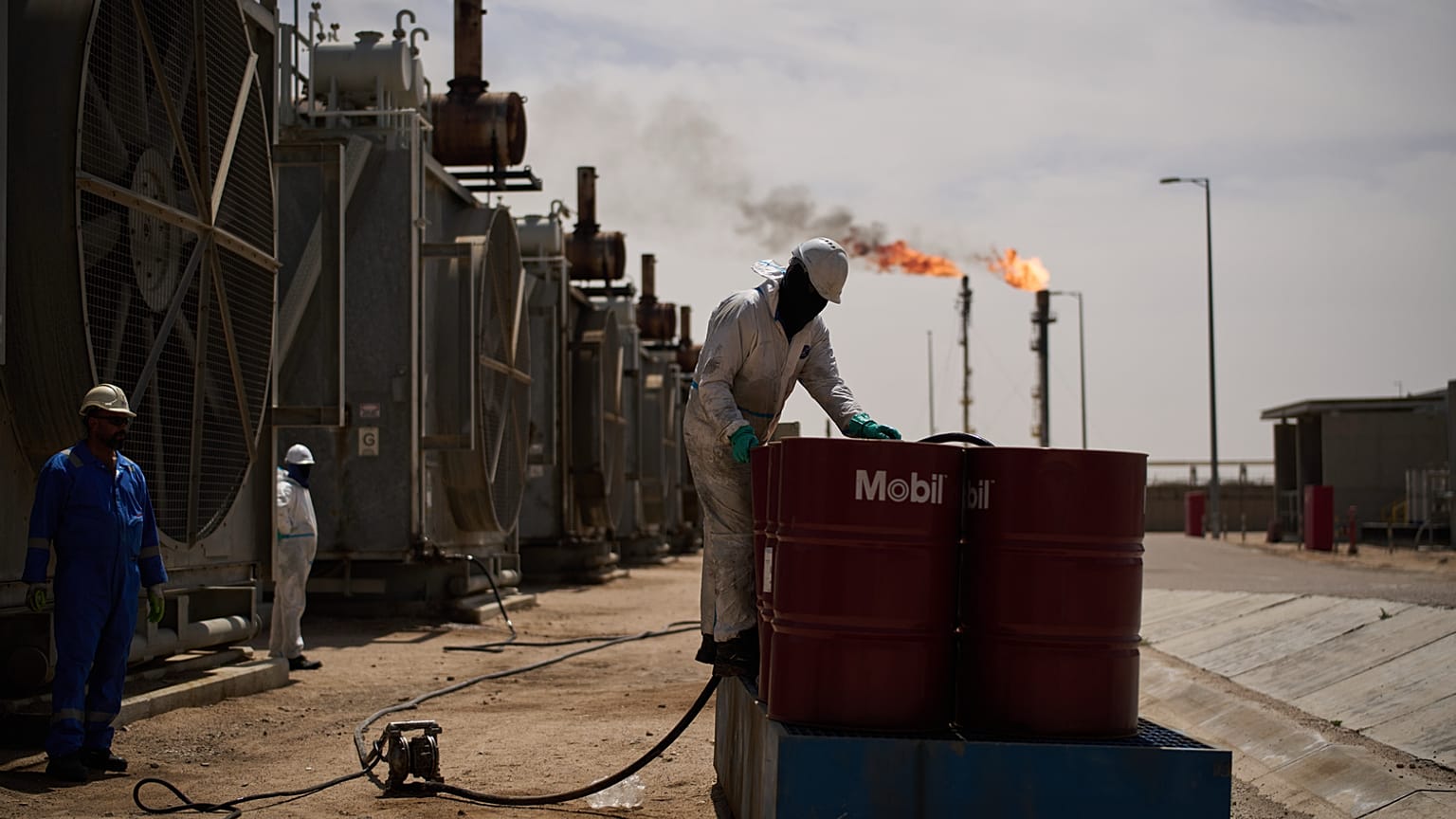
A labourer collects engine oil while working at the degassing station in the Zubair oil field
Copyright Leo Correa/Copyright 2026 The AP. All rights reserved.

By Chaima Chihi & وكالات
Published on 

Iraq has the fifth largest proven oil reserves in the world, estimated at 145 billion barrels, representing about 17% of total Middle Eastern reserves and around 9% of global reserves, according to the US Energy Information Administration (EIA).

The Iraqi Ministry of Oil has announced the discovery of a large oil field in the southern province of Najaf, near the border with Saudi Arabia.

The discovery is considered one of the most important in the Iraqi energy sector in recent years, as initial estimates indicate that one of the exploration patches contains reserves exceeding 8.8 billion barrels of crude oil.

The Qurnain block is located in southwestern Iraq in Najaf province, about 180 kilometres from Baghdad, along the Iraqi-Saudi border. It is one of the most promising areas for oil exploration, covering an area of 8,773 square kilometres. The contract to develop, explore and produce oil from it was signed on 17 October 2024.

According to data announced by the Ministry, drilling operations at the Shams-11 exploration well showed the presence of light crude oil, with an initial production capacity of 3,248 barrels per day.

The announcement was made during an official meeting between Iraqi Oil Minister Hayan Abdul Ghani and representatives from China's ZhenHua Oil, during which they reviewed progress at the Qurnain site and discussed advanced drilling techniques to increase the efficiency of exploration and production operations and accelerate development.

ZhenHua, through its subsidiary Qurnain Petroleum Limited, is the main operator of exploratory drilling and seismic survey operations in partnership with the Iraqi side.

A Chinese bet on the Iraqi desert

The Chinese company has submitted a rapid investment plan aimed at accelerating the development of the field and moving it to commercial production as soon as possible, the oil ministry said.

Baghdad is working to accelerate a strategic project to build a pipeline linking Basra province in the south with the city of Haditha in Anbar province near the Syrian border, with a planned export capacity of 2.5 million barrels per day.

Meanwhile, Iraq is facing pressure on its oil exports as a result of the war in the Middle East and disruptions in the Strait of Hormuz, a vital corridor for Iraqi energy shipments to global markets.

Before the escalation of regional tensions, Iraq produced about 4.5 million barrels of oil per day, making it the third largest producer in the Organisation of Petroleum Exporting Countries (OPEC), and exported about 3.5 million barrels per day, around 90 per cent of which passed through the Strait of Hormuz.

According to official data issued by the Ministry of Oil, Iraq's oil exports fell to 18.6 million barrels in March, generating revenues of $1.96 billion (€1.77bn) — a decline of around 71 per cent in revenue terms compared to February, when Iraq exported more than 99 million barrels and earned $6.81 billion (€6.15bn).

WAIT, WHAT?!

False and unverified images link Leipzig attack suspect to Antifa and AfD

Rescue workers stand next to a damaged car that has crashed into several people in Leipzig, Germany, Monday, May 4, 2026.
Copyright AP Photo

By Tamsin Paternoster & Noa Schumann
Published on 

Doctored images and videos of unrelated protests have circulated online after a deadly car attack in Leipzig, falsely suggesting the suspect was linked to Antifa or the AfD.

A slew of false and unverified images have spread online after a deadly car attack in Leipzig, with several suggesting that the suspect was linked to the left-wing anti-fascist Antifa movement and Germany's far-right Alternative for Germany (AfD) party.

The perpetrator, named in German media as Jeffrey K, drove a car into a crowd, killing two people and seriously injuring several others.

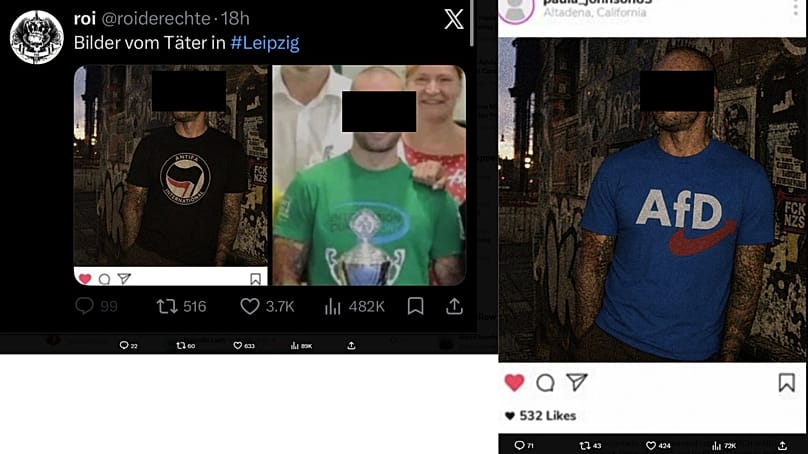
In the aftermath of the attack, one widely shared image claims the suspect was wearing a T-shirt with the logo "Antifa International".

The Cube, Euronews' fact-checking team, was not able to independently verify where the original image was taken or its online origin.

German fact-checkers traced one of its earliest uploads to an account that posted what appeared to be a genuine photo of the suspect wearing a green shirt alongside the picture of him wearing the "Antifa International" shirt.

Images claiming to show suspect are unverified or doctored.
Images claiming to show suspect are unverified or doctored. @roiderechte

When asked, the account's uploader said he had found the image on a niche website "Pr0gramm" — although searches of the website show no evidence of the image.

The screenshot of the image shows an account that posted the photograph was located in California, and taken from a template used to illustrate an Instagram display, suggesting that the image could be doctored.

Another account that amplified the picture later clarified that it was fake, despite Grok, an AI chatbot developed by Elon Musk's xAI, originally deeming it authentic.

At the same time, a doctored photo of the same image showing the man wearing a T-shirt with the logo of the AfD party spread online. Analysis of this image against the other one clearly shows it has been digitally manipulated.

Some of the posts sharing the image of the alleged suspect wearing the AfD shirt did so to show evidence of how easily a photo could be altered. However, several posts, some with thousands of views, held captions alleging the suspect was an AfD voter based on the manipulated image.

Despite these false images linking the alleged perpetrator to both Antifa and the AfD, authorities say there is currently no evidence to suggest the perpetrator had a political or religious motive.

Only limited information on the suspect has been released, with authorities confirming that he is a 33-year-old man, a resident of Leipzig and born in Germany.

They added he had come to the attention of authorities previously for "threats and defamatory offences in his social circle" and was admitted and treated in a psychiatric hospital.

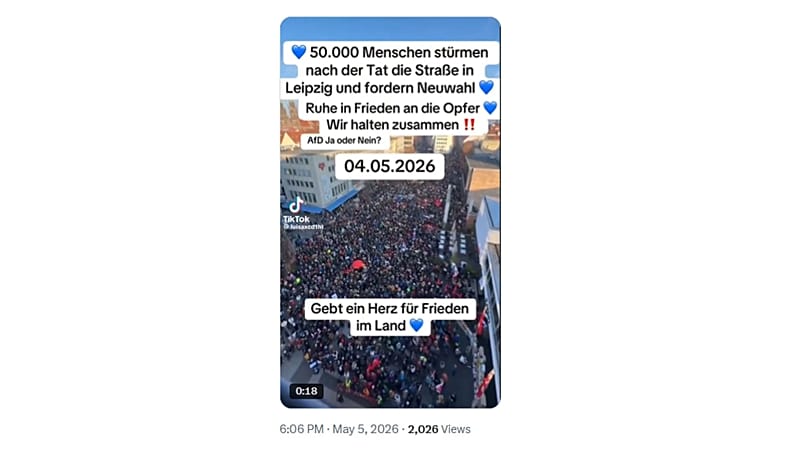
In the aftermath of the incident, several videos circulating on TikTok and X claimed to show thousands of people gathering in support of new elections and the AfD following the attack.

Videos claiming to show protesters in Leipzig pushing for new elections are not current and use unrelated footage.
Videos claiming to show protesters in Leipzig pushing for new elections are not current and use unrelated footage. @WWietje

These videos spread on TikTok and X, with one garnering tens of thousands of views.

But this footage is not current and unrelated to the incident. A reverse image search shows it is from a protest in February 2025 in Nuremberg.

At the time, at least 20,000 demonstrated for democracy in the city's Kornmarkt square, according to German news agency DPA.