Wednesday, May 20, 2026

Ikea to cut 850 jobs at parent company

ByAFP
May 18, 2026


Ikea image: — © GETTY IMAGES NORTH AMERICA/AFP Brandon Bell

Inter Ikea Group, the holding company that oversees Ikea, announced Monday that it was cutting 850 jobs, saying its organisation with 27,700 employees overall had grown too “complex”.

The group, which owns the Ikea brand name and manages the retailer’s product range as well as sourcing, said the cuts were needed to simplify its structure.

“Despite many positive achievements, Inter Ikea Group has grown a bit too complex and too fragmented in a retail environment that requires simplicity and speed,” Henrik Elm, chief financial officer of Inter Ikea Group, said in a statement.

Going forward the group plans to focus on three goals: “Increase sales growth, significantly reduce prices, and boost visitation across customer meeting points.”

Of the 850 staff positions being cut, around 300 will be in Sweden “based on current plans,” Inter Ikea said, adding that the “final impact” would be confirmed as the process progressed.

In November, Inter Ikea reported a 32 percent drop in annual profit for its 2024-2025 financial year as it lowered prices to boost sales and faced higher costs due to US tariffs.

Sales for its year ending in August fell by one percent to 44.6 billion euros ($51.9 billion), but sales volume increased by 2.6 percent and the number of store visitors rose by 1.9 percent.

Ingka Group, which owns most Ikea franchises and employs 166,000 people in 37 countries, announced in March that it also was restructuring to simplify its organisation, and said up to 800 positions could be cut.
India’s strategic $9 bn megaport plan for pristine island


By AFP
May 18, 2026


Local residents sit o Old Shastri Nagaram Beach on the outskirts of Campbell Bay on Great Nicobar Island - Copyright AFP Shubham KOUL


Bhuvan BAGGA

On a remote island in the Andaman Sea, bulldozers are tearing into pristine forests that are home to one of Earth’s most isolated people — part of India’s ambition for a $9 billion megaport, airport and city.

Designed to rival China’s investments around the Indian Ocean, New Delhi’s colossal project will be built on Great Nicobar Island, a site offering a naval presence far closer to Southeast Asia than India’s mainland.

Authorities promise sweeping economic transformation at the entrance to one of the world’s busiest waterways — the Strait of Malacca, through which up to 30 percent of global trade passes.

But secretive military moves are also afoot, with plans for upgraded or new runways for both military and civilian use.

“The Great Nicobar Island Project, which is of strategic, defence and national importance, transforms the region into a major hub of maritime and air connectivity in the Indian Ocean region,” Prime Minister Narendra Modi said in September.

Access to parts of Great Nicobar requires special permits, particularly for any contact with Indigenous groups.

Roads, bridges and docks will be built on the island, opening it up for port activity and tourism, and serving expanded military installations.

But the project, nearly 3,000 kilometres (1,860 miles) from New Delhi, has also sparked opposition from residents and environmentalists.

Roughly 95 percent of the 910 square kilometre (351 square mile) island, encircled by lagoons and coral reefs, is biologically under-explored forest rich in unique species.

Nearly a fifth of the land will be cleared for the project.

Rights group Survival International warned that the island’s Indigenous groups face “genocide in the name of ‘mega-development'”.

Totalling around 1,200 people, these include the Nicobarese as well as the Shompen, hunter-gatherers who shun contact with outsiders, who Survival describes as “one of the most isolated peoples on Earth.”

– Strategic –

The government insists it has met all “green” requirements and has pledged to protect Great Nicobar’s peoples, communities, as well as its unique flora and fauna, by establishing protected zones.

India’s environmental court has said that it did “not find any good ground to interfere” with the plans.

“We have also noted… the area is located in China’s ‘string of pearls’ strategy which is sought to be countered by Indian authorities under India’s ‘Act East’ policy,” the court added.

Beijing has long been accused of seeking to develop facilities around the Indian Ocean — a so-called “string of pearls” — to counter India’s rise and secure its own economic interests.

Environment Minister Bhupender Yadav has said that the project “poses no threat to the island’s tribal groups, does not come in the way of any species, and does not jeopardise the eco-sensitivity of the region”.

The first $4 billion phase on Great Nicobar — construction of a port at Galathea Bay and airport at Campbell Bay — should be completed within three years, according to the archipelago’s governor, former navy admiral Devendra Kumar Joshi.

Once finished, the container port will handle more than 20 million twenty-foot equivalent units (TEUs), making it one of India’s three largest ports.

“In the long run, it may well be competing to become the container handling hub in the entire Indo-Pacific region,” Joshi said, rivalling Singapore and Malaysia’s Port Klang.

The megaport may be the showpiece, but the new infrastructure on the southern tip of the 836-island archipelago is only part of a grand plan for the chain, stretching 800 kilometres (500 miles).

Government development plans envision the expansion of existing naval and air facilities across the islands.

Joshi has said two new airports will be built — in the archipelago’s capital Sri Vijayapuram and on Great Nicobar — and older runways expanded to three-kilometre strips, capable of handling heavy-lift cargo aeroplanes.

“All of them will be dual-use runways, used by military and for commercial flights,” Joshi said in February.

One already upgraded runway, on Car Nicobar island, was inaugurated in January by India’s Chief of Defence Staff, Anil Chauhan.

Beyond the runways, the military aspect of the project remains largely secret.

Yet the island’s strategic position has not escaped notice over the centuries, from India’s medieval Cholas to the British, all of whom stationed warships there, just 175 kilometres (110 miles) from Indonesia.

“Great Nicobar Island is like India’s unsinkable aircraft carrier,” said Nitin Gokhale, a New Delhi-based security expert.

“The fact that everyone, including the Chinese, can see our ability to keep a close watch, creates a new paradigm for us.”

– ‘Nonsense’ –

But environmentalists view the plans with dread.

Manish Chandi has been one of the few to regularly visit the small villages of the Nicobarese, which are off-limits except with special permission.

“I just don’t understand the rationale for the project,” Chandi said, noting that there was no clarity about how huge investments can be recovered economically.

Plans extend beyond the port to include a gas-solar power plant, hotels, and a town across 161 square kilometres — multiple times larger than the archipelago’s capital.

The island’s population is projected to grow, from 9,000 people today to 336,000 by 2055.

Tourism projections anticipate 98,000 visitors by 2029, and more than one million by 2055.

The government has promised to compensate for the swathes of trees cut down by planting seedlings in Haryana — a northern state next to New Delhi.

“It is all nonsense,” Chandi added. “We are removing crocodiles from their natural habitat, and saying we are going to conserve them.”

– ‘Duty’ –

Some islanders warn that the isolated Indigenous populations’ millennia-old culture risks being bulldozed away.

“If we lose control of these lands, our culture too will be lost,” said the Nicobarese’s most senior leader, 54-year-old Barnabas Manju.

The Indians who arrived from the mainland are also sceptical.

The first families from outside the islands only settled in 1969, encouraged by the government who feared losing control of the sparsely populated territory.

Sharda Devi, 55, a settler’s daughter, recalls the first arrivals “toiling in some of the harshest conditions” to carve plantations out of the tangled forests.

She initially welcomed the project, before realising the airport would encroach on her land.

“The government is going to take back 11 acres (4.5 hectares) alloted to my father, without offering us another suitable plot of land or even proper compensation,” she said.

Her neighbour, 71-year-old Kusum Mishra, who arrived 50 years ago, also dismissed the “petty compensation” offered, complaining that “they are uprooting us and destroying our lives.”

– ‘See the world’ –

Around 400 kilometres away, change is already starting to ripple through the archipelago’s island of Little Andaman, which Joshi has said will see the “next developmental thrust” after Great Nicobar.

Raja, one of just 143 surviving members of the En-iregale, or “perfect person” in their language, describes a life on Little Andaman where his people still fish in bountiful coral reefs or hunt wild boar in the areas of forest still protected by their millennia-old stewardship.

“We don’t need anything from the government — or anyone,” he told AFP, stressing that “we have everything”.

Past forced contact with outsiders brought trauma, including disease outbreaks that devastated Indigenous populations lacking immunity.

Many of Raja’s community, more widely known as the Onge, still live in near isolation in neat thatched homes on stilts in coastal forests.

But contact is growing rapidly today, even if outsiders are barred from entering Indigenous territory, with members curious about the wider world — and the modern comforts it can offer.

Authorities, treading a delicate line in managing an increasing number of visitors, began last year to recruit more than 500 young men from communities across the archipelago as police “homeguards”.

“They are sons of the soil,” said HGS Dhaliwal, police chief of the archipelago.

Raja, along with his friend Jhaj, was among the first five men from their community recruited.

Jhaj, who speaks some Hindi, which he learnt in a government school around their settlement, has become a keen volleyball player.

Weeks after completing his training, he made a major drug seizure, after finding a seven-kilogramme (15-pound) methamphetamine stash, hidden by traffickers who ply the Andaman Sea south from Myanmar.

“These developments point to better things on the horizon,” Ashish Biswas, 54, who works for a government-backed society, Andaman Adim Janjati Vikas Samiti (AAJVS), which mediates between locals and outsiders.

“I see so many of them in our local school wanting to study and improve, to follow Jhaj and Raja’s inspiration.”

Raja said that his salary was attracting other young members of his community, interested in the world beyond their island.

“They now know that if they wear the uniform, they too will get to travel outside the village and see other places,” Raja said.
FacebookTwitterLinkedInEmailShare
India’s Adani to pay $275 mn settlement to US over alleged Iran sanctions violations


ByAFP
May 18, 2026


Adani Enterprises Limited (AEL), part of Gautam Adani's sprawling multinational conglomerate of companies, will pay the settlement amount over allegations it imported Iranian LPG - Copyright AFP Shammi MEHRA

One of Indian billionaire industrialist Gautam Adani’s companies will pay the United States $275 million to settle a probe into whether it violated Washington’s sanctions against Iran, the US Treasury said in a statement on Monday.

The Office of Foreign Assets Control (OFAC) said the agreement had been reached with Adani Enterprises Limited (AEL), part of the magnate’s sprawling multinational conglomerate of companies.

“AEL agreed to settle its potential civil liability for 32 apparent violations of OFAC’s Iran sanctions,” the Treasury said, pointing to AEL’s purchases of liquefied petroleum gas (LPG) shipments between November 2023 and June 2025.

Monday’s announcement came days after Adani agreed to pay a separate $18 million settlement in a US civil court case linked to corruption, without admitting guilt, according to one of his other companies.

In that case, Adani was accused of having participated in an estimated $250 million scheme to bribe Indian officials for lucrative solar energy supply contracts.

Monday’s US settlement announcement said AEL had cooperated with OFAC’s probe and agreed to additional nonmonetary remedial measures to strengthen compliance with US sanctions.

The probe focused on LPG imports arranged through a Dubai-based supplier that claimed to be exporting Omani and Iraqi gas, OFAC said.

“Red flags should have put AEL on notice that the LPG actually originated from Iran,” the statement said.

The Adani Group is one of India’s largest business empires, operating businesses ranging from ports and power plants to cement factories and media houses.

Gautam Adani, one of India’s richest men, has been rocked in recent years by corporate fraud allegations and a stock crash.

Adani is a close ally of Indian Prime Minister Narendra Modi and hails from the leader’s home state of Gujarat.

India is the world’s second-largest buyer of LPG, and the fourth-largest buyer of liquefied natural gas (LNG), much of which is sourced through the Middle East.


Ex-Google man takes reins at under-fire BBC


ByAFP
May 18, 2026


New BBC director general Matt Brittin arrives at the BBC's central London headquarters - Copyright AFP Brook Mitchell

A former Google executive took over as the BBC’s new director-general on Monday amid proposed job cuts and a $10-billion lawsuit brought by US President Donald Trump, arguing that the world now “needs the BBC more than ever”.

Matt Brittin, 57, who has no broadcasting or journalism experience, starts the job against a background of drastic shifts in the media landscape.

The British-born executive was for over a decade president of Google’s Europe, Middle East and Africa division, which earns around a third of its revenue. He previously worked as a consultant for McKinsey.

Arriving at the BBC’s central London headquarters for his first day in charge, he was greeted by a handful of placard-waving protesters from the National Union of Journalists (NUJ).


The BBC is set to cut up to 2,000 jobs amid financial pressures and a challenging media landscape – Copyright AFP/File Susannah Ireland

The corporation has said it is looking to axe up to 2,000 jobs as it tries to reduce costs by 10 percent over the next three years.

Brittin told reporters he was “honoured” and “humbled” to be taking on the role.

But he warned that “tough choices are unavoidable as we make savings”, in a note to staff.

“We must be where audiences are, and experiment more bravely: test ideas, learn quickly and back what works,” he added.

Brittin replaces Tim Davie, who had held the BBC post since 2020. He resigned in November over the Trump lawsuit.

– Reinvention –

Trump launched his legal action over a documentary that included an edited clip of a speech he made ahead of the US Capitol riot in January 2021. The edit made it appear he explicitly urged supporters to attack the seat of Congress.

The BBC said in March it had formally asked a US federal court in Florida to dismiss the lawsuit.

Brittin also faces the politically sensitive task of renegotiating the BBC’s Royal Charter that outlines the corporation’s governance. Its current charter will end next year.

A sizeable proportion of the BBC’s income comes from the licence fee, which is payable by all UK households with a television, or whose occupants watch live screening online.

But the BBC lost more than £1.1 billion in revenues last year as fewer homes felt the need to apply for one, a parliamentary committee report said in November.

The Trump lawsuit is the latest scandal to hit the corporation.

Earlier in 2025 it was forced to issue several apologies for “serious flaws” in the making of another documentary entitled “Gaza: How To Survive A Warzone”, broadcast last February.

In October it accepted a sanction from the UK media watchdog for what was deemed a “materially misleading” programme, whose child narrator was later revealed to be the son of Hamas’s former deputy agriculture minister.

Brittin said the BBC had “proved throughout its history how quickly it can reinvent itself to serve the needs of audiences”.

“We need, collectively, to call on that sense of urgency now. That means moving with velocity and clarity,” he added in his note to staff.
New York art auctions roar back with blockbuster sales


ByAFP
May 19, 2026


Mark Rothko's 'Brown and Blacks in Reds' was among the pieces recently put up for auction in New York - Copyright AFP TIMOTHY A. CLARY


Raphaƫlle PELTIER

With record prices for Jackson Pollock, Constantin Brancusi and Mark Rothko, New York’s spring auctions are soaring, confirming a trend that began in late 2025: blockbuster sales are back.

According to an AFP database, 12 works have already sold for more than $30 million this May in the city, including two that exceeded $100 million.

That’s a reversal following a slump in sales leading up to 2025, which experts attributed to global economic uncertainty and a lack of high-value works on the market.

“We’re really in a trend reversal,” Thierry Ehrmann, head of art market information firm Artprice, told AFP.

A Jackson Pollock painting on Monday became the fourth most expensive work ever sold at auction when it was bought at Christie’s in New York.

With its black drips of paint accented by touches of red on a huge canvas spanning over three meters (nine feet), Pollock’s “Number 7A, 1948” sold for $181.2 million.

The previous record for American painter Pollock was $61.2 million, set in 2021.

Also on Monday, a bronze head cast by the French-Romanian artist Constantin Brancusi reached $107.6 million — compared with $71.2 million for his previous record in 2018.


– Market shift –


The first signs of a spending surge date back to late 2025.

Sixteen works sold for more than $30 million that year, all in New York, with two records at Sotheby’s.

Bought for $236.4 million, “Portrait of Elisabeth Lederer” by Austrian painter Gustav Klimt became the second most expensive work ever sold at auction.

And “The Dream (The Bed),” a self‑portrait by Mexican artist Frida Kahlo, was acquired for $54.7 million — making it the priciest painting by a woman.

Market analysts note that many of these works come from prestigious private collections released onto the market in single blocks, which increases their appeal to major collectors.

Ehrmann, of Artprice, said there has also been a shift in the demographic of buyers.

“It’s no longer a market for the ultra‑rich,” he said, with younger people aged around 35 pursuing auctions, often drawn from the tech world and the global south.

And more buyers are women, Ehrmann said, which can benefit female artists.

The auction record for the American painter Alice Neel was broken on Monday at Christie’s, with $5.7 million for “Mother and Child (Nancy and Olivia).”

The most expensive painting ever sold at auction remains the “Salvator Mundi,” (Savior of the World), a Renaissance work attributed to Leonardo da Vinci, which was bought for $450 million in 2017.
FacebookTwitterLinkedInEmailShare
SpaceX’s IPO moonshot draws some doubters on Wall Street


By AFP
May 19, 2026


Ahead of Wall Street liftoff, SpaceX backers say the company is the gatekeeper to space itself - Copyright AFP Karl Mondon


Thomas URBAIN

Elon Musk wants to take SpaceX public — and he’s asking investors to believe the rocket and AI company is worth almost $1.75 trillion.

On Wall Street, not everyone is convinced.

What does that number actually mean? SpaceX made $18.5 billion in sales last year. Musk is asking investors to value the company at nearly 100 times that.

To put it another way: even Apple, one of the most valuable companies on Earth, is worth about 11 times its annual revenue, as measured by market capitalization. Nvidia, the darling of the AI revolution, is worth 25 times.

The upcoming IPO — short for initial public offering, when a private company sells shares to the public for the first time — could be one of the biggest in history.

Ahead of the Wall Street liftoff, expected in mid-June, SpaceX backers say the company isn’t just a rocket business but rather the gatekeeper to space itself.

“SpaceX controls the rails and controls access to orbit,” said Chad Anderson, CEO of Space Capital, an investment firm that already owns a stake in SpaceX.

He argues we are only at the beginning of a decades-long space infrastructure boom worth hundreds of billions of dollars, from replacing aging satellites to building data centers in orbit.

The company’s satellite internet service, Starlink, is already generating most of SpaceX’s revenue and profit.

“If they can be the low-cost provider of Internet access to lots of people around the world, that can be an enormous source of revenue and profits,” said Jay Ritter, an IPO expert at the University of Florida.

And Musk has made clear he is thinking way bigger than quarterly profits — out-of-this-world big.

“I need to make sure SpaceX stays focused on making life multiplanetary and extending consciousness to the stars,” he wrote on X in March.

“If SpaceX succeeds in this absurdly difficult goal, it will be worth many orders of magnitude more than the economy of Earth.”

– Amazing or overvalued? –

Not so fast, say the skeptics.

When SpaceX absorbed xAI — Musk’s artificial intelligence company and the owner of social network X — in February, eyebrows went up on Wall Street.

Eric Jhonsa of Dutch Asset Corporation pointed to a broader problem: “AI startups with little or no revenue getting sky-high valuations.”

“Is this an amazing company or is it ridiculously overvalued? The answer is yes,” quipped Scott Galloway, a marketing professor at NYU Stern.

Geoff Robinson, a financial analyst, was more blunt: “If I read one more ‘expert’ take on the SpaceX IPO that ignores the laws of financial physics, I’m going to need an actual rocket to escape the nonsense. The communication around this deal needs a serious BS filter.”

Critics also raise more basic concerns: profit margins in the rocket launch business are thin, Starlink’s prices may be too high to win over the mass market, and it’s still unclear whether data centers in space are even a viable idea.

Kim Forrest, chief investment officer at Bokeh Capital Partners, argues that traditional financial math may simply not apply here.

“What people are really buying is the hope and dream of commercial space,” she said, “which is more than a dream. It’s a reality.”

But Ritter offers a note of caution.

“Lots of things have to go right in order for revenue and profits to grow to justify that valuation,” he said.

“And occasionally it happens — but most of the time, something doesn’t work out according to plan. And that’s where I’ve gotten concerned about SpaceX.”
Humpback whales make record swims between Australia and Brazil


By AFP
May 20, 2026


Such vast journeys by humpback whales -- which can grow up to 17 metres long -- are exceedingly rare - Copyright AFP/File JOAQUIN SARMIENTO

A pair of humpback whales swam record-breaking journeys between the eastern shores of Australia and breeding grounds in Brazil, research published on Wednesday found.

The work by a team of international scientists used tens of thousands of images taken of whale tales to identify the two vast sea-dwelling mammals and reveal they had popped up on both sides of the world.

One was spotted in Queensland in 2007 and then appeared near Sao Paulo, Brazil, in 2019 — a distance across oceans of 14,200 kilometres (8,823 miles).

Another was seen off the coast off Bahia in Brazil before being sighted 22 years later in Hervey Bay, Australia 15,100 kilometres away.

The pictures represent the longest-distance ever seen between two pictures of the same humpback whale, researchers said.

Such vast journeys by the rorquals — which can grow up to 17 metres (55 feet) long — are exceedingly rare, they added.

“Despite their rarity, these exchanges matter for the long-term health of whale populations,” Griffith University PhD researcher and report co-author Stephanie Stack said.

“Occasional individuals moving between distant breeding grounds can help maintain genetic diversity across populations,” she added.

They “may even carry new song styles from one region to another –- humpback whale songs are known to spread culturally across ocean basins, much like music trends in human populations”.

Researchers said the work also leant further credence to a theory about humpback whale patterns known as the “Southern Ocean Exchange”.

That hypothesis suggests the mammals sometimes travel to feeding grounds in the Antarctic but then take a different journey home — ending up in a completely new breeding area.

“Climate-driven changes to the Southern Ocean, including shifts in sea ice and the distribution of Antarctic krill (the whale’s main prey), may be making such crossings more likely over time,” Griffith University said.


The world built more coal power in 2025, but used less


ByAFP
May 20, 2026


Coal power generation fell last year globally, but coal capacity grew - Copyright AFP/File ANTHONY WALLACE


Sara HUSSEIN

The world built and commissioned more coal power in 2025, but used the polluting fuel less, with the United States the only major economy to substantially increase generation, analysis showed Thursday.

Coal is a key contributor to planet-warming greenhouse gas emissions, and phasing it out is crucial to taming climate change.

The growing affordability and abundance of renewable energy means solar and wind power can now cover growing electricity demand in much of the world.

That helped push coal generation down globally by 0.6 percent in 2025 from a year earlier, according to a new report from Global Energy Monitor, which has tracked coal power for more than a decade.

But despite the generation drop, coal power capacity — plants that came online or were commissioned — jumped 3.5 percent last year.

The overwhelming majority of that — 95 percent — was in China and India, GEM said.

China’s coal capacity grew six percent last year, but coal-powered electricity generation fell 1.2 percent, in part because of soaring renewable capacity.

The same was true in India, where capacity grew almost four percent, even as generation fell nearly three percent.

In both countries, “many of the provinces and states leading coal development are major coal-producing regions”, said Christine Shearer, project manager of GEM’s Global Coal Plant Tracker and author of the report.

They have “strong industrial incentives to keep building coal”, she told AFP.


– US actively increases coal –


China is the world’s top emitter, while India ranks third behind the United States.

Beijing sees coal as a reliable failsafe for intermittent renewable supply, particularly for after power shortages several years ago.

India, the world’s most populous country, is leaning heavily on coal to meet soaring electricity demand.

But coal’s persistence is also the result of infrastructure issues.

Non-fossil fuels already account for 50 percent of India’s installed capacity, but infrastructure and other issues mean the country still generates around three-quarters of its electricity from coal.

Globally, the retirement of coal power also slowed last year, with nearly 70 percent of units that were due to end operations instead staying online, GEM said.

In Europe, those missed targets were linked primarily to decisions taken during the 2022-23 energy crisis caused by Russia’s invasion of Ukraine.

In the United States however, retirement delays were due to a government push for coal, said Shearer.

“US coal-fired generation rose by more than 80 TWh (terawatt hours) year-on-year, a figure so large that no other country came close,” she said.

The surge “was not simply a function of (demand) growth, it reflected a policy environment that actively encouraged it,” she added.


– Coal ‘favouritism’ –


The energy crisis sparked by the US-Israeli war with Iran has seen some countries turn back to coal, reactivating idle coal units or delaying retirements.

In China, coal-fired power generation also jumped in the first part of the year, in part due to “underperformance” by wind and nuclear.

“But the oversupply and favouritism of coal power is an important factor,” added Lauri Myllyvirta, co-founder of the Centre for Research on Energy and Clean Air, and contributor to the report.

While figures from May suggest China’s coal generation may have dropped again, “the problem of excess coal capacity and entrenched favouritism of coal in the grid remain”, he told AFP.

Globally, coal-fired generation has risen 0.3 percent so far this year, Shearer said, while wind and solar generation has jumped 10 percent.

“Clean energy is absorbing most of the world’s new electricity demand, with coal barely growing at all,” she said.


Stellantis signs Europe joint venture with China’s Dongfeng

ByAFP
May 20, 2026


Dongfeng will build its Voyah cars at a Stellantis plant to gain ground in Europe - Copyright AFP Jade GAO
Laurence BENHAMOU

Jeep and Fiat owner Stellantis said Wednesday that it had formed a joint venture with China’s Dongfeng to share manufacturing, sales and engineering operations in Europe.

The deal to bolster sales as the EU pushes carmakers to produce more clean-energy vehicles will see Dongfeng’s Voyah EVs built at Stellantis’s plant in Rennes, western France, for the European market, the companies said in a statement.

By building locally, Dongfeng can avoid hefty EU tariffs on Chinese EV imports imposed as a way to protect domestic automakers.

It is the latest move by Stellantis chief Antonio Filosa to revive sales and profits at the world’s fourth-largest automaker, in particular in Europe, where the shift away from combustion engines has sputtered.

The company announced earlier this month a deal with Dongfeng to build Jeep and Peugeot models for the Chinese market, and increase cooperation on technology research and development.

Dongfeng and other Chinese carmakers meanwhile are looking to Europe and other export markets as their home market remains tough, with consumer spending slumping.

Brands such as BYD, Chery, Geely, Leapmotor, Jaecoo, and XPeng were virtually unknown three years ago in Europe.


– ‘Greater value’ –


Stellantis will lead the Europe joint venture with a 51 percent stake, while Dongfeng will have 49 percent. Financial details were not disclosed.

“With this new chapter in our collaboration, we will give our customers an even greater choice of competitive products and pricing, leveraging the best of Stellantis’s global footprint alongside Dongfeng’s access to China’s advanced new energy vehicles ecosystem,” Filosa said in a statement.

Dongfeng’s chairman Qing Yang said in the statement: “Through coordination in technology, branding, and global markets, it will unlock greater value from the joint venture, accelerate Dongfeng’s global expansion, (and) support Stellantis’s global strategic shift and China presence.”

The Rennes plant has been operating well below capacity for years as demand in the European auto market remains well below pre-Covid levels, and currently produces only a high-end Citroen SUV.

Stellantis announced Tuesday that it would start building smaller, low-cost electric cars for the European market as buyers increasingly look to rival Chinese models.

EU rules call for 90 percent of all cars sold in the bloc to be electric by 2035, and the European Commission recently created a new, tax-friendly category for small EVs to encourage demand.

Stellantis, formed from the merger of France’s PSA and Italy-based Fiat Chrysler five years ago, said its Dongfeng Peugeot Citroen Automobile joint venture had built over 6.5 million cars in China since its creation 34 years ago.

Filosa is set to lay out the company’s strategy to jump-start sales and profits for its 14 brands at an investors’ day in Michigan, the heart of the US auto industry, on Thursday.

Stellantis joins race to build mini-EVs for Europe


By AFP
May 19, 2026


Stellantis CEO Antonio Filosa, right, with a Fiat 500 hybrid, one of the models he is banking on to spur EV sales in Europe - Copyright AFP MARCO BERTORELLO

Stellantis, owner of the Jeep and Fiat brands, announced Tuesday that it would start building smaller, low-cost electric cars for the European market, where demand for clean-energy vehicles has fallen short of automakers’ hopes.

It it the latest carmaker on the continent to embrace more affordable EVs in the face of brutal competition from Chinese rivals looking to make inroads overseas.

The company did not specify which of its 14 brands would start producing its “E-Cars” at Stellantis’s Pomigliano d’Arco factory near Naples in Italy.

“Our customers are calling for a revival of small, stylish vehicles, proudly produced in Europe, which are also affordable and environmentally friendly,” chief executive Antonio Filosa said in a statement.

Filosa was brought in last year with a mandate to address multiple challenges for the world’s fourth-biggest automaker, not least under-utilisation of its European factories in a market still recovering from the Covid-19 pandemic.

Automakers are also racing to shift away from combustible engines under EU rules that call for 90 percent of all cars sold in the bloc to be electric by 2035.

To ease the transition, the European Commission created last December a new category for small EVs that would get more favourable tax treatment and count more in their overall electric offerings — if they are built in Europe.

Renault has already jumped in with its R5 and Twingo models, while Volkswagen is rolling out a new ID.Polo, unveiled last month.

“The E-Car… is being developed in the true tradition of European ‘people’s mobility — addressing the unprecedented contraction of the small affordable car segment in Europe in recent years,” Stellantis said.

The announcement comes as the company is reportedly exploring deals with Chinese automakers to sell them underused European factories.
Canada takes key step towards new oil pipeline


ByAFP
May 16, 2026


The Syncrude refinery in the oil sands region of Alberta in western Canada - Copyright AFP DaphnƩ LEMELIN

Prime Minister Mark Carney and the leader of Canada’s oil‑rich Alberta province took a major step Friday toward building an oil pipeline that could substantially increase crude exports to Asia.

Expanding overseas energy exports has emerged as a key part of Carney’s strategy to reduce Canada’s economic reliance on the United States, but plans for a new pipeline are facing stiff resistance over environmental concerns.

Alberta’s conservative Premier Danielle Smith was a relentless critic of Carney’s climate‑focused predecessor, Justin Trudeau, accusing him of suffocating the province’s oil industry, but she has sought to work with Carney.

Carney and Smith cleared a key hurdle toward a new pipeline on Friday by signing a deal on industrial carbon pricing, a system that extracts a fee from large‑scale CO2 emitters.

Oil companies have been critical of the system, but Smith said Friday that the prohibitive rates set under Trudeau’s government had been “rolled back.”

Ottawa and the provincial government agreed that the rate would gradually rise to a fee of CAN$130 ($96) per tonne of CO2 emitted by 2040. Trudeau had called for a rate of CAN$170 by 2030.

At the announcement in Alberta’s capital, Edmonton, Carney said a final proposal for a pipeline that will serve Asian markets should be submitted to his major projects office by July 1.

He said Canada had earned “the trust of Asian countries who want our energy because they know that we are a safe, stable, reliable partner in a world that is anything but.”

Carney has repeatedly warned that the trade hostility ushered in by President Donald Trump is not a passing phase and Canada needs to plan for a fundamentally different economic relationship with the US, including by broadening ties with Asia.

Pipeline approval is also contingent on developing what Carney called “the largest global initiative for carbon capture and storage.”

Some Indigenous groups and First Nations have said they will oppose any pipeline that runs from Alberta to Canada’s Pacific Coast.

The leader of the left‑wing New Democratic Party, Avi Lewis, charged that Friday’s announcement “marks the Carney government’s official surrender to the oil and gas lobby.”

The announcement also comes at a fraught political moment.

Alberta separatists have built record‑high support of roughly 30 percent for the province’s independence by railing against Ottawa’s control over the provincial oil industry.

Carney, who was raised in Alberta, insists the province can thrive within a united Canada.
‘MAGA’s Weird Obsession’ Continues as House Passes Bill Forcing Schools to ‘Out’ Trans Kids

One Democratic lawmaker said the legislation “puts trans youth in harm’s way and censors content that acknowledges trans people’s existence.”


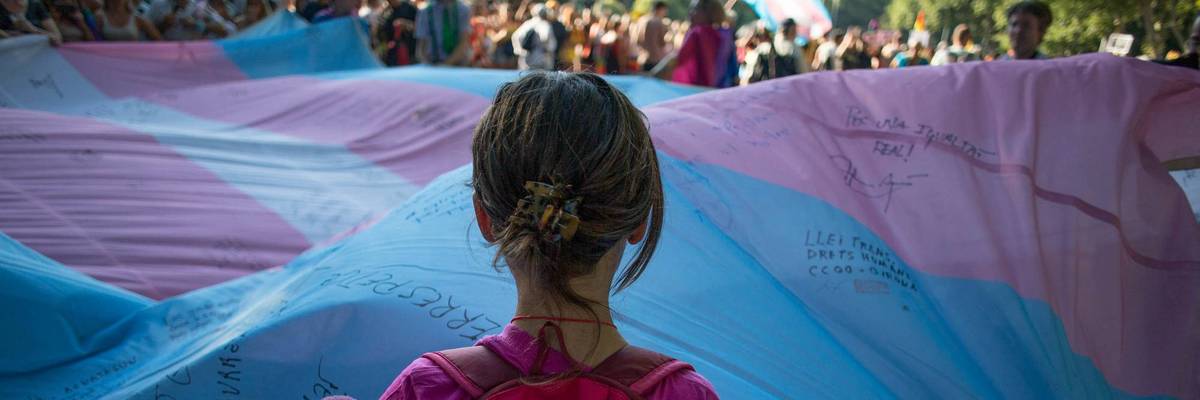
A girl helps holds the Transgender Pride flag during a July 9 2022 rally in Madrid.
(Photo by Luis Soto/SOPA Images/LightRocket via Getty Images)

Brett Wilkins
May 20, 2026
COMMON DREAMS

The Republican-controlled US House of Representatives on Wednesday passed legislation that critics warn would force public schools receiving federal funding to “out” transgender students to their parents without or without their consent, a policy that advocates warn could endanger many trans youth.

HR 2016, the Stopping Indoctrination and Protecting Kids Act—but dubbed the “Don’t Say Trans” bill by some critics—was introduced by Reps. Tim Walberg (R-Mich.) and Burgess Owens (R-Utah) and passed by a vote of 217-198, with eight Democrats joining every Republican and one Independent present in voting for the legislation.

The bill—which faces an uncertain future in the Senate—requires federally funded elementary and middle schools to obtain parental consent before changing a student’s gender markers, pronouns, or preferred names on school forms. It also mandates parental consent for a student’s access to sex-based accommodations, such as locker rooms or bathrooms.


The legislation also prohibits federal elementary and secondary education funds from being used to advance concepts of so-called “gender ideology”—an inaccurate term that GLAAD says is “deployed by opponents to undermine and dehumanize transgender and nonbinary people”—in the classroom. The term features prominently in a day-one executive order signed by President Donald Trump in what critics say is an effort to effectively erase trans people from public existence.

“Too many schools are keeping parents in the dark about what’s happening in their own children’s classrooms, even going so far as to withhold critical information about their kids’ well-being and development,” Walberg said.

“Families deserve honesty, not secrecy—especially when it comes to issues like gender identity,” he continued. “Simply put, parents should never be the last to know—that’s not political, it’s common sense.”

“Meanwhile, political and ideological agendas are being pushed through curriculum without parents’ knowledge or consent, sidelining the very people responsible for raising these children,” Walberg added.

However, Rep. Pramila Jayapal (D-Wash.)—whose daughter is transgender—accused Republicans of “targeting trans kids with a bill that would require public schools to forcibly out students who want to use certain pronouns or accommodations, even if it would put them in danger.”

“I’m a hell no,” Jayapal said of the bill. “Trans kids deserve better.”


Other House Democrats echoed Japayal’s objections, with Rep. Robin Kelly of Illinois warning that the “Republicans’ extreme bill puts trans youth in harm’s way and censors content that acknowledges trans people’s existence.”

“I will always stand up for student safety, and I am voting NO,” Kelly added.

Rep. Christian Menefee of Texas said that “instead of making sure America’s schools have the resources and support they need to ensure every student is given the same shot at success, Republicans are bringing a ‘Don’t Say Trans’ bill to the floor today to forcibly out trans students, even if doing so would put students in immediate physical danger.”

“Parents across the country want their children to learn in safe, affirming environments, without worrying about their kids being outed for their gender identity,” he added. “I won’t vote to put those kids in danger.”

Rep. Laura Friedman of California lamented: “This week, congressional Republicans could have spent their time working with us to help Americans afford groceries and pay their rent. Instead, they spent their time advancing a bill meant to demean trans youth.”

“I voted no and urge them to focus on the real needs of Americans,” Friedman added.

The eight Democrats who voted for the bill are: Reps. Vicente Gonzalez and Henry Cuellar of Texas, Don Davis of North Carolina, Cleo Fields of Louisiana, Laura Gillen of New York, Marcy Kaptur of Ohio, Marie Gluesenkamp Perez of Washington, and Eugene Vindman of Virginia.

The Human Rights Campaign (HRC) called HR 2616 part of “MAGA’s weird obsession with trans people.”

“When the going gets tough for Republicans in Congress—when they have no answers to soaring gas prices from Trump’s illegal war with Iran, rampant corruption, or spiking health premiums—they can’t help but fall back on their favorite strategy: fearmongering,” HRC’s Jennifer Pike Bailey wrote on Tuesday. “And unfortunately, the transgender community is still the scapegoat du jour.”

“Policies that denigrate trans youth don’t succeed in erasing these students, they just make their lives immeasurably harder,” she continued. “It’s the job of schools to keep youth safe. And as we’ve seen, LGBTQ+ students are in physical danger when harmful policies are implemented. Recent FBI data shows that in states that have passed these types of laws, anti-LGBTQ+ hate crimes in schools have quadrupled.”

“Opponents of LGBTQ+ equality are creating a lot of noise, and the only way to stop them is to be louder,” Pike Bailey stressed. “We need phone calls, emails, letters to every member of Congress telling them to stop these attacks. And then we need to show up at the ballot box.”


Tyler Hack, executive director of the trans political advocacy group Christopher Street Project, said in a statement that “HR 2616 is yet another escalation in Republicans’ sick obsession with criminalizing queer people and trans youth.”

“This ‘Don’t Say Trans’ bill does not protect kids—it is government-mandated forced outing,” Hack added. “Mandating that teachers act as agents of the state and out their own students is not protection; it’s cruelty.”

According to the Trans Legislation Tracker, “an independent research organization tracking bills that impact trans and gender-diverse people across the United States,” there are currently 778 state-level and 126 national bills under consideration “that would negatively impact” targeted people.

One of the most recently approved bills, signed into law Friday by Republican South Carolina Gov. Henry McMaster, forces trans and nonbinary students who need to use public school restrooms to go outside to porta-potties. LGBTQ Nation’s Greg Owen slammed the law as a “latter-day ‘separate but equal’ attack on trans rights.”

The Campaign for Southern Equality (CSE) said that “this bill will do nothing to make our schools safer.”

“Rather,” CSE added, “it will make using the bathroom a difficult and even dangerous experience for trans and nonbinary youth, who are extremely likely to be bullied and harassed when using the bathroom.”


America's founders would be 'disgusted' by Republicans: Historian


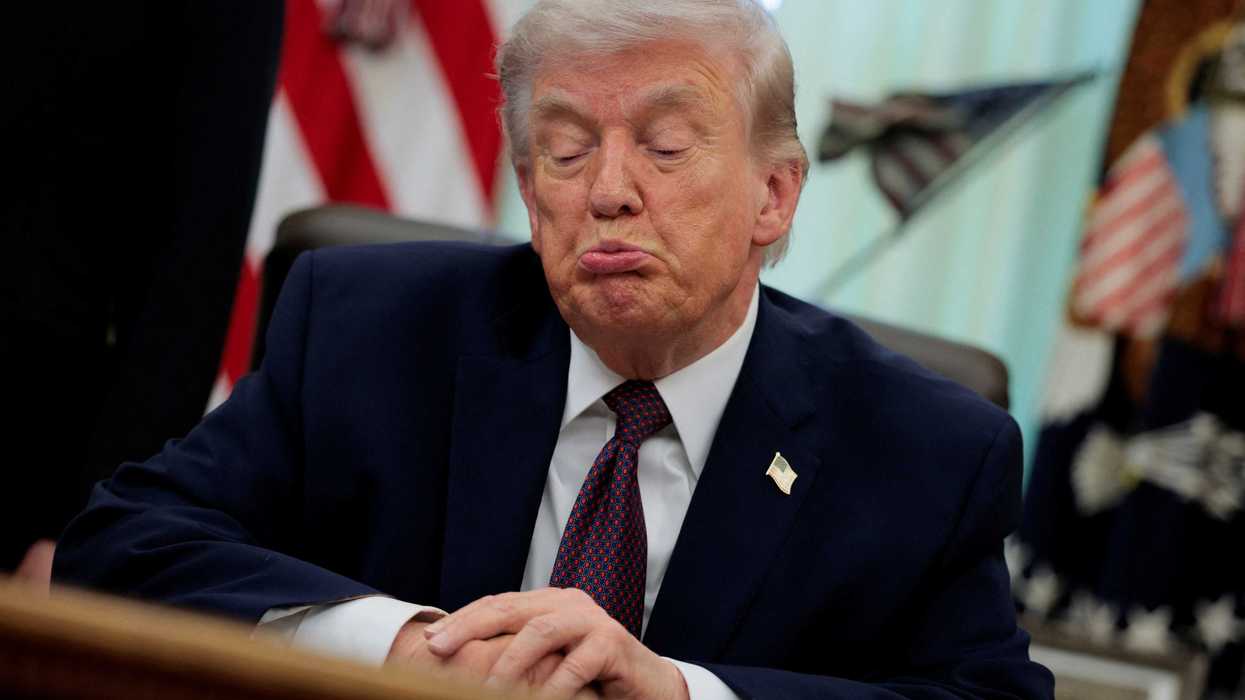
U.S. President Donald Trump reacts as he speaks during the signing ceremony for an executive order on mail ballots, in the Oval Office of the White House in Washington, D.C., March 31, 2026. REUTERS Evan Vucci

May 20, 2026  
ALTERNET


President Donald Trump’s administration would disgust America’s founding fathers, explained a top historian and documentarian — and they'd be even more shocked at Republican lawmakers who fail to fight back.

“The founders would less be surprised by someone taking authoritarian power than they would be by [Congressional] abdication,” said historian Ken Burnshistorian Ken Burns, who has made more than 30 acclaimed documentaries on American history and other subjects. “Article One is the legislative and Article Two is the executive. That would be the manager carrying out what the executive — what the legislative — wanted. And that is not happening. And we're seeing even the courts go into that realm.”

Burns told MS NOW that America’s first president, George Washington, had three main warnings for America after leaving office: “avoid partisanship, no foreign entanglements, and leave office, please. That's his message. And those things are a good starting point.”


In his Farewell Address, which he submitted in writing in 1796 after Secretary of the Treasury Alexander Hamilton helped him draft it, Washington was particularly fretful over partisanship destroying American democracy.

“The alternate domination of one faction over another, sharpened by the spirit of revenge, natural to party dissension, which in different ages and countries has perpetrated the most horrid enormities, is itself a frightful despotism,” Washington explained. “But this leads at length to a more formal and permanent despotism. The disorders and miseries which result gradually incline the minds of men to seek security and repose in the absolute power of an individual; and sooner or later the chief of some prevailing faction, more able or more fortunate than his competitors, turns this disposition to the purposes of his own elevation, on the ruins of public liberty.”

Washington — who insisted on stepping down from power peacefully after the end of his second term and thereby began the tradition of peacefully giving up power that every president except Trump has followed — also warned against leaders who refused to accept that the law applies to them when they happen to dislike it.

“The basis of our political systems is the right of the people to make and to alter their constitutions of government,” Washington said. “But the Constitution which at any time exists, till changed by an explicit and authentic act of the whole people, is sacredly obligatory upon all. The very idea of the power and the right of the people to establish government presupposes the duty of every individual to obey the established government.”

Washington also urged Americans to vigilantly guard their First Amendment rights, even encouraging the affordable distribution of newspapers despite many of them criticizing his policies.

Trump’s link to the 'lies' of staged wrestling exposed in new documentary

London, England - August 27 2023: Will Ospreay with a flying dropkick at AEW All In at Wembley Stadium (Shutterstock)

May 12, 2026
ALTERNET

Comedian and satirist Munya Chawawa’s documentary “Wrestling With Trump” punches President Donald Trump in ways he should have been punched at the very beginning of his political career, says Guardian writer Lucy Mangan.

“Trump is the ultimate showman. He’s a master of it, a billionaire Barnum, but with a greed so insatiable it moves him ever further from entertainment into malevolence,” Mangun said. “If the Democrats had realized this earlier and recognized the strength the man was playing to and the particular voting public weaknesses he was preying upon, instead of sneering with distaste, then maybe we wouldn’t be in this mess.”

Chawawa, however, takes the “underused idea” that Trump and his team’s campaigns and style of government “use the same playbook as that created by the U.S. pro-wrestling industry’s most famous promoters, World Wrestling Entertainment (WWE),” said Mangan.

The connection is more than obvious, added Mangan. World Wrestling Entertainment was founded by Vince McMahon and his since-estranged wife, Linda. Vince quit the business 2024 in the wake of allegations of sex trafficking and sexual assault, but his wife Linda is now the U.S. secretary of education.

One of the most-recognized tropes of fake wrestling is its habit of dividing “heroes” (white Americans) and villains (non-American, non-white Americans) with “Babyfaces” (good guys who play by the rules) “Heels” (who aren’t and don’t).

It works in the ring and at political rallies, said Chawawa, who notices Trump’s use of trash talk and his alienation of brown people to “rouse the bloodlust” and “make [voters] commit” to a world leader “who promises to rid the world of all the people perceived to be the cause” of white voters’ frustrations.

And then there’s the wrestling industry’s use of “kayfabe,” and its blurring of the lines between truth and lies. Chawawa, in his documentary, “speaks to MAGA folk who can call Trump a “blue collar billionaire” without batting an eyelid. It’s a sign of the “astonishing power” Trump has “to warp the senses, collapse contradictions and reconstruct a reality that suits him better,” reports Mangun.

“Kayfabe, in wrestling, is the pretense that everything is real – that the invective is unscripted, that the Heels’ and heroes’ backstories are authentic, that the moves are unchoreographed, and that the body slams, hip checks and chokeholds are as dangerous and painful as they look. For as long as the fight lasts, you live the illusion. Nothing is true except what you are told you see.”


What Jefferson and Madison would have thought about ‘rededicating’ the US to God

A man participates in a worship service on the day of Rededicate 250: A National Jubilee of Prayer, Praise & Thanksgiving at the National Mall in Washington, D.C., U.S., May 17, 2026. REUTERS/Seth Herald

May 20, 2026

Thousands of Americans prayed on the National Mall on May 17, 2026, during “Rededicate 250”: a day-long rally to “come together in prayer and worship ahead of the nation’s 250th birthday,” as organizers described it. U.S. House Speaker Mike Johnson, one of many Republican politicians and conservative Christian leaders to speak, led a prayer to “rededicate the United States of America as one nation under God.”

Planned by Freedom 250, a public-private partnership, the rally prompted criticism that it blurred the lines separating church and state. According to the Pew Research Center, 73% of adults agree that religion should be kept separate from government policies, and only 19% of Americans say the United States should stop enforcing that principle.

But figures allied with the Trump administration have challenged the premise that the U.S. government should be – or was meant to be – separate from religion. In 2023, Johnson remarked that “The separation of church and state is a misnomer … it comes from a phrase that was in a letter that Jefferson wrote. It’s not in the Constitution. And what he was explaining is they did not want the government to encroach upon the church – not that they didn’t want principles of faith to have influence on our public life.”

As a scholar of American legal and religious history, I have written extensively about the development of religious freedom in the U.S., and the origins of the separation of church and state.

Two of the Founding Fathers shaped American views on these topics more than any other: Thomas Jefferson and James Madison. Yet their views have also become lightning rods for controversy as the “wall” between church and state comes under scrutiny.

My 2024 book, “The Grand Collaboration,” seeks to answer several questions: What was Jefferson’s and Madison’s understanding of religious freedom? And why were they so deeply committed to that principle?
Bedrock of law – in Virgina and beyond

Jefferson wrote the Virginia Bill for Religious Freedom in 1777, the most comprehensive declaration of religious freedom at the time. The bill guaranteed freedom of conscience, protected religious assemblies from government oversight, prohibited government funding of religious institutions and boldly declared that religious opinions were outside the authority of civil officials.

Several years later, Madison guided these ideals into law. His “Memorial and Remonstrance Against Religious Assessments,” a protest against a proposal to support Christian teachers with tax money, affirmed the values of church-state separation and religious equality. He helped defeat the proposal – and set the stage for Virginia to adopt Jefferson’s bill.

As president, Jefferson went on to pen a letter to a Baptist association in Connecticut where he immortalized the phrase “a wall of separation between church and state.”

The Bill of Rights contains two clauses about religion, both in the First Amendment: that “Congress shall make no law respecting an establishment of religion, or prohibiting the free exercise thereof.”

What qualifies as “establishment of religion,” however, is open to debate.

In 1947, the U.S. Supreme Court embraced church-state separation as the guiding principle for interpreting the religion clauses, relying extensively on the two Virginians’ writings and actions. As Justice Hugo Black wrote, “In the words of Jefferson, the clause against establishment of religion by law was intended to erect ‘a wall of separation between Church and State.’”

The duo’s documents served as the authority for the legal principle of church-state separation, and for more than five decades, their bona fides remained unquestioned in the law.
Shift at SCOTUS

Criticism of church-state separation intensified in the 1980s. As the religious right grew into a political force, commentators argued that the concept was anti-religious and did not represent the prevailing views about church and state during the founders’ time.

In recent decades, such arguments have attracted politicians and jurists, including members of the Supreme Court. Justice Clarence Thomas has written that the court’s earlier separationist interpretations of the Constitution “sometimes bordered on religious hostility.” Legal scholar Philip Hamburger has declared that “the constitutional authority for separation is without historical foundation” and “should at best be viewed with suspicion.”

Several recent Supreme Court decisions have rejected a separationist approach to church-state matters. For example, the conservative majority has allowed taxpayer dollars to be used at religious schools, the display of religious symbols on government property, and religious expression by public school employees.

In a 2022 dissent, Justice Sonia Sotomayor bemoaned that the court has turned the separation of church and state from a “constitutional commitment” to a “constitutional violation.”

The justices’ earlier reliance on Jefferson and Madison has borne the brunt of criticism that their views on church-state matters did not represent their peers, or that neither man was in favor of separation as he has been portrayed.
Exchange of ideas

To better understand Jefferson’s and Madison’s beliefs, I examined many of the 2,300 letters between the two on “Founders Online,” a National Archives website. I also looked at correspondence with other acquaintances.

Both founders had deistic leanings, meaning they believed in a supreme being, but thought science and reason were the best paths to understanding religion. They were only nominally observant Christians, but more protected from religious intolerance than other “dissenters” due to their high social standing and affiliation with the Anglican Church.

All the more striking, then, that they worked throughout their lives to advance religious freedom.

Religious matters were never far from their minds. For instance, in Madison and Jefferson’s exchanges discussing the need for a bill of rights, freedom of conscience was invariably at the top of the list. Both were convinced that government should avoid supporting religion, even if no particular religion was given preference. They also insisted that people should have broad religious freedoms.

These views were clearly on the vanguard, but other religious rationalists and religious dissenters also advocated a comprehensive understanding of religious freedom.

Both men were committed to advancing religious freedom because they saw it as deeply entwined with freedom of inquiry and conscience. “Reason and free enquiry are the only effectual agents against error,” Jefferson wrote in 1784. Allowing people to investigate ideas freely “will support the true religion,” because “Truth can stand by itself.”

Similarly, Madison declared “the freedom of conscience to be a natural and absolute right.”

In their view, free inquiry was the fount of other rights. Religious freedom, for example, was a subset of freedom of conscience. And a healthy separation of church and state was key to ensuring those freedoms.
‘A pillar of support’

The letters reveal the extent to which Jefferson and Madison complemented and reinforced each other’s attitudes toward church and state. They also reveal the close intellectual and emotional affection that each man held for the other, and how much each man valued the other’s support.

In their final exchanges before Jefferson’s death on July 4, 1826, he implored Madison, “To myself, you have been a pillar of support thro’ life. Take care of me when dead, and be assured that I shall leave with you my last affections.”

Madison responded with similar affection: “You cannot look back to the long period of our private friendship & political harmony, with more affecting recollections than I do.”

Jefferson’s and Madison’s half-century of collaboration on behalf of religious freedom and equality is an important chapter in the nation’s founding history. I believe its legacy should be remembered and celebrated, not discarded.

This is an updated version of an article originally published on June 25, 2024.

Steven K. Green, Professor of Law, Director of the Center for Religion, Law & Democracy, Willamette University

This article is republished from The Conversation under a Creative Commons license. Read the original article.
The real reason Stephen Colbert got canceled

(Screenshot/CBS)
May 19, 2026 
ALTERNET


Stephen Colbert’s last show is this Thursday evening.

CBS refused to renew his contract, and you know exactly why: He mocked and criticized Trump.

CBS says it’s ending “The Late Show” because the show was costing CBS some $40 million a year. That’s utter bull----. Colbert allowed CBS to charge higher fees to local affiliates, because it attracted millions of viewers to those affiliates’ 11 p.m. news programs in anticipation of “The Late Show” airing right after. The show was also a promotional gold mine for CBS, whose series stars were often interviewed by Colbert. No wonder CBS was “feverish” to lock Colbert into a new contract only three years ago.


What really happened couldn’t be clearer. Führer Trump was furious at Colbert’s mocking and publicly called for CBS to cancel him (or “put him to sleep NOW” as Trump wrote in one social media post). At the same time, CBS’s parent company, Paramount, was on the verge of a lucrative merger deal that Trump could interfere with.

Paramount had already sucked up to Trump by offering him $16 million to settle a lawsuit he brought against CBS News’s “60 Minutes,” although he had almost no chance of prevailing in court.


In a monologue, Colbert called the settlement a “big fat bribe,” which it was. Days later he got word he’d been canceled. About a week after that, the deal was approved.

Before Colbert started at CBS, he hosted Comedy Central’s “The Colbert Report,” where he played a right-wing, blowhard, curmudgeonly TV host.

I was often a guest, presumably because I was a good foil for the blowhard Colbert was acting. (I’ve also been a guest on his “The Late Show.”)


The first time I came to do “The Colbert Report,” I was nervous. I didn’t know how to respond to someone who’d be acting as a conservative ---hole but wasn’t one in real life.

I was sitting alone in the greenroom when Colbert popped in. He introduced himself, sat down, and then, smiling, said, “Just wanted to warn you that I play a real jerk out there.”

“Oh, I know,” I said. “I’ve watched the show.”


“Good. Don’t argue with me. Just play along,” he counseled.

“I’ll try not to argue,” I said. “But I go on so many of these combative shows that I may automatically start arguing.”

Colbert laughed. “That’s fine. Just let me do the heavy lifting. I’ll be so obnoxious that viewers will see the wisdom in your argument!”

“Sounds good,” I said, still nervous.


“Just have fun!” Colbert advised, before vanishing to his set.

Here’s one of our discussions.

Colbert was anything but a right-wing jerk. In fact, as I’ve come to know him over the years, he’s remarkably self-effacing and wicked smart. He’s progressive in his politics, of course, but never dogmatic. Even when he skewers Trump on his “The Late Show,” he does it with gentle humor and no trace of anger or bitterness.

I’ve done many thousands of interviews over my adult life. Some interviewers, like the late Bill Moyers, have been so thoughtful and well-prepared that I’ve barely had to think; I just fall into a natural conversation with them. Others are so stilted or slick that they hardly listen to what I say, and the interview has the tortuous feel of gears grinding from one topic to another.


Colbert is like Moyers in being well-prepared and listening intently. But he adds a rapid-fire wit that can make a serious point while putting an audience in stitches.

When Colbert interviewed me last August about my latest book, CBS had just announced that his contract wouldn’t be renewed and that by late May the show would be off the air for good.

A stagehand met me at the side door to the old Ed Sullivan Theater. As he led me to the greenroom, I asked him how everyone there was taking the news.

“Not well,” he said. After a pause he said, “We’re like a family here.”


Some time later, Stephen came by the greenroom. I asked him how he was doing. “Oh, I’m fine,” he said. “I’ll find something else to do. But there are about a hundred people here who will be out of jobs, and frankly I’m worried about them.”

They are like a family — Stephen Colbert, his executive producer, the segment producers and directors, showrunners, writers, cameramen, gaffers, grips, lighters, stagehands, custodians, musicians. Stephen has treated them like a family. His respect and concern for them is unusual in the business but consistent with the courtesy and kindness I discovered the first time I met him.

In sharp contrast is the way CBS and Paramount’s new owners, Larry and David Ellison, have treated Colbert and all those who have made “The Late Show” such an important part of our entertainment and political firmament.

Behind the Ellisons lurks Trump, who treats everyone like s--- except strongmen he can’t control such as Vladimir Putin and Xi Jinping.

After this Thursday’s show, the Ed Sullivan Theater will go dark, and we’ll lose one of the nation’s funniest and most courageous, truthful, and gentlemanly critics of Trump and his lawless regime. Our society and democracy will be the worse for it.

Farewell, and thank you, Stephen.

Robert Reich is a professor of public policy at Berkeley and former secretary of labor. His writings can be found at https://robertreich.substack.com/.


Colbert didn't just entertain America — he redefined American patriotism

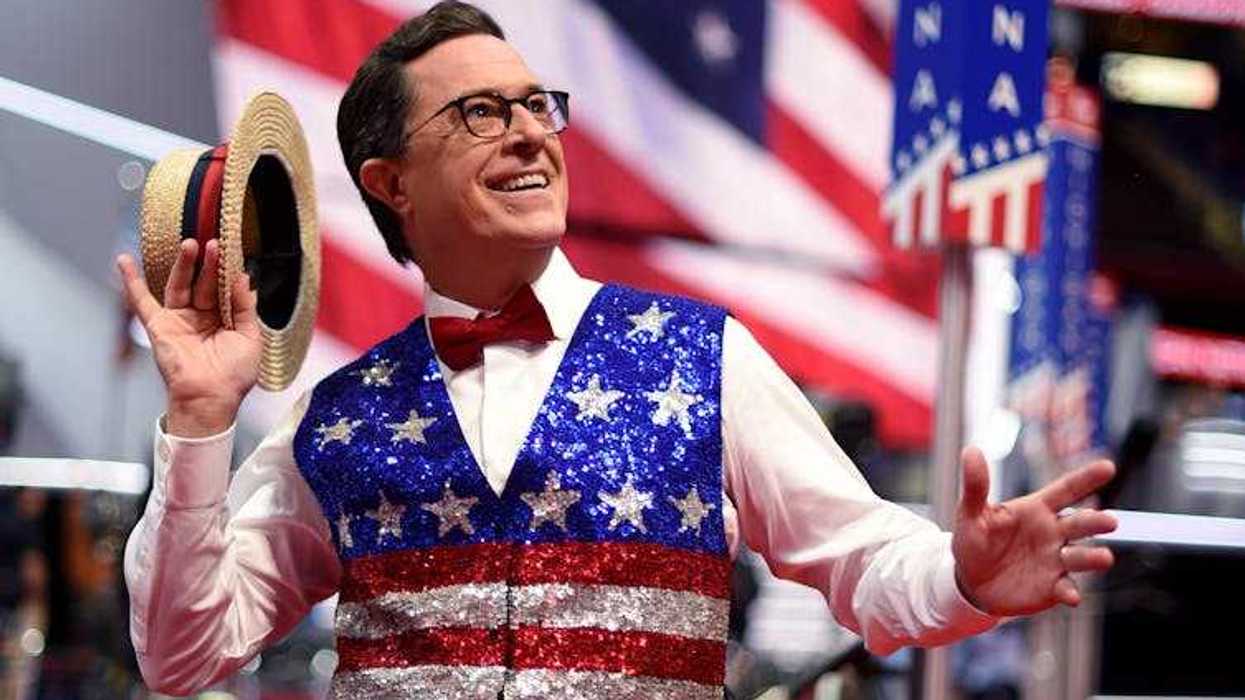
Colbert tapes a segment for ‘The Late Show’ at Quicken Loans Arena ahead of the 2016 Republican National Convention in Cleveland. Timothy A. Clary/AFP via Getty Images

May 20, 2026 

Stephen Colbert’s final episode as host of “The Late Show” on May 21, 2026, won’t mark the end of his career.

But as a scholar of political satire, I think it offers a chance to reflect on the lasting impact of his comedy, which has spanned his work as a correspondent on “The Daily Show,” his conservative pundit persona on “The Colbert Report” and his reinvention on “The Late Show.”

The best satirists do more than entertain. They influence public discourse and leave lasting marks on political life. This group includes towering writers such as Benjamin Franklin and Mark Twain, alongside performers like Lenny Bruce and George Carlin.

In my view, Stephen Colbert has earned a spot in the top tier. Here are five reasons why.
1. He didn’t just satirize the news – he informed the public

Most satirists offer wry commentary about political events.

Colbert often did something more ambitious: He helped audiences understand them.

Critics have long dismissed political comedy as superficial entertainment, but Colbert’s satire frequently offered valuable information to the public.

In 2010, the U.S. Supreme Court’s Citizens United decision transformed campaign finance law, tilting political influence toward wealthy people and corporations. As host of the “Colbert Report,” the comedian responded by creating an ongoing series of “Colbert Super PAC” segments. Working with former Federal Election Commission Chair Trevor Potter, Colbert was able to translate the opaque mechanics of campaign finance law into accessible civic education.

Colbert used his platform to highlight the dangers of unrestricted, anonymous donations in politics.

It’s hard to fully track the impact of this approach. But a 2007 Pew Research Center study did find that audiences for satirical news programs such as “The Daily Show” and “The Colbert Report” scored high on political knowledge measures, outperforming audiences who only consumed political news from traditional outlets.

That urge to use satire as a vehicle for civic education continued after Colbert became host of “The Late Show” in 2015.

With debates raging over the border wall proposed by the first Trump administration, Colbert brought experts on to the program to break down the engineering, financial and logistical realities of building one that spanned the entirety of the U.S.-Mexico border. Yes, the absurdity of the physics and finances elicited laughs. But Colbert also helped viewers understand why Trump’s promises were implausible.
2. He gave Americans a new political vocabulary

When the world is absurd, the satirist uses ironic wit to make sense of it.

Colbert excelled at distilling the spin and duplicity of politics into memorable soundbites.

On the first episode of “The Colbert Report” in 2005, he introduced the word “truthiness” to describe the tendency to prefer what “feels true” over what the evidence supports. It incisively gave a name to a deceptive political tactic, one that the Bush administration had repeatedly used, from “Mission Accomplished,” to “weapons of mass destruction” and “enhanced interrogation techniques.”

“Truthiness” took on a life of its own. Merriam-Webster named it Word of the Year in 2006.

Colbert continued this rhetorical work on “The Late Show.” For example, in February 2017, after Donald Trump escalated his attacks on the press by labeling major news outlets “the enemy of the American people,” the comedian shifted from parody to diagnosis. He foregrounded the phrase’s authoritarian history, insisting that the rhetoric signaled a meaningful escalation in attacks on First Amendment rights, rather than a passing controversy.

In other words: There was nothing to laugh about here.
3. He blurred the line between satire and direct action

Media scholars have increasingly noted how political comedians now function as hybrid figures who blur journalism, entertainment and civic engagement. According to communications scholar Joseph Faina, Colbert may be one of the clearest examples of that shift.

Colbert’s satirical presidential campaign in South Carolina in 2007 mocked the theater of American electoral politics. He actually attempted to enter the race through official channels, only to be blocked by the South Carolina Democratic Party. But even in his failure to appear on the ballot, he was able to show how party control and media spectacle, not just voter choice, structure the field of viable candidates.

In 2010, he held a rally with Jon Stewart on the National Mall before a crowd of over 200,000 people. Assuming his conservative pundit persona, Colbert blended irony and sincerity, mocking the self-seriousness, sensationalism and outrage-driven news cycles of cable news through his competing calls for “sanity” and “fear.” But the event was also designed to motivate voter turnout in the midterm elections.

That interventionist impulse continued on “The Late Show.” During the 2020 election cycle, for example, Colbert encouraged voting through segments like “Better Know a Ballot.” A riff on his previous “Better Know a District” from “The Colbert Report,” the “Better Know a Ballot” series was designed to educate viewers about ballot access, voting procedures and the practical elements of democratic participation.
4. He measurably influenced political behavior

Claims about comedians changing politics can easily become exaggerated. But Colbert’s influence has empirical support.

Research by political communication scholars Jody Baumgartner and Jonathan Morris found that exposure to political satire can increase viewers’ sense of what’s known as “political efficacy” – the belief that they can understand and engage with politics. Other studies suggest satirical news audiences are often more politically active than they’re assumed to be.

Colbert is repeatedly cited in these studies as one of the prime examples of a satirist who makes an impact.

Take, for instance, the so-called “Colbert bump,” where candidates who appear on his programs experience boosts in fundraising, visibility and media coverage. Political scientist James H. Fowler found that Democratic candidates who appeared on “The Colbert Report” experienced a 44% increase in campaign donations within 30 days of their appearance.

A similar effect could be seen on “The Late Show.”

After Colbert interviewed Texas state Rep. James Talarico, a U.S. Senate candidate, in February 2026, CBS canceled the segment, claiming – perhaps disingenuously – that the network could be punished for not adhering to the FCC’s “equal time” rule, which requires broadcast stations to offer comparable airtime to opposing candidates.

A taped version of the interview was nonetheless posted to YouTube, where it racked up over 9 million views, helping fuel Talarico’s US$27 million first-quarter fundraising haul, the largest amount ever raised by a U.S. Senate candidate in the first quarter of an election year.
5. He redefined American patriotism

To rank Colbert among America’s most important satirists requires one additional consideration: his role in redefining not only what America stands for, but what it means to be patriotic.

Many satirists lean toward cynicism, portraying politics as hopelessly corrupt and public life as fundamentally absurd. Not Colbert.

As linguist Geoffrey Nunberg argued in his 2006 book, “Talking Right: How Conservatives Turned Liberalism into a Tax-Raising, Latte-Drinking, Sushi-Eating, Volvo-Driving, New York Times-Reading, Body-Piercing, Hollywood-Loving, Left-Wing Freak Show,” conservatives had claimed a monopoly on patriotism as the 20th century drew to a close. At the same time, many of them promoted what’s known as “blind patriotism,” in which any criticism of the U.S. is cast as evidence of insufficient national loyalty.

Colbert’s satire directly challenged that framework.

To expose that performative patriotism, Colbert’s persona on “The Colbert Report” wrapped itself in exaggerated patriotic imagery: flags, bombast, overconfidence and chest-thumping nationalism.

But the joke was never America itself. The target was a performance of patriotism that treated dissent as disloyalty, emotional certainty as evidence and partisan identity as civic virtue.

As I argue in my 2011 book, “Colbert’s America,” Colbert’s satire consistently distinguished between nationalism and democratic patriotism. The former demands unquestioning loyalty. The latter demands accountability. For example, through segments like “Threat-Down” on “The Colbert Report,” he satirized the way nationalism often depends on exaggerating fictive dangers and denouncing symbolic, external enemies.

In that sense, Colbert belongs in a distinctly American satirical tradition that stretches back to Benjamin Franklin. The great American satirists have used humor not to reject the national project, but to expose the gap between its ideals and its realities. They reshape how citizens understand power and civic responsibility.

For nearly three decades, Stephen Colbert has done exactly that.

Sophia A. McClennen, Professor of International Affairs and Comparative Literature, Penn State

This article is republished from The Conversation under a Creative Commons license. Read the original article.