Saturday, May 09, 2026

German pharmacies decline as sector warns of underfunding

05.05.2026, DPA


Photo: Hauke-Christian Dittrich/dpa


The number of pharmacies in Germany continued to decline at the start of the year, according to data released on Tuesday by the German Pharmacists' Association.

At the end of March, there were 16,541 pharmacies nationwide, 60 fewer than at the turn of the year, the association said. Since early January, 19 new openings were offset by 79 closures. The figures include both main pharmacies and branches, of which a pharmacy can operate up to three.

Hans-Peter Hubmann, head of the German Pharmacists’ Association, said the supply of medicine to the public remained secure, but warned the trend could not continue for long.

Every closure means longer distances for thousands of patients, he said, adding that the long-term decline was rarely due to individual mismanagement or increased competition, but rather what he described as chronic underfunding of pharmacies.

The sector has long called for an increase in a fixed dispensing fee from €8.35 ($9.75) to €9.50 per prescription package. A proposal by Germany's governing coalition was postponed due to pressure on statutory health insurers.

Health Minister Nina Warken has since said she intends to revisit the planned increase, while also preparing broader cost-containment measures as part of wider healthcare reform.

The financial situation of Germany's pharmacies is also expected to be discussed at an industry economic forum in Berlin on Tuesday.

Western Europe corporate bankruptcies hit record high, analysis finds

05.05.2026, DPA


Photo: Hannes P Albert/dpa


Corporate bankruptcies in Western Europe rose to their highest level on record last year, underscoring the deepening impact of an economic downturn that is increasingly seen as structural rather than cyclical, according to a report by private German firm Creditreform.

The number of insolvencies climbed 4.8% year-on-year to around 197,610 cases in 2025, marking the fourth consecutive increase and the highest level since records began in 2002.

“The crisis is not only cyclical, it is structural. Weak global trade and geopolitical risks are weighing on European companies,” said Patrik-Ludwig Hantzsch, head of economic research at Creditreform. 

High energy costs and bureaucracy are also undermining competitiveness, particularly compared with the United States and China, he added. "This double burden is eroding the very foundations of many businesses."

A further increase in insolvencies is expected this year.

Hantzsch said the current level of bankruptcies in Western Europe exceeds that seen after the 2008–09 financial crisis. Although the pace of increase has recently slowed, insolvency levels remain elevated.

Diverging trends in Europe

The sharpest increase in the region was recorded in Switzerland, where cases jumped 35.3%, largely due to a legal change at the start of 2025 that tightened enforcement of public claims and lowered the effective threshold for insolvency.

Above-average increases were also recorded in Greece (+24.4%), Finland (+12.1%) and Germany (+8.8%). Germany, Europe's biggest economy, saw more than 24,000 insolvencies, the highest level since 2014.

By contrast, six countries — including the Netherlands, Ireland and Norway — reported declines. 

Insolvency trends varied across sectors, according to Creditreform. The sharpest increases were seen among service providers (+8.7%) and manufacturing (+3.6%), compared with trade and hospitality (+3%) and construction (+0.1%).

EU approves €5bn in subsidies for climate measures in German industry

07.05.2026, DPA


Photo: Julian Stratenschulte/dpa

By Doris Pundy, dpa

The European Commission has approved German subsidies worth €5 billion ($5.9 billion) to assist businesses in the industrial sector in their efforts to reduce greenhouse gas emissions.

The "decision supports industry in making the shift to cleaner production while keeping a clear focus on efficiency and fairness," said EU Commission Vice-President Teresa Ribera on Thursday.

Under the scheme, financial support will be available to projects that involve "fundamental technological changes and replace fossil fuels or raw materials with low-carbon alternatives," the commission said.

Eligible technologies include electrification, the use of hydrogen or biomethane, carbon capture and storage, and similar innovations.

Aid payments will only cover the extra cost of switching to a cleaner alternative, and "if these become cheaper to operate, beneficiaries will have to reimburse the difference," the commission said.

State aid in the EU has to be approved by Brussels and is strictly regulated to ensure fair competition between companies from economically strong member countries and those from less affluent regions.

The plans by the German government show "how we can move forward on decarbonization while preserving a level playing field and ensuring that competition continues to work for Europe’s long-term prosperity," Ribera said.

Beneficiaries will be selected based on the cost efficiency of the planned technological changes, the commission said, which is "measured as the aid requested per tonne of avoided CO2 emissions."

Industrial sectors that are covered by the EU's emissions trading scheme (ETS) can be supported under the state aid scheme. These sectors include steel and other metals' production, plaster, glass, ceramics, paper, pulp, cement, lime and chemicals.

The European Union has set itself the goal to be climate-neutral by 2050, and aims to reduce net greenhouse gas emissions by 2030 by at least 55% compared to 1990 levels.

VW becomes largest shareholder in Tesla rival Rivian

06.05.2026 DPA


Photo: Sven Hoppe/dpa


Volkswagen has become the largest single shareholder in Tesla rival Rivian, according to a filing by the US electric vehicle maker with the Securities and Exchange Commission (SEC).

The German carmaker now holds a 15.9% stake in Rivian, surpassing early backer Amazon, which owns about 13%, according to recent reports. Amazon uses Rivian-built electric delivery vans for parcel deliveries.

Volkswagen's growing stake is linked to a joint venture with the US carmaker aimed at developing Rivian's electrical architecture for VW electric models. Volkswagen has committed to invest up to $5.8 billion in the partnership.

A key feature of Rivian's system is a so-called zonal architecture, which organizes vehicle functions by area rather than by individual systems. Traditional vehicles use separate control units for specific tasks, such as climate control.

Under Rivian's approach, multiple functions are consolidated, allowing a single computing unit to control features such as acceleration and window operation on one side of the vehicle. The design reduces complexity and wiring length, lowering costs. 

Tesla and several Chinese carmakers have also adopted similar zonal architectures.

Rivian is currently preparing to launch a lower-cost SUV model, the R2, in the US to boost sales. With its first two vehicles, Rivian's sales remain far behind market leader Tesla.

Profit down 80% at Germany's Daimler Truck as tariffs hit US business

06.05.2026, DPA


Photo: Bernd Weißbrod/dpa


By Robin Wille, dpa

Profit at Germany’s Daimler Truck fell 80% in the first quarter, the commercial vehicle manufacturer said on Wednesday, as weaker performance in North America weighed on results.

Net profit dropped to €149 million ($175 million) from €749 million a year earlier.

Revenue declined 13% to €9.98 billion, while operating profit (EBIT) fell 71% to €292 million from about €1 billion in the same period last year.

The DAX-listed company said financial results were primarily affected by lower profitability in its North American business.

The company, however, pointed to a positive dynamic in incoming orders, with order intake rising by 50% in the first quarter compared with the same period a year earlier. In the United States, orders recovered even more strongly.

"We are well positioned for continued improvement over the course of the year, even against the backdrop of a challenging first quarter," said Daimler Truck chief executive Karin Rådström.

"Global order intake increased by 50% year over year, fuelled by a strong recovery in the US, and this momentum will benefit our performance in the quarters ahead."

Weakness in the US market and lower bus sales recently contributed to another decline in deliveries at Daimler Truck. In the first quarter of this year, the company sold 68,849 trucks and buses worldwide, a decline of 9% year-on-year.

Profit at the under-pressure commercial vehicle maker fell 34% last year to €2 billion. US tariffs and weak demand in North America weighed heavily on the business. Revenue and vehicle sales also declined.

To become more competitive, the company launched a cost-cutting programme last year, aiming to reduce ongoing costs in Europe by more than €1 billion by 2030. In Germany, around 5,000 jobs are expected to be cut, with the Mercedes-Benz truck brand particularly affected. Cost reductions are also planned in North America.

GERMANY

Continental subsidiary cuts 3,000 jobs globally

07.05.2026, DPA


Photo: Ole Spata/dpa\


Tyre and plastics technology group Continental wants to cut 3,000 jobs worldwide at its plastics technology subsidiary Contitech, including 1,600 in Germany, with the company and the IGBCE union reaching an agreement on the framework conditions, they said on Thursday.

The union said the deal amounted to a comprehensive transformation package.

The agreement governs the socially responsible reduction of about 1,600 jobs in Germany, the company said. Some of the affected activities will be relocated abroad. Redundancies for operational reasons are to be avoided until at least the end of 2030, IGBCE said.

Savings of €150 million

The cuts are part of the cost-saving programme Continental announced in November that calls for €150 million ($177 million) in yearly savings, starting in 2028. The company said jobs would be cut to achieve this, but had not previously given exact figures.

"We cannot prevent job cuts," IGBCE executive board member Francesco Grioli said in the statement, but the agreements would mitigate the impact on employees affected by the cuts. 

They would also create "prospects at German sites," he said, including investment commitments. "So for all the pain, the package is something to show for it."

Contitech said it would "make all measures as socially responsible as possible." The package of measures agreed includes a voluntary programme, early retirement arrangements and targeted placement of those affected into other jobs internally and externally.

Porsche to close three subsidiaries, about 500 jobs affected


08.05.2026, DPA


Photo: Marijan Murat/dpa


Germany's struggling sports car manufacturer Porsche plans to close three subsidiaries as part of its efforts to "focus on its core business."

The affected units are battery specialist Cellforce Group, Porsche E-Bike Performance and the software subsidiary Cetitec , Porsche announced on Friday. 

About 500 employees are affected. Just two weeks ago, the company also announced its intention to sell its stake in the luxury sports car manufacturer Bugatti.

According to chief executive Michael Leiters, Porsche was being forced “to make painful cuts – including at our subsidiaries.” A timeline for the closures has not yet been specified.

Porsche eBike Performance was originally founded to develop e-bike drive systems. According to the statement, operations are being discontinued due to fundamentally changed market conditions. A total of about 350 jobs are affected in Germany and Croatia.

At the software firm Cetitec, around 60 employees in Germany and 30 in Croatia are affected by the planned wind-up. 

Leiters had already signalled additional job reductions during his first public appearance in March, on top of an initial cost-cutting package.

Around 1,900 jobs are set to be cut in the Stuttgart region by 2029 in what the company describes as a socially responsible manner. In addition, contracts for roughly 2,000 temporary workers have already expired. 

Negotiations over a second round of cost-cutting measures have been ongoing for some time but have yet to produce a result.

Germany's Klingbeil says Canada 'ideal' partner amid global tensions

08.05.2026, DPA


Photo: Soeren Stache/dpa


German Finance Minister Lars Klingbeil called for closer economic cooperation with Canada on Friday, citing growing geopolitical tensions and the economic fallout from the conflict involving Iran.

Speaking during a meeting in Toronto with Canadian Finance Minister François-Philippe Champagne, Klingbeil said Europe needed to reduce strategic dependencies and strengthen its economic resilience and sovereignty.

It is becoming clear that Europe must move away from dependencies and strengthen its resilience and sovereignty, Klingbeil said. "And Canada is an ideal partner for this."

The two-day visit is focused on expanding cooperation in areas including critical raw materials, defence and artificial intelligence.

Klingbeil also sought to encourage greater Canadian investment in Germany, describing the country as an innovative business location made more attractive through reforms and investment incentives.

The two ministers also visited a facility operated by Canadian aircraft manufacturer Bombardier.

Champagne highlighted his recent participation in meetings of EU finance ministers and the Eurogroup, saying closer ties with Europe were intentional and reflected a shared interest in strengthening trans-Atlantic cooperation.

Klingbeil described Canada as a "partner in values."

Reports: US DoJ investigating possible inside trading during Iran war

08.05.2026, DPA


Photo: Kenneth Martin/ZUMA Press Wire/dpa


The US Department of Justice (DoJ) is investigating a series of suspiciously timed transactions in the oil market that took place shortly before major policy announcements by President Donald Trump and top Iranian officials about the Iran war, US media reported on Thursday. 

The investigation involves at least four trades in which traders made a total of more than $2.6 billion by betting on oil prices falling before they did, reported US broadcasters ABC News and NBC News, citing people familiar with the matter.

The bets were reportedly placed shortly before new announcements by Trump or Iranian government officials. The Commodity Futures Trading Commission (CFTC), the federal agency responsible for commodity trading, is also involved in the investigation.

Four transactions worth billions

According to ABC News, traders bet more than $500 million that oil prices would fall in March shortly before the US president announced the postponement of threatened attacks on Iran's power grid. In April, there were three additional transactions that are now under investigation:

On April 7, traders reportedly bet $960 million on falling oil prices shortly before Trump announced a temporary ceasefire. On April 17, speculators bet $760 million on falling oil prices, 20 minutes before Iranian Foreign Minister Abbas Araghchi announced the reopening of the Strait of Hormuz.

On April 21, unidentified parties placed $430 million on falling oil prices, 15 minutes before Trump's announcement of an extended ceasefire.

A source told NBC News that the investigation was still in its early stages and that there is no evidence of criminal misconduct so far. In addition to the current probe, investigators also plan to examine suspicious activity on speculative trading platforms in a separate proceeding, also related to the Iran conflict.

Oil and gas prices have risen sharply on global markets as a result of the Iran war.

Pope says arms trade being prioritized over 'respect for human life'

08.05.2026, DPA


Photo: Gennaro Piscopo/ZUMA Press Wire/dpa


Leo XIV has called on the faithful to work for peace on the anniversary of his election as pope. 

"The wars that are still raging in many parts of the world call for a renewed commitment – not only in economic and political terms, but also in spiritual and religious terms. Peace begins in the heart," said the head of the world’s 1.4 billion Catholics during a sermon in Pompeii on Friday.

Emphasizing the power of prayer, he said: "We cannot resign ourselves to the images of death that the news presents to us every day." 

To applause from the congregation, the Leo continued that "no earthly power will save the world, but only the divine power of love."

The pope said he has two particularly urgent concerns: the family, which is suffering from a weakening of the marital bond, and peace, which is being jeopardized "by international tensions and an economy that prioritizes the arms trade over respect for human life."

Crowds lined the Pope’s route through the streets of Pompeii. The Pontiff blessed children who were brought to him and greeted people in wheelchairs.

Thousands of German school students protest against military service

08.05.2026, DPA


Photo: Michael Ukas/dpa


Tens of thousands of school students took to the streets across Germany on Friday to protest against a possible return to compulsory military service.

Rallies and demonstrations took place in dozens of cities under the slogan "School strike against mandatory military service," coinciding with the anniversary of the end of World War II on May 8. 

Police in Berlin said around 1,200 participants turned out in the capital to march from the Brandenburg Gate to the headquarters of Chancellor Friedrich Merz's conservative party, carrying signs reading: "Education instead of bombs" and "Berlin instead of the front lines." Organizers put the number at 5,000.

In the northern city of Hamburg, organizers said around 6,000 people took to the streets, while police counted about 2,300 participants.

The protests were not the first nationwide action against military service. In early March, around 50,000 young people participated in a school strike against conscription and compulsory service of all kinds in some 150 cities across the country.

Germany reintroduced a voluntary military service programme last year in an effort to raise troop numbers in response to Russia's war in Ukraine and new NATO targets.

The law, which took effect on January 1, aims to recruit volunteers to expand the armed forces. If recruitment targets are not met, however, parliament could decide to reinstate compulsory military service.

South Africa's recurring waves of xenophobic violence
DW
05/07/2026

For nearly two decades, South Africa has suffered recurring bouts of xenophobic attacks. From deadly riots in 2008 to the rise of Operation Dudula, thousand of foreign nationals have been displaced time and again.

Attacks on foreigners have been recurring in South Africa over the past two decades, resulting in widespread destruction
Image: Kim Ludbrook/dpa/picture alliance


For more than two decades, South Africa has had to reckon with repeated outbreaks of anti-immigrant violence targeting mainly migrants and refugees from neighboring nations and other parts of the African continent.

Critics say that political rhetoric around immigration, combined with deep economic frustration, has helped fuel this sense of hostility toward foreigners; time and again, foreign nationals have been beaten, displaced, killed and had their businesses looted in various parts of the country.

DW takes a look at how xenophobia in South Africa has evolved over the years.
1994–2007: Rising tensions after apartheid

After the end of apartheid in 1994, South Africa became a major destination for migrants seeking work and stability. Many arrived from neighboring countries that faced economic collapse, conflict or political repression.

At the same time, South Africa struggled with soaring unemployment, inequality and increasingly poor services while the government's focus was largely on nation-building during this fresh chapter.

But while political power structures shifted, much of the country's wealth, land and major businesses have remained concentrated in the hands of a white minority, leaving the deep economic inequalities inherited by decades of segregation largely unchanged.

A 2021 World Bank study found that the richest 10% of South Africans — predominantly white — still own more than 85% of the country's wealth.

Attacks on migrants in townships started becoming more prevalent during the late 1990s and early 2000s. Foreign shop owners were accused of "stealing jobs" or undercutting local businesses, especially in the informal economy.

2008: The first explosion of attacks on foreigners


In May 2008, xenophobic violence erupted in the Alexandra township near Johannesburg before spreading across the country.

According to the UN refugee agency UNHCR, at least 62 people were killed, more than 670 injured and over 100,000 displaced during the attacks. Many of the victims were migrants from Zimbabwe, Mozambique, Malawi and Somalia.

One of the most infamous images of the violence showed Mozambican migrant Ernesto Nhamuave being burned alive by a mob in the Ramaphosa informal settlement near Boksburg.


South African President Thabo Mbeki condemned the attacks, saying at the time that no one "in our society has any right to … explain naked criminal activity by cloaking it in the garb of xenophobia."

However, Mbeki's administration was heavily criticized for this approach, with many commentators labeling his administration's frequent framing of such attacks as opportunistic criminal acts rather than the result of deep-seated anti-immigrant sentiment as "denialism."

Human Rights Watch later said the string of attacks had exposed "deep-rooted intolerance and poor local governance."


2015: Further attacks in Durban and Johannesburg


Another major wave of violence broke out in 2015, mainly in the cities of Durban and Johannesburg. Countless foreign-owned shops were looted and burned.

According to Human Rights Watch, at least seven people were killed and thousands displaced during this wave of attacks.

The violence followed controversial remarks attributed to the Zulu king, Goodwill Zwelithini, who reportedly said at the time that foreigners should "pack their bags and leave."

The late king later denied encouraging the violence.

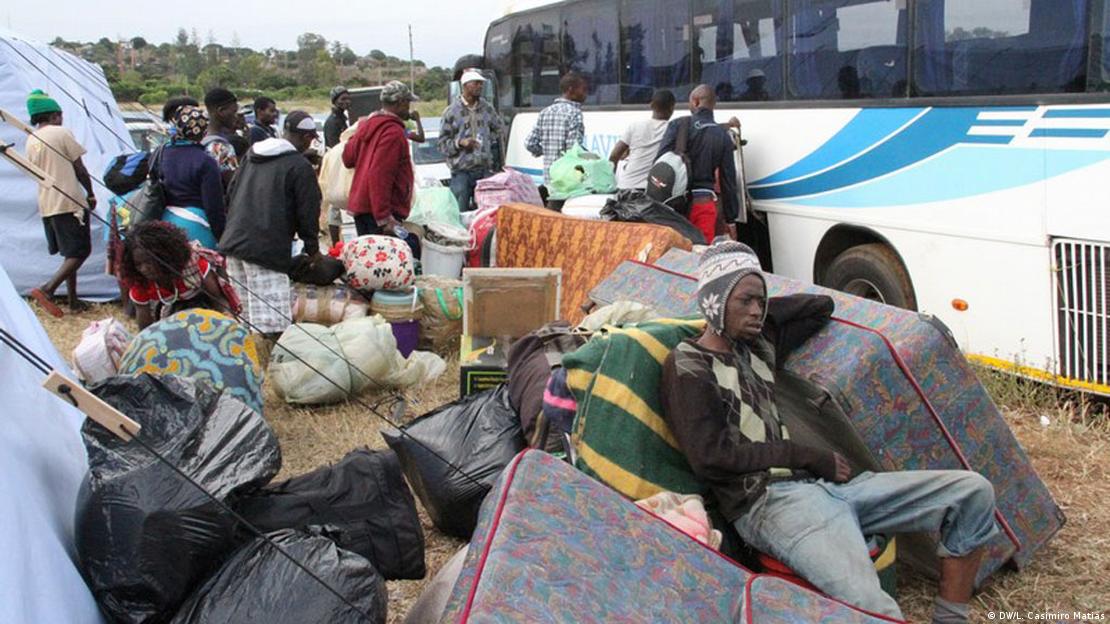
In the past, Zimbabwe has sent buses to return citizens from South AfricaI
mage: DW/L. Casimiro Matias

Several African countries organized evacuations for those wanting to leave South Africa during these turbulent times: Neighboring Zimbabwe sent buses to bring its nationals home, while Malawi and Mozambique also assisted returnees with logistics.

2019: Nigerians targeted amid diplomatic fallout


In September 2019, violence swept through parts of Johannesburg and Pretoria again.

According to South African police figures cited by Reuters, at least 12 people were killed, and hundreds of businesses looted or destroyed. Nigeria evacuated more than 500 of its citizens from South Africa.

The attacks triggered a diplomatic crisis across Africa, with Nigeria even temporarily boycotting the World Economic Forum on Africa hosted in Cape Town.

South African President Cyril Ramaphosa condemned the violence, saying that there "is no justification for any South African to attack people from other countries."

Yet critics again argued that the government continued to frame the unrest as being rooted in crime rather than calling it out as xenophobia.


2021-2022: The rise of Operation Dudula

The anti-migrant group Operation Dudula emerged in the township of Soweto in 2021, and quickly garnered national attention for its ambitions.

The group organized marches against undocumented migrants, conducted raids on businesses and accused foreigners of taking jobs from South Africans while overburdening public services.

Human rights organizations accused Operation Dudala of fueling vigilantism and xenophobia, as well as blocking foreign nationals from accessing healthcare, schools, and informal trading spaces.


Zandile Dabula, the leader of Operation Dudula, told DW at the time: "The escalating crime, drug trafficking, human trafficking, that's bad," linking these phenomena to foreign nationals while insisting that the group only sought to fight irregular immigration and crime.

The group later even registered as a political party ahead of the 2024 elections, and has been growing since, alongside other anti-migrant movements.
2024-2026: 'South Africans are not xenophobic'

Tensions around immigration have remained high, particularly against the backdrop of South Africa's escalating economic crisis: South Africa's official unemployment rate stood at nearly 33% in the first quarter of 2025, according to Statistics South Africa, while youth unemployment remained above 45%.

Fresh outbreaks of violence in 2026 have triggered protests from leaders in Ghana and Nigeria, with a renewed criticism of South Africa's handling of xenophobia. Nigeria's Foreign Minister Bianca Odumegwu-Ojukwu stressed: "Nigerian lives and businesses in SA must not continue to be put at risk.”

Nigeria has meanwhile expanded its official response to the latest attacks by announcing a "voluntary repatriation” program for its nationals after two were killed as part of the recurring violence.

South Africa's presidential spokesperson Vincent Magwenya has rejected claims that widespread xenophobia has resurfaced in the country, stating that "South Africans are not xenophobic."

He has said that what is being observed are merely "pockets of protest, which is permissible within our constitutional framework."


Why are foreigners being targeted again?


Around the world, migrants are frequently cast as scapegoats for deeper structural problems, reaching from inequality and corruption to weak economic growth and state failure.

In South Africa, this scapegoating has overwhelmingly targeted Black and African migrants, who make up more than two-thirds of South Africa's estimated 3 million foreign residents.

Many observers warn that the country's problem with xenophobic violence has become cyclical, resurfacing whenever economic or political pressures intensify and revealing how quickly hardship can be turned into hostility.

Edited by: Sertan Sanderson

Silja Fröhlich is a German journalist and TV