Showing posts sorted by date for query YELLOW PERIL. Sort by relevance Show all posts

Monday, August 25, 2025


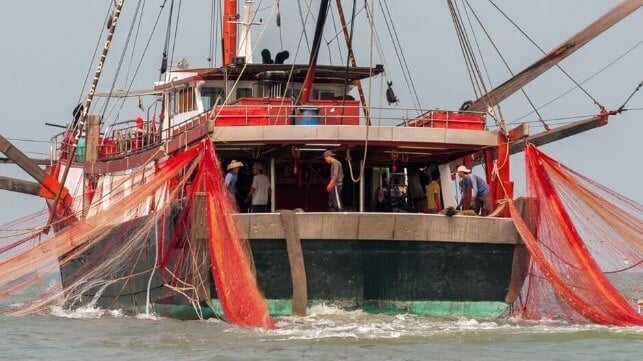
Ghana Adopts a New Fisheries Law to Curb IUU Fishing

Trawler
Winhorse / iStock

Published Aug 24, 2025 3:59 PM by The Maritime Executive


In the past decade, the scourge of IUU (illegal, unregulated and unreported) fishing in West Africa has grown into a billion-dollar trade, leaving local livelihoods in peril. Poor fisheries governance has seen industrial trawlers encroach in areas designated for artisanal fishermen, which has become a major threat for small pelagic fish. In Ghana for instance, IUU fishing has been estimated to cost the country between $14.4 million and $23.7 million annually. In 2021, the European Union issued a yellow card to Ghana, a warning that the country could lose access to the lucrative European seafood market unless IUU fishing is tackled.

It is in this context that Ghana last week adopted a new fisheries and aquaculture law. The legislation was passed by the parliament in July and was signed into law by President John Dramani Mahama on August 19.

Ghana’s Ministry of Fisheries and Aquaculture said that the landmark law is part of a wider government effort to avoid sanctions in key global seafood markets. “The law is crucial in maintaining Ghana’s access to global markets, where seafood has become one of the country’s fastest-growing non-traditional exports,” noted the Ministry. Recent data from the Ministry indicate that Ghana’s seafood exports have reached more than $425 million annually.

The campaign group Environmental Justice Foundation (EJF), which has been tracking IUU fishing in Ghana, also lauded the law as a bold step of leadership in the region. The Act safeguards livelihoods of over 200,000 small-scale fishers and millions of Ghanaians who depend on artisanal fisheries.

A notable reform by the new law is the expansion of the inshore exclusion zone (IEZ), doubling in size from 6 to 12 nautical miles off the coast. The IEZ allows local fishermen space to fish without competition from industrial trawlers. In the past few years, traditional fishers have faced immense competition from Chinese-backed trawlers, especially with the rise of ‘saiko trade’ in Ghana’s fishing industry. Saiko trade was formerly a traditional barter trade system where bycatch was exchanged for farm produce. The trade later transformed, and now involves industrial trawlers transferring frozen stocks of bycatch to small canoe operators for onward sale.

The practice is fueling depletion of small pelagics such sardinella, traditionally caught by artisanal fishermen and a staple food for local communities. In the past 15 years, average annual income per artisanal canoe has dropped by as much as 40 percent, according to data by EJF. In addition, over 90 percent of small-scale fishers have reported declining catches.

Early this year, Ghana attempted to rein in the industrial trawlers, a move that saw the government suspend fishing licenses of four Chinese vessels. The vessels were accused of unauthorized transshipment at sea (saiko trading) among other violations. The four vessels include Meng Xin 10, Florence 2, Long Xiang 607 and Long Xiang 608. The fishing ban will last for one year.

Saturday, August 09, 2025

The Treaty of Lausanne still casts a long shadow


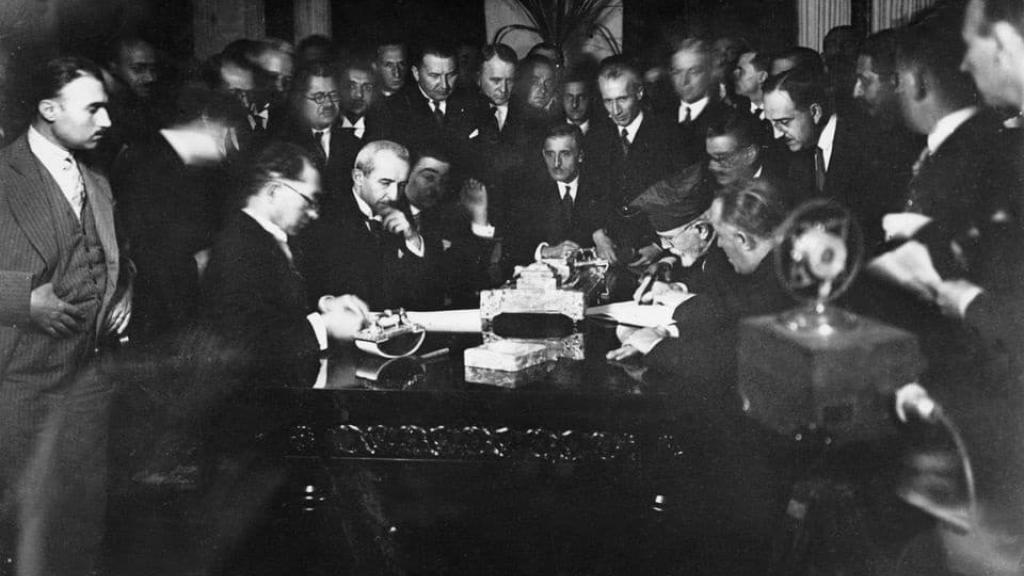
treaty signing

In November 1922, representatives of the World War I victors met with their Turkish counterparts in the Swiss lakeside city of Lausanne. They were tasked with negotiating a diplomatic settlement to replace the Treaty of Sèvres (1920), which had never been ratified. Australia, which had no independent foreign policy at the time, was party to the Treaty by virtue of its status as a member of the British Empire.

On July 24, 1923, the two sides signed the Treaty of Peace with Turkey, commonly known as the Treaty of Lausanne. This ratified the new boundaries of the Turkish state, granted amnesty for all crimes against humanity committed by the Ottoman state since 1914, and agreed to “mutual ethnic cleansing” between Greece and Turkey.

Significantly, it dropped Kurdish self-determination, as promised in the earlier Treaty of Sèvres. Although Turkey agreed to “assure full and complete protection of life and liberty to all inhabitants of Turkey without distinction of birth, nationality, language, race or religion,” the promise proved hollow. Immediately after the proclamation of the Republic of Turkey, President Ataturk banned the Kurdish language and afterwards continued the Young Turk policies of forced assimilation, even to the point of genocide. The leaders of the West, Australia included, have been like the Three Wise Monkeys; seeing, hearing, and speaking no evil about the crimes of the Turkish state; indeed even branding legitimate Kurdish resistance as “terrorism”.

So, what were the origins of the brutal ideology of the new state and why did the Allies renege of their promises? To understand the first point, we must step back in time to developments in the declining years of the Ottoman Empire. The empire had once been powerful and dynamic. Following the conquest of Constantinople in 1453, it expanded enormously, spreading through what is present day Iraq and Syria, down the Red Sea Coast to include Mecca, across Egypt and the North African littoral, and engulfing the Balkan Peninsula in southeastern Europe, including today’s Greece, Albania, Bulgaria, and Serbia. Between 1541 and 1686, the Ottomans ruled Hungary and their further expansion was only halted by the lifting of the siege of Vienna in 1683.

Although the empire was a byword for barbarism in Christian Europe, we have to be careful of “orientalist” stereotypes. The Christian kingdoms of the time were no exemplars of what we call human rights today. Muslim Turks were dominant but the empire practised what, at risk of anachronism, we might call a rough form of multiculturalism. The empire was home to a bewildering patchwork of peoples, often living cheek-by-jowl, speaking many languages, and practising religions. Non-Turks, Jews, and Christians could and did rise to important administrative, business and military positions. In 1492, when Ferdinand and Isabella expelled the Spanish Jews from Iberia, they found a safe haven in the Ottoman city of Salonika, where they thrived until they were deported to the Nazi death camps in 1944.

It is a truism that empires rise, decline and fall. Thus it was with the Ottoman Empire, which in the 19th century was widely known as “the sick man of Europe.” In 1832, Greece won its independence and nationalist revolts followed throughout the Balkans, creating waves of Muslim refugees. In 1830, France annexed Algeria and in 1882 Egypt was lost to Britain. Naturally, educated Ottoman citizens resented the empire’s decay and wondered how it might be arrested. They turned to Western Europe for ideas of how the system might be reformed.

By the late years of the 19th century, Ottoman patriots came to see the autocratic rule of the Sultan as a barrier to progress and looked towards British-style constitutional monarchy as a check on absolutism. They were also drawn to European ideas of science, civic reform and political liberalism. One secretive group emerged as the Committee for Union and Progress. Although they became more widely known as the Young Turks, they were initially reflective of the empire’s ethnic diversity. Their ideas brought them into conflict with traditionalist supporters of the autocratic status quo.

In 1908, the Young Turks seized power under the battle cry of LIBERTY! They aimed to create a powerful, rationally organised state protected by a modern military, with guarantees of democratic rights. They soon forgot their promises and succumbed to the European idea of the “ethnically pure” nation state. Their Ottoman patriotism had degenerated into a narrow Turkish nationalism, accompanied by dictatorial intolerance and brutality. The heartlands of the empire in Anatolia and European Turkey would be “purified” of non-Turkish languages and cultures. Young Turk paranoia was increased by further loss of territory in the Balkan Wars of 1912.

Before the Young Turks went to war on the side of Germany and Austria-Hungary in 1914, they began an ambitious programme of “ethnic social engineering”. Non-Turks would be permitted to make up no more than 5–10% of any “Turkish” town or district. This would be achieved by population transfers: Kurds, Armenians, Greeks and others would be forced out and Turks would be moved in. Or Kurds would be forcibly assimilated. The Young Turks were also planning mass murder: “disloyal” elements would be exterminated.

The day after the Allied landings in Gallipoli, the Young Turks began the Armenian genocide. It was premeditated. Armenian units in the Ottoman army had been disarmed and dispersed. Armenian civilians who were not immediately killed were sent on death marches into the Syrian desert. It is likely that as many as 1.4 million Armenians and 500,000 Greeks, together with tens of thousands of Assyrians, were murdered in what was the first genocide of the 20th century. At the same time, the deportations and forced assimilation of Kurds proceeded apace.

Unfortunately for the Young Turks, they had chosen the losing side in World War I. They were forced to agree to Allied occupation of Istanbul and the Bosphorus, and their leaders either fled or were put on trial for their crimes. The Empire lost further vast territories. Under the terms of the Sykes-Picot agreement of 1916, much of the Ottoman’s Arab majority vilayets were handed over to Britain and France, and the Muslim holy cities of Medina and Mecca were lost forever.

The question remained of what would become of Anatolia and the rump European portions of the empire adjacent to Istanbul. The US President, Woodrow Wilson, proposed that,

The Turkish portions of the present Ottoman Empire should be assured of a secure sovereignty but the other nationalities which are now under Turkish rule should be assured an undoubted security of life and an absolutely unmolested opportunity of autonomous development… (Point 14 of Wilson’s Fourteen Point proposal for the post-war peace treaties.)

The other Allied powers had different ideas. Under the Treaty of London in 1915, Italy had been promised a share of the Turkish islands and the Anatolian mainland. They had no reasonable claim, but Greece could point to the large Greek majorities in significant areas of western Anatolia as justification for their claims in that region. For their own reasons, the Allies were also sympathetic at the time to Kurdish aspirations for their own state in eastern Anatolia, and for the expansion of an independent Armenia.

On August 10, 1920, the powerless Turkish government signed the Treaty of Sèvres. The Treaty triggered widespread anger in Turkey and across the colonial and Muslim world. It did not embody the Wilsonian principles of self-determination, except in the case of the Kurds. Kurdish representatives at Sèvres successfully argued for a separate Kurdish state. Article 64 spelled this out:

If within one year from the coming into force of the present Treaty the Kurdish peoples within the areas defined in Article 62 shall address themselves to the Council of the League of Nations in such a manner as to show that a majority of the population of these areas desires independence from Turkey, and if the Council then considers that these peoples are capable of such independence and recommends that it should be granted to them, Turkey hereby agrees to execute such a recommendation, and to renounce all rights and title over these areas.

The Treaty was never ratified. Turkish nationalists, led by Mustapha Kemal — later known as Ataturk, the Father of Turks — were determined to resist and carve out a Turkish ethno-state. War broke out between the Turks and the Greeks and their Allied supporters. The conflict, known to the Turks as the War of Independence, was fought with horrific brutality. For instance, the Aegean city of Smyrna, today’s Izmir, was burned to the ground and the Greek population put to the sword. Both sides committed appalling atrocities. Some Kurds fought alongside the Turks, but others stood aside or pushed for their own interests.

The Western Allies recognised the Turkish victory and Turkish claims by signing the Treaty of Lausanne. Three months later, the Ottoman parliament dissolved itself and proclaimed the Republic of Turkey. The Treaty gave Turkey most of what it wanted. The current boundaries of the new state were ratified. The Allies gave a blanket amnesty for all crimes committed by the Turkish state right back to 1914, including the Armenian, Greek and Assyrian genocides.

Moreover, the Treaty approved the forced population transfers between Turkey and Greece, and Turkey and Bulgaria. In what we may fairly call mutual ethnic cleansing, some 1.5 million Greeks and 500,000 Turks were forced out of their homelands. Ironically, many expelled “Greeks” spoke Turkish, and many deported “Turks” spoke Greek. Indeed, cinemas in the Greek city of Thessaloniki — the former Ottoman Salonika — regularly showed Turkish films right up to the 1960s as a result of the deportations. (See Bruce Clark, Twice a Stranger: How Mass Expulsion Forged Modern Greece and Turkey.)

Ataturk was determined that the new Republic would be a state ruled by and for ethnic Turks. Non-Turkish populations would be assimilated to the Turkish nation, forcibly if necessary, for despite the forced transfers and earlier exterminations, hundreds of thousands of Armenians, Greeks and Assyrians remained within the Republic’s boundaries. Kurds made up as much as 20% of the population, but the new state denied their existence: they were “Mountain Turks,” and their language and customs were banned from the outset.

Incredibly, the Kurds have resisted Turkification to this day, often rising up to resist their oppressors. The state has responded with great brutality, as in the genocide at Dersim in 1937-38. Military operations and mass deportations have left much of eastern Anatolia depopulated and economically underdeveloped. The policy of cultural genocide even flouts the provisions of the Treaty of Lausanne, which explicitly bound Turkey to respect other languages and cultures.

Sadly, the world has ignored the history of criminal abuse that followed Lausanne.

Back at the time of the signing of the Treaty, Turkey was something of a pariah. It had fought on the side of the defeated Central Powers and there was some awareness that it had committed horrendous crimes against humanity. The Allies worried that the Republic might seek an alliance with the Soviet Union and were prepared to ignore the obvious flouting of the terms of Lausanne if it kept Turkey within the Western fold. Britain and France also wanted a secure boundary between Turkey and their new oil-rich possessions in Iraq and Syria. When Turkey joined NATO in 1952, the Allies were even more prepared to ignore the abuses.

Turkey has enjoyed a strangely sympathetic press here in Australia, and this is bound up with the myth that Australia “became a nation” in 1915 when the ANZACs landed at Gallipoli. In fact, they were part of a British invasion force and Australia was not consulted when Britain went to war.

Australian attitudes to its foes in the many wars it has fought have seldom been cordial or respectful. The Germans were bloodthirsty “Huns.” The Japanese were scarcely human “Nips” or worse, part of a dreaded “yellow peril.”

In contrast, the Turks are seen as “the gallant enemy” — “Johnny Turk” who fought the ANZACs so valiantly at Gallipoli. Thousands of Australians regularly make a pilgrimage to Gallipoli to mark the anniversary of the Allied landings 110 years ago, including Defence Minister Richard Marles, who went last year as a guest of the Turkish government. Ataturk, despite his crimes against humanity, is venerated as a super-hero worthy of the title of Father of Turks. Thus, many accept without evidence that Ataturk wrote the following words for his Interior Minister, Sukru Kaya, to use in a speech at Canakkale in 1934:

Those heroes that shed their blood and lost their lives ... You are now lying in the soil of a friendly country. Therefore rest in peace. There is no difference between the Johnnies and the Mehmets to us where they lie side by side in this country of ours. You, the mothers, who sent their sons from faraway countries, wipe away your tears. Your sons are now lying in our bosom and are in peace. After having lost their lives on this land, they have become our sons as well.

In primary school and regularly thereafter, Australian kids are drilled in the national myth, with Ataturk’s alleged words seen as holy writ. We were never told that the Armenian genocide began the day after the landing at Suvla Bay. Even less is said about Kaya’s involvement in the genocide and the subsequent crimes against the Kurds. It is worth remembering that John Howard, whose government first listed the Kurdistan Workers’ Party (PKK) as a terrorist organisation, has been a key promoter of the ANZAC myth as part of the sanitisation of Australian colonial history. The two matters are closely intertwined and the Treaty of Lausanne continues to cast a long shadow.

This is an edited transcript of a speech given by John Tuly to the conference, “Treaty of Lausanne - Partition, Denial, Massacre, Kurdish Struggle & the Future of Kurdistan” on July 24. John Tully is honorary professor at the College of Arts and Education at Victoria University in Melbourne, Australia.


Imperialism, repression and resistance: The long war against Kurds in Iran


For most of the media, the United States and Israel’s war on Iran has become last month’s story, but this story is far from over, and has many prequels. Like other conflicts and wars in the region, Iran’s troubled relations with the US and Israel — and also with the Iranian Kurds — have their roots in the poisonous soil of European imperialism.

The border between Rojehlat (eastern or Iranian Kurdistan) and the other parts of Kurdistan has hardly changed since the 17th century, but the division of the rest of Kurdistan by the 1923 Treaty of Lausanne, and the treaty’s failure to recognise a Kurdish state, weakened the position of Kurds everywhere. While Lausanne followed the imperial conflict of World War I, World War II — in many ways a continuation of the first — was followed by the creation of Israel and international recognition of the Zionists’ settler-colonial project.

World War I helped catalyse the Russian Revolution and subsequent global competition between the forces of Communism and capitalist imperialism. World War II allowed this to transform into the Cold War between East and West. In both periods, as still today, an overriding mission of Western governments has been the crushing of any emergence of communism, or even socialism.

Their geographical separation from World War II, and relatively late entry into the conflict, gave the US economic, political and military dominance, and enabled the growth of the US’s military-industrial complex, whose power President Dwight Eisenhower warned about in his farewell address in 1961. This power has been used to intervene in other countries to prevent the emergence of left forces and unseat governments out of line with US capitalist interests.

During the 19th century, Iran fell under increasing economic dominance by European imperial powers. Iran’s leaders gave away economic concessions in exchange for short-term gains, and early last century, the British Anglo Persian Oil Company took control of oil fields in southwest Iran.

In 1953, it was Iran’s turn to undergo a CIA regime change — a joint operation organised by the US and the old imperial power, Britain. Iran’s parliament had voted to nationalise the oil industry — a challenge to Western commercial interests that was deemed intolerable. Prime Minister Mohamad Mosaddegh was removed in a coup, and power was consolidated under the Shah, Mohammad Reza Pahlavi, who had first been put in control by Britain and Russia during the war, when his father had refused to let the Allies use the trans-Iranian railway.

Pahlavi maintained his rule through his notorious secret police, the Savak, but, by the 1970s, economic hardship and inequality were becoming increasingly unbearable. In 1978–79, a mass movement strengthened by workers — especially oil workers — crippled the country and forced Pahlavi to flee.

The rise of the Islamic Republic

Support for the left was surging, and workers’ strike committees were creating kernels of alternative organisation when Ayatollah Ruhollah Khomeini returned from exile in France. Khomeini was able to appeal to the more conservative elements, especially small business owners and the rural or recently rural poor, while neutralising potential opposition through superficially progressive rhetoric.

One by one, Khomeini crushed those opposing him — secular leftists, Islamic leftists, women, groups seeking national autonomy. He had no hesitation in carrying out mass assassinations to impose his version of Islamic rule and himself as supreme leader. He was able to do this because he initially had the West’s backing — as a safe anti-left alternative — and because many left party leaders failed to understand the threat he posed, casting him as a “progressive bourgeois” who they should work with rather than oppose.

In November 1979, Iranian student activists took over the US embassy in Tehran, taking 66 US citizens hostage and demanding the extradition of Pahlavi, who had gone to the US for cancer treatment. Fifty-two of the hostages were not released until January 1981. Khomeini supported the hostage-taking, calling the US “the Great Satan”. 

In 1980, the US cut diplomatic relations with Iran and implemented sanctions in response to the hostage taking, which were subsequently increased several times, with drastic impacts on people’s living standards. During the 1980s, the US gave support to Iraq in the Iran-Iraq War, and, in 1984, President Ronald Reagan designated Iran a “state sponsor of terror” following attacks on the US military in Lebanon by the Iranian-backed Hezbollah.

With the US’s “war on terror” following 9/11, President George Bush declared Iran to be part of an “axis of evil”, alongside Iraq and North Korea. Meanwhile, fears that Iran was developing nuclear weapons led to more sanctions by the US, EU and United Nations. In 2015, Iran agreed to a deal whereby they would limit nuclear development and submit to regular inspections in exchange for the lifting of these sanctions. However, in 2018, US President Donald Trump pulled out of the agreement and reinstated sanctions.

In the early summer of 2019, explosions blamed on Iran hit oil tankers in the Gulf of Oman, and Iran shot down a US drone. The next year, the US assassinated Iranian general Qasem Soleimani, head of Iran’s elite Quds Force.

Under Pahlavi, relations between Iran and Israel had been good, reflecting shared alignment with the US and against pan-Arabism. Israel helped develop Iran’s military and secret service. Relations changed with the revolution, when Khomeini declared Israel an enemy of Islam and handed the Israeli embassy to the Palestine Liberation Organisation (PLO) — though the Iran-Iraq war forced Iran to continue to rely on buying Israeli weapons for some years.

Iran’s support for Palestinians was both ideological — as fellow Muslims — and strategic. It wanted to win support as defenders of Islam, and to distract attention from continued economic hardship. After Israel invaded Lebanon in 1982 — a time when 11 members of the Kurdistan Workers Party died fighting alongside the PLO — Iran helped organise Lebanese Shia and create Hezbollah.

The end of the Cold War, and the defeat of Iraq in the Gulf War, left Iran and Israel competing for regional dominance under the US, the one remaining superpower.

Kurdish resistance

Kurds — who make up 12–15% of Iran’s population — suffered under the ethnic nationalism of Pahlavi and were active in the revolution. They fought for autonomy, not to replace one autocratic centralised regime with another. The Kurdish provinces held out the longest against Khomeini’s Islamic Republic.

Kurdish resistance was largely led by the leftist Kurdish Democratic Party of Iran (KDPI) and Komola, the Society of the Revolutionary Toilers of Iranian Kurdistan. In August 1980, Khomeini declared a jihad against the “infidel” Kurds, licensing extreme brutality by the regime’s Islamic Revolutionary Guard Corps. By the end of 1981, Kurdish resistance was largely defeated, with small-scale fighting continuing into 1983.

Kurdish struggles for rights and freedom have become entangled in rivalries between regional powers, exploiting these divisions and being exploited by them. In the Iran-Iraq war, support given to Iran by Kurds persecuted by the Iraqi government helped bring the full wrath of Saddam Hussein down on Iraqi Kurdish towns and villages, including Halabja, where Hussein’s military massacred 5000 people in a chemical attack. (Palestinian reverence for Hussein as a supporter of their cause has undoubtedly complicated relations with the Kurds.)

The Islamic Republic proved to be every bit as racist towards non-Persians as Pahlavi had been, as well as prejudiced against Sunnis, which most Kurds are. Rather than attempt to win Kurdish support, the government has kept control over the Kurdish regions through economic deprivation and pervasive securitisation.

Overt political opposition of any kind is impossible in Iran, where even campaigning on ecological issues can land you in prison, and the remnants of the KDPI and Komola moved across the border with their families to refugee camps in Iraq.

The Kurdistan Free Life Party (PJAK) was founded in 2004 to propagate the ideas of Abdullah Öcalan in Rojhelat, but Öcalan’s influence there was already strong, as demonstrated by the mass protests at the time of his capture in 1999. PJAK guerrillas are based in the border mountains.

Anti-regime protests

Iran under the mullahs [religious clerics] has seen several waves of mass protest — against lack of freedoms, poor economic conditions and lack of vital services — each put down with extreme violence.

In 2019, anti-government uprisings were taking place in over two-thirds of Iranian provinces when the government unleashed its security forces, leaving 1500 people dead. Between then and the 2022 protests triggered by the government killing of Jina Amini for a misarranged headscarf, there were mass strikes by groups struggling to survive on starvation wages and pensions, and protests by farmers unable to get the water needed for their crops, as well as protests for women’s rights. More recently, there have been more protests about the lack of clean water.

The Iranian regime demands the total subservience of women, and also takes every opportunity to oppress its Kurdish minority. Of the many communities that make up the population of Iran, Kurds have been left with the least to lose, and, despite strongly patriarchal tribal traditions, many Iranian Kurds have also been exposed to the Kurdish freedom movement and its focus on women’s freedom.

The protests — which developed into an uprising — were especially strong in Kurdish areas and among the Baluch minority at the other end of the country. The Kurdish movement’s slogan of Jin Jiyan Azadi — Women Life Freedom — became the call of the resistance, alongside anti-regime slogans such as “Death to the Dictator”.

People rose up in resistance in every province, and there was tremendous support among students. But outside the Kurdish regions, the uprising failed to achieve the mass mobilisation of workers needed to stop the functioning of the economy and bring down the government. The tight grip of the Iranian Revolutionary Guard Corps on every aspect of life has made this much harder to achieve than it was in 1979, and reports of brave and inspiring resistance began to be overtaken by accounts of brutal and sadistic state violence.

Last September, two years on from the uprising, Amnesty International reported that “people in Iran continue to endure the devastating consequences of the authorities’ brutal crackdown” and that “authorities have also further escalated their assault on human rights, waging a war on women and girls”. Hengaw Organisation for Human Rights reported that 143 Kurds lost their lives in the uprising.

Although the Iranian Kurdish parties outlawed in Iraq did not intervene practically, they were attacked by Iranian missiles and drones, and, under Iranian pressure, Iraq has forced them to disarm and relocate away from the border. This has not impacted PJAK, whose bases are hidden in the mountains.

Shifting balance of forces in the Middle East

This last year has seen seismic changes in the political balance in the Middle East, with Israel, armed and backed by the US and their Western friends, gaining hegemonic power over an increasing area at the expense of Iran — and Russia. Besides their genocidal attack on Gaza and Iran-backed Hamas, Israel crippled Hezbollah. This seriously weakened the Iranian presence in Syria. With Russia — President Assad’s other backer — distracted by war in Ukraine, Ahmed al-Sharaa and his Hayat Tahrir al-Sham were able to take control in Damascus.

There is evidence that Britain and the US supported this takeover, and they have been quick to rebrand al-Sharaa from “terrorist” to welcomed head of state. Israel took advantage of the change of regime in Syria to bomb the country’s military bases and ensure that it will never be able to challenge Israeli dominance.

For many years, Israel has carried out limited attacks against Iran, including assassinations and sabotage, often targeting its nuclear program. With Iran’s regional allies, Hamas, Hezbollah and Assad, weakened or vanquished, the Zionist state is determined to consolidate its dominance.

On June 13, it launched a well-prepared attack, which included the assassination of 30 generals and nine nuclear scientists, as well as attacks on Iran’s nuclear facilities and military resources. This was framed as preventing the imminent development of an Iranian nuclear bomb, but Israel has been making the same claim that Iran is on the threshold of achieving a bomb for over a decade.

At the time the attack took place, the US was attempting to negotiate a new deal that would restrict and monitor Iran’s nuclear developments in exchange for lifting sanctions. As Israel had planned, the US stopped their negotiations and followed Israel with an attack of their own, employing weapons that could penetrate Iran’s underground facilities, which Israel did not have the means to do themselves. It is thought that Israel hoped to draw the US into a full regime change war, but the US made clear that their intervention was a one off — at least for the time being.

For Iranian Kurds, this 12-day war brought brief hopes that they might be able to use the chaos to build democratic autonomy — as in Syria — alongside fears that, like other attempts at regime change from outside, this would end in years of violence and instability. PJAK explained that what was happening was “a war of power and conflicting interests, not a war of liberation for peoples and nations”. More immediate concerns that the Iranian regime would take out their anger on their own minorities and political opponents proved well founded.

Post-war repression

A month after the ceasefire, Hengaw reported that since the beginning of the war at least 1800 people had been arrested, 500 of them Kurds, and that most had been accused of espionage for Israel. While Israel clearly has many spies in Iran, there is no reason to believe that these are the people being arrested, as this is used as a convenient charge for destroying government opponents. Six people (including three Kurds) have already been executed for espionage. 

At least 29 civilians were killed by government forces during checkpoint raids, and there has been increased pressure on political prisoners, heavy sentences — including death — for political activists and increasing use of the death penalty.

Israel’s attack was the result of years of planning and demonstrated how deeply Mossad had infiltrated into Iran. However, it is unclear how much damage has been done to Iran’s ability to produce a nuclear weapon, and it can be argued that it now has a much stronger incentive to do so.

Israel was shocked by the extent of the Iranian response and the damage it inflicted in Tel Aviv. But even after agreeing to a ceasefire, Israel made clear that, as in Lebanon, it has no intention of abiding by it and will cut Iran down to size whenever it wants. Its defence minister stated, “I have instructed the [Israel Defence Forces] to prepare an enforcement plan against Iran, which includes maintaining Israel’s air superiority, preventing the advancement of nuclear capabilities and missile production, and responding to Iran’s support for terrorist activities against the State of Israel.” 

Trump stated just this week that if Iran rebuilds their nuclear facilities, “we’ll wipe it out faster than you can wave your finger at it”.

Meanwhile, plans for a “Zangezur Corridor” could prove a trigger for new conflict in the region. This corridor would link (pro-Israel) Azerbaijan to Azerbaijan’s Nakhichevan exclave — and hence Turkey — through a slice of Armenian territory along the border with Iran. Washington has proposed that the US should build and manage it. But what is seen as an east-west link by Azerbaijan and Turkey is regarded as a barrier to north-south trade by Iran and Russia, and Iran has moved its forces to the border.

There is no end in sight for further fighting, both across Iran’s borders and internally. On July 19, an Iranian drone killed a PJAK fighter in Iraq. PJAK retaliated by killing three members of Iran’s Revolutionary Guard Corps. 

Meanwhile, alongside the continuing crackdown, Kurds in Iran have been mourning the deaths of three environmental activists who died fighting wildfires because the Iranian government has no interest in stopping fires destroying Kurdish lands.

This is an edited transcript of a speech given by Sarah Glynn to a Green Left forum, “The Kurds and the Israeli-US war on Iran” on August 1.  Sarah Glynn is Strasbourg-based writer for Green Left, a socialist activist and co-author of several books including Climate Change is a Class Issue


Thursday, July 03, 2025


Neofascism and climate change


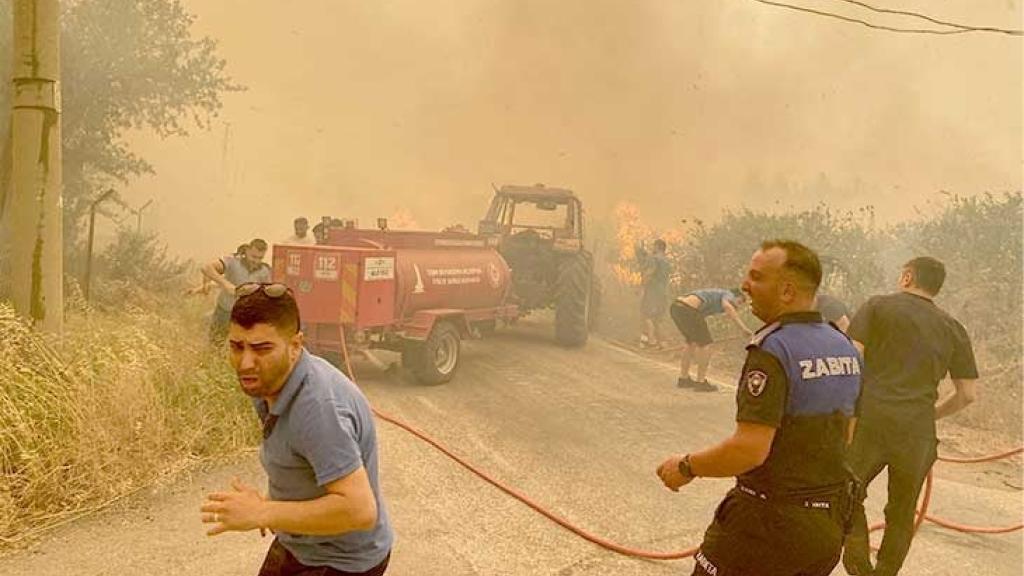
smoke bushfire

First published in Arabic at Al-Quds al-Arabi. Translation from Gilbert Achcar's blog.

As a record-breaking heat wave engulfs much of Europe and North America, and as climate change and global warming — against which environmental scientists have long warned, calling for urgent action before it’s too late — are increasingly confirmed, at this alarming juncture for the future of the planet and its human and animal inhabitants, it is worth asking what is driving neofascist movements to question, to varying degrees, the reality of climate change, or at least its connection to human behaviour. We have previously noted that “Neofascism is pushing the world towards the abyss with the blatant hostility of most of its factions to indispensable environmental measures, thus exacerbating the environmental peril, especially when neofascism has taken over the reins of power over the most polluting people in the world proportionally to its number, namely the people of the United States.” (“The age of neofascism and its distinctive features”).

This pattern of denying the seriousness of climate change is neither natural nor intuitively fathomable, unlike other characteristics of neofascism, such as nationalism, ethnicism, racism, sexism, and extreme hostility to emancipatory social values. What, then, drives neofascist movements to deny the increasingly obvious reality and, most importantly, to oppose policies aimed at combating climate change in an attempt to mitigate it and prevent the catastrophe from worsening? Researchers have identified three main factors that explain this pattern. One relates to the far right’s traditional ideological arsenal, while the other two relate to the two class poles that determine neofascist behaviour: the broad social base and the narrow economic elite, whose support they seek to garner.

The first factor is based on ultranationalism, which is often reflected in “sovereigntist” and “isolationist” policies that reject any international agreements limiting the freedom of the nation-state to determine its economic and other policies. This behaviour reaches its most absurd level when it comes from the country with the greatest influence in shaping international agreements and policies, namely the United States. We have seen how Donald Trump justified Washington’s withdrawal from the Paris Climate Accords, as if they stemmed from some collusion of the rest of the world to limit America’s freedom to develop its economy, particularly in exploiting its natural resources of fossil fuels, i.e. coal, oil, and gas. The neofascist rejection of international environmental agreements thus falls within a comprehensive rejection of any rules that, from the ultranationalist perspective, limit national sovereignty.

The second factor consists in tickling the feelings of the social base whose electoral support neofascists seek to gain. They exploit the discontent of some lower-income categories with the lifestyle changes and cost required in fighting climate change. This discontent is certainly magnified when neoliberal governments seek to make categories with modest incomes bear the cost of the fight, rather than imposing this cost on big capital, the primary culprit behind environmentally harmful pollution. A striking example of such an endeavour is the additional tax that French President Emmanuel Macron’s government attempted to impose in 2018 on vehicle fuel, a measure that would have mostly impacted the lower categories of car users. This attempt sparked one of the largest waves of popular protest in France this century, known as the Yellow Vests movement. One of the movement’s demands against the government was to impose a tax on the largest fortunes, rather than an additional burden on a large segment of the population.

Here we come to the third factor explaining the neofascist position on climate change. One of the well-known characteristics of old fascism is that it sought to gain the support of big capital despite its demagogic “populist” rhetoric, which claimed to champion the interests of the lower social classes and, in some cases, even claimed “socialism” — as in the case of German Nazism whose official name bore that label. The collusion between fascists and big capital stemmed primarily from the latter’s fear of the rise of the labour movement, with its social-democratic and communist wings, amid the economic crisis experienced during the interwar years of the last century — the years of the original fascist era.

Today, however, with the labour movement significantly weakened by the neoliberal onslaught and technological change, big capital’s motivation for colluding with neofascist movements is not defensive, but offensive. We are faced with a type of big capital that seeks to shield its monopolistic growth at the expense of small and medium capital. To do so, it needs to get rid of the restrictions previously imposed to limit monopolies, inspired by an economic liberalism committed to preserving competition as the primary driver of capitalist development. From this perspective, environmental policies are seen as restrictions imposed on the freedom of capital, a freedom involving an intrinsic contradiction, as complete, unrestricted freedom inevitably leads to the emergence of monopolies that undermine that same freedom.

The most prominent example of this is Peter Thiel, one of the leading US capitalists and the foremost proponent and supporter of neofascism among them. Thiel was one of the most ardent supporters of Donald Trump’s presidential campaign and is also known to be the political godfather of Vice President J.D. Vance, the quasi-official spokesperson of neofascist ideology in the Trump administration. Thiel shamelessly declares his preference for monopolies, arguing that they allow for unfettered technological progress through unlimited enrichment, while opposing environmental policies on the grounds that they limit international competition! He shares this view with holders of US monopolies in advanced technologies and their applications in commerce and social media, who supported Trump’s recent campaign and are betting on him to combat the restrictions and taxes that European governments seek to impose on them. Trump has placed this task at the top of his agenda in the trade war that he has declared against the rest of the world.

Saturday, May 17, 2025

Danish Politiken Smears China Based on CIA,

US, EU and NATO Funded Sources


And of course, they don’t tell their readers


In Danish here for Danish readers.

The development – or decline – of the Danish daily newspaper Politiken as a quality newspaper in the field of foreign policy pains me. Allow me a personal, somewhat nostalgic introduction. I wrote frequently for Politiken from 1971 to 1994. As a 20-year-old sociology student, I was naturally proud to be published in what was then a prestigious, liberal media outlet, which was initially shaped by Hørup’s anti-militarism and cultural radicalism.

In Denmark, there was a – albeit quite traditional but serious and multifaceted – discussion about the state of the world. There was actually quite a lot of room for different opinions, and it was natural that many opinions were expressed and met in the Danish media – creating the social debate that is essential for security, peace and democracy. There were debates on security policy around the country – in folk high schools, assembly halls, upper secondary schools and trade unions.

How I miss that Denmark, which is dead and gone today.

Back then, no one would dream of excluding/cancelling discussions about peace – nor did anyone suggest that Denmark should contribute to the militarisation of the world or participate in wars abroad – no, Denmark should first and foremost be able to defend itself against an attack or if, God forbid, Article 5 of the NATO Treaty should come into force. Denmark was called a ‘footnote nation;’ the principles were upheld that NATO membership was compatible with the country never accepting nuclear weapons, foreign bases, pre-positioning of equipment, weapons and ammunition on its soil, and that Denmark should not participate in NATO’s nuclear planning group.

Those were the days. There were politicians who could both read books and write books – readable ones at that.

And back then, long ago, Politiken was, in my view, the leading newspaper (along with Information, which, however, had less general influence) for common sense, diversity, broad social debate and room for both pro- and anti-military perspectives.

And peace – and futurology, including global perspectives, Club of Rome reports, which I reviewed, etc.

OK, things change over 50 years, of course. But Politiken’s current position on foreign and security policy is not a law of nature. Over time, the owners and editorial managers of the daily newspaper could have chosen to preserve at least some of the soul of what Politiken used to be.

But where does Politiken – which still confidently calls itself ‘the organ of the highest enlightenment since 1884’ – stand today?

For me, with the above background to compare (there are advantages to getting older…), it stands as one of the highest organs of propaganda about other countries and their – Western-determined – role as threats to the fine, pure, innocent Western world. Whether intentional or not, Politiken legitimises and promotes militarism infinitely more strongly than anti-militarism and peace.

Today, it can rightly be called PolitPravda.

My younger readers should know that Pravda was the organ of the Soviet Communist Party; Pravda means ‘the truth’ – and that wasn’t exactly what Pravda contained.

In the areas of foreign and security policy, today’s Politiken runs on what I call FOSI – Fake+Omission+Source Ignorance. The newspaper’s management clearly sees its role as blindly loyal support for the militarism of the American empire – NATO, interventions, bombings, regime change, hatred of Russia – although not necessarily for Trump’s policies or the grabbing of Greenland.

FOSI has been and continues to be practised in the coverage of Syria, Israel, Russia, Ukraine… Palestine. And China, which I discuss further down.

*****

I have just listened to the fifth episode of Politiken’s populist podcast series: Putin – The World’s Most Dangerous Man? The episode is alternately titled The Grand Plan and How He Is Creating a Generation of Ardent NationalistsListen here.

It is incomprehensibly trivialising, intellectually lazy and unprofessional, with a few facts and guesswork about, for example, Putin’s daily routines, spiced with the journalist’s personal opinions and ‘assessments,’ interrupted now and then by exclusively US-Western media Russophobic expert quotes, which are concocted into breakneck interpretations of the banal central thesis that Putin is power-mad with his Grand Plan for the re-establishment of the old Soviet empire.

No, dear reader, this is not political satire on Politiken’s humour page, ATS, or elsewhere. These are grown adults conveying this message without any form of analysis or arguments for or against the thesis, based solely on Western mainstream sources. It is blatant Russophobia, entirely in line with the relentless opinion-shaping efforts of the government, the military’ intelligence’ agency, FET, and other media outlets. It is opinion journalism of the worst kind and of no use whatsoever to anyone seeking qualified knowledge.

There are no theories or concepts, and therefore no rigour. It is tabloid drivel at the lowest level of information and limited in its understanding, in that Russia and Putin are not seen as part of the international system or as a partner in a very complex conflict with the cultural West, which all Soviet/Russian leaders since Gorbaechev, also Putin, has stated clearly that they feel their country belongs to. In this presentation, Russia is an isolated entity – only action and never reaction. It is about a Russia that is only itself and in no way navigates the challenges posed by, for example, NATO. At Politiken, Russia is a pariah that can be talked about – and disparaged – however one pleases.

This is the result of 110% groupthink, and there is only one possible attitude towards ourselves and towards Russia (and China). From my own experience, I know that it is impossible to get a response from today’s journalists if you point out that their portrayals are, for example, factually incorrect, biased and lacking in basic knowledge and fairness. Or if the top management has chosen a very specific systematic approach to reporting.

How many times have you seen that this or that country is engaging in dis/misinformation – and that we must protect ourselves against this sedition? We are to understand that it is only the others who do this; we in the West do not engage in such mis/dis behaviour. It is only Russia that threatens us – we cannot in any way be perceived as threatening in the eyes of Russia or China. We have good intentions, but they do not.

Coincidentally, this awful story about the CIA’s activities in China came out at the same time as Politiken’s series. You will not find that story in Politiken.

Thus, nothing is too low, simple or stupidly propagandistic. It would be demeaning to children to describe it as ‘sandbox level.’

This fifth podcast about the world’s most dangerous man is completely uninteresting if you want to know anything about Russia, Putin and international politics – including the invasion/war in Ukraine, which, in NATO agitprop style, is of course and quite foolishly called ‘full-scale,’ which is about the only thing (along with ‘unprovoked’) it cannot be described as. It is simply factual nonsense and should not have made it through quality control. When it does, it is because it is NATO speak, and therefore, there is no professional or ethical problem.

I wonder how far they can go – and how long it will take – before loyal readers of the highest organ of propaganda realise that they are being deceived? When will the Pravda Moment hit Politiken’s readers?

And if it is not deliberate deception, then it is simple ignorance and professional incompetence. A third – entirely hypothetical, of course – possibility is that senior editors at Politiken a little too often have lunch with people from the American embassy and say ‘No, thank you’ if they receive invitations from embassies that do not represent NATO and the EU.

*****

In keeping with the West’s incredible, rapid intellectual decline and impending fall, coupled with its support for armament and militarism, Politiken has also descended into pure propaganda when it comes to China. In an ‘analysis’ a few days ago, it claimed that China is hunting down critics all over the world. Read it here.

In another, the theme is that China has infiltrated the UN and distorts and lies about everything related to human rights. Read it here. These are pure smear articles by journalist John Hansen and the newspaper’s Asia correspondent Sebastian Stryhn Kjeldtoft – who is based in Taipei, Taiwan, and not in mainland China.

China has infiltrated the UN with an army of fake NGOs. Meet the gongos↗

This is yet another example of how the media sees it as its primary task to write only negatively about China. You hardly ever see anything positive about China and its impressive development over the past 40 years. The classic themes are Tibet, Hong Kong, the ‘genocide’ and ‘concentration camps’ in Xinjiang, Xi Jinping is a dictator – and the system is a dictatorship because it is not a democracy in the Western sense – Chinese researchers, students and agents have stolen everything in the West, China’s military build-up is a threat to the Western world – and then, of course, Taiwan, which, according to Western media, is an independent state (or should be), but is constantly threatened by an invasion launched by Beijing.

On the other hand, you never hear about what the US and the rest of the West are doing vis-à-vis China – and it is not small stuff and is not done on small budgets. TFF and my staff have mapped out this entire media-based Cold War initiated by the West. Read the full report with extensive, concrete documentation here.

Both articles are based on material from an organisation that Politiken neither describes nor provides its readers with a link to, namely ‘the journalistic network ICIJ’ – as if readers already knew what ICIJ stands for, much like NATO or the EU. ICIJ’s website can be found here.

I visited this website on 6 May 2025 and found that of the 13 top articles, 11 are about China – and only about how terrible China is. Several focus on the well-worn story of how China persecutes all Uyghurs. In Politiken, the issue of the Uyghurs in Xinjiang is presented by quoting Zumretay Arkin, vice-president of the World Uyghur Congress, ‘who is fighting for democracy and independence for the Uyghurs, an ethnic minority in the Xinjiang region of western China.’ (My italics).

However, the whole thing is a little more complicated. A very small minority of Uyghurs want an independent East Turkestan and have been trying to achieve this goal for a couple of decades by carrying out around 1,200 terrorist attacks in and outside Xinjiang. The United States and US-backed terrorist movements support them, and the East Turkestan government-in-exile has been based in Washington for 20 years!

Many have been arrested and sentenced to prison or re-education camps in China – and it is certainly no fun to be there. But it is also no fun for China that the United States supports violent separatist movements in its largest province – and that some of these Uighur terrorists have been trained by al-Nusra and have been fighting in Syria for years with the aim of returning to Xinjiang and ‘liberating’ it – a province considerably larger than France and with extensive natural resources, through which China’s new Silk Road project, BRI, involving 140 countries runs.

But in Western media and political propaganda, the terrorist element of this is never mentioned; it is simply that China persecutes Muslims in general and Uighurs in particular. Because remember: this was said by Trump’s then-Secretary of State Mike Pompeo – a habitual liar and former CIA chief who has himself said that he is proud to have trained CIA agents to ‘lie, cheat and steal.’ On his last day at work, he left a ‘statement’ saying that what was happening in Xinjiang was genocide. Full stop. To date, the State Department has never backed this up with any form of documentation. But TFF has documented how this outright lie has come about, how it is part of the US media’s Cold War against China, and here you can read a report from Xinjiang, which I co-authored.

People who have no idea what social analysis or journalism is – but have a political agenda – have since promoted the lie, the fake and omission. Whether they know what they are doing or are simply ignorant, I will leave unsaid – but neither is particularly honourable. And the very same media and politicians are simultaneously concealing the actual Israeli/Zionist genocide and ensuring that it is not stopped. The US and its media allies are – once again – at the centre of moral decay.

Back to the ICIJ website. The ICIJ’s ‘Our team’ consists of 42 journalists; no less than 25 of them are listed as ‘United States,’ and it is indeed in Washington that the organisation has its headquarters. The chairwoman of the board, Rhona Murphy, has worked with a number of leading conservative American media outlets.

And who finances the ICIJ – which Politiken’s source-uncritical China smear campaign chooses not to reveal to its readers in the two articles? Well, as I thought – yes, I have a nasty mind: A long list of government organisations, foundations and funds in NATO countries, in the West in general – none outside. See the list here.

Three stand out: the EU, the US State Department and the usual suspect, NED – The National Endowment for Democracy, which is indisputably well known as a front organisation for the CIA. There is hardly a US regime change where NED has not pumped money into NGOs to carry out colour revolutions, etc. The organisation was created by Ronald Reagan, and a former NED director has stated that most people would not want to accept money directly from the CIA and that NED appears less controversial as an NGO.

As I write this article, Politiken publishes another smear article on 6 May and an editorial by Marcus Rubin – a law graduate, former US correspondent for Politiken and now feature editor and member of the editorial board – with the cultured, journalistically objective headline: “China’s oppression is both lawless and boundless. It makes for frightening reading about an extremely powerful dictatorial regime.”

A taste:

It makes for frightening reading about an extremely powerful dictatorial regime whose power is spreading both in Asia and throughout the rest of the world, and which will stop at nothing. The goal of the campaign of repression is to stifle any criticism of the regime in Beijing by persecuting, subjugating and destroying its critics – wherever they may be. The Danish Security and Intelligence Service (PET) acknowledges the problems and assesses that China is also ‘attempting to exercise control over Chinese people in Denmark to a large extent.

Not a single fact, not a single example, not a single piece of evidence. No documentation. It is as if Rubin asked an AI machine to ‘Write some shit about China.’

The third article in the “highest level of information” about China appeared on 28 April with this sober headline: “Eric compares his former workplace to the Gestapo.” And the introduction reads:

Chinese people who criticise the Communist Party are hunted down all over the world. Now one of the regime’s former manhunters, the spy “Eric”, tells his story in Politiken. For 15 years, he helped spy on and plan the kidnappings of dissidents, even though he secretly hated the Communists. Now Eric himself has become a victim.

Like the other articles, the story is accompanied by a tasteful illustration of this type and begins:

We meet “Eric” at dusk in an anonymous car in a secret location in Australia. He fumbles with the video camera, nervous that some detail in the background might reveal his location. He knows better than most what China’s hackers are capable of. Eric is convinced that his life is in danger. That is why Politiken does not publish his real name…

So we are simply expected to believe Politiken: that this is objective journalism and not Sinophobic propaganda in the service of the US/the West. China’s intelligence service is like the Gestapo, and so you know that President Xi Jinping is like Hitler. And – surprise, surprise! – it is emphasised that the Chinese embassy has not responded to Politiken’s smear campaign.

What Politiken naturally never covers is the positive development in China, for the people in general. That, according to the World Bank, 700 million people have been lifted out of poverty in record time. That the country has developed from a poor and dirty underdeveloped country 40 years ago to being the world’s most successful welfare state today, with a super-modern infrastructure, where people have access to education, health, employment, culture – and where incredible resources have been invested in research and development. Unique in the history of humankind.

Would Politiken kindly publish the figures from the American Edelman Trust Barometer, which show that, year after year, China is the country in the world where the largest proportion of the population has trust in its government. The figure is around 90%; the corresponding figure is 30, some higher and some lower for many in the ‘democratic’ West.

Would you kindly explain in an editorial how on earth it can be that over 120 million Chinese leave China every year to travel to the rest of the world and 99.999999% return and would not dream of settling permanently anywhere in the Western world. Oh yes, Marcus Rubin, they have all simply been completely brainwashed, haven’t they?

I wonder if Politiken can find a single Westerner who has travelled around China as a tourist on their own for just 14 days and returned home with the same attitude towards China, the Communist Party and the population as Western racist US/NATO agitprop media continue to have in the current Yellow Peril hysteria, which Politiken also shamelessly and ignorantly promotes with its smear campaigns?

I am not saying that various media outlets should write hallelujah articles about China. Journalism should never be about conveying a solely positive or solely negative image. It should be about being curious, being fair and conveying facts that are useful for the highest level of public information.

Politiken simply does not do this. Or it prefers its agitprop role.

*****

Politiken’s writers make a big deal out of the fact that China has so-called ‘gongos’ – governmental non-governmental organisations, i.e. government-controlled/influenced NGOs. That is absolutely correct. But it does not occur to them that the ICIJ – and tons of Western NGOs – are wholly or partly funded by their governments and therefore, in practice, also have a restricted mandate and become near-governmental. It does not occur to them – because they have hardly investigated it, as they are uncritical of their sources as long as the message is anti-China (sinophobic) – that they are promoting claims without documentation from the ICIJ, which is partly funded by the US government, including the NED…CIA.

Even less – one would hope – does it occur to them that they are helping to legitimise armament and increase the risk of actual war between the US/NATO and Russia and/or China. All false threat scenarios have that consequence.

If Politiken is the organ of the highest information, the lights have gone out on the Danish mass media scene. The articles I have reviewed here are so journalistically poor and so propagandistic that it is far more accurate and relevant to compare Politiken with the old Pravda. (I am only talking about foreign and security policy areas – not about Politiken as a whole).

Which reminds me that one of the most unique bridge builders between Russia, Ukraine and the United States, Edward Lozensky (1941-2025), has just passed away. Read about him here. Among many other things, he is known for this spot-on description of reality – that of the Western world – which only causes me pain in my heart:

“The Americans are busy
turning their country into the Soviet Union.
And they don’t even realise they’re doing it.”

This does not only apply to the United States. It applies to the entire Western world. It applies to Denmark. And to PolitPravda.

Jan Oberg is a peace researcher, art photographer, and Director of The Transnational (TFF) where this article first appeared. Reach him at: oberg@transnational.orgRead other articles by Jan.