Are we all fools? Apparently, the US Forest Service and our politicians think so as we see exploding budgets for addressing wildfire that result in taxpayers subsidizing logging our National Forests in remote wild places. I call it wildfire hysteria because it certainly is not a logical thought process as politicians and agencies rely on an uninformed public that can be manipulated by fear into supporting deforestation and destruction of our most important wildlife habitats. This is the Shell Game, deceiving the public.
The work of our team on Canada lynx habitat in the Rocky Mountains and litigating timber projects that fragment and destroy that habitat drove me to explore in detail the underlying data and justification for these projects. A common thread is they are based on being within the Wildland Urban Interface (WUI). What is this WUI?

FEMA has defined the WUI as the “zone of transition between unoccupied land and human development. It is the line, area or zone where structures and other human development meet or intermingle with undeveloped wildland or vegetative fuels.” FEMA states that more than 60,000 communities in the US are at risk for WUI fires, that between 2002 and 2016 an average of over 3,000 structures per year were lost to WUI fires. Finally, they say, “The WUI area continues to grow by approximately 2 million acres per year.”
Why the growth in the WUI? Are the Forests moving into town? No, of course not, people are moving into forested or other vegetated areas that can burn, creating an untenable situation. This is the problem as local governments approve subdivisions, resorts and individual homes in areas adjacent to our National Forests or other wildlands. The map shows states such as Montana have a high percentage of homes and structures in this WUI.
Where’s the Shell Game?
According to a recent article, the Forest Service is using the threat of fire to meet timber targets while “The agency has sought to minimize environmental oversight and used authorities critics say incentivize the logging of older trees”.
One of those authorities is the Healthy Forest Restoration Act (HFRA). This was enacted under GW Bush and is an Orwellian title that disguises habitat Destruction as Restoration. Under HFRA, agencies such as the Forest Service can use exclusions from doing environmental analysis based on the area being in the Wildland Urban Interface, or at risk of insects and disease. What we as ecologists or naturalists would call a healthy forest is now redefined as in need of manipulation and ultimately, logging.
Natural disturbances such as fire, insects or disease, which reset succession and create diverse habitats, are to be prevented by the current congressional and agency cure. The cure is called fuel treatments or fuel reduction. These are used as the rationale to clearcut, thin, chain, and burn large swaths of our public lands and forests, thereby eliminating functional ecosystems and secure habitat for wildlife such as Grizzly bears, Canada lynx, deer, elk and myriad small mammals and birds. Millions of acres are at risk, not from wildfire, which is natural, but from agenda-driven extraction and destruction.
I recall one of my first projects of this sort was in the North Fork of the Salmon River in Idaho. I looked at the maps and aerial images provided by the Forest Service and could not find any evidence of anything “urban” other than a house here or there and a ski area on the National Forest in mostly open terrain. Yet miles of the watershed were to be logged to protect this so-called urban place, like it was Central Park or some place in a city. Where were the fire hydrants? Did Lemhi County require anything other than handing out permits to build with no requirements, no government oversight, no personal responsibility, no fire protection? But as sure as a fire happens, they will be there with their hands out for Federal dollars and more fire suppression.
My classic example of this western hypocrisy is illustrated by the late Senator Jake Garn of Utah. Senator Garn wanted to pave the Burr Trail through what is now the Grand Staircase Escalante National Monument. He said the Federal Government needed to get out of the way so the road could be paved, but “we sure could use $50 million to pay for it”. I paraphrase, but you get the gist, its Manifest Destiny, private property rights, exploitation for private profit with no constraints and at the expense of the taxpayers, watersheds, rivers and streams, forests, and wildlife.
What about Fuel Treatments and Wildfires
There has been much written about the ineffectiveness of these fuel treatments due to drought and wind-driven fires either not encountering treated areas or burning right through them. For example, one paper points out that “wildlands cannot be fireproofed”, that residual biomass can still burn, and that these fuel treatments are transient, needing repeating at intervals. It’s a “futile and counter-productive” endeavor. The US Forest Service Fire Sciences Lab concluded from analyzing fuel treatments that the “net effect of all treatments…averaged a 7% reduction in burned area”. Another analysis found that the probability of fuel treatments encountering a fire within a period of 20 years of reduced fuels is 2 – 7.9% .
Then there are examples of areas where structures are burned and live trees remain adjacent to them, or burning embers jump highways and rivers and ignite more fires. Noted fire scientists have written about the problem being not the forest, but the wind driven burning embers igniting homes miles away. These then ignite adjacent homes.
I live in a log cabin in the footprint of the 2018 Roosevelt Fire near Bondurant, Wyoming that burned 60,000 acres. The old cabin survived while large fir trees next to it burned. Why did the old log cabin survive? I can only believe it was the metal roof. My example would seem to indicate that clearing all vegetation next to the home is maybe not needed. Instead, applying home hardening which includes non-combustible roofing, keeping flammable tree debris off roofs, out of gutters or on the ground within 5 feet of flammable siding and other measures. Most recommendations are to clear trees and brush within a zone of 100 feet from the structure. These should be local government enforced requirements and property owner responsibilities and if not done, neither the insurance companies nor government should be held liable for bailing them out. Read more.
The Federal Government Mandate for Logging
From the top down, our Federal Government is intent on paving the way for more and more of these WUI projects to increase logging. A current White House Executive Order emphasizes “Immediate Expansion of American Timber Production” along with expanded exclusions from oversight such as laws that protect endangered species and other wildlife.
Then there is the Secretary of Agriculture Memorandum “Increasing Timber Production and Designating an Emergency Situation on National Forest System Lands” claiming our National Forests are “in crisis due to uncharacteristically severe wildfires, insect and disease outbreaks, invasive species, and other stressors whose impacts have been compounded by too little active management”. Active management, meaning more logging. In total, this Emergency Situation Designation applies to 112,646,000 acres, or 59% of our National Forests. Historical records indicate that the area burned in recent wildfires is low compared to the past.
Then, to quote Tom Shultz, Forest Service Chief, “I want to refocus our efforts on safety, active forest management, fire management and recreation. As a field-based organization, safety must always be at the forefront of our minds. Years of fire suppression and declining timber harvest have left us with significant fuel buildup. I want us to do more to create resilient forests through active forest management, including timber sales, fuels reduction through mechanical thinning and prescribed fires, as well as fighting fires safely and protecting resource values.” All sounds good, right? Something for everyone except wildlife.
The Money
The Forest Service Fiscal Year 2025 Budget Justification shows allocations of $8.9 billion including $2.6 billion for Wildland Fire Management and an off-budget $3.2 billion from the Wildfire Suppression Operations Reserve Fund. The Wildland Fire Mgt funds include fire “pre-suppression” activities such as forest thinning, prescribed burns and so forth. Commercial timber harvest would be justified within these activities. A recent article describes annual losses on timber sales of nearly $2 billion.
In California, for example, private insurers are required to cover homes, and pass these costs to homeowners across the State through surcharges, while regulations to create buffers around homes are delayed. Meanwhile, who pays? A recent article by Kenneth Abraham, University of Virginia Law School suggests it could be “rising insurance premiums, taxpayer-funded bailouts or homeowners absorbing significant losses”. Then we have the example of Gavin Newsom suspending environmental laws so reconstruction can be expedited. We rush to rebuild so history can repeat itself.
Montana
I used the Forest Service model to map the WUI for Montana to see the trend in WUI area over time. According to their model, the WUI has increased by 77%, or 612,000 acres in the last three decades. Of course, the forest hasn’t moved, people have moved to the forest.
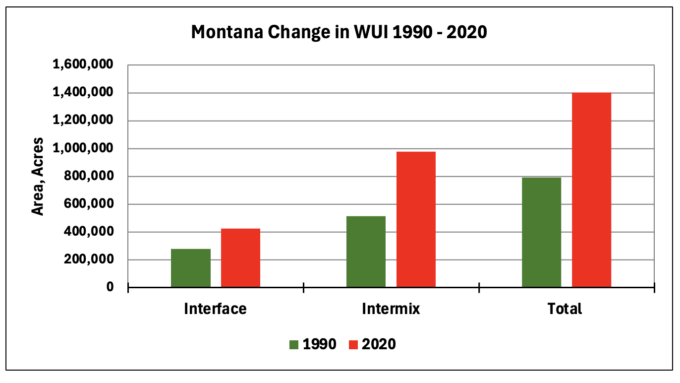
Intermix and Interface terms relate to whether structures are surrounded by at least 50% vegetation cover (intermix) or within 2.4 km of a patch of vegetation at least 5 km2 that contains at least 75% vegetation cover (Interface).
We are seeing an onslaught of logging, thinning and burning (fuel reduction) projects proposed by the Forest Service in Montana and other states, largely justified as being in the WUI. Recent examples of these our team is opposing are the Round Star (28,000 acres), Cyclone Bill (40,000 acres), and Rumbling Owl (5,400 acres) projects in the Flathead NF, or the Pintler Face (11,000 acres) project in the Beaverhead Deerlodge NF. These occur in or adjacent to areas previously logged or “treated” and are only the tip of the iceberg.
The Beaverhead Deerlodge NF Case
The series of maps below tell the story of the WUI in the Beaverhead Deerlodge NF (BHDL). I mapped the BHDL to show the nearest urban centers. Most are many miles from the Forest. Anaconda and Butte are the closest to the Forest.
I used data from the BHDL to map the Wildland Urban Interface within this 3.6 million-acre National Forest. In the map you can see a large part of the BHDL is classified as WUI. Roads are included in the WUI with mile-wide buffers. The WUI as defined by the BHDL is 1.6 million acres, or 44% of the Forest. Under the exclusions provided in the HFRA this 44% of the Forest is now available for logging and other fuel treatments with minimal protection for wildlife and watersheds, while serving as a barrier to public input or litigation to stop these “cures”.
But, if we want to know the actual truth about the WUI in this National Forest, I used the most recent model developed by the US Geological Survey and more current building densities. (Ironically, this publication is found on the Forest Service website). This model analysis resulted in a total area of WUI within the BHDL of 35,000 acres. This is 2% of the Forest, not the 44% the BHDL itself has delineated to clear the way for wholesale logging. There you have it, there can be no explanation other than enabling subsidized logging on our National Forests, a situation some call “logging without laws”. The Shell Game.

Beaverhead Deerlodge National Forest (green outline) with nearest Urban centers.

Beaverhead Deerlodge National Forest with its version of the WUI (in orange).

Beaverhead Deerlodge National Forest with WUI mapped based on the actual occurrence of structures and definitions in the law. (Orange areas are Intermix WUI and red areas are Interface WUI).