Showing posts sorted by relevance for query SCHADENFREUDE. Sort by date Show all posts

Thursday, October 13, 2022

PLAYING WITH TOY SOLDIERS
Trump knew he'd lost 2020 — and that's when he ordered abrupt military withdrawals around the globe: Jan. 6 hearing


Sarah K. Burris
October 13, 2022


Rep. Adam Kinzinger (R-IL) said Thursday during a hearing held by the House Select Committee investigating the Jan. 6 attack that former President Donald Trump knew full-well that he lost the 2020 election. Meanwhile, he was acting on that loss, and trying to quickly withdraw troops from around the globe even though the Department of Defense urged him not to.

Kinzinger showed videos of several defense officials who testified that it was young staffer Johnny McEntee, who did nothing more than run the staffing office of the White House, and who penned the directive ordering all troops out of Afghanistan and Somalia.

"Knowing that he had a lost and had only weeks in office, President Trump rushed to complete his unfinished business," said Kinzinger. "One key example is this: President Trump issued an order for a U.S. troop withdrawal."

"He disregarded concerns about the consequences for the fragile government on the front line of the fight against ISIS and terrorists. Knowing he was leaving office, he acted immediately and signed the order on November 11, which would have required the withdrawal of troops from Somalia and Afghanistan all to be complete before the Biden administration on January 20."

RELATED: Trump’s ‘false’ victory speech was a ‘premeditated plan’ to stay in office: Jan. 6 hearing

He showed clip after clip of high-ranking military and security officials revealing that Trump wanted the "immediate" withdrawal of all troops from Afghanistan. Military leaders told him it would be a disaster, but Trump didn't care. When Joe Biden entered office, it was the mess that he was forced to clean up and for which he was blamed. The implication is that it was what Trump wanted.

Watch video below or at this link.


roar-assets-auto.rbl.ms


Former Trump official: He 'wanted people to die' in the riot so he could declare martial law and stay in power


Matthew Chapman
October 13, 2022

Capitol rioters (Photo by Saul Loeb for AFP)


On Thursday's edition of MSNBC's "Deadline: White House," during a discussion about the final January 6 Committee hearing, former Trump administration Homeland Security official Miles Taylor said he believes the former president wanted members of Congress to be killed on January 6.

Taylor, a Trump-skeptic who wrote the infamous anonymous New York Times op-ed describing himself as part of a "resistance" within the executive branch, argued the former president would have used such deaths as a pretext to declare martial law and remain in office in perpetuity.

"It made my heart race to watch today's hearing, really, because they brought up Trump's mindset, and the question was, what was his mindset?" Taylor told anchor Nicolle Wallace. "I'm going to demystify that for America right now. I've spent time with the guy in the Oval Office, the White House situation room, and Air Force One. I'll tell you what his mindset was on January 6th."

"I believe Donald Trump wanted people to die," said Taylor. "He wanted people to die who were elected officials, en masse, so he could call out the military, so he could invoke the Insurrection Act, so he could prevent the peaceful transfer of power. That's not a conspiracy theory. In fact, in hindsight, it's pretty damn clear to me this is what he had in mind from day one in office."

This plan from Trump, said Taylor, explains something that had mystified himself and other national security officials about the former president from day one: why he continually refused to condemn right-wing domestic terrorist groups every time there was a violent incident. "Why did he make excuses for domestic terrorist groups? Because he was on their side."

"We saw in testimony the other week in courts that the January 6th plotters knew they were engaging in an insurrection, an armed insurrection. That's what they intended," said Taylor. "And we have people, extremists ... two hops away from the president of the United States who were planning on making that happen. He wanted people to die on January 6th so that he could use those presidential powers to prevent our democracy from transitioning to a new president. And I think the committee presented that in extremely powerful passion."

Watch below or at this link.
Miles Taylor says Trump "wanted people to die" on January 6

Feeling “schadenfreude” about Trump’s COVID-19 diagnosis may have impacted people’s views on the election

2022/10/12
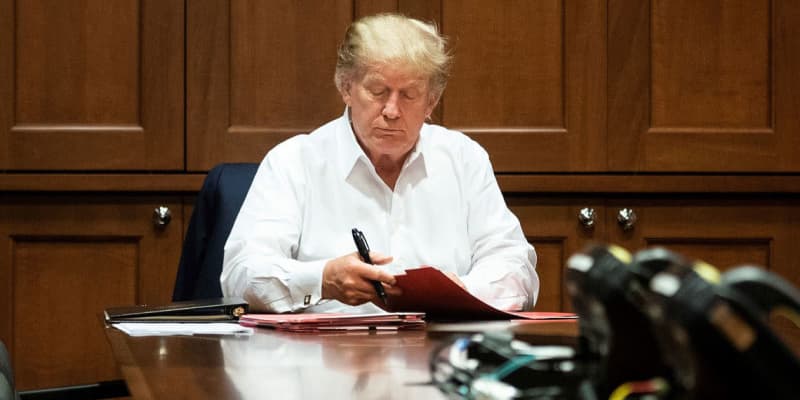

A recent study examined Americans’ feelings of schadenfreude and sympathy toward Trump’s COVID-19 diagnosis in 2020. The findings, published in the Journal of Social and Political Psychology, revealed that Democrats expressed more schadenfreude and less sympathy toward Trump’s diagnosis compared to Republicans. Democrats were also more likely to think that the diagnosis would sway people’s votes in the upcoming election.

Schadenfreude, a German word that has been adopted by the English language, describes a feeling of pleasure at another person’s misfortune. This emotion tends to occur within competitive environments, often when there is a conflict between two groups. Study author Joanna Peplak and her co-authors wanted to explore the role of schadenfreude within a particularly heated intergroup context — the latest U.S. presidential election.

“I have been interested in schadenfreude (i.e., feeling pleasure in others’ misfortunes) for some time now and have been primarily conducting research on individual and development differences in children’s and adolescents’ experiences of schadenfreude in social interactions,” explained Peplak, a postdoctoral scholar at the University of California-Irvine.

“My primary research questions include: When and why do individuals experience schadenfreude? Do frequent experiences of schadenfreude influence how we treat others? Although schadenfreude is primarily thought to be immoral, can it reflect moral facets as well?”

“For this paper, I was interested in investigating similar questions except in the political context—specifically in response to former President Trump’s COVID-19 diagnosis within weeks of the Presidential Election. My goal was to shed light on the emotions that contribute to partisanship and voting behavior,” Peplak said.

In October 2020, it was announced that then president Donald Trump had contracted COVID-19. The 2020 election campaign was particularly competitive given Trump’s controversial politics and the ongoing pandemic. Because Trump was perceived by many to have mishandled the COVID crisis, some Americans may have felt that he deserved his diagnosis, particularly Democrats.

Peplak and her colleagues opted to investigate feelings of schadenfreude (and its opposite, sympathy) among the American public in response to Trump’s COVID-19 diagnosis. The researchers also explored whether these feelings influenced citizens’ voting intentions.

About a week after Trump’s diagnosis was announced, 506 Americans answered an online questionnaire. With both open-ended questions and scale items, the survey assessed participants’ levels of schadenfreude and sympathy concerning Trump’s diagnosis. Participants were next asked whether they thought the diagnosis would affect their and other Americans’ voting intentions in the upcoming election.

In general, the respondents reported slightly more sympathy than schadenfreude. As expected, Democrats demonstrated more schadenfreude than toward Trump compared to Republicans. But even among Democrats, the levels of schadenfreude were not high (about 3 on average on a 5-point scale).

“Given the political climate prior to the 2020 Presidential Election and the influx of media responses that displayed individuals’ schadenfreude, I was surprised that feelings of schadenfreude in the sample of Democrats we surveyed for this study were relatively low,” Peplak told PsyPost. “This may be because our participants took COVID-19 diagnoses seriously. That is, even though Democrats may not have liked and/or agreed with former President Trump, their feelings of schadenfreude following his diagnosis may have been tempered by the relative severity of the diagnosis.”

The researchers next assessed the nature of participants’ feelings of schadenfreude and sympathy. There are said to be different subtypes of schadenfreude depending on the cognitions behind the emotion — deservingness-based schadenfreude, competition-based schadenfreude, and malice-based schadenfreude.

By coding participants’ responses to the open-ended questions, the researchers ascertained that the higher schadenfreude and lower sympathy among Democrats was motivated by deservingness beliefs and very little malice. For example, of the total sample, 43% indicated that they felt Trump deserved his diagnosis, 16% expressed care for his well-being, and only 5% expressed malice. These themes were associated with participants’ level of schadenfreude — Americans who expressed that Trump deserved the diagnosis or expressed malice toward him demonstrated higher schadenfreude.

Interestingly, respondents felt that Trump’s diagnosis would impact others’ voting intentions more than their own. Democrats were especially likely to anticipate a shift in votes. Across the sample, of those who thought votes would change, most (76%) thought it would sway more votes toward the Democrats. When they expressed why they thought this, most felt that Trump’s diagnosis would help voters recognize Trump’s mishandling of the pandemic.

Neither schadenfreude nor sympathy was linked to anticipated shifts in voting intentions. However, feeling that Trump deserved his diagnosis was. The authors report, “Those who believed then-President Trump’s diagnosis was deserved (cognition strongly associated with schadenfreude) were four times more likely to believe the public would change their vote to the Democratic Party.”

Peplak said the study provided three important takeaways:

“1. The groups that you belong to and associate with shape your emotional reactions. We found that schadenfreude was higher in Democrats and sympathy was higher in Republicans following former President Trump’s COVID-19 diagnosis.”

“2. Schadenfreude might not always reflect hatred or malice. We found that many participants experienced schadenfreude following former President Trump’s COVID-19 diagnosis because they believed it reflected deservingness or justice following his mismanaged response to the pandemic.”

“3. Experiencing schadenfreude in response to a political event may (indirectly) influence voting behavior. We found that the more Americans believed Trump’s diagnosis was deserved (a belief strongly related to experiences of schadenfreude), the more likely they were to think others would change their vote to the Democratic Party in the 2020 Presidential Election.”

Overall, the study shed light on how emotionally charged political events may influence the public’s thoughts about an upcoming election. But the authors noted that their study only examined voting intentions and not voting behavior. It would be interesting for future research to explore whether emotions like schadenfreude might actually change voting behavior and influence election results.

“There is still much to be learned about schadenfreude in the political arena and whether and how feeling schadenfreude might change behavior,” Peplak said. “For example, future work should seek to answer questions such as: Does expressed schadenfreude (e.g., via social media) expand political party divided? Does schadenfreude based in correcting injustice motivate us to correct our own injustices?”

The study, “Schadenfreude and Sympathy Following President Trump’s COVID-19 Diagnosis: Influence on Pre-Election Voting Intentions”, was authored by Joanna Peplak, J. Zoe Klemfuss, and Peter H. Ditto.


Friday, April 30, 2021

Illnesses of controversial celebrities can negatively affect public health

 MASS HYSTERIA, SOCIAL PATHOLOGY, 

MASS MEDIA HYPERCONDRISM 

PENN STATE

Research News

UNIVERSITY PARK, Pa.-- Not all public figures are equally beloved, and sometimes when more controversial celebrities get sick, it may negatively affect people's health intentions. In a study of people's reactions to radio host Rush Limbaugh's announcement of a lung cancer diagnosis and Kentucky Sen. Rand Paul's announcement of a diagnosis of COVID-19, researchers at Penn State found that those who took pleasure in their misfortune were themselves less likely to take steps to prevent lung cancer or COVID-19.

"Schadenfreude is the emotion of feeling pleasure in another's misfortune," said Jessica Gall Myrick, associate professor of media studies. "In our study, after learning the news of a politician's illness, if people felt schadenfreude, they were much less likely to intend to take the actions that would prevent either lung cancer or COVID-19."

In general, previous research by Myrick has found that coverage of celebrity ailments can raise public awareness of serious illnesses, which can then serve as a motivation for people to avoid bad activities or start new healthy routines. But most studies on the topic examine how the public responds to well-liked celebrities. Respondents were not asked if they liked or disliked the person reporting the illness in the current study, but rather if they felt schadenfreude upon hearing the news of Limbaugh and Paul.

Myrick and doctoral student Jin Chen of the Donald P. Bellisario College of Communications recently conducted two online surveys shortly after news coverage of illnesses associated with two provocative public figures. Their results were published in Journalism and Mass Communication Quarterly.

The first survey was conducted with 414 American adults following Limbaugh's February 2020 announcement that he was diagnosed with advanced lung cancer. The second survey was conducted in March 2020 to 407 American adults following Paul's announcement that he had been diagnosed with COVID-19. Paul was the first national politician to confirm a diagnosis. Respondents were recruited and the surveys were conducted using Amazon Mechanical Turk.

The researchers tested the idea that when the average person sees news coverage about the illness of a public figure that they do not like, then they can experience the emotion of schadenfreude. They examined how that feeling affected people's intentions to prevent themselves from getting sick after hearing the news about Limbaugh and Paul, respectively.

Both of these surveys showed the same pattern; the respondents who felt greater schadenfreude toward Limbaugh and Paul after learning of their illnesses were less inclined to take the steps to prevent lung cancer and COVID-19.

Political ideology was not related to feelings of schadenfreude, according to these studies. The only factor that could predict how much schadenfreude people felt was how well they believed they knew these famous individuals through the media.

"The more media exposure people had to these political figures, and the more familiar people felt they were knowledgeable about the political figures, the more pleasure they experienced in learning of their illness," Myrick said. "That pleasure in the political figure's pain seemed to demotivate people to take action to protect themselves."

Myrick added that schadenfreude is a positive emotion and when "we feel happy and pleased, we also feel safe." This may be the reason people are less likely to avoid the health risks.

"Basically, why would we do anything to alter this good feeling by confronting a depressing health threat and thinking about bad things that could happen to us?" Myrick said. "Because schadenfreude puts us in a pleasant, pleasureful state, we let our guards down for risks to our own health."

The findings could have serious public health implications, according to Myrick. It makes it hard for health advocates to convince some segments of the population to take preventative actions when controversial political figures get sick.

"We need additional research to figure out the underpinnings of these feelings to see if there are other ways," she said. "Either through encouraging empathy for the ill or maybe even by better channeling the feelings of schadenfreude toward positive action."

###

Myrick is affiliated with the Science Communication Program, a program in the Bellisario College that supports research in the science of science communication.

Wednesday, October 06, 2021


Is this the Schadenfreude moment for China sceptics?
The Evergrande crisis is merely the tip of the iceberg of an overheated and indebted property sector.

 AFP
Updated: 04 Oct 2021,
Vivek Deheji

The woes of Chinese property development firm, Evergrande, heavily indebted to both domestic and foreign lenders and on the verge of collapse, has engendered a Schadenfreude moment amongst China sceptics: but is it premature? After the crisis broke out, some proclaimed that the imminent failure of Evergrande might just be China’s “Lehman moment", referring to the 2008 bankruptcy of the New York investment bank, Lehman Brothers, which was the opening salvo in the global financial crisis. Yet, global financial markets settled after a day or two of turmoil, as investors bet that that the Chinese state, which still heavily regulates the economy, will restructure the debt-laden firm in a manner that forestalls any potential international contagion. The critics might just have to wait before popping the Schadenfreude champagne corks.

Yet, even absent contagion, the Evergrande saga is but the tip of the iceberg of an overheated and indebted property sector which potentially threatens the edifice of the larger Chinese economy and, therefore, indirectly the global economy too. In a fascinating long read, British-born historian Niall Ferguson makes just such a case
 
(“Evergrande's Fall Shows How Xi Has Created a China Crisis", Bloomberg Opinion, 26 September bloom.bg/3A9KCWI).

As Ferguson observes, Evergrande is emblematic of a China that has developed in the past decade with an economic development paradigm premised on “urbanization on steroids". For all of the skyscrapers, both commercial and residential, that dot the landscape of Chinese cities, large and even small, many of them remain empty and their property developers unable to sell enough units to pay-off the debt incurred in putting up the buildings to begin with.

In other words, the property sector in China, larger even than in the US on the eve of the collapse of Lehman, is a ticking time bomb that could have significant macroeconomic consequences beyond the property and financial sectors through the impact on Chinese households, who are heavily invested in a property market that has been in bubble territory for some time. Citing research by Harvard economics professor Kenneth Rogoff and his co-author Yuanchen Yang of Beijing’s Tsinghua University, Ferguson notes that housing wealth accounts for a whopping 78% of total assets in China, much higher than the 35% share in the United States, for instance. The upshot is that consumer spending in China is, as per Rogoff-Yang, “significantly more sensitive to a decline in housing prices" than in the US. The impacts of a more generalized collapse in the property market in China could be large and consequential for the global economy.

For those with a long enough memory, none of these recent developments should come as a surprise. As long ago as 2004, economist James Dean and I argued, and as I summarized for Mint readers much later (“Will the elephant overshadow the dragon?", 5 March 2015 bit.ly/3ixSLyx), that the Chinese model is characterized by the glaring contradiction between ever-increasing economic freedoms and an authoritarian political dispensation. What is more, the economic development paradigm of the Chinese Communist authorities was focussed on an infrastructure-driven, “build and they will come" model, in sharp contrast to, say, the Indian model in which the supply of new infrastructure is driven by the demand for it, rather than the reverse.

The consequence, as Dean and I argued in 2004, was a Chinese development success story that was something of a house of cards, and built upon excessive investment, including in housing—what the Austrian school of economics would call “malinvestment". Chinese growth statistics would, therefore, in an important sense be inflated. After all, if the economy grows rapidly because of a stock of property and infrastructure that ultimately will never be put to use, and which leads to the accumulation of large debts, such rapid growth may be unsustainable and, in a certain sense, illusory.

Up until now, China sceptics, including your columnist, have been confounded by the reality that successive generations of the Chinese leadership have shown a remarkable ability to continue to refresh and reinvent their model—both economic and political—thus ensuring that growth rates remain high and that the spectre of social chaos and unrest remains at bay. Every Chinese leader since Deng Xiaoping and his pioneering reforms of the late 1970s have managed to maintain the unwritten but all-important bargain with the populace: “we will give you the opportunity to get rich, and the price is that you must stay out of politics". But perhaps, just perhaps, the chickens may finally have come home to roost on the watch of authoritarian strongman, Xi Jinping—what, writing in 2015, I had reckoned might be an “implosion" in the Chinese economy or a “belated and disorderly democratization" of the society.

What might make this time different is that in the past few years, Xi has begun to rewrite the unwritten social compact, and increase government and party control over the economy, and reign in what he clearly believes is an excessively free and insufficiently regulated market economy, undoing the premise of Deng’s reforms. He has also been, first quietly and now overtly, building a cult of personality to match that around Mao. If the economy and the public mood sour, Xi may end up ruing these choices.

Sunday, August 16, 2026

The Crocodilian Logic of Zionism


 August 14, 2026

Image by Tahir osman.

Since 7 October, 2023, the Israeli government has experienced a sense of relief. It believed it no longer needed to pretend to care about Palestinians as human beings and could pursue their annihilation and dispossession openly. These have depended on two factors: international impunity, guaranteed by US imperial backing and subservient Western governments, and internal Israeli genocidal enthusiasm cultivated over decades and extending across society.

Support for dispossession depends on the ruling class’s cultivation of segregation between in-and-out groups, fearmongering and propaganda, alongside rewards for aggression, including material gains such as land and other resources, elevated social status and impunity for aggression against the constructed out-group. This manipulation of fear and reward conditions societies to accept genocide as normal, even righteous, because they have been neurologically wired to steal.

The latest example of this dynamic came when Israeli National Security Minister Itamar Ben Gvir proposed surrounding Ketziot prison with a moat of Nile crocodiles (Crocodylus niloticus) to guard Palestinian prisoners.

Who knows, maybe the crocs will be enticed by a benefits package similar to that of newly arrived settlers. After all, both are being recruited to help secure the Zionist frontier.

An appeal to the reptilian brain

Nile crocodiles possess extremely powerful jaws, are opportunistic carnivores, can grow up to 6.1 meters (20 feet) in length, and weigh over 450 kilograms (1,000 pounds). They typically ambush prey near waterholes before executing a “death roll” to subdue large animals (including people). Due to the crocodiles’ inability to chew their food, the roll serves as the primary mechanical tool to break bones, tear flesh and rip the hapless victim into manageable, bite-sized pieces for swallowing.

Ben Gvir’s proposal, which mimics Donald Trump’s failed Alligator Alcatraz, is tragically far from satire. In fact, the National Security Ministry has budgeted around $7 million for the construction of the moats, which are underway. This includes long-term plans for the reptiles’ maintenance and care.

For now, however, the plan has been placed on hold; not out of concern for Palestinians who may be subjected to these barbarically punitive measures, including a death roll, but because of concerns for the animals’ welfare.

The crocodile proposal offers a revealing window into how systems of domination and dehumanisation condition societies, particularly those lower on the in-group hierarchy, to derive rewards from cruelty in service of ruling-class theft.

Similar to many Israeli policies since 7 October, it functions as political theatre designed to reward the most primitive impulses associated with the brain’s emotional/ limbic system and related pathways (what is colloquially called “the reptilian brain”) of domination, fear, humiliation, revenge and schadenfreude (pleasure derived from another’s misery).

While Zionist ruling classes indulge in land and resource theft in Gaza, Lebanon and Syria, Ben Gvir appeals to those for whom humiliating and abusing people perceived as inferior provides a psychological boost, reinforcing a sense of superiority.

Conscription of crocodiles also provides a political spectacle aimed at harvesting votes, a dopamine delivery system for an Israeli public conditioned to celebrate cruelty as virtue. Within this genocidal milieu, Ben Gvir reigns supreme, ascending the Israeli political hierarchy with the prime minister’s office firmly in his sights.

As Richard H. Smith details in The Joy of Pain: Schadenfreude and the Dark Side of Human Nature, a recurring theme among perpetrators is that many were themselves mistreated in the past and sought opportunities for payback. In Israeli society, however, this extends across society, with people encouraged to embody a victim mentality reinforced by the conflation of Zionism and Judaism, drawing on the historical experiences of world Jewry, from the Holocaust to the decontextualisation of Palestinian resistance to Zionist oppression and colonisation.

Indeed, schadenfreude serves as a cheap reward for aggression in service of ruling-class theft of land and other resources, as reflected by the shameless and gleeful sadism demonstrated by Israeli soldiers, particularly since 7 October, for which imperial and domestic impunity promise a lack of accountability and therefore permission and even encouragement to engage in it.

Photos of bound and blinded Palestinian civilians alongside grinning Israeli soldiers have even been used as social currency, including on dating apps.

Dehumanisation and recovery

Frantz Fanon, the Martinican psychiatrist, author and revolutionary thinker, analysed how colonialism dehumanises both the oppressed and the oppressor, with the dehumanisation of the latter expressed through the humiliation and abuse inflicted upon the former.

Engagement in the destruction of Indigenous society epitomises the dehumanisation of the oppressor, which destroys the physical humanity of the oppressed while eroding its own humanity through the forsaking of what makes it human: the capacity for empathy across racial, gender and other constructed divides.

The crocodile episode reflects the extent to which Israeli Zionist society has forsaken its humanity in service of theft, and how its ruling class suppresses empathy while appealing to primitive “reptilian” neural processes of fear and reward to service its greed.

For nearly three years, the Zionist rampage has relentlessly destroyed any semblance of empathy toward the Palestinian people, replacing it with escalated dehumanisation, disgust at their culture, history and existence, and glee at their suffering. What remains is an endless descent into moral depravity and cruelty, where racism, colonial theft and capitalist individualism are celebrated as the very foundation of an identity, and escape from this construct is actively discouraged through threats of severe social and physical punishment.

This is precisely what systems of domination depend upon: convincing people that what has been conditioned is “natural” and therefore cannot be undone, or else. Yet what has been conditioned can be unlearned, and what has been wired for domination can be rewired toward empathy, solidarity and co-resistance by restructuring the social hierarchies that sustain domination.

This is the central argument of my forthcoming book with historian Ilan Pappé, Wired to Steal: Zionism and the Shaping of the Western Mind: an examination of the behavioural and neurological mechanisms through which systems of domination, including Zionism, condition people to participate in, and even derive reward from, the dispossession of others, while showing how that conditioning can be undone.

This piece first appeared in The New Arab.

Yoav Litvin is a Doctor of Psychology/ Behavioral Neuroscience and author of Wired to Steal: Zionism and the Shaping of the Western Mind with Ilan Pappé (Interlink Books, Fall 2026). For more info, please visit yoavlitvin.com

Thursday, March 20, 2025


Embattled Tesla recalls Cybertrucks over risk of panel detachment


By AFP
March 20, 2025


US President Donald Trump (R) with Tesla CEO Elon Musk (L) and a Cybertruck at the White House - Copyright AFP/File Mandel NGAN

Tesla is recalling more than 46,000 Cybertrucks because of a defect that can lead an exterior panel to detach, increasing the risk of a crash, according to a safety notice reviewed Thursday by AFP.

The recall affects essentially all of the futuristic-looking vehicles delivered in the United States.

The move is due to a part Tesla calls a “cant rail” — an exterior panel — that was affixed with an adhesive “susceptible to environmental embrittlement,” according to a company filing on the National Highway Traffic Safety Administration website.

Detachment of the part, which Tesla describes as “cosmetic,” poses the risk of creating a “road hazard for following motorists and increase their risk of injury or a collision,” according to the NHTSA document.

The recall is the latest blemish on the stainless steel behemoths, a signature vehicle for Elon Musk’s electric auto company.

It comes as the brand encounters consumer blowback in the wake of Musk’s key advisory role in President Donald Trump’s administration.

Tesla received two field complaints in January about the issue, but company engineers determined there was no problem.

Then in February, the NHTSA notified Tesla of another complaint.

The company, which also cited social media postings on the issue, undertook another investigation that led to a voluntary recall, said Tesla, which will use a different adhesive to attach the part.

As of March 14, Tesla had 151 warranty claims that may be related to the condition. The company said it knows of no accidents.

Demand for the Cybertruck and other Tesla vehicles has tumbled in recent weeks in many consumer markets as Musk presses on with deep cuts in US government departments and staffing through his Department of Government Efficiency.

Analyst Dan Ives of Wedbush Securities called for Musk to clearly define how he will balance his role with Trump and his duties as Tesla CEO.

“Let’s call it like it is: Tesla is going through a crisis and there is one person who can fix it….Musk,” said Ives, who argued that Musk must provide details on when new vehicles will arrive in dealerships and about a plan for autonomous driving in Texas.

“The violence at Tesla dealers, cars being keyed in parking lots, social movements against Musk around the globe…have all created a massive overhang for Tesla’s stock,” Ives said. “This is a moment of truth for Musk.”

Tesla shares fell in early trade Thursday.


Tuesday, August 15, 2023

SCHADENFREUDE
Hillary Clinton’s Reaction To Trump 2020 Election Case Indictments On ‘The Rachel Maddow Show’ Goes Viral

Armando Tinoco
Mon, August 14, 2023 


Hillary Clinton was all laughs and giggles Monday during her appearance on The Rachel Maddow Show, which coincided with a Georgia grand jury returning 10 indictments in the Trump 2020 election interference case.

“I can’t believe this,” Clinton said while she laughed as Maddow introduced her on the show.


Clinton leaned back in her chair and laughed some more as the MSNBC host said, “This is not the circumstances in which I expected to be talking to you.”

“Nor me Rachel,” Clinton added. “It’s always good to talk to you. Honestly, I didn’t think that it would be under these circumstances. Yet another set of indictments.”


Clinton had been set to appear on Maddow’s show to talk about an opinion piece she wrote for The Atlantic in which she talks about the politicization of social issues. The former First Lady of the United States and Secretary of State wound up giving her take on the latest indictments surrounding Trump.

“I don’t know that anybody should be satisfied. This is a terrible moment for our country to have a former president accused of these terribly important crimes,” Clinton said. “The only satisfaction is that the system is working. That all of the efforts by Trump and his allies and enablers to try and silence the truth and undermine democracy have been brought into the light. And justice is being pursued.”

Trump was Clinton’s opponent in the 2016 presidential race which she ultimately lost. During his campaign, Trump incited his crowd of followers to chant “Lock her up,” in reference to Clinton using a personal e-mail system to handle classified information.

“I hope that we won’t have accountability just for Donald Trump and if there are others named in these indictments along with him for their behavior but we will also have accountability for a political party that has just thrown in with all the lies and the divisiveness and the lack of any conscience about what has been done to the country,” Clinton also said tonight

Hillary Clinton Promises She Gets No Satisfaction From Trump Indictment, Really

Igor Bobic
Mon, 14 August 2023 

Hillary Clinton said she took no pleasure from Donald Trump’s legal troubles as a grand jury investigating the former president’s efforts to overturn the 2020 election results returned an indictment Monday night in what could be his fourth set of criminal charges this year.

“I don’t know that anybody should be satisfied,” Clinton, who lost to Trump in the 2016 presidential election, told MSNBC’s Rachel Maddow on Monday after initially smiling and shaking her head at the news. “I just feel great profound sadness that we have a former president who has been indicted for so many charges.”

“He set out to defraud the United States of America and the citizens of our nation,” Clinton, a former secretary of state, added of Trump. “He used tactics of harassment and intimidation. He made threats. He and his allies went after state officials... . We’ll wait to see what [Georgia prosecutors] say ... but I don’t know that anybody should be satisfied. This is a terrible moment for our country to have a former president accused of these terribly important crimes.”

Trump was indicted by the Department of Justice earlier this month over his attempts to ensure the winner of the 2020 presidential election, Democrat Joe Biden, was not certified as president. Georgia’s case deals explicitly with Trump trying to get that state’s electoral vote results overturned.

In 2016, Trump rode to the White House in part by accusing Clinton of being “crooked” amid an investigation into classified materials kept on a private email server during her time as secretary of state, prompting chants at his campaign rallies of “Lock her up.”

Now Trump is the one facing criminal charges, including in a separate federal probe stemming from his alleged mishandling of classified documents after he left office.

But if Clinton is feeling any schadenfreude at the fact that Trump is facing possible jail time, she didn’t show it during Monday’s interview.

“The only satisfaction may be that the system is working,” she said. “That all the efforts [to subvert the 2020 election] have been brought into the light and justice is being pursued.”

The former Democratic senator also referred to Trump as a “demagogue” and said he led a “deliberate effort to divide Americans [and] to lie to Americans.

“What happened on January 6 — ‘Don’t believe what you saw, believe what I tell you’ — those are all the hallmarks of authoritarian, dictatorial kinds of leaders,” she added.

Tuesday, July 25, 2023


How people judge anti-vaxxers who die from COVID-19


Some believe those who reject vaccines deserve worse outcomes

Peer-Reviewed Publication

OHIO STATE UNIVERSITY


COLUMBUS, Ohio – When people who publicly reject COVID-19 vaccines later die from the disease, observers have complex reactions to their fates, a new study suggests.


While very few rejoice in the deaths of anti-vaxxers, some people believe those who are dogmatic against vaccines are deserving of worse outcomes – and that reaction is related to the political party affiliation and vaccination status of the person evaluating the anti-vaxxer.


Democrats and those who were vaccinated were more likely than Republicans and the unvaccinated to think anti-vaxxers who died got what they deserved – but even 63% of Democrats in the study thought an anti-vaxxer deserved to have a full recovery from the disease (compared to 80% of Republicans).


Only 4.6% of people in the study thought an anti-vaxxer who contracted COVID-19 deserved death.


The study involved participants reading mock social media posts from an anti-vaxxer and reacting to different scenarios about how this anti-vaccine advocate reacted as he or she got sick and later died.


“What we found indicates that people may view those on social media as characters in a morality play,” said study co-author Matthew Grizzard, associate professor of communication at The Ohio State University.


“Our results show that people -- particularly those who were vaccinated themselves -- are likely to judge those who shared misinformation about the COVID vaccine as immoral and deserving of some level of retribution.”


The study was published July 22, 2023 in the journal New Media & Society.


The study was inspired by the “Herman Cain Award” forum (called a subreddit) on the social media site reddit.  Herman Cain was a Republican politician who contracted COVID-19 and died, and whose social media accounts continued to disseminate COVID-19 misinformation after his death. On the reddit forum, people share stories of anti-vaxxers and COVID deniers who died from the disease.


The Herman Cain Award site and others like it resulted in news coverage that categorized the sites as cruel and heartless.


But this study suggests a more nuanced interpretation of those who judged anti-vaxxers who got sick and died, said study co-author Rebecca Frazer, who recently earned her PhD in communication at Ohio State.


“We have people who are judging anti-vaxxers and considering them deserving of some level of suffering, but on the other hand, there’s very little positive emotion about watching them suffer,” Frazer said.


“Those two things seem in tension, but they are both in our findings.”


The researchers used a professional panel company to recruit an adult sample that was matched to the U.S. population on age, sex, race/ethnicity and region. The final sample included 932 people that was close to the U.S. population in political affiliation and vaccination status.


All participants were shown a series of mock Facebook status updates that mimicked the actual posts found in the Herman Cain Award subreddit.  The status updates were from a person named Terry Adams, with the gender intentionally unspecified.


In the first post, Terry expressed uncertainty about the COVID-19 vaccine or was dogmatically opposed to the vaccine.


In this case, all participants – Republicans and Democrats included – liked Terry more when he or she was less dogmatic and only expressed uncertainty about the vaccine.


But in later posts, when Terry contracted COVID and became critically ill, differences appeared in how people reacted to Terry, depending on whether he or she regretted not getting the vaccine or doubled down on not taking it.


Democrats had less positive evaluations of Terry than Republicans. In addition, vaccinated participants regardless of their political party also had less positive evaluations when Terry doubled down on not getting the vaccine.


“Republicans were more okay with Terry continuing to question the vaccine and less positive than Democrats when Terry regretted not getting the vaccine,” Grizzard said.


In the final Facebook post, Terry’s brother announced that Terry had died of COVID. Participants in the study were asked how “satisfied” they were with Terry’s death.  Overall, participants were more satisfied with his or her death when Terry maintained anti-vaccination views right up to death.


Vaccinated participants were more satisfied with Terry’s death than unvaccinated participants, and Democrats were more satisfied than Republicans.


But no group showed high levels of satisfaction, the results showed.  Participants rated their satisfaction on a scale of 1 to 7, with 7 being the most satisfied. The average score was 2.93 for Democrats, compared to 2.51 for Republicans.


The researchers also asked participants to rate how happy they were with Terry’s death – a question that aimed to get at the German concept of “schadenfreude,” which has been defined as “feelings of pleasure that a person experiences in response to another person’s failures or misfortunes.”


Participants rated their happiness on a scale of 0 to 6, with six being the most happy.  Results showed that even participants who thought Terry deserved death had an average happiness rating of only 1.6 on the scale, compared to 0.54 for those who thought Terry deserved to fully recover.


“We saw a moral judgment by those who thought Terry deserved some level of suffering or death, and they wanted justice to be served, or at least what they considered justice,” Frazer said.


“But even they didn’t express a lot of happiness at Terry’s death.”


Overall, the results suggest that most people don’t take pleasure in anti-vaxxers dying, even if they believe they deserve it, Grizzard said.


“It is more a feeling that anti-vaxxers acted immorally and maybe put others at risk. And because of that, they deserve some level of suffering. But even those who are judging these anti-vaxxers most harshly are typically not rejoicing in their suffering or death,” Grizzard said.

Excess death rates for Republican and Democratic registered voters in Florida and Ohio during pandemic

JAMA Internal Medicine

Peer-Reviewed Publication

JAMA NETWORK


About The Study:

 In this study evaluating 538,000 deaths in individuals ages 25 and older in Florida and Ohio between March 2020 and December 2021, excess mortality was significantly higher for Republican voters than Democratic voters after COVID-19 vaccines were available to all adults, but not before. These findings suggest that differences in vaccination attitudes and reported uptake between Republican and Democratic voters may have been factors in the severity and trajectory of the pandemic in the U.S. 

Authors: Jacob Wallace, Ph.D., of the Yale School of Public Health in New Haven, Connecticut, is the corresponding author.

(doi:10.1001/jamainternmed.2023.1154)

Editor’s Note: Please see the article for additional information, including other authors, author contributions and affiliations, conflict of interest and financial disclosures, and funding and support.

#  #  #

 https://jamanetwork.com/journals/jamainternalmedicine/fullarticle/10.1001/jamainternmed.2023.1154?guestAccessKey=f5237917-e2bc-4cba-9f0d-ee6d516b3d85&utm_source=For_The_Media&utm_medium=referral&utm_campaign=ftm_links&utm_content=tfl&utm_term=072423