Trump tariffs suffer staggering setback in U.S. court
One U.S. trade lawyer called this the most significant legal defeat of a president on trade policy in decades
Story by Alexander Panetta
CBC
A U.S. court delivered a sharp rebuke of President Donald Trump's trade policy on Wednesday, declaring he abused his authority and striking down many of his tariffs — at least for now.
The upshot for trading partners, including Canada: Certain specific tariffs on steel and aluminum remain in place, but gone, for now, are sweeping levies on entire countries.
The order by the Manhattan-based U.S. Court of International Trade quashes Trump's 10 per cent across-the-board tariff on most nations and his declaration of a fentanyl emergency to impose 25 per cent tariffs on numerous Canadian and Mexican goods.
The White House vowed to fight back with every available tool. This means an immediate appeal and Trump possibly turning to different legal weapons to fight his trade wars.
Nevertheless, this decision made history.
'By far the biggest decision in ages'
American courts tend to be deferential to presidents on trade policy, but Trump has tested their limits with a barrage of protectionist actions unlike anything in modern history.
One U.S. trade lawyer called this the most significant legal defeat of a president on trade policy in decades, with the possible exception of certain court setbacks for Richard Nixon.
"It's by far the biggest decision in ages," Scott Lincicome told CBC News. "It's a very big deal. The only question is how long it lasts."
He predicted fallout on several fronts. The court said the U.S. Constitution gives Congress exclusive authority to regulate commerce with other countries that is not overridden by the president's emergency powers to safeguard the economy.
It said Trump abused the 1977 International Emergency Economic Powers Act (IEEPA) to apply his fentanyl tariffs on Canada and Mexico, as well as his worldwide tariffs.
"We do not read IEEPA to delegate an unbounded tariff authority to the president," said the 49-page decision. "The challenged [tariffs] will be vacated and their operation permanently enjoined."
The court gave the administration 10 days to implement its order.
One U.S. trade lawyer called this the most significant legal defeat of a president on trade policy in decades
Story by Alexander Panetta
CBC
A U.S. court delivered a sharp rebuke of President Donald Trump's trade policy on Wednesday, declaring he abused his authority and striking down many of his tariffs — at least for now.
The upshot for trading partners, including Canada: Certain specific tariffs on steel and aluminum remain in place, but gone, for now, are sweeping levies on entire countries.
The order by the Manhattan-based U.S. Court of International Trade quashes Trump's 10 per cent across-the-board tariff on most nations and his declaration of a fentanyl emergency to impose 25 per cent tariffs on numerous Canadian and Mexican goods.
The White House vowed to fight back with every available tool. This means an immediate appeal and Trump possibly turning to different legal weapons to fight his trade wars.
Nevertheless, this decision made history.
'By far the biggest decision in ages'
American courts tend to be deferential to presidents on trade policy, but Trump has tested their limits with a barrage of protectionist actions unlike anything in modern history.
One U.S. trade lawyer called this the most significant legal defeat of a president on trade policy in decades, with the possible exception of certain court setbacks for Richard Nixon.
"It's by far the biggest decision in ages," Scott Lincicome told CBC News. "It's a very big deal. The only question is how long it lasts."
He predicted fallout on several fronts. The court said the U.S. Constitution gives Congress exclusive authority to regulate commerce with other countries that is not overridden by the president's emergency powers to safeguard the economy.
It said Trump abused the 1977 International Emergency Economic Powers Act (IEEPA) to apply his fentanyl tariffs on Canada and Mexico, as well as his worldwide tariffs.
"We do not read IEEPA to delegate an unbounded tariff authority to the president," said the 49-page decision. "The challenged [tariffs] will be vacated and their operation permanently enjoined."
The court gave the administration 10 days to implement its order.
Rush to get goods across border
One of Lincicome's predictions is that some countries will now feel less urgency to negotiate tariff deals with Trump. Another prediction? Expect a gusher of goods to flow into the U.S. soon — especially at the land borders with Canada and Mexico — as importers take advantage of this potentially temporary lull in Trump's trade wars, pending a higher court decision.
"The June import stats are going to be wild," said Lincicome, vice-president of general economics at the Cato Institute, a Washington-based think-tank.
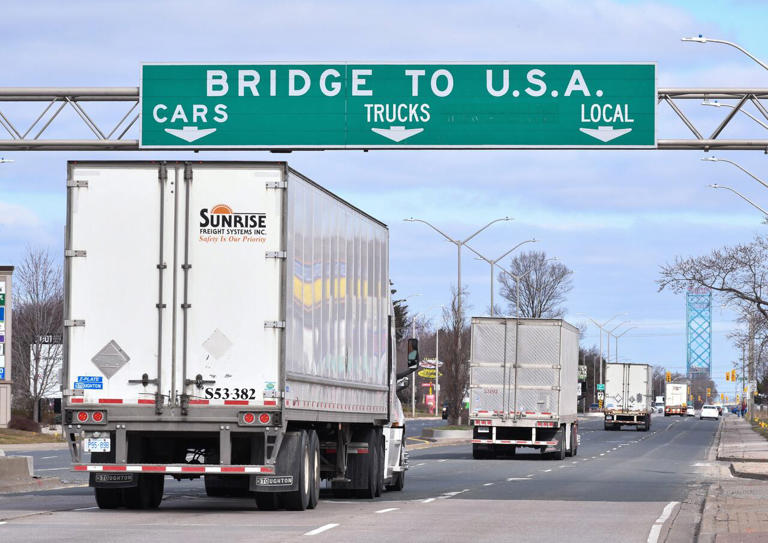
Transport trucks approach the Canada/U.S. border in Windsor, Ont., on March 21, 2020. Cross-border shipping is expected to surge in the wake of Wednesday's ruling. (Rob Gurdebeke/The Canadian Press)
"Particularly for Canadians, this stuff's just sitting on the other side of the border. It's going to be like the Flight of the Valkyries across the border."
That is, until, and if, Trump wins an appeal or he uses another legal tool, such as a 1974 trade law that allows temporary 150-day tariffs for less urgent matters.
The ruling came in a pair of lawsuits, one filed by the non-partisan Liberty Justice Center on behalf of five small U.S. businesses that import goods from countries targeted by the duties and the other by 13 U.S. states.
The companies, which range from a New York wine and spirits importer to a Virginia-based maker of educational kits and musical instruments, have said the tariffs will hurt their ability to do business. At least five other legal challenges to the tariffs are pending.
'Our laws matter'
Oregon Attorney General Dan Rayfield, a Democrat whose office is leading the states' lawsuit, called Trump's tariffs unlawful, reckless and economically devastating.
"This ruling reaffirms that our laws matter, and that trade decisions can't be made on the president's whim," Rayfield said in a statement.

Wednesday's ruling reaffirmed that 'trade decisions can't be made on the president's whim,' said Oregon Attorney General Dan Rayfield, whose office led the lawsuit over the tariffs launched by 13 states. Here, he is pictured at a news conference at the Oregon Department of Justice office in Portland in April. (Jenny Kane/The Associated Press)
The White House promised to fight. Trump spokesman Kush Desai said unfair foreign trade had created historic and persistent deficits and decimated American communities, workers and defence manufacturing.
"It is not for unelected judges to decide how to properly address a national emergency," he said.
"President Trump pledged to put America First, and the administration is committed to using every lever of executive power to address this crisis."
In imposing the tariffs in early April, Trump called the trade deficit a national emergency that justified his 10 per cent across-the-board tariff on all imports, with higher rates for countries with which the United States has the largest trade deficits, particularly China.
Many of those country-specific tariffs were paused a week later. The Trump administration on May 12 said it was also temporarily reducing the steepest tariffs on China while working on a longer-term trade deal. Both countries agreed to cut tariffs on each other for at least 90 days.
Trump's on-and-off-again tariffs, which he has said are intended to restore U.S. manufacturing capability, have shocked U.S. financial markets.
The U.S. dollar rose against both the Swiss franc, a traditional currency safe haven, and the Japanese yen following the court decision.
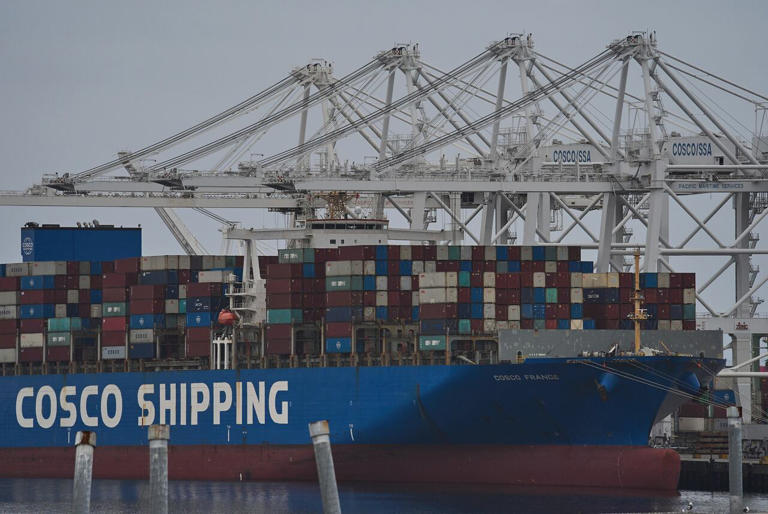
The Cosco Shipping France container ship moored at the Long Beach Container Terminal in the Port of Long Beach, Calif., in April. The court ruling could embolden the U.S.'s European trading partners and make them hesitant to enter into tariff negotiations. (Damian Dovarganes/The Associated Press)
Wednesday's decision can be appealed to the U.S. Court of Appeals for the Federal Circuit in Washington, D.C., and ultimately the U.S. Supreme Court.
Several Washington-based trade experts said the defeat casts a cloud over Trump's attempts to negotiate with other countries, including Canada. They said other countries may have less incentive to bargain.
"This decision throws the existing negotiations for a loop," said trade lawyer Simon Lester. "Foreign governments will have to reevaluate how they react to the Trump administration's trade demands."
Another Washington trade analyst said the coming days will be telling.
"The administration is likely in panic mode at the moment," said Inu Manak, a fellow at the Council on Foreign Relations.
"The very basis for all the negotiations they are undertaking has been jeopardized, so there is no incentive for any trading partner to continue negotiating with the United States until it is clear whether or not the tariffs will, in fact, be stopped in 10 days."
If the tariffs are, indeed, halted for a longer period, she said, Trump's aides will likely seek more targeted tools, such as the Section 232 tariffs used to penalize specific sectors, as Trump did with steel and aluminum.
The bottom line, Manak said: Trump's trade policy has been revealed to not only be "half-baked" but has also pushed the limits of presidential power too far.
One of Lincicome's predictions is that some countries will now feel less urgency to negotiate tariff deals with Trump. Another prediction? Expect a gusher of goods to flow into the U.S. soon — especially at the land borders with Canada and Mexico — as importers take advantage of this potentially temporary lull in Trump's trade wars, pending a higher court decision.
"The June import stats are going to be wild," said Lincicome, vice-president of general economics at the Cato Institute, a Washington-based think-tank.
Transport trucks approach the Canada/U.S. border in Windsor, Ont., on March 21, 2020. Cross-border shipping is expected to surge in the wake of Wednesday's ruling. (Rob Gurdebeke/The Canadian Press)
"Particularly for Canadians, this stuff's just sitting on the other side of the border. It's going to be like the Flight of the Valkyries across the border."
That is, until, and if, Trump wins an appeal or he uses another legal tool, such as a 1974 trade law that allows temporary 150-day tariffs for less urgent matters.
The ruling came in a pair of lawsuits, one filed by the non-partisan Liberty Justice Center on behalf of five small U.S. businesses that import goods from countries targeted by the duties and the other by 13 U.S. states.
The companies, which range from a New York wine and spirits importer to a Virginia-based maker of educational kits and musical instruments, have said the tariffs will hurt their ability to do business. At least five other legal challenges to the tariffs are pending.
'Our laws matter'
Oregon Attorney General Dan Rayfield, a Democrat whose office is leading the states' lawsuit, called Trump's tariffs unlawful, reckless and economically devastating.
"This ruling reaffirms that our laws matter, and that trade decisions can't be made on the president's whim," Rayfield said in a statement.
Wednesday's ruling reaffirmed that 'trade decisions can't be made on the president's whim,' said Oregon Attorney General Dan Rayfield, whose office led the lawsuit over the tariffs launched by 13 states. Here, he is pictured at a news conference at the Oregon Department of Justice office in Portland in April. (Jenny Kane/The Associated Press)
The White House promised to fight. Trump spokesman Kush Desai said unfair foreign trade had created historic and persistent deficits and decimated American communities, workers and defence manufacturing.
"It is not for unelected judges to decide how to properly address a national emergency," he said.
"President Trump pledged to put America First, and the administration is committed to using every lever of executive power to address this crisis."
In imposing the tariffs in early April, Trump called the trade deficit a national emergency that justified his 10 per cent across-the-board tariff on all imports, with higher rates for countries with which the United States has the largest trade deficits, particularly China.
Many of those country-specific tariffs were paused a week later. The Trump administration on May 12 said it was also temporarily reducing the steepest tariffs on China while working on a longer-term trade deal. Both countries agreed to cut tariffs on each other for at least 90 days.
Trump's on-and-off-again tariffs, which he has said are intended to restore U.S. manufacturing capability, have shocked U.S. financial markets.
The U.S. dollar rose against both the Swiss franc, a traditional currency safe haven, and the Japanese yen following the court decision.
The Cosco Shipping France container ship moored at the Long Beach Container Terminal in the Port of Long Beach, Calif., in April. The court ruling could embolden the U.S.'s European trading partners and make them hesitant to enter into tariff negotiations. (Damian Dovarganes/The Associated Press)
Wednesday's decision can be appealed to the U.S. Court of Appeals for the Federal Circuit in Washington, D.C., and ultimately the U.S. Supreme Court.
Several Washington-based trade experts said the defeat casts a cloud over Trump's attempts to negotiate with other countries, including Canada. They said other countries may have less incentive to bargain.
"This decision throws the existing negotiations for a loop," said trade lawyer Simon Lester. "Foreign governments will have to reevaluate how they react to the Trump administration's trade demands."
Another Washington trade analyst said the coming days will be telling.
"The administration is likely in panic mode at the moment," said Inu Manak, a fellow at the Council on Foreign Relations.
"The very basis for all the negotiations they are undertaking has been jeopardized, so there is no incentive for any trading partner to continue negotiating with the United States until it is clear whether or not the tariffs will, in fact, be stopped in 10 days."
If the tariffs are, indeed, halted for a longer period, she said, Trump's aides will likely seek more targeted tools, such as the Section 232 tariffs used to penalize specific sectors, as Trump did with steel and aluminum.
The bottom line, Manak said: Trump's trade policy has been revealed to not only be "half-baked" but has also pushed the limits of presidential power too far.
By The Associated Press
Published: May 29, 2025

The screens show the Korea Composite Stock Price Index (KOSPI), left, the foreign exchange rate between U.S. dollar and South Korean won, center, and the Korean Securities Dealers Automated Quotations (KOSDAQ) are seen at a dealing room of Hana Bank in Seoul, South Korea, Wednesday, May 28, 2025. (AP Photo/Lee Jin-man)
Financial markets welcomed a U.S. court ruling that blocks President Donald Trump from imposing sweeping tariffs on imports under an emergency-powers law.
U.S. futures jumped early Thursday and oil prices rose more than $1. The U.S. dollar rose against the yen and euro.
The court found the 1977 International Emergency Economic Powers Act, which Trump has cited as his basis for ordering massive increases in import duties, does not authorize the use of tariffs.
The White House immediately appealed and it was unclear if Trump would abide by the ruling in the interim. The long term outcome of legal disputes over tariffs remains uncertain. But investors appeared to take heart after the months of turmoil brought on by Trump’s trade war.
The future for the S&P 500 was up 1.5% while that for the Dow Jones Industrial Average gained 1.2%.
In early European trading, Germany’s DAX gained 0.5% to 24,160.75. The CAC 40 in Paris jumped 0.9% to 7,860.67. Britain’s FTSE was nearly unchanged at 8,722.63.
Japan’s Nikkei 225 index jumped 1.9% to 38,432.98. American’s largest ally in Asia has been appealing to Trump to cancel the tariffs he has ordered on imports from Japan and to also stop 25% tariffs on steel, aluminum and autos.
The ruling also pushed the dollar sharply higher against the Japanese yen. It was trading at 145.40 yen early Thursday, up from 144.87 yen late Wednesday.
A three-judge panel ruled on several lawsuits arguing Trump exceeded his authority, casting doubt on trade policies that have jolted global financial markets, frustrated trade partners and raised uncertainty over the outlook for inflation and the global economy.
Many of Trump’s double-digit tariff hikes are paused for up to 90 days to allow time for trade negotiations, but the uncertainty they cast over global commerce has stymied businesses and left consumers wary about what lies ahead.
“Just when traders thought they’d seen every twist in the tariff saga, the gavel dropped like a lightning bolt over the Pacific,” Stephen Innes of SPI Asset Management said in a commentary.
The ruling was, at the least, “a brief respite before the next thunderclap,” he said.
Elsewhere in Asia, Hong Kong’s Hang Seng added 1.3% to 23,561.86, while the Shanghai Composite index gained 0.7% to 3,363.45.
Australia’s S&P/ASX 200 gained 0.2% to 8,409.80.
In South Korea, which like Japan relies heavily on exports to the U.S., the Kospi surged 1.9% to 2,720.64. Shares also were helped by the Bank of Korea’s decision to cut its key interest rate to 2.5% from 2.75%, to ease pressure on the economy.
Taiwan’s Taiex edged 0.1% lower, and India’s Sensex lost 0.2%.
On Wednesday, U.S. stocks cooled, with the S&P 500 down 0.6% but still within 4.2% of its record after charging higher amid hopes that the worst of the turmoil caused by Trump’s trade war may have passed. It had been roughly 20% below the mark last month.
The Dow industrials lost 0.6% and the Nasdaq composite fell 0.5%.
Trading was relatively quiet ahead of a quarterly earnings release for Nvidia, which came after markets closed.
The bellwether for artificial intelligence overcame a wave of tariff-driven turbulence to deliver another quarter of robust growth thanks to feverish demand for its high-powered chips that are making computers seem more human. Nvidia’s shares jumped 6.6% in afterhours trading.
Like Nvidia, Macy’s stock also swung up and down through much of the day, even though it reported milder drops in revenue and profit for the latest quarter than analysts expected. Its stock ended the day down 0.3%.
The bond market showed relatively little reaction after the Federal Reserve released the minutes from its latest meeting earlier this month, when it left its benchmark lending rate alone for the third straight time. The central bank has been holding off on cuts to interest rates, which would give the economy a boost, amid worries about inflation staying higher than hoped because of Trump’s sweeping tariffs.
In other dealings early Thursday, the yield on the 10-year Treasury rose to 4.52% from 4.47% late Wednesday.
U.S. benchmark crude oil gained $1.06 to $62.90 per barrel. Brent crude, the international standard, added $1.00 to $65.32 per barrel.
The euro slipped to $1.1280 from $1.1292.
Elaine Kurtenbach, The Associated Press
Financial markets welcomed a U.S. court ruling that blocks President Donald Trump from imposing sweeping tariffs on imports under an emergency-powers law.
U.S. futures jumped early Thursday and oil prices rose more than $1. The U.S. dollar rose against the yen and euro.
The court found the 1977 International Emergency Economic Powers Act, which Trump has cited as his basis for ordering massive increases in import duties, does not authorize the use of tariffs.
The White House immediately appealed and it was unclear if Trump would abide by the ruling in the interim. The long term outcome of legal disputes over tariffs remains uncertain. But investors appeared to take heart after the months of turmoil brought on by Trump’s trade war.
The future for the S&P 500 was up 1.5% while that for the Dow Jones Industrial Average gained 1.2%.
In early European trading, Germany’s DAX gained 0.5% to 24,160.75. The CAC 40 in Paris jumped 0.9% to 7,860.67. Britain’s FTSE was nearly unchanged at 8,722.63.
Japan’s Nikkei 225 index jumped 1.9% to 38,432.98. American’s largest ally in Asia has been appealing to Trump to cancel the tariffs he has ordered on imports from Japan and to also stop 25% tariffs on steel, aluminum and autos.
The ruling also pushed the dollar sharply higher against the Japanese yen. It was trading at 145.40 yen early Thursday, up from 144.87 yen late Wednesday.
A three-judge panel ruled on several lawsuits arguing Trump exceeded his authority, casting doubt on trade policies that have jolted global financial markets, frustrated trade partners and raised uncertainty over the outlook for inflation and the global economy.
Many of Trump’s double-digit tariff hikes are paused for up to 90 days to allow time for trade negotiations, but the uncertainty they cast over global commerce has stymied businesses and left consumers wary about what lies ahead.
“Just when traders thought they’d seen every twist in the tariff saga, the gavel dropped like a lightning bolt over the Pacific,” Stephen Innes of SPI Asset Management said in a commentary.
The ruling was, at the least, “a brief respite before the next thunderclap,” he said.
Elsewhere in Asia, Hong Kong’s Hang Seng added 1.3% to 23,561.86, while the Shanghai Composite index gained 0.7% to 3,363.45.
Australia’s S&P/ASX 200 gained 0.2% to 8,409.80.
In South Korea, which like Japan relies heavily on exports to the U.S., the Kospi surged 1.9% to 2,720.64. Shares also were helped by the Bank of Korea’s decision to cut its key interest rate to 2.5% from 2.75%, to ease pressure on the economy.
Taiwan’s Taiex edged 0.1% lower, and India’s Sensex lost 0.2%.
On Wednesday, U.S. stocks cooled, with the S&P 500 down 0.6% but still within 4.2% of its record after charging higher amid hopes that the worst of the turmoil caused by Trump’s trade war may have passed. It had been roughly 20% below the mark last month.
The Dow industrials lost 0.6% and the Nasdaq composite fell 0.5%.
Trading was relatively quiet ahead of a quarterly earnings release for Nvidia, which came after markets closed.
The bellwether for artificial intelligence overcame a wave of tariff-driven turbulence to deliver another quarter of robust growth thanks to feverish demand for its high-powered chips that are making computers seem more human. Nvidia’s shares jumped 6.6% in afterhours trading.
Like Nvidia, Macy’s stock also swung up and down through much of the day, even though it reported milder drops in revenue and profit for the latest quarter than analysts expected. Its stock ended the day down 0.3%.
The bond market showed relatively little reaction after the Federal Reserve released the minutes from its latest meeting earlier this month, when it left its benchmark lending rate alone for the third straight time. The central bank has been holding off on cuts to interest rates, which would give the economy a boost, amid worries about inflation staying higher than hoped because of Trump’s sweeping tariffs.
In other dealings early Thursday, the yield on the 10-year Treasury rose to 4.52% from 4.47% late Wednesday.
U.S. benchmark crude oil gained $1.06 to $62.90 per barrel. Brent crude, the international standard, added $1.00 to $65.32 per barrel.
The euro slipped to $1.1280 from $1.1292.
Elaine Kurtenbach, The Associated Press

No comments:
Post a Comment