Cruise Industry Sues Hawaii Saying “Green Fee” is Unconstitutional
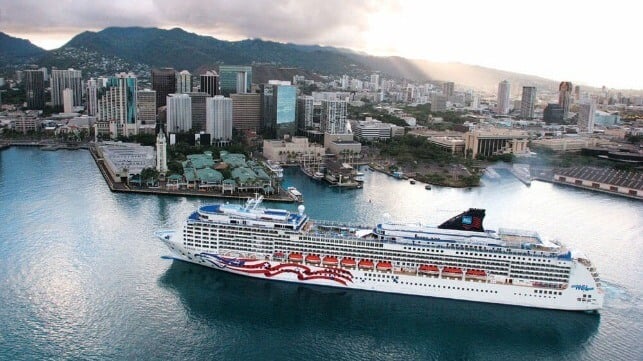
The cruise industry has taken the unusual step of filing a lawsuit seeking to enjoin the enforcement of a new Hawaiian law that they claim is unconstitutional and will impose unreasonable fees on cruise ships docking in the state. At issue is a new law known as the “Green Fee” enacted in Hawaii in May and due to go into effect on January 1, increasing the state tax on hotels and short-term rentals, and for the first time extending the tax to cruise ship passengers.
The state government ratified the first-of-its-kind legislation this year, saying it would provide funding to deal with the impacts of climate change on its resources. It cited beach erosion and the devastating fire on Maui in 2023. Experts have predicted the new taxes could raise as much as $100 million annually.
Hotel guests and short-term rentals have long been paying taxes in Hawaii. The new law increases the tax on those visitors from the current 10.25 percent, adding .75 percent for a total of 11 percent of their stay, with various exemptions. At the same time, the law imposes for the first time an 11 percent “Green Fee” on cruise ship passengers for the time their ship is docked in Hawaiian ports and also gives the local government the authority to collect an additional 3 percent surcharge.
The trade group Cruise Lines International Association, along with several representatives of Hawaii businesses impacted by the cruise tax, filed suit in U.S. District Court for Hawaii on August 27, seeking an injunction to block the tax and reporting requirements.
According to the suit, the “Green Fee” is a “blatant violation” of the U.S. Constitution, federal Rivers and Harbors regulations, and the principles of freedom of speech. The suit contends that U.S. federal legislation ensures that “navigable waters of the United States are a common resource, not one to be commandeered by individual states for their own parochial revenue-raising interests.” They assert that no other state has attempted this type of fee, which they allege will be used to fund the state’s treasury and fund green projects as opposed to being linked to services provided to the cruise ships.
The suit highlights the regulations in the federal Rivers and Harbors Appropriation Act of 1884 as well as the “tonnage clause” in the U.S. Constitution. They write that Hawaii is violating federal statutory limits on the fees states may impose for the use of navigable waters. They also claim the tax is unfair because it lacks the exemptions provided for hotel and short-term rental guests and is disproportionate for cruise passengers compared to other entities related to tourism in the state.
The suit also attacks a provision that requires the cruise ships to post notices about compliance with the fee onboard and include similar information in every advertisement for Hawaii-bound cruises. Since the fee is unconstitutional, they assert the notification is a violation of free speech.
Cruises they report bring about 3000,000 tourists annually to Hawaii based on 2023 data. Hawaii government data shows that there were more than 9.6 million visitors to the state in 2023.
In the suit, CLIA contends the additional fees will make Hawaii cruises far more expensive for families. They write it will add hundreds of dollars to the cost of popular cruise itineraries that dock in Hawaii’s ports. They suggest that families will forgo trips to Hawaii in favor of other destinations, also hurting the state’s broader economy and businesses in Hawaii that draw revenues from cruise passengers.
The suit asks the court to enjoin the state from enforcing the new legislation. A hearing is scheduled for the end of October.
The cruise industry has long been known to use its size to pressure destinations that impose taxes or other levies, but this is only the second time that CLIA has filed suit against a state. In 2016, CLIA Alaska sued Juneau, Alaska, as part of its fight with the state over head taxes. That suit also hinged on the “tonnage clause,” and in 2018, the U.S. District Court sided with CLIA that a tax could only be imposed for services that were being provided to the vessel. The following year, CLIA and Juneau reached a settlement in the case over the use of the passenger taxes.
The cruise industry has been facing similar pressures internationally. Greece recently imposed new fees to deal with the impact on the most popular islands after many complained that the ports, such as Santorini and Mykonos, were being overrun by cruise passengers. Mexico also announced a large head tax, but later reached an agreement with the cruise industry for a more phased approach to the fees.
Disney Adventure Cruise Ship Departs Wismar for Trials
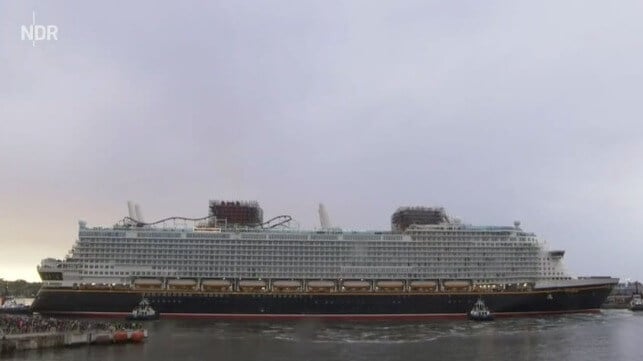
Disney’s newest cruise ship and the eleventh largest in the cruise industry departed Wismar, Germany, on the evening of September 1, for sea trials. It marks several firsts as Disney will be the third cruise line to exceed the 200,000 gross ton mark, while also bringing to a close the construction in Wismar, which was marked by the financial collapse of Genting Hong Kong and the bankruptcy of the builder MV Werften.
The departure of the Disney Adventure was delayed, with reports that it had been planned for Saturday and then pushed back first to Sunday and finally to Monday. The German media outlet NDR reports there were concerns over the water level in the Bay of Wismar, which is currently low, and winds due to the size and height of the ship at nearly 70 meters (230 feet).
The ship got underway at around 1830 on September 1, with NDR reporting the harbor had been closed to all other ships and boats. A flotilla of tugs and harbor boats was on hand to assist the massive 1,122-foot (342-meter) vessel as it pushed off the fitting-out dock where it had been since April. It moved forward slowly and then pivoted with the assistance of tugs and its bow thrusters. The construction scaffolds still remain around the vessel's funnels.
Due to the low water level, the ship will be making a stop at Mukran, Germany, on Rügen Island. There, it will refill its fresh water tanks and take on final supplies before heading into the North Sea for trials. The ship will then proceed to Bremerhaven after the trials to complete fitting out and is scheduled for a handover to Disney Cruise Line around the end of the month.
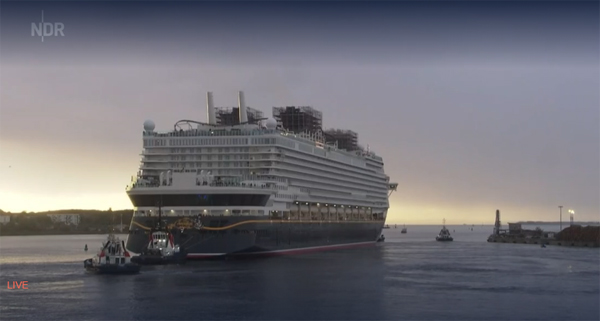
Disney Adventure departing Wismar, Germany (NDR live broadcast)
At 206,500 gross tons, the Disney Adventure is part of the emerging group of cruise ships exceeding the 200,000 GT mark and follows only Royal Caribbean International’s Icon and Oasis class and MSC Cruises’ World class in size. Norwegian Cruise Line and Carnival have ordered similarly large cruise ships, which will begin delivery late in the decade.
Disney acquired the ship from the bankruptcy of MV Werften and employed Meyer Werft to complete the construction at the shipyard in Wismar. The yard itself has been sold to TKMS for naval construction.
Work on the ship began in 2018 for Genting Hong Kong’s Dream Cruises, known as Global One and named Global Dream. Designed for the Asian cruise market, the ship was going to have accommodations for approximately 9,500 passengers and over 2,000 crew. MV Werften filed for bankruptcy in January 2022. A planned sister ship was scrapped before assembly began.
Disney redesigned the ship in keeping with its brand and experiences. Passenger capacity is now reported at approximately 6,700 and 2,300 crew. The ship was finally emerged from the building hall in April.
Areas of the ship, such as a large casino, were reworked, and decor was created in the Disney style. Some features, including a roller coaster amusement, have been retained from the original design. Disney scheduled the ship to operate short cruises from Singapore year-round starting in mid-December.
It is part of a large expansion of the cruise line. Late this year, the company will also add a cruise ship to its U.S.-based operations, the Disney Destiny, which was recently floated out at Meyer’s yard in Papenburg, Germany. Work has begun on another cruise ship at Papenburg, and Disney has ordered three additional ships, also to be built by Meyer. The operator of the Disney Tokyo Resort has also ordered its first cruise ship.
Disney launched the cruise line in 1998 with a ship called Disney Magic. Today, the company operates six cruise ships with the operation reported to be one of the most profitable portions of the Disney corporation.

No comments:
Post a Comment