Opinion
Rosh Hashana helps us envision a Judaism beyond nationalism
(RNS) — The idea of ‘the Jewish People’ as a unified nation is a modern invention.
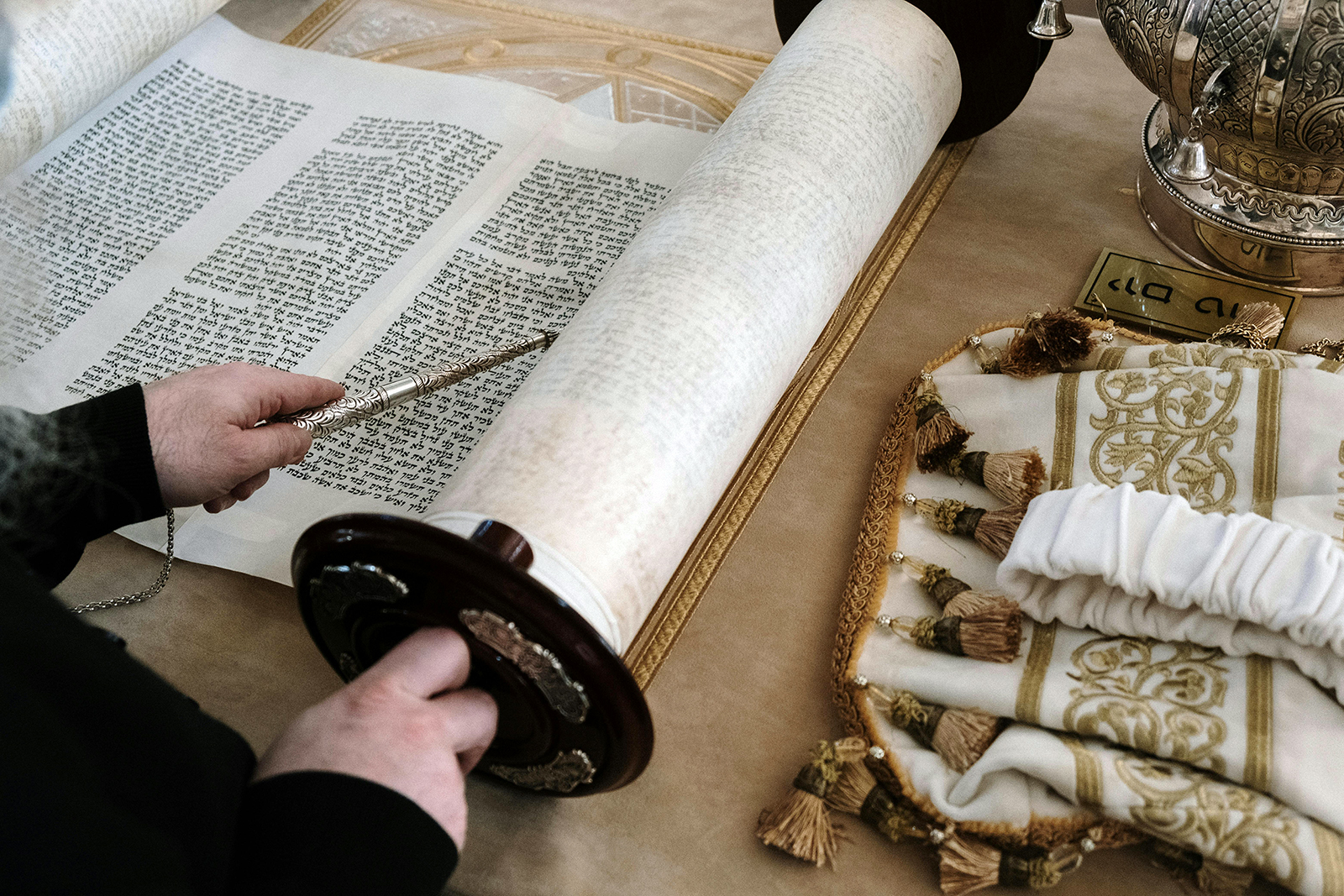
(Photo by cottonbro studio/Pexels/Creative Commons)
Andrue Kahn
September 23, 2025
(RNS) — As antisemitism, Zionism and Judaism continue making daily headlines, I frequently find myself in conversations about what it means to be Jewish. The conflict in Gaza has generated a slurry of confusion about Judaism, anti-Judaism, Zionism and anti-Zionism and led to utter chaos with regard to perceptions of Jews, by Jews and by others. Jews are being pressed to define who we are, how we belong and what responsibilities we carry.
The holiday of Rosh Hashana offers a vital place to begin. Other Jewish holidays focus on ancient Israelite history; Rosh Hashana is universal. It celebrates the creation of the universe and humanity. Its prayers describe God as the judge of all life, not only of Jews. The Jewish story is, it tells us, a story about the whole world.
This emphasis on the universal is especially important as much of Jewish discourse in America has become consumed by ethnonationalism. Jewish nationalism (or Zionism) is said by some to be inseparable from Judaism itself. Others, myself included, look to the kind of Jewish universalism found in Rosh Hashana as a call to resist nationalism’s exclusionary and often supremacist logic.
This debate itself is rooted in rich theological and historical questions: What does it mean for Jews to be “chosen,” and how did the modern concept of “Jewish peoplehood” arise from that idea?
The notion of Jews as “chosen” by God has been interpreted over the centuries as divine favoritism, as a burden, as an aspirational motivation to model justice. Accordingly, Jews have celebrated chosenness as a gift or discarded it as an outdated relic that invited resentment and arrogance. But at its core, chosenness has been about covenant. Jewish teachings and practices, or Torah, provided tools to connect to the divine and humanity’s highest aspirations. Jews, born or by choice, were “chosen” by choosing to take on the commitments of Torah.
In mid-20th-century America, a new idea of “Jewish peoplehood” was popularized by Rabbis Mordecai Kaplan, the founder of Reconstructionist Judaism, and Stephen S. Wise, a major shaper of Reform Judaism. This described Jews as an ethnic collective, and in so doing it adopted the ideas of U.S. Supreme Court Justice Louis Brandeis’ American Zionism. In a 1915 speech, Brandeis said:
A man is a better citizen of the United States for being also a loyal citizen of his state. … Every Irish American who contributed towards advancing home rule (in Ireland) was a better man and a better American for the sacrifice he made. Every American Jew who aids in advancing the Jewish settlement in Palestine, though he feels that neither he nor his descendants will ever live there, will likewise be a better man and a better American for doing so.
The new language of peoplehood proved enormously successful. It embodied Brandeis’ goal of making Jewish difference legible to the American mainstream as a European-style national people with a singular history, language and land. This was attractive in an era when European Jewish immigrants sought to integrate into white ethnic America, while strengthening ideological ties to the emerging state of Israel.
But what was actually on offer was a chosenness remodeled into ethnonational exceptionalism. Kaplan’s basic premise was, as he wrote in his 1955 book, “A New Zionism,” rooted in the “persistence in the Gentile consciousness of Jews as an identifiable group.” The problem with this ideology is that it smuggled into the very heart of Jewish identity a belief central to the most virulent antisemitic views, that Jews are united as a singular, global group with shared nationalist goals. It also flattened the immense diversity of Jewish cultures into a nationalist identity consistent with European, generally Ashkenazi, Judaism.
Building on this premise, Kaplan reframed Judaism as “a non-creedal religious civilization, centered in loyalty to the body of the Jewish People throughout the world.” In “The Religion of Ethical Nationhood,” written in 1970, he made this more explicit: “Judaism … has pioneered in adumbrating man’s potential in achieving that collective religious experience which can motivate men and nations to achieve ethical nationhood.”
“Peoplehood” became a powerful framework. It not only gave American Jews a sense of unity but provided a narrative linking the Holocaust to the state of Israel: Jews were a people nearly destroyed, now restored in their land. It dovetailed neatly with American exceptionalism, casting the U.S. as the rescuer of Jews and the guarantor of Israel, and Israel as the unifying thread linking all Jews. Israel became the necessary “homeland for the Jews,” and support for Israel became the litmus test of belonging. Those who dissent are often accused of betraying “the Jewish People.”
But this framework distorts Jewish history. For most of Jewish existence, there was no unified “Jewish People.” Jews have lived and thrived heterogeneously in places as widespread as Aleppo, Mtskheta, Addis Ababa, Baghdad, Sanaa and Cochin, each with distinct practices, customs and self-understandings. They often disagreed sharply with one another, and rarely imagined themselves a single, homogeneous nation.
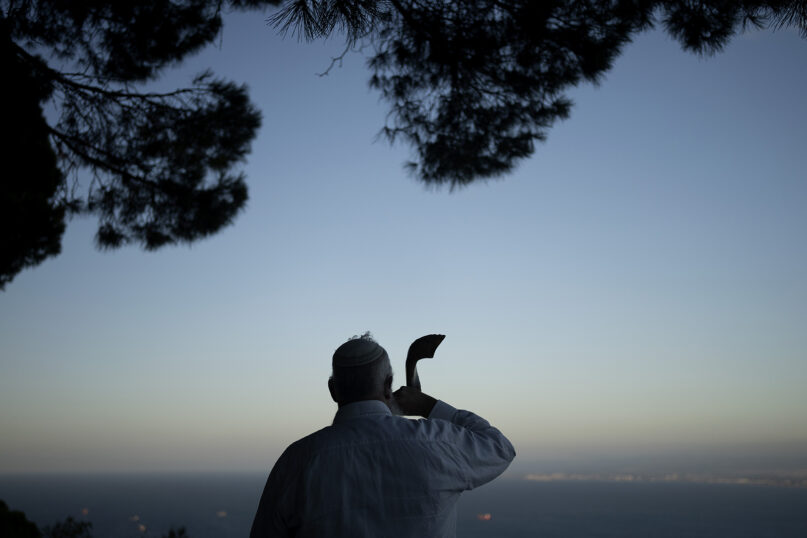
A man blows a shofar, a ram’s horn, marking Rosh Hashana, the Jewish new year, overlooking the port of Haifa, Israel, Oct. 4, 2024. (AP Photo/Maya Alleruzzo)
Instead of nationalism, Jewish collectivity was mythopoetic: a spiritual understanding of covenant via Torah, which expressed itself in many differing, and often mutually exclusive, forms throughout the world.
Rosh Hashana reminds us of this historical reality. On this holiday, Jews do not celebrate the birth of a single people, but the creation of the world. The image is expansive: Every creature passes before the Creator, every being is judged, every life matters.
That vision undercuts the narrowness of a falsely homogenizing peoplehood. It reminds us that the Jewish story is bound up with the story of all humanity — as Jews have dwelled among all humanity. Torah is a wisdom tradition carried in Jewish form and meant to be tested, adapted, shared and lived out in relationship with the rest of the world.
Jewish texts echo this universalism. Classical rabbinic midrash teaches that the Torah was offered to all nations. The medieval rabbinic giant Maimonides wrote to a convert that Abraham’s lineage is spiritual, not genetic. These perspectives affirm what Rosh Hashana proclaims: that Jewish distinctiveness is real, insofar as it complements the distinctiveness of each facet of the whole of humanity.
In her 1991 feminist classic “Standing Again at Sinai,” Judith Plaskow critiques the patriarchal notion of chosenness and sees Jewish identity as one thread in a wider tapestry. Within the Jewish community, diversity is a divine guide to connecting with the non-Jewish world. Jews are called to live fully as themselves and as Jews, always in relation to others, always as part of a larger human ecosystem.
Judith Butler, in their 2013 book “Parting Ways,” develops the idea of “unchosenness,” arguing that Jews live in “irreversible heterogeneity.” Jewish identity arises precisely from the fact that we do not choose our neighbors, our histories or our vulnerabilities. In this, we are inescapably bound to others who are different from us. Diaspora is not a problem to be solved through nationalism, Butler says; it is the essence of Jewish ethical life. To be Jewish is to practice responsibility amid difference, to learn how to cohabitate in a world we share.
Plaskow and Butler, taken together, offer a vision of Judaism that resonates deeply with the spirit of Rosh Hashana. They move us beyond exceptionalism toward interdependence. They remind us that Jewish flourishing requires many communities, locally grounded, engaged with Torah and committed to justice with their neighbors.
This is not an abandonment of Jewish identity. On the contrary, it is a recovery of Judaism’s richest strands. The idea of “the Jewish People” as a unified nation is a modern invention. Jewish flourishing has happened best in conversation with neighbors and by applying ethical practices to daily life.
RELATED: On Rosh Hashana, wishing you a punny new year
Rosh Hashana’s universalism calls us back to this truth. All humanity shares one origin. All life stands before one Creator. If we truly believe this, then the Jewish task is to defy nationalism and live out Torah’s wisdom in ways that build solidarity and justice across boundaries.
This year, as Jews around the world gather for Rosh Hashana, I invite us to let go of myths that no longer serve us. Let us question whether “peoplehood” is the foundation we want. Let us reclaim a Judaism that is at once particular and universal, distinct and connected, local and global. May we not strive to be a singular “People” above others, but communities among communities, committed to the flourishing of all life.
(Rabbi Andrue Kahn is executive director of the American Council for Judaism. The views expressed in this commentary do not necessarily reflect those of Religion News Service.)
How the spiritual sound of the shofar shapes the Jewish new year – a Jewish studies scholar explains
(The Conversation) — The shofar is used on many different occasions in the Bible. But today, for many Jews, it is most associated with the High Holidays: Rosh Hashana and Yom Kippur.
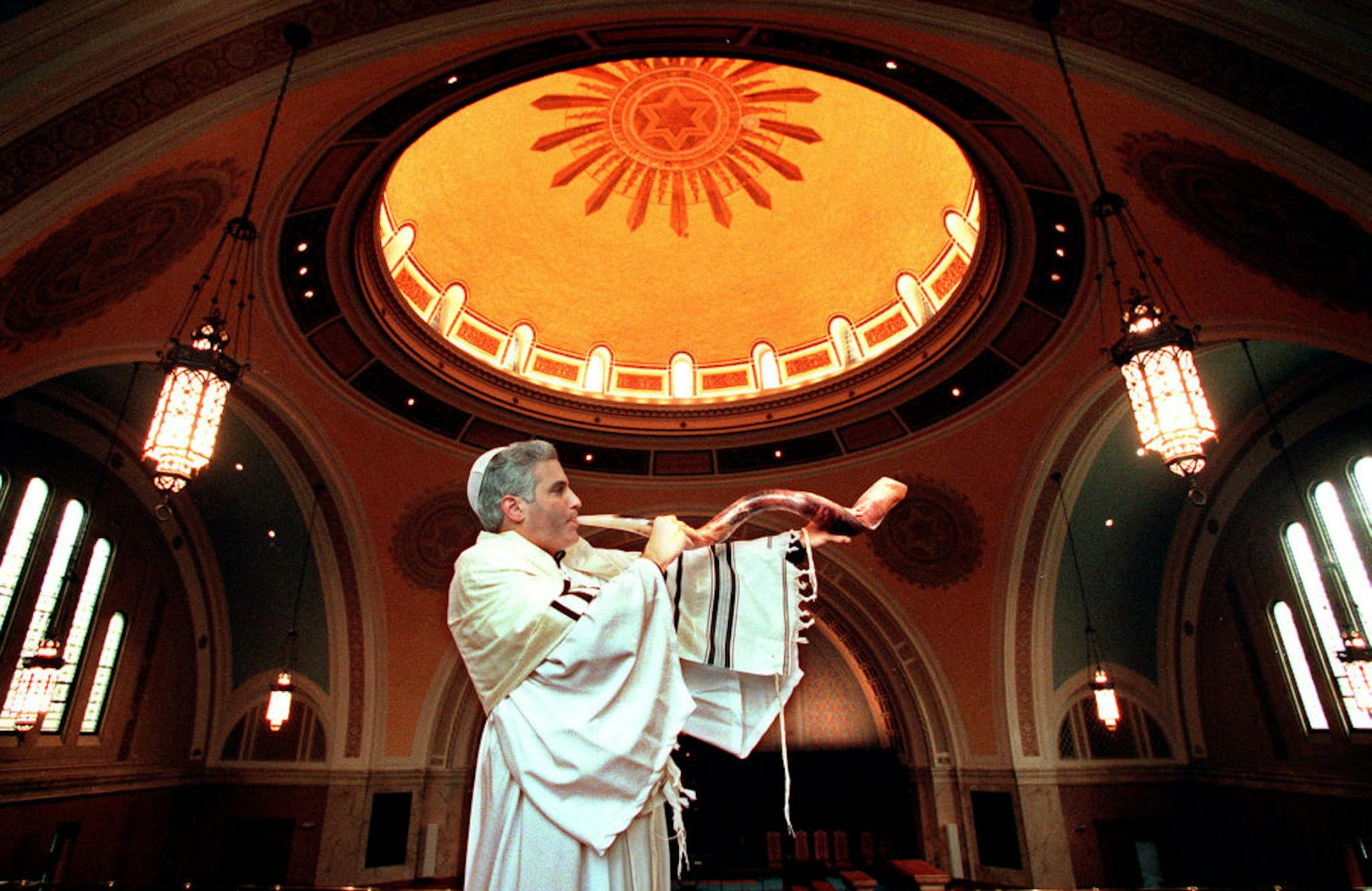
Mark Lipof blows a shofar during the lead-up to Yom Kippur at Temple Ohabei Shalom in Brookline, Mass.
(Michael Fein/MediaNews Group/Boston Herald via Getty Images)
Sarah Pessin
September 19, 2025
(The Conversation) — It’s the Jewish High Holiday season, and Jews the world over are preparing to visit their local synagogues – for community, for prayer, and to hear the arresting, soulful sounds of the shofar.
An animal horn – typically a ram’s horn – used as a wind instrument, the shofar is featured over 70 times in the Torah. In ancient Jewish tradition, horns were sounded for everything from calls to action to royal coronations. In the spirit of both, the Bible calls upon Jews to raise forth shofar blasts on Rosh Hashana, which literally means the “head,” or start, of the year.
The holiday is a time of communitywide soul-searching. Beyond marking the Jewish new year, it also commemorates the world’s birthday, the creation of humans, and the sovereignty and majesty of God. Marking the start of the High Holiday season, Rosh Hashana kicks off a 10-day period of reflection that culminates in Yom Kippur, the Day of Atonement, whose last moments are also marked by the shofar’s call.
According to the Talmud, a central collection of rabbinic teachings on Jewish law and theology, three divine books are opened on Rosh Hashana. Each person is inscribed into one of the three: one book for the righteous, one for the wicked and one for those in between, who are given till Yom Kippur to set their hearts straight.
Rabbis say the shofar’s sounds cause God to move from his “throne of judgement” to his “throne of mercy.” They also say that shofar sounds can penetrate human hearts, prompting them toward repentance – while mimicking the broken-hearted cries of someone recognizing just how much they need to repent.
September 19, 2025
(The Conversation) — It’s the Jewish High Holiday season, and Jews the world over are preparing to visit their local synagogues – for community, for prayer, and to hear the arresting, soulful sounds of the shofar.
An animal horn – typically a ram’s horn – used as a wind instrument, the shofar is featured over 70 times in the Torah. In ancient Jewish tradition, horns were sounded for everything from calls to action to royal coronations. In the spirit of both, the Bible calls upon Jews to raise forth shofar blasts on Rosh Hashana, which literally means the “head,” or start, of the year.
The holiday is a time of communitywide soul-searching. Beyond marking the Jewish new year, it also commemorates the world’s birthday, the creation of humans, and the sovereignty and majesty of God. Marking the start of the High Holiday season, Rosh Hashana kicks off a 10-day period of reflection that culminates in Yom Kippur, the Day of Atonement, whose last moments are also marked by the shofar’s call.
According to the Talmud, a central collection of rabbinic teachings on Jewish law and theology, three divine books are opened on Rosh Hashana. Each person is inscribed into one of the three: one book for the righteous, one for the wicked and one for those in between, who are given till Yom Kippur to set their hearts straight.
Rabbis say the shofar’s sounds cause God to move from his “throne of judgement” to his “throne of mercy.” They also say that shofar sounds can penetrate human hearts, prompting them toward repentance – while mimicking the broken-hearted cries of someone recognizing just how much they need to repent.
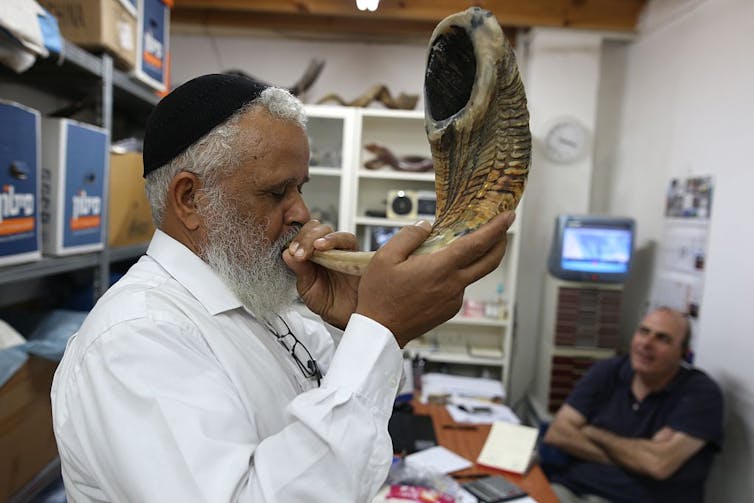
A Jewish man preparing for Rosh Hashana tests the sound of a shofar before buying it.
Menahem Kahana/AFP via Getty Images
As a scholar of Jewish tradition, I’ve worked extensively on the downright esoteric writings of Moses Maimonides, a 12th-century Jewish philosopher. When it comes to the meaning of the shofar’s call, though, Maimonides offers a refreshingly down-to-earth take in the Mishneh Torah, his guide to Jewish law: “Wake up you sleepy ones from your sleep and you who slumber, arise. Inspect your deeds, repent, remember your Creator.”
Sonic-spiritual pause
The sound of the shofar is uniquely rich and searching, somewhere between a human cry and an otherworldly hum. It fills the room as well as one’s entire body – inviting a moment of pause, of existential reckoning.
During the High Holidays there are three varieties of shofar blasts, which are combined into a series of sound constellations throughout the prayer service.
The first kind of blast is a single, solid sounding called “tekiah.” This one also comes in a “tekiah gedolah,” or “big tekiah,” version that stretches on for a longer stint. The second sound pattern is called “shevarim,” made up of three medium blares. And the third is called “teruah,” consisting of at least nine staccato soundings – or, for Jews of Yemenite heritage, another single tone.
The shofar is sounded throughout the two days of Rosh Hashana – in some congregations, 100 times per day. The constancy and repetition enhance the sounds’ capacity to engage participants’ minds, hearts and spirits.
Three types of shofar blasts are combined during High Holiday services.
The sound of the shofar is uniquely rich and searching, somewhere between a human cry and an otherworldly hum. It fills the room as well as one’s entire body – inviting a moment of pause, of existential reckoning.
During the High Holidays there are three varieties of shofar blasts, which are combined into a series of sound constellations throughout the prayer service.
The first kind of blast is a single, solid sounding called “tekiah.” This one also comes in a “tekiah gedolah,” or “big tekiah,” version that stretches on for a longer stint. The second sound pattern is called “shevarim,” made up of three medium blares. And the third is called “teruah,” consisting of at least nine staccato soundings – or, for Jews of Yemenite heritage, another single tone.
The shofar is sounded throughout the two days of Rosh Hashana – in some congregations, 100 times per day. The constancy and repetition enhance the sounds’ capacity to engage participants’ minds, hearts and spirits.
Three types of shofar blasts are combined during High Holiday services.
Sourcing shofars
To make a shofar, a horn is boiled to soften its innards for removal. Using heat to straighten part of the horn, the craftsman carefully drills a hole and carves a mouthpiece at one end. Heat can be used to further straighten the horn, and the finish can range from natural to polished.
As for the species and shape of shofars, there are differences of opinion – and of culture. Amid rabbinic debates over straight shofars or curved ones for Rosh Hashana, Maimonides says only a curved ram’s horn will do. Jews of Yemenite heritage use the kudu antelope, whose spectacularly long horns produce a strikingly deep sound. And the “Moroccan shofar” is said to have emerged during the Spanish Inquisition: Because Jews needed to hide their shofars to avoid persecution, they were crafted to be flat and straight.
The hollowness of the shofar is what produces its unique sound, so it needs to be made of a horn, not an antler. And it will need to come from a kosher animal, an animal permissible to eat under Jewish law – which, for land animals, means having split hooves and chewing its cud.
On both counts, only certain animals will do, including goats, antelopes and rams. And regardless of the kind of shofar it is, it takes some practice to get a sound to come out of it at all.
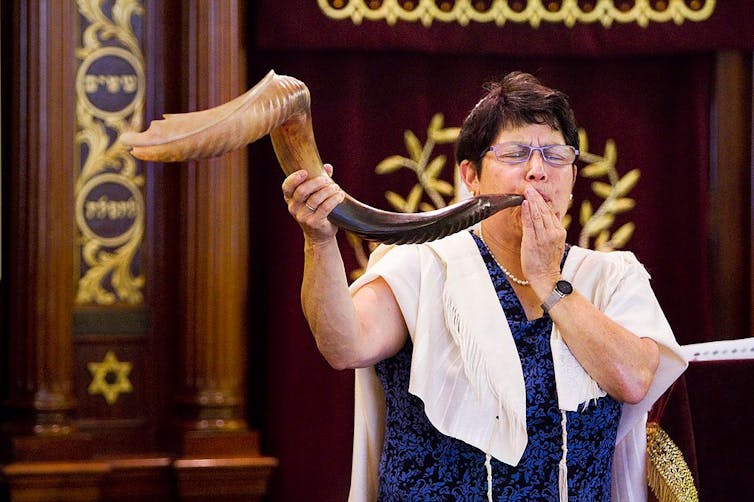
Rabbi Carolyn Braun plays a shofar during a ceremony at The Cedars retirement community in Portland, Maine
Carl D. Walsh/Portland Press Herald via Getty Images
To make a shofar, a horn is boiled to soften its innards for removal. Using heat to straighten part of the horn, the craftsman carefully drills a hole and carves a mouthpiece at one end. Heat can be used to further straighten the horn, and the finish can range from natural to polished.
As for the species and shape of shofars, there are differences of opinion – and of culture. Amid rabbinic debates over straight shofars or curved ones for Rosh Hashana, Maimonides says only a curved ram’s horn will do. Jews of Yemenite heritage use the kudu antelope, whose spectacularly long horns produce a strikingly deep sound. And the “Moroccan shofar” is said to have emerged during the Spanish Inquisition: Because Jews needed to hide their shofars to avoid persecution, they were crafted to be flat and straight.
The hollowness of the shofar is what produces its unique sound, so it needs to be made of a horn, not an antler. And it will need to come from a kosher animal, an animal permissible to eat under Jewish law – which, for land animals, means having split hooves and chewing its cud.
On both counts, only certain animals will do, including goats, antelopes and rams. And regardless of the kind of shofar it is, it takes some practice to get a sound to come out of it at all.
Rabbi Carolyn Braun plays a shofar during a ceremony at The Cedars retirement community in Portland, Maine
Carl D. Walsh/Portland Press Herald via Getty Images
Holy covenant
The popular use of rams’ horns is also a nod to the biblical story of the binding of Isaac, which is traditionally read during Rosh Hashana services.
According to the Book of Genesis, God commanded Abraham to sacrifice Isaac, his beloved son. After nearly going through with the killing, Abraham has a heavenly vision in which he is thanked for his loyalty to God and instructed to spare Isaac after all. Abraham sees a ram caught in a nearby thicket, which he sacrifices to God instead. The next verses describe God blessing Abraham and all his future descendants – which Jews read as a key moment in their identity as a people.
In the Talmud and across a number of other Jewish texts, blowing a ram’s horn for the new year invokes this same redemptive energy: God’s willingness to watch over not just Abraham and Isaac but the entire Jewish community, in a spirit of mercy and blessing.
Using a bull’s horn as a shofar, on the other hand, doesn’t fly. Rabbis rule it out because the term for a cow horn in the bible is “keren,” not “shofar.” The bull’s horn is also seen as too much of a reminder of another key story from the Torah: the Sin of the Golden Calf.
As the Book of Exodus describes it, God led the people of Israel out of slavery in Egypt. He then shares that he would reveal his law to them as a form of everlasting covenant, working through Moses as his spokesperson.
To make the point, God called Moses up to Mt. Sinai, accompanying him in the form of thunder, lightning and fire. Together with pillars of smoke, and louder and louder shofar blasts, the experience left the people awestruck. While details are debated, the text says that they then assented to God’s law – including the commandment not to worship idols.
Yet when Moses heads back to the mountaintop, the Israelites fear he’s abandoned them. Eager for immediate spiritual support, and in spite of having just agreed to God’s law, they built a bovine idol and proceed to worship at its feet.
God considers destroying the people. Yet Moses reminds God of the promise to protect Abraham and his descendants – a direct loop back to the binding of Isaac.
What’s in a word
It appears that the origin of the term “shofar” is “šappāru,” a word in the Akkadian language of the ancient Near East that originally referred to types of rams, deer or wild goats. But there is also a rabbinic commentary connecting the word “shofar” to the Hebrew term for beauty and improvement – suggesting the shofar inspires people to beautify their souls, aligning their actions with their values.
Regardless of the historical etymology of the word, this reading certainly captures the tenor and texture of hearing the shofar during the High Holidays. Its sounds inspire Jews to take spiritual inventory, surveying where the previous year has led them and planning the paths upon which they will next embark.
(Sarah Pessin, Professor of Philosophy, University of Denver. The views expressed in this commentary do not necessarily reflect those of Religion News Service.)
The Conversation religion coverage receives support through the AP’s collaboration with The Conversation US, with funding from Lilly Endowment Inc. The Conversation is solely responsible for this content.

No comments:
Post a Comment