New clashes in Iran as protests enter second week: rights groups
By AFP
January 4, 2026

Protests have affected at least 40 different cities in Iran to varying degrees over the last week - Copyright AFP MAXIME SCHMID
Stuart WILLIAMS
New deadly clashes between protesters and security forces erupted in Iran over the weekend, rights groups and local media said Sunday, as demonstrations first sparked by anger over the rising cost of living entered a second week.
At least 12 people including members of the security forces have been killed since the protests kicked off with a shopkeeper’s strike in Tehran on December 28, according to a toll based on official reports.
Overnight, protests featuring slogans criticising the Islamic republic’s clerical authorities were reported in Tehran, Shiraz in the south, and in areas of western Iran where the movement has been concentrated, according to the US-based Human Rights Activists News Agency (HRANA) monitor.
The demonstrations are the most significant in Iran since a 2022-2023 movement sparked by the death in custody of Mahsa Amini, who had been arrested for allegedly violating Iran’s strict dress code for women.
The latest protests have been concentrated in parts of the west with large populations of the Kurdish and Lor minorities, and have yet to reach the scale of the 2022-2023 movement, let alone the mass street demonstrations that followed disputed 2009 presidential elections.
But they do present a new challenge for supreme leader Ayatollah Ali Khamenei — 86, and in power since 1989 — coming on the heels of a 12-day war with Israel in June that saw nuclear infrastructure damaged and key members of the security elite killed.
The protests have taken place in 23 out of 31 provinces and affected, to varying degrees, at least 40 different cities, most of them small and medium-sized, according to an AFP tally based on official announcements and media reports.
– Deadly clashes –
The Norway-based Hengaw rights group said that Revolutionary Guards opened fire on protesters in the Malekshahi county of the western Ilam province on Saturday, killing four members of Iran’s Kurdish minority.
The group said it was checking reports that two other people had been killed, adding dozens more were wounded. It also accused the authorities of raiding the main hospital in the city of Ilam to seize the bodies of the protesters.
The Iran Human Rights NGO, also based in Norway, gave an identical toll of four dead, as well as 30 wounded, after “security forces attacked the protests” in Malekshahi.
Both organisations posted footage of what appeared to be bloodied corpses on the ground, in videos verified by AFP.
Iran’s Mehr news agency alluded to the clashes, saying a Revolutionary Guard was killed in a confrontation with “rioters” at a police office.
“Rioters attempted to storm a police station,” the Fars news agency reported, saying “two assailants were killed”.
In Tehran, sporadic demonstrations on Saturday night were reported in districts in the east, west and south, the Fars news agency said.
Videos verified by AFP showed security forces dispersing protesters who had gathered overnight and blocked a road by overturning garbage cans.
On Sunday, the vast majority of shops were open in the capital, although the streets appeared less crowded than usual, with riot police and security forces deployed at major intersections, AFP observed.
– ‘Growing confrontation’ –
The protests began last week with a shutdown by merchants in the Tehran bazaar, an influential economic hub, and spread to other regions as well as universities.
UN special rapporteur on human rights in Iran Mai Sato said Friday that “reports indicate growing confrontation between protesters and security forces”, and warned the violent response witnessed during the 2022-2023 movement “must not be repeated”.
HRNA said that over the last week at least 582 people have been arrested. Hengaw said almost all of those killed were from ethnic minorities, chiefly Kurds and Lors.
President Donald Trump said on Friday that the United States was “locked and loaded” to respond if Iran killed protesters — a day before the American operation to capture Iran’s ally Venezuelan President Nicolas Maduro.
Iranian Foreign Minister Abbas Araghchi called the remarks “reckless”, and warned that the armed forces were “on standby” in the event of any intervention.
Israeli Prime Minister Benjamin Netanyahu, meanwhile, said Sunday that his country stood in “solidarity with the struggle of the Iranian people”, adding it was possible they were “taking their destiny into their own hands”.
Publicly, Iranian officials including Khamenei have taken a conciliatory tone when it comes to protesters’ economic demands, while warning that destabilisation and chaos will not be tolerated.
By AFP
January 4, 2026
Protests have affected at least 40 different cities in Iran to varying degrees over the last week - Copyright AFP MAXIME SCHMID
Stuart WILLIAMS
New deadly clashes between protesters and security forces erupted in Iran over the weekend, rights groups and local media said Sunday, as demonstrations first sparked by anger over the rising cost of living entered a second week.
At least 12 people including members of the security forces have been killed since the protests kicked off with a shopkeeper’s strike in Tehran on December 28, according to a toll based on official reports.
Overnight, protests featuring slogans criticising the Islamic republic’s clerical authorities were reported in Tehran, Shiraz in the south, and in areas of western Iran where the movement has been concentrated, according to the US-based Human Rights Activists News Agency (HRANA) monitor.
The demonstrations are the most significant in Iran since a 2022-2023 movement sparked by the death in custody of Mahsa Amini, who had been arrested for allegedly violating Iran’s strict dress code for women.
The latest protests have been concentrated in parts of the west with large populations of the Kurdish and Lor minorities, and have yet to reach the scale of the 2022-2023 movement, let alone the mass street demonstrations that followed disputed 2009 presidential elections.
But they do present a new challenge for supreme leader Ayatollah Ali Khamenei — 86, and in power since 1989 — coming on the heels of a 12-day war with Israel in June that saw nuclear infrastructure damaged and key members of the security elite killed.
The protests have taken place in 23 out of 31 provinces and affected, to varying degrees, at least 40 different cities, most of them small and medium-sized, according to an AFP tally based on official announcements and media reports.
– Deadly clashes –
The Norway-based Hengaw rights group said that Revolutionary Guards opened fire on protesters in the Malekshahi county of the western Ilam province on Saturday, killing four members of Iran’s Kurdish minority.
The group said it was checking reports that two other people had been killed, adding dozens more were wounded. It also accused the authorities of raiding the main hospital in the city of Ilam to seize the bodies of the protesters.
The Iran Human Rights NGO, also based in Norway, gave an identical toll of four dead, as well as 30 wounded, after “security forces attacked the protests” in Malekshahi.
Both organisations posted footage of what appeared to be bloodied corpses on the ground, in videos verified by AFP.
Iran’s Mehr news agency alluded to the clashes, saying a Revolutionary Guard was killed in a confrontation with “rioters” at a police office.
“Rioters attempted to storm a police station,” the Fars news agency reported, saying “two assailants were killed”.
In Tehran, sporadic demonstrations on Saturday night were reported in districts in the east, west and south, the Fars news agency said.
Videos verified by AFP showed security forces dispersing protesters who had gathered overnight and blocked a road by overturning garbage cans.
On Sunday, the vast majority of shops were open in the capital, although the streets appeared less crowded than usual, with riot police and security forces deployed at major intersections, AFP observed.
– ‘Growing confrontation’ –
The protests began last week with a shutdown by merchants in the Tehran bazaar, an influential economic hub, and spread to other regions as well as universities.
UN special rapporteur on human rights in Iran Mai Sato said Friday that “reports indicate growing confrontation between protesters and security forces”, and warned the violent response witnessed during the 2022-2023 movement “must not be repeated”.
HRNA said that over the last week at least 582 people have been arrested. Hengaw said almost all of those killed were from ethnic minorities, chiefly Kurds and Lors.
President Donald Trump said on Friday that the United States was “locked and loaded” to respond if Iran killed protesters — a day before the American operation to capture Iran’s ally Venezuelan President Nicolas Maduro.
Iranian Foreign Minister Abbas Araghchi called the remarks “reckless”, and warned that the armed forces were “on standby” in the event of any intervention.
Israeli Prime Minister Benjamin Netanyahu, meanwhile, said Sunday that his country stood in “solidarity with the struggle of the Iranian people”, adding it was possible they were “taking their destiny into their own hands”.
Publicly, Iranian officials including Khamenei have taken a conciliatory tone when it comes to protesters’ economic demands, while warning that destabilisation and chaos will not be tolerated.
Iranians rally in Tehran as violence intensifies in western regions
Sporadic protests over economic and political grievances broke out inTehran on Saturday, local media reported, while clashes escalated in western Iran. The demonstrations, which first kicked off last Sunday and have since spread across the country, have left at least 12 dead, including security forces.
Issued on: 04/01/2026
By: FRANCE 24
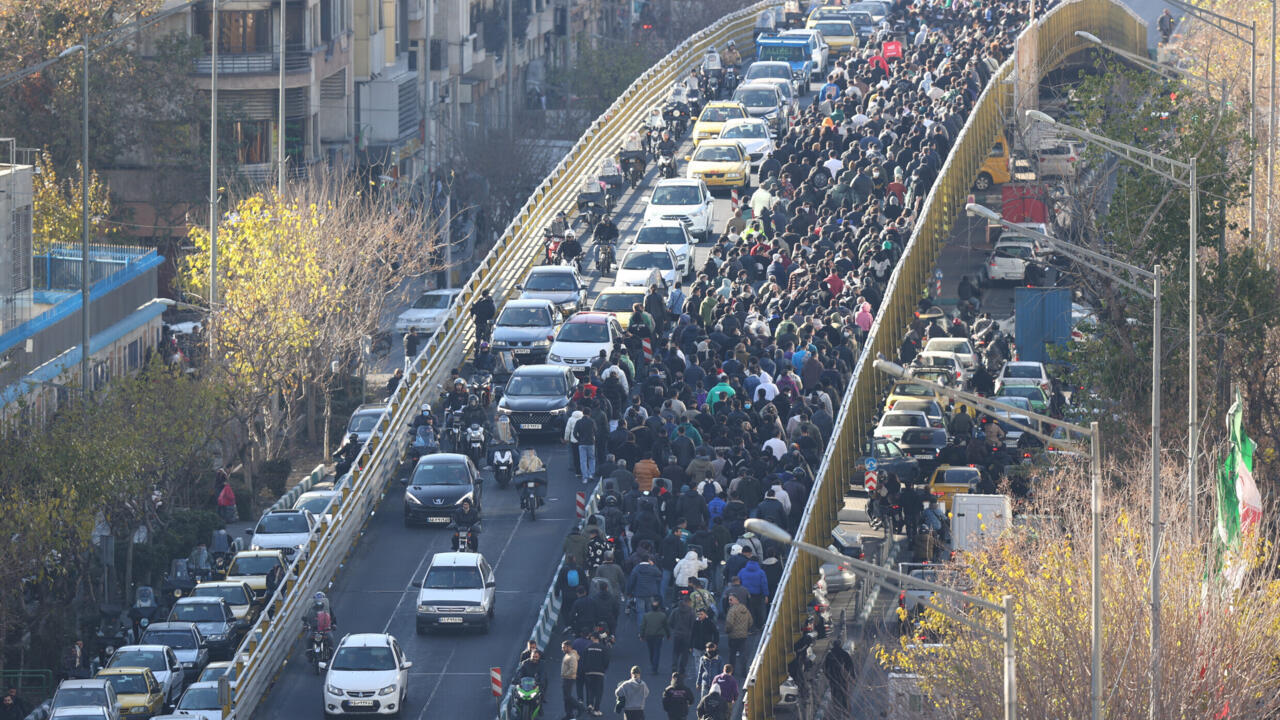
In this file photo, protesters march on a bridge in Tehran, Iran, on December 29, 2025. AP
Sporadic protests broke out in the Iranian capital on Saturday evening, according to local media, which also reported intensifying clashes in the west of the country.
The demonstrations first kicked off last Sunday when shopkeepers staged a strike over economic concerns, but have since spread in size and scope, with protesters making political demands.
The protests have affected, to varying degrees, at least 40 different cities, mostly medium-sized and located in the country's west, according to an AFP tally based on official announcements and media reports.
At least 12 people have been killed, including members of the security forces, according to a toll based on official reports.
Protests Saturday evening in Tehran were described as "limited" by the Fars news agency, which said they were "generally made up of groups of 50 to 200 young people".
Tehran's population is about 10 million.
Demonstrations were reported in the districts of Novobat and Tehran Pars in the capital's east; Ekteban, Sadeghieh and Sattarkhan in the west; and Naziabad and Abdolabad in the south, Fars said.
Demonstrators shouted slogans including "death to the dictator", Fars said, though no major incidents were reported beyond some stone throwing and rubbish bins being set alright.
The news agency said the situation in Tehran "contrasted with an intensification of violence and organised attacks in other regions, notably the country's west".
In Malekshahi, a county of about 20,000 residents including a sizeable Kurdish population, a member of the security forces was killed in clashes, Iranian media reported Saturday.
"Rioters attempted to storm a police station," Fars said, adding that "two assailants were killed".
Local media's accounting of the protests is not exhaustive, and state-run outlets have downplayed their coverage of the demonstrations, while videos flooding social media are often impossible to verify.
(FRANCE 24 with AFP)
Sporadic protests broke out in the Iranian capital on Saturday evening, according to local media, which also reported intensifying clashes in the west of the country.
The demonstrations first kicked off last Sunday when shopkeepers staged a strike over economic concerns, but have since spread in size and scope, with protesters making political demands.
The protests have affected, to varying degrees, at least 40 different cities, mostly medium-sized and located in the country's west, according to an AFP tally based on official announcements and media reports.
At least 12 people have been killed, including members of the security forces, according to a toll based on official reports.
Protests Saturday evening in Tehran were described as "limited" by the Fars news agency, which said they were "generally made up of groups of 50 to 200 young people".
Tehran's population is about 10 million.
Demonstrations were reported in the districts of Novobat and Tehran Pars in the capital's east; Ekteban, Sadeghieh and Sattarkhan in the west; and Naziabad and Abdolabad in the south, Fars said.
Demonstrators shouted slogans including "death to the dictator", Fars said, though no major incidents were reported beyond some stone throwing and rubbish bins being set alright.
The news agency said the situation in Tehran "contrasted with an intensification of violence and organised attacks in other regions, notably the country's west".
In Malekshahi, a county of about 20,000 residents including a sizeable Kurdish population, a member of the security forces was killed in clashes, Iranian media reported Saturday.
"Rioters attempted to storm a police station," Fars said, adding that "two assailants were killed".
Local media's accounting of the protests is not exhaustive, and state-run outlets have downplayed their coverage of the demonstrations, while videos flooding social media are often impossible to verify.
(FRANCE 24 with AFP)
What to Know about the Protests Now Shaking Iran as Tensions Remain High Over Its Nuclear Program
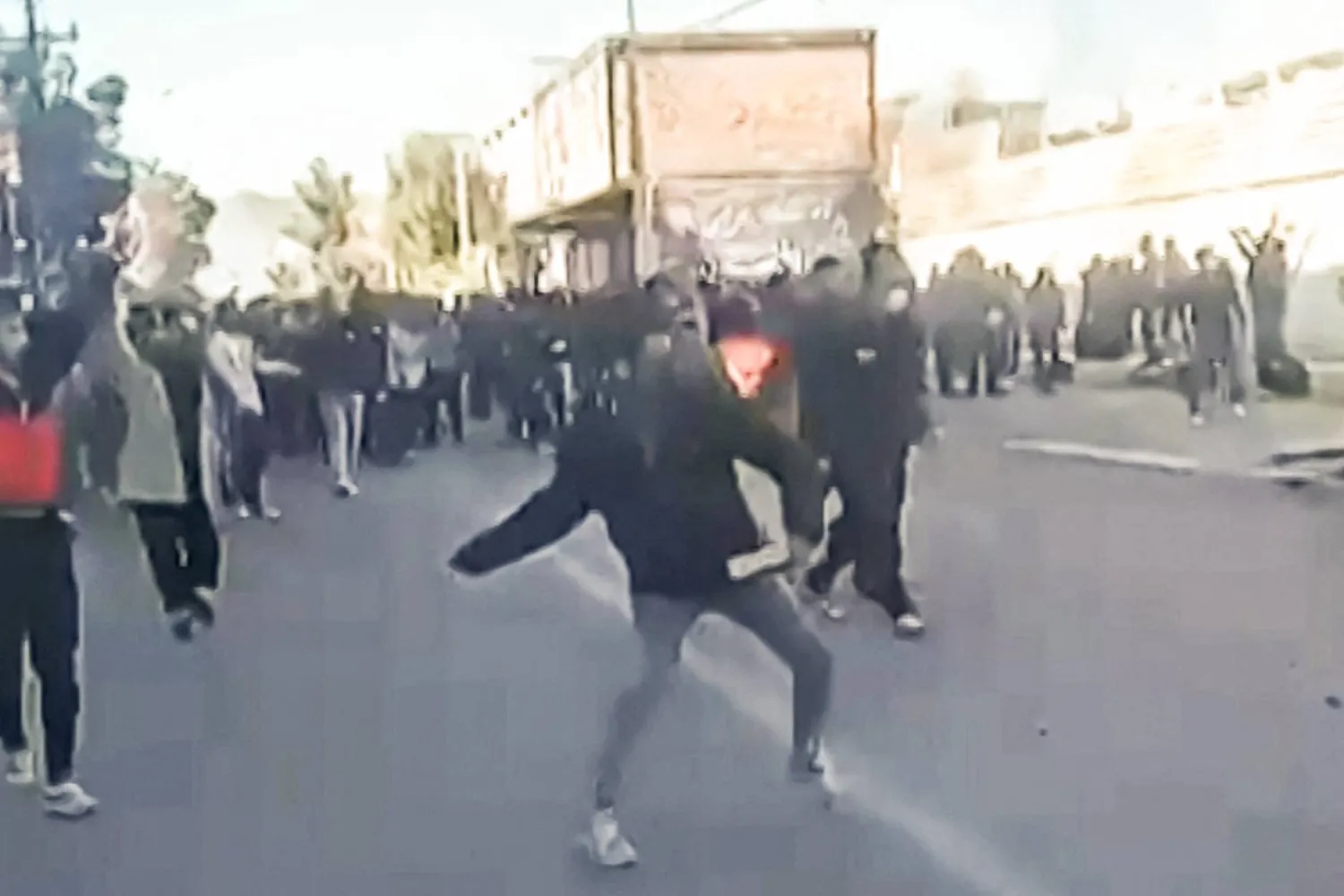
This grab taken on January 2, 2026, from UGC images posted on social media on December 31, 2025, shows protestors attacking a government building in Fasa, in southern Iran on December 31, amidst spontaneous nationwide protests driven by dissatisfaction at the country's economic stagnation. (Photo by UGC / AFP)
Asharq Al Awsat
4 January 2026 AD ـ 15 Rajab 1447 AH
Widening protests in Iran sparked by the republic's ailing economy are putting new pressure on its theocracy.
Tehran is still reeling from a 12-day war launched by Israel in June that saw the United States bomb nuclear sites in Iran. Economic pressure, intensified in September by the return of United Nations sanctions on the country over its atomic program, has put Iran's rial currency into a free fall, now trading at some 1.4 million to $1.
Meanwhile, Iran's self-described “Axis of Resistance” — a coalition of countries and militant groups backed by Tehran — has been decimated in the years since the start of the Israel-Hamas war in 2023, The Associated Press said.
A new threat by US President Donald Trump warning Iran that if Tehran “violently kills peaceful protesters,” the US “will come to their rescue" has taken on new meaning after American troops captured Venezuelan President Nicolás Maduro, a longtime ally of Tehran.
Here's what to know about the protests and the challenges facing Iran's government.
How widespread the protests are
Demonstrations have reached over 170 locations in 25 of Iran’s 31 provinces, the US-based Human Rights Activists News Agency reported early Sunday. The death toll had reached at least 15 killed, it added, with more than 580 arrests. The group, which relies on an activist network inside of Iran for its reporting, has been accurate in past unrest.
Understanding the scale of the protests has been difficult. Iranian state media has provided little information about the demonstrations. Online videos offer only brief, shaky glimpses of people in the streets or the sound of gunfire. Journalists in general in Iran also face limits on reporting such as requiring permission to travel around the country, as well as the threat of harassment or arrest by authorities.
But the protests do not appear to be stopping, even after Supreme Leader Ali Khamenei on Saturday said “rioters must be put in their place.”
Why the demonstrations started
The collapse of the rial has led to a widening economic crisis in Iran. Prices are up on meat, rice and other staples of the Iranian dinner table. The nation has been struggling with an annual inflation rate of some 40%.
In December, Iran introduced a new pricing tier for its nationally subsidized gasoline, raising the price of some of the world’s cheapest gas and further pressuring the population. Tehran may seek steeper price increases in the future, as the government now will review prices every three months.
The protests began first with merchants in Tehran before spreading. While initially focused on economic issues, the demonstrations soon saw protesters chanting anti-government statements as well. Anger has been simmering over the years, particularly after the 2022 death of 22-year-old Mahsa Amini in police custody that triggered nationwide demonstrations.
Iran's alliances are weakened
Iran's “Axis of Resistance," which grew in prominence in the years after the 2003 US-led invasion and subsequent occupation of Iraq, is reeling.
Israel has crushed Hamas in the devastating war in the Gaza Strip. Hezbollah, the Shiite militant group in Lebanon, has seen its top leadership killed by Israel and has been struggling since. A lightning offensive in December 2024 overthrew Iran’s longtime stalwart ally and client in Syria, President Bashar Assad, after years of war there. Yemen's Iranian-backed Houthis also have been pounded by Israeli and US airstrikes.
China meanwhile has remained a major buyer of Iranian crude oil, but hasn't provided overt military support. Neither has Russia, which has relied on Iranian drones in its war on Ukraine.
The West worries about Iran’s nuclear program
Iran has insisted for decades that its nuclear program is peaceful. However, its officials have increasingly threatened to pursue a nuclear weapon. Iran had been enriching uranium to near weapons-grade levels prior to the US attack in June, making it the only country in the world without a nuclear weapons program to do so.
Tehran also increasingly cut back its cooperation with the International Atomic Energy Agency, the UN's nuclear watchdog, as tensions increased over its nuclear program in recent years. The IAEA's director-general has warned Iran could build as many as 10 nuclear bombs, should it decide to weaponize its program.
US intelligence agencies have assessed that Iran has yet to begin a weapons program, but has “undertaken activities that better position it to produce a nuclear device, if it chooses to do so.”
Iran recently said it was no longer enriching uranium at any site in the country, trying to signal to the West that it remains open to potential negotiations over its atomic program to ease sanctions. But there's been no significant talks in the months since the June war.
Why relations between Iran and the US are so tense
Iran decades ago was one of the United States’ top allies in the Mideast under Shah Mohammad Reza Pahlavi, who purchased American military weapons and allowed CIA technicians to run secret listening posts monitoring the neighboring Soviet Union. The CIA fomented a 1953 coup that cemented the shah’s rule.
But in January 1979, the shah, fatally ill with cancer, fled Iran as mass demonstrations swelled against his rule. Then came the Iranian Revolution led by Khomeini, which created Iran’s theocratic government.
Later that year, university students overran the US Embassy in Tehran, seeking the shah’s extradition and sparking the 444-day hostage crisis that saw diplomatic relations between Iran and the US severed.
During the Iran-Iraq war of the 1980s, the US backed Saddam Hussein. During that conflict, the US launched a one-day assault that crippled Iran at sea as part of the so-called “Tanker War,” and later shot down an Iranian commercial airliner that the US military said it mistook for a warplane.
Iran and the US have seesawed between enmity and grudging diplomacy in the years since, and relations peaked with the 2015 nuclear deal, which saw Iran greatly limit its program in exchange for the lifting of sanctions. But Trump unilaterally withdrew America from the accord in 2018, sparking tensions in the Mideast that intensified after Hamas' Oct. 7, 2023, attack on Israel.


No comments:
Post a Comment