UN Security Council Abandoned Palestinians. Humanity Must Refuse to Follow Suit.
In the new year, Palestinians face new forms of colonization and new challenges to our rights and survival.
By Michel Moushabeck ,
January 1, 2026
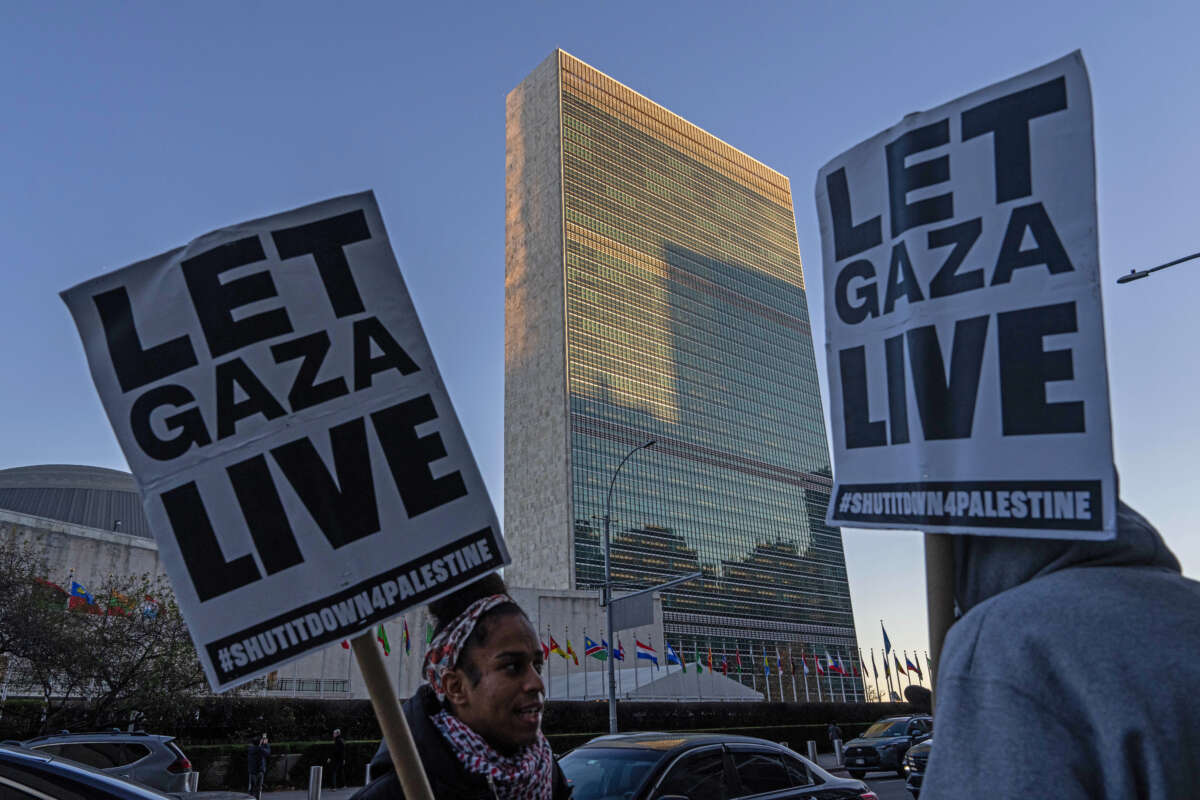
Pro-Palestinian demonstrators gather outside the United Nations headquarters on November 17, 2025, in New York City, New York.Adam Gray / Getty Images
Today we have a so-called ceasefire that is killing Palestinians on a daily basis. When it comes to Israel, the word “ceasefire” simply means that Palestinians are not allowed to retaliate against Israeli airstrikes, shelling, artillery, bombs, house demolitions, or suicide drones. In reality, Israel can fire all it wants and has been doing so since the minute the agreement took effect. According to President Donald Trump, “nothing is going to jeopardize” the ceasefire in Gaza.
The ceasefire, hailed as a success by the U.S. and the Western world, has done little to end the siege of Gaza and the deepening starvation and malnutrition of Palestinians, especially the children. And it is unlikely to usher in a pathway to freedom, equality, or self-determination for the Palestinian people in the foreseeable future.
The “ceasefire” is nothing but a cover for Israel’s genocidal practices, supported by the U.S. and Western nations, and disguised by mainstream media. It is a deceptive appearance and a ploy that deflects criticism, allows the continued supply of U.S. weapons to Israel, shields the Israeli regime from accountability, disappears the Gaza genocide from the news, and enables Israel to continue the extermination and displacement of Palestinians.
Can We Stop Pretending There Is a Functioning “Ceasefire” in Gaza?
Since October 10, 2025, the day the ceasefire agreement between Hamas and the Israeli government went into effect, the Israeli military has killed nearly 400 Palestinians and injured over 1,000, according to the Gaza Health Ministry. Under the ceasefire agreement, Israel is required to allow 600 trucks of aid and other goods into Gaza every day, but UN data show that Israel continues to block food aid, medical supplies, and tents in violation of the agreement.
Agnès Callamard, secretary general of Amnesty International, said in a statement on November 27: “The ceasefire risks creating a dangerous illusion that life in Gaza is returning to normal … the world must not be fooled. Israel’s genocide is not over.”
Today we have a so-called ceasefire that is killing Palestinians on a daily basis. When it comes to Israel, the word “ceasefire” simply means that Palestinians are not allowed to retaliate against Israeli airstrikes, shelling, artillery, bombs, house demolitions, or suicide drones. In reality, Israel can fire all it wants and has been doing so since the minute the agreement took effect. According to President Donald Trump, “nothing is going to jeopardize” the ceasefire in Gaza.
The ceasefire, hailed as a success by the U.S. and the Western world, has done little to end the siege of Gaza and the deepening starvation and malnutrition of Palestinians, especially the children. And it is unlikely to usher in a pathway to freedom, equality, or self-determination for the Palestinian people in the foreseeable future.
The “ceasefire” is nothing but a cover for Israel’s genocidal practices, supported by the U.S. and Western nations, and disguised by mainstream media. It is a deceptive appearance and a ploy that deflects criticism, allows the continued supply of U.S. weapons to Israel, shields the Israeli regime from accountability, disappears the Gaza genocide from the news, and enables Israel to continue the extermination and displacement of Palestinians.
Can We Stop Pretending There Is a Functioning “Ceasefire” in Gaza?
Since October 10, 2025, the day the ceasefire agreement between Hamas and the Israeli government went into effect, the Israeli military has killed nearly 400 Palestinians and injured over 1,000, according to the Gaza Health Ministry. Under the ceasefire agreement, Israel is required to allow 600 trucks of aid and other goods into Gaza every day, but UN data show that Israel continues to block food aid, medical supplies, and tents in violation of the agreement.
Agnès Callamard, secretary general of Amnesty International, said in a statement on November 27: “The ceasefire risks creating a dangerous illusion that life in Gaza is returning to normal … the world must not be fooled. Israel’s genocide is not over.”
According to the Gaza Health Ministry, the total death toll of Palestinians since October 7, 2023, is now 70,100, with 171,151 injured and many more buried under the rubble. The Israeli bombardment resulted in an estimated 50 million tons of rubble.
What the statistics don’t reflect are the number of people in Gaza that were killed by Israel not through bombs and airstrikes, but through indirect means: Palestinians killed because of lack of shelter after Israel destroyed their homes; because of the destruction of their water supplies and desalination plants, electricity supplies, and sanitation systems; because of the flattening of clinics and hospitals; and because of starvation and diseases.
The United Nations Relief and Works Agency for Palestine Refugees (UNRWA) said shelter materials for 1.3 million people and about 5,000 trucks of emergency supplies remain stalled outside Gaza as Israel continues to block all UNRWA-associated goods from entering.
The Palestinians in Gaza, the West Bank, and East Jerusalem, who have endured 77 years of brutal Israeli military occupation and a system of apartheid that denies them their rights, are left with no choice other than to continue their struggle for liberation and against erasure and ethnic cleansing — including their right to armed resistance as recognized under international law.
UN Security Council Loses Sight of Its Mission and Betrays the Palestinians
On November 17, 2025, in an unexpected and disgraceful vote of 13-0 that is counter to the UN’s raison d’être — with two abstentions from Russia and China — the UN Security Council (UNSC) adopted Resolution 2803, which embraces Trump’s — or is it Israeli Prime Minister Benjamin Netanyahu’s? — “20-point peace plan,” effectively normalizing genocide, rewarding U.S. complicity, and establishing new colonial rule over the lives of 2.3 million Palestinians in Gaza. It grants full control over Gaza to a U.S.-led “Board of Peace,” headed by Trump himself, that will oversee the administration and reconstruction of the Strip and establishes an “International Stabilization Force” in charge of security and disarming the resistance — not a UN peacekeeping force that will protect Palestinians.
Palestinians who have endured two years of genocide — and the total destruction of their homes and livelihoods — were not part of the negotiations and had no say in this matter.
The plan — hatched by the Trump-Netanyahu team and legitimized by the UNSC — includes no mention of the genocide and does not call for accountability for the war crimes and crimes against humanity committed over the last two years. This plan, which whitewashes the genocide, will never be forgotten or forgiven by any Palestinian. It denies Palestinians their humanity, their right to self-determination, and does nothing to address their grievances or root causes of their struggle. It will simply prolong the illegal occupation and will not advance peace or stability in the region in any meaningful way.
Israel views the inclusion of language in the resolution about a “pathway to Palestinian statehood” as nonbinding. In fact, the day after the UNSC vote, Netanyahu publicly stated his strong opposition to a Palestinian state. Israeli National Security Minister Itamar Ben-Gvir demanded that Palestinian President Mahmoud Abbas be imprisoned and other Palestinian Authority officials killed if the UN paved the way to Palestinian statehood.
Just like the Oslo Accords of 1993 that were supposed to bring about self-determination and statehood for the Palestinians, this plan is also doomed for failure. Instead of peace, the Oslo Accords entrenched Israeli control over the Palestinian occupied territories, expanded Israeli settlements, increased land theft by the Israeli state, and created a system of oppression that continues to dominate Palestinian lives.
After UNSC’s Surrender to US and Israel, Is There Any Hope for Palestinians?
Across Palestine, oppression, displacement, and ethnic cleansing continue unabated. While the genocide was raging in Gaza, the West Bank saw large-scale assaults, house demolitions, armed settler rampages, and attacks on Palestinian communities resulting in the displacement of over 32,000 residents from their homes. During Operation Iron Wall, which began early in 2025, some 850 homes were demolished in the Jenin, Tulkarem, and Nur Shams refugee camps, resulting in “the largest displacement of Palestinians in one operation since the 1967 war,” according to a Human Rights Watch report released on November 20.
If there is to be hope for peace in the Middle East, we need to keep organizing for a permanent end to the genocide, the siege, and the current prevailing system of apartheid in Israel.
The UNSC vote was a major setback for the movement in solidarity with Palestine that saw tremendous global support and massive growth over the past couple of years. It shows that a lot more work is needed to make the movement broader and stronger in order to be better prepared for future challenges in the struggle for justice and liberation, especially as we are faced with the rise of authoritarianism and increased involvement of billionaires and war profiteers in politics and their influence over foreign and domestic policy.
Over the past two years, the global movement for a free Palestine won the battle of public opinion, but little has changed in the positions of the political leadership in Washington. The movement has made great strides in educating people about the struggle and plight of the Palestinians and countering media bias, largely thanks to the fearless and unstoppable younger generation, including anti-Zionist Jews in the U.S. and elsewhere who reject the ideology of settler-colonialism, Jewish supremacy, genocide, and the premise that the Israeli government speaks in the name of all Jews around the world.
The Boycott, Divestment, and Sanctions movement, commonly known as BDS, has been effective in its reach and in contributing to changes in policies of governments — from Spain to Turkey, from Malaysia to Colombia, from Slovenia to Norway and elsewhere — putting pressure on corporations and institutions complicit in the genocide and Israeli apartheid. Their sustained pressure has had a great impact, isolating the Israeli regime globally and hurting those corporations complicit in its crimes.
BDS has had many significant divestment achievements during the past two years. Those who divested from companies linked to Israel include leading European pension funds such as Denmark’s public pension fund; church groups, including Presbyterian Church (U.S.A), the United Methodist Church, and the United Church of Christ; universities such as San Francisco State University, Union Theological Seminary, University of California, Davis, and others. Internationally, Radboud University, Utrecht University, University of Amsterdam, and Trinity College Dublin, to name a few, have ended ties with Israeli academic institutions.
Many Palestine advocates felt naively optimistic when the International Court of Justice (ICJ) issued its advisory opinion on July 19, 2024, concluding that “the State of Israel’s continued presence in the Occupied Palestinian Territory is unlawful” and that “Israel is under an obligation to bring to an end its unlawful presence in the Occupied Palestinian Territory as rapidly as possible.” The resolution that followed and was adopted by the UN General Assembly (UNGA) on September 18, 2024, ordered Israel to dismantle its system of apartheid within 12 months. Instead, Israel’s system of apartheid is worse than ever before.
But regardless, the significance of the UNGA resolution; the ICJ findings; the International Criminal Court’s arrest warrants for Netanyahu and Former Israeli Defense Minister Yoav Gallant for war crimes; the recognition of the State of Palestine by the vast majority of UN member countries (157 nations, including France, Britain, and Canada); the isolation of Israel and the U.S.; the extensive reports of human rights organizations that detail Israeli apartheid; and the unprecedented and growing global movement offers Palestinians some hope of a new period of transformative changes in the struggle for Palestinian rights.
In another demonstration of the U.S. and Israel’s isolation, on November 23, 2025, the U.S., Israel, and Argentina were the only three countries to vote against a UN General Assembly resolution condemning torture, which was supported by 169 nations.
Let us keep reminding U.S. taxpayers that they are the ones footing the bill for the bombs, missiles, and weapons used by the Israeli military to kill Palestinian families and maim Palestinian children.
In spite of all these gains, we have seen the U.S. deliver some $21.7 billion worth of weapons and military aid to Israel since October 7, 2023. We have also witnessed severe repression of anti-genocide protests; numerous arrests of pro-Palestinian student activists; the silencing of dissent and violent removal of peaceful student encampments on university campuses; the erosion of academic freedom; weaponization of antisemitism; threats of university federal funding cuts; and federal kidnappings of pro-Palestinian writers, academics, and activists. Many colleges, universities, states, and countries have enacted policies that stifle pro-Palestinian activism.
What Can Palestine Advocates Do to Advance the Cause of Freedom and Equality for All?
If there is to be hope for peace in the Middle East, we need to keep organizing for a permanent end to the genocide, the siege, and the current prevailing system of apartheid in Israel. We need to increase our efforts and move into a proactive and shared commitment to keep raising our voices and educating about Palestine in order to dismantle the oppressive system and end the denial of Palestinian rights. We also need to uplift Palestinian voices so the world can hear their stories, testimonies, and lived experiences.
Activists during the civil rights movement, the anti-Vietnam War movement, and the movement against South African apartheid succeeded by using a variety of tactics to bring about changes in government policies: mass demonstrations, marches on Washington, and uprisings; student protests on university campuses; labor movement protests and strikes; grassroots organizing; pressuring Congress through lobbying; and boycotts and divestments. The movement for Palestinian freedom and equality is no different.
Let us keep reminding U.S. taxpayers that they are the ones footing the bill for the bombs, missiles, and weapons used by the Israeli military to kill Palestinian families and maim Palestinian children — funds that could otherwise be used for improving health care and education. And above all, let us make sure that Netanyahu’s campaign for a massive increase in U.S. aid to Israel does not succeed. Israel will be making the case for a 20-year U.S. commitment that will top the $3.8 billion the U.S. already sends Israel every year.
All this will depend in part on the ability of advocates for Palestine to put pressure on representatives in Congress to push for an arms embargo to halt U.S. weapons to Israel and support proposals such as the “Block the Bombs Act.”
Other actions include getting local governments to divest from companies complicit in genocide and apartheid, and electing representatives who cannot be bought by AIPAC and those capable of shifting the political calculus around U.S. support for Israel — financial, military, and diplomatic. We’ve seen it happen in New York City — the city with the U.S.’s largest Jewish population and the world’s second-largest Jewish population after Tel Aviv — with the election of Zohran Mamdani as mayor.
The suffering in Gaza demands we all face a vital question: What kind of future do we want for ourselves, and for our children and grandchildren, and are we willing to fight for it?
Today, polls show that most people in the U.S. agree that their government shouldn’t be funding Israel. This marked transformation set the stage for Mamdani’s historic win in New York City and proves that support for Palestinian rights is good politics.
Christian faith leaders were instrumental in the civil rights movement, the anti-Vietnam War movement, and the boycotts that ended apartheid in South Africa. And yet today, most — especially Christian evangelicals — seem largely silent. Christian Zionists believe that the return of Jews to the Holy Land and the founding of Israel in 1948 was a fulfillment of biblical prophecy, viewing it as a prerequisite for the Second Coming of Christ. This belief translates into unwavering political, religious, and financial support for the Israeli state and is the movement’s greatest challenge: how to get concerned congregants to demand their leaders speak up against genocide.
While the atrocities in Gaza have had a devastating impact on Palestinian lives and livelihood, Gaza has also shattered the myth of Israeli military prowess and its ability to conquer and eliminate any Palestinian resistance with its advanced weaponry and high-tech surveillance.
Contrary to Israeli ethnic cleansing plans, designs for a Greater Israel, and efforts at Palestinian erasure, Palestinians refuse to be uprooted from their homeland no matter the cost. The approximately 15 million Palestinians in the world — 6 million in occupied Gaza, the West Bank, and East Jerusalem; around 2 million in Israel; and 7 million in the diaspora — aren’t going away. Their struggle for freedom and equality will continue undeterred.
Palestine does not belong to those who are intent on ethnically cleansing its Indigenous inhabitants — and it most certainly does not belong to Donald Trump or the “Board of Peace.” Try as they might, Gaza is not available for takeover or colonization by the U.S.
An excerpt from a poem by Gaza poet Nour Abdel Latif titled “Buried Truths, Rising Voices” sums up the feelings of every Palestinian:
But a voice born of truth
is never laid to rest.
It lingers —
in the dust, in the wind,
in every heartbeat that dares to remember.
One day, it will rise again —
not as a whisper,
but as a storm.
Palestine has become a footprint and a guiding light for liberation movements around the world. It shows us that our struggles are interwoven and that our actions are most effective when we are united in fighting for change.
Around the world, when people protest and march in the streets demanding a free Palestine, they are at the same time also marching for climate justice, the right of all colonized peoples to resist their occupiers, and numerous other causes. They are marching against apartheid, militarism, empire, and fascism. They are demanding compliance with international law.
For us in the U.S., fighting for Palestinian rights is also fighting for our rights and against authoritarianism: fighting for our right to speak up, to protest, to have a free press and not to be silenced, censored, or kidnapped because of our political beliefs.
Palestine is also our future. The suffering in Gaza demands we all face a vital question: What kind of future do we want for ourselves, and for our children and grandchildren, and are we willing to fight for it? Do we speak up and act together for change, or will we let Israel and the U.S. slide the world into an abyss of hatred and endless wars?
This article is licensed under Creative Commons (CC BY-NC-ND 4.0), and you are free to share and republish under the terms of the license.
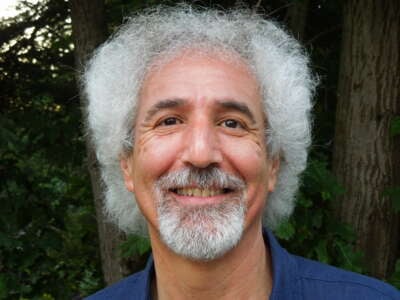
Michel Moushabeck is a Palestinian American writer, editor, translator and musician. He is the founder and publisher of Interlink Publishing, a 38-year-old, Massachusetts-based, independent publishing house. Most recently, he guest edited the winter issue of the Massachusetts Review titled “A View from Gaza.” Follow him on Instagram @ReadPalestine.
What the statistics don’t reflect are the number of people in Gaza that were killed by Israel not through bombs and airstrikes, but through indirect means: Palestinians killed because of lack of shelter after Israel destroyed their homes; because of the destruction of their water supplies and desalination plants, electricity supplies, and sanitation systems; because of the flattening of clinics and hospitals; and because of starvation and diseases.
The United Nations Relief and Works Agency for Palestine Refugees (UNRWA) said shelter materials for 1.3 million people and about 5,000 trucks of emergency supplies remain stalled outside Gaza as Israel continues to block all UNRWA-associated goods from entering.
The Palestinians in Gaza, the West Bank, and East Jerusalem, who have endured 77 years of brutal Israeli military occupation and a system of apartheid that denies them their rights, are left with no choice other than to continue their struggle for liberation and against erasure and ethnic cleansing — including their right to armed resistance as recognized under international law.
UN Security Council Loses Sight of Its Mission and Betrays the Palestinians
On November 17, 2025, in an unexpected and disgraceful vote of 13-0 that is counter to the UN’s raison d’être — with two abstentions from Russia and China — the UN Security Council (UNSC) adopted Resolution 2803, which embraces Trump’s — or is it Israeli Prime Minister Benjamin Netanyahu’s? — “20-point peace plan,” effectively normalizing genocide, rewarding U.S. complicity, and establishing new colonial rule over the lives of 2.3 million Palestinians in Gaza. It grants full control over Gaza to a U.S.-led “Board of Peace,” headed by Trump himself, that will oversee the administration and reconstruction of the Strip and establishes an “International Stabilization Force” in charge of security and disarming the resistance — not a UN peacekeeping force that will protect Palestinians.
Palestinians who have endured two years of genocide — and the total destruction of their homes and livelihoods — were not part of the negotiations and had no say in this matter.
The plan — hatched by the Trump-Netanyahu team and legitimized by the UNSC — includes no mention of the genocide and does not call for accountability for the war crimes and crimes against humanity committed over the last two years. This plan, which whitewashes the genocide, will never be forgotten or forgiven by any Palestinian. It denies Palestinians their humanity, their right to self-determination, and does nothing to address their grievances or root causes of their struggle. It will simply prolong the illegal occupation and will not advance peace or stability in the region in any meaningful way.
Israel views the inclusion of language in the resolution about a “pathway to Palestinian statehood” as nonbinding. In fact, the day after the UNSC vote, Netanyahu publicly stated his strong opposition to a Palestinian state. Israeli National Security Minister Itamar Ben-Gvir demanded that Palestinian President Mahmoud Abbas be imprisoned and other Palestinian Authority officials killed if the UN paved the way to Palestinian statehood.
Just like the Oslo Accords of 1993 that were supposed to bring about self-determination and statehood for the Palestinians, this plan is also doomed for failure. Instead of peace, the Oslo Accords entrenched Israeli control over the Palestinian occupied territories, expanded Israeli settlements, increased land theft by the Israeli state, and created a system of oppression that continues to dominate Palestinian lives.
After UNSC’s Surrender to US and Israel, Is There Any Hope for Palestinians?
Across Palestine, oppression, displacement, and ethnic cleansing continue unabated. While the genocide was raging in Gaza, the West Bank saw large-scale assaults, house demolitions, armed settler rampages, and attacks on Palestinian communities resulting in the displacement of over 32,000 residents from their homes. During Operation Iron Wall, which began early in 2025, some 850 homes were demolished in the Jenin, Tulkarem, and Nur Shams refugee camps, resulting in “the largest displacement of Palestinians in one operation since the 1967 war,” according to a Human Rights Watch report released on November 20.
If there is to be hope for peace in the Middle East, we need to keep organizing for a permanent end to the genocide, the siege, and the current prevailing system of apartheid in Israel.
The UNSC vote was a major setback for the movement in solidarity with Palestine that saw tremendous global support and massive growth over the past couple of years. It shows that a lot more work is needed to make the movement broader and stronger in order to be better prepared for future challenges in the struggle for justice and liberation, especially as we are faced with the rise of authoritarianism and increased involvement of billionaires and war profiteers in politics and their influence over foreign and domestic policy.
Over the past two years, the global movement for a free Palestine won the battle of public opinion, but little has changed in the positions of the political leadership in Washington. The movement has made great strides in educating people about the struggle and plight of the Palestinians and countering media bias, largely thanks to the fearless and unstoppable younger generation, including anti-Zionist Jews in the U.S. and elsewhere who reject the ideology of settler-colonialism, Jewish supremacy, genocide, and the premise that the Israeli government speaks in the name of all Jews around the world.
The Boycott, Divestment, and Sanctions movement, commonly known as BDS, has been effective in its reach and in contributing to changes in policies of governments — from Spain to Turkey, from Malaysia to Colombia, from Slovenia to Norway and elsewhere — putting pressure on corporations and institutions complicit in the genocide and Israeli apartheid. Their sustained pressure has had a great impact, isolating the Israeli regime globally and hurting those corporations complicit in its crimes.
BDS has had many significant divestment achievements during the past two years. Those who divested from companies linked to Israel include leading European pension funds such as Denmark’s public pension fund; church groups, including Presbyterian Church (U.S.A), the United Methodist Church, and the United Church of Christ; universities such as San Francisco State University, Union Theological Seminary, University of California, Davis, and others. Internationally, Radboud University, Utrecht University, University of Amsterdam, and Trinity College Dublin, to name a few, have ended ties with Israeli academic institutions.
Many Palestine advocates felt naively optimistic when the International Court of Justice (ICJ) issued its advisory opinion on July 19, 2024, concluding that “the State of Israel’s continued presence in the Occupied Palestinian Territory is unlawful” and that “Israel is under an obligation to bring to an end its unlawful presence in the Occupied Palestinian Territory as rapidly as possible.” The resolution that followed and was adopted by the UN General Assembly (UNGA) on September 18, 2024, ordered Israel to dismantle its system of apartheid within 12 months. Instead, Israel’s system of apartheid is worse than ever before.
But regardless, the significance of the UNGA resolution; the ICJ findings; the International Criminal Court’s arrest warrants for Netanyahu and Former Israeli Defense Minister Yoav Gallant for war crimes; the recognition of the State of Palestine by the vast majority of UN member countries (157 nations, including France, Britain, and Canada); the isolation of Israel and the U.S.; the extensive reports of human rights organizations that detail Israeli apartheid; and the unprecedented and growing global movement offers Palestinians some hope of a new period of transformative changes in the struggle for Palestinian rights.
In another demonstration of the U.S. and Israel’s isolation, on November 23, 2025, the U.S., Israel, and Argentina were the only three countries to vote against a UN General Assembly resolution condemning torture, which was supported by 169 nations.
Let us keep reminding U.S. taxpayers that they are the ones footing the bill for the bombs, missiles, and weapons used by the Israeli military to kill Palestinian families and maim Palestinian children.
In spite of all these gains, we have seen the U.S. deliver some $21.7 billion worth of weapons and military aid to Israel since October 7, 2023. We have also witnessed severe repression of anti-genocide protests; numerous arrests of pro-Palestinian student activists; the silencing of dissent and violent removal of peaceful student encampments on university campuses; the erosion of academic freedom; weaponization of antisemitism; threats of university federal funding cuts; and federal kidnappings of pro-Palestinian writers, academics, and activists. Many colleges, universities, states, and countries have enacted policies that stifle pro-Palestinian activism.
What Can Palestine Advocates Do to Advance the Cause of Freedom and Equality for All?
If there is to be hope for peace in the Middle East, we need to keep organizing for a permanent end to the genocide, the siege, and the current prevailing system of apartheid in Israel. We need to increase our efforts and move into a proactive and shared commitment to keep raising our voices and educating about Palestine in order to dismantle the oppressive system and end the denial of Palestinian rights. We also need to uplift Palestinian voices so the world can hear their stories, testimonies, and lived experiences.
Activists during the civil rights movement, the anti-Vietnam War movement, and the movement against South African apartheid succeeded by using a variety of tactics to bring about changes in government policies: mass demonstrations, marches on Washington, and uprisings; student protests on university campuses; labor movement protests and strikes; grassroots organizing; pressuring Congress through lobbying; and boycotts and divestments. The movement for Palestinian freedom and equality is no different.
Let us keep reminding U.S. taxpayers that they are the ones footing the bill for the bombs, missiles, and weapons used by the Israeli military to kill Palestinian families and maim Palestinian children — funds that could otherwise be used for improving health care and education. And above all, let us make sure that Netanyahu’s campaign for a massive increase in U.S. aid to Israel does not succeed. Israel will be making the case for a 20-year U.S. commitment that will top the $3.8 billion the U.S. already sends Israel every year.
All this will depend in part on the ability of advocates for Palestine to put pressure on representatives in Congress to push for an arms embargo to halt U.S. weapons to Israel and support proposals such as the “Block the Bombs Act.”
Other actions include getting local governments to divest from companies complicit in genocide and apartheid, and electing representatives who cannot be bought by AIPAC and those capable of shifting the political calculus around U.S. support for Israel — financial, military, and diplomatic. We’ve seen it happen in New York City — the city with the U.S.’s largest Jewish population and the world’s second-largest Jewish population after Tel Aviv — with the election of Zohran Mamdani as mayor.
The suffering in Gaza demands we all face a vital question: What kind of future do we want for ourselves, and for our children and grandchildren, and are we willing to fight for it?
Today, polls show that most people in the U.S. agree that their government shouldn’t be funding Israel. This marked transformation set the stage for Mamdani’s historic win in New York City and proves that support for Palestinian rights is good politics.
Christian faith leaders were instrumental in the civil rights movement, the anti-Vietnam War movement, and the boycotts that ended apartheid in South Africa. And yet today, most — especially Christian evangelicals — seem largely silent. Christian Zionists believe that the return of Jews to the Holy Land and the founding of Israel in 1948 was a fulfillment of biblical prophecy, viewing it as a prerequisite for the Second Coming of Christ. This belief translates into unwavering political, religious, and financial support for the Israeli state and is the movement’s greatest challenge: how to get concerned congregants to demand their leaders speak up against genocide.
While the atrocities in Gaza have had a devastating impact on Palestinian lives and livelihood, Gaza has also shattered the myth of Israeli military prowess and its ability to conquer and eliminate any Palestinian resistance with its advanced weaponry and high-tech surveillance.
Contrary to Israeli ethnic cleansing plans, designs for a Greater Israel, and efforts at Palestinian erasure, Palestinians refuse to be uprooted from their homeland no matter the cost. The approximately 15 million Palestinians in the world — 6 million in occupied Gaza, the West Bank, and East Jerusalem; around 2 million in Israel; and 7 million in the diaspora — aren’t going away. Their struggle for freedom and equality will continue undeterred.
Palestine does not belong to those who are intent on ethnically cleansing its Indigenous inhabitants — and it most certainly does not belong to Donald Trump or the “Board of Peace.” Try as they might, Gaza is not available for takeover or colonization by the U.S.
An excerpt from a poem by Gaza poet Nour Abdel Latif titled “Buried Truths, Rising Voices” sums up the feelings of every Palestinian:
But a voice born of truth
is never laid to rest.
It lingers —
in the dust, in the wind,
in every heartbeat that dares to remember.
One day, it will rise again —
not as a whisper,
but as a storm.
Palestine has become a footprint and a guiding light for liberation movements around the world. It shows us that our struggles are interwoven and that our actions are most effective when we are united in fighting for change.
Around the world, when people protest and march in the streets demanding a free Palestine, they are at the same time also marching for climate justice, the right of all colonized peoples to resist their occupiers, and numerous other causes. They are marching against apartheid, militarism, empire, and fascism. They are demanding compliance with international law.
For us in the U.S., fighting for Palestinian rights is also fighting for our rights and against authoritarianism: fighting for our right to speak up, to protest, to have a free press and not to be silenced, censored, or kidnapped because of our political beliefs.
Palestine is also our future. The suffering in Gaza demands we all face a vital question: What kind of future do we want for ourselves, and for our children and grandchildren, and are we willing to fight for it? Do we speak up and act together for change, or will we let Israel and the U.S. slide the world into an abyss of hatred and endless wars?
This article is licensed under Creative Commons (CC BY-NC-ND 4.0), and you are free to share and republish under the terms of the license.
Michel Moushabeck is a Palestinian American writer, editor, translator and musician. He is the founder and publisher of Interlink Publishing, a 38-year-old, Massachusetts-based, independent publishing house. Most recently, he guest edited the winter issue of the Massachusetts Review titled “A View from Gaza.” Follow him on Instagram @ReadPalestine.

No comments:
Post a Comment