The AI Race and the Space Race: Can Great Power Rivals Inch toward Cooperation?
At the July 2025 launch of America’s AI Action Plan, President Trump said that the country is in a fast-moving competition to develop groundbreaking technology that may well determine the global balance of power. He pledged that the U.S. would do whatever it takes to lead: “America is the country that started the AI race, and as President, I’m here today to declare that America is going to win it.”
Alongside this announcement, we’ve seen Silicon Valley firms vie for market share while they collectively press for a muscular nationalism. In contrast to the custom of quietly shaping policy out of the public eye, their advocacy has been loud and proud with countless audio and video clips online. In published works, Anthropic CEO Dario Amedei’s 2024 essay, Machines of Loving Grace is a case in point, along with Palantir CEO Alex Karp’s 2025 book The Technological Republic—the latter a rallying call for closer ties between Silicon Valley and national security. Former Google CEO Eric Schmidt adds to this mix in his April 2025 written testimony to Congress:
The People’s Republic of China understands the foundational power of AI and energy, and they are investing massively and strategically to achieve global dominance in both. They are pouring resources into AI R&D while simultaneously building the world’s leading renewable energy capacity and modern grid infrastructure. Our response must be equally ambitious, coordinated, and decisive. We are in a race, and we must win.
To this end, White House AI and Crypto Czar David Sacks has moved to roll back many of Biden’s AI regulations and facilitate data center development through accelerated permitting and infrastructure support. This has set off a flood of venture capital, an outcome intended to maintain and possibly increase the country’s lead in the sector. As never before, Washington and Silicon Valley operate as one in a zero-sum competition with China, raising tensions in an increasingly complicated bilateral relationship.
China’s Response to the AI Action Plan
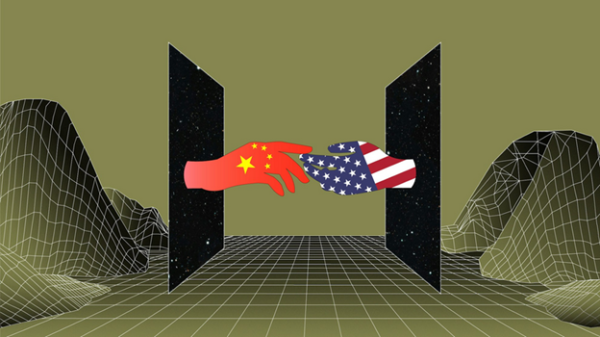
Three days after the announcement of America’s AI Action Plan, the Chinese government responded—not in kind, but with an olive branch. Premier Li Qiang proposed the establishment of an organization that promotes and facilitates global AI cooperation, stressing that global consensus was urgently needed. He added that China would actively encourage the development of open-source AI and that Beijing was prepared to share advances with other countries, particularly those in the Global South.
The following month, China introduced a second plan, the AI+ plan, that is notably more comprehensive and inward-looking, setting specific timelines for integrating AI across domestic public and private institutions. The AI+ plan restates the country’s intention of releasing its AI tools open source, a matter that many countries view as intrinsic to their sovereignty. Further, an open-source approach would boost competitiveness and spark innovation in regionally specific ways.
Then at the United Nations last September, Premier Li unveiled an additional plan, the AI+ International Cooperation Initiative, which seeks to integrate AI technology into the development of countries worldwide. The initiative calls on each country “to enhance policy exchange and practical cooperation, and share best practices and solutions on the basis of mutual respect and mutual benefit.” It favors UN-led multilateralism, shared risk management, and cross-border standards—strategic messaging tailored to an American audience.
Comparing the AI Race to the 1960s Space Race
AI Czar Sacks has likened the AI race with China to the 1960s space race with the Soviet Union, but emphasizes that the outcome today is far more consequential: “It will determine who reshapes the global economy and who the superpowers of the 21st century are going to be.”
The comparison to the space race is an interesting one, but for reasons other than what Sacks had in mind. While President Kennedy publicly promoted the idea of winning the space race, he quietly made efforts to collaborate with the Soviet Union. Several different times, Kennedy proposed to Soviet Premier Nikita Khrushchev that his country might consider joining forces with ours on a lunar expedition.
Kennedy first raised the subject with Khrushchev at their June 1961 summit in Vienna. “Why don’t we do it together?” he asked. Khrushchev was initially receptive to the idea but later indicated that they should give priority to an agreement on disarmament.
Then, in March 1962, Kennedy sent the Soviet premier a letter, suggesting that U.S.-Soviet cooperation in space might serve a number of valuable purposes. The letter mentioned a few possibilities, such as cooperating on a weather satellite system, a radio tracking station, or a separate satellite system that maps the Earth’s magnetic field. It continued:
Beyond these specific projects we are prepared now to discuss broader cooperation in the still more challenging projects which must be undertaken in the exploration of outer space. The tasks are so challenging, the costs so great, and the risks to the brave men who engage in space exploration so grave, that we must in all good conscience try every possibility of sharing these tasks and costs and of minimizing these risks.
Kennedy returned to the idea of a U.S.-Soviet collaboration publicly in his September 1963 speech at the United Nations. It came just three months after his landmark “Peace Speech” at American University, which had made quite an impression on Khrushchev and was widely distributed throughout the U.S.S.R. Here, after discussing a limited test ban treaty and the principles of disarmament, Kennedy proposed a joint lunar mission and asked:
Why should man’s first flight to the moon be a matter of national competition? Why should the United States and the Soviet Union, in preparing for such expeditions, become involved in immense duplications of research, construction, and expenditure? Surely we should explore whether the scientists and astronauts of our two countries—indeed of all the world—cannot work together in the conquest of space … All these and other new steps toward peaceful cooperation may be possible.
Khrushchev turned down Kennedy’s proposal yet again, with concerns that a joint lunar expedition would expose sensitive information about the U.S.S.R.’s defense systems, but the diplomatic gesture was not lost on him. Even so, with Kennedy gone just two months afterward, the proposal languished.
More than 30 years later, Khrushchev’s eldest son, Sergei, revealed that his father by early November 1963 had reconsidered Kennedy’s proposal. Sergei told SpaceCast News Service in 1997 that the Soviet leader had come to decide that his country had more to gain from close examination of U.S. technology than it had to lose from exposing Soviet rocket and missile systems. Beyond the proposal itself, Nikita Khrushchev viewed cooperation with the West as a potential opportunity to reduce troop numbers and even repurpose weapons systems for nonmilitary use.
Now the tables are turned, with the U.S. on the receiving end of a diplomatic initiative. Given that AI technology is not fully understood and that much of the ongoing research presents still greater uncertainties, let’s hope that reasonable minds step up and establish some basic rules of the road—with China, and with the world.
At the July 2025 launch of America’s AI Action Plan, President Trump said that the country is in a fast-moving competition to develop groundbreaking technology that may well determine the global balance of power. He pledged that the U.S. would do whatever it takes to lead: “America is the country that started the AI race, and as President, I’m here today to declare that America is going to win it.”
Alongside this announcement, we’ve seen Silicon Valley firms vie for market share while they collectively press for a muscular nationalism. In contrast to the custom of quietly shaping policy out of the public eye, their advocacy has been loud and proud with countless audio and video clips online. In published works, Anthropic CEO Dario Amedei’s 2024 essay, Machines of Loving Grace is a case in point, along with Palantir CEO Alex Karp’s 2025 book The Technological Republic—the latter a rallying call for closer ties between Silicon Valley and national security. Former Google CEO Eric Schmidt adds to this mix in his April 2025 written testimony to Congress:
The People’s Republic of China understands the foundational power of AI and energy, and they are investing massively and strategically to achieve global dominance in both. They are pouring resources into AI R&D while simultaneously building the world’s leading renewable energy capacity and modern grid infrastructure. Our response must be equally ambitious, coordinated, and decisive. We are in a race, and we must win.
To this end, White House AI and Crypto Czar David Sacks has moved to roll back many of Biden’s AI regulations and facilitate data center development through accelerated permitting and infrastructure support. This has set off a flood of venture capital, an outcome intended to maintain and possibly increase the country’s lead in the sector. As never before, Washington and Silicon Valley operate as one in a zero-sum competition with China, raising tensions in an increasingly complicated bilateral relationship.
China’s Response to the AI Action Plan
Three days after the announcement of America’s AI Action Plan, the Chinese government responded—not in kind, but with an olive branch. Premier Li Qiang proposed the establishment of an organization that promotes and facilitates global AI cooperation, stressing that global consensus was urgently needed. He added that China would actively encourage the development of open-source AI and that Beijing was prepared to share advances with other countries, particularly those in the Global South.
The following month, China introduced a second plan, the AI+ plan, that is notably more comprehensive and inward-looking, setting specific timelines for integrating AI across domestic public and private institutions. The AI+ plan restates the country’s intention of releasing its AI tools open source, a matter that many countries view as intrinsic to their sovereignty. Further, an open-source approach would boost competitiveness and spark innovation in regionally specific ways.
Then at the United Nations last September, Premier Li unveiled an additional plan, the AI+ International Cooperation Initiative, which seeks to integrate AI technology into the development of countries worldwide. The initiative calls on each country “to enhance policy exchange and practical cooperation, and share best practices and solutions on the basis of mutual respect and mutual benefit.” It favors UN-led multilateralism, shared risk management, and cross-border standards—strategic messaging tailored to an American audience.
Comparing the AI Race to the 1960s Space Race
AI Czar Sacks has likened the AI race with China to the 1960s space race with the Soviet Union, but emphasizes that the outcome today is far more consequential: “It will determine who reshapes the global economy and who the superpowers of the 21st century are going to be.”
The comparison to the space race is an interesting one, but for reasons other than what Sacks had in mind. While President Kennedy publicly promoted the idea of winning the space race, he quietly made efforts to collaborate with the Soviet Union. Several different times, Kennedy proposed to Soviet Premier Nikita Khrushchev that his country might consider joining forces with ours on a lunar expedition.
Kennedy first raised the subject with Khrushchev at their June 1961 summit in Vienna. “Why don’t we do it together?” he asked. Khrushchev was initially receptive to the idea but later indicated that they should give priority to an agreement on disarmament.
Then, in March 1962, Kennedy sent the Soviet premier a letter, suggesting that U.S.-Soviet cooperation in space might serve a number of valuable purposes. The letter mentioned a few possibilities, such as cooperating on a weather satellite system, a radio tracking station, or a separate satellite system that maps the Earth’s magnetic field. It continued:
Beyond these specific projects we are prepared now to discuss broader cooperation in the still more challenging projects which must be undertaken in the exploration of outer space. The tasks are so challenging, the costs so great, and the risks to the brave men who engage in space exploration so grave, that we must in all good conscience try every possibility of sharing these tasks and costs and of minimizing these risks.
Kennedy returned to the idea of a U.S.-Soviet collaboration publicly in his September 1963 speech at the United Nations. It came just three months after his landmark “Peace Speech” at American University, which had made quite an impression on Khrushchev and was widely distributed throughout the U.S.S.R. Here, after discussing a limited test ban treaty and the principles of disarmament, Kennedy proposed a joint lunar mission and asked:
Why should man’s first flight to the moon be a matter of national competition? Why should the United States and the Soviet Union, in preparing for such expeditions, become involved in immense duplications of research, construction, and expenditure? Surely we should explore whether the scientists and astronauts of our two countries—indeed of all the world—cannot work together in the conquest of space … All these and other new steps toward peaceful cooperation may be possible.
Khrushchev turned down Kennedy’s proposal yet again, with concerns that a joint lunar expedition would expose sensitive information about the U.S.S.R.’s defense systems, but the diplomatic gesture was not lost on him. Even so, with Kennedy gone just two months afterward, the proposal languished.
More than 30 years later, Khrushchev’s eldest son, Sergei, revealed that his father by early November 1963 had reconsidered Kennedy’s proposal. Sergei told SpaceCast News Service in 1997 that the Soviet leader had come to decide that his country had more to gain from close examination of U.S. technology than it had to lose from exposing Soviet rocket and missile systems. Beyond the proposal itself, Nikita Khrushchev viewed cooperation with the West as a potential opportunity to reduce troop numbers and even repurpose weapons systems for nonmilitary use.
Now the tables are turned, with the U.S. on the receiving end of a diplomatic initiative. Given that AI technology is not fully understood and that much of the ongoing research presents still greater uncertainties, let’s hope that reasonable minds step up and establish some basic rules of the road—with China, and with the world.

No comments:
Post a Comment