In an astonishing verdict, a judge ruled in favor of four elderly people who confronted authorities inside the facilities of one of the most powerful outposts of the US military-industrial complex: L3Harris.
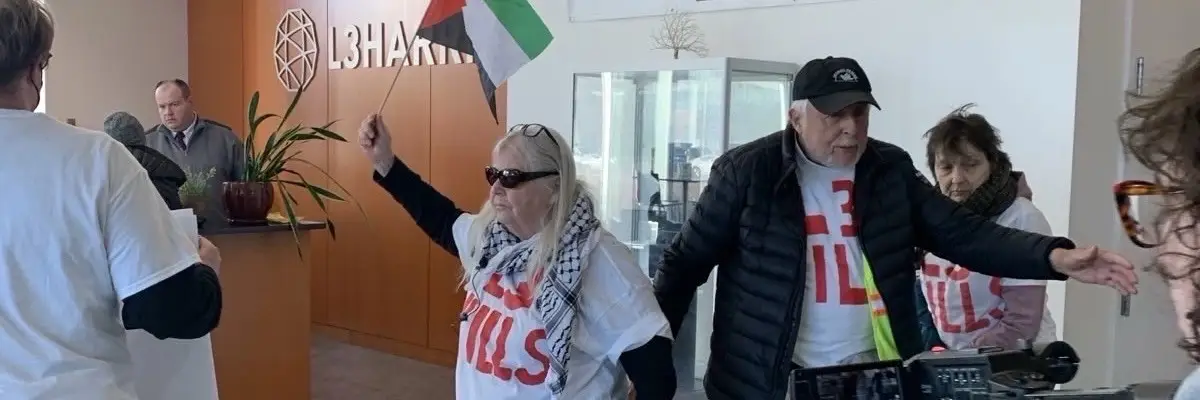
Members of Demilitarize Western Massachusetts occupy the lobby of L3Harris plant in Northampton, Massachusetts on March 19, 2025.
(Photo by Demilitarize Western Massachusetts)
Phil Wilson
Jan 04, 2026
Common Dream
Northampton, Massachusetts District Court Judge Mary Beth Ogulewicz put her neck bravely within the noose of potential political and corporate retribution when she rendered the verdict on December, 23: “After consideration of the testimony, exhibits, applicable law, and arguments of counsel, I find the defendants Not Responsible on all counts.”
This is an astonishing verdict in favor of four elderly people who confronted authorities inside the facilities of one of the most powerful outposts of the US military-industrial complex on March, 19, 2025. They armed themselves with only conscience, play money, red paint, and a whimsical sense of in vivo political theater. They entered the lobby of munitions profiteer L3Harris and tossed the paint-soaked play money on the floor, refused to leave, and tried to serve L3Harris CEO Chris Kubasik (who is headquartered in Florida) with an arrest warrant for war crimes. They fully anticipated that Northampton Police would arrest them, and they were predictably charged with trespassing and disturbing the peace.
From this point on, the narrative takes a turn toward the surreal. The defendants’ post verdict press release explains:
The case and the verdict are highly unusual for several reasons. First, Judge Ogulewicz converted the charges from criminal to civil offenses, with lower penalties, saying that the allegations against the Defendants did not merit criminal prosecution. In addition, the Judge allowed the necessity defense to be raised and argued at the hearing. Finally, victory in the use of the necessity defense in protest cases is extraordinarily rare.
The seldom used “necessity defense” appears to be a euphoric fantasy created as a gift for those committed to civil disobedience. The necessity defense gives legal flexibility to support those who violate legal norms in order to mitigate a more nefarious harm. A good Samaritan who breaks your house window to enter and put out a stove fire might use the necessity defense to avoid breaking and entering charges. Likewise, a well-intentioned bystander who prevents a rageful person from beating their own child might use the necessity defense if charged for assault.
Writ small, the necessity defense has a clear, logical function to assure that legal contradictions do not stymy justice. But writ large, what is the leeway given to a good Samaritan when confronted by the massive criminal intentions of their own government? Do we, as US citizens, hold the right to intervene in state-sponsored criminal violence? If I can legally prevent my neighbor from beating his child, why can’t I also attempt to stop my government from murdering countless children in... let us say, Gaza?
And even more subtly nuanced—can I attempt to confront my criminally violent government and its corporate proxies regardless of the likelihood that the confrontation will have the desired result? Is civil disobedience a subset of the necessity defense?
Judge Mary Beth Ogulewicz ruled that, indeed, civil disobedience ought to be seen as a perfectly legal, and critically useful, response to state-mandated crimes. Henry David Thoreau argued this position 165 years ago, but now the ideals of one of America’s preeminent philosophers has belatedly entered the realm of legal precedent.
The morning after Judge Ogulewicz’s decision, I spoke with Nick Mottern, an 86-year-old defendant found innocent of all charges. He was uncertain whether or not the case will be appealed, but of course the system will mobilize on behalf of war profiteers, he believed. We picketed L3Harris alone at first, before being joined by a sympathetic resident from an adjacent housing complex. The morning featured lovely cloud formations scattered by an icy wind. We struggled to keep our aging feet planted on a sleet-covered walkway. Two days before Christmas, the death factory looked half abandoned.
The fact that civil disobedience persists, led by people who could easily excuse themselves on the basis of their aged frailty, ought to be contemplated far and wide.
What will the decision mean for our quest to mobilize local opposition against our very own outpost of the military-industrial complex? How many people do we need to overwhelm the lobby of L3Harris? What if 1,000 people scrunched in—more people than the police have means to arrest? Can the police even arrest people on murderous L3Harris property after the courts have determined that civil disobedience conforms to the contours of the “necessity defense”? Nick and I parse these things often, but now something had moved, but how much?
Hope does not often assert itself when tiny protests face off against the might of US capitalism—a bizarre mismatch staged on a lonely sidewalk, a vigil of uncertainty. We are two aging, stubborn fixtures, to be ignored with a shake of the head. Our ritual may yield nothing, but it urgently must continue, and now, thanks to the court decision, the whole endeavor has been reframed.
Here is how the defendants reacted to their triumph:
Trish Gallagher:
L3H earns huge profits making weapons of war. We think this is blood money. The goal of our act of civil disobedience was to persuade L3H to stop making a killing on killing.
Priscilla Lynch:
We pushed for a jury trial because we believed that a jury of our peers would share our horror at what was and is happening in Gaza with weapons from L3 Harris and would share the belief in the necessity of our actions. In fact, the 75 or so “jury of our peers,” present in the courtroom and overflowing into hallway confirmed our belief. The Court’s verdict validates the necessity of our action against the perpetrators of Genocide, including L3Harris right here in Northampton.
Nick Mottern:
We are extremely grateful that our lawyer and the judge understood that the real lawbreaker in this case is L3Harris Technologies, which is violating various US and international laws daily to profit from the slaughter of Palestinians.
Paki Wieland:
The verdict gives weight to the Necessity Defense. This finding will strengthen Necessity as a stance in the future.“
(From the defendants’ post verdict press release)
The work of resistance begins again, a series of pauses and regroupings proceeds with new inspiration. The monstrosity of US war crimes, that did not begin with President Donald Trump (who merely carries on the traditions with newfound honesty), will not be halted by a few small town heroes like those quoted above. But the fact that civil disobedience persists, led by people who could easily excuse themselves on the basis of their aged frailty, ought to be contemplated far and wide. Nick hopes that the story of the court victory will be delivered on media platforms everywhere.
Our work is licensed under Creative Commons (CC BY-NC-ND 3.0). Feel free to republish and share widely.
Phil Wilson
Phil Wilson is a retired mental health worker who has written for Common Dreams, Counterpunch, Resilience, Current Affairs, The Future Fire, The Hampshire Gazette, and other publications. Phil’s writings are posted regularly at Nobody’s Voice.
Full Bio >
Northampton, Massachusetts District Court Judge Mary Beth Ogulewicz put her neck bravely within the noose of potential political and corporate retribution when she rendered the verdict on December, 23: “After consideration of the testimony, exhibits, applicable law, and arguments of counsel, I find the defendants Not Responsible on all counts.”
This is an astonishing verdict in favor of four elderly people who confronted authorities inside the facilities of one of the most powerful outposts of the US military-industrial complex on March, 19, 2025. They armed themselves with only conscience, play money, red paint, and a whimsical sense of in vivo political theater. They entered the lobby of munitions profiteer L3Harris and tossed the paint-soaked play money on the floor, refused to leave, and tried to serve L3Harris CEO Chris Kubasik (who is headquartered in Florida) with an arrest warrant for war crimes. They fully anticipated that Northampton Police would arrest them, and they were predictably charged with trespassing and disturbing the peace.
From this point on, the narrative takes a turn toward the surreal. The defendants’ post verdict press release explains:
The case and the verdict are highly unusual for several reasons. First, Judge Ogulewicz converted the charges from criminal to civil offenses, with lower penalties, saying that the allegations against the Defendants did not merit criminal prosecution. In addition, the Judge allowed the necessity defense to be raised and argued at the hearing. Finally, victory in the use of the necessity defense in protest cases is extraordinarily rare.
The seldom used “necessity defense” appears to be a euphoric fantasy created as a gift for those committed to civil disobedience. The necessity defense gives legal flexibility to support those who violate legal norms in order to mitigate a more nefarious harm. A good Samaritan who breaks your house window to enter and put out a stove fire might use the necessity defense to avoid breaking and entering charges. Likewise, a well-intentioned bystander who prevents a rageful person from beating their own child might use the necessity defense if charged for assault.
Writ small, the necessity defense has a clear, logical function to assure that legal contradictions do not stymy justice. But writ large, what is the leeway given to a good Samaritan when confronted by the massive criminal intentions of their own government? Do we, as US citizens, hold the right to intervene in state-sponsored criminal violence? If I can legally prevent my neighbor from beating his child, why can’t I also attempt to stop my government from murdering countless children in... let us say, Gaza?
And even more subtly nuanced—can I attempt to confront my criminally violent government and its corporate proxies regardless of the likelihood that the confrontation will have the desired result? Is civil disobedience a subset of the necessity defense?
Judge Mary Beth Ogulewicz ruled that, indeed, civil disobedience ought to be seen as a perfectly legal, and critically useful, response to state-mandated crimes. Henry David Thoreau argued this position 165 years ago, but now the ideals of one of America’s preeminent philosophers has belatedly entered the realm of legal precedent.
The morning after Judge Ogulewicz’s decision, I spoke with Nick Mottern, an 86-year-old defendant found innocent of all charges. He was uncertain whether or not the case will be appealed, but of course the system will mobilize on behalf of war profiteers, he believed. We picketed L3Harris alone at first, before being joined by a sympathetic resident from an adjacent housing complex. The morning featured lovely cloud formations scattered by an icy wind. We struggled to keep our aging feet planted on a sleet-covered walkway. Two days before Christmas, the death factory looked half abandoned.
The fact that civil disobedience persists, led by people who could easily excuse themselves on the basis of their aged frailty, ought to be contemplated far and wide.
What will the decision mean for our quest to mobilize local opposition against our very own outpost of the military-industrial complex? How many people do we need to overwhelm the lobby of L3Harris? What if 1,000 people scrunched in—more people than the police have means to arrest? Can the police even arrest people on murderous L3Harris property after the courts have determined that civil disobedience conforms to the contours of the “necessity defense”? Nick and I parse these things often, but now something had moved, but how much?
Hope does not often assert itself when tiny protests face off against the might of US capitalism—a bizarre mismatch staged on a lonely sidewalk, a vigil of uncertainty. We are two aging, stubborn fixtures, to be ignored with a shake of the head. Our ritual may yield nothing, but it urgently must continue, and now, thanks to the court decision, the whole endeavor has been reframed.
Here is how the defendants reacted to their triumph:
Trish Gallagher:
L3H earns huge profits making weapons of war. We think this is blood money. The goal of our act of civil disobedience was to persuade L3H to stop making a killing on killing.
Priscilla Lynch:
We pushed for a jury trial because we believed that a jury of our peers would share our horror at what was and is happening in Gaza with weapons from L3 Harris and would share the belief in the necessity of our actions. In fact, the 75 or so “jury of our peers,” present in the courtroom and overflowing into hallway confirmed our belief. The Court’s verdict validates the necessity of our action against the perpetrators of Genocide, including L3Harris right here in Northampton.
Nick Mottern:
We are extremely grateful that our lawyer and the judge understood that the real lawbreaker in this case is L3Harris Technologies, which is violating various US and international laws daily to profit from the slaughter of Palestinians.
Paki Wieland:
The verdict gives weight to the Necessity Defense. This finding will strengthen Necessity as a stance in the future.“
(From the defendants’ post verdict press release)
The work of resistance begins again, a series of pauses and regroupings proceeds with new inspiration. The monstrosity of US war crimes, that did not begin with President Donald Trump (who merely carries on the traditions with newfound honesty), will not be halted by a few small town heroes like those quoted above. But the fact that civil disobedience persists, led by people who could easily excuse themselves on the basis of their aged frailty, ought to be contemplated far and wide. Nick hopes that the story of the court victory will be delivered on media platforms everywhere.
Our work is licensed under Creative Commons (CC BY-NC-ND 3.0). Feel free to republish and share widely.
Phil Wilson
Phil Wilson is a retired mental health worker who has written for Common Dreams, Counterpunch, Resilience, Current Affairs, The Future Fire, The Hampshire Gazette, and other publications. Phil’s writings are posted regularly at Nobody’s Voice.
Full Bio >

No comments:
Post a Comment