We Must Demand Coverage That Doesn’t Fan the Flames of War With China
Western media is trying to make it sound like war was China’s idea, when it’s the US that has been actively preparing for it for the last decade.

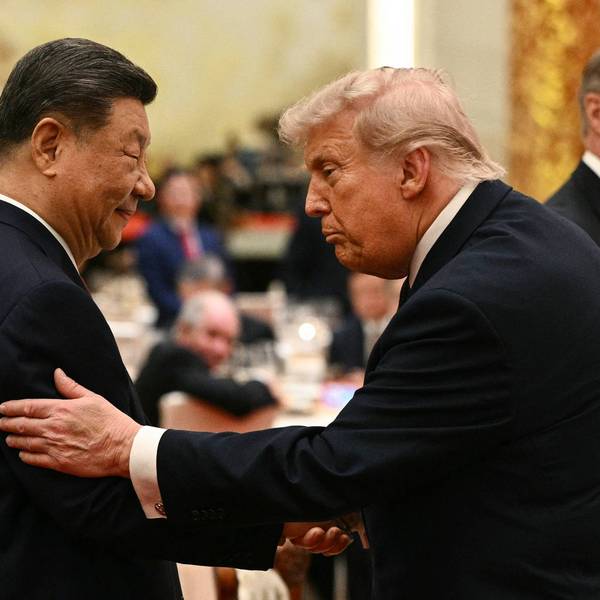
China’s President Xi Jinping (L) looks at US President Donald Trump as they attend a state banquet at the Great Hall of the People in Beijing on May 14, 2026.
(Photo by Brendan Smialowski/ AFP via Getty Images)
Megan Russell
May 31, 2026
Western media is trying to make it sound like war was China’s idea, when it’s the US that has been actively preparing for it for the last decade.
China’s President Xi Jinping (L) looks at US President Donald Trump as they attend a state banquet at the Great Hall of the People in Beijing on May 14, 2026.
(Photo by Brendan Smialowski/ AFP via Getty Images)
Megan Russell
May 31, 2026
Common Dreams
This month, the world watched as US President Donald Trump wrangled up his bro-squad of capitalist billionaires and chartered them across the world to China. We watched in disbelief as the China-hating Trump administration paraded around Beijing gawking at beautiful ceilings and giant rose bushes. “China is beautiful,” Trump said.
All the while, the top US oligarchs met with Chinese officials, hoping to find openings they could us to slither into China’s large, booming markets and siphon off even more wealth that they most definitely don’t need. Fortunately, China just wasn’t that interested.
Amid Trump-Xi Meeting, US Coalition Urges Congress to ‘Prioritize Peace’ and End ‘Confrontational Posture’ With China

Even though nothing much came of the meetings, all the China hawks in Washington were on the edge of their seats, anxious that better relations with China would risk their favorite justification for raising the military budget to an unprecedented $1.5 trillion. But we need to prepare for war with China by 2025… no, 2027… wait, maybe 2030? Forever?
Mainstream media had a lot to say about the meeting. The Guardian was especially deceptive, with one article titled:

This is the kind of headline we’ve come to expect from outlets like the New York Post, whose credibility is on par with a spam email. In fact, they did have a similar article:

It’s not a huge surprise that Western media is trying to make it sound like war was China’s idea, when it’s the US that has been actively preparing for it for the last decade. It’s part of their strategy to use misleading headlines to stoke fear about China, so nobody pays attention to the war-antagonizing behavior of the United States.
When President Xi Jinping speaks about the “Thucydides Trap,” he is warning the US against treating war with China as inevitable and instead urging it to pursue diplomacy and cooperation. Many US policymakers, however, continue to frame China’s rise primarily as a military threat, expanding military posturing across the Asia-Pacific in an effort to preserve US dominance even at the risk of escalation.
It’s reported that Trump and Xi also talked at length about the US war on Iran. This conflict—as well as US military actions in Venezuela—is also tied to the broader US confrontation with China. Both countries possess major oil, gas, and critical mineral reserves and have become important economic partners to China. By targeting two of China’s key energy suppliers, the US is attempting to limit China’s access to the resources, while hoarding them for itself (and Israel).
The US war on Iran has been a disaster, which is one of the reasons Trump is in China, hoping for concessions. It’s not just energy dominance the US is worried about. While oil and gas prices are skyrocketing around the world, Iran has made an exception for Chinese oil tankers, which trade with Iran using the Chinese yuan. For decades, US global power has depended on the petrodollar system, which keeps global energy trade tied to the US dollar and gives the US enormous economic warfare abilities. But China’s continued purchase of Iranian oil using the yuan, along with growing efforts by countries across the Global South to trade outside the dollar system, threatens to weaken that dominance.
The global order is clearly shifting toward a more multipolar world. The question is whether the US will respond with diplomacy or attempt to preserve unipolar dominance through military confrontation with China. To prevent escalation, we must reject the idea that war between great powers is inevitable. And we must also demand media coverage that accurately and credibly covers the role the United States is playing in escalating tensions. That includes news outlets like The Guardian, which clearly prioritize painting China as the villain over credible and in-depth reporting.
Our work is licensed under Creative Commons (CC BY-NC-ND 3.0). Feel free to republish and share widely.
Megan Russell
Megan Russell is CODEPINK's China is Not Our Enemy Campaign Coordinator. She graduated from the London School of Economics with a Master’s Degree in Conflict Studies. Prior to that, she attended NYU where she studied Conflict, Culture, and International Law. Megan spent one year studying in Shanghai, and over eight years studying Chinese Mandarin. Her research focuses on the intersection between US-China affairs, peacebuilding, and international development.
Full Bio >
This month, the world watched as US President Donald Trump wrangled up his bro-squad of capitalist billionaires and chartered them across the world to China. We watched in disbelief as the China-hating Trump administration paraded around Beijing gawking at beautiful ceilings and giant rose bushes. “China is beautiful,” Trump said.
All the while, the top US oligarchs met with Chinese officials, hoping to find openings they could us to slither into China’s large, booming markets and siphon off even more wealth that they most definitely don’t need. Fortunately, China just wasn’t that interested.
Amid Trump-Xi Meeting, US Coalition Urges Congress to ‘Prioritize Peace’ and End ‘Confrontational Posture’ With China
Even though nothing much came of the meetings, all the China hawks in Washington were on the edge of their seats, anxious that better relations with China would risk their favorite justification for raising the military budget to an unprecedented $1.5 trillion. But we need to prepare for war with China by 2025… no, 2027… wait, maybe 2030? Forever?
Mainstream media had a lot to say about the meeting. The Guardian was especially deceptive, with one article titled:
This is the kind of headline we’ve come to expect from outlets like the New York Post, whose credibility is on par with a spam email. In fact, they did have a similar article:
It’s not a huge surprise that Western media is trying to make it sound like war was China’s idea, when it’s the US that has been actively preparing for it for the last decade. It’s part of their strategy to use misleading headlines to stoke fear about China, so nobody pays attention to the war-antagonizing behavior of the United States.
When President Xi Jinping speaks about the “Thucydides Trap,” he is warning the US against treating war with China as inevitable and instead urging it to pursue diplomacy and cooperation. Many US policymakers, however, continue to frame China’s rise primarily as a military threat, expanding military posturing across the Asia-Pacific in an effort to preserve US dominance even at the risk of escalation.
It’s reported that Trump and Xi also talked at length about the US war on Iran. This conflict—as well as US military actions in Venezuela—is also tied to the broader US confrontation with China. Both countries possess major oil, gas, and critical mineral reserves and have become important economic partners to China. By targeting two of China’s key energy suppliers, the US is attempting to limit China’s access to the resources, while hoarding them for itself (and Israel).
The US war on Iran has been a disaster, which is one of the reasons Trump is in China, hoping for concessions. It’s not just energy dominance the US is worried about. While oil and gas prices are skyrocketing around the world, Iran has made an exception for Chinese oil tankers, which trade with Iran using the Chinese yuan. For decades, US global power has depended on the petrodollar system, which keeps global energy trade tied to the US dollar and gives the US enormous economic warfare abilities. But China’s continued purchase of Iranian oil using the yuan, along with growing efforts by countries across the Global South to trade outside the dollar system, threatens to weaken that dominance.
The global order is clearly shifting toward a more multipolar world. The question is whether the US will respond with diplomacy or attempt to preserve unipolar dominance through military confrontation with China. To prevent escalation, we must reject the idea that war between great powers is inevitable. And we must also demand media coverage that accurately and credibly covers the role the United States is playing in escalating tensions. That includes news outlets like The Guardian, which clearly prioritize painting China as the villain over credible and in-depth reporting.
Our work is licensed under Creative Commons (CC BY-NC-ND 3.0). Feel free to republish and share widely.
Megan Russell
Megan Russell is CODEPINK's China is Not Our Enemy Campaign Coordinator. She graduated from the London School of Economics with a Master’s Degree in Conflict Studies. Prior to that, she attended NYU where she studied Conflict, Culture, and International Law. Megan spent one year studying in Shanghai, and over eight years studying Chinese Mandarin. Her research focuses on the intersection between US-China affairs, peacebuilding, and international development.
Full Bio >
Bennito L. Kelty
May 30, 2026
RAW STORY
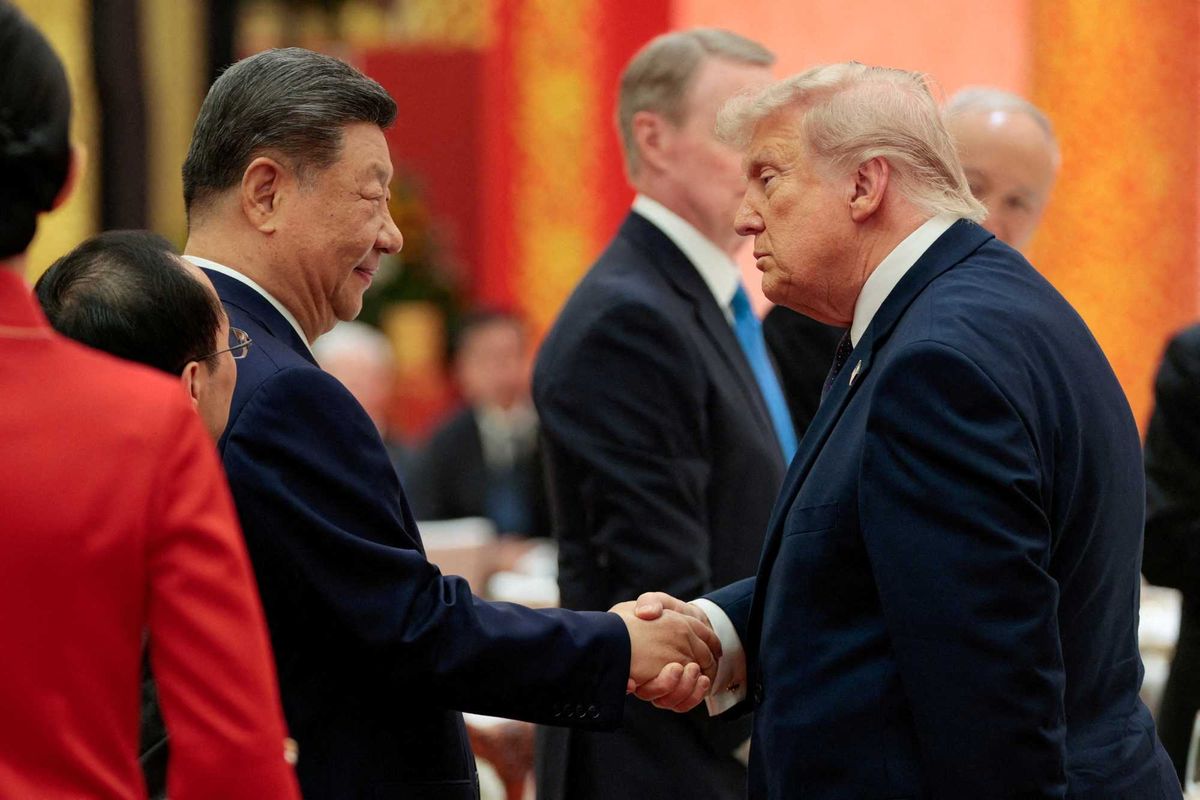
Chinese President Xi Jinping and President Donald Trump shake hands at a state banquet at the Great Hall of the People in Beijing, China, May 14, 2026. REUTERS/Evan Vucci
Business leaders and industry groups are waiting for clarity and follow-up from the Trump administration on promises it made during the China summit earlier this month, according to new reporting.
The White House assured that a "board of trade" would help relieve Chinese and American tariffs, but it's still "ironing" out the plan, "a signal the clarity industry is searching for is unlikely to come all at once," Politico reported.
Ed Brzytwa, an executive for the Consumer Technology Association, said industry groups don't know what kind of products will see reduced tariffs. U.S. Trade Representative Jamieson Greer "hasn't been clear about it, neither have the Chinese," he told Politico.
Trump has "three and a half months to get this thing up and running," Wendy Cutler, a former senior U.S. trade negotiator, told Politico. She was looking ahead to Chinese leader Xi Jinping's upcoming visit to Washington in September.
"There will be pressure to show progress, given how few deliverables came out of this last summit meeting," Cutler said.
An anonymous White House official told Politico, "further details to come" on the plans that came out of the summit.
"The administration looks forward to engaging more with the business community on this historic policy that reflects our commitment to better manage trade between the U.S. and China," the official said, according to Politico.

No comments:
Post a Comment