Michigan Prof’s Only Offense: Humanizing Palestinians

I am a Jewish American-Israeli, and a veteran of the IDF. But according to the University of Michigan administration, I am someone who needs to be protected from the truth.
On May 2, the University did not merely censor this year’s commencement speech. It treated the mention of Palestinian humanity as a radioactive heresy that had to be scrubbed from the record as if a crime had been committed.
The “outrageous” remarks were delivered by Professor Derek Peterson, a distinguished historian. During his address, Peterson suggested that the greatness of the University lies not so much in its scoreboard but rather in its pursuit of justice. He honored a list of pioneers: Sarah Burger, who paved the way for women to be admitted; Moritz Levi, the first Jewish professor, who opened doors for generations of Jewish students; and the Black Action Movement, which fought for the inclusion of Black people.
Then, he dared to praise a coalition of Jewish, Christian, and Muslim students who protested the worst man-made humanitarian catastrophe of this century. Specifically, he commended the pro-Palestinian student activists for opening our hearts to the “injustice and inhumanity of Israel’s war in Gaza.”
For this act of empathy, President Domenico Grasso issued a groveling apology on behalf of the administration for “hurtful and insensitive” remarks. It was a masterclass in institutional spinelessness. To honor Jewish professors is commendable. To honor Black students is noble. But to suggest that Palestinians, too, possess human rights worth defending—that, in this administration’s view, is heresy.
It takes a profound level of moral bankruptcy to turn a blind eye to Israel’s campaign of mass killing and destruction that a global consensus of human rights organizations—including the Israeli groups B’Tselem and Physicians for Human Rights Israel, as well as the International Association of Genocide Scholars—has called the commission of genocide. The real scandal, apparently, is not the slaughter itself, but the possibility that a few donors might have had their commencement brunch disturbed by hearing those crimes named aloud.
The irony is staggering. University leaders oversee an institution supposedly devoted to truth. Yet they react to a call for empathy with the same reflexive suppression one might expect from a white Southern university in the Segregation era, terrified of the “subversive” idea that Black Americans should be granted equal rights.
The administration’s official statement claimed that commencement was “neither the time nor the place” for such remarks.
This rationale raises the obvious question: When, exactly, is the “correct” time to acknowledge the systematic destruction of every hospital in Gaza and the killing of nearly 1,000 doctors, nurses and medics? Is there a pre-approved window during which the University of Michigan permits its faculty to decry the murder of more than 21,000 children? Or is there a donor-vetted litmus test to determine which atrocities we are allowed to name?
As a Jewish lawyer and activist who knows this conflict intimately, I find the University’s “outrage” to be particularly ignorant and insulting. We are not protected by the silencing of truth. The administration does not honor our history or the Jewish idea of speaking truth to power by censoring those who acknowledge these horrors and appeal to conscience. Instead, it brings shame and embarrassment upon this world-renowned academic institution.
This censorship serves as a grim reminder that under the current leadership, academic freedom and the pursuit of truth end exactly where the protection of donor money begins. It must be a heavy burden for these administrators to carry all that “hurt” while tens of thousands of human beings are being extinguished.
Derek R. Peterson Michigan graduation remarks 2 May 2026
“The message Rutgers is sending to this class and everyone around the country is alarming,” said Rami Elghandour. “Don’t dare stand for anything. Don’t dare speak up.”
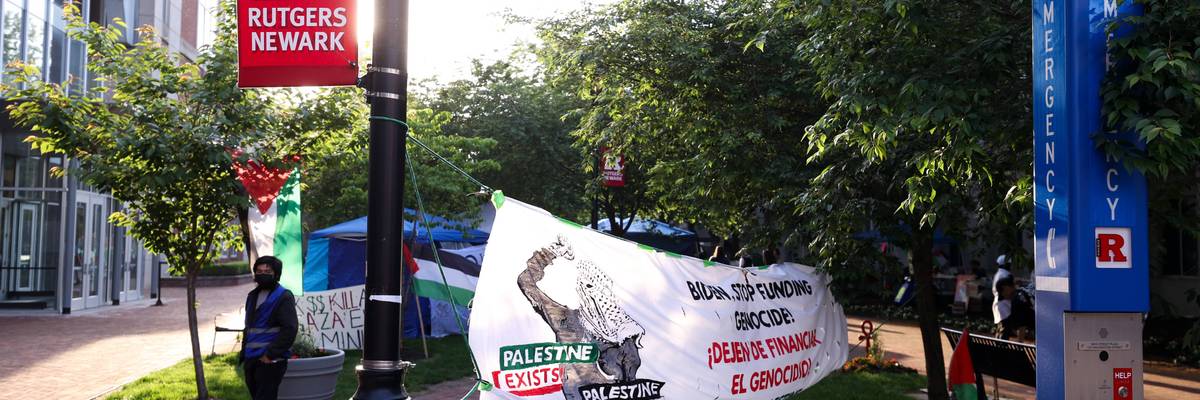
Students of Rutgers University set up Gaza solidarity encampment at a New Jersey university on the Rutgers-Newark campus in Newark, United States on May 21, 2024.
(Photo by Lokman Vural Elibol/Anadolu via Getty Images)
May 07, 2026
Faculty members at Rutgers University in New Jersey on Thursday were among those condemning the school’s decision to rescind an invitation to Rami Elghandour, a biotech executive and producer of the Gaza-focused film The Voice of Hind Rajab, who had been invited to speak at the School of Engineering commencement next week.
Elghandour said the engineering school’s dean, Alberto Cuitiño, had informed him that he was no longer scheduled to give the commencement address after a “few” students told the administration they would not attend the graduation in protest of Elghandour’s online advocacy for Palestinian rights.
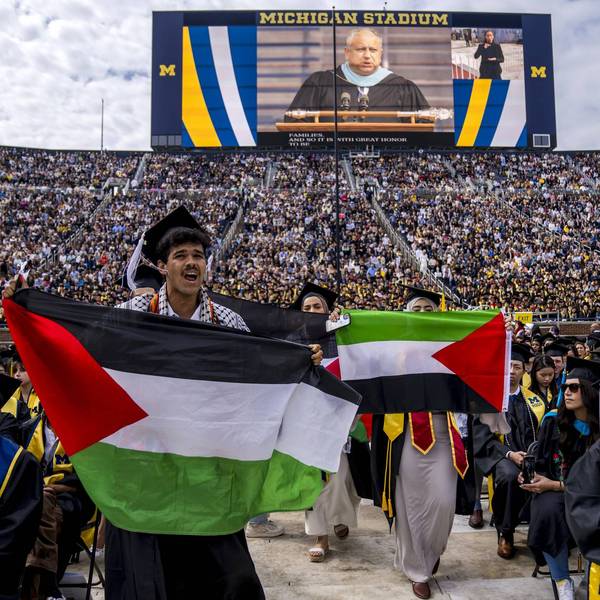
‘Cowardly’: University of Michigan Blasted After Apologizing for Commencement Speaker’s Praise of Pro-Palestine Students
“Commencement season is here, and with it the usual cycle of silencing voices that stand up for human rights,” said Waheed U. Bajwa, a professor at Rutgers in New Brunswick. “This one hits close to home... I publicly call on Rutgers to reverse this!”
Elghandour, a graduate of the engineering school, released a statement saying that the school had “decided that the feelings of a handful of students who said that my social media posts ‘opposed their beliefs’ were more important than the experience of the entire graduating class, the reputation of the school, the dignity and belonging of Arab and Muslim students, and the First Amendment.”
Speaking to the New Jersey Globe, a spokesperson for the university cited a specific post that Elghandour wrote in April on the social media platform X, saying that Israel has “committed genocide” and is “running dungeons where they train dogs to sexually assault prisoners.”
“Weapons embargo is the absolute minimum,” said Elghandour. “Sanctions and diplomatic isolation are beyond justified.”
Leading human rights organizations and Holocaust scholars are among those who have called Israel’s assault on Gaza, which began in October 2023 in retaliation for a Hamas-led attack and has killed more than 72,000 Palestinians, a genocide.
Calls for the US to suspend military aid to Israel in light of the war are hardly a fringe view in the US; a Quinnipiac University poll released last August found that 60% of voters across all parties supported a suspension of aid.
Middle East Eye reported in December on Palestinian detainees’ allegations that Israeli guards had used dogs to sexually assault them. Rights organizations including the Euro-Mediterranean Human Rights Monitor, the Palestinian Center for Human Rights, and the Council on American-Islamic Relations (CAIR) have also collected testimonies alleging such abuse.
Rutgers spokesperson Dory Devlin told the Globe that some students had accused Elghandour of making an “inflammatory claim” when they said they would not attend the graduation if he spoke.
“Rutgers chose me in part because of my humanitarian work,” said Elghandour in his statement. “They put my role as an executive producer for the Oscar-nominated The Voice of Hind Rajab front and center. They led with my social justice advocacy. Until it was inconvenient. That’s the difference between virtue signaling and principles. One withstands challenge. The other wilts in the slightest breeze.”
“The message Rutgers is sending to this class and everyone around the country is alarming,” he added. “Don’t dare stand for anything. Don’t dare speak up.”
He said he plans to record the speech he had been scheduled to give and post it online so students can still hear it.
Hank Kalet, a journalism professor at the school who serves as vice president of the Rutgers Adjunct Faculty Union, told the Globe that the university’s actions met “the definition of viewpoint censorship.”
“We have somebody who is offering, in a public way on X, some opinions about genocide in Gaza and being retaliated against because of the opinions that he has,” said Kalet, who is Jewish. He told the outlet that he did not believe Elghandour to be antisemitic.
Naureen Akhter, public affairs director for CAIR-New Jersey, noted that Rutgers had recently hosted Israel Defense Forces soldiers on its campus as part of a national tour called “Triggered: The Ceaseless Tour.”
“It is unconscionable that Rutgers rolls out the red carpet to soldiers engaged in genocide yet finds expression of pro-Palestine solidarity from one of their distinguished alumni so objectionable, they refuse to have him address graduates,” said Akhter. “We call on Rutgers School of Engineering to reinstate Rami Elghandour as commencement speaker and approach issues of student safety and freedom of expression with more care.”
The Rutgers student body is no stranger to advocacy for Palestinian rights. As on other college campuses across the US, students held a sustained protest in the spring of 2024, demanding the school divest from companies that do business with Israel, terminate its relationship with Tel Aviv University, and take other steps to demonstrate solidarity with Palestinians.
Rutgers-Newark also defended its decision to host pro-Palestinian comedian Ramy Youssef at its 2025 commencement after a state lawmaker claimed his involvement would alienate Jewish students at the university.
The decision to cancel Elghandour’s speech came days after the University of Michigan publicly apologized for a graduation speech by Professor Derek Peterson, who had applauded students who spoke out for Palestinian rights in campus protests, saying they exemplified the school’s long history of social activism.
“I think [Palestine] is the moral issue of our time, and I believe it’s been used to undermine democratic institutions in the US,” Elghandour told The Guardian on Wednesday.
Bajwa said on social media that “everyone says they’d have stood against slavery, the Holocaust, segregation, and more.”
“Easy to be righteous about the past,” he said. “But what about now? What moral tests are you failing in your own time? That’s the real test of courage.”

No comments:
Post a Comment