Xi’s ‘blunt’ warning to Trump on Taiwan exposes profound risks: analysts
ByAFP
May 14, 2026

Chinese leader Xi Jinping issued an unusually blunt message to US President Donald Trump over Taiwan that exposes potential pitfalls in the relationship, analysts said - Copyright AFP Brendan Smialowski
Peter CATTERALL
Chinese leader Xi Jinping’s unusually “blunt” warning to US President Donald Trump over Taiwan at Thursday’s summit in Beijing exposes potentially grave pitfalls in the relationship, although its immediate impact could be limited, analysts say.
US sales of military equipment to the self-ruled island claimed by Beijing have long enraged the Chinese government, threatening to derail already-fraught engagement on trade and other issues between the world’s top two economies.
China has vowed to bring Taiwan under its control, by force if necessary, while the United States — which diplomatically recognises only Beijing — is required under domestic law to provide weapons to the democratic island so that it can defend itself.
Xi warned Trump on Thursday that “the Taiwan question is the most important issue” in their bilateral relationship, according to remarks published by Chinese state media soon after the talks began.
“If mishandled, the two nations could collide or even come into conflict, pushing the entire China-US relationship into a highly perilous situation,” he said.
Such “blunt” rhetoric is “out of the ordinary” coming from Xi in conversation with a US president, Adam Ni, editor of the China Neican newsletter, told AFP.
“Xi wants to make it very clear to Trump and to the public record that he thinks the Taiwan issue is the potential powder keg between the two superpowers,” Ni said.
Chong Ja Ian of the National University of Singapore said China “has been signalling a desire for US compromise on Taiwan in the lead-up to the summit”.
“Perhaps they see some opportunity to convince Trump,” Chong said.
“So far, the US side has not indicated any movement.”
– ‘No consensus yet’ –
Trump has not commented publicly on Taiwan since arriving in Beijing on Wednesday evening.
He ignored multiple questions on the subject from reporters during a visit to the Temple of Heaven on Thursday afternoon, where he and Xi posed for photographs after talks.
A readout of the meeting from a White House official also made no mention of Taiwan.
Treasury Secretary Scott Bessent said Trump would say more on Taiwan “in the coming days”, adding that the president “understands the sensitivities” about the island.
Trump said days before the trip that he would discuss US arms sales to Taiwan with Xi — something that would be a break with a decades-long policy of not consulting with Beijing on the issue.
Secretary of State Marco Rubio, who is also in Beijing and known for his firm line on China as a senator, suggested continuity in an interview with Fox News aboard Air Force One.
“It’s not in China’s interest or anyone’s interest for there to be any sort of forced change in the status quo. I think stability there is very important,” he said.
Tzeng Wei-feng of the National Chengchi University’s Institute of International Relations in Taipei told AFP that he thinks Xi and Trump “don’t have a consensus yet” on the issue of arms sales.
While a deal on that sensitive subject is unlikely, Tzeng said, it’s possible that Trump will make “some statement that weakens the United States’ promise on defending Taiwan”.
– ‘Non-negotiable’ –
Trump repeatedly touted his personal relationship with Xi in the run-up to the summit, praising him as “a Leader of extraordinary distinction” in a social media post on Tuesday.
Many observers say Trump is placing great stock in his ability to cash in on that rapport during the summit.
Casting a shadow over talks is the unresolved US-Israeli war with Iran, which previously delayed Trump’s visit to China — the top customer of Iranian oil.
Speculation has emerged that Trump would seek to use US arms sales to Taiwan as a bargaining chip to encourage Beijing to use its leverage with Tehran to accept a deal to end the war.
However, Ryan Hass, an expert on China and Taiwan at the Washington-based Brookings Institution, threw cold water on the proposition.
“Doing so would violate Beijing’s longstanding principle that Taiwan is ‘non-negotiable’. It isn’t how Beijing rolls,” he wrote on social media.
“More likely, both leaders will affirm their shared interest in stabilising relations and use (economic and) commercial deals to demonstrate progress.”
burs-pfc-ehl/dhw/pbt
Subdued Trump left waiting for ‘big hug’ from Xi
By AFP
May 14, 2026

President Donald Trump claimed before heading to China that Chinese leader Xi Jinping would give him a "big, fat hug", but appears to have been left waiting - Copyright POOL/AFP Brendan SMIALOWSKI
Danny KEMP
Donald Trump paid a visit to the Temple of Heaven in the Chinese capital on Thursday, but the US president had a face like thunder.
Standing stiff and unsmiling next to Chinese President Xi Jinping, Trump appeared unmoved by the former imperial temple in Beijing where emperors once prayed for good harvests.
The 79-year-old American leader, who rarely misses a chance to talk to reporters, arrived in Beijing the night before after a lengthy 16-hour flight, and was uncharacteristically subdued as he was guided around the temple by Xi.
Asked by reporters including AFP how earlier talks with the Chinese leader had gone, a seemingly tired Trump replied: “Great.”
“Great place. Incredible. China’s beautiful,” he added.
But he ignored two questions on whether they had discussed Taiwan, after Xi warned that differences between the United States and China over the self-governing island claimed by Beijing could lead to conflict.
Trump had claimed before heading to China for the first time in nearly a decade that Xi would give him a “big, fat hug”.
But that did not happen.
The atmosphere had been less frosty when Trump arrived at the dominating Great Hall of the People for the talks.
The Chinese were careful to appeal to Trump’s love of pomp, greeting him with marching bands, soldiers in lockstep and a cannon salute that echoed through Tiananmen Square.
Trump beamed and applauded when hundreds of Chinese schoolchildren in brightly coloured outfits waved flags and flowers and chanted “welcome, welcome, warm welcome”.
The two leaders shook hands warmly, Trump patting Xi’s hand, and exchanged a few words on the red carpet before the cameras.
Trump — who has insisted that his personal relationship with Xi will win business deals — praised the Chinese president as a “great friend” and “great leader”.
– ‘Come into conflict’ –
But times have changed since he last visited Beijing in 2017, and he is now in a more assertive China — one that did not immediately call Trump a friend in return.
Behind the scenes, it appeared that Xi had set out an uncompromising stance on Taiwan, according to comments released by state media.
Trump had also come looking for China’s help to end the Iran war, and to extend a trade truce with Beijing, but there was no immediate sign of a breakthrough.
Instead, there was virtual silence from Trump, who refrained from commenting on his Truth Social platform that he normally posts on multiple times a day, and from the White House.
And as Xi warned that the world’s two largest economies could “come into conflict” if Washington mishandles the Taiwan issue, minor skirmishes broke out on the sidelines of their meeting.
At the Great Hall of the People, journalists from both sides jostled each other to get a place before the meeting as US and Chinese officials tried to keep order.
Then at the Temple of Heaven, US and Chinese officials held a tense discussion after local security blocked a US Secret Service agent accompanying travelling journalists from entering the complex with his weapon.
As temperatures in Beijing creeped to above 30C, Chinese officials refused to allow US reporters, including an AFP journalist, to leave a side room where they were being held and join Trump’s motorcade to his hotel.
Amid raised voices, White House officials and journalists eventually pushed past the Chinese officials to make it to their vans before the US president drove off without them.
ByAFP
May 14, 2026
Chinese leader Xi Jinping issued an unusually blunt message to US President Donald Trump over Taiwan that exposes potential pitfalls in the relationship, analysts said - Copyright AFP Brendan Smialowski
Peter CATTERALL
Chinese leader Xi Jinping’s unusually “blunt” warning to US President Donald Trump over Taiwan at Thursday’s summit in Beijing exposes potentially grave pitfalls in the relationship, although its immediate impact could be limited, analysts say.
US sales of military equipment to the self-ruled island claimed by Beijing have long enraged the Chinese government, threatening to derail already-fraught engagement on trade and other issues between the world’s top two economies.
China has vowed to bring Taiwan under its control, by force if necessary, while the United States — which diplomatically recognises only Beijing — is required under domestic law to provide weapons to the democratic island so that it can defend itself.
Xi warned Trump on Thursday that “the Taiwan question is the most important issue” in their bilateral relationship, according to remarks published by Chinese state media soon after the talks began.
“If mishandled, the two nations could collide or even come into conflict, pushing the entire China-US relationship into a highly perilous situation,” he said.
Such “blunt” rhetoric is “out of the ordinary” coming from Xi in conversation with a US president, Adam Ni, editor of the China Neican newsletter, told AFP.
“Xi wants to make it very clear to Trump and to the public record that he thinks the Taiwan issue is the potential powder keg between the two superpowers,” Ni said.
Chong Ja Ian of the National University of Singapore said China “has been signalling a desire for US compromise on Taiwan in the lead-up to the summit”.
“Perhaps they see some opportunity to convince Trump,” Chong said.
“So far, the US side has not indicated any movement.”
– ‘No consensus yet’ –
Trump has not commented publicly on Taiwan since arriving in Beijing on Wednesday evening.
He ignored multiple questions on the subject from reporters during a visit to the Temple of Heaven on Thursday afternoon, where he and Xi posed for photographs after talks.
A readout of the meeting from a White House official also made no mention of Taiwan.
Treasury Secretary Scott Bessent said Trump would say more on Taiwan “in the coming days”, adding that the president “understands the sensitivities” about the island.
Trump said days before the trip that he would discuss US arms sales to Taiwan with Xi — something that would be a break with a decades-long policy of not consulting with Beijing on the issue.
Secretary of State Marco Rubio, who is also in Beijing and known for his firm line on China as a senator, suggested continuity in an interview with Fox News aboard Air Force One.
“It’s not in China’s interest or anyone’s interest for there to be any sort of forced change in the status quo. I think stability there is very important,” he said.
Tzeng Wei-feng of the National Chengchi University’s Institute of International Relations in Taipei told AFP that he thinks Xi and Trump “don’t have a consensus yet” on the issue of arms sales.
While a deal on that sensitive subject is unlikely, Tzeng said, it’s possible that Trump will make “some statement that weakens the United States’ promise on defending Taiwan”.
– ‘Non-negotiable’ –
Trump repeatedly touted his personal relationship with Xi in the run-up to the summit, praising him as “a Leader of extraordinary distinction” in a social media post on Tuesday.
Many observers say Trump is placing great stock in his ability to cash in on that rapport during the summit.
Casting a shadow over talks is the unresolved US-Israeli war with Iran, which previously delayed Trump’s visit to China — the top customer of Iranian oil.
Speculation has emerged that Trump would seek to use US arms sales to Taiwan as a bargaining chip to encourage Beijing to use its leverage with Tehran to accept a deal to end the war.
However, Ryan Hass, an expert on China and Taiwan at the Washington-based Brookings Institution, threw cold water on the proposition.
“Doing so would violate Beijing’s longstanding principle that Taiwan is ‘non-negotiable’. It isn’t how Beijing rolls,” he wrote on social media.
“More likely, both leaders will affirm their shared interest in stabilising relations and use (economic and) commercial deals to demonstrate progress.”
burs-pfc-ehl/dhw/pbt
Subdued Trump left waiting for ‘big hug’ from Xi
By AFP
May 14, 2026
President Donald Trump claimed before heading to China that Chinese leader Xi Jinping would give him a "big, fat hug", but appears to have been left waiting - Copyright POOL/AFP Brendan SMIALOWSKI
Danny KEMP
Donald Trump paid a visit to the Temple of Heaven in the Chinese capital on Thursday, but the US president had a face like thunder.
Standing stiff and unsmiling next to Chinese President Xi Jinping, Trump appeared unmoved by the former imperial temple in Beijing where emperors once prayed for good harvests.
The 79-year-old American leader, who rarely misses a chance to talk to reporters, arrived in Beijing the night before after a lengthy 16-hour flight, and was uncharacteristically subdued as he was guided around the temple by Xi.
Asked by reporters including AFP how earlier talks with the Chinese leader had gone, a seemingly tired Trump replied: “Great.”
“Great place. Incredible. China’s beautiful,” he added.
But he ignored two questions on whether they had discussed Taiwan, after Xi warned that differences between the United States and China over the self-governing island claimed by Beijing could lead to conflict.
Trump had claimed before heading to China for the first time in nearly a decade that Xi would give him a “big, fat hug”.
But that did not happen.
The atmosphere had been less frosty when Trump arrived at the dominating Great Hall of the People for the talks.
The Chinese were careful to appeal to Trump’s love of pomp, greeting him with marching bands, soldiers in lockstep and a cannon salute that echoed through Tiananmen Square.
Trump beamed and applauded when hundreds of Chinese schoolchildren in brightly coloured outfits waved flags and flowers and chanted “welcome, welcome, warm welcome”.
The two leaders shook hands warmly, Trump patting Xi’s hand, and exchanged a few words on the red carpet before the cameras.
Trump — who has insisted that his personal relationship with Xi will win business deals — praised the Chinese president as a “great friend” and “great leader”.
– ‘Come into conflict’ –
But times have changed since he last visited Beijing in 2017, and he is now in a more assertive China — one that did not immediately call Trump a friend in return.
Behind the scenes, it appeared that Xi had set out an uncompromising stance on Taiwan, according to comments released by state media.
Trump had also come looking for China’s help to end the Iran war, and to extend a trade truce with Beijing, but there was no immediate sign of a breakthrough.
Instead, there was virtual silence from Trump, who refrained from commenting on his Truth Social platform that he normally posts on multiple times a day, and from the White House.
And as Xi warned that the world’s two largest economies could “come into conflict” if Washington mishandles the Taiwan issue, minor skirmishes broke out on the sidelines of their meeting.
At the Great Hall of the People, journalists from both sides jostled each other to get a place before the meeting as US and Chinese officials tried to keep order.
Then at the Temple of Heaven, US and Chinese officials held a tense discussion after local security blocked a US Secret Service agent accompanying travelling journalists from entering the complex with his weapon.
As temperatures in Beijing creeped to above 30C, Chinese officials refused to allow US reporters, including an AFP journalist, to leave a side room where they were being held and join Trump’s motorcade to his hotel.
Amid raised voices, White House officials and journalists eventually pushed past the Chinese officials to make it to their vans before the US president drove off without them.
Trump reportedly 'humiliated' after rival leader snubs president at airport: 'Rocky start'
Alexander Willis
May 13, 2026
RAW STORY
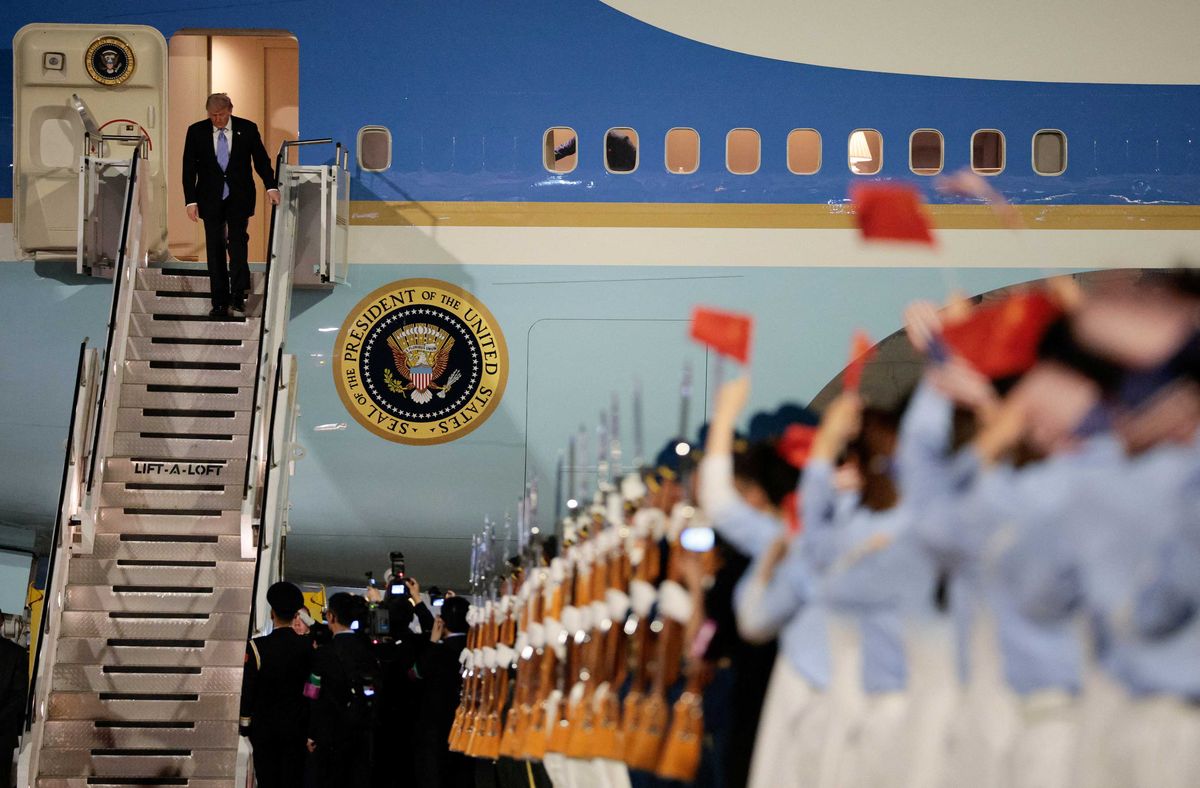
U.S. President Donald Trump arrives aboard Air Force One at Beijing Capital International Airport during his visit to the country, in Beijing, China, May 13, 2026. REUTERS/Evan Vucci
President Donald Trump landed in Beijing, China Wednesday ahead of his high-stakes summit with President Xi Jinping, but critics soon noticed a key figure was absent during Trump’s arrival.
“Donald Trump has arrived in China to find that President Xi did NOT greet him at the airport,” reads a statement from the progressive advocacy platform Call To Activism, run by digital strategist and political influencer Joe Gallina.
“MAGA is in spin mode heralding the ‘red carpet treatment,’ but the visit is already at a rocky start. Instead of a presidential welcome, Trump was greeted by US Ambassador to China David Perdue; Xi’s vice president, Han Zheng; China’s Ambassador to Washington Xie Feng; and Executive Vice Minister of Foreign Affairs Ma Zhaoxu.”
Trump was, in fact, not greeted by Xi as he stepped off Air Force One Wednesday, and instead met by other Chinese officials. Trump’s own niece, Mary L. Trump, took notice of what she characterized as a snub as well.
“Xi couldn't be bothered to meet Donald at the airport because he understands as well as Donald does that humiliating your underlings is a great way to keep them in check,” she wrote in a social media post on X to her more than 1.6 million followers.
As argued by journalist Charbel Antoun, Trump walks into the U.S.-China summit with a “weakened” hand given his inability to secure a peace deal with Iran amid the ongoing U.S.-Israeli war against the Middle East nation. And on Monday, Trump’s efforts to end the war on his own terms were undercut after Tehran agreed to a U.S.-Iran peace deal brokered by China.
Alexander Willis
May 13, 2026
RAW STORY
U.S. President Donald Trump arrives aboard Air Force One at Beijing Capital International Airport during his visit to the country, in Beijing, China, May 13, 2026. REUTERS/Evan Vucci
President Donald Trump landed in Beijing, China Wednesday ahead of his high-stakes summit with President Xi Jinping, but critics soon noticed a key figure was absent during Trump’s arrival.
“Donald Trump has arrived in China to find that President Xi did NOT greet him at the airport,” reads a statement from the progressive advocacy platform Call To Activism, run by digital strategist and political influencer Joe Gallina.
“MAGA is in spin mode heralding the ‘red carpet treatment,’ but the visit is already at a rocky start. Instead of a presidential welcome, Trump was greeted by US Ambassador to China David Perdue; Xi’s vice president, Han Zheng; China’s Ambassador to Washington Xie Feng; and Executive Vice Minister of Foreign Affairs Ma Zhaoxu.”
Trump was, in fact, not greeted by Xi as he stepped off Air Force One Wednesday, and instead met by other Chinese officials. Trump’s own niece, Mary L. Trump, took notice of what she characterized as a snub as well.
“Xi couldn't be bothered to meet Donald at the airport because he understands as well as Donald does that humiliating your underlings is a great way to keep them in check,” she wrote in a social media post on X to her more than 1.6 million followers.
As argued by journalist Charbel Antoun, Trump walks into the U.S.-China summit with a “weakened” hand given his inability to secure a peace deal with Iran amid the ongoing U.S.-Israeli war against the Middle East nation. And on Monday, Trump’s efforts to end the war on his own terms were undercut after Tehran agreed to a U.S.-Iran peace deal brokered by China.
Erin Burnett blown away as Trump 'mocked across China': 'America has lost its swagger'
Bennito L. Kelty
May 13, 2026
RAW STORY
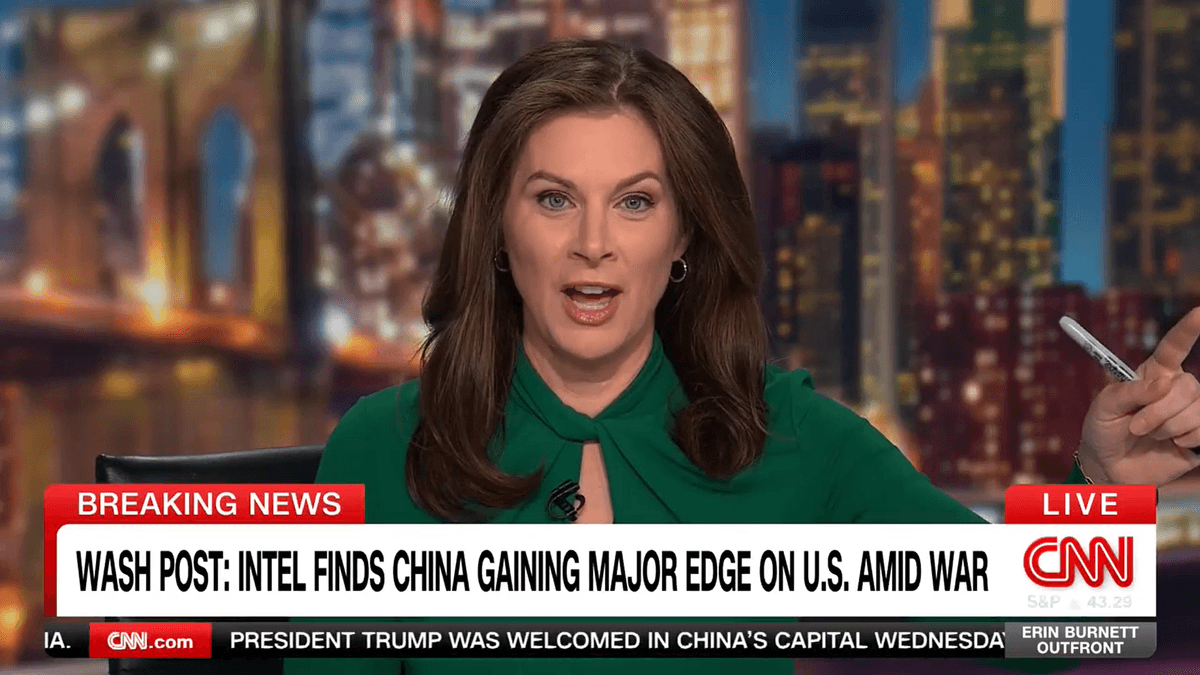
Erin Burnett read social media posts from China that mocked Trump as he met with Xi Jinping (CNN/Screenshot)
CNN anchor Erin Burnett was stunned to see the level of uninhibited mockery China has been hurling at Trump during his visit.
"Trump is about to meet with Chinese leader Xi Jinping tonight, a high-stakes meeting which is being mocked across China," Burnett explained. "Beijing's strict censors are letting the ridicule go viral, which is a statement in and of itself."
"America has lost its swagger. They're nothing but a paper tiger," one of those viral posts read. "The U.S. economy is in bad shape. Trump has been blustering Iran for so long."
"They will look up to us from now on," read another post that Burnett shared. "Trump came to China! We won the tariff war!" read another.
"Trump, you're welcome to visit China and learn from us," the mockery continued.
"The U.S. is no longer a country that we look up to. We can now compete with them with confidence and strength," a Chinese social media user wrote.
"In China, political content like this never goes viral, especially when you have a head of state coming," Burnett explained. "This is because government censors want this to go viral, and by the tone of the messages, the Chinese government feels they've got the upper hand."
CNN reporter taken aback as Chinese residents let Trump have it
Alexander Willis
May 13, 2026
RAW STORY
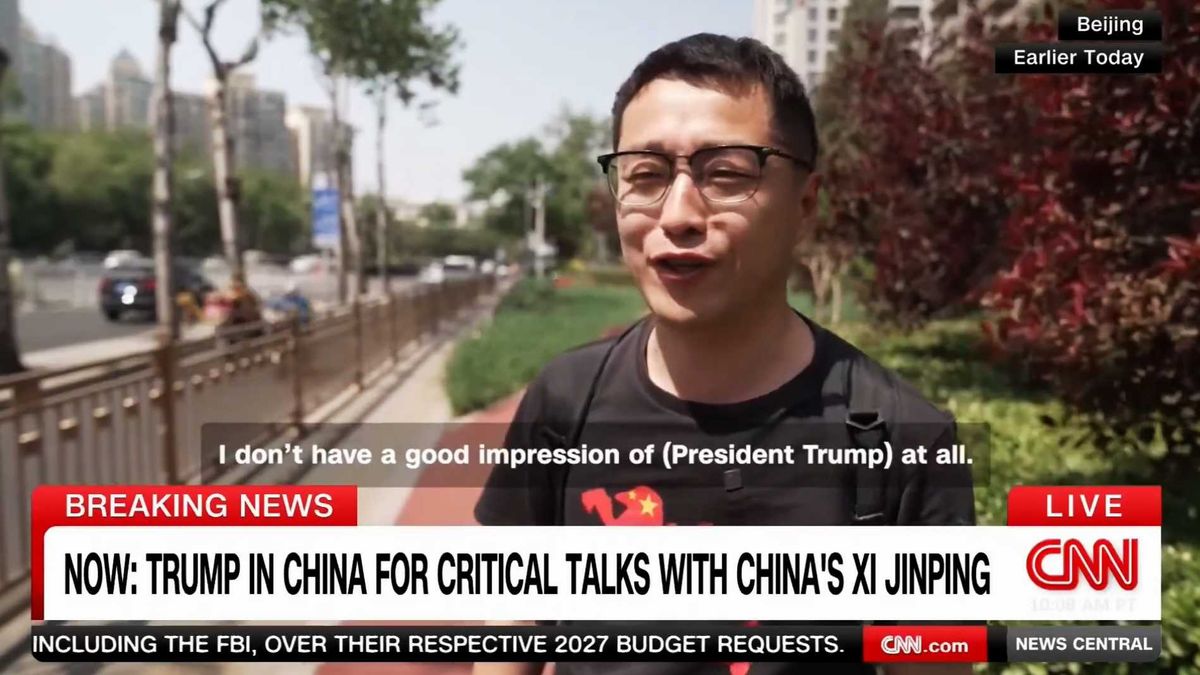
Beijing, China resident Mr. Liu speaks to CNN on Wednesday, May 13, 2026.
Beijing, China resident Mr. Liu speaks to CNN on Wednesday, May 13, 2026.
(Screengrab / CNN)
President Donald Trump landed in China on Wednesday ahead of his high-stakes summit with President Xi Jinping, reportedly hoping for help with his deeply unpopular war against Iran – but Beijing residents interviewed by CNN were quick to pour cold water on the idea.
“I don't have a good impression of President Donald Trump at all,” one Beijing resident, identified as Mr. Liu, told CNN. “The U.S.-Iran conflict was stirred up by him, too. Look at the trade and economic war before, wasn't that him too?”
CNN’s Boris Sanchez said, citing U.S. officials, Trump is “expected to encourage Xi to push Iran to re-open the Strait of Hormuz,” a critical shipping waterway through which a fifth of the world’s oil trade historically flows. On the ground in Beijing, CNN’s Mike Valerio reiterated Sanchez’s claim and expressed shock at the pushback he personally heard from Beijing residents.
“What's important for everybody back home in America to know: deals and getting help with the war in Iran are far and away the two biggest topics the president is going to raise in his meeting with President Xi Jinping,” Valerio said.
“In terms of asking for help from China to re-open the Strait of Hormuz, we went up and down throughout town in Beijing most of the day yesterday, and I was so struck by so many who told us they do not want China getting involved at all in this U.S.-Israeli war.”
President Donald Trump landed in China on Wednesday ahead of his high-stakes summit with President Xi Jinping, reportedly hoping for help with his deeply unpopular war against Iran – but Beijing residents interviewed by CNN were quick to pour cold water on the idea.
“I don't have a good impression of President Donald Trump at all,” one Beijing resident, identified as Mr. Liu, told CNN. “The U.S.-Iran conflict was stirred up by him, too. Look at the trade and economic war before, wasn't that him too?”
CNN’s Boris Sanchez said, citing U.S. officials, Trump is “expected to encourage Xi to push Iran to re-open the Strait of Hormuz,” a critical shipping waterway through which a fifth of the world’s oil trade historically flows. On the ground in Beijing, CNN’s Mike Valerio reiterated Sanchez’s claim and expressed shock at the pushback he personally heard from Beijing residents.
“What's important for everybody back home in America to know: deals and getting help with the war in Iran are far and away the two biggest topics the president is going to raise in his meeting with President Xi Jinping,” Valerio said.
“In terms of asking for help from China to re-open the Strait of Hormuz, we went up and down throughout town in Beijing most of the day yesterday, and I was so struck by so many who told us they do not want China getting involved at all in this U.S.-Israeli war.”
Beijing resident Mr. Li, for instance, told CNN it was not China’s "diplomatic principle” to get involved in such matters. Ms. Yuan, another Beijing resident, was more blunt in her opposition.
“I don't think China should interfere too much in those kinds of issues,” she told CNN.
Trump’s visit to China already got off to “a rocky start,” according to the progressive advocacy platform Call To Activism, after the president stepped off Air Force One to be greeted not by Xi, but by lower-ranking Chinese officials, the optics of which Mary L. Trump, Trump’s niece, described as “humiliating.”
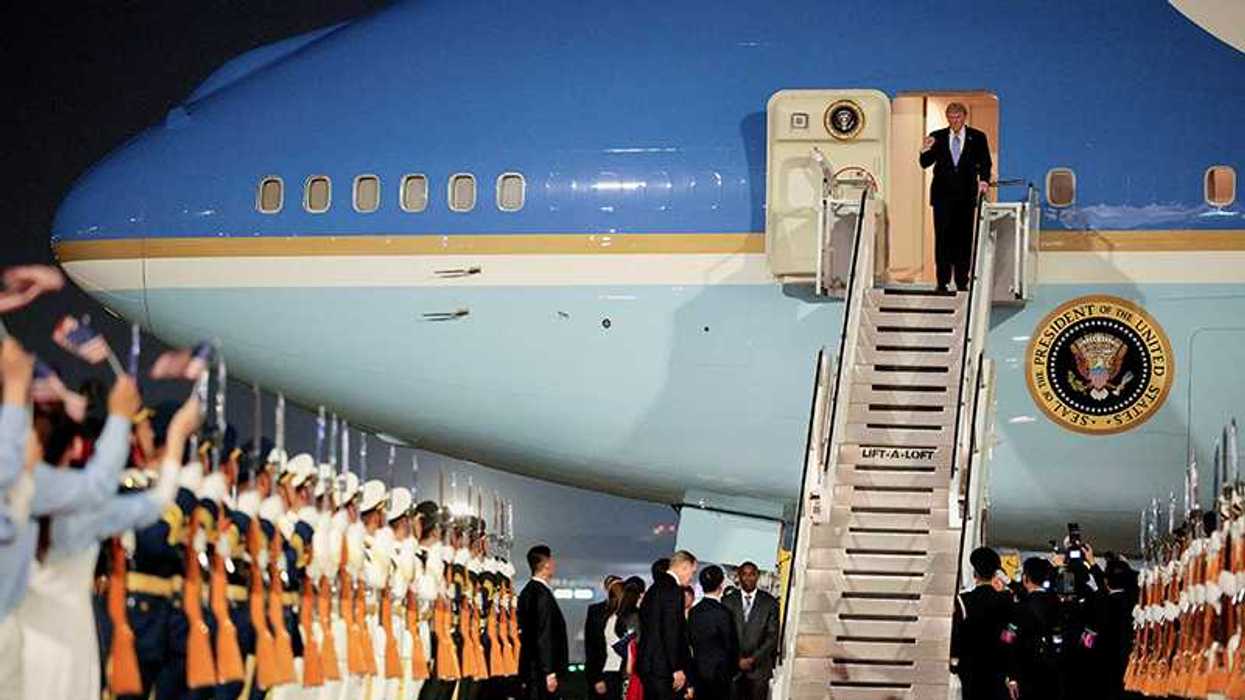
U.S. President Donald Trump arrives aboard Air Force One at Beijing Capital International Airport during his visit to the country, in Beijing, China, May 13, 2026.
REUTERS/Evan Vucci TPX IMAGES OF THE DAY
May 13, 2026
ALTERNET
CNN reported Wednesday morning (U.S. time) that during the 20-plus-hour flight President Donald Trump took from Washington D.C. to Beijing on Tuesday and Wednesday, he never once spoke to the press, which is unusual.
As the president landed in China ahead of his summit with Xi Jinping, Senior White House correspondent Kristen Holmes reported that a number of tech CEOs were on the plane with Trump while others took the overflow plane.
"So you see them now opening the door, John, and we'll wait and see how long President Trump takes to actually come out and greet everyone," continued Holmes. "He's been on a long flight and he didn't talk to the press at all, which is incredibly notable. A guy who loves talking to the press, particularly when he's on a 20-or-so-hour flight, he did not do that this time around."
Co-host Kate Bolduan keyed in on the comments and how unusual it was.
"That was actually going to be my question because I was — we of course, as we woke up to the news, you know, woke up to knowing that you guys were all flying over waiting and kind of expecting" Trump to speak to the press, Bolduan explained.
"Are we going to get some information or a gaggle, if nothing else, of the president?" the host asked.
Co-host John Berman returned to the matter in a later conversation, saying that Trump allowed his final remarks about Iran and America's economic situation to marinate in the political news.
Trump on Tuesday, before departing for China, told reporters he doesn't think "even a little bit" about Americans' financial situation when executing the war in Iran.
“The only thing that matters when I'm talking about Iran, they can't have a nuclear weapon. I don't think about Americans' financial situation. I don't think about anybody. I think about one thing: We cannot let Iran have a nuclear weapon," Trump said Tuesday.
'Glaring': Speculation abounds as Melania noticeably absent from husband's China trip
Nicole Charky-Chami
May 13, 2026
Nicole Charky-Chami
May 13, 2026
RAW STORY
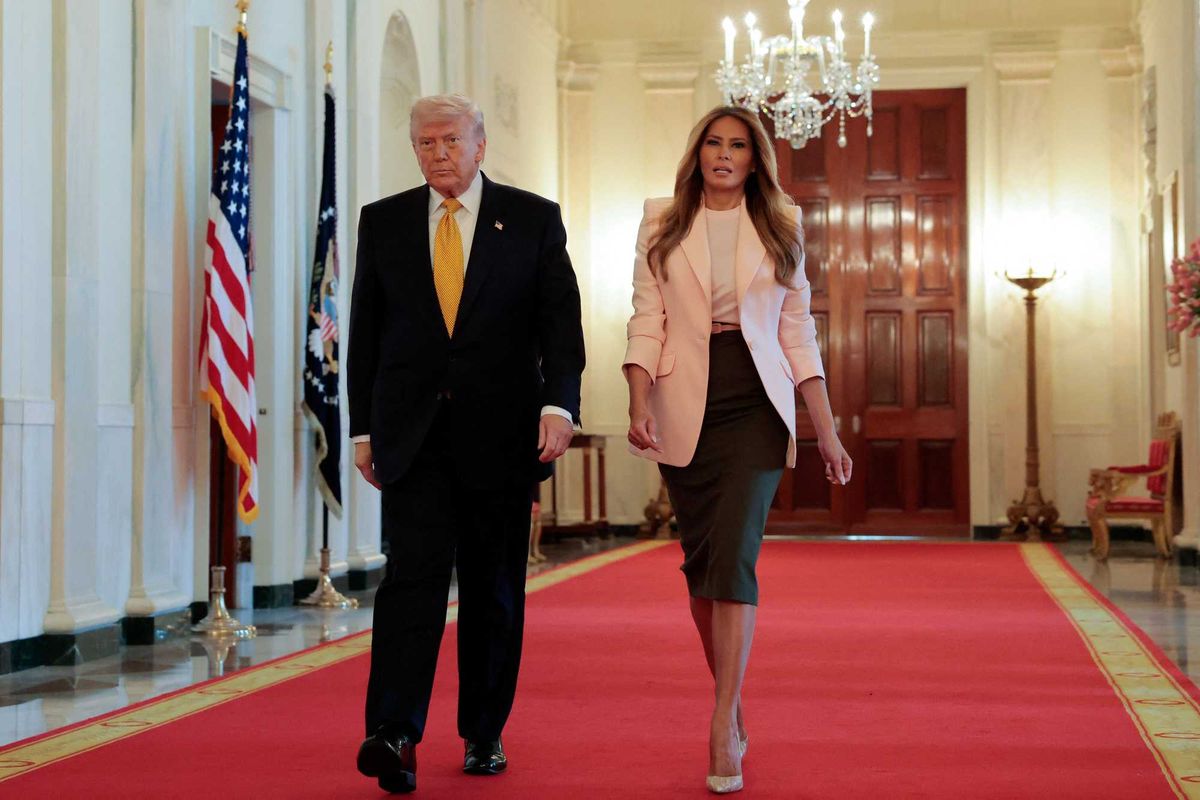
President Donald Trump and First lady Melania Trump walk to attend an event to mark Military Mother's Day, in the East Room at the White House in Washington, D.C., on May 6, 2026. REUTERS/Kylie Cooper
President Donald Trump's high-stakes three-day China visit has revealed one person conspicuously missing — his wife, First Lady Melania Trump.
Trump was accompanied to Beijing with his cabinet, his son Eric, and daughter-in-law Lara, and 16 corporate CEOs, The Daily Beast reported. And hours before taking off to leave the United States, the first lady's office dropped a cryptic confirmation in a statement to the South China Morning Post, without any explanation for why she would miss out on the trip.
"First Lady Melania Trump is not travelling this time," Melania's spokesperson said.
When pressed for additional details, her team went silent.
The snub marks the latest chapter in what insiders describe as a widening rift between the first couple.
"The move comes amid speculation about the first lady increasingly breaking with her husband as she seems to be trying to charter her own course," The Beast reported. "Trump and his White House aides were reportedly blindsided last month when she called a surprise press conference to read a statement declaring she had no ties to the late sex trafficker Jeffrey Epstein. The move appeared only to revive the scandal that Trump himself had been eager to put to rest."
Melania has been noticeably absent at the White House throughout the second Trump administration and often does not travel with the president. And although first ladies don't always attend trips, the questions around her attendance have raised eyebrows.
"Her absence is all the more glaring because it follows a trend that has stood out in Trump’s second term: She’s been appearing alongside him less and less on state visits," according to The Beast.
President Donald Trump and First lady Melania Trump walk to attend an event to mark Military Mother's Day, in the East Room at the White House in Washington, D.C., on May 6, 2026. REUTERS/Kylie Cooper
President Donald Trump's high-stakes three-day China visit has revealed one person conspicuously missing — his wife, First Lady Melania Trump.
Trump was accompanied to Beijing with his cabinet, his son Eric, and daughter-in-law Lara, and 16 corporate CEOs, The Daily Beast reported. And hours before taking off to leave the United States, the first lady's office dropped a cryptic confirmation in a statement to the South China Morning Post, without any explanation for why she would miss out on the trip.
"First Lady Melania Trump is not travelling this time," Melania's spokesperson said.
When pressed for additional details, her team went silent.
The snub marks the latest chapter in what insiders describe as a widening rift between the first couple.
"The move comes amid speculation about the first lady increasingly breaking with her husband as she seems to be trying to charter her own course," The Beast reported. "Trump and his White House aides were reportedly blindsided last month when she called a surprise press conference to read a statement declaring she had no ties to the late sex trafficker Jeffrey Epstein. The move appeared only to revive the scandal that Trump himself had been eager to put to rest."
Melania has been noticeably absent at the White House throughout the second Trump administration and often does not travel with the president. And although first ladies don't always attend trips, the questions around her attendance have raised eyebrows.
"Her absence is all the more glaring because it follows a trend that has stood out in Trump’s second term: She’s been appearing alongside him less and less on state visits," according to The Beast.
Jen Psaki mocks Vance as Trump jets off without him: 'Doing his homework while Dad's away'
Matthew Chapman
May 13, 2026
The Trump administration's Medicaid cuts, which California's attorney general said will gut programs that help seniors and people with disabilities remain in their homes, were unveiled with what Psaki described as unusual fanfare — "tons of pomp and circumstance."
The timing was no accident, she argued. Vance made the announcement the day before California Gov. Gavin Newsom was scheduled to unveil the state's annual budget, delivering a one-two punch intended to dominate news cycles and put Newsom on defense.
"Politically speaking, today was kind of a twofer," Psaki said. "He got some headlines to stay relevant while Marco got to ride on the big plane to go do big boy stuff in China. And he got to attack Gavin Newsom."
Newsom is widely considered one of Vance's most formidable potential rivals in the 2028 presidential race, making California a particularly attractive target for the vice president's political maneuvering.
Matthew Chapman
May 13, 2026
RAW STORY
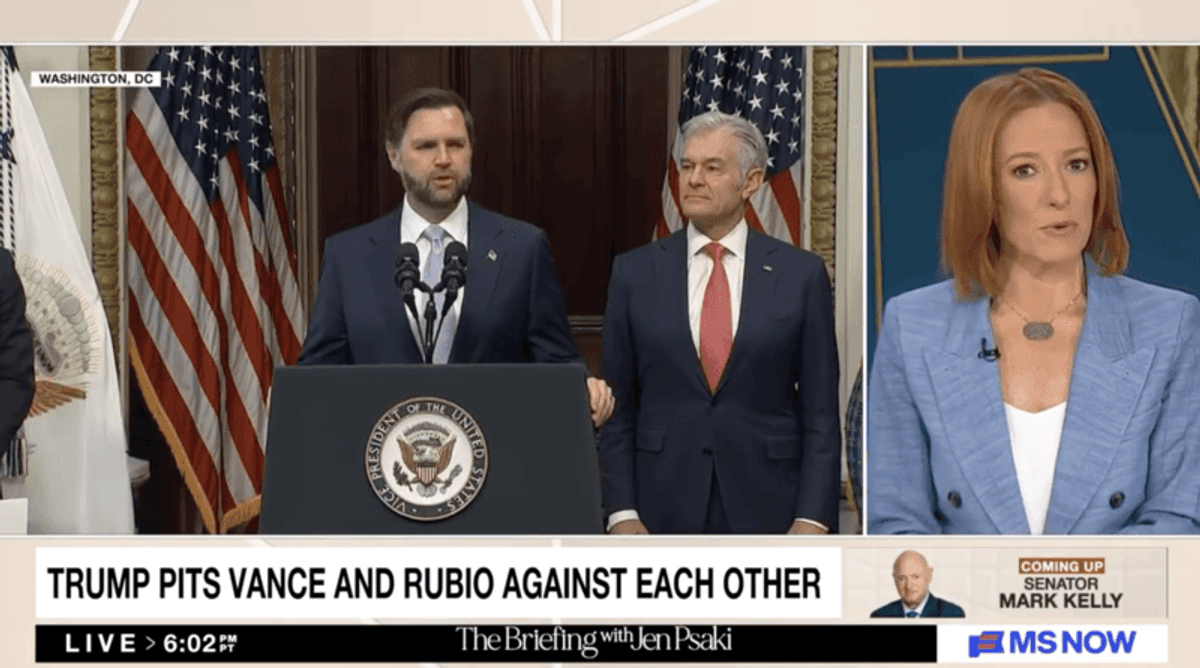
(Screengrab via MS NOW)
Vice President JD Vance drew sharp ridicule from MS NOW host Jen Psaki on Tuesday after he gleefully announced the suspension of more than $1.3 billion in Medicaid payments to California — a move Psaki framed as a naked bid for attention while his political rivals grabbed the spotlight.
"JD Vance is desperately trying to remind dad he's still his most special boy," Psaki quipped on her show, mocking the announcement as political theater designed to keep Vance relevant while Secretary of State Marco Rubio accompanied President Donald Trump to China. "He's still doing his homework, even though dad's away on his big work trip."
Vance himself joked about the seeming disconnect, comparing himself to Macaulay Culkin's character in "Home Alone."
(Screengrab via MS NOW)
Vice President JD Vance drew sharp ridicule from MS NOW host Jen Psaki on Tuesday after he gleefully announced the suspension of more than $1.3 billion in Medicaid payments to California — a move Psaki framed as a naked bid for attention while his political rivals grabbed the spotlight.
"JD Vance is desperately trying to remind dad he's still his most special boy," Psaki quipped on her show, mocking the announcement as political theater designed to keep Vance relevant while Secretary of State Marco Rubio accompanied President Donald Trump to China. "He's still doing his homework, even though dad's away on his big work trip."
Vance himself joked about the seeming disconnect, comparing himself to Macaulay Culkin's character in "Home Alone."
The Trump administration's Medicaid cuts, which California's attorney general said will gut programs that help seniors and people with disabilities remain in their homes, were unveiled with what Psaki described as unusual fanfare — "tons of pomp and circumstance."
The timing was no accident, she argued. Vance made the announcement the day before California Gov. Gavin Newsom was scheduled to unveil the state's annual budget, delivering a one-two punch intended to dominate news cycles and put Newsom on defense.
"Politically speaking, today was kind of a twofer," Psaki said. "He got some headlines to stay relevant while Marco got to ride on the big plane to go do big boy stuff in China. And he got to attack Gavin Newsom."
Newsom is widely considered one of Vance's most formidable potential rivals in the 2028 presidential race, making California a particularly attractive target for the vice president's political maneuvering.
'Amateur hour': CBS News' MAGA-friendly anchor's Taiwan broadcast ends in shambles
Travis Gettys
May 14, 2026
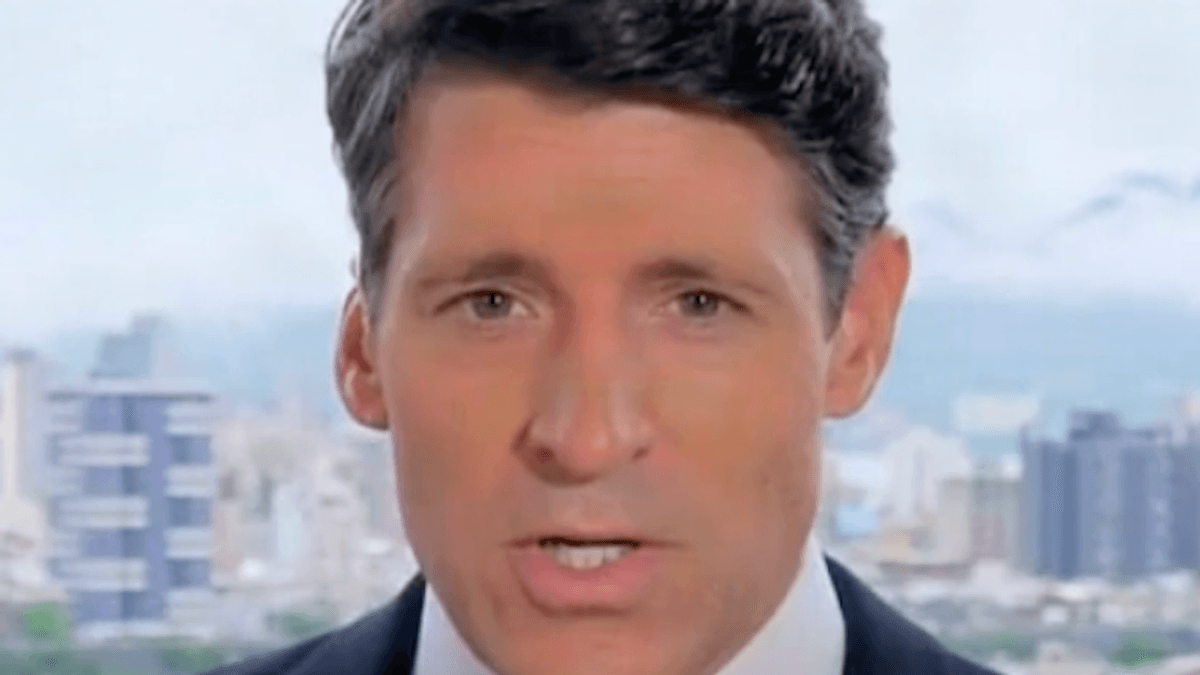
Tony Dokoupil/CBS News-YouTube
"CBS Evening News" anchor Tony Dokoupil’s first broadcast from Taiwan ended in shambles after his cameraman suffered an on-air medical emergency.
The MAGA-coded anchorman was introducing the summit between President Donald Trump and Chinese President Xi Jinping when the camera shot tilted and producers abruptly cut to B-roll footage, reported The Daily Beast.
“Is he okay?” Dokoupil asked after a thud could be heard off camera. “We’re gonna take a quick break, we have an — a medical emergency here. We’re calling a doctor."
Producers showed more B-roll footage of Chinese landscapes played before cutting to a studio shot of CBS News chief correspondent Matt Gutman.
“So I’m going to sign off for Tony Dokoupil, who’s been reporting in Taiwan,” Gutman told viewers. “We’re going to go to break, we’ll be right back.”
CBS News later confirmed on its X account that the camera operator had suffered a medical emergency during the broadcast and made clear that he was expected to recover.
Dokoupil was broadcasting from Taipei instead of Beijing because the network failed to secure a Chinese visa for the anchor, although it's not clear whether the lapse was due to a late application or another issue.
Prior to the emergency, the broadcast had been bedeviled by awkward pauses and technical difficulties.
Dokoupil repeatedly fiddled with his earpiece, which led to lengthy pauses during a handoff from White House correspondent Weijia Jiang reporting live from Beijing and after foreign correspondent Anna Coren finished her report.
“Amateur, amateur, amateur hour," an Emmy-winning network TV executive told the Daily Beast.
The evening news program has seen its rating tumble to just 3.7 million, with only 473,000 average viewers in the closely watched advertising demo of 25-54-year-olds, since conservative pundit Bari Weiss took over as editor-in-chief.
That's far behind "ABC World News Tonight," which averaged 8.2 million total viewers and 976,000 in the key demo, and "NBC Nightly News," which averaged 6.1 million and 903,000, respectively.
Travis Gettys
May 14, 2026
RAW STORY
Tony Dokoupil/CBS News-YouTube
"CBS Evening News" anchor Tony Dokoupil’s first broadcast from Taiwan ended in shambles after his cameraman suffered an on-air medical emergency.
The MAGA-coded anchorman was introducing the summit between President Donald Trump and Chinese President Xi Jinping when the camera shot tilted and producers abruptly cut to B-roll footage, reported The Daily Beast.
“Is he okay?” Dokoupil asked after a thud could be heard off camera. “We’re gonna take a quick break, we have an — a medical emergency here. We’re calling a doctor."
Producers showed more B-roll footage of Chinese landscapes played before cutting to a studio shot of CBS News chief correspondent Matt Gutman.
“So I’m going to sign off for Tony Dokoupil, who’s been reporting in Taiwan,” Gutman told viewers. “We’re going to go to break, we’ll be right back.”
CBS News later confirmed on its X account that the camera operator had suffered a medical emergency during the broadcast and made clear that he was expected to recover.
Dokoupil was broadcasting from Taipei instead of Beijing because the network failed to secure a Chinese visa for the anchor, although it's not clear whether the lapse was due to a late application or another issue.
Prior to the emergency, the broadcast had been bedeviled by awkward pauses and technical difficulties.
Dokoupil repeatedly fiddled with his earpiece, which led to lengthy pauses during a handoff from White House correspondent Weijia Jiang reporting live from Beijing and after foreign correspondent Anna Coren finished her report.
“Amateur, amateur, amateur hour," an Emmy-winning network TV executive told the Daily Beast.
The evening news program has seen its rating tumble to just 3.7 million, with only 473,000 average viewers in the closely watched advertising demo of 25-54-year-olds, since conservative pundit Bari Weiss took over as editor-in-chief.
That's far behind "ABC World News Tonight," which averaged 8.2 million total viewers and 976,000 in the key demo, and "NBC Nightly News," which averaged 6.1 million and 903,000, respectively.
'Appalling' director's surprise appearance during Trump's China trip incenses analyst
Robert Davis
May 13, 2026
Robert Davis
May 13, 2026
RAW STORY
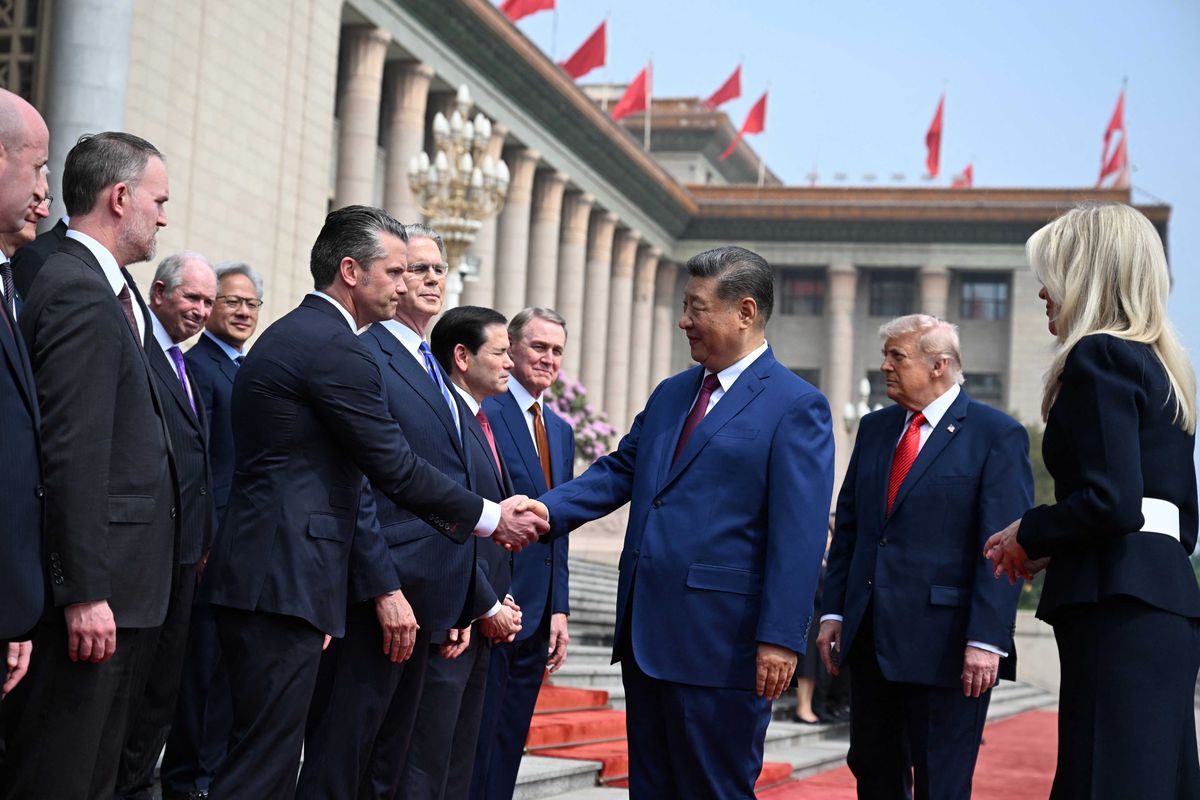
President Xi Jinping shaking hands with U.S. Secretary of Defense Pete Hegseth. The scene as U.S. President Donald Trump participates in events at the Great Hall of the People and does a greeting with the President of the People’s Republic of China Xi Jinping May 14, 2026, in Beijing China during a trip focused on trade, regional security, and strengthening bilateral ties between the world’s two largest economies. Kenny Holston/Pool via REUTERS
The full breadth of President Donald Trump's entourage of American business leaders and dignitaries was unveiled during a welcoming ceremony in China early Thursday morning, which included an appearance of one individual who incensed a political analyst.
Ana Navarro, a CNN commentator, noted that Brett Ratner, who directed Melania Trump's eponymous documentary on Amazon, was among those selected by Trump to travel with his delegation. Ratner's travel to China on the U.S. taxpayers' dime incensed Navarro because of his sordid history in Hollywood and the harm he's caused to some women.
"There is also another person who is in this official delegation, and that was on Air Force One, and that's Brett Ratner, who was the director and producer of the 'Melania' movie," Navarro said on CNN's "NewsNight." "But let us remember, Brett Ratner had been basically banished from Hollywood in 2017 because there were very serious sexual predatory allegations against him."
"His name is all over the Epstein file because of his association with Epstein," she continued. And so, because he volunteered to do that documentary on Melania, that Amazon allegedly paid $40 million for, he is now being brought back and rehabilitated by Donald Trump."
"I find it appalling, appalling, and I urge people to go look up the women," she added. "Some of the biggest names in Hollywood who spoke up against the sexual harassment and sexual acts of Brett Ratner, which included things like masturbating in front of them. And there he is as part of the official U.S. delegation flying on Air Force One on our dime. I find that appalling."
President Xi Jinping shaking hands with U.S. Secretary of Defense Pete Hegseth. The scene as U.S. President Donald Trump participates in events at the Great Hall of the People and does a greeting with the President of the People’s Republic of China Xi Jinping May 14, 2026, in Beijing China during a trip focused on trade, regional security, and strengthening bilateral ties between the world’s two largest economies. Kenny Holston/Pool via REUTERS
The full breadth of President Donald Trump's entourage of American business leaders and dignitaries was unveiled during a welcoming ceremony in China early Thursday morning, which included an appearance of one individual who incensed a political analyst.
Ana Navarro, a CNN commentator, noted that Brett Ratner, who directed Melania Trump's eponymous documentary on Amazon, was among those selected by Trump to travel with his delegation. Ratner's travel to China on the U.S. taxpayers' dime incensed Navarro because of his sordid history in Hollywood and the harm he's caused to some women.
"There is also another person who is in this official delegation, and that was on Air Force One, and that's Brett Ratner, who was the director and producer of the 'Melania' movie," Navarro said on CNN's "NewsNight." "But let us remember, Brett Ratner had been basically banished from Hollywood in 2017 because there were very serious sexual predatory allegations against him."
"His name is all over the Epstein file because of his association with Epstein," she continued. And so, because he volunteered to do that documentary on Melania, that Amazon allegedly paid $40 million for, he is now being brought back and rehabilitated by Donald Trump."
"I find it appalling, appalling, and I urge people to go look up the women," she added. "Some of the biggest names in Hollywood who spoke up against the sexual harassment and sexual acts of Brett Ratner, which included things like masturbating in front of them. And there he is as part of the official U.S. delegation flying on Air Force One on our dime. I find that appalling."
AI rivalry overshadows push for guardrails at Xi-Trump talks: experts
By AFP
May 12, 2026

Image: — © AFP
Luna Lin with Katie Forster in Tokyo
Fears that artificial intelligence could help people design bioweapons or hack into national infrastructure are mutual concerns for Xi Jinping and Donald Trump, despite their countries’ fierce rivalry over the technology, analysts say.
As the leaders prepare for a rare summit in Beijing this week, policy experts have stressed the importance of US-Chinese discussions on steps to contain the risks, such as a hotline for de-escalation when an AI crisis hits.
But with China set on narrowing the United States’ lead in the strategic sector, the stakes will be high.
“There is a kind of shared concern about where this AI arms race might be going,” and if it could create an “out of control” scenario, said Michael Jinghan Zeng, a professor at City University of Hong Kong.
“Despite critical disagreements on a wide range of issues, there is also this kind of understanding from both sides” on the need for AI guardrails, he told AFP.

The White House recently accused Chinese entities of “industrial-scale” efforts to steal US technology on artificial intelligence – Copyright AFP Kent NISHIMURA
The White House recently accused Chinese entities of “industrial-scale” efforts to steal US technology, while Beijing blocked the acquisition of a Chinese-founded AI agent tool by tech giant Meta.
In 2024, Xi agreed with Trump’s predecessor Joe Biden that humans must remain in control of the decision to fire nuclear weapons.
Although little more has followed, Xi and Trump could “commit to some rhetorical signal” in Beijing as a basis for further cooperation, Zeng said.
– ‘Catastrophic risks’ –
The AI cybersecurity threat has been highlighted by Mythos, a powerful new model that US startup Anthropic withheld from public release to stop it from being exploited by hackers.
And “if a non-state actor uses an AI model to develop a biological weapon, that could pose catastrophic risks to both the United States and China,” Chris McGuire of the Council on Foreign Relations wrote in a recent article.
“Over the long term, addressing these risks will require cooperation,” McGuire said, cautioning that China’s “willingness to make and abide by robust international commitments on AI safety is low”.
Washington says the latest AI model from Chinese startup DeepSeek — considered the country’s most advanced — is about eight months behind the top offerings from US companies.
To stop Chinese tech firms catching up too quickly, the United States bars them from purchasing the most cutting-edge chips made by California-based Nvidia.
China has boosted its domestic AI chip industry in response, and could be hoping to use its control over rare earths as leverage at the summit on Thursday and Friday.
– ‘Intertwined’ –
Top US executives, including Tesla’s Elon Musk and Apple’s Tim Cook, will accompany Trump — with Nvidia boss Jensen Huang a last-minute addition to the trip.
Chen Liang, founder of Strategic Times Consulting, told AFP he did not expect any “dramatic breakthroughs”.
Trump’s visit will merit attention if he and Xi manage to “shelve the most sensitive issues” while establishing “rule-based tracks” on points of cooperation, Chen said.
But competition is likely to remain stiff “in high-tech sectors like AI chips that directly involve the core interests of both sides”.
Beijing has refuted accusations made by the White House of large-scale Chinese AI “distillation” of US rivals — a practice often used by companies to create cheaper, smaller versions of their own models.
Meanwhile, China’s top economic planning body has blocked Meta’s $2-billion bid for China-founded, Singapore-based AI agent startup Manus.
The move, which followed a regulatory review, has been seen as a sign of China’s growing oversight of its AI sector.
Yet “the talent, capital, and supply chains underpinning the field are deeply intertwined across the United States and China,” said Grace Shao, a China AI analyst and author of the AI Proem newsletter.
“Any delusion of full decoupling isn’t realistic on any near-term horizon”, she told AFP.
“Leadership in the technology… will define the next decade of productivity and growth, so it’s in everyone’s interest that the two superpowers find common ground on sensible guardrails for AI.”
By AFP
May 12, 2026
Image: — © AFP
Luna Lin with Katie Forster in Tokyo
Fears that artificial intelligence could help people design bioweapons or hack into national infrastructure are mutual concerns for Xi Jinping and Donald Trump, despite their countries’ fierce rivalry over the technology, analysts say.
As the leaders prepare for a rare summit in Beijing this week, policy experts have stressed the importance of US-Chinese discussions on steps to contain the risks, such as a hotline for de-escalation when an AI crisis hits.
But with China set on narrowing the United States’ lead in the strategic sector, the stakes will be high.
“There is a kind of shared concern about where this AI arms race might be going,” and if it could create an “out of control” scenario, said Michael Jinghan Zeng, a professor at City University of Hong Kong.
“Despite critical disagreements on a wide range of issues, there is also this kind of understanding from both sides” on the need for AI guardrails, he told AFP.
The White House recently accused Chinese entities of “industrial-scale” efforts to steal US technology on artificial intelligence – Copyright AFP Kent NISHIMURA
The White House recently accused Chinese entities of “industrial-scale” efforts to steal US technology, while Beijing blocked the acquisition of a Chinese-founded AI agent tool by tech giant Meta.
In 2024, Xi agreed with Trump’s predecessor Joe Biden that humans must remain in control of the decision to fire nuclear weapons.
Although little more has followed, Xi and Trump could “commit to some rhetorical signal” in Beijing as a basis for further cooperation, Zeng said.
– ‘Catastrophic risks’ –
The AI cybersecurity threat has been highlighted by Mythos, a powerful new model that US startup Anthropic withheld from public release to stop it from being exploited by hackers.
And “if a non-state actor uses an AI model to develop a biological weapon, that could pose catastrophic risks to both the United States and China,” Chris McGuire of the Council on Foreign Relations wrote in a recent article.
“Over the long term, addressing these risks will require cooperation,” McGuire said, cautioning that China’s “willingness to make and abide by robust international commitments on AI safety is low”.
Washington says the latest AI model from Chinese startup DeepSeek — considered the country’s most advanced — is about eight months behind the top offerings from US companies.
To stop Chinese tech firms catching up too quickly, the United States bars them from purchasing the most cutting-edge chips made by California-based Nvidia.
China has boosted its domestic AI chip industry in response, and could be hoping to use its control over rare earths as leverage at the summit on Thursday and Friday.
– ‘Intertwined’ –
Top US executives, including Tesla’s Elon Musk and Apple’s Tim Cook, will accompany Trump — with Nvidia boss Jensen Huang a last-minute addition to the trip.
Chen Liang, founder of Strategic Times Consulting, told AFP he did not expect any “dramatic breakthroughs”.
Trump’s visit will merit attention if he and Xi manage to “shelve the most sensitive issues” while establishing “rule-based tracks” on points of cooperation, Chen said.
But competition is likely to remain stiff “in high-tech sectors like AI chips that directly involve the core interests of both sides”.
Beijing has refuted accusations made by the White House of large-scale Chinese AI “distillation” of US rivals — a practice often used by companies to create cheaper, smaller versions of their own models.
Meanwhile, China’s top economic planning body has blocked Meta’s $2-billion bid for China-founded, Singapore-based AI agent startup Manus.
The move, which followed a regulatory review, has been seen as a sign of China’s growing oversight of its AI sector.
Yet “the talent, capital, and supply chains underpinning the field are deeply intertwined across the United States and China,” said Grace Shao, a China AI analyst and author of the AI Proem newsletter.
“Any delusion of full decoupling isn’t realistic on any near-term horizon”, she told AFP.
“Leadership in the technology… will define the next decade of productivity and growth, so it’s in everyone’s interest that the two superpowers find common ground on sensible guardrails for AI.”
Op-Ed: Trump and entourage meet Xi – Historical roleplay vs a lot of issues
ByPaul Wallis
DIGITAL JOURNAL
May 12, 2026

Chinese exports increased 5.5 percent last year, despite a bruising trade war with Washington - Copyright AFP STR
The meeting between Trump and Xi this week is likely to be one of history’s much-publicized and much-misunderstood events. It will have a significance that history is likely to miss completely. This is an opportunity to clean up a global mess that could simply be ignored.
This is not, and cannot be, just another mere scripted diplomatic get together of “the guys”. The America and China of the past are very different now. They’re on different pages of the global situation in many ways. The balance of economic power is an integral part of the meeting, and it’s likely to impact the next few decades.
It’s an odd mix of people and entities. The meeting almost looks like a board meeting. Trump is bringing an entourage of Elon Musk, Tim Cook, and other luminaries from corporate America with him. Their elevation to the status of national representatives may irritate some, but they are players in the wider global trade game that China is winning.
There’s a lot to talk about:
Trade: China is dominating global trade, and the US is struggling with its trade policies at the most fundamental levels. The friction is real enough, and it’s becoming increasingly clear that China has the upper hand.
AI: The economic models of AI for the US and China are poles apart. Investment markets are having to wade through the increasing range of future challenges in the AI and tech diasporas. Notable challenges include dealing with the complexities of state owned enterprises and vastly different regulatory systems.
Taiwan: This nearly 80-year-old grim reminder of the past is evolving in PRC and Taiwan relations, but the US doesn’t have a clear stated strategic position.
Rare earths: The critical minerals market, which China has snared, underpins core resources for advanced technologies. An agreement between the US and China is in place, although it’s seen as a “ceasefire” in trade negotiations rather than a fixture in terms of trade.
Iran: China is very much opposed to the US war with Iran. That position is unlikely to change.
There’s another glaring issue. The US is no longer acting as the nominal leader of the free world. The constant abrasion and distortion of US relations with allies haven’t helped. In Asia, Trump is being referred to as a “supplicant”. In that sense, Trump cannot negotiate from a position of strength in global strategic terms.
The inevitable question must be asked. What can realistically be achieved by the Trump and Xi meeting? Clarification of trade, defusing tensions, forward-looking trade and cooperation, or what? Or just more of the same, diplomatically expressed, however inadequate that may be?
The world needs clarity. Let’s hope it happens.
____________________________________________________________
Disclaimer
The opinions expressed in this Op-Ed are those of the author. They do not purport to reflect the opinions or views of the Digital Journal or its members.
ByPaul Wallis
DIGITAL JOURNAL
May 12, 2026
Chinese exports increased 5.5 percent last year, despite a bruising trade war with Washington - Copyright AFP STR
The meeting between Trump and Xi this week is likely to be one of history’s much-publicized and much-misunderstood events. It will have a significance that history is likely to miss completely. This is an opportunity to clean up a global mess that could simply be ignored.
This is not, and cannot be, just another mere scripted diplomatic get together of “the guys”. The America and China of the past are very different now. They’re on different pages of the global situation in many ways. The balance of economic power is an integral part of the meeting, and it’s likely to impact the next few decades.
It’s an odd mix of people and entities. The meeting almost looks like a board meeting. Trump is bringing an entourage of Elon Musk, Tim Cook, and other luminaries from corporate America with him. Their elevation to the status of national representatives may irritate some, but they are players in the wider global trade game that China is winning.
There’s a lot to talk about:
Trade: China is dominating global trade, and the US is struggling with its trade policies at the most fundamental levels. The friction is real enough, and it’s becoming increasingly clear that China has the upper hand.
AI: The economic models of AI for the US and China are poles apart. Investment markets are having to wade through the increasing range of future challenges in the AI and tech diasporas. Notable challenges include dealing with the complexities of state owned enterprises and vastly different regulatory systems.
Taiwan: This nearly 80-year-old grim reminder of the past is evolving in PRC and Taiwan relations, but the US doesn’t have a clear stated strategic position.
Rare earths: The critical minerals market, which China has snared, underpins core resources for advanced technologies. An agreement between the US and China is in place, although it’s seen as a “ceasefire” in trade negotiations rather than a fixture in terms of trade.
Iran: China is very much opposed to the US war with Iran. That position is unlikely to change.
There’s another glaring issue. The US is no longer acting as the nominal leader of the free world. The constant abrasion and distortion of US relations with allies haven’t helped. In Asia, Trump is being referred to as a “supplicant”. In that sense, Trump cannot negotiate from a position of strength in global strategic terms.
The inevitable question must be asked. What can realistically be achieved by the Trump and Xi meeting? Clarification of trade, defusing tensions, forward-looking trade and cooperation, or what? Or just more of the same, diplomatically expressed, however inadequate that may be?
The world needs clarity. Let’s hope it happens.
____________________________________________________________
Disclaimer
The opinions expressed in this Op-Ed are those of the author. They do not purport to reflect the opinions or views of the Digital Journal or its members.

No comments:
Post a Comment