Sunday, January 26, 2025

Nuclear Stocks Soar on Stargate AI Infrastructure Announcement


By Alex Kimani - Jan 25, 2025

Nuclear energy stocks are experiencing a resurgence due to increased demand from AI and data centers.

The Trump administration's $500 billion AI infrastructure venture further boosted nuclear stocks.

Nuclear power is seen as a solution to meet the growing energy demands of AI and data centers while reducing greenhouse gas emissions.


Over the past couple of years, the nuclear energy sector has enjoyed a renaissance in the U.S. and many western countries thanks to the global energy crisis triggered by Russia’s war in Ukraine, high power demand and nuclear’s status as a low-carbon energy source. Uranium demand has soared thanks to a series of policy "U-turns" with governments from Japan to Germany revising plans to phase out nuclear power. Uranium spot prices hit an all-time high of $81.32 per pound in February, double the level 12 months prior. According to the World Nuclear Association, demand from reactors is expected to climb 28% by 2030, and nearly double by 2040. Not surprisingly, the sector’s popular benchmark, VanEck Uranium and Nuclear ETF (NYSEARCA:NLR), recently hit an all-time high.

However, last month, nuclear energy stocks started pulling back sharply, mostly because the sector was seriously overheating. One of the biggest losers was NuScale Power Corp. (NYSE:SMR), with the stock crashing nearly 30% in a matter of weeks. The selloff kicked off after the company disclosed an agreement with several brokerage firms in which the company may offer and sell from time to time as much as $200M in common stock. NuScale says proceeds from the sale will be used for general corporate purposes, including operating expenses, capital expenditures, R&D costs and working capital. NuScale is a developer of modular light water reactor nuclear power plants. Small modular nuclear reactors (SMRs) are advanced nuclear reactors with power capacities that range from 50-300 MW(e) per unit, compared to 700+ MW(e) per unit for traditional nuclear power reactors.

Thankfully, nuclear stocks are on fire again after President Donald Trump on Tuesday announced a $500 billion joint venture with Oracle Corp. (NYSE:ORCL), OpenAI, and SoftBank (OTCPK:SFTBY) to build AI infrastructure in the U.S. The companies have pledged to commit $100 billion to start, and as much as $500 billion over the next four years toward the initiative, with Trump calling it “largest AI infrastructure project in history.” OpenAI, ChatGPT maker, said it expects the project, called Stargate, to help support American leadership in AI, and that it could create "hundreds of thousands" of jobs in the U.S. Other tech giants including Nvidia Corp.(NASDAQ:NVDA) Microsoft (NASDAQ:MSFT)) and Arm Holdings (NASDAQ:ARM) are also expected to be technology partners in the project.

NuScale stock has rocketed 1,175% over the past 12 months; Oklo Inc. (NYSE:OKLO), which is backed by OpenAI CEO Sam Altman, has surged 299%, Vistra Corp. (NYSE:VST) has soared 386% while Centrus Energy (NYSE:LEU) has jumped 73% over the timeframe.

Meanwhile, shares of Nano Nuclear Energy (NASDAQ:NNE) have jumped 1,017% since its May 2024 IPO. The shares made further gains on Thursday after the company was awarded patents related to its designs for a modular transportable nuclear generator. Nano Nuclear is developing ZEUS, a solid core battery reactor, and ODIN, a low-pressure salt coolant reactor.

Yet another big mover is Baltimore, Maryland-based Constellation Energy Corporation (NASDAQ:CEG), a power utility that sells natural gas, energy-related products, and sustainable solutions. CEG shares have soared 200% over the past 52 weeks. The company owns approximately 33,094 megawatts of generating capacity consisting of nuclear, wind, solar, natural gas, and hydroelectric assets.

Long-Term Bullish

The big nuclear rally kicked off last year after NuScale signed an agreement with Standard Power to supply the data center provider with SMRs. Standard Power--a developer of modular data centers–will use NuScale Power's power solutions at two separate sites, where up to 12 SMRs (at each site) would be used to provide power for new data centers. Suddenly, the market took note of SMRs as a viable solution for data centers struggling to keep up with surging power demands by artificial intelligence (AI) computing. The International Energy Agency has projected that global data center electricity consumption will jump from 460 terawatt-hours in 2022 to 1,000 terawatt-hours in 2026.

The long-term outlook for the nuclear sector remains bullish, with nuclear power expected to meet surging AI demand and lower greenhouse gas emissions. According to Goldman Sachs, escalating electricity needs from running AI data centers will generate downstream investment opportunities that will benefit utilities, renewable energy generation, and industrial sectors. The investment bank has forecast that data center power demand will grow at 15% compound annual growth rate from 2023-2030, with data centers consuming 8% of total U.S. electricity output at the end of the forecast period compared to ~3% currently. Analysts estimate that ~47 GW of additional power generation capacity will be required to meet the growth in U.S. data center power demand by 2030.

Last year, a total of 34 countries, including the U.S., pledged to increasingly deploy nuclear power to reduce reliance on fossil fuels. According to the International Energy Agency's (IEA) report Electricity 2024, nuclear power generation is forecast to reach an all-time high globally in 2025, exceeding the previous record set in 2021 as new reactors begin commercial operations in multiple markets, including China, India, South Korea, and Europe; output from France climbs and several plants in Japan are restarted.

By Alex Kimani for Oilprice.com


OPG awards major contract for Pickering refurbishment


Friday, 24 January 2025

Ontario Power Generation has awarded a contract for works associated with the refurbishment of four units at its Pickering plant to a joint venture of AtkinsRéalis company Candu Energy Inc and Aecon Group Inc.

OPG awards major contract for Pickering refurbishment
Pickering (Image: OPG)

The contract for works associated with the Pickering Nuclear Generating Station Retube, Feeder and Boiler Replacement project covers professional engineering services, procurement of long-lead components, and construction and execution planning for the refurbishment of Pickering units 5-8. The mandates are worth around CAD1.1 billion (USD767 million) to the joint venture for early works and CAD1 billion for the definition phase. Early works are already under way.

Aecon and AtkinsRéalis have successfully completed the refurbishment of three of the Darlington units ahead of schedule. That project is now more than 85% complete. The Pickering award "builds on the success of our joint venture on the Darlington Refurbishment Project and signifies OPG’s continued confidence in our team to refurbish their reactor fleet on-time, within budget and with an unwavering commitment to safety and quality”, Aecon President and CEO Jean-Louis Servranckx said.

AtkinsRéalis is the original equipment manufacturer of the CANDU reactor technology: the pressurised heavy water reactor design was developed by federal Crown corporation Atomic Energy of Canada Ltd which sold its reactor division to SNC-Lavalin's Candu Energy subsidiary in 2011 (SNC-Lavalin Group Inc rebranded to AtkinsRéalis in 2023).

With Ontario's Independent Electricity System Operator forecasting a 75% increase in electricity demand by 2050, nuclear capacity features in the province's plans which include new capacity as well as life extensions of existing units. In addition to the plans to refurbish Pickering units 5-8, which were announced in January 2024, major life extension programmes are under way at the Bruce and Darlington nuclear plants. Four small modular reactor units are planned at Darlington, new nuclear reactors totalling 4,800 MW are planned at Bruce Power’s site, and OPG recently announced it is exploring the suitability of three of its sites in southern Ontario to host new energy generation including new nuclear power.

The Pickering life-extension project will not only sustain current jobs but also create new employment opportunities for a highly skilled and well-paying engineering, skilled trades, and manufacturing workforce, AtkinsRéalis said.

"Refurbishing Pickering secures decades more of the low carbon reliable baseload electricity Ontario needs to meet forecasted soaring demand,” said Nicolle Butcher, OPG President and CEO. “Drawing on our shared experience on the on-time, on-budget Darlington Refurbishment Project, working with trusted partners like AtkinsRéalis and Aecon sets the stage for similar project excellence as we refurbish Units 5-8 at the Pickering Nuclear Generating Station.”

UK opts for disposal of plutonium inventory

Friday, 24 January 2025

The UK government has announced that the country's stockpile of some 140 tonnes of civil plutonium - currently stored at the Sellafield site in Cumbria - will be immobilised and eventually disposed of in a geological disposal facility. The inventory arose from the reprocessing of used fuel undertaken over many decades.

UK opts for disposal of plutonium inventory
Nuclear fuel reprocessing plant product store (Image: NDA)

"Continued, indefinite, long-term storage leaves a burden of security risks and proliferation sensitivities for future generations to manage," Michael Shanks, Parliamentary Under-Secretary of State at the Department for Energy Security and Net Zero, said in a written statement to the House of Commons. "It is the government's objective to put this material beyond reach, into a form which both reduces the long-term safety and security burden during storage and ensures it is suitable for disposal in a Geological Disposal Facility (GDF)."

He noted that, following a public consultation in 2011, the government at the time formed a preliminary policy view to pursue reuse of plutonium as mixed-oxide (MOX) fuel but to remain open to any alternative proposals for plutonium management.

The Nuclear Decommissioning Authority (NDA) has since carried out technical, deliverability and economic analysis to identify a preferred option for a long-term disposition solution, including options for immobilisation and reuse. The outcome of this work recommended immobilisation as the preferred way forward to put the material beyond reach soonest and with greatest delivery confidence.

"Following further development work, the NDA will select a preferred technology for immobilisation of the plutonium as a product suitable for long-term storage and subsequently disposal in a GDF," Shanks said. "We expect that around the end of the decade following government approval the NDA and Sellafield will begin delivery of the major build programme of plutonium disposition infrastructure." 

The NDA welcomed the decision, saying the next phase will be to seek approval for a major programme on plutonium disposition, requiring a nuclear material processing plant and interim storage capability to be built at Sellafield, "bringing major investment to the area and supporting thousands of skilled jobs for decades".

It added: "In the meantime, plutonium will continue to be stored in a suite of custom-built facilities at Sellafield that ensure its safety and security in line with regulatory requirements."

Sellafield Ltd CEO Euan Hutton said: "We have safely and securely managed plutonium at Sellafield since the 1940s, developing world leading expertise in the process. The decision to immobilise the material places Sellafield at the centre of the effort, working with the NDA, Nuclear Waste Services and our partners including the supply chain, to create a solution that delivers maximum value for all of our stakeholders."

UK to cut legal hold-ups to infrastructure projects

Friday, 24 January 2025

UK Prime Minister Keir Starmer has announced plans to limit legal challenges to major infrastructure projects - including nuclear power plants - to just one hearing in court instead of the current three hearings.

UK to cut legal hold-ups to infrastructure projects
The proposed Sizewell C plant (Image: EDF Energy)

"Current excessive rules mean unarguable cases can be brought back to the courts three times – causing years of delay and hundreds of millions of cost to projects that have been approved by democratically elected ministers, while also clogging up the courts," the government said. "Data shows that over half - 58% - of all decisions on major infrastructure were taken to court, getting in the way of the government's central mission to grow the economy, and put more money in hardworking people's pockets."

On average, it said, each legal challenge takes around a year and a half to be resolved – with many delayed for two years or more - and the courts have spent more than 10,000 working days handling these cases.

As an example, it said work on the Sizewell C nuclear power plant project in Suffolk was left uncertain for two years and legal costs increased because of a case lodged by a small group of activists, with the High Court dismissing it and describing aspects as "utterly hopeless".

The government said its new approach "will strike the right balance between ensuring ongoing access to justice and protections against genuine issues of propriety, while pushing back against a challenge culture where small pressure groups use the courts to obstruct decisions taken in the national interest".

Starmer said: "For too long, blockers have had the upper hand in legal challenges - using our court processes to frustrate growth. We're putting an end to this challenge culture by taking on the NIMBYs and a broken system that has slowed down our progress as a nation.

"The current first attempt - known as the paper permission stage - will be scrapped. And primary legislation will be changed so that where a judge in an oral hearing at the High Court deems the case Totally Without Merit, it will not be possible to ask the Court of Appeal to reconsider. To ensure ongoing access to justice, a request to appeal second attempt will be allowed for other cases."

The government has also set out reforms to end the block and delay to building homes and infrastructure from current environmental obligations. A new Nature Restoration Fund would enable developers to meet their environmental obligations more quickly and with greater impact – accelerating the building of homes and improving the environment.

EDF Energy welcomed the proposals to reform the way developers mitigate their environmental impact. The proposals for a strategic nature restoration fund, it said, could find solutions that work for both the environment and local communities, without putting vital new infrastructure at risk. 

"Hinkley Point C has already designed and built significant environmental protections and its clean power will make a major impact in the fight against climate change. For example, Hinkley Point C is the first power station in the Severn to have fish protection measures in place, with a specially designed low velocity cooling water intake system and a fish return system," it said. "However, the current lengthy process to identify and implement acceptable compensation for a small remaining assessed impact on fish has the potential to delay the operation of the power station."

EDF Energy said it is still working with local communities and stakeholders to find solutions that work for both communities and the environment. "We're also reviewing the potential of any innovative technologies to see if they could help us further protect fish without risking the lives of divers in the dangerous waters of the Severn Estuary. Hinkley Point C hopes that government can establish a new framework that manages these current challenges in a more proportionate and effective manner."


TVA names contractors for Clinch River SMR project

Friday, 24 January 2025

The Tennessee Valley Authority's collaborative contractors Bechtel, Sargent & Lundy and GE Hitachi will use an integrated approach as they carry out initial planning for a potential small modular reactor at Clinch River in Tennessee.

TVA names contractors for Clinch River SMR project
An artist rendering of a proposed SMR plant at Clinch River (Image: TVA)

The contractors will work with GE Hitachi - designer of the BWRX-300 SMR - and Tennessee Valley Authority (TVA) as an integrated project team to plan, design, and potentially procure, construct and commission Clinch River Unit 1, the companies said.

The integrated project delivery approach to contracting they will use promotes integration of work processes and is a different approach to that used in previous US nuclear construction projects. TVA Clinch River Project Senior Vice President Bob Deacy said it will make the project a "true" team effort incentivising delivery on time and on budget. "We will actively work together toward a target budget and schedule - creating a significant advantage to drive nuclear innovation, share risks and reduce costs," he said.

The integrated project delivery model is best practice from the construction industry, and has been successfully used for generation projects by Ontario Power Generation (OPG) - which, along with TVA and Polish company Synthos Green Energy, is collaborating with GE Hitachi to develop a standard design for the BWRX-300. OPG is also using the integrated project delivery model for its small modular reactor (SMR) project at its Darlington site in Ontario, Canada.

The integrated project delivery team approach is also said to suit developing the potential for multiple SMRs, and the team scope will also provide preliminary plans with estimated cost reduction forecast as it relates to constructing multiple SMRs to identify innovations and to provide a progression of cost reduction for additional reactors.

Bechtel and TVA have worked together on previous nuclear projects, most recently in the completion of Watts Bar Unit 2 in 2016, and the engineering, construction, and project management company's current portfolio includes large-scale reactors such as the recently completed Vogtle units in the USA and Poland's first nuclear power plant, as well as advanced reactors including the Natrium Advanced Reactor Demonstration Project in the USA.

"We are committed to leveraging our extensive experience and expertise, utilising new tools and innovations, to construct this project. We look forward to continuing our partnership with TVA to deliver new, clean energy," Ahmet Tokpinar, general manager of Bechtel's Nuclear Power business, said.

Sargent & Lundy will lead the detailed design for the site-specific implementation of the BWRX-300 at Clinch River, continuing a 40-year relationship with TVA, Sargent & Lundy Chairman, President and CEO Victor Suchodolski said, adding that the partnership "marks a major step forward for the future of clean, carbon-free nuclear energy in the United States".

The team is now beginning the validation phase, during which TVA will collaborate with Bechtel, Sargent & Lundy and GE Hitachi to jointly develop the cost estimate and schedule for the Clinch River SMR. This is anticipated to be completed within 1-2 years.

The US Nuclear Regulatory Commission awarded TVA an early site permit for the construction of SMRs at Clinch River in 2019, certifying that the site is suitable for the construction of a nuclear power plant from the point of view of site safety, environmental impact and emergency planning, but without specifying the choice of technology. A separate licence would be required to construct and operate a plant. TVA entered an agreement with GE Hitachi in 2022 to support its planning and preliminary licensing for the potential deployment of a BWRX-300 at the site, which is near Oak Ridge.

TVA's board has yet not voted to approve an SMR at Clinch River, although in August it approved USD150 million in additional advanced funding to support the project, bringing the authority's investment since the February 2022 launch of its New Nuclear Program to USD350 million.

Earlier this month a TVA-led coalition submitted an application for USD800 million in "first mover" funding from the US Department of Energy's Generation III+ SMR programme to support deployment of SMRs. TVA President and CEO Jeff Lyash said this funding, if granted, would accelerate construction of an SMR at Clinch River by two years, with commercial operation planned for 2033.

Expansion of Swedish repository under way

Friday, 24 January 2025

Blasting work 45 metres below ground has begun, marking the start of the expansion of Sweden's existing SFR final repository for low and intermediate-level waste at Forsmark. The extension - expected to take six years to complete - will triple the capacity of the repository.

Expansion of Swedish repository under way
The ceremonial start of blasting (Image: Frida Karlsson/SKB)

The SFR repository is situated 60 metres below the bottom of the Baltic Sea and began operations in 1988. The facility comprises four 160-metre-long rock vaults and a chamber in the bedrock with a 50-metre-high concrete silo for the most radioactive waste. Two parallel kilometre-long access tunnels link the facility to the surface. The facility currently has a total final disposal capacity of about 63,000 cubic metres of waste.

Most of the short-lived waste deposited in the SFR comes from Swedish nuclear power plants, but radioactive waste from hospitals, veterinary medicine, research and industry is also deposited within it.

Sweden's radioactive waste management company Svensk Kärnbränslehantering AB (SKB) is extending the repository so that it can accommodate waste from the decommissioning and dismantling of the country's nuclear power plants. This will include reactor components, concrete and other building materials.

The plan is that the repository, when extended, will have six new rock vaults, 240-275 metres long. The intention is to construct the extension at a depth of 120-140 metres, level with the lowest part of the current SFR repository. On completion the facility will have a total storage capacity of approximately 180,000 cubic metres.
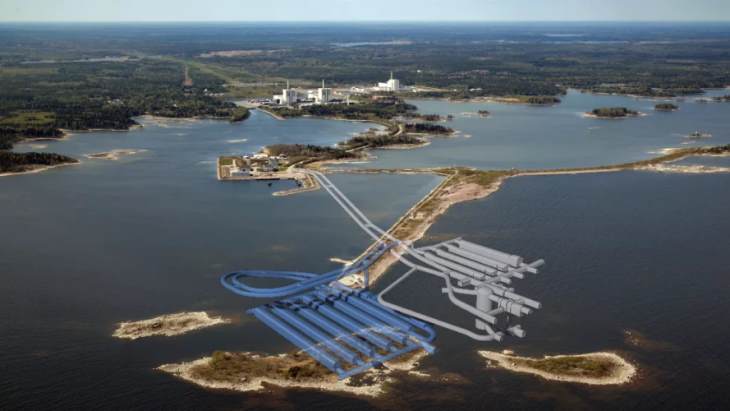

The blue area shows where SKB plans to extend the existing SFR repository (Image: SKB)

Rock construction work got under way in December 2024, and on 23 January the official launch of blasting took place together with construction firm Skanska, which is delivering the extension project in collaboration with SKB.

SKB CEO Stefan Engdahl, together with Ida Tjerngren, project manager for the extension, Skanska Sweden CEO Magnus Persson, Fabian Sjöberg, Municipal Commissioner of Östhammar and Daniel Westlén, State Secretary to the Minister for Climate and Environment, jointly pressed the button to initiate one of the first explosive charges, which symbolised the start of work on the extension.

"It feels really good that we've now started rock excavation in Forsmark," Engdahl said. "The extension of SFR is an important precondition for fossil-free electricity production at the nuclear power plants, now and in the future."

SKB signed a collaboration agreement with Skanska in July 2023 regarding the expansion of the SFR repository.

"That Skanska is involved in contributing to societal development with this truly unique project is a prestigious honour," Persson said. "We have a close collaboration with SKB, and this project is a great example of how successful things can be when we share expertise, experiences, and knowledge with one another."

Czech minister says KHNP contract timetable still on track

Friday, 24 January 2025

Minister of Industry and Trade Lukáš Vlček said he had discussed with Korea Hydro & Nuclear Power CEO Joo-ho Whang about finalising the EPC contract and the involvement of Czech companies in the country's new nuclear project.
Czech minister says KHNP contract timetable still on track
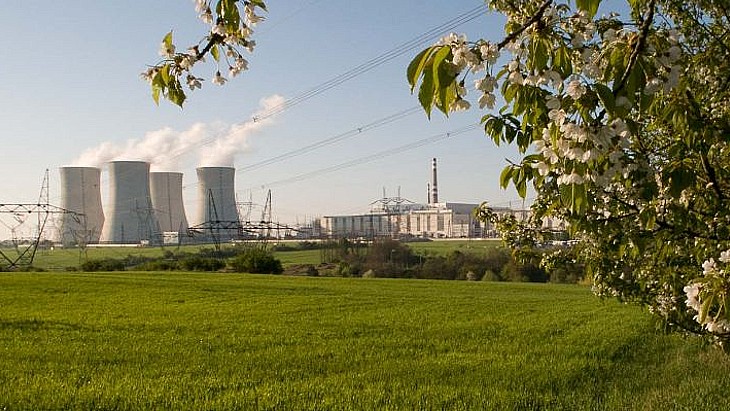
Dukovany's four units started up in the 1980s (Image: CEZ)

According to a statement from the Czech Republic's trade ministry, they also discussed the recent agreement between KHNP and Westinghouse, with Vlček saying it had eliminated one possible risk to the project, adding: "We were assured by the Korean side that the results of these agreements should not have negative impacts on the project schedule and budget or on the expected involvement of domestic companies."

On that last point, he also said: "Czech companies have cutting-edge technologies and expertise. We want them to be involved in the project from the beginning and to have the highest possible share in its implementation. Localisation is a key issue for the Czech Republic, and therefore we expect further concrete steps before the signing of the EPC contract."

He also said that "everything regarding the contract is going according to schedule" with the signing still expected to take place at the end of March.

The ministry said it would undertake further negotiations with the Czech Chamber of Commerce "with the aim of supporting the project and ensuring related activities, specifying the scope of cooperation and ensuring effective transfer of technology and know-how to Czech industry".

Background
 

The Czech Republic currently gets about one-third of its electricity from the four VVER-440 units at Dukovany, which began operating between 1985 and 1987, and the two VVER-1000 units in operation at Temelín, which came into operation in 2000 and 2002.

In October 2023, Westinghouse, EDF and KHNP submitted binding bids for a fifth unit at the Dukovany nuclear power plant, and non-binding offers for up to three more units - another one at Dukovany and two at the Temelin nuclear power plant. Westinghouse was proposing its AP1000, EDF was proposing its EPR1200 reactor, KHNP was proposing its APR1000. But in February the Czech government announced it was changing the tender to be binding offers for four new units, with Westinghouse not included because it "did not meet the necessary conditions".

Prime Minister Petr Fiala explained at the time that the decision to switch to binding offers for all four units was the result of the original tender suggesting that contracting for four units, rather than having separate processes, could have a 25% benefit in terms of costs.

In July, he announced KHNP as the preferred bidder, with contract negotiations to begin with the aim of signing contracts for the initial unit by the end of March 2025 - the target for test operation of the first new unit is 2036 with commercial operation in 2038. He said the winning tender "based on the evaluation of experts, offered better conditions in most of the evaluated criteria, including the price". The KHNP bid was for a cost of around CZK200 billion (USD8.6 billion) per unit, if two units were contracted.

Last week Westinghouse and KHNP and KEPCO reached an agreement on their long-running intellectual property dispute and to collaborate on the deployment of new nuclear reactors around the world.

Rostov's first unit set for 30-year life extension

Friday, 24 January 2025

The first unit at Rostov nuclear power plant was launched in 2001 and its operating licence is due to expire in 2030. A large-scale work programme has been approved as part of plans for a 30-year life extension.
Rostov's first unit set for 30-year life extension
(Image: Rosatom)

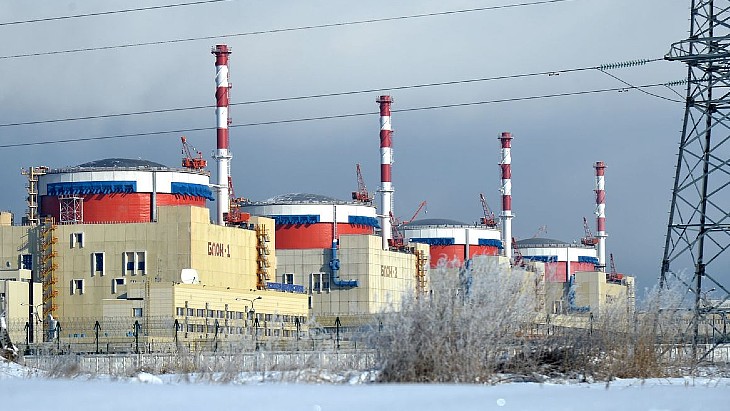
The Rostov plant features four VVER-1000 units and is about 13 kilometres from the city of Volgodonsk in southwest Russia. It is part of Rosatom's plant operating division Rosenergoatom, which carried out modernisation work at all four units during 2024.

The most extensive work was carried out on the first unit, with the control system, uninterruptible power supply and electric motors of the pump units modernised, while the reinforcement cables of the protective shell, neutron flux control equipment and parts of the ventilation system were replaced.

Andrey Salnikov, Rostov NPP Director, said: "The modernisation of the first power unit in 2024 launched a large-scale project to extend its service life by another 30 years. The document (the life extension project plan) was approved by the Rosatom state corporation and is designed to last until 2029."

Rosatom said that after the completion of the modernisation, "which is being carried out with the aim of increasing the operational reliability and safety of the power unit", its service life will be extended for another 30 years.

Since it entered operation in 2001 Rostov 1 has supplied 171.66 terawatt hours of electricity.

  World Nuclear News

There's Apparently a Huge Financial Problem With Trump's Massive AI Project


Victor Tangermann
Sat, January 25, 2025 

President Donald Trump's behemoth $500 billion AI infrastructure project, dubbed Stargate, may be doomed from the start.

Trump made the sweeping announcement earlier this week, revealing that the ChatGPT maker, investment company SoftBank, tech giant Oracle, and Abu Dhabi state-run AI fund MGX would initially spend a total of $100 billion on the project, with the eventual goal of reaching half a trillion dollars in just a few years.


But in reality, according to the Financial Times' sources, Stargate may be facing insurmountable financial challenges as it attempts to get off the ground.

"They haven’t figured out the structure, they haven’t figured out the financing, they don’t have the money committed," an unnamed source told the newspaper.

Did Trump put the cart before the horse by making a splashy announcement before the pieces were in place? Critics of the project think it's entirely possible.

The FT's reporting is especially interesting considering this is exactly what multi-hyphenate Elon Musk, a personal enemy of Altman's, accused OpenAI of earlier this week.

"They don’t actually have the money," the mercurial CEO tweeted just hours after the project was announced.

"SoftBank has well under $10B secured," Musk wrote in a followup an hour later. "I have that on good authority."


It's difficult to gauge the legitimacy of either Musk's or the FT's claims. Could Stargate actually collapse under its own weight, stumbling at the starting line without the necessary funds to build out data centers in the United States?

It's true that SoftBank has had a troubled history with past investments, posting a record $32 billion loss for its Vision Fund in 2023. Many companies the lender has backed have shuttered or filed for bankruptcy, with WeWork being a particularly notable example.

Musk certainly has plenty to gain from voicing his doubts, having founded his own AI company that was passed over by the Stargate program. He's has had an extremely strained relationship with Altman for years.

OpenAI and SoftBank are each expected to commit $19 billion to fund Stargate, as The Information reported on Wednesday. Effectively, each company will hold a 40 percent interest in the project.

The companies behind Stargate claim that work has already begun. Construction began for an Oracle-funded data center in Abilene, Texas, in June 2023, well over a year before Stargate was announced.

But other than that, details about Stargate are notably thin.

"There’s a real intent to do this, but the details haven’t been fleshed out," an unnamed source told the FT. "People want to do splashy things in the first week of Trump being in office."


Canadian NDP MP Angus calls for investigation into Elon Musk over potential election interference

CBC
Sat, January 25, 2025 


Timmins-James Bay New Democrat MP Charlie Angus says he is concerned that Elon Musk and his social media platform X could try to interfere in the next Canadian election.
(Parliament of Canada)

New Democrat MP Charlie Angus is calling on Elections Canada to launch an investigation into Elon Musk and his social media platform X, saying he is concerned about potential interference by the tech billionaire in the next federal election.

In a two-page letter to Chief Electoral Officer Stéphane Perrault, Angus said Musk has been playing a role in recent elections in a variety of countries, donating millions of dollars to conservative candidates and using X, formerly known as Twitter, to amplify the political messages of candidates he favours.

"He has formed alliances with right-wing populist leaders, amplified extremist influencers and spread hate disinformation towards marginal groups," Angus wrote.
Concerns over 'X's huge power'

Now, Angus wrote, Musk is getting involved in Canadian politics, "praising the current leader of the Conservative Party, aligning himself with far-right influencers and their platforms and criticizing the current prime minister."

Musk, the world's richest man, was born in South Africa but lives in the United States and holds citizenship there. His mother is from Saskatchewan, and Musk moved to Canada in 1989, attending Queen's University for two years. CBC News was unable to confirm whether Musk currently holds Canadian citizenship.

Angus wrote that X "serves as a pathway for Russian misinformation and the rise of hate and threats in Canada. Given X's huge power, any overt efforts by Mr. Musk to support a particular party or leader could easily impact our electoral integrity."

Questions from CBC News to Musk and to two of his companies have not yet received a response.

Angus called on Perrault to launch an investigation into X "and possible avenues for manipulation by Mr. Musk or right-wing influencers," which he did not name, as well as to insist during the upcoming federal election campaign that Musk commit to transparency of the algorithms used on his platform to allow election observers to see whether X is interfering by promoting or suppressing political posts.

Angus's letter comes two weeks after Meta owner Mark Zuckerberg announced that his social media platforms like Facebook and Instagram would move away from fact-checking in the U.S. and would ease content restrictions worldwide — something experts say could make it easier for online misinformation and foreign interference to influence the next Canadian election.

In an interview, Angus said what he sees on other platforms is concerning but his letter targeted X because he believes Musk's apparent willingness to use X's algorithm to intervene in other countries' affairs makes him the biggest threat.

Angus said if Parliament weren't prorogued, he would call for committee hearings into the issue.

Matthew McKenna, spokesman for Elections Canada, said it is up to the Commissioner of Canada Elections office to conduct investigations and enforce the Canada Elections Act, rather than Elections Canada.

However, he said Elections Canada does take questions about foreign interference seriously.

"We understand that in the current context, people might have questions about what may or may not constitute foreign interference," McKenna wrote in an emailed response. "We should note that other than a few specific exceptions, under the Canada Elections Act, all individuals, Canadian or non-Canadian, are free to express their views on any topic."

Angus said he sent the letter to Elections Canada because he decided it was the more suitable office.

The letter to Elections Canada is both "appropriate" and "well timed," said Aengus Bridgman, director of the Media Ecosystem Observatory in Montreal.

"There is this issue with the primary way that political elites and politicians continue to use X as the main platform and that is controlled and distorted by one individual who is not necessarily acting with Canada's best interests at heart," Bridgman said in an interview.

"I think this is something that every Canadian should be worried about going into the next election."

Bridgman said Musk has described X as a platform for free speech, but in reality his control of X is considerable.

"He does have enormous influence over what Canadians are seeing on that platform and that's concerning. Any additional transparency and communication about that is very valuable and will help inform the way Canadians treat that platform in the next election."

Bridgman said one example of Musk using X to try to influence a political outcome is the current German election. Musk has posted his support for the far-right AfD party.

"These are posts that get tens of millions of views and there have been alarms raised in the European context," said Bridgman. "There's the perception that there's an outside influence, really a foreign interference, in that election."

Minister of Democratic Institutions Ruby Sahota didn't comment on Angus's concerns but said protecting Canada's democracy and its electoral systems is a priority.

"Individuals have the right to free speech within the bounds of the law, and a strong democracy thrives on open dialogue and diverse perspectives," said Sahota, listing several steps the federal government has taken to detect and deter election interference.

"While maintaining the freedom of debate, protecting Canada's democracy and elections from threats is an issue we take extremely seriously."
Footage of Musk’s fascist salute projected onto Berlin Tesla factory by Led by Donkeys

24 January, 2025 
Left Foot Forward

‘The world’s richest man, Elon Musk, is promoting the far right in Europe. Don’t buy a Tesla.’


Campaign group Led by Donkeys has projected the clip of Elon Musk making two ‘Nazi salutes’ at Trump’s inauguration onto the side of his Tesla factory in Berlin.

The video featured Musk making the gesture alongside the words “Heil Tesla”, a reference to the Nazi greeting used to pay homage to fascist leader Adolf Hitler.

Responding to comments that the gesture resembled a Nazi salute, Musk said: “Frankly, they need better dirty tricks. The ‘everyone is Hitler’ attack is sooo tired.”

Led By Donkeys and Germany’s Centre for Political Beauty also shared a mini documentary on Instagram yesterday. The caption read: “The world’s richest man, Elon Musk, is promoting the far right in Europe. Don’t buy @teslamotors. Location: Tesla Gigafactory, Berlin.”

“This is the Tesla Gigafactory in Berlin where Elon Musk builds Tesla cars for the European market. It’s factories like this that have made him the world’s richest person.

“But now he’s using that wealth, billions of dollars amassed by selling Teslas, to promote European far-right parties,” the voiceover from the mini-documentary says.

The voiceover goes on to say that Musk is supporting far-right Alternative für Deutschland (AfD) in the upcoming German election. AfD members have been accused of using Nazi slogans and trivialising the Holocaust.

The video also shows tweets Musk has posted in support of far-right figure and football hooligan Tommy Robinson. It also notes that the tech billionaire recently came to the defence of Andrew McIntyre who was a “key architect” of the riots after the Southport attacks last summer.

During Musk’s speech at Trump’s inauguration on Monday, the owner of X and Tesla thanked Trump supporters for getting him elected.

“I just want to say thank you for making it happen,” Musk said during his speech at Capital One Arena, referring to Trump winning the US presidential election.

Musk then turned and saluted again, his arm and hand slightly lower. He told the audience: “My heart goes out to you. It is thanks to you that the future of civilization is assured. Thanks to you. We’re gonna have safe cities, finally safe cities. Secure borders, sensible spending. Basic stuff. And we’re gonna take ‘Doge’ to Mars.”

A spokesperson for Led By Donkeys told the PA news agency: “Musk is using his wealth from Tesla to back far-right parties and degrade democracy.

“He shouldn’t be surprised if people don’t fancy driving round in his cars for much longer.

“Increasingly it’s not a great look.”

Olivia Barber is a reporter at Left Foot Forward

Musk Follows That Salute by Telling Germans: Don’t Feel ‘Guilt’ Over Country’s Past

Liam Archacki
Sat, January 25, 2025 

The Daily Beast/Getty Images


Elon Musk urged an audience at a German far-right political rally not to feel “guilty” about their country’s history.

The surprise speech comes less than a week after he was accused of making a “Sieg Heil”-style salute while giving a speech during President Donald Trump’s inauguration. (Musk has denied this was his intent in making the gesture.)

Projected onto a massive screen at a campaign event for right-wing political party Alternative für Deutschland (AfD), Musk told supporters on Saturday, “It’s OK to be proud to be German. This is a very important principle.”

“I think there’s frankly too much of a focus on past guilt (in Germany), and we need to move beyond that,” Musk continued. “Children should not feel guilty for the sins of their parents—let alone their great grandparents.”

Although Musk didn’t mention Nazism explicitly, his speech was heard by many as addressing the collective guilt felt by many German people following Nazi atrocities perpetrated during World War II, including the Holocaust.


A representative for Musk did not immediately respond to the Daily Beast’s request for clarification on his remarks.

Musk drew fire last month when he publicly announced support for AfD, Germany’s third-largest party, which critics accuse of racism, xenophobia, and Islamophobia.

“Only the AfD can save Germany,” wrote Musk, who has emerged as key adviser and backer of Trump.

Shortly before delivering a victory speech on stage at Trump’s inauguration festivities on Monday, Musk threw a straight-arm pose that many commentators—and many critics—said bore a resemblance to the Roman salute, symbolism widely associated with fascist movements, and Nazism specifically.

Musk dismissed the comparison as “pure propaganda,” but still took the opportunity to crack a series of Nazi jokes on X.

It isn’t the first time Musk has faced allegations of antisemitism.


Elon Musk’s controversial gesture at a Trump event following the president’s inauguration. / ANGELA WEISS / AFP via Getty Images

In response to a post on X that accused Jews of “hatred against whites,” Musk in 2023 wrote, “You have said the actual truth.”

After criticism that the remark platformed antisemitic conspiracy theories, Musk apologized and called the post “foolish.”


Elon Musk is ‘funding Tommy Robinson’s legal battles’, according to UK far-right leader’s team

22 January, 2025 
Left Foot Forward

“The statement from Robinson’s team says the assistance from the world’s richest man was “unexpected”.


Musk, who has repeatedly drawn criticism in recent weeks for posting false claims about UK politics, has shown support for Robinson on his X platform and also called for the far-right leaders release.

Musk has repeatedly attacked the Labour Party, posting a series of false claims about UK MPs and the grooming gangs scandal on his X platform, falsely accusing ministers of inaction over gang rape and child abuse.

According to the ipaper, Robinson’s team claims that Musk is supporting him financially with two legal cases.

The ipaper reports: “A message sent out on Robinson’s X and Telegram accounts stated: “We are grateful to Elon Musk and his team at X for agreeing to provide support to Tommy Robinson for two specific legal cases.”

“The statement from Robinson’s team says the assistance from the world’s richest man was “unexpected”.

“We extend our heartfelt gratitude to Elon and his team for their unexpected and generous assistance with these cases. Tommy is immensely grateful for their support, which came as a complete surprise.”

News of Musk’s alleged support for Robinson with his legal cases comes just days after the owner of X was widely condemned for appearing to make back-to-back fascist salutes at the inauguration rally.

Basit Mahmood is editor of Left Foot Forward
How the roots of the ‘PayPal mafia’ extend to apartheid South Africa

Chris McGreal
THE GUARDIAN
Sun 26 January 2025

A member of the South African AWB in 2010 and Elon Musk during a speech after Trump’s inauguration on 20 January 2025
.Photograph: AFP via Getty Images, Reuters

When Elon Musk’s arm shot out in a stiff arm salute at Donald Trump’s inaugural celebrations, startled viewers mostly drew the obvious comparison.

But in the fired-up debate about Musk’s intent that followed, as the world’s richest man insisted he wasn’t trying to be a Nazi, speculation inevitably focused on whether his roots in apartheid-era South Africa offered an insight.

In recent months Musk’s promotion of far-right conspiracy theories has grown, from a deepening hostility to democratic institutions to the recent endorsement of Germany’s far-right Alternative für Deutschland (AfD). He has taken an unhealthy interest in genetics while backing claims of a looming “white genocide” in his South African homeland and endorsing posts promoting the racist “great replacement” conspiracy theory. Increasingly, his language and tone have come to echo the old South Africa.

He is not alone. Musk is part of the “PayPal mafia” of libertarian billionaires with roots in South Africa under white rule now hugely influential in the US tech industry and politics.

They include Peter Thiel, the German-born billionaire venture capitalist and PayPal cofounder, who was educated in a southern African city in the 1970s where Hitler was still openly venerated. Thiel, a major donor to Trump’s campaign, has been critical of welfare programs and women being permitted to vote as undermining capitalism. A 2021 biography of Thiel, called The Contrarian, alleged that as a student at Stanford he defended apartheid as “economically sound”.

David Sacks, formerly PayPal’s chief operating officer and now a leading fundraiser for Trump, was born in Cape Town and grew up within the South African diaspora after his family moved to the US when he was young. A fourth member of the mafia, Roelof Botha, the grandson of the apartheid regime’s last foreign minister, Pik Botha, and former PayPal CFO, has kept a lower political profile but remains close to Musk.

Related: ‘Reactionary nihilism’: how a rightwing movement strives to end US democracy

Among them, Musk stands out for his ownership of X, which is increasingly a platform for far-right views, and his proximity to Trump, who has nominated Musk to head a “department of government efficiency” to slash and burn its way through the federal bureaucracy.

Some draw a straight line between Musk’s formative years atop a complex system of racial hierarchy as a white male, in a country increasingly at war with itself as the South African government became ever more repressive as resistance to apartheid grew, and the man we see at Trump’s side today.


The week before the inauguration, Steve Bannon, Trump’s former adviser, described white South Africans as the “most racist people on earth”, questioned their involvement in US politics and said Musk was a malign influence who should go back to the country of his birth.

Others are sceptical that Musk’s increasingly extreme views can be tracked back to his upbringing in Pretoria. The acclaimed South African writer Jonny Steinberg recently called attempts to explain Musk through his childhood under apartheid “a bad idea” that resulted in “facile” conclusions.


But for those looking to join dots, there is fodder from Musk’s early life with a neo-Nazi grandfather who moved from Canada to South Africa because he liked the idea of apartheid through his high school education in a system infused with the ideology of white supremacy.

Musk’s formative years in the 1980s came amid a cauldron of rebellion in the Black townships which drew a state of emergency and a bloody crackdown by the state. Some whites fled the country. Others marched with the neo-Nazi Afrikaner Resistance Movement against any weakening of apartheid.

The South Africa into which Musk was born in 1971, and to which Thiel moved as a child from Germany, was led by a prime minister, John Vorster, who had been a general in a fascist militia three decades earlier that allied itself with Hitler.

The Ossewabrandwag (OB) was founded shortly before the second world war. It opposed South Africa entering the war as an ally of Britain and plotted with German military intelligence to assassinate the prime minster, Jan Smuts, as a prelude to an armed uprising in support of Hitler.


Vorster made no secret of his sympathy for Nazi, or National Socialist, ideology which he compared to the Afrikaner political philosophy of Christian nationalism.

“We stand for Christian nationalism which is an ally of National Socialism,” he said in 1942. “You can call this anti-democratic principle dictatorship if you wish. In Italy it is called ‘Fascism’, in Germany ‘German National Socialism’ and in South Africa ‘Christian nationalism’.”

Smuts’s government took a dim view of that and a few weeks later interned Vorster as a Nazi sympathiser.

Related: KKK distributes flyers in Kentucky telling immigrants to ‘leave now’

At the end of the war, the OB was absorbed into the National party, which then won the 1948 election, in which Black South Africans had no vote, on a commitment to impose apartheid. In 1961, Vorster joined the government as minister of justice and five years later became prime minister.

Nazism may have been defeated in Europe but Christian nationalism was alive and kicking in South Africa under Vorster, with its own brand of racial classification and stratification justified by the need to keep the “swart gevaar”, or black danger, at bay.


In schools, Christian nationalist education sought to forge a South African identity around a singular version of the country’s history. Musk and Thiel were taught that the Afrikaner, mostly the descendants of Dutch colonisers, was the real victim of South Africa’s strife whether at the hands of grasping British imperialists or treacherous Zulu chiefs.


The truth is we didn’t see Black people quite as equals. We didn’t think about it

Bea Roberts, who grew up in an apartheid-supporting family but came to oppose the system and later worked for the Institute for a Democratic South Africa, remembers a heavy emphasis on Afrikaners as victims pursuing apartheid in order to protect their culture and even their very existence.

“It was a strange mix of ‘we got fucked up by the British in the [second Boer] war, and our women and children died in thousands in the concentration camps’ so we are going to rebuild our nation and make sure that that we are invincible. And we’ll do that by extreme means,” she said.


Schooling, like much else, was segregated by race for most of the apartheid era and, on paper at least, white pupils across South Africa were subject to the same Christian nationalist education. But white society was itself divided and the historical narrative embraced in Afrikaans-speaking schools could often became the basis for an implicit rejection of apartheid philosophy in English-speaking ones.

Musk attended a Johannesburg high school and then the Pretoria boys high school, an institution whose other alumni include students who went on to become leading anti-apartheid activists such as Edwin Cameron, a South African supreme court justice after the collapse of white rule, and Peter Hain, who moved to Britain, where he became a leading campaigner against apartheid and then a Labour government minister.

Phillip Van Niekerk, former editor of the leading anti-apartheid Mail and Guardian newspaper in Johannesburg, had Afrikaner parents but attended an English-speaking school. He recalled that the official version of history did little to engender support for the apartheid system among a lot of English speakers even if they benefited from it and did little to challenge it.


“We hated the National party government. Even our teachers were kind of hostile. It was seen almost like an imposition. Yet you imbibe things through the culture. The truth is we didn’t see Black people quite as equals. We didn’t think about it,” he said.

Thiel got all that and more at schools in South Africa and its de facto colony, South West Africa, which became independent as Namibia in 1990.

South West Africa had been a German colony until the end of the first world war and Thiel lived for a time in the city of Swakopmund, where he attended a German-language school while his father worked at a nearby uranium mine.

At that time, Swakopmund was notorious for its continued glorification of Nazism, including celebrating Hitler’s birthday. In 1976, the New York Times reported that some people in the town continued to greet each other with “Heil Hitler” and to give the Nazi salute.

Van Niekerk visited Swakopmund during South African rule.

“I was there in the 1980s and you could walk into a curio shop and buy mugs with Nazi swastikas on them. If you’re German and you’re in Swakopmund in the 1970s, which is when Thiel was there, you’re part of that community,” he said.


Thiel, who moved to the US when he was 10, has described his schooling in Swakopmund as instilling a dislike of regimentation that steered him towards libertarianism.

Thiel’s father worked at a uranium mine in Rössing where, as in the gold and coalmines of the Reef around Johannesburg, Black laborers were paid just enough to survive, living conditions were dire and the work dangerous. White managers, on the other hand, lived a lifestyle of neo-colonial luxury with servants at the ready.

Musk’s father, Errol, was also in the mining business among other interests. He once boasted that his stake in Zambian emerald mines made him “so much money we couldn’t even close our safe”. Musk’s mother, Maye, has said the family owned two homes, a plane, a yacht and a handful of luxury cars.

Errol Musk has said that he opposed apartheid and joined the Progressive Federal party but then left because he didn’t like its demand for one person, one vote, and instead favored a more gradual reform with separate parliaments for different races. That was the liberal position inside the Musk family.


Musk’s maternal grandfather, Joshua Haldeman, moved from Canada to South Africa in 1950 because he liked the newly elected apartheid government.

In the 1930s, Haldeman was the Canadian leader of a fringe political movement originating in the US, Technocracy Incorporated, that advocated abolishing democracy in favor of government by elite technicians but which took on overtones of fascism with its uniforms and salutes.

The Canadian government banned Technocracy Incorporated during the second world war as a threat to the country’s security in part for its opposition to fighting Hitler. Haldeman was charged with publishing documents opposing the war and sent to prison for two months.

After the war, Haldeman led a separate political party that among other things promoted the antisemitic forgery the Protocols of the Elders of Zion. When that went nowhere, he moved to South Africa because he said he liked the core National party philosophy of Christian nationalism that Vorster likened to Nazism.

Errol Musk described Maye’s parents as so extreme he stopped visiting them.


We white South Africans, by the very nature of our privileges and our place in the racial hierarchy, grew up believing we were the master race

“They were very fanatical in favor of apartheid,” he told Podcast and Chill. “Her parents came to South Africa from Canada because they sympathised with the Afrikaner government. They used to support Hitler and all that sort of stuff.”

Haldeman was killed in a plane crash when Elon was three years old but the boy remained close to his grandmother and mother. He is estranged from his father, whom Maye has described as abusive of her and their children. Errol Musk once claimed to have shot and killed three people who broke into his house.


Musk has described his father as a “terrible human being”.

“Almost every evil thing you could possibly think of, he has done,” he told Rolling Stone without elaborating in 2017.

What is indisputable is that Musk and Thiel grew up amid incredible privilege where the racial hierarchy was clear. Those who claimed to reject apartheid sought to explain this privilege not as the result of systemic racial oppression but the natural order of things thanks to their own abilities. That in turn led some to regard all forms government as oppressive and true liberty as an individual battle for survival.

The biography of Thiel said he held a view common among apartheid’s supporters at the time that Black South Africans were better off than Africans in other parts of the continent even if they were systematically denied their rights. Thiel has denied ever having supported apartheid.

Van Niekerk said that opposition to apartheid did not necessarily mean rejection of white supremacy or privilege, a point made in a 1968 British television documentary the year before Thiel was born.


The commentary observed that the English-speaking mining barons and other industrialists in Johannesburg usually claimed to be “hostile to apartheid, call themselves liberal” but did little to oppose the system while profiting from it.

Helen Suzman, at the time a member of the South African parliament who was often a lone voice in opposition to apartheid, was critical of these powerful industrialists and businessmen, saying “people who do nothing are responsible”. She accused them of hiding behind apartheid to exploit Black workers.

“I see no reason why the industrialists should not improve the living conditions of their workers,” she said.

In the documentary, Stanley Cohen, the managing director of the OK Bazaars supermarket chain owned by his family, was asked why he only employed whites behind the counter and no South Africans of other races even though many of the customers were Black. Cohen acknowledged that it was not a legal requirement, but did it to indulge the racist prejudices of white customers.


“There is no reason why they [Black people] can’t work behind the counters. There’s no law against it. But there is this natural prejudice in this country which you can’t legislate for or against,” he said.

A decade later, power was shifting. The uprising that began in Soweto in 1976 had become a full-blown national crisis for the apartheid system by the 1980s. A low-level civil war was under way. In response, the state grew even more violent and repressive. White paranoia was fed by the creep of independent Black African states under Marxist-leaning governments ever closer to South Africa’s borders, with Angola and Mozambique in the 1970s followed by Zimbabwe in 1980.

Talk of white genocide emerged, a conspiracy theory that has taken on new life in recent times with the killings of white farmers in South Africa and Zimbabwe. Support surged for the neo-Nazi Afrikaner Weerstandsbeweging (AWB), or Afrikaner Resistance Movement, founded in the early 1970s to oppose any relaxation of apartheid.


The AWB, founded by Eugene Terre’Blanche, an imposing and flamboyant figure given to riding around on a horse from which he occasionally fell off, made no secret of its model with a badge strikingly similar to a swastika in design and colors. It’s supporters were also fond of the stiff-armed Hitler salute as they paraded on the streets of Pretoria. At its peak, the AWB appeared to have the support of more than 10% of white South Africans.

Roberts said life for privileged whites in particular was “definitely a bubble, and one filled with self-belief”. But she said that it became increasingly difficult to ignore reality.

“I think Musk in Pretoria in the 1980s must have had a sense of what Black people were experiencing and why they were angry. I grew up fairly conservative but I was able to change my views. I think you have to be fairly rigid in the 80s to still cling on to the belief that the apartheid system was fine and correct and in everybody’s best interest,” she said.

Musk left South Africa in 1988 in the midst of this ferment, two years before FW de Klerk carved out a path to freedom by releasing Nelson Mandela. Had he stayed, Musk faced being conscripted into the military for two years, an obligatory service for white men, that could well have meant fighting in the “border war” in Angola and Namibia or being sent to put down Black protests in the townships.

Instead, Musk took Canadian citizenship through his mother and moved to Ontario. Van Niekerk said that, whether he wants to admit it or not, Musk also took a part of South Africa with him.

“We all [white South Africans], by the very nature of our privileges and our place in the racial hierarchy, grew up believing we were the master race, even if we didn’t actively think about it,” he said.

Chris McGreal is the Guardian’s former Johannesburg correspondent


The bros’ new clothes: How Big Tech lurched to the right

Sat, January 18, 2025
MASHABLE


Musk, Zuckerberg and Bezos, the trifecta of tech titans — all now supporting Donald Trump.

The sight of Elon Musk, Jeff Bezos and Mark Zuckerberg sitting together at Donald Trump's inauguration — as they reportedly will do Monday — would be a shock for their 2016 selves.

Back then, these titans of the tech world were way to the left of Trump, whose political stances put him about as far to the right as Republicans get, then and now.

Musk, once a vocal Barack Obama supporter, voted for Trump's opponent Hillary Clinton in 2016. The Bezos of that year blasted candidate Trump for "eroding democracy." Zuckerberg didn't make an endorsement, but the issues he put his money behind at the time — social justice, inequality, easing the immigration process — put him squarely on the Democratic side of the political line.

The most vocal tech world supporter of Trump in 2016, Paypal co-founder Peter Thiel, was seen as an outlier back then: Silicon Valley was solid blue. Now the outlier is Nvidia CEO Jensen Huang, who hasn't donated to Trump's inauguration fund and won't be attending.

All the other big names in tech will be there: Apple's Tim Cook, Google's Sundar Pichai, Microsoft's Satya Nadella, OpenAI's Sam Altman, and TikTok's Shou Chew, have all donated $1 million or more, and all save Altman will be in attendance.

What happened? It wasn't just that these men were made so much richer by a stock market rally following Trump's election in November. A similar rally happened in November 2016 as well, and it didn't make tech CEOs any less reluctant at a Trump Tower meeting with the president-elect. That was the roundtable where Thiel's smile stood out in a sea of grimaces.


Paypal co-founder Peter Thiel, left, and Apple CEO Tim Cook display very different reactions to Donald Trump speaking after his 2016 election. 
Credit: Jabin Botsford/The Washington Post via Getty Images

The process of tech leaders learning to love Trump may have begun piecemeal during his first administration. But it only really kicked into high gear over the course of 2024, with a speed and ferocity that has left many observers' heads spinning. No wonder President Biden, in his farewell address, warned of a tech-led "oligarchy" that may threaten democracy itself.

To understand what happened, let's take a look at the three richest tech bros, who also happen to be the three wealthiest men in the world, and the journey they took from opposing Trump in 2023 to sitting together at his inauguration in 2025.
Elon Musk

Nowadays, of course, Musk is so central in Trump's camp that he is sometimes described as the incoming "co-president." He donated $250 million, spoke at Trump rallies, called himself "Dark MAGA," and clearly put more than a thumb on the scale for Trump on Twitter/X throughout the fall of 2024.

Musk's America PAC seized the @America account from its original owner, and even now faces a fresh lawsuit from Pennsylvania's Attorney General over that PAC's dubious $1 million lottery for swing state voters.

But it's important to remember that Musk wasn't always this far right, and his turn towards Trump came fairly recently. Yes, he joined Trump's business council in 2017, but he also quit when Trump withdrew the U.S. from the Paris Climate accords. Back then, the Bay Area-based Burning Man attendee was still happy to support Pride month.

Musk drifted rightwards during the pandemic years, when he moved Tesla HQ to Texas and, according to reports, began feuding with his trans daughter. The drift seems to have accelerated when he bought Twitter in 2022, started tweeting about the "woke mind virus," and endorsed the GOP (unsuccessfully) in that year's midterm elections.

Even then, Musk was no Trump fan. In 2023 he helped launch Florida governor Ron DeSantis' presidential campaign in a disastrous Twitter Spaces. Musk's statement that Trump should "sail into the sunset" prompted a brief feud with the former president. "I could have said, "drop to your knees and beg," and he would have done it," Trump responded, recalling an Oval Office meeting in his first term.

Then came 2024, and three key events. First, DeSantis dropped out in January. Then on May 31, Donald Trump's conviction in a New York courtroom over hush money payments that possibly swung a close 2016 election his way. Musk fumed that the charges were "trivial" and politically motivated. By then, perhaps not coincidentally, Trump was already talking to Musk about a possible advisory role — and we were starting to learn just how many federal agencies were investigating Musk.

But the deal was sealed in July when Trump survived a shooting in Butler, Pennsylvania. Musk "fully endorsed" Trump on Twitter that day, then made his first appearance with Trump on his return to Butler in October.

By then, Trump had already promised Musk his Department of Government Efficiency, or DOGE, the advisory group that Musk is set to lead along with fellow billionaire Vivek Ramaswamy. The latest reports on DOGE say that Musk will have an office inside the White House itself.

Notably, Musk did not have to drop to his knees and beg for any of this. Which leads us to wonder: who is really on whose leash here?

Jeff Bezos

In the 2016 election, Amazon founder Jeff Bezos was one of Trump's most outspoken critics in the tech world. A month after Trump entered the White House, Bezos' Washington Post unveiled its pointed new slogan, echoing its owner's warnings: "Democracy dies in darkness." Bezos and the Post's coverage continued to earn Trump's ire.


Two years later, in an equally pithy Medium post, Bezos attacked Trump ally David Pecker, head of the company that owns the National Enquirer, for what Bezos said was blackmail over nude photos of the billionaire.

But a curious thing had started to happen by then. With his growing wealth, which spiked in the late 2010s, plus his new marriage and new yacht, Bezos started to develop a serious case of Rich Guy Brain. By 2022, his tone on social media had changed entirely, becoming much more Musk-like. No longer was Bezos skewering his Trumpian opponents for literally threatening to expose his ass; instead, he was discussing compliments on his ass.

Finally came the moment that Bezos' opposition broke. His top lieutenant at the Post told staffers there would be no presidential endorsement in 2024 — which, if democracy was still at risk, seemed a curious case of fence-sitting. (Indeed, the Post staff had prepared a Kamala Harris endorsement that was effectively spiked.)

More than 200,000 Post subscribers cancelled their subscription in disgust. Still, Bezos seemed unmoved. This time he penned a piece explaining that newspaper endorsements didn't matter. It was, he said, a complete coincidence that Trump was visiting his space company Blue Origin the same day.

After the election, Bezos continued his shift towards Trump. In a December interview he said the incoming president was "calmer" and had "grown a lot over the last eight years." Time will tell whether that's true, or whether Bezos has simply shifted to the side of Dark MAGA.


Mark Zuckerberg

Unlike Musk and Bezos, who moved Trumpwards all at once, the Facebook founder seems to have slalomed back and forth in his attempts to placate Republicans in Washington since Trump first took office.

Prior to Trump's first election, Zuckerberg was easily the most liberal of this Big Tech trio. As a New York Times investigation during election season noted, he helped found Fwd.us, an advocacy group dedicated to giving undocumented immigrants a path to citizenship. The Zuckerberg-Chan initiative spent nearly half a trillion dollars on causes such as legalizing drugs, reducing the number of people in U.S. prisons, and promoting universal healthcare.

But then in the immediate aftermath of the 2016 election, Zuckerberg quickly tossed aside claims that unchecked fake news on Facebook had contributed to Trump's victory. He later regretted that stance, but not enough to avoid being dubbed Misinformer of the Year in 2017 by the watchdog group Media Matters for America.

Zuckerberg's response to Trump's first election was twofold: he minimized the presence of news posts in Facebook feeds, which unintentionally contributed to a widespread crash in readership for media entities. And he set up a fact-checking service, which often earned the ire of conservative groups. The fact-checking service was nuked in January 2025, pleasing the incoming Trump administration.

Often wanting to appear amenable to conservative concerns about the news feed and which stories get promoted, Zuckerberg made repeated changes to the algorithm that boosted pro-GOP voices. When internal data showed right-wing news sites like the Daily Caller were getting more interactions on Facebook than anyone else, Zuckerberg nixed the release of that data.

The more amenable he is, however, the more conservative voices (including Musk) complain — an old tactic called "playing the ref." Now Zuckerberg has morphed again, apologizing even for his donation to election integrity groups in 2020. Most recently, he told Joe Rogan that corporate America needs more "masculine energy."

What that means for the social media giant remains to be seen, but America is certainly about to get a lot more oligarch energy from Zuck and his fellow tech bros.


Experts sound the alarm over Meta's controversial decision about fact-checking on Facebook: '[The] effects have become more obvious and proven every day'

Alyssa Ochs
Sun, January 26, 2025


Tech giant Meta has eliminated fact-checking and made it possible for false climate information to spread online more rapidly.

Social media sites are now at a heightened risk of misleading the public and undermining scientific proof of our planet's rapidly changing climate.

What's happening?

As E&E News reported, Meta CEO Mark Zuckerberg will partner with President-elect Donald Trump to reduce censorship at the expense of accurate fact-checking. He stated his belief that fact-checking has gone too far and that fact-checkers have become politically biased.

Meta no longer partners with newsrooms, climate scientists, or other third-party moderators. Instead, its platforms will rely on their users to identify inaccuracies and fake news.

The company is also moving its domestic content moderation team from California to Texas to address Zuckerberg's concerns about bias and censorship.
Why is climate fact-checking important?

Climate scientists are concerned about Meta's abandonment of fact-checking because it could lead to misinformation that hinders global progress toward a cleaner, greener future.

Watch now: High-speed rail can cut an hour commute to 15 minutes — so why isn't it more prevalent?

Climate fact-checking helps dispel myths that lead to misunderstandings and inaction to improve public health and sustainability. It ensures access to accurate information and helps people make informed decisions about their daily behavior and community involvement.

Michael Khoo from Friends of the Earth said: "Disinformation's effects have become more obvious and proven every day. We're seeing it hamstring our ability to mitigate climate change with false attacks on wind power."

Andrew Dessler from Texas A&M University said: "The trend is towards living in a world where there basically are no facts. This is just sort of another step down the road."


Trump Staffers Expect More Ring-Kissing, Sucking Up From Mark Zuckerberg

William Vaillancourt
Fri, January 24, 2025 


Getty Images

Meta CEO Mark Zuckerberg may have donated $1 million to Donald Trump’s inaugural fund, ended Facebook’s fact-checking program, and shelved Meta’s DEI initiatives, but those close to Trump say that should be just the start of the tech billionaire’s attempts to ingratiate himself with the president.

“There is a lot more ass-kissing that needs to be done,” a senior Trump administration official told Rolling Stone on Friday. “He just needs to prove himself. It’s a good start, but he can’t just snap his fingers and make the past not happen.”

Zuckerberg, who traveled to Mar-a-Lago in December, has since been publicly critical of both the Biden administration, and more generally about how society is being “emasculated.”

Those comments came on Joe Rogan’s podcast a few weeks ago, around the time that Zuckerberg added Trump pal Dana White to the board of Meta—another move seen as part of Zuckerberg’s plan to align his social media platform with Trump’s vision.

Another White House official told Rolling Stone that they will be “keeping an eye on how (Zuckerberg) follows through” on those plans.

Zuckerberg’s eyes, meanwhile, have been elsewhere.


Zuckerberg promised Trump crony Stephen Miller he would not ‘obstruct’ president-elect’s agenda

Ariana Baio
INDEPENDENT UK
January 17, 2025·


Less than two months before Mark Zuckerberg announced Meta would be axing its diversity, equity and inclusion program, he assured Trump adviser Stephen Miller that he would not get in the way of the president-elect’s agenda.

The meeting between Zuckerberg, the billionaire co-founder of Facebook and CEO of Meta, and Miller, a powerful figure within Donald Trump’s inner circle and the architect of his hard-line immigration policies, happened shortly after the president-elect won the election.

Miller told Zuckerberg he had a chance to help change the United States – on Trump’s terms, sources familiar with the conversation told the New York Times.

Those terms include ditching DEI policies that corporate America, such as Meta, had openly embraced roughly four years ago during the Black Lives Matter movement.


Stephen Miller, an influential Trump adviser, is held largely responsible for creating Trump’s hard-line immigration policies. He reportedly met with Meta founder Mark Zuckerberg shortly after the election (AP)

Zuckerberg reportedly agreed and signaled that changes were coming to the company to oversees Facebook and Instagram. Sources familiar with the conversation said Zuckeblamed Meta’s former chief operating officer, Sheryl Sandberg, for pushing inclusivity policies at the company.

In early January, those close to Zuckerberg reportedly shared the potential changes with Miller. Days later, the changes to Meta’s diversity program were made public.

The tech giant said as a result of the Supreme Court declaring some diversity programs unconstitutional it plans to end its DEI programs across training, hiring and choosing suppliers, according to an internal memo seen by Axios.

Facebook also announced it would cease its fact-checking program and instead rely on community notes – a similar function implemented on X, the platform owned by Trump’s close friend Elon Musk.

Fact-checkers, who pushed back on Trump’s false claims of mass election fraud after the 2020 election, were another ire of the president-elect.


Zuckerberg, the CEO of Meta, has recently become friendly with Trump. He reportedly talked DEI programs with Miller at a recent meeting (AP)

The Trump-inspired changes to the tech giant’s extraordinarily influential platform are happening as the United States prepares for a second, but far more calculated, Trump presidency.

Zuckerberg and other tech giants such as Amazon CEO Jeff Bezos, OpenAI CEO Sam Altman and TikTok CEO Shou Chew have immediately flocked to the president ahead of inauguration, hoping to make nice with him before he implements sweeping changes across the country.

With four years of presidential experience, and another four years of building grudges, Trump is coming into the White House fully prepared to upend the policies he dislikes. He’s relying on influential people such as Miller to help him deliver on those.

The Independent asked the Trump–Vance transition team and Meta for comment.