Friday, May 29, 2026

THE GRIFT

Trump’s “Board of Peace” Has No Funds for Gaza Reconstruction

“For us, it doesn’t look like a peace deal, it looks like a trap,” said Bisan Owda, a Palestinian journalist in Gaza.

May 29, 2026

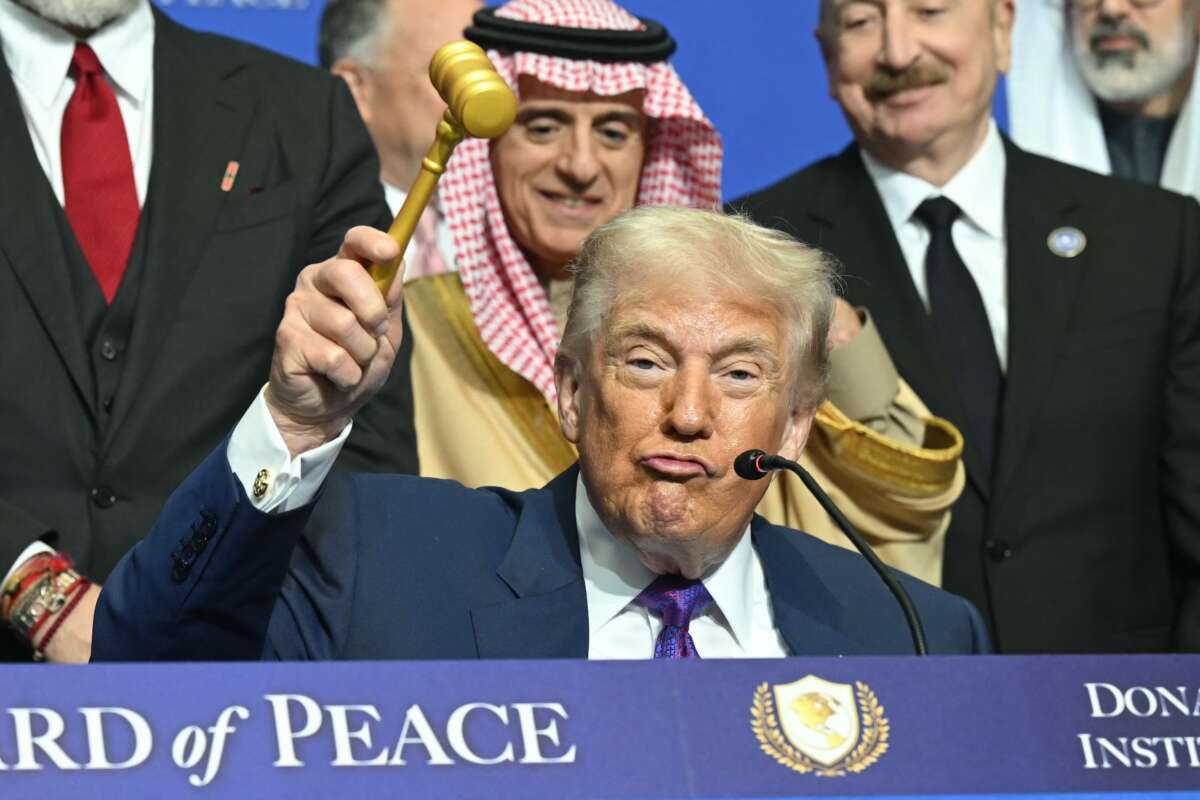
US President Donald Trump holds a gavel during a signing ceremony at the inaugural meeting of the "Board of Peace" in Washington, DC, on February 19, 2026.Saul Loeb / AFP

President Donald Trump’s “Board of Peace” fund has no money for the reconstruction of Gaza, despite raising billions of dollars since January.

On Wednesday, the Financial Times reported that “Zero dollars have been deposited” into the board’s financial fund — but that the body has received donations directly into its JP Morgan bank account, which allows it to override transparency regulations.

At its inaugural meeting in February, member states pledged $7 billion for the Board of Peace’s relief and reconstruction package for Gaza, and Trump promised an additional $10 billion.

The Financial Times reported that earlier this year, Morocco contributed $3 million and the United Arab Emirates (UAE) $20 million to the board’s JP Morgan account, and that this funding has helped cover the position of Nickolay Mladenov, the “director-general” of the Board of Peace, as well as salaries for the Palestinian technocrats selected by the board to govern Gaza. The UAE also provided $100 million to train a new police force in Gaza — but the funds are frozen and the program has not started.

In April, a U.S. official traveled to Saudi Arabia to ask its leaders to follow up on its $1 billion pledge to the board, as it had become concerned that funds were not materializing, according to Middle East Eye. Officials claimed that the U.S. has been relying on the Gulf region to fund the board.

Earlier this month, Reuters reported that the U.S. is considering asking Israel to hand over $5 billion in tax money it collected from the Palestinian Authority in the occupied West Bank — money it has been withholding from the Palestinian Authority — to help fund the Board of Peace. This suggests that the Trump administration is hoping that the Palestinian Authority — which has partial, limited jurisdiction over the West Bank, and not Gaza — will foot part of the bill for Gaza’s reconstruction, despite the fact that it was not invited to join the board and that it is undergoing a deep financial crisis.

Over 20 countries have signed onto the Board of Peace, but many key NATO allies declined to sign on, including the U.K., France, Germany, Italy, Spain, Norway, and Sweden. Reportedly, these countries were concerned by Russia’s involvement as well as suggestions that the Board of Peace might be the Trump administration’s attempt to replace the UN.

At the Board of Peace inaugural meeting, Trump said that the body might one day oversee the UN. “The Board of Peace is going to almost be looking over the United Nations and making sure it runs properly,” he said.

Secretary of State Marco Rubio stated that while the board’s first agenda point is the reconstruction of Gaza, it would eventually expand: “We hope that this can serve as a model for other complex and difficult situations, so they can be solved in the same way.”

The board’s charter noted that states seeking permanent membership would be required to pay $1 billion.

The board’s plan for Gaza “reconstruction” centers largely on Jared Kushner’s blueprint for a high-tech tourism hub filled with skyscrapers, rather than addressing the wants and needs of Palestinians whose homes, schools, and hospitals have been destroyed in Israel’s genocide.

Palestinians in Gaza have condemned the Board of Peace as a scheme to further deny Palestinian sovereignty.

“The Board of Peace is talking about rebuilding Gaza, the disarmament, the entry of the international forces, and the illusion of tourism destinations over the graveyards of our children…. For us, it doesn’t look like a peace deal, it looks like a trap,” said journalist Bisan Owda, who has been documenting Israel’s genocide for more than two years.

In a video for Mondoweiss, Owda interviewed Palestinians in Gaza about the Trump administration’s plan for their homeland.

“People have endured this war for two years,” one man said. “Some lost their children, some lost their homes, their futures, their businesses. And in the end you come and tell me all that is gone, and you’ll give me — as we hear — a whole neighborhood housed in an apartment building. And I’m supposed to forget my land, forget who I am, forget my property and my heritage?”
Workers, Students, and Indigenous Movements Shut Down Bolivia in Popular Rebellion

The popular revolt has mounted a broader challenge to neoliberalism, austerity, and US imperialism in Latin America.
May 28, 2026
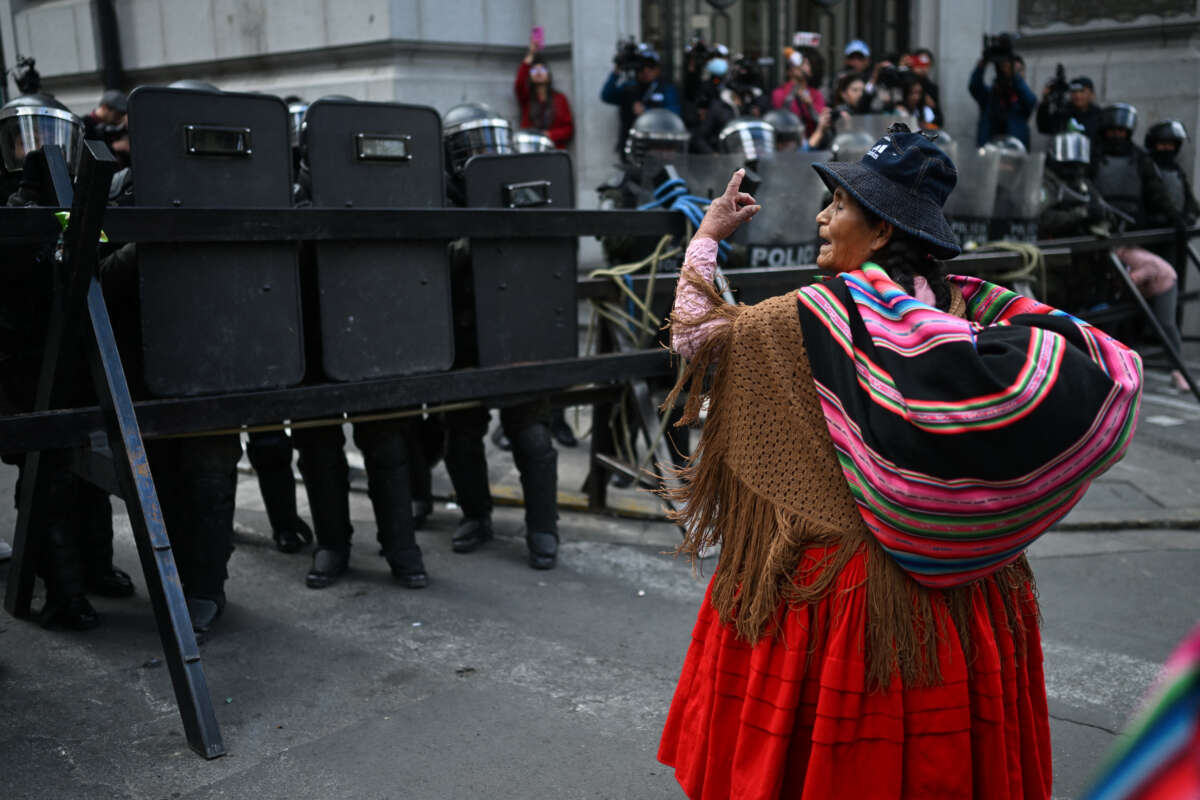
An Indigenous woman gestures in front of riot police during a protest against the government of President Rodrigo Paz on Mother's Day in La Paz, Bolivia, on May 27, 2026.Marvin RECINOS / AFP via Getty Images


Truthout is an indispensable resource for activists, movement leaders and workers everywhere. Please make this work possible with a quick donation.

For more than a week, the nation of Bolivia has been in a state of full-on revolt.

In response to neoliberal reforms by the recently elected right-wing government led by President Rodrigo Paz, unions have launched a general strike, peasants and Indigenous peoples have set up dozens of roadblocks throughout the country, and massive marches have been held in the capital, La Paz. These are just a few expressions of a much broader social discontent, which has brought the country to a halt and stoked mass resistance to the larger project of U.S-aligned, right-wing attacks on workers and social movements in Latin America.

Joseph Bouchard, a social scientist and journalist currently in La Paz as a visiting fellow at the Universidad Mayor de San Andrés, explained the diverse character of the movement. “It’s sort of a grouping of different social movements and groups that I think represents the wide spectrum within the Bolivian left,” Bouchard told Truthout. “You have teachers unions and workers unions. You have mining unions. You have just regular people joining who are not necessarily part of any movement. You have an Indigenous federation who used to be part of an anti-dictatorship movement in the 1980s. You have [former president Evo Morales’s] people … And so you have really all these groups that together add up to sort of the largest representation of the Bolivian left, disaffected voters, organized groups, disorganized groups.”

While the diversity of the movement also brings a wide range of demands, one of the most popular is for President Paz to resign, with some sectors of the movement arguing that the country should maintain a general strike indefinitely until Paz has been ousted. The level of outrage is especially profound considering that Paz has only been in office for six months.
How to Lose a Populace in 6 Months

In October 2025, Bolivia elected right-wing populist Rodrigo Paz, ending 20 years of government by the left-wing MAS (Movement to Socialism) party founded by former president Evo Morales. Paz, running on a campaign of “capitalism for all,” promised to address economic hardships plaguing the country. His campaign also benefited from the implosion of MAS, which was experiencing intense infighting from which it has not recovered.

Despite appealing to the economic concerns of the Bolivian people and positioning himself as more of a centrist than the country’s established (and much more extreme) right, once elected Paz wasted no time in carrying out attacks on the country’s workers and poor. One of his first moves was to eliminate a tax on large fortunes. He has also proposed education policies that teachers have criticized as privatization-oriented measures.

Two policies in particular have incited the outrage now rocking the country: a land privatization law and Supreme Decree 5503, which eliminated state fuel subsidies.

Two policies in particular have incited the outrage now rocking the country: Law 1720, a land privatization law which many see as a move to hand over Indigenous lands to agribusiness and other large-scale landowners, and Supreme Decree 5503, which eliminated state fuel subsidies, practically doubling the consumer cost of fuel overnight. Along with the rising fuel costs, Paz’s government has further angered Bolivians by importing low quality fuel, or “junk fuel,” as the people call it, which has reportedly damaged people’s vehicles, imposing repair costs many cannot afford.

It did not take long for the outrage to spread. Bolivia had already seen significant protests in December 2025, just a month into Paz’s presidency, but these were halted due to negotiations between the government and the country’s largest union federation, Central Obrera Boliviana (COB). Despite these negotiations the Paz administration continued advancing neoliberal reforms, further fueling outrage and forcing COB and other unions, including teachers unions, to call strikes at the start of May. Around the same time, rural Indigenous communities embarked on a long march to the capital, while other peasant and Indigenous communities erected blockades across major roads.

Despite its best efforts, the Bolivian government has not yet quashed the nationwide shutdown, though on May 26 the country’s Chamber of Deputies voted to repeal restrictions on the use of military force against protesters. Even before the vote, the state had deployed militarized forces against protesters. This repression has only further radicalized the movement, with some protesters using dynamite, rocks, and slingshots to defend themselves against the military, according to multiple sources on the ground who spoke with Truthout. Reports emerging on social media confirm this as well.

A history student at the Universidad Mayor de San Andrés who spoke with Truthout described the repressive climate that the protesters are braving.

“Especially police, they have been repressing the movement with chemical agents, rubber bullets, and so on,” she told Truthout. “[The military] tried to stop the blockades which have been in the roads, but 30 minutes after they left, the blockades were rebuilt with even more people.”

The student, who is a member of the socialist youth group Combate Rojo, asked to remain anonymous due to the doxxing to which members of her organization have been subjected from the far right. She mentioned that arrests and violence have been common in the crackdown on protests.

A Challenge to the Regional Right and U.S. Imperialism

The protests in Bolivia are not merely a national issue. They have implications for a regional strategy in which the United States is relying on far-right allies in Latin America to advance U.S. interests. These interests are expressed clearly in Trump’s 2025 National Security Strategy, which names the Western Hemisphere as the administration’s top region of strategic interest. It states, “The goal is for our partner nations to build up their domestic economies, while an economically stronger and more sophisticated Western Hemisphere becomes an increasingly attractive market for American commerce and investment.”

The protests in Bolivia have implications for a regional strategy in which the United States is relying on far-right allies in Latin America to advance U.S. interests.

Paz has closely aligned Bolivia with the United States, joining the recently formed Shield of the Americas, a military alliance composed mostly of right-wing governments with the stated mission of fighting cartels. On May 21, the alliance issued a joint statement condemning the protests in Bolivia, alleging that the protesters are being led by “criminals and drug traffickers.”

Under the Trump administration, allegations of drug trafficking have been used to justify a wide range of interventionist and militaristic policies including the attack on Venezuela and kidnapping of President Nicolás Maduro, the establishment of a seemingly permanent military occupation along the U.S.-Mexico border, dozens of illegal and deadly strikes on boats in the Caribbean, and a growing military campaign in Ecuador that has resulted in the bombing of a civilian farm in a rural village.

Bouchard argued that the U.S. response to the protests is a rejection of Latin American sovereignty.

“You can vote for a government and then decide you’re unhappy with what they’re doing if you feel like they’re betraying their promises or not fulfilling what they voted for,” Bouchard said. “This is how democracy works. U.S. government and right-wing allies in Latin America are basically saying that no protests are ever legitimate; if you vote for a government you’re basically supposed to accept whatever they do after.”

Several of the Latin American governments who signed the Shield of the Americas statement are likely observing the protests in Bolivia with concern that their own populations could draw inspiration from them.

The same week that Bolivian trade unions launched their general strike, Argentina and Chile saw massive student-led demonstrations against attacks on public education. Both Argentine President Javier Milei and Chilean President José Antonio Kast have been pushing their own neoliberal reforms similar to those carried out by Paz.

“They know that they can bring down governments … They’ve done it before many times. These tactics work and they can get concessions.”

Even in Brazil, which is currently governed by the left-wing government of President Luiz Inácio Lula da Silva, university students and municipal teachers in São Paulo have been on strike and held combative marches against austerity pushed by the state’s far right governor. While the protests in Brazil, Argentina, and Chile have not reached anywhere near the level of widespread anger expressed in Bolivia, they demonstrate a regional trend in which workers, students, and broader communities are beginning to rise up against economic strain and far right movements.

The history student who spoke with Truthout said that there are many in the movement in Bolivia who understand that their uprising poses a challenge to far more than just Paz’s agenda.

“[Protesters] mention Milei, they mention the genocide [in Gaza],” she said. “That internationalist connection to U.S. imperialism and Israel, it’s there. You just can’t hide it.”

Bouchard said that the Bolivian people understand their country’s history, and this informs how radical the movement has become and how much more radical it can get.

“They know that they can bring down governments,” Bouchard said. “They’ve done it before many times. These tactics work and they can get concessions. They know that the Paz government is quite weak, and if they use these tactics like they’ve done before they can win.”


This article is licensed under Creative Commons (CC BY-NC-ND 4.0), and you are free to share and republish under the terms of the license.

Sam Carliner

Sam Carliner is a freelance journalist with a focus on U.S. foreign policy, geopolitics and international struggle. His writing has appeared in Teen Vogue, Responsible Statecraft, Salon, Shadowproof, Waging Nonviolence, and other publications. He previously managed social media at the feminist antiwar organization CODEPINK. Currently he writes and edits for the socialist publication Left Voice, with a focus on international coverage. Follow him on Twitter: @saminthecan.
A small disclaimer exposes a secret Trump project run by Airbnb founder


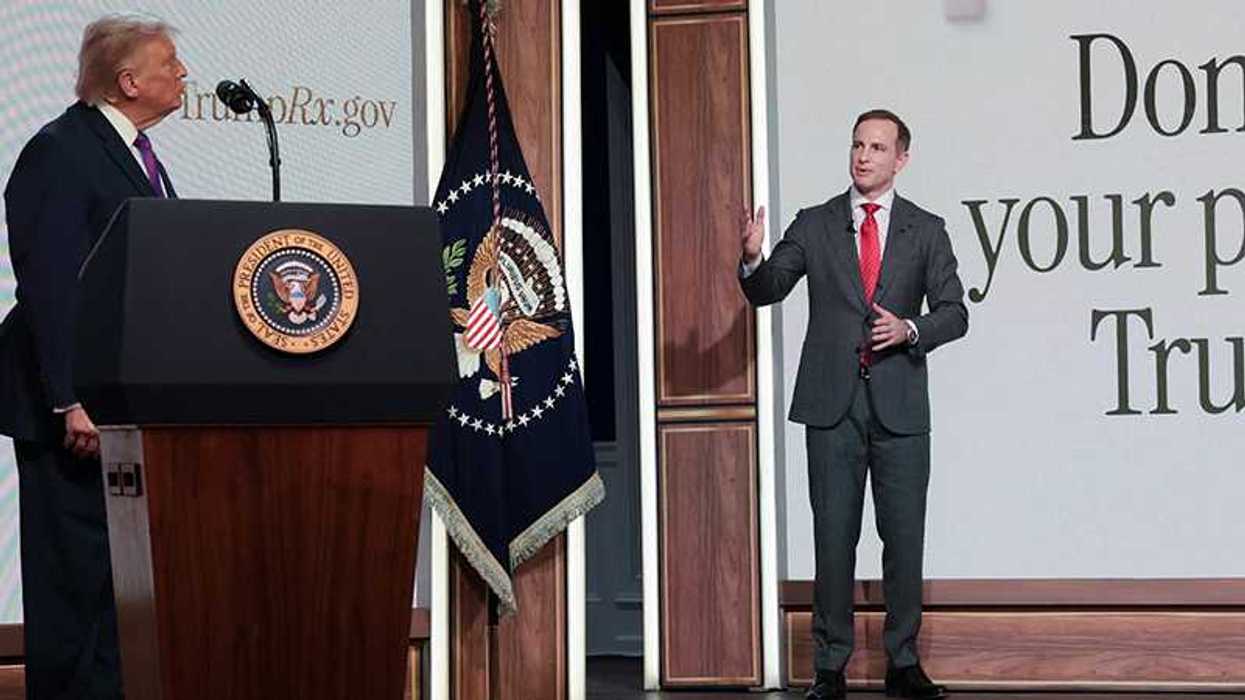
U.S. President Donald Trump looks at Chief Design Officer of the United States Joe Gebbia on the White House campus in Washington, D.C., U.S., May 18, 2026. REUTERS/Jonathan Ernst

May 29, 2026
ALTERNET

A small disclaimer on a website just exposed a secret project with no reporting, oversight, transparency or accountability under the thumb of President Donald Trump's office.


Audrey Henson, who researches and writes about the intersection of technology and power, found the disclaimer in the footer of a page on the TrumpRx website, which claims to offer access to drugs the government is trying to renegotiate prices for.

"In the footer of the page, beneath all of it, I found something I have never seen on a federal government website in my life. A byline. The government does not do this," explained Henson. "The IRS does not sign its work. The FBI does not. Social Security does not. No federal agency that has ever built a website has felt the need to take credit for it. In plain bold text, sitting directly above the privacy policy, it said: Designed and Engineered in D.C. by National Design Studio. So I clicked through."

What she said she found was "The National Design Studio," an "office" created by one of Trump's executive orders in Aug. 2025.

According to Joe Gebbia, co-founder of Airbnb, the goal was to redesign how Americans experience their government online. He reports directly to Trump's chief of staff, Susie Wiles.

"His position requires no Senate confirmation, which means he files no financial disclosures, which means the office he runs does not appear in any federal procurement database, which means, as far as the official record is concerned, it barely exists," wrote Henson. That, she said, is the point.

Staff is hired under Section 3161, which allows for temporary advisory bodies meant to be part-time advisors and volunteers. Their salary isn't public, and there is no inspector general to keep an eye on ethics. Henson called it essentially what DOGE was meant to be, the "department" that was promised would save $2 trillion by cutting "waste, fraud and abuse" in government. Gebbia was previously working for DOGE.

So, Henson compared the names from DOGE with those of the National Design Studio and found them remarkably similar. " The National Design Studio is not a successor to DOGE. It is DOGE with a better logo and a design philosophy," she said.

What she found in the code of the pages on TrumpRx is that each page is "making phone calls to servers all over the internet with dozens per second." One of those is "PostHog," a Silicon Valley analytics company that records what users do on a website and reports it back to those who own it. It's everything from following mouse movements to scrolls and clicks.

"I had not clicked anything. I had just opened the page, and it was already on the phone with PostHog telling them about me," Henson said. It includes your IP address and any other identifying information it can obtain. Henson said it's not something she expected to see on a government website.

So, she checked other government sites. Real Food, Trump Accounts and others are all part of the PostHog tracking and data collection.

"And on ndstudio.gov alone, running alongside PostHog, was something someone had built entirely by hand. Five hundred and forty lines of custom JavaScript with a name embedded directly in the code: AutoMonitor. What it appears to do is rewire the part of the browser that handles how a page talks to the outside world, so that every conversation the page has with any server gets copied and forwarded to a private backend with no public presence. The studio has the structural ability to keep a copy of every recording as it passes through their infrastructure. I cannot prove they are keeping one. The pipe is built that way on purpose, and that is the part that matters," Hensen explained.

The problem is that the government requires a number of things for websites, which include privacy disclosures, notices in the Federal Register and published contracts with outside vendors, she said. None of those exist on the 12 National Design Studio programs. Those laws were enacted after Watergate to protect Americans from secret government surveillance programs. Each missing piece at those 12 sites is a crime, resulting in 36 breaches of federal law. There is a privacy disclosure on the Trump Rx page, but Hensen said that some paragraphs contradict each other.

"A federal health website is lying to the people using it and cannot even keep the lie consistent," Hensen warned.

Then she went searching for more, finding at least 40 on top of the first 12. Some of the sites haven't been announced.

"I started reading the names. Sites that looked like they belonged to the State Department. To NASA. To the Department of Homeland Security. And then two that stopped me cold: a working preview of vote.gov, and something called fbi-kirk-tipline. I checked the public ownership records for every subdomain, and every single one traced back to the same place, the Executive Office of the President," she said.

The sites were built by the National Design Studio. Everything was built by the White House using the same Cloudflare account, which isn't normal for a federal agency either.

"The login screen for the gated preview sites read: loveisaskill.cloudflareaccess.com. Love is a skill is a phrase Gebbia has used publicly to describe Airbnb’s design philosophy," said Henson. To her, this indicates Gebbia owns these personally, not the government.

Akash Bobba, one of the people on DOGE, now controls one of the sites for an agency as well as emails and security configurations. It "means a White House staffer has full visibility into who applies for grants, who gets approved and who inside that agency is talking to whom," said Henson.

Henson also remembered an Oct. 2025 conference call in which Bobba was recorded saying that the group was building a federal voter registration system on vote.gov.

"Voters would register through a federal portal, their identities verified through Login.gov, their citizenship verified through DHS’s SAVE database, their registrations transmitted to the states," Henson continued. "A state election director asked him what data the federal government would retain. He said, on a recording, in an election year: I don’t know what they retain and what they are logging. The person presenting a federal voter registration system to state election directors did not know what data his own system kept on American voters."

She noted that there is a previous law that blocks the White House from overseeing voter registration, so it violates that law too.

A few weeks before Trump signed the executive order, essentially forcing small parts of the SAVE Act on the public, the security certificate appeared. The order mandates that within 90 days of the signing, they must have a federally created "list" of citizen-verified voters. That 90 days is up in a few weeks. The Justice Department told the judge overseeing lawsuits against the order that it was in the deliberation phase. The websites show that the claim doesn't match up with reality.

"The certificate is dated April 10. DOJ told a federal court the infrastructure does not exist. Both of those cannot be true," Henson said. "Either DOJ lied to a federal judge, or the studio is building a replacement for the country’s voter registration site without telling the agencies whose work it would replace. There is no third option."

She then went to the State Department website for passports. The White House owns that website now, too. On May 5, the first security certificate was issued. The new website has no official seal on it or a privacy notice. She said that, based on the staging environment, it looks to her like the government wants to require Americans "to upload their passport photo through a White House-controlled website, on the same Cloudflare account, by the same people, with no privacy notice on file. A passport photo is biometric quality. Linked to your identity through Login.gov. Collected through infrastructure the White House owns, sealed from public view."

She cautioned that it appears the site is being built this week.


DHS Secretary Claims Plans Underway to Stop International Flights from Sanctuary Cities


DHS Secretary Mullin threatened to stop processing international flights in sanctuary cities in response to protests.
May 28, 2026

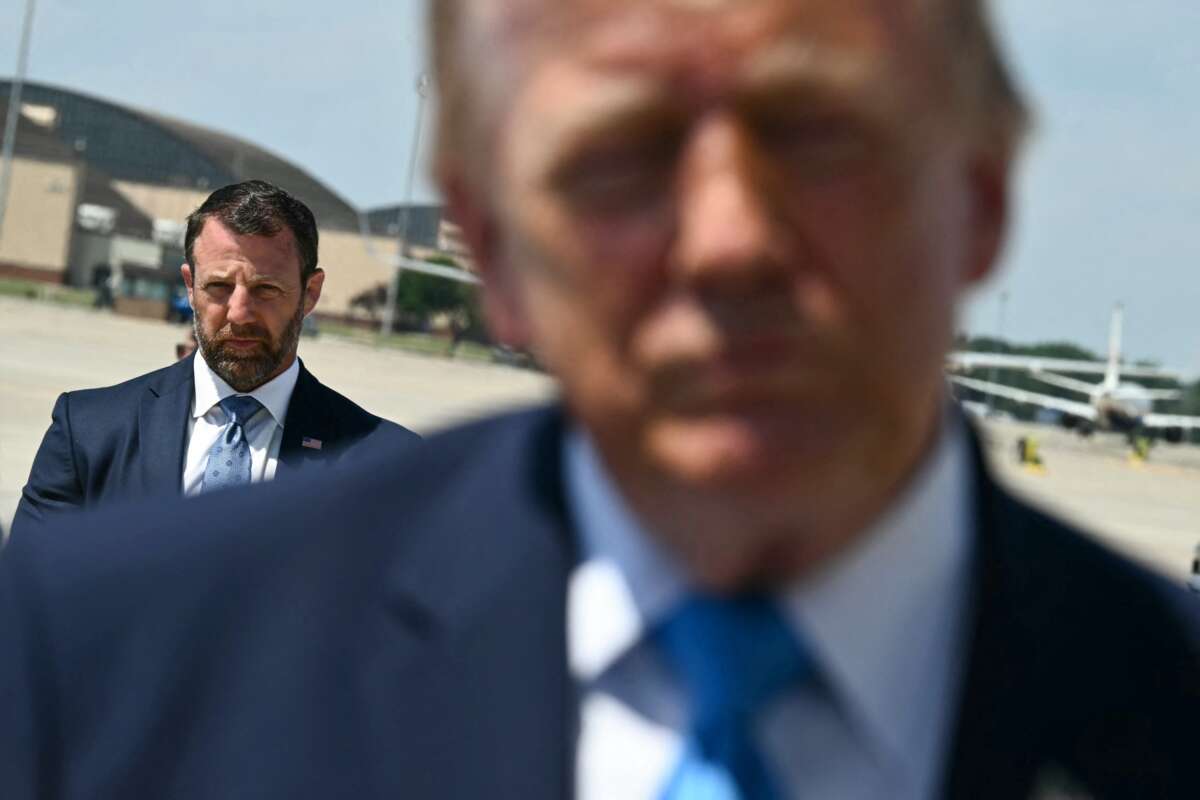
US Secretary of Homeland Security Markwayne Mullin looks on as President Donald Trump speaks to reporters after stepping off Air Force One at Joint Base Andrews, Maryland on May 20, 2026.Kent Nishimura / AFP

Department of Homeland Security (DHS) Secretary Markwayne Mullin claimed that the Trump administration is in the process of drawing up plans to stop processing international flights in sanctuary cities in retaliation for the protests at Delaney Hall, an immigrant jail in Newark, New Jersey.

In an interview with Fox News on Tuesday, Mullin complained that local police had not assisted ICE in facing off against protestors at Delaney Hall. He denied that a hunger strike was taking place at the immigrant jail, and baselessly called the protestors — many of whom are family members of those detained – “antifa.”

“We’re currently drawing up plans” to stop “processing international flights” into cities where Democrats “aren’t allowing us to do our job and enforce federal laws,” he said.

“They don’t want us to enforce immigration, but they want us to process immigration at their facilities?” Mullin continued, grossly mischaracterizing the actions of Democrats.

This was after a group of New Jersey Democratic officials attempted to enter Delaney Hall on Monday.

Since Friday, detainees have been waging a hunger and labor strike at the jail in protest of the inhumane conditions and lack of due process for those detained. Family members of the detained have amplified their strike by protesting outside the jail and broadcasting phone calls with their detained family members – that is, until the jail cut off their phone access. Protestors have also repeatedly blocked ICE vehicles attempting to transfer one of the leaders of the strike in retaliation for his organizing.

In addition to shutting off phone access of detainees and transferring one of the strike leaders, ICE agents have teargassed, pepper sprayed, and tackled protestors over the past several days.

Mullin had previously threatened to halt immigration processing at airports in sanctuary cities in April, but his comments on Tuesday suggest a more serious consideration by the administration.

The Trump administration’s published list of sanctuary cities include many cities with major international airports, among them Newark, Boston, New York City, Philadelphia, Chicago, Denver, Seattle, San Francisco, and Los Angeles.

Delaney Hall, operated by for-profit private prison company GEO Group, was intentionally chosen because of its proximity to Newark’s international airport, in order to allow for rapid deportations of migrants.

Mullin’s claim that police in sanctuary cities do not work with ICE echoes comments by Trump border czar Tom Homan earlier this month – and is misleading at best. While there are restrictions to cooperation with ICE in sanctuary cities, widespread reports have found that collaboration still exists between local law enforcement and ICE across the country — sometimes through the use of legal loopholes, and other times, violating sanctuary laws entirely.

Travel industries and major airlines have expressed their disapproval of Mullin’s threat against international flights, saying that such an action would harm the industry.

Morning Joe tears apart top Trump official over scheme to cause 'economic paralysis'


Morning Joe, Image via Screengrab.
May 29, 2026 
 ALTERNET


Homeland Security Secretary Markwayne Mullin is drawing vehement criticism for essentially threatening to halt international flights in and out of Democrat-controlled cities if they oppose President Donald Trump's immigration policies. And some of the criticism is coming from conservative MS NOW host Joe Scarborough, who had a scathing response to Mullin's threat during a Friday morning broadcast of "Morning Joe."


Mullin told Fox News that if "radical left Democrats" defied Trump's immigration policies, "we shouldn't be processing international flights into their cities." And Scarborough warned that if Mullin's idea were actually implemented, it would have dire consequences for the U.S. economy and international air travel.

Scarborough, a former GOP congressman, told fellow "Morning Joe" host Mika Brzezinski, "It makes your teeth hurt, the stupidity…. (Mullin) wants to…. totally screw up international commerce. I mean, it is really bizarre how backward these people are, and they are focusing on all the wrong things — which may be why the president has his lowest approval rating. Well, the lowest approval rating of any president, according to Gallup, since Richard Nixon in the midst of Watergate."

The Never Trump conservative continued, "Maybe he should get people in place that actually focus on the right things instead of these bizarre things like shutting down or disrupting flights at Newark (International Airport). It's just crazy."

A Fox News anchor pointed out that "pulling CBP (U.S. Customs and Border Protection) out of airports" in major cities run by Democrats "would effectively be the end of international travel into big airports like LAX, San Francisco, Boston Logan, JFK, Newark, Chicago, Philly, Seattle, many others."

Scarborough and Lemire emphasized that removing international flights from major U.S. cities would have dire economic consequences way beyond those cities.

Lemire told Scarbrough and Brzezinski, "It's like you saw the economic paralysis that came from the Strait of Hormuz closing and said, 'Oh, let's bring that home. Let's do some of that here.' Because…. it would have such impact beyond these handful of blue cities, these sanctuary cities the DHS wants to punish. Travel executives have warned the government about that. Others in the industry have. Even some Republicans have quietly expressed some reservations, like: look, this pain is not going to be limited to the handful of cities and states you want it to be. We're going to feel it around the country and beyond."

The MS NOW host continued, "So perhaps, Mika, they'll be talked out of this particular idea."


Kennedy Center win celebrated as 'one-two-punch' victory over Trump


Sarah K. Burris
May 29, 2026
ALTERNET


US District Court Judge Christopher R. Cooper shot down President Donald Trump's effort to rename the John F. Kennedy Center for the Performing Arts after himself, citing the congressional laws that established the institution, making the name of it "abundantly clear."

"Congress likewise took pains to ensure that no other memorial-like dedication would grace the Center’s public spaces. As a result, the Kennedy Center Board’s decision to rename the Center, along with its decision to affix President Trump’s name to the building’s façade, violate Congress’s unequivocal mandate. As stated at the outset, Congress gave the Kennedy Center its name, and only Congress can change it," the judge wrote in his 94-page opinion.

"And because the Defendants are currently in violation of Congress's express statutory direction, the Court will order that they remove President Trump's name from the institution's title, as represented on the façade of the Center, any other physical or digital signage, and official materials," it continues.

The Center is meant to memorialize "President Kennedy and President Kennedy alone," Judge Cooper ruled.

He also made it clear that the name can't be redesignated as the "Trump-Kennedy Center" even if it was a "nickname" or an unofficial name. The statute is clear that even in that case, it would violate the law.


Judge Cooper adds that Trump's decision to close the Center down for two years was "a dereliction of common law duty of prudence," explained Lawfare's Roger Parloff.

The ruling came on what would have been Kennedy's 109th birthday.

Legal expert and Trump foe Norm Eisen celebrated the ruling for his colleagues at the litigation group Democracy Defenders Action


He called it a one-two-punch, "the renaming and the closure of the Kennedy Center are enjoined."

"About time," cheered former prosecutor Joyce Vance.

"The ruling is a stinging blow for the president, who has made clear his personal stake in the rebranding and remodeling of the Kennedy Center," wrote Politico in its report.


" Trump wants to unilaterally decide everything and put his face and name everywhere for what was supposed to be nonpartisan with congressional oversight and then MAGA pretends to be confused as to why anyone would take issue with that," lawyer Damin Toell said on X.

“'Why don’t acts want to play at the Trump Kennedy Center, it’s a total mystery, they must hate America' vibes," replied The Bulwark's Sonny Bunch.

It prompted questions from followers about how quickly Trump's name must be removed. But another was concerned that Trump might order the building bulldozed after he took down the East Wing of the White House. One grandfather offered to help remove the sign.

"Remember that while Trump might get away with some of the stupid and childish stuff he pulls in the short-term, in the long-term courts overturn him 9 times out of 10. Today he got walloped over his Kennedy Center antics," said one person promoting Eisen's announcement.


"If this is the thing that finally causes him to stroke out, I will sing the entirety of Les Misérables on the Kennedy Center steps," pledged one man.

Writer Aaron Von Dorn said that he continues to find it "wild" that Trump shamelessly put his name on a Kennedy memorial. "I just cannot understand that kind of raw need."


Judge tramples Trump's attempt to rename the Kennedy Center


May 29, 2026 


A federal judge has ordered that President Donald Trump cannot rename the John F. Kennedy Center for the Performing Arts, nor may he close it for what the Trump administration said were two years of renovations.

“The Kennedy Center’s organic statute makes crystal clear that the Center is to be named for President Kennedy, and it cannot bear any other formal name or public memorial based on the Board’s unilateral say-so,” the judge wrote, CNBC reports. “Congress gave the Kennedy Center its name, and only Congress can change it.”

The judicial decision arrived on May 29, the day birth of John F. Kennedy, for whom the building was named in honor.

The John F. Kennedy Center for the Performing Arts has been a Washington, D.C. cultural institution since its dedication in 1971, serving as a national memorial to the 35th president following his assassination in 1963. Established by an act of Congress, the Kennedy Center operates under a specific congressional mandate that designates it as a living memorial to President Kennedy. The institution's governing statute, passed by Congress, explicitly establishes the center's name and purpose, making any unilateral changes subject to congressional authority rather than presidential discretion.

Trump's attempt to rename the facility and close it for extended renovations represents one of several recent efforts by his administration to reshape Washington's cultural and institutional landscape. Earlier this year, Trump attempted to add his name to other historic buildings and monuments, prompting legal challenges from government watchdog groups and constitutional scholars who argue the president lacks unilateral authority to alter congressionally-designated memorials.

The Trump administration had not publicly specified what name it intended to give the Kennedy Center, though the timing of the closure announcement—paired with Trump's broader efforts to rebrand federal institutions—suggested the proposed changes aligned with his administration's priorities. The two-year renovation timeline would have effectively removed one of Washington's premier cultural venues from public access during a significant portion of his term.

Federal judges have increasingly scrutinized Trump administration actions that exceed traditional presidential authority. This ruling reinforces the principle that congressional statutes create binding legal constraints on executive power, particularly regarding institutions explicitly established by legislative action. The decision also underscores ongoing judicial resistance to what critics characterize as executive overreach in areas traditionally reserved for congressional authority. The Kennedy Center ruling may establish precedent for other challenges to Trump administration attempts to unilaterally alter federally-designated memorials and institutions.


Trump's big MAGA birthday bash in full meltdown


U.S. President Donald Trump attends an event to honor Angel Families at the White House in Washington, D.C., U.S., February 23, 2026. REUTERS

May 29, 2026 
ALTERNET


On Wednesday, the musical lineup was announced for the Great American State Fair, an event that will be held at the National Mall to mark the country’s semiquincentennial, which President Donald Trump has promoted as something of a MAGA-patriot bash. By Friday, the concert series was in disarray as nearly all of the proclaimed performers had pulled out, asserting that they’d been misled by organizers. As Washingtonian explained, “They thought they were performing at a nonpartisan celebration of the nation’s birthday — and had not been informed that Freedom 250 was an organization closely tied to Donald Trump.”

As a result, “the Great American State Fair seems to be melting down, in a bizarre situation that involves dueling semiquincentennial celebrations, a congressional probe into possibly shady fundraising practices, apparently empty concert stages, and one very weird rant recorded to Instagram from the toilet.”

So far, 5 of 9 artists from the original lineup have dropped out, including Martina McBride, Bret Michaels, Young MC, Morris Day & the Time, and the Commodores. According to McBride, “I was presented with an opportunity to perform at a nonpartisan event but that turned out to be misleading.” Said Michaels, the event “has evolved into something much more divisive than what I agreed to be a part of.” Young MC claimed that “the artists were never told about any political involvement.” “It’s a no for me,” posted Morris Day, while the Commodores declared, “Our music has always been our voice and we choose not to publicly affiliate with any single political party. We support the betterment of all Americans.”

The remaining artists have delivered wide-ranging responses, from silence, to neutrality, to full-throated enthusiasm, to the just plain bizarre. Trump ally Vanilla Ice says he is “super honored to do this concert.” Fab Moran, the surviving member of the infamous 80s pop group Milli Vanilli, stated, “I am here to entertain and unite people, not divide them.” Flo Rida hasn’t responded to the controversy, but he previously pulled out of a 2015 Miss USA pageant after Trump made racist remarks about Mexicans, so his participation may change.

One artist, C+C Music Factory, hasn’t quit, but its frontman's unusual response to the controversy doesn’t bode well for the concert series.

As Washington detailed, “In a strange, profanity-laden Instagram video that appears to have been recorded from the toilet, frontman Freedom Williams claims that his agent didn’t mention Trump when he booked the Great American State Fair concert; all Williams knew was that he’d agreed to do ‘a show in Washington,’ which seemed fine. ‘I don’t fuck with Trump,’ he said multiple times. But he also said he’d ‘vote for Genghis Khan, Hitler, or Ivan the Terrible’ or ‘do a show in North Korea pissing on an American flag’ before he let the public tell him what to do. Williams stressed that he is un-cancellable. ‘I just might do it,’ seems to be where he’s landed on the Great American State Fair.”

While the United States’ 250th birthday is technically a nonpartisan event, Trump has gone out of his way to make the celebration a MAGA affair, right down to the organization putting it together. As Washingtonian notes, “The organization sponsoring the Great American State Fair is not America250, the nonpartisan entity created by Congress to administer the country’s semiquincentennial celebrations. It’s Freedom 250 (officially the ‘White House Task Force on Celebrating America’s 250th Birthday’), an organization created by President Trump, and run by a Trump appointee.”

Critics allege that Freedom 250 is really just another Trump grift that provides wealthy donors presidential access. According to Washingtonian, “For one million dollars or more…donors to Freedom 250 can secure an invitation to a private reception hosted by Trump himself. As the New York Times explained earlier this year, Freedom 250 allows ‘people and companies with interests before the Trump administration’ to make ‘tax-deductible donations to gain access to, and seek favor with, a president who has maintained a keen interest in fund-raising, and a willingness to use the levers of government power to reward financial supporters.’”

In response, Democratic senators launched a probe into the organization’s fundraising, writing that “Government-sponsored civic commemorations should not serve as platforms for political messaging or partisan activity, nor should they create opportunities for donors to exert influence with federal decision-makers under the guise of patriotic celebration.”
BAN DEEP SEA MINING

2,315 Meters Under the Sea, Greenpeace Stages Deepest Protest in World History

“By safeguarding these deep-sea ecosystems within a global network of ocean sanctuaries and establishing a moratorium on deep sea mining, we can create a resilient safety net for marine life, and protect the health of our global oceans for generations to come.”


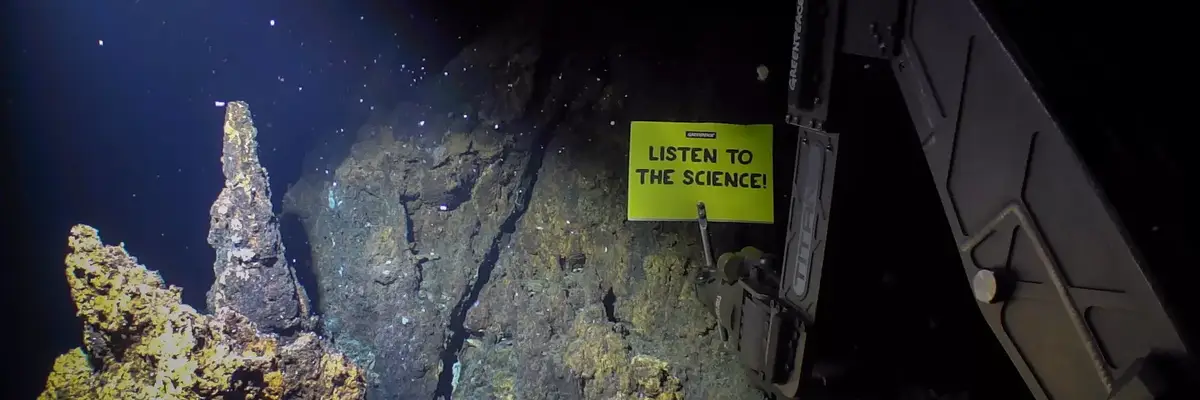
An expedition led by Greenpeace International, Greenpeace Germany, and Greenpeace Nordic deployed an underwater robot and banner reading ‘Listen To The Science’ to deliver a direct message to global leaders from 2,300 meters below the surface, in the deepest protest ever made.

(Photo: © Greenpeace)


Jon Queally
May 27, 2026
COMMON DREAMS

Aided by a sophisticated underwater submersible, activists with Greenpeace on Wednesday set a world record for the deepest protest ever by displaying a banner 1.4 miles beneath the surface of the Arctic Ocean to oppose industrial deep-sea mining and urging protection of the world’s oceans.

According to the international environmental group, the message “LISTEN TO THE SCIENCE!” was displayed 2,315 meters below sea level using a remotely operated vehicle called ‘ROV Holly.’

Executed during a deep-water survey expedition between Iceland and the island of Svalbard, the robotic hand of the submersible held up the sign in front of a hydrothermal vent field known as Loki’s Castle, which is located along the Arctic Mid-Ocean Ridge that separates the Arctic Ocean’s Greenland Sea from the Norwegian Sea.

“This marks the deepest banner protest in history, to speak for ecosystems that have no voice of their own,” said Dr. Sandra Schöttner, chief scientist for the Deep Arctic Expedition at Greenpeace International. “World leaders have already promised to protect 30 percent of the oceans, now they must listen to the science and actually do it. We cannot meet our global goals if we also allow industrial exploitation of unexplored and vulnerable ecosystems in the deep sea. It is high time that leaders keep their promises and give the oceans a chance to recover.”

The Arctic Mid Ocean Arctic Ridge—which the group characterized as “one of Earth’s least known wildernesses”—goes down to depths of up to 3000 meters. The expedition and historic protest is part of a Greenpeace campaign that is calling for the deep-sea world of hydrothermal vents like Loki’s Castle and others, as well as seamounts and the “extraordinary creatures” that live in such ecosystems to be protected with the establishment of a network of marine sanctuaries.

“By safeguarding these deep-sea ecosystems within a global network of ocean sanctuaries and establishing a moratorium on deep sea mining,” said Dr. Schöttner, “we can create a resilient safety net for marine life, and protect the health of our global oceans for generations to come.”

Efforts to ban deep-sea mining by environmentalists, ocean stewards, and conservationists were stymied in the US with an executive order last year issued by President Donald Trump which seeks to bolster and expand the practice by the mining industry.

Trump was condemned for the move, which Greenpeace at the time called “an insult to multilateralism” due to its sidestepping of a UN-backed process designed to protect the oceans, and “a slap in the face to all the countries and millions of people around the world who oppose this dangerous industry.”

Trump’s failures, however, have been counteracted at some level by other nations who have paused or put stronger protections in place when it comes to deep-sea mining. In December, Norway paused controversial plans to issue a fresh round of drilling and mining license beneath undersea areas it controls.

As part of its ongoing campaign to curb the destructive practice, Greenpeace is calling on world leaders to honor existing global climate targets, implement the UN Ocean Treaty to protect 30% of the global ocean by 2030, and establish an immediate moratorium on deep-sea mining.

“There is no version of seabed mining that is sustainable or safe,” Greenpeace Aotearoa campaigner Juressa Lee said last year. “Alongside our allies who want to protect the ocean for future generations, we will continue to say a loud and bold no to miners who want to strip the seafloor for their profit.”
Vermont Applauded for Banning Parkinson’s-Linked Neurotoxic Herbicide Paraquat

Noting that “70+ countries and one US state” have banned the chemical, the Michael J. Fox Foundation said that “this is a clear and critical message” to federal and state lawmakers that “the time to ban paraquat is now.”


A crop duster sprays pesticide on a field in Whitman County, Washington on June 20, 2011.
(Photo by Wolfgang Kaehler/Avalon/Universal Images Group via Getty Images)


Brett Wilkins
May 26, 2026
COMMON DREAMS

In a move cheered by advocates for public health and the environment, Vermont on Tuesday became the first US state to ban paraquat, a neurotoxic herbicide banned in over 70 countries but protected by the Trump administration despite being linked to Parkinson’s disease.

Democratic Vermont Gov. Phil Scott signed H. 739, which bans the sale and use of paraquat, after the legislation was passed by the state Legislature with strong bipartisan support. The ban—which contains a provision allowing for limited use of the chemical on fruit orchards through the end of 2030—is set to take effect on November 1.

As Public Interest Research Group (PIRG) campaigner Liam Sacino recently noted, the US Environmental Protection Agency [EPA] acknowledges that “even a small amount” of paraquat “can be fatal, and there is no known antidote.”

“The agency has also decided that due to health risks, it should never be used around home gardens, schools, recreational parks, golf courses, or playgrounds,” Sacino added. “Regardless of these conclusions, the EPA still allows paraquat to be sprayed on farms, posing a potentially increased risk to those who work on the farms and live nearby.”

The EPA paradoxically calls paraquat “an important tool for the control of weeds in many agricultural and non-agricultural settings,” a stance promoted by the chemical industry, some of whose highly toxic products the pesticide-friendly Trump administration has designated as vital to US national security.

Ban advocates point to mounting evidence that paraquat exposure greatly increases the risk of developing Parkinson’s disease, a neurodegenerative illness. One recent UCLA study found that the odds of developing Parkinson’s could more than double for people living within 500 meters of paraquat application.

That study added to a body of research linking paraquat to Parkinson’s that dates back to at least 2011, when National Institutes of Health researchers concluded that the brain disorder is “positively associated” with the herbicide. A 2013 paper published in the peer-reviewed journal Neurology found that exposure to paraquat roughly doubled the risk of developing Parkinson’s. In 2020, four of the world’s leading neurologists published a book citing paraquat as a cause of the ailment.

Parkinson’s advocacy groups, including the Parkinson’s Foundation and Michael J. Fox Foundation, hailed the Vermont ban.

The Michael J. Fox Foundation noted that “70+ countries and one US state have now banned paraquat.”

“This is a clear and critical message to other states and our federal government: The time to ban paraquat is now,” the group added.


Environmental groups also cheered the ban.

“We applaud Gov. Scott and the champions in the Legislature that made this moment possible that will protect all Vermonters, including farmers and children, from being exposed to this dangerous chemical,” Environmental Working Group legislative director Geoff Horsfield said in a statement.

“With Vermont leading the way, states across the country now have a clear path to end the use of one of the most toxic herbicides still on the market,” Horsfield added. “This is a turning point in the effort to protect public health from a chemical that has been tied to devastating neurological harm.”

Other states including California, New Jersey, New York, and Pennsylvania have either introduced bills to ban or strictly limit paraquat, or are considering doing so.

“We should not wait for federal action when we can act now to protect farmworkers and families,” PIRG’s Sacino said Tuesday.
Guatemalan President Denies Deal With US for Joint Strikes on Drug Cartels

“There is no agreement authorizing foreign military operations by any country in national territory,” the office of President Bernardo Arévalo said in response to a New York Times report.


US and Guatemalan troops train together in Poptún, Guatemala on July 12, 2019.
(Photo by Spc. Samuel Keenan/US Army)

Brett Wilkins
May 28, 2026
COMMON DREAMS

While acknowledging a request for US support in fighting drug cartels, Guatemala’s president on Thursday refuted reporting by The New York Times claiming his government “has agreed to carry out joint strikes with the United States military inside its territory”—action that would violate the country’s Constitution.

Citing “three people familiar with the talks,” the Times reported that “President Bernardo Arévalo of Guatemala agreed to both airstrikes and other military action in a call with [US] Defense Secretary Pete Hegseth... with operations to start as early as next month.”

However, Arévalo’s office pushed back in a statement stressing that “there is no agreement authorizing foreign military operations by any country in national territory.”


The presidential statement said that Guatemalan Defense Minister Henry Sáenz wrote to Hegseth “to request US cooperation in operations led by Guatemalan security forces against narco-trafficking organizations as part of a strategy launched in 2024.”

“This request falls within the framework of existing bilateral agreements on the matter, and adheres to constitutional provisions and laws regarding cooperation agreements on civil and military security,” the office added.

Arévalo’s office stressed that Guatemala’s Constitution stipulates that foreign military forces can only be deployed in the country if authorized by a two-thirds vote of the national Legislature.

A source from Arévalo’s government told El País Thursday on condition of anonymity that the Trump administration has been exerting “great pressure” for two months.

“What they offered us is to select one or two places to bomb and televise everything,” the source said. “But we have been clear that this is not going to happen. It cannot operate a US military force in the country, simply because it is unconstitutional.”

Arévalo’s office said it is seeking US assistance in training, strategic and tactical support, and intelligence sharing, pointing to recent actions against drug trafficking, including the capture of an arsenal in Las Cruces, Petén, the seizure of a narcotics laboratory in Ayutla, San Marcos, and the capture of numerous suspected narco-traffickers.

Asked during a Thursday press conference about the possibility of joint combat operations like those reportedly carried out by US and Ecuadorian forces in the South American nation, Arévalo claimed unfamiliarity with the details of the agreement between those two countries.

Progressive US lawmakers are demanding answers about “reports of serious human rights violations and the bombing of what appear to have been civilian facilities” in Ecuador, including a “dairy and cattle farm with no known links to armed groups or drug trafficking” where unarmed civilians were allegedly tortured.

Arévalo brushed off a suggestion that his request for US cooperation could open the door to human rights violations in Guatemala, telling reporters that “the best defense against any violation of human rights is our respect and commitment to the laws of the republic and to current legislation.”

While Guatemala does suffer from serious narco-trafficking issues, many Guatemalans are wary of US intervention, given past meddling including the 1954 CIA-orchestrated overthrow of reformist President Jacobo Árbenz, which was followed by decades of right-wing repression, civil war, and a US-backed genocide against Indigenous Mayan peoples during which around 200,000 people were killed.

In March, the Trump administration lifted longstanding restrictions on arms transfers to Guatemala.

“Now, our soldiers are going to have access to modern technology, radars, night viewfinders,” Sáenz told La Hora on Friday.


The defense minister said he discussed closer counter-narcotics cooperation with the United States during the “Shield of the Americas” summit, during which senior officials from over a dozen nations—most of them ruled by right-wing governments—gathered at President Donald Trump’s golf resort near Miami.

In addition to Guatemala, the Trump administration has been trying to pressure other Latin American nations into launching joint military operations against narco-traffickers. President Claudia Sheinbaum of Mexico has vehemently rejected US requests, even as President Donald Trump has threatened “to do something” about cartels in her country.

“The epicenter of cartel violence is not Mexico, it’s the United States,” Sheinbaum defiantly declared in March. “The cartels are fueled by the United States’ demand for drugs and armed with US weapons, and thanks to the United States, they are able to orchestrate enormous bloodshed and chaos throughout Latin America.”

In January, Trump ordered the bombing and invasion of Venezuela, whose president, Nicolás Maduro, was abducted to the United States on dubious “narco-terrorism” allegations that were then significantly walked back.

Trump has also threatened to attack Colombia, Panama, and Cuba, whose people are bracing for what many observers fear is an impending US war. If Trump does order military action against Cuba, it would be the 12th country he’s attacked during the course of his two White House terms. Trump also ordered the ongoing bombing campaign targeting boats his administration claims—without providing evidence—were smuggling drugs in the Caribbean Sea and Pacific Ocean. Around 200 people have been killed by the US strikes.

As Nick Turse of The Intercept reported Wednesday:
Trump has turned the Western Hemisphere into a war zone as part of what he and others have called the Donroe Doctrine. This bastardization of the 1823 Monroe Doctrine has been used to justify strikes on civilian boats in the Caribbean Sea and Pacific Ocean; an attack on Venezuela and the abduction of its president; CIA operations in Mexico; joint counter-cartel operations in Ecuador dubbed “Operation Total Extermination”; and increased military and intelligence operations elsewhere in Latin America.

Experts contend that, like the boat strikes, any airstrikes carried out against drug cartels would likely constitute illegal acts of murder, even if conducted with the permission of governments in targeted countries.

“As with the boat strikes, depending on the facts, further attacks could amount to premeditated killings outside of armed conflict, which some of us lawyers would refer to as murder,” former US State Department lawyer Brian Finucane told The New York Times on Thursday.

“Congress never authorized any of these strikes,” he added. “So US personnel who participate in these actions could face consequences down the road, after the Trump administration.”
‘These Extrajudicial Killings Are Becoming Normalized,’ Amnesty Warns After More Trump Boat Bombings

“Not only are these killings illegal, they are immoral. People of good conscience cannot allow this to continue.”


Unclassified footage released by US Southern Command shows the targeting of a vessel in the eastern Pacific on May 28, 2026.
(Photo: US Southern Command)

Jake Johnson
May 28, 2026
COMMON DREAMS


The Trump administration on Wednesday killed two more people in the eastern Pacific by bombing a vessel accused—without evidence—of trafficking drugs, bringing the death toll from the US military’s illegal campaign of boat attacks in international waters closer to 200.

Amnesty International, which has spoken out forcefully against the boat strikes since they began in September 2025, warned in a statement Wednesday that “these extrajudicial killings are becoming normalized” as they fade from the headlines and lawmakers do nothing to stop the administration.

“Not only are these killings illegal, they are immoral,” said Amanda Klasing, Amnesty’s national director for government relations. “People of good conscience cannot allow this to continue, yet Congress has so far failed to halt, or even slow down, this lethal and unlawful campaign.”

The US Southern Command announced strikes in the eastern Pacific Ocean on Tuesday and Wednesday, attacks that killed three people total.

SOUTHCOM called the victims “narco-terrorists” without any evidence. According to a tracker maintained by The Intercept’s Nick Turse, the Trump administration’s boat bombing campaign has killed 197 people since September 2025.


“Numbers alone cannot capture the unimaginable human toll of this horrific campaign of murder at sea,” Klasing said Wednesday. “Every single person that the U.S. has killed at sea was arbitrarily deprived of their right to life, and they and their families have a right to justice. Lawmakers must do everything in their power to halt this campaign and hold everyone responsible accountable for their role in these extrajudicial killings.”

“We are witnessing the height of lawlessness—a government taking military action to kill people who it unilaterally deems ‘criminals’ or ‘terrorists’ and then bragging about it on social media and stonewalling members of Congress demanding explanations,” Klasing added. “Regardless of whether the victims committed crimes or not, killing them is completely illegal under both US and international law. Alleged criminal suspects should be dealt with by law enforcement who are bound by international human rights law, which prohibits using lethal force unless absolutely necessary based on an imminent threat to life.”

Few of the nearly 200 victims of the US military’s assault on vessels in the Caribbean and eastern Pacific have been publicly identified. Earlier this year, family members of two Trinidadian men—Chad Joseph and Rishi Samaroo—killed by a US strike in October filed a wrongful death lawsuit against the Trump administration.

“Rishi was a hardworking man who paid his debt to society and was just trying to get back on his feet again and to make a decent living in Venezuela to help provide for his family,” said Sallycar Korasingh, Samaroo’s sister. “If the US government believed Rishi had done anything wrong, it should have arrested, charged, and detained him, not murdered him. They must be held accountable.”

Ana Piquer, Amnesty’s Americas director, called for urgent action from the international community to rein in the lawless Trump administration.

“Beyond US authorities, we need to see leadership from other governments in the region, as well as the Organization of American States,” said Piquer. “The international community must speak out firmly against these murders, which constitute a serious threat to human rights and respect for international law. Governments must immediately suspend intelligence sharing that may contribute to these operations. They further should suspend export licenses to any defense material that could be used to perpetuate these murders.”