Sunday, June 07, 2026

Pope Leo makes clear Iran is not a 'just war,' as he travels to Madrid for week in Spain

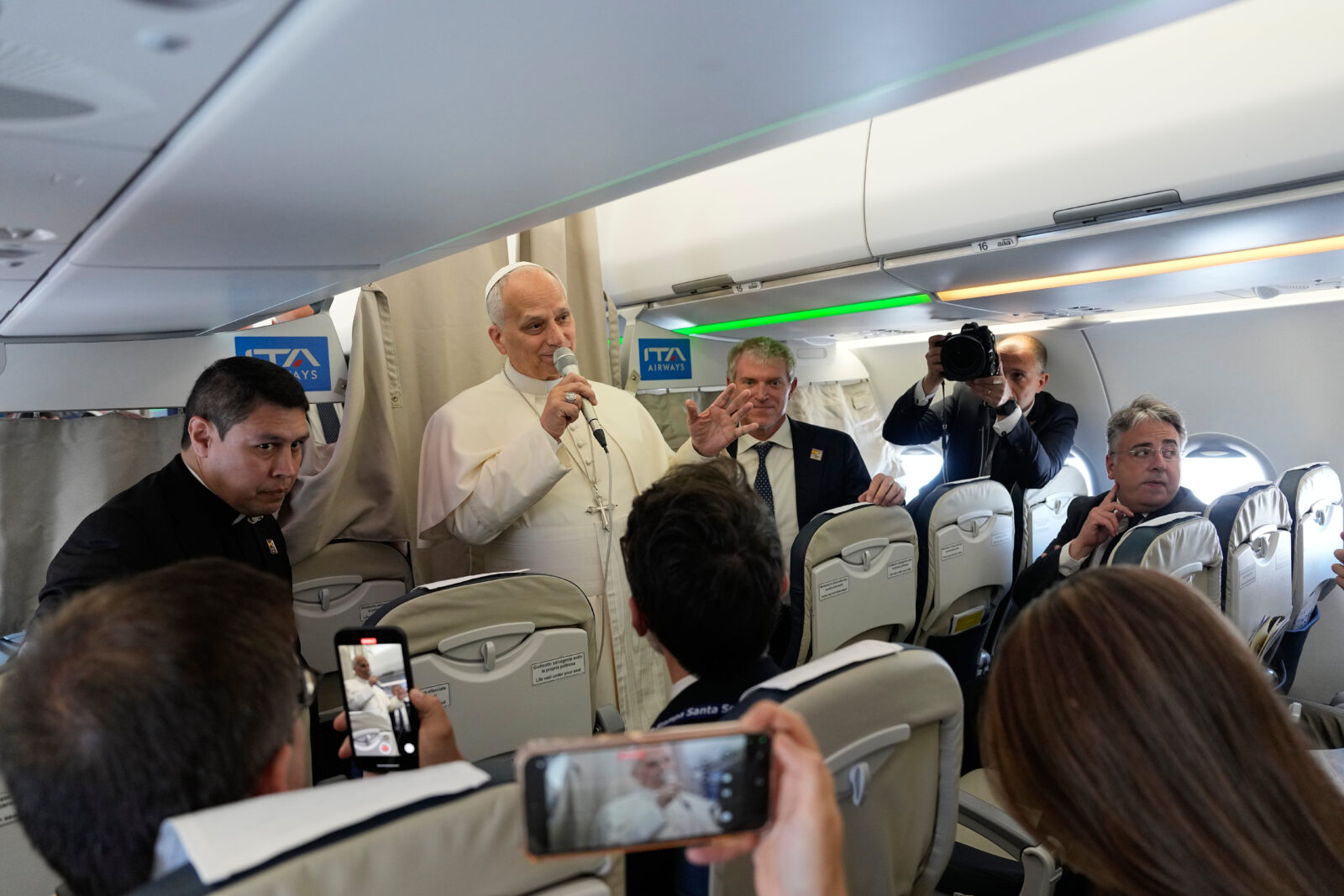
ABOARD THE PAPAL PLANE (RNS) — The pope touched on ‘just war’ theory, the war in Ukraine, the soccer World Cup and even Bad Bunny during the papal flight taking him to Madrid.


Pope Leo XIV talks to journalists aboard the papal flight from Rome to Madrid, Saturday, June 6, 2026, on the occasion of his apostolic journey to Spain. (AP Photo/Alessandra Tarantino, Pool)


Claire Giangravè
June 6, 2026  
RNS


ABOARD THE PAPAL PLANE (RNS) — Pope Leo XIV said the war in Iran does not qualify as a “just war” according to Catholic teaching, while answering questions by journalists aboard the papal plane for his six-day visit to Spain.

“I believe it has been already declared clearly,” Leo said answering a question by Italian journalist Franca Giansoldati, of Il Messaggero, on Saturday (June 6). “There is no just war there,” he said, referencing the conflict in Iran.

The question referred to U.S. Vice President JD Vance’s remarks in April, where he used just war theory to justify the war in Iran. On that occasion, Vance said the pope should “be careful” when talking about theology.

“When the pope says that God is never on the side of people who wield the sword, there is more than 1,000-year tradition of just war theory,” he said. President Donald Trump later said Leo was “weak” on war in a post on Truth Social.

Leo pointed to his most recent encyclical, “Magnifica Humanitas” (Magnificent Humanity), which says that just war theory has “too often been used to justify any kind of war” and is “now outdated.”

“The problem is that the just war theory comes from centuries past when we couldn’t imagine the weapons, human beings’ ability for destruction,” Leo said.

The document urges alternative ways to overcome conflict — “dialogue, diplomacy and forgiveness” — condemning the use of force which disproportionately harms civilians.

The pope made “overcoming the theory of the ‘just war'” one of the themes of the first summit of cardinals he convened at the Vatican June 26-27, called a consistory.

Aboard the plane, Leo also weighed in on the war in Ukraine, especially after Russian President Vladimir Putin recently refused to meet with Ukrainian President Volodymyr Zelenskyy. “I am worried for Ukraine,” Leo said. “We must really push to reach an end to the conflict and the war and find a solution,” he added, calling for continued negotiations.

“Already, four years and a half have passed. We must reach a solution,” he said, recognizing the United States’ efforts to mediate a peace.

The pope also said he is in contact with religious leaders in Lebanon, whom he met when he visited the country in November. “The situation is very complex,” he said, as Israel continues its offensive in the southern part of the country.

Regarding clerical sexual abuse, which he will likely address during his visit to Spain when he meets with abuse victims, Leo said “abuse remains an open wound.”

Finally, Leo said he will support the United States in the soccer World Cup, though he does not know how many games he will be able to watch. He also said that while “the pope is for all teams, Prevost is for Madrid!,” using his former last name.

He addressed the rise in religiosity among some young people in many European countries and parts of the United States. “Young people that are looking for something more, having grown up in many cases that, if you will, spiritual dimension in their lives, they realize there’s an emptiness and a lack of a sense of meaning,” he said, adding that he hopes his visit to Spain will encourage the young who have drawn closer to the church there.

Leo also commented on the Puerto Rican singer Bad Bunny, who is doing 10 concerts in Madrid this month, amid rumors of a possible virtual meeting between the two. “If (young people) are confronted with the question ‘do they want to see the Bad Bunny or do they want to see the pope?,’ I think many will see Bad Bunny. But I think there will also be a few here to see the pope. And that says something, you know?”
Opinion

The status quo at Jerusalem’s Al-Aqsa Mosque is deteriorating

(RNS) — The long-standing practice has been to preserve the site for Muslim worship and allow visitors of other faiths.


Worshippers enter the Al-Aqsa Mosque compound in Jerusalem’s Old City, April 9, 2026, after a ceasefire reached by Iran, Israel and the United States. (AP Photo/Mahmoud Illean)


Daoud Kuttab
June 4, 2026 
RNS

(RNS) — At first, last week’s investigative report by Middle East Eye journalists, revealing a secret U.S.-Israel plan to end Jordanian custodianship of Jerusalem’s most contentious holy site, seemed far-fetched. The plan purports to replace Jordan’s administrative body with an Israeli-appointed one that would reframe the Muslim site, allowing public access to a “multifaith center.”

When questioned, U.S. Secretary of State Marco Rubio appeared surprised. “I’m not even aware of those reports. … I’ve never heard that,” he said in a congressional hearing about the matter. Rubio then stressed the “great” partnership between the U.S. and Jordan.

But those on the ground were not surprised by the report. The long-standing status quo, dating back to 19th-century Ottoman rule and reinforced by international resolutions and the 2014 U.S.-Israel-Jordan agreement, has been to preserve the site for Muslim worship and allow visitors of other faiths. But in practice, that agreement has been eroding for decades, increasingly so since the war in Gaza in late 2023.

The 14-hectare compound, which includes Al-Aqsa Mosque and the Dome of the Rock, holds deep significance for Islam; Muslims believe that the Prophet Muhammad ascended to heaven from there to receive divine revelations. Together, the two structures that make up Haram al-Sharif/Al-Aqsa Mosque are a UNESCO World Heritage site and are considered the third-holiest site in Islam.

Israeli police have restricted mosque entry from Palestinians during holidays, citing security concerns. And Israeli police have increasingly allowed Jews, who believe that the Temple Mount beneath Al-Aqsa is the location of the ancient First and Second Temples, to perform rituals and prayers inside the complex, despite the 2014 meeting in Amman where Israeli Prime Minister Benjamin Netanyahu and Jordan’s King Abdullah II, in the presence of U.S. Secretary of State John Kerry, affirmed that “Al-Aqsa is for Muslims to pray and for all others to visit.”


Israeli police escort Jewish visitors marking the holiday of Passover to the Al-Aqsa Mosque compound, known to Muslims as the Noble Sanctuary and to Jews as the Temple Mount, in the Old City of Jerusalem during the Muslim holy month of Ramadan, April 9, 2023. (AP Photo/Mahmoud Illean)

Since Ariel Sharon’s provocative breach of the mosque in 2000 and the removal of Jordan’s waqf guards from the Mughrabi Gate, Jewish extremists have entered the mosque without permission from Jordanian waqf authorities. Jewish settler visits, accompanied by armed Israeli forces, have surged by more than 18,000% since 2003, according to statistics released by the Jordanian authorities, from 289 to over 53,000 in 2024.

Researchers have warned that, under the rhetoric of religious and historical ties, Israel is steadily expanding its influence at the site. What began as a police revision permitting greater Jewish prayer has become a broader precedent.

Israeli media reports in early 2026 indicated that Netanyahu supported a decision by Israel’s national security minister, Itamar Ben-Gvir, allowing Jewish prayer at Al-Aqsa. Israeli media coverage also notes that the prime minister said the policy changes were coordinated with him and that he dismissed warnings that such moves breached decades‑old arrangements.

On May 14, Ben-Gvir personally led a Jewish extremist group into the Al-Aqsa compound and raised an Israeli flag, danced, sang and declared that “the Temple Mount is in our hands.” The incident underscored the high-stakes nature of policy shifts and the urgency of careful stewardship and inclusive dialogue to prevent escalation.

Concurrently, a draft bill advanced by a right-leaning Israeli ministerial committee seeks to regulate the call to prayer by requiring mosques to obtain prior authorization to use loudspeakers, with security forces empowered to intervene more readily. Penalties would include steep fines and confiscation of equipment, effectively creating a regime where permission is the default and prohibition the exception, potentially suspending a core element of Islamic worship at moments deemed to violate the permit. The proposed fines — around $17,300 for operating loudspeakers without a permit and about $3,500 for noncompliance — underscore the seriousness of the shift.


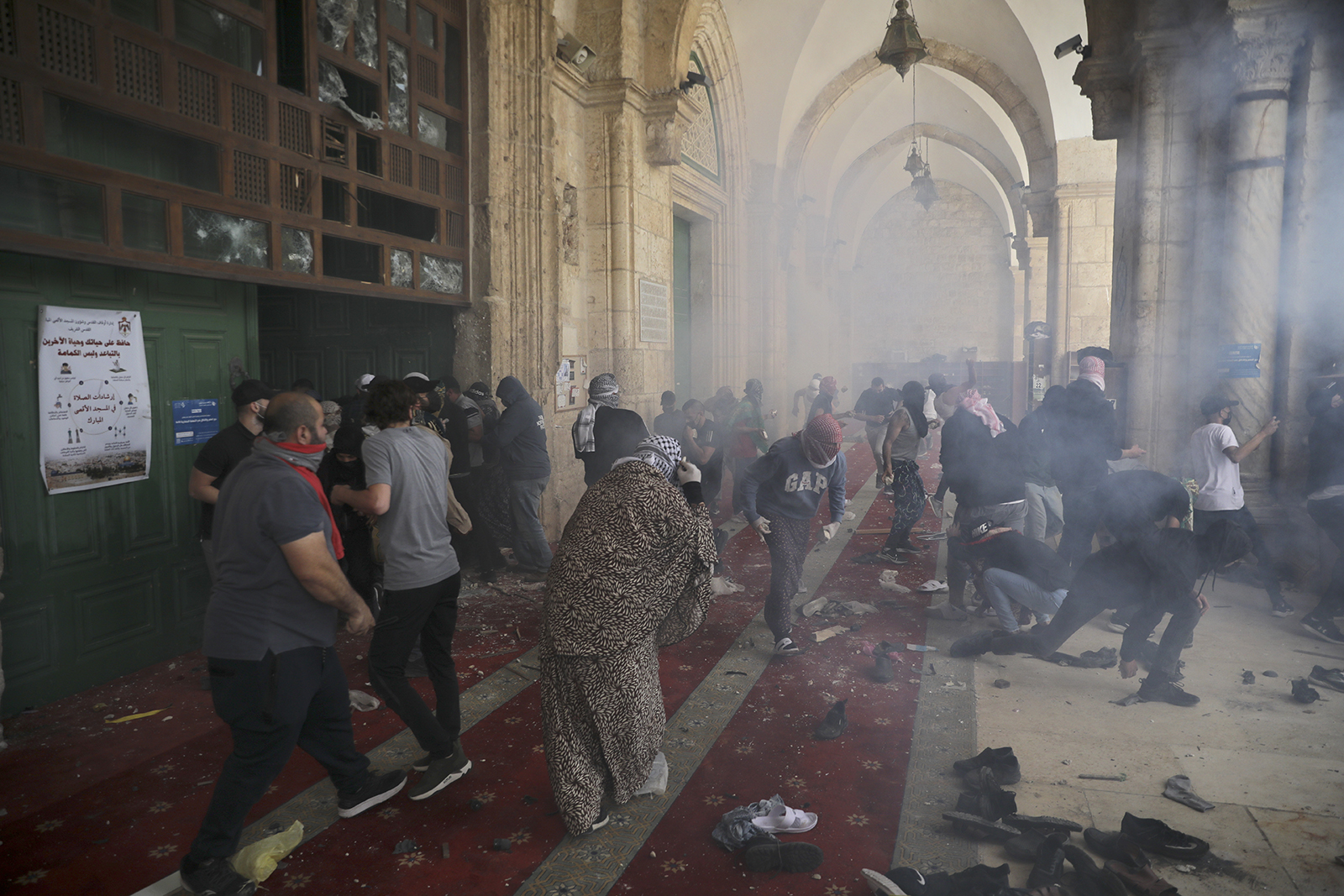
Palestinians clash with Israeli security forces on May 10, 2021, at the Al-Aqsa Mosque compound in Jerusalem’s Old City. (AP Photo/Mahmoud Illean)

The Islamic-Christian Commission for Supporting Jerusalem and Holy Sites has expressed profound concern over escalating Israeli measures targeting Al-Aqsa Mosque.

“Obstructing restoration, maintenance, and preservation work, hindering repairs to facilities and gates, and delaying vegetation removal and hazard mitigation reflects a deliberate policy to paralyze the waqf administration and strip it of its authority,” the commission said in a June 2 statement.

The long-standing agreement scaffolding the site’s governance was carefully formed on the basis of religious legitimacy, historical memory and a web of legal instruments intended to prevent flare-ups in a city that can ignite regional and even global tensions.


RELATED: Israel’s defense for closing Holy Week sites in Jerusalem takes a new twist

Religious legitimacy for the Hashemite custodianship derives from the Hashemite lineage’s ties to the Prophet Muhammad and from the widely understood duty to guard Al-Aqsa as a sacred obligation. Consolidated in 1924, the custodianship has endured despite shifting sovereignty, linking Jordan’s national identity to the city and its governance. Legally, it is reflected in international and bilateral instruments recognizing shared stewardship of Jerusalem’s holy places, a framework invoked in diplomacy to avert crises.

The Hashemite custodianship of the holy sites is a responsibility upheld by King Abdullah II and is firmly recognized and documented in international treaties and agreements, including Article 9 of the Jordan-Israel Peace Treaty. Jordan has also stressed that Israel, as an occupying power, has no authority under international law or United Nations Security Council resolutions to alter the historic and legal status quo of Jerusalem.

Al-Aqsa Mosque remains a focal point where faith, history and geopolitics intersect, and changes to its custodianship, access rules or administration carry implications far beyond a single site, affecting regional stability and international diplomacy.

A sustained commitment to the 19th‑century status quo, the trilateral understandings of 2014 and ongoing diplomatic efforts is essential to prevent escalation and to preserve a framework that accommodates worship, history and peace for all who revere Jerusalem’s sacred places.

(Daoud Kuttab is the senior communications officer of the World Evangelical Alliance. The views expressed in this commentary do not necessarily reflect those of Religion News Service.)

INDIA

Uttarakhand: Muslims at Receiving End, Another Mosque Sealed Amid Protests


S.M.A. Kazmi |


An old mosque in Thano area, in existence since 1978, was sealed by the MDDA authorities for being ‘illegal’ after persistent demand by Hindutva groups.

Dehradun: With Assembly elections fast approaching in Uttarakhand, the minority Muslim community which has been at the receiving end of wrath of the ruling BJP/RSS dispensation for the past nearly nine years, are being cornered and targeted in every possible way by the Hindutva brigade having the patronage of the State administrative machinery and police.

An old mosque at Thano village area of Dehradun, which has been existence since 1978, was sealed by the authorities of Mussoorie Dehradun Development Authority (MDDA) for being ‘illegal’ on the persistent demand of the Hindutva groups owing allegiance to the ruling party.

This is the fifth mosque in and around Dehradun which has been shut down by the administration of Uttarakhand Chief Minister Pushkar Singh Dhami, who is seen as the rising young star of Hindutva forces in the country and is leaving no stone unturned in emulating his counterpart neighbour, Uttar Pradesh Chief Minister Yogi Adityanath, in anti-Muslim rhetoric.

The mosque was sealed on the ground that the map for its construction was not sanctioned. Members of the Bajrang Dal had been agitating for some time against the mosque, questioning a mosque could come up in a rural area. The local Muslims claim that the mosque was functioning since 1978 and even a room was of the mosque had been constructed by the minorities’ welfare department of the state government.

Regarding the issue of sanctioning of map, the local Muslims claim that none of the buildings in the said village has got maps sanctioned by MDDA, which itself came into being in the 1980s. However, acting under pressure from Hindutva groups, the mosque was sealed.

Nayeem Quraishy, President of Muslim Sewa Sangathan, who along with other members staged a dharna in front of the MDDA office, charged the authorities of bias against Muslims.

“It is blatant use of arbitrary powers to seal the mosque and clear infringment of Article 25 of the Constitution. Has anyone asked for the maps and documents of Hindu religious places which are coming up at public and forest land? But Muslims are targeted,” he lamented.

The Muslim Sewa Sangathan said it plans to knock the doors of High Court to seek justice. Hafiz Shah Nazar, a spokesperson of Jamait-E-Ulema-Hind, a body of clerics said they would also be taking up the issue with appropriate authorities. They propose to approach the National Human Rights Commission (NHRC) and the Minorities Commission both at the national and state level on the issue.

Earlier, the functioning mosques at MDDA colony, opposite Raipur police station, Asharodi and Dakrani, were sealed for alleged failure to get official permission. On the other hand, it is near impossible to get sanction for a new mosque from the administration and even more difficult to get an old mosque repaired due to objections from Hindutva groups.  

 It was under Dhami’s leadership that anti-Muslim campaigns of ‘Love Jehad’, ‘Land Jehad’, ‘Thook Jehad’, ‘Nakal Jehad’ and demographic change were coined to vilify the minority community in the past nearly six years of his rule. Nothing concrete on the ground has come out of these wild allegations but has helped BJP/RSS in a poisonous narrative against Muslims on social media in a Hindu majority state.

The narrative of these ‘Jehads’ spread by the ruling party and its affiliates hinting a “large scale” planned conspiracy by the Muslims could not be proved on the ground and in the court of law. The oft-repeated allegations of demographic change by the Chief Minister and his resolve to check it with an aim to preserve and conserve the Hindu culture of ‘Devbhoomi’ (land of Gods) fell flat as none from Muslim community was found buying land in the hills, as documented by the Migration Commission employed by the BJP government.

Interestingly, the lands have been bought and sold by the members of the majority Hindu community. However, a miniscule Muslim community, which had been doing odds jobs and businesses in the small towns of hills of Uttarakhand, has been targeted and hounded out by Hindutva groups in the past nine years.

The Banphoolpura riots in Haldwani town two years ago, which resulted in the death of six Muslims in police firing and subsequent police repression following the demolition of a mosque and later alleged police brutalities in the wake of the ‘I love Mohammed’ procession at Kashipur, speaks volumes about the attitude of the police and administration toward Muslims in Uttarakhand.

Apart from being the targets of administration and police, the Hindutva groups unleashed, allegedly by the ruling dispensation, have made the life of common Muslims difficult. These groups are moving with impunity, threatening, attacking and vilifying Muslims and all those who try to stand with the minority community.

The case of ‘Mohammed’ Deepak of Kotdwar who stood up to save an old Muslim shopkeeper and has become a target of the Hindutva forces, is one such example. Even Hindus who have rented out their shops and houses to Muslims are being pressured to get their properties vacated from ‘infidels’. Only a few have dared to stand up to the Hindutva groups.

The Hindutva groups are roaming freely and even scrounging hotels, rest houses and resorts in and around Dehradun and Rishikesh to target any young Muslim staying there. In the past few months, many Muslims youngsters have been beaten up by these groups for staying in the hotels with Hindu girls or women. They were charged with indulging in ‘Love Jehad’. Interestingly, there is no such stigma if the girl happens to be a Muslim with a Hindu boy. Such cases are encouraged and eulogised as ‘home-coming’.

 A Muslim youngster named, Samir, had to die for eloping with a Hindu girl from Gandhi gram area of Dehradun in April. Son of a poor labourer, he eloped with a girl on April 20 and the police along with Bajrang Dal members mounted pressure on his family to produce him. Their house was attacked and ransacked allegedly by Bajrang Dal members as the location of the eloped duo was traced to Tyuni in Uttarakashi district. As per the police version, the girl was recovered but the boy escaped and jumped into the river. The family was informed after a week to identify a dead body found from the river. The family members were too scared after the trauma that they refused to even write a complaint letter seeking an enquiry into the circumstances leading to his death.  

Recently, a footwear showroom was raided by one such group and the word ‘jehadi’ was written with a pen on the nameplates of Muslim employees on the charge that Hindus working there were being harassed. The owners of the footwear chain are Muslims.

These groups and ‘Dals’ have become so powerful that a fortnight ago they took out a rally in Dehradun and in their anti-Muslim zeal, harassed a Hindu girl on her two-wheeler for covering her face with a ‘dupatta’ to save herself from scorching heat. She was asked not to cover herself as a Muslim. Interestingly, this phenomenon was seen in Gujarat, the Hindutva laboratory of harassing girls for covering their faces during harsh summers but it has now reached the hills.

The modus operandi of these groups and individuals has been to magnify their ‘deeds’ by using the social media platforms backed by ruling party networks. They target Muslims and record it to be uploaded on various social media platforms to garner lakhs of views and appreciation for their ‘good’ work from their supporters. They openly call for economic and social boycott of Muslims and even calling for violence against them.

On the other hand, the administration and police look the other way when and where such groups attack. The complaints are mainly ignored or booked against unknown people despite the fact that their ‘deeds’ are recorded and uploaded on social media. The most glaring example is Mohammed Deepak’s case who was threatened by a large group with known faces but the case was been lodged against “unknown” people.

In a game of one upmanship, Chief Minister Dhami on the lines of UP Chief Minister Adityanath, who had announced not to allow Eid Namaz on the roads, announced that Eid prayers would not be allowed at Flat Grounds in Nainital. Eid prayers had been taking place at this ground for the past one century with peace and harmony, but Dhami wanted to surpass Yogi. However, much to his disappointment, the Nainital High Court ruled that Eid Namaz would be held at Flat Grounds and ordered police and administration to make arrangements for peaceful conduct of the prayers.

The double standards of the ruling BJP stood exposed on Eid-Ul-Zuha (May 28) when during the maiden visit of BJP national president Nitin Nabeen to Dehradun, the road outside the BJP state headquarters on Balbir Road was blocked for hours to hold a function to honour him, causing inconvenience to commuters. This is BJP, a party with a difference but indifferent to people’s concern. 

The writer is a senior freelance journalist based in Dehradun, Uttarakhand. The views are personal.

Republic at Risk: Slow Erosion of Trust in India’s Diverse Democracy


Shabir Ahmad Ganaie |


The biggest challenge is whether the social trust necessary to sustain diversity is gradually weakening.


India’s greatest strength has never been uniformity. It has always been its ability to accommodate difference.

From ancient kingdoms to the modern republic, the subcontinent evolved not as a single cultural bloc but as a layered civilisation shaped by multiple faiths, languages, ethnicities, and traditions coexisting within the same political space. Pluralism in India is, therefore, not a fashionable constitutional slogan. It is a historical necessity.

The inscriptions of Emperor Ashoka urged respect for all sects and warned against glorifying one faith by condemning another. Centuries later, Mughal emperor Akbar attempted to institutionalise coexistence through sulh i kul, or “peace with all,” as a governing principle for a deeply diverse empire.

In the 20th century, leaders of the freedom movement reinterpreted this civilisational inheritance within a democratic framework. India’s first Prime Minister, Jawaharlal Nehru, repeatedly argued that secularism was not merely a moral preference but a structural requirement for the survival of a nation as diverse as India.

That warning appears increasingly relevant today.

The central challenge before modern India is no longer whether diversity exists. The challenge is whether the social trust necessary to sustain diversity is gradually weakening.

Over the past decade, recurring incidents of mob violence, communal polarisation, hate speech, and identity-based hostility have generated growing anxiety about the health of India’s democratic culture.

According to recent findings by the Pew Research Center, a significant proportion of Indians across communities continue to value religious diversity, yet many simultaneously prefer strong social separation between religious groups in matters such as marriage and neighborhood life. The coexistence of diversity alongside deepening social distance presents a serious democratic contradiction.

Similarly, the Sweden based V Dem Institute has repeatedly raised concerns regarding increasing polarisation, pressures on civil liberties, and democratic backsliding in India in its annual democracy reports. Regardless of political interpretation, such assessments indicate growing international concern regarding the condition of democratic institutions and civic trust.

One of the most widely discussed cases was the 2019 lynching of Tabrez Ansari in Jharkhand after allegations of theft. Videos of the assault circulated nationally and intensified debate over mob violence, religious polarisation, and delayed institutional response.

Another controversial case concerns the death of Tauseef Raza Mazhari from Kishanganj. Police described the incident as an accidental railway death, while family members alleged assault and foul play. The investigation remains ongoing. Yet the broader issue extends beyond the facts of a single case. In polarised societies, conflicting narratives themselves become sources of instability. Suspicion deepens rapidly when communities lose confidence in impartial institutional processes.

There have also been documented reports of harassment and intimidation targeting Kashmiri students and traders in different parts of India during periods of heightened political tension following developments in Jammu and Kashmir. Civil society groups and independent observers have recorded incidents involving threats, verbal abuse, and social exclusion.

These incidents do not by themselves define India. Nor do they erase the country’s still significant institutional resilience and democratic diversity. However, together they point toward a disturbing transformation in public culture, where religious identity increasingly shapes perceptions of loyalty, belonging, and security.

The danger extends beyond isolated acts of violence.

Democracies rarely collapse only through coups or constitutional breakdowns. More often, they weaken gradually when equal citizenship begins to feel uncertain for sections of society.

When citizens begin believing that justice depends upon identity, democratic trust starts eroding from within.

This erosion carries long term consequences.

Polarisation weakens public faith in institutions. It deepens social fragmentation. It reduces political disagreements into civilisational conflicts. It normalises suspicion between communities that must continue sharing the same society long after elections and headlines fade away.

Recent monitoring by organisations such as India Hate Lab has documented rising instances of hate speech at public events in recent years, particularly during politically charged periods. Such developments matter because rhetoric often shapes social behaviour long before violence becomes visible on the streets.

Comparative experiences from South Asia offer particularly important warnings.

In Pakistan, the Ahmadiyya community has faced decades of legal and social exclusion following the constitutional amendment of 1974 and Ordinance XX of 1984, which prohibited Ahmadis from publicly identifying as Muslims or openly practicing central aspects of their faith.

Human rights organisations, including Human Rights Watch, have repeatedly documented discrimination, blasphemy related prosecutions, attacks on places of worship, and systematic marginalisation targeting the community.

One of the deadliest incidents occurred in Lahore in May 2010, when coordinated attacks on Ahmadi mosques killed nearly ninety worshippers during Friday prayers.

Pakistan demonstrates how exclusion, once normalised legally and politically, can slowly harden into a wider culture of social hostility.

Bangladesh presents a different but equally relevant warning. Human rights organisations have documented repeated attacks on Hindu minorities during periods of political unrest and communal tension. Such episodes demonstrate how quickly minorities become vulnerable when institutions appear weakened, inconsistent, or politically polarised.

These examples are not presented as simplistic equivalence. India’s constitutional structure remains substantially stronger and more democratic than either comparison. Yet constitutional strength alone cannot guarantee social stability.

A common counterargument is that communal tensions and identity conflicts have always existed in India, and that present concerns are therefore exaggerated. History certainly shows that India has witnessed communal violence before. However, the normalisation of polarisation through digital media ecosystems, continuous political mobilization around identity, and the speed at which misinformation now spreads create a far more volatile environment than earlier decades. The scale of amplification has changed dramatically.

Institutions survive not merely through laws, but through public confidence in their neutrality.

That confidence weakens when hate speech becomes normalised in political discourse.

It weakens when communities are portrayed as permanent adversaries rather than equal citizens.

It weakens when mob violence becomes routine enough to stop shocking society.

It weakens when television debates reward outrage more than verification.

Sections of India’s television media ecosystem increasingly operate through confrontation driven formats where sensationalism generates greater commercial value than factual nuance. In such environments, communal tensions are often amplified instead of responsibly contextualised.

Popular culture and cinema also influence social imagination in subtle but lasting ways. Repeated stereotypes and simplified portrayals of religious communities gradually shape perceptions of threat, patriotism, and belonging within public consciousness.

The deeper danger, therefore, is not only communal conflict. The deeper danger is the slow corrosion of democratic trust itself.

No diverse nation can remain stable if large sections of its population begin feeling politically disposable, socially unwelcome, or institutionally unprotected.

Addressing these concerns requires responsibility across institutions.

The state and law enforcement agencies must ensure consistent and impartial enforcement of law in cases involving communal violence, hate speech, and intimidation.

Political leadership must exercise restraint in rhetoric that risks reducing citizens into permanent religious camps for electoral mobilisation.

The judiciary must ensure timely accountability so that impunity does not become normalised.

Media institutions must prioritise verification over sensational amplification, especially during sensitive communal incidents.

Educational institutions, civil society groups, and religious organisations must actively reinforce constitutional ethics, inter community understanding, and habits of coexistence in everyday life.

Ultimately, however, responsibility also belongs to society itself. Democracies depend not only upon constitutions and courts, but upon ordinary civic choices made daily by citizens, whether to reject rumours, resist collective blame, and preserve empathy during moments of tension.

India’s diversity is not under threat because diversity exists. It comes under threat when trust disappears between communities expected to live together within the same democratic framework.

Nations rarely fracture in a single dramatic moment. More often, they weaken slowly through accumulated suspicion, normalised hostility, and unresolved tensions.

What is ultimately at stake is not merely the absence of conflict, but the preservation of trust itself.

And once trust erodes, rebuilding it becomes far more difficult than preserving it ever was.

Shabir Ahmad Ganaie is a researcher in South Asian history, specialsing in socio-political dynamics, minority experiences, and marginalised voices. Shabeerhistory18@gmail.com. The views are personal.
South Africa: Left Meet Issues Bold Call for Working-Class Unity


Nicholas Mwangi |


The Conference of the Left in South Africa has brought together a wide range of left-wing political parties, socialist organizations, and progressive movements in an effort to forge greater unity, coordination, and collective action among working-class forces.

South African left convenes collective conference. Photo: SACP

South Africa’s progressive forces are converging. On May 29, 2026, a diverse array of socialist, communist, and Pan-Africanist organizations converged for the “Conference of the Left.” The meeting was held under a definitive mandate of “Building a Left Movement for Working Class & Popular Power.” At a moment marked by deepening economic crisis, unemployment, austerity, and fragmentation within progressive politics, the gathering reflects an attempt to rethink the future of left politics in the country.

The conference, organized by the South African Communist Party (SACP) has brought together an distinctly broad spectrum of organizations, including the Economic Freedom Fighters, Pan Africanist Congress of Azania, Azanian People’s Organization, Mkhonto we Sizwe Party, the Socialist Party of Azania, Workers’ Socialist Party, Independent Labour Party, the country’s key trade union federations, as well as Marxist and Pan-Africanist formations. Guests and solidarity delegates from various countries have also attended, rallying on the prospects of left unity in South Africa.

What makes the conference politically important is not simply the attendance of these organizations, many of which have historically operated in isolation or in competition, but the recognition that the social and economic conditions facing the working class can no longer be addressed through fragmented struggles.

In a pre-conference statement, organizers argued that the crisis confronting workers and the poor is not temporary but structural. South Africa continues to face mass unemployment, rising living costs, deteriorating public services, and widening inequality, despite the democratic transition of 1994. According to the statement, political freedom has not translated into material transformation for the majority, while the economy remains dominated by private accumulation and corporate power.

They further noted that global capitalism has reorganized itself in ways that have weakened organized labor. Informalization, precarious work, and attacks on trade unions have undermined working-class power, while progressive movements remain divided across parties, unions, and community organizations. The conference therefore sees itself as an attempt to rebuild a common forum through which left organizations can coordinate around shared working-class objectives.

A call for working-class unity

Opening the conference, Solly Mapaila pointed out that the gathering was a platform for collective action.

“We are different political organizations, we are not going to dissolve our independent political organizations, we are creating a platform of common coordination of the working-class agenda.”

Mapaila argued that the material conditions facing ordinary South Africans should form the basis of left unity rather than personal ambitions or organizational rivalries.

“We are seeking to deepen the unity of the working class, to revitalize working class activism and indeed articulate a medium-term agenda based on the objective demands of the working class in our country.”

He further urged humility and mutual respect among progressive forces, acknowledging that no single organization possesses all the solutions.

“We must humble ourselves as forces of the left to recognize that none of us has the monopoly of answers to the struggle of the working class. Therefore, we must treat each other with respect, humility and understanding.”

Next, was Julius Malema, leader of the Economic Freedom Fighters, he situated the gathering within what he described as a global crisis of capitalism.

“This conference convenes at a decisive historical moment characterized by economic instability, political uncertainty, and the visible confusion of the global capitalist order itself.”

Malema highlighted the absurd contradictions of modern society.

“Humanity has never had better scientific knowledge, greater productive potential, or greater technological sophistication than it does today, yet billions of people continue to exist in conditions of insecurity, deprivation, violence and despair because society remains controlled by the private accumulation of profit rather than the fulfillment of basic human needs.”

A major theme of his speech was the importance of Pan-African solidarity in the struggle against imperialism and exploitation.

“A Left that cannot defend Pan-African solidarity has abandoned its own historical mission because the fragmentation of African people along nationalist and xenophobic lines merely strengthens imperialism and weakens working-class unity.”

He pointed out that the future of Africa depends on coordinated efforts to break patterns of dependency.

“The future of African liberation depends fundamentally upon continental solidarity, regional industrialization, and coordinated resistance against global systems of extraction and dependency.”

Malema also identified sectarianism as one of the greatest weaknesses facing progressive politics today.

“International capital coordinates across borders with extraordinary efficiency, yet organizations claiming commitment to socialism often remain paralyzed by sectarianism, ego, historical resentment, and ideological confusion.”

For him, rebuilding hope and confidence among oppressed people is a central challenge of the present era.

“The greatest task facing the Left is therefore also psychological and moral: to restore imagination among the oppressed and to demonstrate once again that societies can be organized differently.”

Speaking on behalf of the uMkhonto we Sizwe Party, Deputy President Tony Yengeni contextualized the conference as a response to a historic demand for unity among progressive forces.

“The time has come for the Black majority to come together, unite, and take over political power.”

Yengeni emphasized that political power must be used to advance genuine liberation for the masses.

“The reason why we are here, we are responding to that command, to forge unity among all progressive forces in the country, so that we can use that political power to liberate our people.”

Looking beyond the conference itself, he called for the establishment of a permanent coordinating structure.

“This conference must emerge as a solid and powerful united left platform.”

He proposed that the gathering establish a revolutionary council capable of guiding the process forward.

“This conference at the end must come out with a revolutionary council and run the affairs of this platform. And it must be guided by a set of principles and anchor it forward.”

Beyond the keynote addresses, representatives from the various participating organizations shared perspectives on the political, economic, and social crisis confronting South Africa and the need for unity among the left.

Whether this process ultimately leads to a permanent united front, a revolutionary council, coordinated campaigns, or a broader movement for socialist transformation remains to be seen. However, the conference has already achieved something important; it has created a space where organizations from diverse left traditions can engage one another directly and explore the possibilities of collective action in a period of deepening crisis.

Courtesy: Peoples Dispatch


Women Face Greatest Risks But Are Critical to Climate Action


Ruhi Bhasin |


Women and girls are disproportionately affected by the climate crisis, yet women’s leadership and local knowledge are critical to building more resilient communities.

The climate crisis is worsening many of the economic and social inequalities already faced by women and girls, making it harder to access health care, education, employment, and other necessities. Women in rural communities are especially vulnerable because many depend directly on agriculture and natural resources to support their families. As extreme weather events become more frequent and severe, these existing pressures are becoming harder to navigate.

As the United Nations has noted, the climate crisis is not “gender neutral.” Women, girls, and children are 14 times more likely to die during extreme weather disasters than men, facing higher rates of displacement and structural inequalities that limit their access to information, mobility, and resources. “An estimated 4 out of 5 people displaced by the impacts of climate change are women and girls. Acute disasters can also disrupt essential services, including sexual and reproductive health care, compounding the negative impacts for women and girls,” stated the United Nations.

How the Climate Crisis Is Affecting Women and Girls

Extreme weather disasters push many women and girls into increasingly precarious situations almost overnight. The torrential rains in Pakistan in 2022 claimed 1,700 lives and affected millions of people. This “extreme weather condition,” resulting from climate change, led to widespread damage and loss but affected women like Sajida severely, robbing many like her of their dreams and aspirations.

Recounting the ordeal she and her family went through, she told UNICEF, “We had nothing to eat for 15 days. My whole family got malaria, and we couldn’t access medicines or hospitals as Khairpur was drowned.” Unable to keep up with her studies after returning to school, she did poorly in her exams and failed to advance to the next class. “Her parents did not have enough funds to help her repeat another school year. … she wanted to grow up to be a doctor, but poverty and repetitive climate catastrophes have robbed her of these aspirations, turning her into a refugee seeking shelter from the battering rains,” stated the UNICEF blog.

In Pakistan, the floods didn’t just rob women and girls of education opportunities but also left almost 650,000 pregnant women without access to health care and forced them to give birth without any medical help. Moreover, research has shown that “extreme heat increases incidence of stillbirth, and warming global temperatures are helping to spread vector-borne illnesses such as malaria, dengue fever, and Zika virus,” stated a UN Women article.

Natural disasters resulting from climate change also lead to more child marriages as families seek to lessen the burden of having to provide for a girl child when resources are already scarce. Those already struggling face greater instability and debilitating poverty after a climate crisis, leading to more cases of conflict-related sexual violence and human trafficking.

“Humanitarian programmes tend to be heteronormative and can reinforce the patriarchal structure of society if they do not take into account sexual and gender diversity,” pointed out Matcha Phorn-in, a lesbian feminist human-rights defender.

Exacerbating the inequalities women and girls struggle to overcome, the climate crisis makes it even harder for them to access the support, stability, and resources needed to recover and adapt during weather catastrophes.

Gendered Perspectives Need to be Part of the Climate Solution

For climate policies to have an impact, women’s equality and empowerment need to be integral to the policy consideration. This requires giving women a seat at the table when important decisions are taken about the climate crisis and ensuring that they have better access to resources.

“By integrating gender considerations into national climate plans, countries can address the distinct needs and adaptive capacities of women and men and ensure equitable access to and sharing of benefits,” stated the UNDP.

Women make up a significant share of the agricultural workforce in many developing countries and produce up to 80 percent of the food supply. Yet despite this central role, many women farmers still lack equal access to resources, technologies, services, and information about adaptation measures, cropping patterns, and weather events. According to the UNDP, these inequalities contribute to lower productivity and wages while leaving women more exposed to the impacts of climate change.

Providing greater access to agricultural resources and information for women can help build more resilient solutions to the climate crisis, especially at the community level. Ensuring that women, especially Indigenous women, are more involved in forest governance can result in more “effective and lasting solutions to deforestation and climate change impacts.”

Women Are Integral to Resolving the Climate Crisis

Any meaningful response to the climate crisis requires the equal participation of women, as they are not only the most affected by the issue but also have the tools and knowledge that hold the key to offering sustainable solutions. “Higher women’s political participation has been shown to lead to improved environmental sustainability. … Moreover, women’s local knowledge of sustainable resource management and their community leadership play a critical role in advancing climate change mitigation and adaptation. They are also important for recovery and resilience across sectors, from water management and food security to nature-based solutions and circular economy,” according to the UNDP.

For instance, Paran Women Group, an Indigenous women’s organization that brings together members of the Maasai and Ogiek communities in Kenya, has cultivated dryland and generated livelihoods through sustainable agriculture, beekeeping, and Indigenous tree nurseries.

Women are also responsible for 70 to 80 percent of all purchasing decisions in wealthy countries and are more likely to recycle, minimize waste, and save water and energy at home. “By leading behavior change and consumer attitudes, women can drive change across sectors. At the political level, research shows clear linkages between women’s leadership and action to tackle climate change. For example, studies have found that countries with higher proportions of women in parliament are more likely to ratify international environmental treaties and have stricter climate policies. … It is time to invest in women as a strong force for change, leading the way to a more sustainable future,” stated the UN.

As climate instability worsens, women’s involvement in environmental decision-making and local resilience efforts is becoming essential—not just for representation, but for building climate solutions that reflect the realities communities are actually facing.

Right from the rural women in the Himalayan region in India who participated in the Chipko movement or “tree-hugging” movement in the 1970s to prevent 2,000 trees from being felled to the Indigenous women activists and allies protesting the Dakota Access Pipeline in 2016, women have been on the frontlines of protecting and nurturing the environment, being “deeply embedded in the history and practice of climate justice.”

Ruhi Bhasin is a senior journalist and features editor with the Independent Media Institute. This article was produced by Economy for All, a project of the Independent Media Institute.

Courtesy: Independent Media Institute