Wednesday, June 10, 2026

'Operation Pushkin': six Georgians on trial in France over theft of rare Russian books

The trial is the latest case aimed at delivering justice after a series of similar thefts in libraries across Europe, allegedly by an organised network.



Copyright PublicDomainPictures.Net

By Serge Duchêne with AFP
Published on 09/06/2026  
EURONEWS

Who says a love of reading doesn’t pay? Sometimes, though, the payoff can translate into years in prison.

Six Georgian nationals appeared before a Paris court on Tuesday for stealing rare editions of classics of Russian literature from prestigious French libraries, including works by Alexander Pushkin whose name in Russia is often accompanied (albeit with a hint of irony) by the phrase “Pushkin is everything to us”, a measure of his importance to Russian culture.

This trial is the latest in a string of similar thefts carried out in recent years in libraries across Europe, suspected of being the work of an organised network.

The thefts targeted rare Russian classics worth a total of several million euros, including works by leading 19th‑century authors such as Pushkin, the father of “Eugene Onegin”, and Nikolai Gogol, the author of the immortal “Dead Souls”.

The defendants, tried in France, are being prosecuted for criminal conspiracy and attempted theft. Some of them also face charges of stealing cultural works on display.

They face up to 10 years in prison.

Seven people were initially due to stand trial, but at the opening of the hearings on Tuesday afternoon it was announced that one woman would be tried separately, on 2 December 2026, for procedural reasons.

Of the six remaining, two are being tried in absentia, with arrest warrants issued for them.

The hearing is scheduled to run until Friday.

Two other people, identified only as Mikheil Z. and Beqa T., have already been convicted and imprisoned in other countries for similar crimes and have been provisionally surrendered to the French authorities.

Mikheil Z., aged 50, was sentenced last year in Lithuania to three years and four months in prison for the organised theft of 19th‑century publications worth 606,000 euros (698,000 dollars).

Beqa T., aged 49, was sentenced to three years and six months in prison in Estonia.

Another man in pre‑trial detention and a woman who has not been remanded in custody were also among the defendants present in court.

According to investigation documents seen by AFP, French investigating judges suspect the defendants of belonging to an organised criminal network.

These thefts, which have also affected Germany, Switzerland and the Czech Republic, led to the creation of a joint investigation team under the aegis of Europol and Eurojust, the European Union’s police and judicial coordination agencies. The team has already led to several arrests in 2024.

All in all, around ten European countries have seen manuscripts disappear from their libraries. European investigators estimate that nearly 170 rare Russian works are thought to have been stolen in several countries.


“Strengthening its protection”


The thefts committed in France took place in 2023 at the Diderot library of the École Normale Supérieure (ENS) in Lyon, as well as at the National Library of France (BnF) and the University Library of Languages and Civilisations (BULAC) in Paris.


According to investigators, the thieves went to the libraries to consult rare, valuable works, photographed and measured them, then returned to replace them with near‑undetectable copies.

Between March and October 2023, Mikheil Z. went to the National Library of France (BnF) on forty occasions to request access to manuscripts, mainly by Pushkin, claiming to be conducting research into democracy in 19th‑century Russian literature.

In November, the library discovered that nine works had been replaced by copies, for an estimated loss of 650,000 euros: eight by Alexander Pushkin (1799–1837) and one by Mikhail Lermontov (1814–1841), leading figures of Russian Romanticism who both, as it happens, died in duels.

Another literary twist is that Lermontov is the author of “The Death of the Poet”, devoted to the death of Pushkin, killed by Georges Charles de Heeckeren d’Anthès, a French soldier and politician who later became a senator under the Second Empire.

All of which was no doubt lost on the perpetrators: Mikheil Z. admitted to investigators that he had stolen the works, but denied any complicity with the other defendants, saying he had acted out of greed and had sold the books in Russia to a certain “Maxim”.

In June 2024, the Russian auction house Litfond listed in its catalogue a second edition of Pushkin’s “The Prisoner of the Caucasus”, a copy matching the one stolen from the BnF.

The auction house told the French authorities it had documents proving that the book had been acquired from its owner in Russia in 2014 or 2015.

In the investigating judges’ view, these thefts may be linked to a desire to repatriate Russian cultural heritage, at a time when relations between Moscow and Europe are increasingly strained following Russia’s invasion of Ukraine.

None of the stolen works has been recovered, but the lawyer for the National Library of France, Alexandre de Konn, said the institution “has not given up hope of getting them back”.

“The Library remains true to its mission: to keep making heritage accessible to the public while constantly strengthening its protection,” he told AFP.
Amnesty accuses Israel of 'ethnic cleansing' of West Bank Bedouins

Ramallah (Palestinian Territories) (AFP) – Amnesty International accused Israel on Wednesday of an "ethnic cleansing" campaign against Bedouin and herding communities in the occupied West Bank, saying the measures aimed to accelerate the annexation of the Palestinian territory.


Issued on: 10/06/2026 - RFI

Amnesty International Secretary General Agnes Callamard in Berlin on June 10, 2026 © John MACDOUGALL / AFP

A new report by the rights group found that these rural Palestinian communities were bearing the brunt of Israeli settler violence and forced displacement.

"Israeli authorities are accelerating annexation through a state-driven campaign of ethnic cleansing targeting Palestinian Bedouin and herding communities" of the West Bank, said the report.

Amnesty said its research showed that 27 Bedouin and herding communities comprising hundreds of Palestinians were forcibly displaced between 2023 and 2025 or were at risk of displacement in the West Bank's Area C, which encompasses 60 percent of the territory and is under full Israeli control under the 1990s Oslo agreements.

In the report titled "Erasing anything Palestinian: Israel's ethnic cleansing of West Bank Bedouin and herding communities", Amnesty accused Prime Minister Benjamin Netanyahu's government, one of Israel's most right-wing to date, of catering to the settler movement's religious nationalist agenda.

"It has accelerated settlement expansion and land grabs, increased financial and logistical support to settlements, and it has armed settlers, thereby enabling a brutal state-sanctioned campaign of settler violence," the report said.

In an apparent effort to counter arguments by Israeli officials that settler violence is caused by bad actors in that community, Amnesty pointed to "explicit calls by Israeli officials for settlement expansion" and "measures aimed at minimising Palestinian presence in Area C".

The "ethnic cleansing campaign is state-led, and state-sponsored, not driven by rogue settlers or so-called extremist ministers", the report concluded.

'Unlawful deportation'

Palestinian Bedouin communities in the occupied West Bank are often isolated and vulnerable to pressure from settlers © ilia YEFIMOVICH / AFP

Far-right Finance Minister Bezalel Smotrich, who himself lives in a settlement, is a vocal proponent of annexing the West Bank to Israel and on Tuesday was banned from France for actively promoting the idea.

In May 2026, the UN rights office had also decried indications of "ethnic cleansing" in Gaza and the West Bank.

Amnesty pointed to Israel's legal responsibilities as an occupying power in the West Bank, and its violations of international humanitarian law.

"These violations include the war crime of unlawful deportation and transfer and the crime against humanity of deportation or forcible transfer of population," the report said.

Bedouin and herder communities, often isolated and without security services, are particularly vulnerable to the threat of violence or displacement.

Since 2023, AFP reporters have witnessed the departure of several Bedouin communities of the West Bank under pressure from settler groups, including the community of Ras Ein al-Auja in early 2026.

"What is happening today is the complete collapse of the community as a result of the settlers' continuous and repeated attacks," Farhan Jahaleen, a Bedouin from the village, told AFP in January.

'Symbolic' sanctions

The Isreali government has continued to approve dozens of new and expanded settlements in the occupied West Bank © ilia YEFIMOVICH / AFP


Amnesty's Secretary General Agnes Callamard launched the report in Berlin, saying that Germany and other European countries had "enabled Israel's policy of ethnic cleansing".

She said that while targeted sanctions against individuals were "important" symbolically, they have "no impact on the rate of settlement expansion" or on "the scale of settlers' violence".

"The EU in particular, must leverage its influence by expediting the long-overdue suspension of its association agreement with Israel," Callamard told reporters.

Since Netanyahu's government came to power in late 2022, it has approved the creation of 102 settlements in the West Bank, according to settlement watchdog Peace Now.

Excluding east Jerusalem, more than 500,000 Israelis live in settlements in the West Bank, which Israel has occupied since 1967, among some three million Palestinians.

All Israeli settlements are illegal under international law.

Some settlers have engaged in arson, vandalism and theft of private property in Palestinian communities, as well as physical assaults and sometimes murder, according to rights groups.

The number of such incidents steadily increased after the start of the war in Gaza in 2023, reaching an average of six per day in the West Bank in 2026, according to the UN humanitarian agency OCHA.

© 2026 AFP

France bars Israel's Smotrich as others push back against Israeli settlement expansion

Smotrich is Israel's finance minister and leader of the far-right Religious Zionism party, which forms a key part of Benjamin Netanyahu's coalition.  10 July, 2023.
Copyright AP Photo

By Simon Ormiston
Published on

The move by Paris comes as the UK, Canada and Norway intensify sanctions on settlement-linked organisations and financial networks accused of supporting violence in the occupied West Bank.

France has banned Israel's Finance Minister Bezalel Smotrich from entering the country, becoming the latest Western nation to take direct action against senior members of Prime Minister Benjamin Netanyahu's coalition as pressure grows over Israeli settlement policy and violence in the occupied West Bank.

French Foreign Minister Jean-Noël Barrot announced the move on Tuesday, accusing Smotrich of promoting policies that undermine prospects for a two-state solution. Barrot said the minister "actively promotes the annexation of the West Bank, which he openly claims, the creation of new settlements in the West Bank, the re-colonisation of Gaza, the economic collapse of the Palestinian Authority and its harmful consequences for the Palestinian population.

"This is a policy that the overwhelming majority of the international community, firmly committed to the two-state solution, cannot accept", Barrot wrote on X.

Barrot also said the ban extends to "four leaders of settler organizations, and twenty-one violent settlers".

Israel swiftly condemned the decision. Foreign Ministry spokesman Oren Marmorstein described the sanctions as "disgraceful", saying they represented an attempt to impose a political position on Israel.

"The real essence of these steps is the attempt to impose a political stance regarding the right of Jews to settle in the Land of Israel and concerning the Israeli-Palestinian conflict - camouflaged as measures against violence," he said.

The move comes just weeks after France barred Israeli National Security Minister Itamar Ben Gvir from entering the country. A number of member states urged the EU to join France, after Gvir posted a video showing detained activists from a Gaza-bound flotilla forced to their knees with their hands tied.

It marks an increasingly confrontational stance towards two of the most prominent far-right figures in the Israeli government.

Coordinated sanctions campaign

France's action forms part of a wider effort by several Western countries to increase pressure on Israel over settlement expansion and settler violence in the West Bank.

France, Britain, Canada and Norway, have all announced measures targeting individuals and organisations linked to settlement activity and violence against Palestinians.

The coordinated approach reflects growing concern among Western governments that continued settlement expansion is threatening the viability of a future Palestinian state.

In the UK, Foreign Secretary Yvette Cooper told parliament on Tuesday that the government was urging British businesses and citizens not to engage in financial activities connected to Israeli settlements in the occupied West Bank.

"We believe that violent settler groups should not be profiting from the land that they have seized from Palestinians," Cooper said.

The Israeli "government has condemned some settler violence, but that rings hollow when there is scant accountability", she added.

The latest measures build on sanctions already imposed by Britain, Canada, Australia and New Zealand against both Smotrich and Ben Gvir last year, when the four countries accused the ministers of inciting violence against Palestinians.

Israel at the time denounced those sanctions as "scandalous".

The coordinated moves underline a growing willingness amongst some nations to move beyond diplomatic criticism and adopt targeted measures against individuals and groups linked to settlement expansion and violence in the occupied territories.


Israeli director Nadav Lapid, angered by boycott calls, pulls out of Marseille festival

“The fact that the greatest Israeli dissident artist, tirelessly working to denounce the fascistic and colonial excesses of his government and its criminal moral failures, in films that have won awards all over the world, should be led to withdraw from a French festival ought to alert us and mobilise us beyond this aberration,” 
Nadav Lapid, winner of the Jury Prize for the film “Ahed's Knee”, at the awards ceremony of the 74th Cannes Film Festival, 17 July 2021
Copyright Vianney Le Caer/2021 Invision

By Serge Duchêne
Published on

The Israeli filmmaker, a critic of Benjamin Netanyahu exiled in France for five years, wonders 'what the hell I'm supposed to do' here if 'my presence is unacceptable and I can simply be erased or swept aside from a film event'.

No one is a prophet in their own land, as the saying goes, but sometimes host countries are hardly any more receptive...

Calls not to work with Israeli institutions “involved in genocide and apartheid against the Palestinian people”, which have been gathering thousands of signatures in Hollywood, have apparently crossed the Mediterranean.

Thus the participation of Israeli director Nadav Lapid in the 37th edition of the Marseille International Film Festival (FID, from 7 to 12 July) was given a decidedly cool reception by some of the selected filmmakers, who initially refused to see him sit on the jury and then to endorse his presence at the festival at all.

The director, winner of the Golden Bear in Berlin in 2019, as well as jury prizes in Locarno (2011) and Cannes (2021), had been due to present his film Policeman (2011) at FID.

What has sparked this outcry, at least according to what has been said publicly, are the Israeli public funds used to finance – in very small part – Lapid's latest film, Yes, screened at Cannes in 2025 in the Directors' Fortnight.

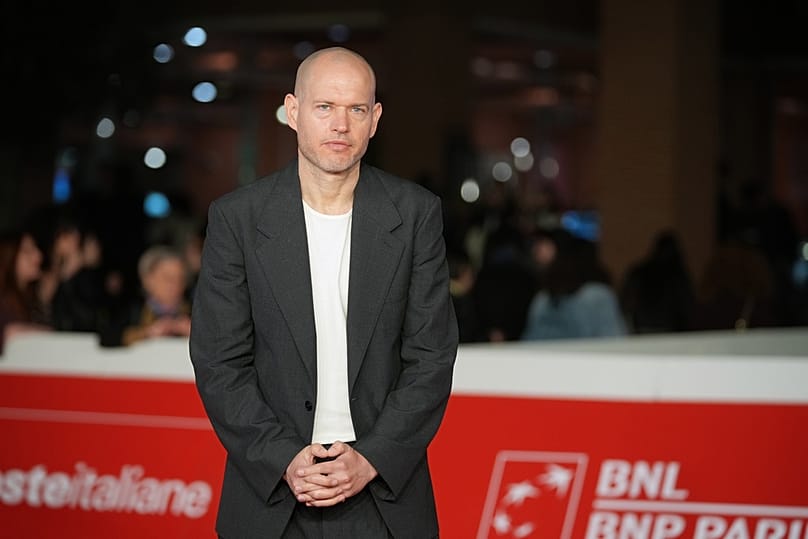
Nadav Lapid poses for photographers on the red carpet at the screening of the film “Ken”, at the Rome Film Festival, in Rome, on Thursday 16 October 2025.
Nadav Lapid poses for photographers on the red carpet at the screening of the film “Ken”, at the Rome Film Festival, in Rome, on Thursday 16 October 2025. Andrew Medichini/Copyright 2025 The AP. All rights reserved

Ironically, or perhaps through activist blindness that sees only the colour of a passport – or of money – Yes, searing like all of the filmmaker's work, portrays an Israeli society disfigured by a thirst for vengeance after 7 October and indifferent to Palestinian deaths in Gaza.

Nadav Lapid is also known as a fierce critic of Benjamin Netanyahu; he moved to France five years ago precisely in protest at the Israeli government's policies.

As for the Israeli money used to produce Lapid's latest incendiary film, “the Israeli subsidy the film received comes from a public fund and not a government one, and it is precisely the kind of independent body that is under attack from the Netanyahu government,” Judith Lou Lévy, producer of Yes at Les Films du Bal, told AFP, adding that this public funding accounted for only 12% of the film's budget.

After the internal call for a boycott, followed by the withdrawal of around ten of the 120 films scheduled at this festival, which showcases independent fiction and documentary cinema, Nadav Lapid himself pulled out of the event in Marseille.

Nadav Lapid, winner of the jury prize for the film “Ahed's Knee”, after the awards ceremony of the 74th Cannes International Film Festival, on 17 July 2021.
Nadav Lapid, winner of the jury prize for the film “Ahed's Knee”, after the awards ceremony of the 74th Cannes International Film Festival, on 17 July 2021. Vianney Le Caer/Vianney Le Caer/Invision/AP

Regrets all round?

In a statement, FID deplored the boycott, calling it “perfectly illegitimate to hold a filmmaker responsible or accountable for the racist, colonial and genocidal policy pursued by the government of his country”.

“Distinctive voices which, like that of Nadav Lapid, strive to think through the specific violence of the state and society of Israel should on the contrary be welcomed and listened to, even if their narratives are then challenged or deconstructed,” the statement said.

For his part, Lapid lamented to AFP the festival's “resignation” and the call for a boycott, which threw him back onto his “vulnerability” as an exile in France. “When I saw the pressure regarding my participation in the festival, I told myself that perhaps I had no place in France. If my presence is unacceptable and I can simply be erased or swept out of a film event, I really don't know what the hell I'm doing here, to be honest,” he said.

While refusing to “feel sorry for himself”, Nadav Lapid says he is “relieved” that film-industry professionals took the initiative of launching an open letter to support him, a text which FID says it “fully” endorses.

Entitled “Inviting an artist to a festival does not make them a cultural ambassador”, the letter, published on Monday in Le Monde (source in French), voices concern that an artist who “has publicly condemned, on numerous occasions, the destruction of Gaza” could be equated with “any kind of Israeli cultural representation”.

Among the roughly 350 signatories are directors Arthur Harari, Louis Garrel, Apichatpong Weerasethakul and Claire Denis, as well as the Société des réalisatrices et réalisateurs de films (SRF) and Palestinian writer Elias Sanbar.

Director Nadav Lapid poses with the Golden Bear awarded to the film “Synonyms” at the awards ceremony of the 2019 Berlinale, in Berlin, Germany, on 16.02.2019.
Director Nadav Lapid poses with the Golden Bear awarded to the film “Synonyms” at the awards ceremony of the 2019 Berlinale, in Berlin, Germany, on 16.02.2019. Christoph Soeder/Copyright 2019 The AP. All rights reserved

In addition, another group of filmmakers, including Oscar-winning director Michel Hazanavicius and Palme d'Or winners Justine Triet and Jacques Audiard, on Tuesday described as an “intellectual failure” the call for a boycott that forced the Israeli director to cancel his trip to Marseille.

“The fact that the greatest Israeli dissident artist, tirelessly working to denounce the fascistic and colonial excesses of his government and its criminal moral failures, in films that have won awards all over the world, should be led to withdraw from a French festival ought to alert us and mobilise us beyond this aberration,” writes this collective, also in Le Monde (source in French), a group that also includes American actor Natalie Portman.

For their part, the 12 filmmakers who had called for a boycott of Nadav Lapid justified their stance in a message on Instagram by their desire “to act against an approved colonial and genocidal reality” and denounced festivals' “insistence” on “producing a symmetry (...) between Palestinian and Israeli productions”.


Leo XIV and Bad Bunny meet at Bernabéu: faith and reggaeton cross paths in Madrid

Pope Leo XIV waves on arrival as he prepares to meet volunteers at IFEMA in Madrid, Spain, on 9 June 2026.
Copyright Copyright 2026 The Associated Press. All rights reserved

By Rafael Salido
Published on


After days of speculation that the Pontiff and the singer might cross paths while both were in Madrid, it has been confirmed that Leon XIV and Bad Bunny met on Monday after the “festival of faith” at the Bernabéu stadium.

Madrid on Monday provided the backdrop for one of the most eagerly anticipated meetings as part of the papal visit: Leo XIV granted a private audience to Puerto Rican artist Bad Bunny at the Bernabéu, RTVE (source in Spanish) has confirmed. Although there are no official images for now, it is known that the two of them spoke for a few minutes, taking advantage of their presence in Madrid over the past few days.

While Bad Bunny’s now legendary “casita” has been installed for days at the Riyadh Air Metropolitano Stadium, where the artist has been playing a ten-show residency since 30 May, the meeting between the two public figures took place in the city’s other major venue, the Santiago Bernabéu, where on Monday a “festival of faith” was held in front of 70,000 people.

It was precisely this overlap in Madrid, the city the Pontiff arrived in last Saturday, that had already fuelled speculation about a possible encounter between the head of the Church and today’s foremost exponent of perreo.

Shrouded in the Vatican’s customary discretion, the meeting became the best-kept secret of the visit. Some attendees took pictures on their mobile phones, but only one official image, captured by the papal entourage, is thought to have been authorised, pending the right moment for its publication.

The possibility of a meeting had already been hinted at days ago by the Archbishop of Madrid and vice-president of the Spanish Bishops’ Conference, José Cobo. “Madrid has a lot to offer. There are people who do not oppose, but build bridges, and bridges can be built,” he said. And he left two premonitory phrases: “Surprises are surprises” and such meetings “are handled with great discretion”.

The encounter between the Pontiff and the global reggaeton icon symbolises the dialogue between the Church and contemporary popular culture. It is no minor detail that Bad Bunny, whose real name is Benito Antonio Martínez Ocasio, served as an altar boy in his childhood and sang in the parish choir in Vega Baja, in his native Puerto Rico, a fact that adds extra layers to a meeting that goes beyond the anecdotal.

Bad Bunny during the Super Bowl halftime show, between the New England Patriots and the Seattle Seahawks, on 8 February 2026, in Santa Clara, California.
Bad Bunny during the Super Bowl halftime show, between the New England Patriots and the Seattle Seahawks, on 8 February 2026, in Santa Clara, California. Copyright 2026 The Associated Press. All rights reserved

Trump’s anger, an unexpected link

Beyond Spanish as a shared language, Leo XIV and Bad Bunny have another element in common: their increasingly public confrontation with the president of the United States, Donald Trump.

The US leader lashed out at the Holy Father after he condemned the war in Iran and described as “unacceptable” certain threats made by Trump himself, prompting the president to label him “weak”. Leo XIV responded without raising his voice: he would continue to proclaim peace “without fear”.

For his part, Bad Bunny has also been a target of Trump’s attacks, who was particularly critical of the Puerto Rican artist when it emerged that he would perform during the Super Bowl halftime show, seen by many as one of the spectacles that best reflects the American essence.

Trump reproached him, among other things, for his stance against the recent immigration raids in the United States. The artist responded from the stage at Levi’s Stadium in Santa Clara, California, championing Latin identity and proclaiming for all to hear: “God bless America”.


Spain’s Socialist PM Sánchez speaks out against EU's deregulation crusade

Pedro Sánchez has been Spain's Prime Minister since 2018.
Copyright Copyright 2026 The Associated Press. All rights reserved.

By Vincenzo Genovese
Published on

As socialists discuss how to regain ground across Europe, the Spanish prime minister has rejected the idea that fewer laws are needed at the European level, putting him at odds with the simplification push led by Germany and Italy.

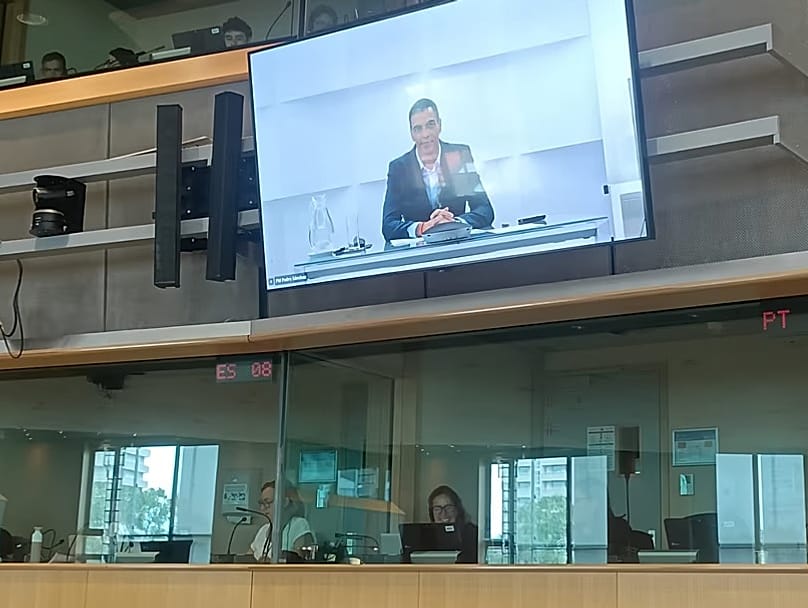
Spain’s Prime Minister Pedro Sánchez has spoken out against the European deregulation push being led by Germany and Italy and embraced by the European Commission.

“Some will say that to compete, you must deregulate. Those who say that are often the very same people who left the world into the financial crisis with that same regime,” Sánchez told an event organised on Tuesday by his Socialist political colleagues at the European Parliament.

“This is not about having more or fewer laws or rules. This is about having good rules and good laws,” he said via videocall.

The Spanish prime minister’s intervention was the most awaited and the most loudly applauded by the Socialist MEPs and staff gathered at the Dialogue on a Progressive European Future, a reflection on the Socialists' political priorities that also featured contributions from Commission Vice-President Teresa Ribera, President of the European Committee of the Regions Kata Tüttő and US Senator Bernie Sanders.

His remarks put him at odds with the current attempt to boost competitiveness by streamlining and simplifying EU laws.

In the last two years, the Commission has put forward a simplification and competitiveness agenda composed of ten “omnibus” packages. The aim is to simplify EU legislation in different sectors to lighten the economic burden on companies.

According to the Commission, this deregulation push has already produced a €15 billion administrative cost reduction for businesses across Europe, with a goal of €37.5 billion by 2029. Critics say this has often come at the expense of environmental and social standards, particularly in the case of a package to ease corporate sustainability reporting approved in 2025.

Several EU countries are backing the Commission's strategy, even asking for further efforts, with Germany, Italy, and the Nordic countries throwing their weight behind that "simplification" agenda.

German Chancellor Friedrich Merz in particular has been very vocal on the need to reduce EU bureaucracy. Since the beginning of last year, he has advocated for the the principle of "one in, two out", meaning that for every new regulation adopted at EU level, two existing ones should be abolished.

Pedro Sánchez's intervention during the S&D's event in Brussels
Pedro Sánchez's intervention during the S&D's event in Brussels Euronews

On Tuesday, Sánchez insisted that European rules must “encourage competitiveness without neglecting social protection”, claiming his country “is proving that we can boost economic growth while reducing inequality [...] that we lead the green transition without losing competitiveness".

This week's event saw Socialist lawmakers and thinkiers touting a “strategic turn”, claiming that Europe needs a new policy orientation based on six pillars: affordable housing, affordable high-quality food, quality jobs, clean energy, a genuine defence union, and more taxes and control for big tech.

The progressive political family is trying to turn things around at a point where Europe appears to be turning to the right.

Three left-leaning prime ministers are still in office in the EU: both Sánchez and Denmark’s Mette Frederiksen are running coalition minority governments, while Maltese Prime Minister Robert Abela enjoys a slim majority in his country's parliament.


Spain trapped in rental crisis: up to half of wages go on housing

People demonstrate in central Madrid on 24 May 2026, calling for the right to affordable, decent housing.
Copyright Manu Fernández / AP

By Javier Iniguez De Onzono
Published on

An estate portal study shows the average wage share has risen 12 percentage points since 2019. Madrid and Catalonia, with 70% of pay, top the regional ranking.

The evidence of the housing crisis Spain is going through is plain for all to see. In the rental market, the cumulative increase since 2022 is around 30%, according to the CIS, while housing construction - PwC data -has been at rock-bottom levels since 2010, with an average of 83,000 homes a year compared with 315,000 on average between 1970 and 2010. In addition, the stock of public housing is clearly inadequate, according to the Bank of Spain: between 1.5% and 3.3% of the total, compared with an EU average of 9.3%.

Warning voices are now even being raised from within the property sector itself, which has faced heavy criticism from platforms such as the Tenants' Union for failing to take firm action against vulture funds or against evictions of vulnerable people. The property portal Fotocasa, which acts as an intermediary for sales and rentals, estimates that Spaniards who rent their homes spent on average 50% of their salary on rent in 2025.

These figures, calculated using the average advertised salaries in job offers posted on the InfoJobs platform - a snapshot that is not very realistic - are higher than those found in similar studies. The Funcas think-tank (source in Spanish) believes that young people, one of the hardest-hit groups, spend around 35% of their budget: still two percentage points above the maximum economists usually recommend for such costs, that is, a third of income at most.

Fotocasa calculates that the share of the average salary going on rent rose from 38% in 2019 to 50% in 2025, while also taking account of disparities between Spain's regions: from the 29% it estimates for residents in Extremadura to 71% for those living in Madrid. The pattern is similar across the rest of the ranking of autonomous communities, with residents in the usual suspects, the Basque Country, the Canary and Balearic Islands, Catalonia and the Valencia region, paying the most.

By contrast, the provinces whose residents devote the smallest share of their gross pay to rent are Jaén (23%), Teruel (25%), Cáceres (27%), Ciudad Real (28%), Albacete (29%), Ourense (29%), Badajoz (29%), Córdoba (29%), Palencia (30%) and Castellón (31%).


marxistshttps://www.marxists.org  › reference  › subject  › economics  › proudhon  › property  › 

What is Property? by Proudhon

Chapter II. Property Considered as a Natural Right. Occupation, and Civil Law as Efficient Bases of Property.


SPACE/COSMOS

Amazon selects Kenya for first African satellite gateway in Project Kuiper challenge to Starlink

Amazon selects Kenya for first African satellite gateway in Project Kuiper challenge to Starlink
Elon Musk's Starlink has a huge head start in Africa over Jeff Bezos's Amazon, which plans a constellation of over 3,200 satellites by 2028 / bne IntelliNews
By bne IntelliNews June 10, 2026

Amazon.com Inc (NASDAQ:AMZN), the US technology and e-commerce group founded by Jeff Bezos, has officially selected Kenya as the location for its first African satellite Internet ground station through its Project Kuiper network and intensifying competition with Elon Musk’s Starlink across the continent.

The facility, known as a satellite gateway or ground station, will serve as a critical link between Amazon’s low Earth orbit (LEO) satellites and terrestrial Internet networks, enabling data transmission between users and the company’s planned satellite constellation, Techpoint Africa writes.

Amazon, through its local subsidiary Amazon Kuiper Kenya Limited, has applied to the country’s Communications Authority (CAK) for a licence to operate communications infrastructure. Regulatory approval would pave the way for the company to launch satellite broadband services in Kenya as Project Kuiper, rebranded for consumers as Amazon Leo, moves towards commercial deployment.

“For Kenya, this is more than just another foreign tech investment. It places the country at the centre of a fast-moving global connectivity battle, where satellite Internet is becoming a serious alternative to fibre and mobile networks, especially in rural and underserved regions,” Techpoint Africa writes.

“For users, it could eventually mean faster Internet access in remote areas, improved digital inclusion, and cheaper backhaul for mobile operators. For government, it strengthens Kenya’s positioning as a regional tech hub while also raising regulatory questions around data sovereignty and infrastructure control.”

Conventional broadband networks, which rely on fibre-optic cables and mobile towers, have struggled to reach remote and low-density areas due to high deployment costs, leaving large segments of the population underserved.

LEO satellite systems offer an alternative by delivering connectivity directly from space to user terminals on the ground, enabling faster speeds and lower latency compared to legacy satellite technologies.

Amazon’s satellite broadband initiative is designed to deliver high-speed Internet connectivity globally through a network of more than 3,200 low Earth orbit satellites. The project is widely viewed as Amazon founder Jeff Bezos's response to the Starlink network, which has already established operations in several African markets, including Kenya. Starlink, owned by billionaire Elon Musk's SpaceX, is now the country’s eighth-largest Internet service provider with more than 22,000 subscribers.

In Sub-Saharan Africa, internet penetration stands at about 36%, according to the ITU estimates. In Kenya, penetration is estimated at about 48%, with more than 27mn users out of a population of over 56mn, based on DataReportal and CAK estimates.

Kenya represents a strategic entry point in the continent’s fast-growing digital economy, where demand for high-speed Internet remains constrained by gaps in traditional infrastructure, particularly outside major urban centres. Starlink has been operating in the country since 2023 and has steadily expanded its customer base among businesses, households and rural users seeking alternatives to conventional Internet services.

Amazon applied in April for a Network Facilities Provider (NFP) Tier 2 licence to operate in Kenya, valid for 15 years. The licence carries an upfront cost of around $115,000 and requires at least 30% local ownership within three years of approval, reflecting Kenya’s push to ensure foreign telecom entrants embed local participation and submit structured rollout plans.

The decision to establish a ground station represents the first major physical infrastructure commitment by Amazon in Africa. The move comes as global technology companies increasingly view the continent as a key growth market for broadband connectivity, driven by rising Internet demand, expanding digital economies and persistent gaps in network coverage.

Meanwhile, Starlink has expanded rapidly across Africa and is now active in markets including Nigeria, Rwanda, Mozambique, Malawi and Zambia, according to company and regulatory data.

It has also partnered with Airtel Africa Plc (LSE:AAF), the telecom operator majority-owned by Bharti Airtel Ltd (NSE:BHARTIARTL), which in March conducted a pilot test in Kenya with Starlink to trial satellite-to-mobile connectivity.

The test was conducted in remote “no connectivity” zones where traditional mobile networks do not reach, ahead of a planned rollout across Airtel’s 14 African markets, including Nigeria, Uganda, Tanzania, Zambia and the Democratic Republic of Congo (DRC).

The trial demonstrated basic data and messaging services, including WhatsApp calls and messaging, maps navigation, Facebook Messenger, and financial transactions through the Airtel app.

MIT Astronomers Discover The Earliest Known Flickering Quasar


June 9, 2026 
By Eurasia Review


A supermassive black hole lies at the heart of every galaxy, including the Milky Way. When a black hole is active, it pulls material in as a whirlpool of high-temperature gas and dust. As this cosmic material piles up and falls onto a black hole, it lights up its vicinity, radiating a huge amount of energy.

The most energetic supermassive black holes are known as quasars, and they are some of the most active and luminous objects in the universe. These voracious systems take in so much material that the energy they emit can outshine all the light in the surrounding galaxy. The pattern of light from a quasar can give scientists clues to how active supermassive black holes shape the galaxies around them.

Now astronomers at MIT and elsewhere have detected a quasar flickering from the very early universe. The scientists traced the light from the quasar back to the “cosmic dawn,” just 850 million years after the Big Bang. The discovery represents the earliest flickering quasar detected to date.

“Although there have been a lot of quasars found in the cosmic dawn, this is the first time we actually see one flickering,” says Gene Leung, a postdoc in the MIT Kavli Institute for Astrophysics and Space Research.


The quasar’s flicker enabled the researchers to determine that, surprisingly, the ancient quasar’s whirlpool of gas and dust, known as an accretion disk, resembled a flat pancake, similar in shape to that of more modern-day quasars.

Their findings add to a longstanding mystery in cosmology: Why do supermassive black holes exist so early in the universe’s history? Physicists have assumed that a flat accretion disk reflects a relatively mature black hole that is in a calm and stable state. Black holes that are just starting to form, like those in the very early universe, should be more unsettled systems, with accretion disks that appear more puffy and chaotic.

The flat accretion disk around this very early quasar heightens the mystery of how supermassive black holes can grow and mature in a very short amount of cosmic time.

“I think what this suggests is that all the messy, very rapid growth phases that we expect all black holes to go through at some point happen very, very early on, before we see them as these very bright luminous quasars,” says Anna-Christina Eilers, assistant professor of physics at MIT. “That’s the picture that’s emerging.”


Eilers, Leung, and their colleagues report their results in a paper appearing in Nature Astronomy. Their co-authors include members of MIT Kavli and multiple other institutions.
Past a pinprick

A supermassive black hole can be billions of times more massive than the sun. These gravitational giants are the central “engines” of most galaxies, helping to regulate a galaxy’s star formation and growth.

“Without supermassive black holes, no galaxy would look the way it does today,” Eilers says. “Black holes play a major role in shaping how galactic ecosystems look.”

It was long assumed that it should take more than a billion years for the first galaxies to settle and mature, so scientists didn’t expect to see supermassive black holes in the very early universe. But observations since the early 2000s showed otherwise. Scientists have spotted more than 200 supermassive black holes in the universe’s first billion years. Such objects were detectable because they were in an extremely active quasar phase, giving off enormous blasts of radiation that could be seen from Earth, 13 billion light years away.

These earliest quasars were observed as pinpricks of light, which signal the existence of a supermassive black hole at early times. But from these bright and distant dots, scientists aren’t able to tell much more about the black holes and their cosmic dawn environments. To do so, they need to catch a quasar’s “flicker.”

“People have known that quasars in the nearby universe can flicker,” Leung says. “The flickering comes from fluctuations in the way the gas is being fed into the black hole. And how a quasar flickers tells us something about the structure of a black hole’s accretion disk, and the kind of ‘bites’ that the black hole is eating.”

Mapping a flicker

Leung and Eilers looked to detect a flickering quasar from the early universe in hopes of learning more about the shape and structure of the earliest supermassive black holes. To do so would be a technical challenge: The further back in time and space an object is, the more distorted its light appears. This effect is due to the expanding universe, which effectively stretches, or “redshifts” light to redder, longer wavelengths. The same stretching occurs in time: Any flicker that naturally occurs over several weeks, for instance, would appear stretched out, flickering only every few months when seen from billions of light years away.

To spot a flickering quasar from the cosmic dawn, the team needed to observe the distant universe at redder wavelengths, and specifically within the infrared spectrum, and over long timescales of many years.

“This was the technical challenge we had to overcome,” Eilers says. “We needed data at longer, infraredwavelengths taken repeatedly over very long timescales.”

The team ultimately found a flicker in data collected by NASA’s Near-Earth Object Wide-field Infrared Survey Explorer (NEOWISE) mission — a space-based infrared telescope that scanned the entire sky over a total of about 14 years. Former MIT postdoc Kishalay De, who is now a faculty member at Columbia University, had launched a project to re-process archival data from NEOWISE. Based on the re-processed data, the team unearthed a signal, from just 850 million years after the Big Bang, which was confirmed to be the earliest flickering quasar.

“We saw the quasar flickering randomly over the 14-year period, much like a candle’s flame flickers without a fixed pattern,” Leung notes.

They estimate that the quasar is as bright as 12 trillion suns, and it is flickering by about 20 percent, meaning that it fluctuates up and down, by a brightness of about 2 trillion suns.

The researchers also tracked how the quasar’s light flickered over several different wavelengths. The wavelength of light reflects a certain temperature of the material that is emitting the light. The closer material is to a black hole, the hotter it is. Researchers can therefore use wavelengths of light to map the shape and structure of material within the accretion disk around a black hole.

Using NEOWISE data, the team analyzed the quasar’s flicker to determine the shape of the accretion disk surrounding the central supermassive black hole. They found that the disk is surprisingly thin and flat — a structure that astronomers mostly see around nearby, older black holes, that have had much longer to settle and mature.

“This provides direct evidence that the same feeding processes and structures observed in the nearby universe were already in place at very early times, despite very different cosmic environments, which had never been seen before,” Eilers says.

“This means something happened even earlier on that led to these systems to look so mature,” Leung adds.

The team hopes to peer even further back in cosmic time to catch a quasar’s earlier, premature development. Then, scientists can start to piece together the conditions that brewed up the first supermassive black holes.

This research was supported, in part, by NASA.


Artemis III: Luca Parmitano selected for next stage of NASA's lunar landing mission

Italian astronaut Luca Parmitano
Copyright AP Photo

By Euronews
Published on


NASA has unveiled the Artemis III crew for a proposed 2027 mission to test key Earth-orbit technologies ahead of sending a human crew to the Moon.

Italian astronaut Luca Parmitano will pilot Artemis III**,** NASA confirmed on Tuesday, one of the key missions to prepare a human crew to return to the moon for the first time since 1972.

Parmitano's inclusion underlines the central role played by Europe in the new phase of space exploration.

The mission, currently scheduled for the second half of 2027, will not head directly to the Moon. It will instead be an experimental flight in low-Earth orbit, designed to test key procedures and technologies, in particular those related to docking between NASA's Orion capsule and the lunar landing modules - known as pathfinders.

At an event at Houston's Johnson Space Center, Parmitano called Italy his "launchpad" into space and the European Space Agency (ESA) a bridge, before dubbing NASA "the rocket, figuratively and literally."

Luca Parmitano is in the European Astronaut Corps for the ESA and was the first Italian and third European to command the International Space Station during an expedition in 2019/2020.

In addition to Parmitano, the Artemis III crew will include US astronauts Andre Douglas, Frank Rubio and Randy Bresnik, with Bob Hines serving as backup.

All of them have been chosen to take part in a series of complex operational tests that are vital for the future lunar missions of the Artemis programme.

During the mission, the Space Launch System rocket will carry the astronauts into orbit, where rendezvous and docking manoeuvres will be simulated between Orion and the lunar lander modules supplied by Jeff Bezos' Blue Origin and Elon Musk's SpaceX.

These operations are among the most delicate stages to negotiate if humans are to return to the Moon, as they demand absolute precision when linking spacecraft together in space.

The Artemis programme brings together numerous international space agencies. The European Space Agency supplies key components for the Orion spacecraft, while the Italian Space Agency is manufacturing habitation modules intended for multiple uses on the lunar surface.

The shared goal is to build a stable infrastructure for exploration beyond Earth's orbit, paving the way for increasingly long and complex missions.


Funding round for Polish-led space tech firm ICEYE values it at €10bn

Funding round for Polish-led space tech firm ICEYE values it at €10bn
ICEYE hands over MikroSAR, Poland’s sovereign radar satellite reconnaissance system, to the Polish Armed Forces. / ICEYE
By bne IntelliNews June 9, 2026

Finland-based space technology company ICEYE said on June 9 it had completed a €1bn funding round that valued the company at over €10bn, driven by growing government demand for sovereign intelligence systems.

The company, which features a Polish CEO and co-founder, has established itself as a major provider of space-based intelligence, with seven European governments procuring its sovereign satellite systems to date.

"The company has raised €450mn in a primary series F funding round led by General Atlantic, at a valuation of over €10bn. Additional investors include Solidium, Tesi, Varma, Ilmarinen, Lifeline Ventures, as well as Nokia, from Finland, Qatar Investment Authority (QIA) and TCV. Together with a secondary placement, the total Series F funding round exceeds €1bn," ICEYE said in a press release.

The company stated that proceeds from the funding round will drive the expansion of its global footprint and deepen its intelligence capabilities, positioning it to deliver sovereign intelligence systems and data to governments and customers at a new scale.

"The quality of investors who have chosen to back us at this scale reflects a shared belief. Sovereign intelligence from space is entering a new era and the window to build it is now. ICEYE has built the world's most advanced, proven capability to meet that demand. This funding enables us to accelerate the delivery of new capabilities to governments and customers faster than ever before," Rafal Modrzewski, Co-Founder & CEO of ICEYE, said as cited in the press release.

The capital injection follows a period of financial growth for the firm. In 2025, ICEYE scaled growth, profitability, and cash generation simultaneously - crossing over €250mn in revenue, and over €100mn in EBITDA, while building a contracted backlog of over €1.5 bn.

To meet expanding demand, ICEYE is doubling its production capacity from 50 satellites per year today to a target of 100 annually by 2028 and beyond, supported by a matching launch cadence, according to the release.

The announcement follows the recent delivery of a fully operational sovereign space system to the Polish Armed Forces, achieved within 12 months from contract signing to operational capability. ICEYE noted that this deployment, among the fastest in history, is now being replicated across Europe, the Middle East and Asia as the pace of adoption accelerates.