It’s possible that I shall make an ass of myself. But in that case one can always get out of it with a little dialectic. I have, of course, so worded my proposition as to be right either way (K.Marx, Letter to F.Engels on the Indian Mutiny)
Canadian Prime Minister Justin Trudeau, who has been criticized by some indigenous communities, on Thursday apologized and posthumously exonerated a Cree chief unjustly imprisoned for treason more than 130 years ago.
The Liberal prime minister received widespread support from Canada's First Nations when he ran for office four years ago promising to reconcile Canada with the native peoples wronged during the country's colonial past.
Chief #Poundmaker, or #Pihtokahanapiwiyin, was a #Cree leader during #Canada's #NorthWestRebellion*** of 1885. Historians have said he helped prevent a massacre of federal soldiers during a battle with the primarily French speaking rebels, who were descendants of First Nation and European settlers, was a Cree leader during Canada's North-West Rebellion of 1885.
Historians have said he helped prevent a massacre of federal soldiers during a battle with the primarily French speaking rebels, who were descendants of First Nation and European settlers
THE FRENCH SPEAKING REBELS HAVE A NAME THEY ARE THE #METIS PEOPLE, MANY ALSO SPOKE ENGLISH THEY HAVE RIGHTS IN CANADA AS FIRST PEOPLES AS WELL AS FIRST NATIONS THEY WERE REBELLING FOR PROVINCIAL RIGHTS SEPARATE FROM OTTAWA AND IN RECOGNITION OF AUTONOMOUS PARLIAMENTARY STRUCTURE AKA #RIELREBELLION ***, FOR WHICH RIEL WAS HANGED IN REGINA SASK, AT NWMP/RCMP HQ WE HAVE NO FEDERAL TROOPS, THAT IS MEXICO WE HAD THE #NWMP THE PREDECESSOR TO THE #RCMP FOR MORE SEE MY REBEL YELL http://plawiuk.blogspot.com/2005/07/rebel-yell.html AND THE GREAT CANADIAN METIS LEADER GABRIEL DUMONT WHOM GEORGE WOODCOCK CALLED A PRAIRIE ANARCHIST https://plawiuk.blogspot.com/search?q=GABRIEL+DUMONT
Sunday, June 14, 2020
Chief Allan Adam arrest: Cameras not enough to solve RCMP systemic racism, experts say
THE RCMP ARE A MILITARY OCCUPATIONAL FORCE, THAT PROVIDED ACCESS TO INDIAN LANDS WEST OF THE OTTAWA VALLEY, FOR THE RAILROADS.
Dashcam footage of the RCMP's arrest of Athabasca Chipewyan First Nation Chief Allan Adam in Alberta shows that capturing such incidents on camera isn't enough to address issues of systemic racism in the policing of Indigenous communities in Canada, experts say.
Chief Adam was arrested outside a casino in Fort McMurray, Alta., by RCMP officers early on March 10. A RCMP dashboard camera recorded the events and the footage was filed as a court exhibit on Thursday.
The nearly 12-minute video shows the back-and-forth between Adam and an RCMP officer leading up to the arrest, which culminated with a second police officer running into view and tackling Adam to the ground.
"It's horrific and it's barbaric," said Lori Campbell, a two-spirit Cree/Métis and director of the Waterloo Indigenous Students Centre.
Before the release of the video, Adam had held a news conference to publicize his arrest — the latest in a number of violent police confrontations with Indigenous people that came to light in recent weeks.
On Monday, Prime Minister Justin Trudeau said he wants police to be equipped with body-worn cameras to help overcome what he said was public distrust in law enforcement.
He added he had raised the issue with RCMP Commissioner Brenda Lucki.
Lucki later announced she would "engage in work and discussion… on a broader rollout of body-worn cameras" to in an effort to increase trust between the national police force and the communities it serves, as well as boost accountability and transparency.
Chad Haggarty served for 17 years in the RCMP in Alberta and now works as a student-at-law in criminal defence in Calgary — the only city in Canada to have equipped all its front-line officers with body cameras.
From a legal perspective, he said body-worn cameras are "indispensable" and "the best tool" the public has right now to ensure appropriate conduct by police officers.
But he added those cameras may not prevent improper conduct from occurring.
"It may not stop them from the terrible things that they're going to do, but it certainly allows us to go back and examine the propriety of their actions," he said.
Campbell said that's exactly what she took away from watching the footage of Adam's arrest, saying the presence of the dashcam didn't "stop the outcome of what occurred."
"It doesn't matter whether there's cameras there or not," she told Global News.
Campbell argued the cameras haven't been proven to accomplish what many advocates originally thought they would — which was to serve as a deterrent. Several studies conducted on use of body-cameras have concluded the cameras have had no measurable impact on police behaviour, but others have found some benefit.
"For police services now who haven't been using the body cameras in Canada to decide that that is going to be their next proactive reform decision to make and to spend money on, we already know it's not working, so they don't need to do that," Campbell argued.
"All it is doing is filming essentially this violence porn against Black and brown people that people are now watching. And every time we see it, it's devastating and trauma-inducing."
In recent weeks, video footage also circulated of an RCMP officer hitting an Inuk man with the door of a moving truck during an arrest in Nunavut. Days later, Chantel Moore, an Indigenous woman from B.C., was shot dead by police in Edmundston, N.B. RCMP created to control Indigenous people
The RCMP as an institution was never built to keep Indigenous communities safe, Campbell said. Rather, it was used to confine Indigenous peoples on reserves and clear the way for western settlement.
Canada's first prime minister, Sir John A. Macdonald, got the idea for the Mounties from the Royal Irish Constabulary, a paramilitary police force the British created to keep the Irish under control.
"He decided that instead of it being too expensive to send military out west, that he would form his own essentially Royal Irish Constabulary, but he called it the North-West Mounted Police," Campbell said.
"He enlisted 200 men and sent them out west to contain the Indigenous peoples and to surveil them and to protect settlers from Indigenous people.
"Then, of course, later that becomes the RCMP and that is still who polices and surveils and confines us in our communities."
During the years residential schools were in operation, it was RCMP officers who were tasked with going into Indigenous communities and forcefully removing the children, added Gabrielle Lindstrom, an assistant professor in Indigenous Studies with Mont Royal University's department of humanity.
"The RCMP are definitely part of the colonial legacy and play a huge role in that. And they continue to play a huge role in that today," Lindstrom said.
Because of this history, many Indigenous people grew up fearing police and have a visceral reaction to the sight of law enforcement, said Reuben Breaker, an elected councillor with the Siksika Nation, east of Calgary.
"I don't drink or do drugs or anything like that, but nonetheless, the image of a police car... there's automatic fear and guilt because that's what we associate with the RCMP," he said on Friday.
"In our language, they're called Inakiikowan. That means people that capture."
Breaker told Global News seeing the video of Adam's arrest "automatically brings anger" to Indigenous people.
"It's so common," he said, speaking from Strathmore, Alta.
"That has happened in many communities for many, many years. But it just has gone unreported or unresolved."
Today, Indigenous people are over-represented in Canada's corrections system. The federal prison ombudsman sounded the alarm about this earlier this year, warning that the proportion of Indigenous people in federal custody had reached a record high of more than 30 per cent due to entrenched imbalances.
After backlash, RCMP acknowledges systemic racism
As outrage mounts across Canada about the treatment on Indigenous people, one first step is for RCMP leadership to acknowledge there is systemic racism within the national police force, Campbell and Haggerty argued.
The RCMP's deputy commissioner in Alberta was criticized this week for denying systemic racism existing in the force. In a later interview with Global News, Lucki, for her part, said she believes there is "unconscious bias" among members in the police force but that she's "struggling" with the definition of systemic racism and how that applies to the institution of the RCMP.
"I did acknowledge that we, like others, have racism in our organization, but I did not say definitively that systemic racism exists in the RCMP. I should have," she wrote.
"As many have said, I do know that systemic racism is part of every institution, the RCMP included. "Throughout our history and today, we have not always treated racialized and Indigenous people fairly."
RCMP media relations declined Global News' request for an interview with Commissioner Lucki about the released video of Adam's arrest on Friday.
The deputy commissioner in Alberta also backpedalled on his comments in a press conference late Friday. Cultural, structural changes needed in RCMP, experts argue
After an acknowledgement, "changing the behaviour of race-based policing is going to require ... a cultural shift within the RCMP," Haggarty argued.
Accomplishing that requires concrete action, he and Campbell agreed.
In the immediate future, Campbell said a good place to start would be the release of the delayed federal action plan, promised in response to the final report of the National Inquiry into Missing and Murdered Indigenous Women and Girls.
That report stated: "The RCMP have not proven to Canada that they are capable of holding themselves to account."
But given the foundations on which the RCMP was built, Campbell is not optimistic the massive police service can be appropriately reformed and instead favours defunding the force and reallocating the resources.
Instead of investing in body cameras, Campbell argued, "take that money and invest it in things like social services, child services, community programming, mental health supports, social workers."
In her statement on Friday, Lucki said the RCMP is focused on "thoughtful action."
"We now have the opportunity to lead positive change on this critical issue. It is time to double down on these efforts -- there is so much more to do," she said.
"There is no one answer, no single solution, no one approach. It is the ongoing commitment to work and continue to learn that will help us make real progress and I am motivated and determined to make change."
‘Jeopardy!’ clue draws backlash: Canadian actress Devery Jacobs knocks ‘harmful misinformation’ about RCMP
A clue on the gameshow left out the controversial history of the Royal Canadian Mounted Police
Abhya Adlakha ·Editor, Yahoo News Canada Tue, January 17, 2023
Indigenous Canadian actress and writer Kawennáhere Devery Jacobs, known professionally as Devery Jacobs, called out the American game show Jeopardy! for spreading misinformation on Monday.
A clue on the game show claimed that the Royal Canadian Mounted Police (RCMP) was created to clean up whiskey traders from the United States.
(FORT WHOOP UP US SOVERIGN TERRITORY IN LETHBRIDGE ALBERTA; BLACKFOOT NATION) However, Devery Jacobs called out the show and said that the RCMP was actually created to "control and assert sovereignty over Indigenous people" instead of protecting communities.
In fact, both reasons are true.
According to Britannica, the RCMP, formerly known as the North West Mounted Police at its time of creation, was created for both reasons—to deal with the whiskey traders from the United States and to "pacify" Indigenous Peoples and maintain order in the new Canadian Northwest Territories.
"The original force of 300 men was sent to deal with traders from the United States, who were creating havoc among (Indigenous Peoples) by trading cheap whiskey for buffalo hides," the webpage reads.
However, it is also true that the Canadian paramilitary police force was established to maintain order following the transfer in 1870 of Rupert's Land and Northwestern Territory to Canada from the Hudson's Bay Company.
Following the purchase, Canada's first Prime Minister Sir John A. Macdonald, established the Mounties to resemble the Royal Irish Constabulary, a paramilitary police force the British created to keep the Irish under control
In an interview with the Global News, history lecturer Steve Hewitt said that the job of the Mounties was to "clear the plains, the Prairies, of Indigenous People" and to displace Indigenous people.
The mounted police's approach has often be characterized by historians as "benevolent despotism" to "legal tyranny". The police—sometimes forcefully—tried to apply Canadian law to First Nations.
Indigenous People who resisted were starved onto reserves. The federal government brought in the Indian Act and used Mounties to forcibly remove Indigenous children from their homes, sparking a residential school crisis that has been called Canada's "genocide", leaving generations of trauma.
Canada indigenous chief Allan Adam battered during arrest THIS HAPPENED IN ALBERTA HOME TO THE WHITE SUPREMACIST CHRISTIAN PARTY UCP AND ITS LEADER PREMIER KENNEY BBC•June 13, 2020
Video of an indigenous chief's violent arrest has shocked Canada, turning a spotlight on systemic racism in the country's police force.
The footage shows Athabasca Chipewyan First Nation Chief Allan Adam being floored and repeatedly punched by a Royal Canadian Mounted Police officer.
The confrontation took place in Fort McMurray, Alberta, on 10 March.
Protests demanding police reform have spread across Canada recently after spilling over from the US.
Although RCMP Commissioner Brenda Lucki initially said she "can't say for sure" PATHETIC whether systemic racism is a problem with the police, on Friday afternoon she released a statement saying "systemic racism is part of every institution, the RCMP included". "Throughout our history and today, we have not always treated racialized and Indigenous people fairly," she wrote.
Prime Minister Justin Trudeau called for an independent investigation.⇓ What does the video show? Before the public release of the footage on Thursday night, the local RCMP division said they had reviewed it and found the officer's actions "reasonable".
The incident begins when an RCMP officer approaches Mr Adam and his wife over an expired licence plate.
The nearly 12-minute-long video, recorded by a dashcam from the RCMP officer's vehicle parked behind Mr Adam's lorry in a casino car park, begins with Mr Adam having a tense and profanity-laden discussion with the officer.
"I'm tired of being harassed by the RCMP," he says.
Mr Adam and the officer continue to have a heated argument. At about the 4:45 mark, the officer tries to arrest his wife, twisting her arm behind her back until she says: "Ow!"
That is when Mr Adam gets out again, shouting: "Leave my wife alone!" He pushes the officer away. Everyone gets back in the vehicle.
Backup is called, and Mr Adam gets out of the lorry. The officer begins to arrest him, and Mr Adam says "don't touch me", using an expletive. That is when a second officer runs at him full speed, knocks him down, and repeatedly punches him while shouting: "Don't resist."
The incident is being investigated by the Alberta Serious Incident Response Team, which oversees incidents involving police where someone is hurt. What do Allan Adam and his lawyer say?
Mr Adam told Canadian media: "Because we are a minority and nobody speaks up for us, every time our people do wrong and the RCMP go and make their call, they always seem to use excessive force.
"And that has to stop. And enough is enough."
Mr Adam's lawyer Brian Beresh wants his client's charges, which include assaulting an officer and resisting arrest, to be dropped. Mr Adam is next due in court on 2 July.
Mr Beresh has practised law for 44 years, and says police violence against indigenous people has been a constant issue.
"I've seen this from the first day I've started to practise," he told the BBC.
"I'd like there to be some positive action taken by the RCMP, in terms of how they can prevent this from happening again. If this can happen with my client who's a respected chief, what about the First Nations person who is living on the street, who doesn't have my client's standing?"
The final straw
Analysis by Robin Levinson King, BBC News, Toronto
This video comes not so much as a surprise, but as a final straw to those who have for years been demanding an end to systemic racism and police brutality.
Over the past two weeks, thousands of Canadians have marched in mostly peaceful protests held in cities across the country for the Black Lives Matter movement. While the protests may have been sparked by the death of George Floyd in the US, the Canadians marching have been clear to say that systemic racism is not just an American problem.
In addition to Mr Adam's arrest, the recent deaths in police custody of Regis Korchinski-Paquet, a black woman in Toronto, and Chantel Moore, an indigenous woman New Brunswick, have become touchstones in the wider discussion about race and policing in Canada, which has included calls to defund police.
Although Canada is often praised for its politeness and multiculturalism, especially in comparison to the US, it has its own legacy of violence and oppression of indigenous and black people to contend with - a legacy which continues to have ramifications today.
While most Canadian police forces do not track race-based data, media reports find that black Canadians are also more likely be stopped by police and experience police violence. What is the political reaction?
Calls for an end to racial injustice are gaining traction. Prime Minister Justin Trudeau said on Friday he has "serious questions" after watching the video.
"We have all now seen the shocking video of Chief Adam's arrest and we must get to the bottom of this," he said. "The independent investigation must be transparent and be carried out so that we get answers."
BLM protest in Ottawa
Last week, he marched in a Black Lives Matter protest and has said Canada has a problem with systemic racism "in all our institutions, including in all our police forces, including in the RCMP".
But Mr Trudeau also faces serious criticism both personally and politically, especially after photos surfaced during last autumn's election campaign of him in black face.
He has also been under scrutiny for not making greater strides at indigenous reconciliation.
Last year, a government report into murdered and missing indigenous women found that Canada was complicit in "race-based genocide" against indigenous women. Many of the report's recommendations have yet to be implemented.
Trudeau has 'serious questions' on arrest videoReuters Videos•June 12, 202039 Comments
"The events that have been brought to light over the past days highlight, without question, there is systemic discrimination within our institutions, including the RCMP."
Canadian Prime Minister Justin Trudeau on Friday demanded answers, after he viewed a newly released dashcam video that shows Royal Canadian Mounted Police arresting a prominent indigenous leader.
In the video from March 10, Chief Allan Adam of Athabasca Chipewyan First Nation accuses an officer of harassing him.
About 7 minutes into the video, an officer tackles Adam to the ground.
An officer then punches Adam in the face.
Adam alleges police beat him up during the incident involving an expired license plate in Fort McMurry, Alberta.
He released a photo of his swollen and bloodied face.
Then - this video emerged after it was filed as a court exhibit.
“I think everyone who has seen this video has serious questions about what exactly happened, about how it happened this way and about that use of force that we saw. That’s why we’re calling for an independent, transparent investigation that will get the answers that so many people are asking right now.”
The RCMP said officers used reasonable force after Adam resisted arrest.
An independent agency has begun an investigation. Adam has been charged with resisting arrest and assaulting police. He is due in court on July 2.
People of indigenous descent account for just under 5 percent of Canada’s population. Many live in communities hit by crime, ill-health and poverty. Complaints about police discrimination are widespread.
Video Transcript
JUSTIN TRUDEAU: The events that have been brought to light over the past days highlight that without question, there is systemic discrimination within our institutions, including within the RCMP.
- Canadian Prime Minister Justin Trudeau on Friday demanded answers after he viewed a newly released dash cam video that shows a Royal Canadian Mounted Police arresting a prominent indigenous leader. In the video from March 10, Chief Allan Adam of Athabasca Chipewyan first nation accuses an officer of harassing him.
About seven minutes into the video, an officer tackles Adam to the grounds. An officer then punches Adam in the face. Adam alleges police beat him up during the incident involving an expired license plate in Fort McMurray, Alberta. He released a photo of his swollen and bloodied face. Then this video emerged after it was filed as a court exhibit.
JUSTIN TRUDEAU: I think everyone who's seen this video has serious questions about what exactly happened, about how it happened this way, and about that use of force that we saw. That's why we're calling for an independent transparent investigation that will get the answers to so many questions people are asking right now.
- The RCMP said officers used reasonable force after Adam resisted arrest. An independent agency has begun an investigation. Adam has been charged with resisting arrest and assaulting police.
He is due in court on July 2nd. People of indigenous descent account for just under 5% of Canada's population. Many live in communities hit by crime, ill health, and poverty. Complaints about police discrimination are widespread.
Canadian PM Trudeau condemns ‘shocking’ police video of aboriginal chief arrestRob Gillies, Associated Press, PA Media: World News•June 12, 2020
Canadian PM Trudeau condemns ‘shocking’ police video of aboriginal chief arrestCanadian prime minister Justin Trudeau has said dashcam video of the violent arrest of a Canadian aboriginal chief is shocking and that black Canadians and indigenous people do not feel safe around police.
The arrest has received attention in Canada as a backlash against racism grows worldwide after the death of George Floyd after a white Minneapolis police officer pressed a knee to his neck.
A 12-minute police video shows an officer charging at Athabasca Chipewyan First Nation Chief Allan Adam with his arm and elbow up as he tackles him to the ground. It also shows the officer punching him in the head
BREAKING NEWS: Dash-cam footage obtained by CTV News shows Athabasca Chipewyan First Nation Chief Allan Adam getting tackled by Wood Buffalo RCMP officers, then punched in the head and put in a choke-hold. #cdnpoli#RCMPpic.twitter.com/NKJeapPzDN Rosa Hwang (@journorosa) June 12, 2020
Mr Trudeau called the video “shocking”, and said: “I have serious questions about what happened. The independent investigation must be transparent and be carried out so that we get answers.
“At the same time, though, we also know that this is not an isolated incident. Far too many black Canadians and indigenous people do not feel safe around police. It’s unacceptable. And as governments, we have to change that.”
Pictures show Mr Adam was left bloodied with his face swollen. Alberta’s police watchdog is investigating.
Police charged Mr Adam with resisting arrest and assaulting a police officer.
The Athabasca Chipewyan First Nation said the Royal Canadian Mounted Police dashcam video was released publicly as part of a court application to get criminal charges against Mr Adam removed.
The video earlier showed a different officer approaching Mr Adam’s truck outside a casino in Fort McMurray, Alberta, early on the morning of March 10. Police have said the truck had expired licence plates.
The video shows him getting in and out of the vehicle, removing his coat and taking a karate-like stance and using expletives as he complains about being harassed by police. His wife and niece get in between Mr Adam and the officer at times.
His lawyer, Brian Beresh, has filed a court motion to have criminal charges dropped over violation of Mr Adam’s constitutional rights.
“All of this resulted from an expired licence plate tag. The video speaks for itself,” Mr Beresh said in a statement.
Mr Trudeau has said the issue of systemic racism in policing is longstanding and needs addressing.
Mr Adam held a news conference last weekend to talk about excessive force and racism. He has noted that although aboriginals represent 5% of Canada’s population, they make up to 30% of the prison population.
Opposition Conservative leader Andrew Scheer said he was troubled by the video.
“It’s very difficult to watch,” he said. “I found it very troubling and very worrying. The events of the last few days and weeks have ignited a very important conversation about the use of excessive force.”
The RCMP said in a statement that the video had been reviewed by supervisors and “it was determined that the members’ actions were reasonable and did not meet the threshold for an external investigation”.
The statement from the Athabasca Chipewyan First Nation called for the officers involved to be punished and criminal charges brought.
This would be popular in Quebec, and popular with aboriginal and Metis peoples. And of course for Western Canada it marks the beginning of our alienation from Ontario that bastion of British Colonialism. So it's a winner as a national holiday whose time has come.
And it would piss off the reactionary right wing revisionists like Flanagan, Morton, and Byfield.
NDP MP Blake Desjarlais (Edmonton Griesbach) made the following statement:
“On November 16th 1885, 139 years ago today, the Canadian government executed Métis Leader, the Honourable Louis Riel. He was the founder of Manitoba, a father of the Confederation, and a brave defender and steward of Métis rights and self-determination. Riel was unjustly executed for opposing colonial polices that forcefully displaced Métis people.
Riel stood for the rights of Métis people and for minority French language rights in Canada. Generations of people to follow would pick up the torch left by President Riel and would go on to fight for greater respect and rights of Métis people. Today we recognize this pain felt by Métis people and commit to truth, justice, and reconciliation by recognizing this profound injustice and commit to a future of Metis dignity and pride, one that Riel would be proud of.
Today, New Democrats, along with Canadians across the country gather to pay their respects to the Honourable Louis Riel and recommit to continuing his legacy by fighting for justice and rights for all."
A poem and introduction written by Louis Riel for his jailer about three weeks before Riel was hanged for treason: Robert Gordon! I beg your pardon for so having kept you waiting after some poor verses of mine. You know, my English is not fine. I speak it; but only very imperfectly.
The snow,
Which renders the ground all white,
From heaven, comes here below:
Its pine frozen drops invite us all
To white -- keep our thoughts and our acts,
So that when our bodies do fall,
Our merits, before God, be facts.
How many who, with good desires,
Have died and lost their souls to fires?
Good desires kept unpractic'd
Stand, before God, unnotic'd.
O Robert, let us be fond
Of virtue! Virtues abound
In every sort of good,
Let virtue be our soul's food. Louis (David) Riel Oct. 27, 1885 Regina Jail
This should be expected when we are taught a safe and sanitized history of the founding of Canada and its gradualist evolution towards parliamentary democracy of Peace, Order and Good Government.
Overlooking the fact that there were rebellions and uprisings, calls for a different kind of Canada, one that so scared the British lords that they kept us under martial law, and British Parliaments thumb until the turn of last century. The POGG ideal makes history booooring. Of course Canada has another history, one not written by the Masters. A Peoples History not a Dominion History.
Some contributions I have made to this social history of Canada I offer here;
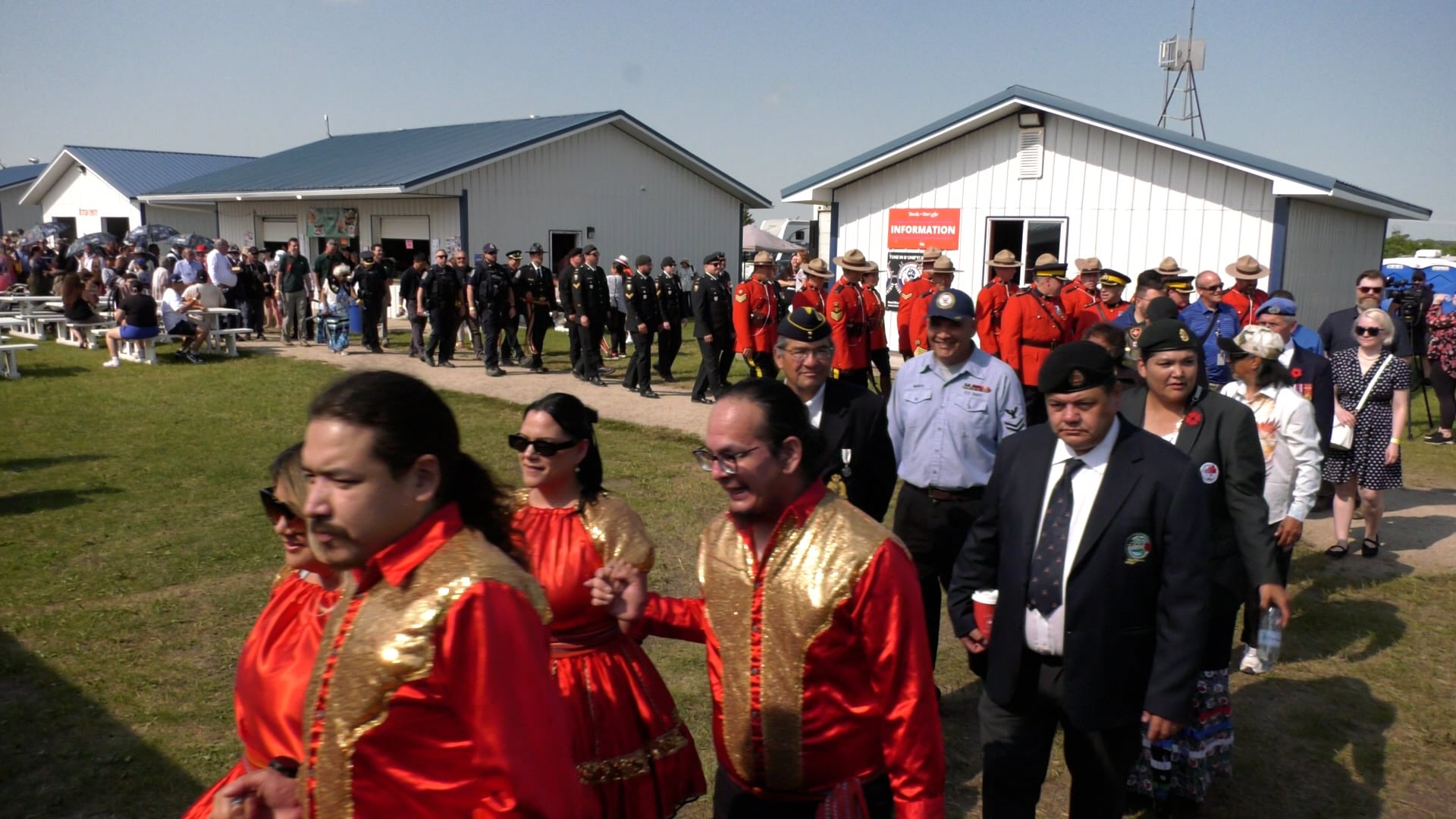
A procession of dignitaries walk into the opening ceremonies at Batoche. (Allison Bamford/CTV News)
BATOCHE, Sask. - Amongst a lively celebration of culture, dancing and music, serious talks are taking place about how Saskatchewan’s Metis people will be governed in the future.
Tens of thousands of Metis people from across Canada gather at Batoche, Sask., every summer for one of the country’s largest outdoor Indigenous festivals.
This year, reclaiming Metis identity and self-governance are key topics of conversation.
“It is our inherent right to be self-determining and self-governing,” said Brennan Merasty, minister responsible for self-government and justice with Metis Nation-Saskatchewan.
“That was the vision of our leader and founder, Louis Riel, and that is the path forward,” he said.
Metis Nation-Saskatchewan (MN-S) is in negotiations with the federal government to sign a treaty that would recognize the nation’s right to govern themselves, while granting jurisdiction to manage internal affairs and core governance matters.
The treaty will include further details in key areas such as harmonizing laws and resolving disputes, according to the federal government.
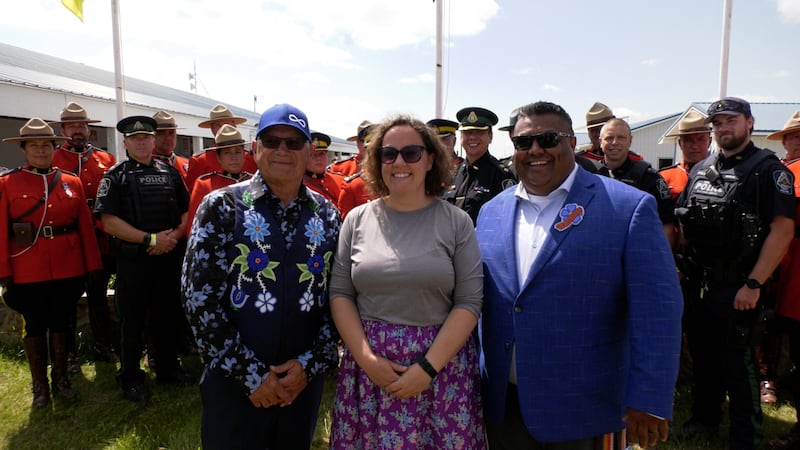
“For over 150 years, we have been struggling in regard to recognition from Canada,” MN-S President Glen McCallum told CTV News.
Both MN-S and the federal government say they are working to foster that relationship.
The two parties have finalized a draft of the treaty that is now being reviewed by Ottawa.
“It takes a while to get to this stage, but we are really happy to be making this step and then the following steps,” said federal Crown-Indigenous Relations Minister Rebecca Alty, who attended the opening ceremonies at Batoche, Sask.
Glen McCallum (left), Rebecca Alty (centre) and Brennan Merasty (right) pose for a photo at Back to Batoche Days. (Allison Bamford/CTV News)
Metis leaders said they were hoping to reach an agreement that would coincide with the Batoche celebrations.
Alty told CTV News there is “no hold up,” rather the government is just following its regular process.
“Sometimes it does not happen (when we want), but we will make it happen,” McCallum said.
“Our people are looking forward to that.”
Once the draft is reviewed, Alty said there is a series of procedural steps that need to take place, including a ratification vote amongst the Metis nation.
The minister could not provide a timeline for when the treaty might be implemented.