Bulgarian sailors return home after being freed by Yemen's Houthis
January 23, 2025
MEMO

The skipper of the cargo ship Galaxy Leader, Lyubomir Chanev is seen at Sofia Airport with his family on 23 January 2025 in Sofia, Bulgaria. [Hristo Vladev – Anadolu Agenc
Two Bulgarian sailors and a Romanian crew member returned home after being held for 14 months by Yemen’s Houthis, receiving a warm welcome from their families and officials at Sofia airport on Thursday, Reuters reports.
The trio were part of the 25-member international crew of the vessel, “Galaxy Leader”, that the Houthis seized off Yemen’s Red Sea coast more than a year ago.
They were released on Wednesday and handed to Oman following the three-day-old ceasefire in Gaza’s war between Israel and Palestinian group, Hamas, Houthi-owned Al Masirah TV reported.
Captain Lyubomir Chanev and First Officer, Danail Veselinov, arrived in Sofia aboard a government airplane that was sent to pick them up from Muscat in Oman on the order of Prime Minister, Rosen Zhelyazkov, local media reported.
The skipper of the cargo ship Galaxy Leader, Lyubomir Chanev is seen at Sofia Airport with his family on 23 January 2025 in Sofia, Bulgaria. [Hristo Vladev – Anadolu Agenc
Two Bulgarian sailors and a Romanian crew member returned home after being held for 14 months by Yemen’s Houthis, receiving a warm welcome from their families and officials at Sofia airport on Thursday, Reuters reports.
The trio were part of the 25-member international crew of the vessel, “Galaxy Leader”, that the Houthis seized off Yemen’s Red Sea coast more than a year ago.
They were released on Wednesday and handed to Oman following the three-day-old ceasefire in Gaza’s war between Israel and Palestinian group, Hamas, Houthi-owned Al Masirah TV reported.
Captain Lyubomir Chanev and First Officer, Danail Veselinov, arrived in Sofia aboard a government airplane that was sent to pick them up from Muscat in Oman on the order of Prime Minister, Rosen Zhelyazkov, local media reported.
Galaxy Leader Crew Released After 14 Months Captivity by Houthis
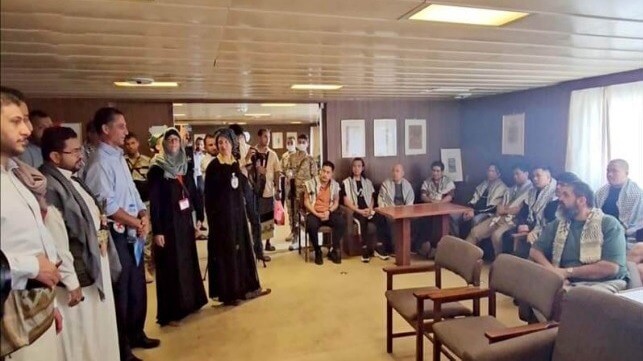
The governing body of the Houthi movement released a statement first reported by Al Masirah TV confirming the crew of the car carrier Galaxy Leader has been released. The crew was held for nearly 14 months by the Houthis which said it was “port of the battle to support Gaza.”
The Supreme Political Council issued a brief statement today, January 22, announcing the release which had been rumored as imminent in recent days. According to the statement, the release came after “communication” with the Hamas movement in Gaza and efforts by negotiators in Oman.
The Houthis said the release “comes in support of the ceasefire agreement in Gaza.” The rebels committed to supporting the truce negotiated by Oman, Egypt, and the United States but warned any violations could prompt further attacks. The Houthis released a statement on Sunday, January 19 saying they would permit the passage of foreign vessels in the Red Sea while continuing to target ships linked to Israel.
Al Masirah TV released images of the crew reportedly during the handover to representatives from Oman. The crew consists of 25 people from the Philippines, Bulgaria, Romania, Ukraine, and Mexico. It is believed the crew will travel to Oman but no details were announced on the repatriation.
The Galaxy Leader was the first vessel attacked by the Houthis with their forces boarding the car carrier on November 19, 2023, while it was under charter to Japan’s NYK and sailing without cargo to India. The Houthis cited the Israeli-linked ownership interests of the ship's commercial operator, UK-based Ray Car Carriers, as the reason for the seizure of the vessel and its crew. The vessel was diverted to an anchorage near Hodeidah, Yemen where it became a public spectacle including a visit by the Houthi military to “welcome the crew to Yemen.”
The Philippines and other nations as well as the IMO and other shipping organizations made repeated appeals for the release of the crew. They highlight their nationalities while saying the crew had no direct involvement in the conflict. The Philippines which had the majority of the crewmembers aboard the vessel repeatedly said the situation was complicated by “politics” warning it was likely to be a drawn-out process for the crew’s release.
IMO Secretary-General Arsenio Dominguez immediately released a statement today saying, “This is a moment of profound relief for all of us - not only for the crew and their families, but also to the wider maritime community... Today’s breakthrough is a testament to the power of collective diplomacy and dialogue, recognizing that innocent seafarers must not become collateral victims in wider geopolitical tensions.”
The Galaxy Leader (17,127 dwt) was built in 2002. The vessel is registered in the Bahamas. Today’s statement made no mention of the release of the vessel.
Mysterious Airfield Near Houthi Hot Zone Gets First Aircraft
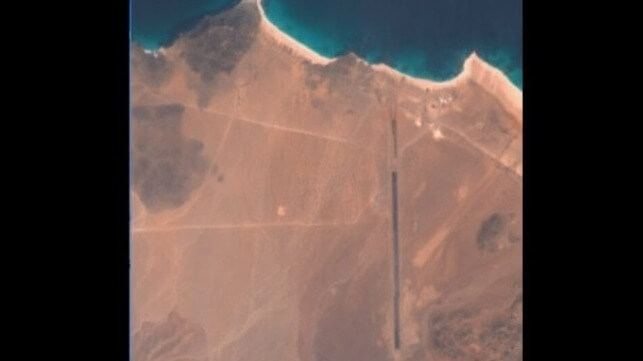
The runway at the mystery airfield on the Yemeni island of Abd Al Kuri remains enigmatically incomplete, with the gap at the northern end of the runway still extant as of January 22, 2025. However, the airfield may have had its first visiting aircraft. Early on January 17, what appears to be a medium-sized winged aircraft was parked on the apron in front of the small terminal building. It was aligned with nose wheel guidelines for parking aircraft.
With a wingspan of approximately 25 meters, if it was an aircraft it was not a C-17 or C-130, but bigger than a Twin Otter. It could possibly be a C-295 short take-off and landing aircraft used both for transport and maritime surveillance missions, for which the 1800 meters of completed runway would have been more than sufficient. Higher resolution satellite imagery will no doubt provide a more reliable answer on aircraft activity in due course.
Although the Gaza ceasefire has generated a statement from the Houthis that in the future, they will restrict their attacks on shipping to vessels that are either Israeli-flagged or owned, tensions remain high in the area while the true intentions of the Houthis become clear. The larger shipping companies in particular are likely to be cautious about re-routing vessels through the Suez Canal until the situation in Gaza becomes clearer. But recent air strikes on Houthi infrastructure have been significantly more damaging than attacks last year, and the ceasefire may have provided an off-ramp for the Houthis, which they were likely seeking.
Western countries appear to be taking no chances. The latest assessed plot of naval forces present in the region shows a heavy presence of naval vessels in the Internationally Recommended Transit Corridor to the north of Abd Al Kuri and Socotra. The Commander US Navy Central Command has also confirmed that the Iranian IRGC spy ship MV Behshad has also returned to the Gulf of Aden area, escorted by IRINS Alborz (F-72) and IRINS Bushehr (422) from the Iranian Navy’s 100th Naval Flotilla.
UN Confirms Level of Damage to Yemen’s Ports

Officials from the Untied Nations provided the first independent confirmation to the level of damage that has been inflicted on Yemen’s Red Sea ports. The officials estimated that less than a quarter of the port capacities remain available expressing concern about the ability to get relief supplies to the citizens of Yemen.
"(The) impact of airstrikes on Hodeidah harbor, particularly in the last weeks, is very important," Reuters reports Julien Harneis, U.N. resident and humanitarian coordinator in Yemen, told a U.N. meeting in Geneva on Tuesday, January 21. Harneis did not assign responsibility for the damage but warned it would impede the efforts to delivery food and fuel to Yemen.
Reports from Yemen indicate there is about two months of cereal and fuel inventories in the ports. UN officials have been working with the local authorities attempting to maintain aid and had a long-term plan to repair damage to the Red Sea ports which have been under the control of the Houthis for a decade. In approximately 2018, the UN conducted an extensive survey of the port facilities and documents the lack of maintenance and problems that needed to be addressed.
In Hodeidah they are now saying four of the port’s five tugboats were sunk and the fifth damaged. Local officials claim the port’s capacity in Hodeidah, Salif, and at the Ras Issa oil terminal was reduced by 70 percent.
UN officials said the ports had been targeted four times in the past six months. U.S. raids focused on key assets during the long-running conflict in the Red Sea region, while the Israel Defense Force carried two large raids in December.
The Israeli raids were in response to repeated missile and drone attacks launched by the Houthis. On December 19, they were there were a total of seven raids targeting Hodeidah as well as one on Salif and two on the oil terminal. In addition, Israel staged four raids on a power station south of Sanaa and two on another power station north of Sanaa.
The Houthi missile attacks continued and on December 26 the IDF conducted a second wave of attacks. That involved a reported 25 Israeli Air Force planes and included the port of Hodeidah as well as the power station and oil terminal. There was also heavy damage including the control tower, runways, and buildings at the Sanaa airport as well as additional targeting of the power station south of Sanaa.
Local officials are saying a total of eight tugs essential to the port operations were damaged.
"The civilian crews who man them (the tugs) are obviously very hesitant,” warned Harneis. “The capacity of the harbor is down to about a quarter," he added, saying the port was used to transit a significant portion of imported aid.
The Houthis continued to launch missile attacks on Israel through January 18 and the announcement of the Gaza ceasefire. They have however threatened to continue to target Israeli shipping and warned more widespread attacks would resume if the truce is violated.
Harneis told the UN briefing that the danger remains high for additional attacks. He also said it was hampering UN mediation efforts to reach a political solution to the conflict. The Houthi forces seized the western areas of Yemen in 2014 and early 2015.

No comments:
Post a Comment