Israel’s Nuclear Deception: Flagrant Lies and Brazen Hypocrisy
June 20, 2025
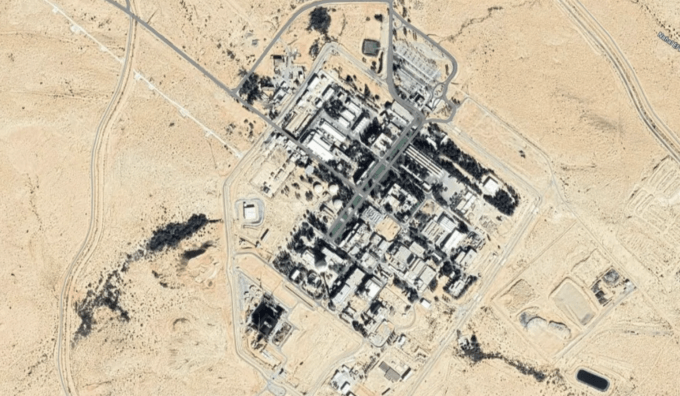
The Negev Nuclear Center, near Dimona. (Source: Google Maps)
Israel, like many other colonial projects, was established through violence and has relied on the use of force to occupy Arab territory ever since. Understanding that its existence depended on having a superior military in a hostile region prompted Israel to initiate a nuclear weapons program soon after its founding in 1948.
Even though Israel was a young nation, by the mid-1950s, with the aid of France, it had secretly begun the construction of a large nuclear reactor. That two allies had teamed up to launch a nuclear weapons program without the knowledge of the administration of President Dwight D. Eisenhower turned out to be a colossal (and embarrassing) American intelligence failure.
Not until June 1960, the final year of Eisenhower’s presidency, did US officials catch wind of what was already known as the Dimona project. Daniel Kimhi, an Israeli oil magnate, having undoubtedly had one too many cocktails at a late-night party at the US embassy in Tel Aviv, confessed to American diplomats that Israel was indeed constructing a large “power reactor” in the Negev desert—a startling revelation.
“This project has been described to [Kimhi] as a gas-cooled power reactor capable of producing approximately 60 megawatts of electric power,” read an embassy dispatch addressed to the State Department in August 1960. “[Kimhi] said he thought work had been underway for about two years and that a completion date was still about two years off.”
The Dimona reactor wasn’t, however, being built to deal with the country’s growing energy needs. As the United States would later discover, it was designed (with input from the French) to produce plutonium for a budding Israeli nuclear weapons program. In December 1960, as American officials grew more worried about the very idea of Israel’s nuclear aspirations, French Foreign Minister Maurice Couve de Murville admitted to US Secretary of State Christian Herter that France had, in fact, helped Israel get the project off the ground and would also provide the raw materials like uranium the reactor needed. As a result, it would get a share of any plutonium Dimona produced.
Israeli and French officials assured Eisenhower that Dimona (now known as the Negev Nuclear Center) was being built solely for peaceful purposes. Trying to further deflect attention, Israeli officials put forward several cover stories to back up that claim, asserting Dimona would become everything from a textile plant to a meteorological installation—anything but a nuclear reactor capable of producing weapons-grade plutonium.
Atomic Denials
In December 1960, after being tipped off by a British nuclear scientist concerned that Israel was constructing a dirty (that is, extremely radioactive) nuke, reporter Chapman Pincher wrote in London’s Daily Express: “British and American intelligence authorities believe that the Israelis are well on the way to building their first experimental nuclear bomb.”
Israeli officials issued a terse dispatch from their London embassy: “Israel is not building an atom bomb and has no intention of doing so.”
With Arab countries increasingly worried that Washington was aiding Israel’s nuclear endeavors, chairman of the Atomic Energy Commission John McCone leaked a classified CIA document to John Finney of The New York Times, claiming that the US had evidence Israel, with the help of France, was building a nuclear reactor—proof that Washington was none too pleased with that country’s nuclear aspirations.
President Eisenhower was stunned. Not only had his administration been left in the dark, but his officials feared a future nuclear-armed Israel would only further destabilize an already topsy-turvy region. “Reports from Arab countries confirm [the] gravity with which many view this possibility [of nuclear weapons in Israel],” read a State Department telegram sent to its Paris embassy in January 1961.
As that nuclear project began to make waves in the press, Israeli Prime Minister David Ben-Gurion moved quickly to downplay the disclosure. He gave a speech to the Knesset, the Israeli parliament, admitting the country was developing a nuclear program. “The reports in the media are false,” he added. “The research reactor we are now building in the Negev is being constructed under the direction of Israeli experts and is designed for peaceful purposes. When it’s complete, it will be open to scientists from other countries.”
He was, of course, lying and the Americans knew it. There was nothing peaceful about it. Worse yet, there was a growing consensus among America’s allies that Eisenhower had been in on the ruse and that his administration had provided the know-how to get the program off the ground. It hadn’t, but American officials were now eager to prevent United Nations inspections of Dimona, fearful of what they might uncover.
By May 1961, with John F. Kennedy in the White House, things were changing. JFK even dispatched two Atomic Energy Commission scientists to inspect the Dimona site. Though he came to believe much of the Israeli hype, the experts pointed out that the plant’s reactor could potentially produce plutonium “suitable for weapons.” The Central Intelligence Agency, less assured by Israel’s claims, wrote in a now-declassified National Intelligence Estimate that the reactor’s construction indicated “Israel may have decided to undertake a nuclear weapons program. At a minimum, we believe it has decided to develop its nuclear facilities in such a way as to put it into a position to develop nuclear weapons promptly should it decide to do so.”
And, of course, that’s precisely what happened. In January 1967, NBC News confirmed that Israel was on the verge of a nuclear capability. By then, American officials knew it was close to developing a nuke and that Dimona was producing bomb-worthy plutonium. Decades later, in a 2013 report citing US Defense Intelligence Agency figures, the Bulletin of the Atomic Scientists revealed that Israel possessed a minimum of 80 atomic weapons and was the only nuclear power in the Middle East. Pakistan wouldn’t acquire nukes until 1976 and is, in any case, normally considered part of South Asia.
To this day, Israel has never openly admitted possessing such weaponry and yet has consistently refused to allow inspectors from the International Atomic Energy Agency to visit the secretive site. Nonetheless, evidence suggests that a “major project” at Dimona was underway in 2021 and that Israel was by then actively expanding its nuclear production facilities. The absence of UN or other inspections at Dimona has resulted in no public acknowledgment from Israel regarding its nuclear warheads, leading to a lack of accountability.
This history of egregious lies and deception renders Israel’s illegal bombing of Iran for its alleged nuclear program all the more hypocritical.
A longer version of this piece first appeared on TomDispatch.
Iran-Israel Conflict: Nuclear Diplomacy At Stake?
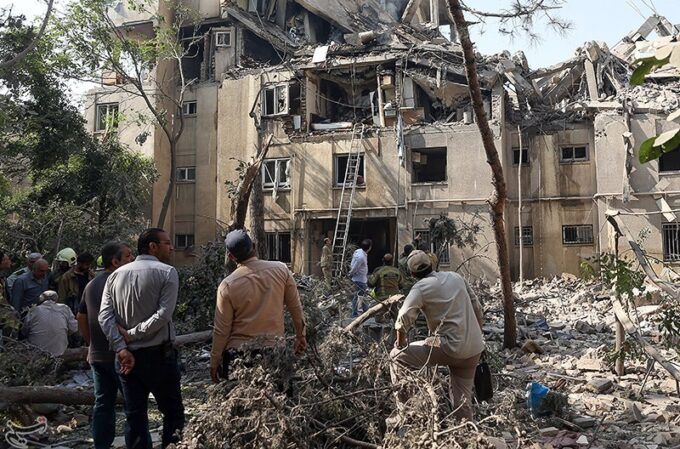
Photograph Source: Tasnim News Agency – CC BY 4.0
Iran-Israel conflict can no longer be viewed as just bilateral but would not have probably reached this stage without Tel Aviv being backed by Washington. Certainly, there is nothing new about this. At the same time, it cannot be ignored that conflict began when US-Iran talks regarding latter’s nuclear program had been initiated. These have been suspended for now. This also implies, the talks would have probably continued and perhaps led to an improvement in US-Iran ties, if Israel had not opted for the so-called “preemptive strike” against Iran on Friday (June 13, 2025), viewed by latter as “declaration of war.” Timing of Israel’s “preemptive strike” is questionable as Iran doesn’t appear to have taken any step to provoke the former to take this move. It is possible, Tel Aviv was not comfortable with the idea of any nuclear deal being reached with Iran. The same may be said about pro-Israel lobby within United States.
Ironically, a key point of President Donald Trump’s campaign to enter the White House was his promise to end wars and bring peace. Now, it seems, he is nowhere this stage or at least doesn’t appear to be. The other point is probably Israeli Prime Minister Benjamin Netanyahu is not desirous of Trump reaching this stage where Palestine-state is concerned. Netanyahu appears to have “succeeded” on this front. Not much has been heard from Trump administration regarding Palestine since Iran-Israel crisis has dominated headlines. Not that Israel gave much importance earlier to what others thought of its strategy towards Palestinians or that it gives much significance now to their approach towards it shooting down those rushing for food. But earlier at least speculations were being voiced against these moves to the degree of some even voicing the need for a change of government in Tel Aviv. It appears, perhaps Netanyahu hopes that Israel’s strikes against Iran have confirmed his return to power. The next legislative elections in Israel are scheduled to be held in October, 2026. He was probable hopeful that a few strikes would be sufficient to lead to a collapse of Iran. He apparently underestimated Iran’s capability to strike back.
It isn’t surprising that now greater noise is being made about change of regime in Iran. Now, the question is:- Is this justified? Do other countries, including superpower and key powers, have the right the dictate/decide who should head government in other sovereign countries? Of course, this step was taken militarily in the name of Arab Spring to bring democracy in several countries by ousting their leaders. It failed. How can democracy be imposed by external powers and militarily? Perhaps, in the case of Iran, talk of “regime-change” has other cards in play. Iran is close to Russia and China. It is possible, regime-change will shift Tehran towards United States. But only if Israel has its way and convinces US about it. At present, as reports indicate, Russia and China are against this. The two are also against US strikes on Iran. Besides, critics have observed that regime-change is likely to lead to chaos within Iran and things may even go out of hand, impossible for external powers to handle. The impact that similar moves earlier had in Afghanistan and also Iraq cannot be ignored.
Continuation of the war isn’t spelling benefits for civilians either in Iran or in Israel. Regarding Israelis, they aren’t apparently used to their lives being disrupted in this manner. To a degree, the same may be said about Iranians. But the latter are certainly used to bias entertained against them by pro-US and pro-Israeli elements.
Paradoxically, some are comparing Iran-Israel conflict to the recent India-Pakistan tension. Well, there is no comparison of the two. Though India and Pakistan are viewed as permanent enemies, time and again cultural similarity has brought their people and even leaders together. Besides, both are non-signatories to Nuclear Non-Proliferation Treaty (NPT) and respect a bilateral nuclear agreement, in force since 1991. This is also viewed as a Confidence Building Measure (CBM), as per which they exchange a list of their nuclear facilities every year and are bound to prevent intentional and/or accidental attack on these. Notwithstanding, their repeated engagement in bilateral tiffs, their nuclear diplomacy has been maintained.
US-Iran talks, which have been suspended, may also be viewed as the superpower having being on the verge of a key nuclear deal, regarding Iran’s nuclear program. If reached, without United States’ military involvement in Iran-Israel crisis, it would be considered a key diplomatic success for the superpower. Of course, till the conflict continues, the question of suspended talks being resumed doesn’t prevail. War only kills, has no winners. Besides, as latest reports indicate that though Trump maybe in favor of an attack on Iran, he isn’t keen to actually move in this direction. This is suggested by his having chosen not to rush into taking a decision on this front, a point which probably is not being welcomed by Israel. This certainly has given other powers time to exercise their diplomatic strategies for de-escalation of Iran-Israel war. If and when US opts for military involvement, the problem will not get resolved with this. War may not end with this. Netanyahu is eager for United States’ military involvement to destroy Iran’s Fordow nuclear facility. If it is actually hit, it is going to have a severe impact on the region as a whole. The possibility of American strikes’ “impact” on Fordow nuclear facility raising questions about United States’ nuclear policy and diplomacy cannot also be ignored. This would also amount to diplomatic strategy earlier given importance by Trump going haywire. Clearly, the key issue is the kind of “success” Trump hopes for, irrespective of what Netanyahu desires. Some importance should be given to US nuclear diplomacy and policy being at stake!The Real Nuclear Threat in Iran
June 20, 2025
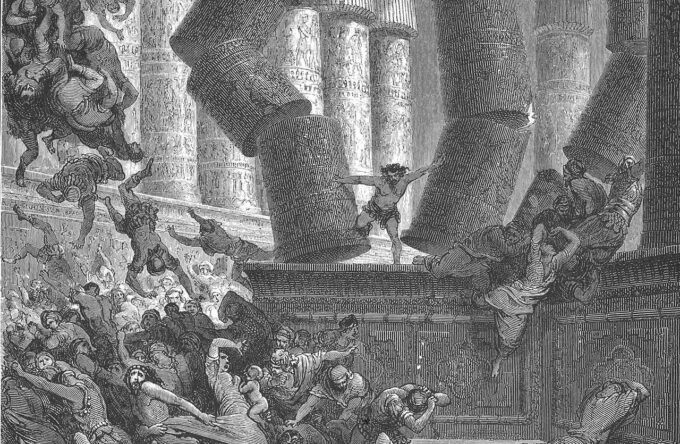
Image Source: Gustave Doré – Doré’s English Bible
It should be evident to all that it would not make sense for any country to possess nuclear weapons if that country would never consider using them even if it were facing a humiliating military defeat.
This was at least theoretically relevant to the war in Ukraine, where European “leaders” initially hoped — and some appear still to hope — to inflict a humiliating defeat upon Russia.
Have these “leaders” never considered that, were they ever to be close to “success” in achieving this objective, it would be entirely rational for the Russian leadership to use Russia’s nuclear weapons — potentially not against Ukraine but, rather, against their own countries?
Fortunately, this was never a serious threat, because inflicting a humiliating defeat upon Russia, which is vastly larger than Ukraine, patient and certain to prevail in any long-lasting war of attrition, has always been inconceivable.
However, there is ample cause to be worried about the threatened or actual use of nuclear weapons arising out of Israel’s current war of aggression against Iran.
Israel is vastly smaller than Iran, impatient and unlikely to prevail in any long-lasting war of attrition.
Israeli leaders are already quite frank and open in arguing that Israel cannot hope to achieve its declared objectives in this war unless President Trump decides, contrary to international law, the U.S. Constitution and the wishes of a substantial majority of the American people, to participate directly in higher-level military action against Iran.
It is not unreasonable to imagine that, if Trump continues to hesitate in the coming days, Prime Minister Netanyahu will tell Trump that, unless the United States actively joins the fight to “finish the job” and “end the war” with its bunker-buster bombs and other massive destructive capabilities, Israel will have no choice but to use its nuclear weapons against Iran in order to do so.
A bluff? Who would know? Who would wish to find out?
Netanyahu is fond of biblical references as justifications for his crimes. “Amalek” for the extermination of the people of Gaza. “Operation Rising Lion” for his war against Iran.
For decades, the “Samson Option” has been evoked with respect to Israel’s nuclear weapons arsenal.
The Negev Nuclear Center, near Dimona. (Source: Google Maps)
Israel, like many other colonial projects, was established through violence and has relied on the use of force to occupy Arab territory ever since. Understanding that its existence depended on having a superior military in a hostile region prompted Israel to initiate a nuclear weapons program soon after its founding in 1948.
Even though Israel was a young nation, by the mid-1950s, with the aid of France, it had secretly begun the construction of a large nuclear reactor. That two allies had teamed up to launch a nuclear weapons program without the knowledge of the administration of President Dwight D. Eisenhower turned out to be a colossal (and embarrassing) American intelligence failure.
Not until June 1960, the final year of Eisenhower’s presidency, did US officials catch wind of what was already known as the Dimona project. Daniel Kimhi, an Israeli oil magnate, having undoubtedly had one too many cocktails at a late-night party at the US embassy in Tel Aviv, confessed to American diplomats that Israel was indeed constructing a large “power reactor” in the Negev desert—a startling revelation.
“This project has been described to [Kimhi] as a gas-cooled power reactor capable of producing approximately 60 megawatts of electric power,” read an embassy dispatch addressed to the State Department in August 1960. “[Kimhi] said he thought work had been underway for about two years and that a completion date was still about two years off.”
The Dimona reactor wasn’t, however, being built to deal with the country’s growing energy needs. As the United States would later discover, it was designed (with input from the French) to produce plutonium for a budding Israeli nuclear weapons program. In December 1960, as American officials grew more worried about the very idea of Israel’s nuclear aspirations, French Foreign Minister Maurice Couve de Murville admitted to US Secretary of State Christian Herter that France had, in fact, helped Israel get the project off the ground and would also provide the raw materials like uranium the reactor needed. As a result, it would get a share of any plutonium Dimona produced.
Israeli and French officials assured Eisenhower that Dimona (now known as the Negev Nuclear Center) was being built solely for peaceful purposes. Trying to further deflect attention, Israeli officials put forward several cover stories to back up that claim, asserting Dimona would become everything from a textile plant to a meteorological installation—anything but a nuclear reactor capable of producing weapons-grade plutonium.
Atomic Denials
In December 1960, after being tipped off by a British nuclear scientist concerned that Israel was constructing a dirty (that is, extremely radioactive) nuke, reporter Chapman Pincher wrote in London’s Daily Express: “British and American intelligence authorities believe that the Israelis are well on the way to building their first experimental nuclear bomb.”
Israeli officials issued a terse dispatch from their London embassy: “Israel is not building an atom bomb and has no intention of doing so.”
With Arab countries increasingly worried that Washington was aiding Israel’s nuclear endeavors, chairman of the Atomic Energy Commission John McCone leaked a classified CIA document to John Finney of The New York Times, claiming that the US had evidence Israel, with the help of France, was building a nuclear reactor—proof that Washington was none too pleased with that country’s nuclear aspirations.
President Eisenhower was stunned. Not only had his administration been left in the dark, but his officials feared a future nuclear-armed Israel would only further destabilize an already topsy-turvy region. “Reports from Arab countries confirm [the] gravity with which many view this possibility [of nuclear weapons in Israel],” read a State Department telegram sent to its Paris embassy in January 1961.
As that nuclear project began to make waves in the press, Israeli Prime Minister David Ben-Gurion moved quickly to downplay the disclosure. He gave a speech to the Knesset, the Israeli parliament, admitting the country was developing a nuclear program. “The reports in the media are false,” he added. “The research reactor we are now building in the Negev is being constructed under the direction of Israeli experts and is designed for peaceful purposes. When it’s complete, it will be open to scientists from other countries.”
He was, of course, lying and the Americans knew it. There was nothing peaceful about it. Worse yet, there was a growing consensus among America’s allies that Eisenhower had been in on the ruse and that his administration had provided the know-how to get the program off the ground. It hadn’t, but American officials were now eager to prevent United Nations inspections of Dimona, fearful of what they might uncover.
By May 1961, with John F. Kennedy in the White House, things were changing. JFK even dispatched two Atomic Energy Commission scientists to inspect the Dimona site. Though he came to believe much of the Israeli hype, the experts pointed out that the plant’s reactor could potentially produce plutonium “suitable for weapons.” The Central Intelligence Agency, less assured by Israel’s claims, wrote in a now-declassified National Intelligence Estimate that the reactor’s construction indicated “Israel may have decided to undertake a nuclear weapons program. At a minimum, we believe it has decided to develop its nuclear facilities in such a way as to put it into a position to develop nuclear weapons promptly should it decide to do so.”
And, of course, that’s precisely what happened. In January 1967, NBC News confirmed that Israel was on the verge of a nuclear capability. By then, American officials knew it was close to developing a nuke and that Dimona was producing bomb-worthy plutonium. Decades later, in a 2013 report citing US Defense Intelligence Agency figures, the Bulletin of the Atomic Scientists revealed that Israel possessed a minimum of 80 atomic weapons and was the only nuclear power in the Middle East. Pakistan wouldn’t acquire nukes until 1976 and is, in any case, normally considered part of South Asia.
To this day, Israel has never openly admitted possessing such weaponry and yet has consistently refused to allow inspectors from the International Atomic Energy Agency to visit the secretive site. Nonetheless, evidence suggests that a “major project” at Dimona was underway in 2021 and that Israel was by then actively expanding its nuclear production facilities. The absence of UN or other inspections at Dimona has resulted in no public acknowledgment from Israel regarding its nuclear warheads, leading to a lack of accountability.
This history of egregious lies and deception renders Israel’s illegal bombing of Iran for its alleged nuclear program all the more hypocritical.
A longer version of this piece first appeared on TomDispatch.
Iran-Israel Conflict: Nuclear Diplomacy At Stake?
Photograph Source: Tasnim News Agency – CC BY 4.0
Iran-Israel conflict can no longer be viewed as just bilateral but would not have probably reached this stage without Tel Aviv being backed by Washington. Certainly, there is nothing new about this. At the same time, it cannot be ignored that conflict began when US-Iran talks regarding latter’s nuclear program had been initiated. These have been suspended for now. This also implies, the talks would have probably continued and perhaps led to an improvement in US-Iran ties, if Israel had not opted for the so-called “preemptive strike” against Iran on Friday (June 13, 2025), viewed by latter as “declaration of war.” Timing of Israel’s “preemptive strike” is questionable as Iran doesn’t appear to have taken any step to provoke the former to take this move. It is possible, Tel Aviv was not comfortable with the idea of any nuclear deal being reached with Iran. The same may be said about pro-Israel lobby within United States.
Ironically, a key point of President Donald Trump’s campaign to enter the White House was his promise to end wars and bring peace. Now, it seems, he is nowhere this stage or at least doesn’t appear to be. The other point is probably Israeli Prime Minister Benjamin Netanyahu is not desirous of Trump reaching this stage where Palestine-state is concerned. Netanyahu appears to have “succeeded” on this front. Not much has been heard from Trump administration regarding Palestine since Iran-Israel crisis has dominated headlines. Not that Israel gave much importance earlier to what others thought of its strategy towards Palestinians or that it gives much significance now to their approach towards it shooting down those rushing for food. But earlier at least speculations were being voiced against these moves to the degree of some even voicing the need for a change of government in Tel Aviv. It appears, perhaps Netanyahu hopes that Israel’s strikes against Iran have confirmed his return to power. The next legislative elections in Israel are scheduled to be held in October, 2026. He was probable hopeful that a few strikes would be sufficient to lead to a collapse of Iran. He apparently underestimated Iran’s capability to strike back.
It isn’t surprising that now greater noise is being made about change of regime in Iran. Now, the question is:- Is this justified? Do other countries, including superpower and key powers, have the right the dictate/decide who should head government in other sovereign countries? Of course, this step was taken militarily in the name of Arab Spring to bring democracy in several countries by ousting their leaders. It failed. How can democracy be imposed by external powers and militarily? Perhaps, in the case of Iran, talk of “regime-change” has other cards in play. Iran is close to Russia and China. It is possible, regime-change will shift Tehran towards United States. But only if Israel has its way and convinces US about it. At present, as reports indicate, Russia and China are against this. The two are also against US strikes on Iran. Besides, critics have observed that regime-change is likely to lead to chaos within Iran and things may even go out of hand, impossible for external powers to handle. The impact that similar moves earlier had in Afghanistan and also Iraq cannot be ignored.
Continuation of the war isn’t spelling benefits for civilians either in Iran or in Israel. Regarding Israelis, they aren’t apparently used to their lives being disrupted in this manner. To a degree, the same may be said about Iranians. But the latter are certainly used to bias entertained against them by pro-US and pro-Israeli elements.
Paradoxically, some are comparing Iran-Israel conflict to the recent India-Pakistan tension. Well, there is no comparison of the two. Though India and Pakistan are viewed as permanent enemies, time and again cultural similarity has brought their people and even leaders together. Besides, both are non-signatories to Nuclear Non-Proliferation Treaty (NPT) and respect a bilateral nuclear agreement, in force since 1991. This is also viewed as a Confidence Building Measure (CBM), as per which they exchange a list of their nuclear facilities every year and are bound to prevent intentional and/or accidental attack on these. Notwithstanding, their repeated engagement in bilateral tiffs, their nuclear diplomacy has been maintained.
The Real Nuclear Threat in Iran
June 20, 2025
Image Source: Gustave Doré – Doré’s English Bible
It should be evident to all that it would not make sense for any country to possess nuclear weapons if that country would never consider using them even if it were facing a humiliating military defeat.
This was at least theoretically relevant to the war in Ukraine, where European “leaders” initially hoped — and some appear still to hope — to inflict a humiliating defeat upon Russia.
Have these “leaders” never considered that, were they ever to be close to “success” in achieving this objective, it would be entirely rational for the Russian leadership to use Russia’s nuclear weapons — potentially not against Ukraine but, rather, against their own countries?
Fortunately, this was never a serious threat, because inflicting a humiliating defeat upon Russia, which is vastly larger than Ukraine, patient and certain to prevail in any long-lasting war of attrition, has always been inconceivable.
However, there is ample cause to be worried about the threatened or actual use of nuclear weapons arising out of Israel’s current war of aggression against Iran.
Israel is vastly smaller than Iran, impatient and unlikely to prevail in any long-lasting war of attrition.
Israeli leaders are already quite frank and open in arguing that Israel cannot hope to achieve its declared objectives in this war unless President Trump decides, contrary to international law, the U.S. Constitution and the wishes of a substantial majority of the American people, to participate directly in higher-level military action against Iran.
It is not unreasonable to imagine that, if Trump continues to hesitate in the coming days, Prime Minister Netanyahu will tell Trump that, unless the United States actively joins the fight to “finish the job” and “end the war” with its bunker-buster bombs and other massive destructive capabilities, Israel will have no choice but to use its nuclear weapons against Iran in order to do so.
A bluff? Who would know? Who would wish to find out?
Netanyahu is fond of biblical references as justifications for his crimes. “Amalek” for the extermination of the people of Gaza. “Operation Rising Lion” for his war against Iran.
For decades, the “Samson Option” has been evoked with respect to Israel’s nuclear weapons arsenal.

No comments:
Post a Comment