Port of Long Beach Recovery Completed and Containership Departs
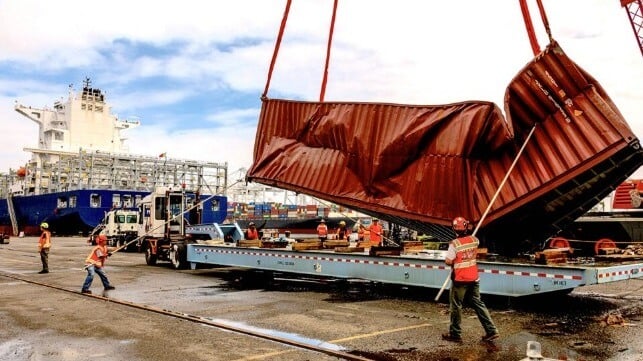
The recovery from the container collapse at the Port of Long Beach has been completed, and the safety restrictions have been lifted. The containership Mississippi has also departed the port on its way back to Asia, bringing to a close the incident after 18 days.
“This was an extremely rare event that required a complex and unique salvage operation,” said Michael Goldschmidt, Port of Long Beach incident commander for the Pier G Container Incident response. “We are grateful to the Coast Guard, vessel managers, salvage teams, and the highly skilled ILWU workers for expediting a safe and speedy return to normal operations.”
A total of 95 containers that fell overboard from the Mississippi at Pier G were recovered in and around the Port of Long Beach. The count, which was originally estimated at 67 and later increased to 75 boxes, increased as they discovered that some units were crushed, submerged, or hidden from view in the nearby boat basin. In the hours after the collapse, they have corralled the boxes and pushed some of them into the basin.
They reported that the efforts employed side-scan sonar and remotely operated vehicles to locate submerged containers. Dive teams were also used to inspect the bottom of the Mississippi and assist in recovering containers around the vessel. After the stacks had been offloaded from the vessel, a tug, pilot vessels, and line handlers were used to reposition the vessel to access containers trapped beneath the bottom of the Mississippi.
The port reduced the safety zone to 100 yards from the originally 500 yards, and then, as of Friday afternoon, September 26, the safety zone was removed. The USCG reports a total of 142 vessel transits were authorized during the salvage operations phase of the response to ensure continued operations in the busy port.
Photos from Friday also showed the Mississippi, which has a capacity of approximately 5,500 TEU, had been fully offloaded. Two of the stacks had been destabilized during the collapse. Boxes were askew on the vessel, and others were hanging over the side or resting on the emission control barge, which was alongside on September 9 when the collapse occurred.
Mississippi departed Port of Long Beach on September 27. Her AIS signal shows she is heading to Cai Mep in Vietnam.
The authorities have not commented on what might have caused the collapse. The U.S. Coast Guard and the National Transportation Safety Board are investigating the incident.
Greece’s $680 Million Investment Plan to Upgrade Ports
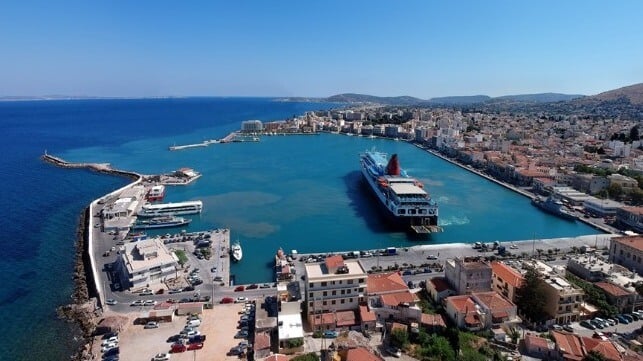
The Greek government has confirmed a $680 million investment plan to modernize the country’s port infrastructure. Speaking at an infrastructure conference in Athens last week, the Greek Deputy Maritime Affairs Minister Stefanos Gkikas said that the port upgrade program will focus on Greece’s island ports.
“The upgrade is a basic priority so that islands acquire equal terms of competitiveness with mainland Greece and international markets,” added Gkikas.
For several years now, port stakeholders in Greece have been highlighting the dilapidated port infrastructure. For instance, some Greek Island ports have gone without repairs for over 30 years. This means the facilities are limited in terms of the type of vessels and cargo they can accommodate. In its annual reports, the Panhellenic Association of Merchant Marine Captains, have decried of the aging Greek port facilities. Some of the pressing challenges that the association has highlighted include years of silt accumulation, significantly reducing port channel depths. Others are crumbling piers and lighthouses, inadequate parking and passenger waiting spaces,
To address some of these challenges, Gkikas said that the maritime ministry has secured $210 million from the National Strategic Reference Framework (NSRF) 2021-2027 Transport program. The initiative is supported by European Union(EU) funds, with additional contributions from Greece. The financing will go into upgrading 30 island ports. Notably, 21 of these port upgrades have already been included in projects being implemented by Growthfund, Greece’s national investment fund.
Greece has also secured another $93 million from EU’s Recovery and Resilience Facility. The funds will further support the planned upgrades in island and regional ports. A major focus of this upgrade effort will include green transition for the ports. Gkikas estimated that at least 12 ports will be equipped with shore power (cold ironing systems) by 2029. $11 million has been allocated for shore power feasibility studies in ports such as Lavrio, Rafina, Kavala and Corfu.
The green transition element of the program is estimated to cost $310 million, with almost half of the financing provided by the Island Decarbonization Fund. The fund is a joint effort between Greece, the EU and the European Investment Bank partly aimed at supporting green transition projects in Greek Islands.

No comments:
Post a Comment