Amnesty: So-Called Gaza ‘Ceasefire’ Becoming Smokescreen For Continued Israeli Genocide

Amnesty International concludes that, over a month after a ceasefire was agreed upon in Gaza and all living Israeli hostages were returned, the Israeli authorities continue to pursue the textbook definition of genocide “by continuing to deliberately inflict conditions of life calculated to bring about their physical destruction.” Moreover, Israeli leaders continue openly to affirm that this course of action is intentional on their parts.
Dan Steinbock here at Informed Comment recently made a similar argument, calling what the Israelis are doing “ecocide.”
The Secretary General of Amnesty International, Agnes Calmard, observed that “Palestinians remain held within less than half of the territory of Gaza, in the areas least capable of supporting life, with humanitarian aid still severely restricted.” Amnesty says that the Israeli military continues to occupy on the order of 55% of the Gaza Strip. There has been no move to rehabilitate the farmland that has been deliberately destroyed by the Israelis over two years or rebuild livestock. The Israelis routinely shoot at Palestinian fishing boats, preventing them from harvesting protein from the sea. The report concludes, “Palestinians are left virtually totally deprived of independent access to forms of sustenance.”
Ms. Calmard warned that: “The ceasefire risks creating a dangerous illusion that life in Gaza is returning to normal. But while Israeli authorities and forces have reduced the scale of their attacks and allowed limited amounts of humanitarian aid into Gaza, the world must not be fooled. Israel’s genocide is not over.”
Amnesty observes that Israeli fighter pilots and troops have killed about 350 people in Gaza since the so-called ceasefire was trumpeted on October 9. Moreover, Israelis are deliberately obstructing the process of rebuilding “life-sustaining infrastructure.” This cruel behavior is also illegal, directly violating “multiple orders from the International Court of Justice (ICJ) for Israel to ensure that Palestinians have access to humanitarian supplies.”
Let me just say that Israeli authorities agreed as part of the ceasefire to allow 600 trucks of food and other aid into Gaza daily. It is only allowing in about 200 trucks per day, only a third of what was pledged. As a result, the World Food Program says it is only able to reach about 100,000 households with food parcels and wheat, and even then it can only get them 75% of full rations. Its target is 320,000 households or 1.6 million needy people.
Again, this is me speaking: These limitations are not natural. They are the result of deliberate Israeli policies. Israeli troops at checkpoints are deliberately slow-rolling the entry of aid into Gaza on orders from Prime Minister Benjamin Netanyahu and his extreme-right cabinet. They are restricting overall humanitarian throughput, creating “major bottlenecks, including de-prioritization of humanitarian cargo, low offloading rates, scanning capacity, and suspended corridors.” Half of the people in the Gaza Strip are children, and thousands of them are undernourished or experiencing food insecurity.
Amnesty’s Agnes Calmard affirmed, “Israel must lift its inhumane blockade and ensure unfettered access to food, medicine, fuel, reconstruction and repair materials. Israel must also make concerted efforts to repair critical infrastructure, restore essential services, provide adequate shelter for the displaced and ensure they can return to their homes.”
The Israelis are even limiting the importation of tents, with many Palestinians sleeping rough or living amid rubble, as winter temperatures plummet and cold rains slice down on children and families. The Israeli destruction of the sewage system leaves people in Gaza at risk of cholera and other water-borne diseases, given open manure pits.
Amnesty is worried that other countries are slacking off in their pressure on Israel to cease genociding the Palestinians. Ms. Calmard said, “Now is not the time to ease pressure on the Israeli authorities. World leaders must demonstrate that they truly are committed to upholding their duty to prevent genocide and to ending the impunity that has fuelled decades of Israeli crimes across the Occupied Palestinian Territory.” She called for a halt to all arms to Israel until its officials cease committing war crimes, and they allow journalists and human rights monitors into the Strip.
She added, “Israeli officials responsible for orchestrating, overseeing and materially committing genocide remain in power. Failing to demonstrate that they or their government will be held accountable effectively gives them free rein to continue the genocide and commit further human rights violations in Gaza and in the West Bank including East Jerusalem.”


United Nations Security Council Resolution 2803 is destined to fail. That failure will come at a price: more Palestinian deaths, extensive destruction, and the expansion of Israeli violence to the West Bank and elsewhere in the Middle East.
The resolution, passed on November 14, 2025, was a consolation prize to Israel after failing to achieve its ultimate objective from the two-year Gaza genocide: the ethnic cleansing of the population and the complete takeover of the Gaza Strip.
Gaza shattered a core Israeli doctrine: the absolute certainty of its military supremacy to subdue the Palestinian people using far superior US and Western-supplied technology. Though the occupation was never expected to be easy – as Israel’s history of violence in the Strip attests – the complete takeover was, in the mind of the Israeli leadership, a certainty. In August, Israeli Prime Minister Benjamin Netanyahu stated with total confidence that Israel aimed to “take control of all of Gaza.” That proved to be wishful thinking.
How Israel has failed to subdue an impoverished and besieged population of 2 million people, subjected to a blockade, a famine, and one of the world’s most horrific genocides, is a question for future historians. The immediate consequence, however, is political: Israel and its Western backers, especially the US, understand that an utter Israeli failure in Gaza would be interpreted by Israel’s victims as a pivotal sign of the times.
In fact, the notion of Israel’s implosion and the end of the Zionist project has moved from the margins of intellectual conversation into the center. These ideas are bolstered by the Israelis themselves and are a recurring topic in Israeli media. Such a headline in Haaretz on November 15 is hardly shocking: “At a Secret Harvard Site, a Massive Archive of Israeliana Is Preserved – in Case Israel Ceases to Exist”.
Thus, US President Donald Trump’s so-called “Comprehensive Stabilization Plan for Gaza,” signed in Sharm el-Sheikh on October 30, 2025, was the official start of the American scheme to save Israel from its own blunders. That supposed ‘ceasefire’ was meant to give Israel the chance to maneuver. Instead of occupying all of Gaza and pushing Palestinians out, Israel would now use social and political engineering to achieve the same goal.
The first phase of the plan, which placed most of Gaza under Israeli military control in anticipation of a gradual withdrawal, is already proving to be a sham. As of the time of writing this article, Israel, according to the Gaza government media office, has violated the agreement nearly 400 times, killing over 300 Palestinians. Israel continues to systematically demolish Palestinian areas and has increasingly begun operating west of the Yellow Line, which separates Gaza into two regions.
Worse still, according to Gaza authorities, Israel has been expanding its share of Gaza, estimated at approximately 58 percent, westward. The ‘ceasefire’ has effectively enforced a new mechanism that allows Israel to carry out a one-sided war – with further territorial expansion, destruction, assassination, and occasional massacres – while Palestinians expect nothing but the mere slowing down of the Israeli death machine. This is not sustainable, especially since Israel has also violated the most basic principle of the imaginary ceasefire: allowing vital aid to enter Gaza.
UNSC 2803 endorses the “Comprehensive Stabilization Plan for Gaza” without placing any legally binding expectations on Israel. It establishes a Transitional Administration and Oversight Council (TAOC), which entirely excludes Palestinians, including the Western-supported Palestinian Authority.
The executive branch of this TAOC would be the International Stabilization Force (ISF), whose sole job is to “stabilize the security environment in Gaza” on behalf of Israel, notably by disarming Palestinian groups. The ISF, according to the resolution, operates “in close consultation and cooperation,” meaning the force is tasked with achieving Israel’s military objectives, thereby allowing Israel to determine the timing and nature of its supposed gradual withdrawal.
Since Palestinians refuse to disarm – as unconditional disarmament without meaningful international guarantees would surely lead to the full return of the Israeli genocide – Israel will certainly refuse to leave Gaza. Netanyahu made that clear on November 16, when he stated that “Israel would not withdraw” without disarming Hamas, “either the easy way or the hard way”.
The partition of Gaza is a US-led attempt to change the nature of the challenge for Tel Aviv, but ultimately aims at achieving the same original objectives. The resolution has served Israel’s interests fully, hence Netanyahu’s enthusiasm, yet Israel is still refusing to respect it, making it clear there will be no phase two of Trump’s original plan.
The entire political scheme, however, is doomed to fail. Though Palestinian suffering will certainly worsen in the coming months, the US-Israeli gambit is fundamentally flawed: it is built on trickery and coercion, resting on the false assumption that Palestinians, fearing genocide, will accept any plan imposed on them. This premise ignores history. Palestinians have consistently defeated such sophisticated mechanisms designed to break them, meaning this new arrangement is equally unsustainable.
Ultimately, the failure of UNSC Resolution 2803 confirms one enduring truth: the Israeli war on Gaza has not stopped. It has simply changed form. It is crucial that people around the world understand this next phase for what it is: a diplomatic maneuver designed to facilitate the ongoing Israeli plan to control the Gaza Strip and ethnically cleanse its population.
The New Kill Zone: Gaza’s Borders after the ‘Ceasefire’
November 26, 2025
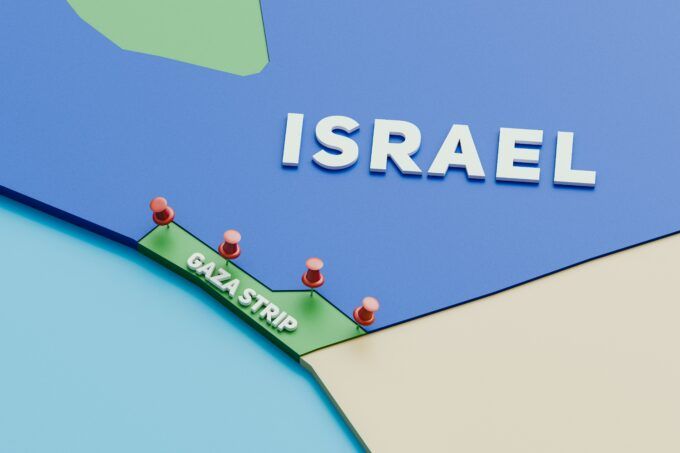
Image by Alex Shuper.
The so-called Gaza ceasefire was not a genuine cessation of hostility, but a strategic, cynical shift in the Israeli genocide and ongoing campaign of destruction.
Starting on October 10, the first day of the announced ceasefire, Israel transitioned tactics: moving from indiscriminate aerial bombardment to the calculated, engineered demolishing of homes and vital infrastructure. Satellite images, corroborated by almost hourly media and ground reports, confirmed this methodical change.
As direct combat forces seemingly withdrew to the adjacent “Gaza envelope” region, a new vanguard of Israeli soldiers advanced into the area east of the so-called Yellow Line, to systematically dismantle whatever semblance of life, rootedness, and civilization remained standing following the Israeli genocide. Between October 10 and November 2, Israel demolished 1,500 buildings, utilizing its specialized military engineering units.
The ceasefire agreement divided Gaza into two halves: one west of the Yellow Line, where the survivors of the Israeli genocide were confined, and a larger one, east of the line, where the Israeli army maintained an active military presence and continued to operate with impunity.
If Israel truly harbored the intention of, indeed, evacuating the area following the agreed-upon second phase of the ceasefire, it would not be actively pursuing the systematic, structural destruction of this already devastated region. Clearly, Israel’s motives are far more insidious, centered on rendering the region perpetually uninhabitable.
Aside from leveling infrastructure, Israel is also carrying out a continuous campaign of airstrikes and naval attacks, relentlessly targeting Rafah and Khan Yunis in the south. Later, and with greater intensity, Israel also began carrying out attacks in areas that were, in theory, meant to be under the control of Gazans.
According to the Palestinian Ministry of Health in Gaza, 260 Palestinians have been killed and 632 wounded since the commencement of the so-called ceasefire.
In practice, this ceasefire amounts to a one-sided truce, where Israel can carry out a relentless, low-grade war on Gaza, while Palestinians are systematically denied the right to respond or defend themselves. Gaza is thus condemned to relive the same tragic cycle of violent history: a defenseless, impoverished region trapped under the boot of Israel’s military calculations, which consistently operate outside the periphery of international law.
Before the existence of Israel atop the ruins of historic Palestine in 1948, the demarcation of Gaza’s borders was not driven by military calculations. The Gaza region, one of the world’s most ancient civilizations, was always seamlessly incorporated into a larger geographical socio-economic space.
Before the British named it the Gaza District (1920-1948), the Ottomans considered it a sub-district (Kaza) within the larger Mutasarrifate of Jerusalem – the Jerusalem Independent District.
But even the British designation of Gaza did not isolate it from the rest of the Palestinian geography, as the borders of the new district reached Al-Majdal (today’s Ashkelon) in the north, Bir al-Saba’ (Beersheba) in the east, and the Rafah line at the Egyptian border.
Following the 1949 Armistice Agreements, which codified the post-Nakba lines, the collective torment of Gaza, as illustrated in its shrinking boundaries, began in earnest. The expansive Gaza District was brutally reduced to the Gaza Strip, a mere 1.3 percent of the overall size of historic Palestine. Its population, due to the Nakba, had explosively grown with over 200,000 desperate refugees who, along with several generations of their descendants, have been trapped and confined in this tiny strip of land for over 77 years.
When Israel permanently occupied Gaza in June 1967, the lines separating it from the rest of the Palestinian and Arab geography became an integral, permanent part of Gaza itself. Soon after its occupation of the Strip, Israel began restricting the movement of Palestinians further, sectionalizing Gaza into several regions. The size and location of these internal lines were largely determined by two paramount motives: to fragment Palestinian society to ensure its subjugation, and to create military ‘buffer zones’ around Israeli military encampments and illegal settlements.
Between 1967 and Israel’s so-called ‘disengagement’ from Gaza, Israel had built 21 illegal settlements and numerous military corridors and checkpoints, effectively bisecting the Strip and confiscating nearly 40 percent of its land mass.
Following the redeployment, Israel retained absolute, unilateral control over Gaza’s borders, sea access, airspace, and even the population registry. Additionally, Israel created another internal border within Gaza, a heavily fortified “buffer zone” snaking across the northern and eastern borders. This new area has witnessed the cold-blooded killing of hundreds of unarmed protesters and the wounding of thousands who dared to approach what was often referred to as the “kill zone.”
Even the Gaza sea was effectively outlawed. Fishermen were inhumanely confined to tiny spaces, at times less than three nautical miles, while simultaneously surrounded by the Israeli navy, which routinely shot fishermen, sank boats, and detained crews at will.
Gaza’s new Yellow Line is but the latest, most egregious military demarcation in a long, cruel history of lines intended to make the lives of the Palestinians impossible. The current line, however, is worse than any before it, as it completely suffocates the displaced population in a fully destroyed area, without functioning hospitals and with only trickles of life-saving aid.
For Palestinians, who have been battling confinements and fragmentation for generations, this new arrangement is the intolerable and inevitable culmination of their protracted, multi-generational dispossession.
If Israel believes it can impose the new demarcation of Gaza as a new status quo, the next few months will prove this conviction devastatingly wrong. Tel Aviv has simply recreated a much worse, inherently unstable version of the violent reality that existed before October 7 and the genocide. Even those not fully familiar with the deep, painful history of Gaza must realize that sustaining the Yellow Line of Gaza is nothing more than a dangerous, bloody illusion.
Dr. Ramzy Baroud is a journalist, author and the Editor of The Palestine Chronicle. He is the author of six books. His forthcoming book, ‘Before the Flood,’ will be published by Seven Stories Press. His other books include ‘Our Vision for Liberation’, ‘My Father was a Freedom Fighter’ and ‘The Last Earth’. Baroud is a Non-resident Senior Research Fellow at the Center for Islam and Global Affairs (CIGA). His website is www.ramzybaroud.net
Nine Days in Gaza: Dr. Amr Gharib’s Testimony from Nasser Hospital
In conversation with Faramarz Farbod, Dr. Amr Gharib, a US physician with dual specialties in Emergency & Family Medicine, reflects on witnessing suffering, resilience, and humanity inside Gaza’s overwhelmed Nasser Hospital.
In this deep and wide-ranging conversation, historian Rashid Khalidi breaks down the political landscape of Palestine today — from the legacy of the Oslo Accords and the failures of the PA to the rise of Hamas, the nature of armed resistance, and the meaning of Oct 7 (Al-Aqsa Flood).
Khalidi explains how he understands Trump’s new plan, comparing aspects of it to the British Mandate era, where promises of statehood were made without any real intention of delivering them. He argues that the Israeli cabinet has no intention of allowing a Palestinian state, so Washington’s talk of “moving toward statehood” has no grounding in political reality.
We also explore the plan’s claims about reconstruction in Gaza. Khalidi questions whether Trump is serious about reconstruction at all — insisting that governance and security must be addressed first, otherwise reconstruction is impossible.
The discussion examines:
- Hamas as a form of resistance, and how Palestinians perceive different forms of resistance
- Hamas governance, its community networks and its political evolution
- How the PA relates to resistance, and why it has lost legitimacy
- Why Arafat and the Tunis leadership misread the Oslo Accords
- Why Russia and China abstained at the UN Security Council
- The shift in U.S. public opinion on Israel–Gaza — and why political change will still be slow
- The role of Arab states, their focus on regime stability, and their complicity in Israel’s actions
- How Khalidi now assesses Oct 7, its causes, and its consequences
This is one of Khalidi’s most comprehensive analyses on Palestinian resistance, global geopolitics, and the future of statehood.


No comments:
Post a Comment