'Scientifically COP30 has been nothing less than a failure,' researcher says
Issued on: 24/11/2025 - FRANCE24
07:54 min

BY: Stuart Norval
A leading climate researcher has told FRANCE 24 that the conclusion of the COP30 summit at the weekend was scientifically nothing less than a failure. Johan Rockström is director of the Potsdam Institute for Climate Impact Research. The German institute is seen as one of the world’s top environmental think tanks. Although more funding for countries to adapt to extreme weather events was agreed, there were no explicit details to phase out fossil fuels or strengthen countries' inadequate emissions-cutting plans, which dozens of nations had demanded. Rockström spoke to us in Perspective.
G20, COP30 and More Mickey-Mouse Multilateralism to Come
November 26, 2025
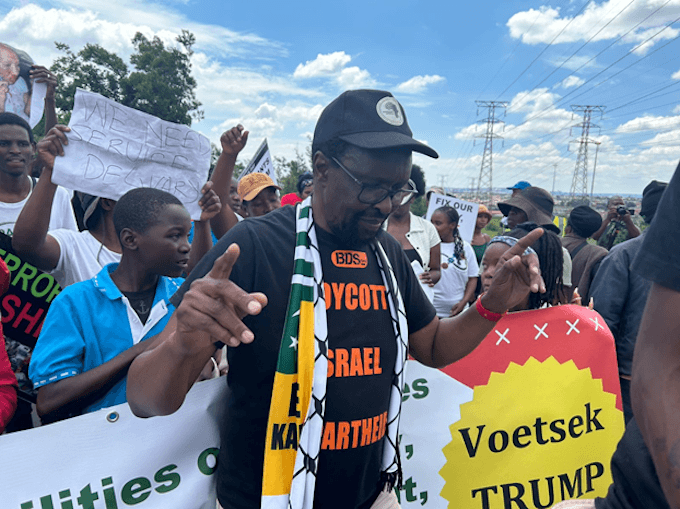
Protest march led by Trevor Ngwane, United Front, from Soweto to the G20 conference center in Johannesburg (November 23). Photo: Premilla Mur.
The third weekend in November offered the world two disastrous days for solving polycrisis problems, starting in the Brazilian Amazon city of Belém at the United Nations climate summit (‘COP30’) on November 22, just as South African President Cyril Ramaphosa hosted (most of) the Group of 20 leaders in Johannesburg. The G20 comprises 19 of the world’s major economies plus the European Union and, in 2023, the African Union was added (tokenistically).
The body was formed in 1999 as a finance ministers’ club at a Berlin meeting, at a time of nervousness about economic crises in several middle-income countries, including South Africa. But it was in 2008 that the G20 graduated to a heads-of-state annual meeting, due to deregulated U.S. banking rapidly degenerating, starting with real estate speculation, leading to Bear Stearns and Lehman Brothers collapsing. U.S. President George W. Bush was told by his financial managers that the coming global meltdown would urgently require new funding sources, especially from middle-income countries with large surplus dollar reserves.
As the G20’s first major act, South African finance minister Trevor Manuel led a committee to grant the International Monetary Fund (IMF) nearly $1 trillion worth of new funding, approved by the G20 in an April 2009 London emergency meeting. That session also coordinated central banks’ low interest rates and money printing, termed Quantitative Easing (‘QE’), so as to flood liquidity into financial markets and thus avoid a repeat of the 1930s Great Depression.
And again in 2020 during the Covid-19 crisis, G20 leaders agreed that their capitalist self-interest was threatened sufficiently by widespread pandemic-prevention lockdowns and economic seizures, that further QE and much lower interest rates were needed. In addition, a brief pause on the poorest countries’ foreign debt repayments was offered. But that didn’t prevent three African economies that were among the 2010s fastest-growing in the world – Zambia, Ghana and Ethiopia – from defaulting on foreign debt repayments between 2020-23, and terrible fiscal pressure to mount across the continent.
These two financial bailouts were G20 interventions that suggest, in a time of peril, imperial-subimperial fusion can be achieved. On the other hand, intra-capitalist divisions over handling Covid-19 vaccines and treatment were not solved within the G20 from 2020-22: British and German leaders vetoed efforts by South Africa and India wanting an Intellectual Property waiver (the way AIDS drugs were made generic in 2001, saving millions of lives). Ramaphosa was at his best appealing for health justice, allied with India’s Narendra Modi; but Boris Johnson and Angela Merkel were too intent on defending their own Big Pharma firms.
Since then, the world’s crises – climate and biodiversity catastrophes, brutal wars, economic volatility, the threat of rampant Artificial Intelligence, extreme inequality and others – have multiplied, and their causes now extend well beyond the greed and irresponsibility of the traditional Western imperial powers. In 2010 when the Brazil-Russia-India-China-South Africa BRICS emerged as a counterpart to the G7, the G20’s responsibilities for global economic management were codified, but other crises were added to the workload. And the recent G20 presidencies of Indonesia (2022), India (2023) and Brazil (2024) – all BRICS members (Jakarta having joined in 2025) – highlighted the subimperial powers’ newly-significant roles, not in providing alternatives, but instead in legitimizing status quo multilateralism.
Indeed, with the advent of far-right Western rulers (Trump from 2017-21 and again since January this year, and in Italy, Giorgia Meloni since 2022), and three more neo-fascist parties currently leading in European polls – Reform in the United Kingdom (which hosts the 2027 G20), the Alternative for Germany, and the French National Front – there arises the threat and reality of fast-spreading ‘paleo-conservative’, economically-isolationist, xenophobic and socially-reactionary politics.
In this ominous period, the African continent’s first hosting of the G20 was meant to build upon Lula Ignacio da Silva’s November 2024 Rio de Janeiro summit, by taking the baton on coordinated international taxation of the ultra-rich and on food security, adding ‘disaster resilience and response,’ African debt relief, climate financing for a ‘just energy transition’ and ‘harnessing critical minerals for inclusive growth and sustainable development.’ The likes of Joe Stiglitz and other progressives were even drawn into a major inequality commission – albeit one which did not have the grace to recognize any social activists’ initiatives.
From the beginning of 2025, more than 130 official meetings were held in various glamourous South African sites. Not only did G20 civil servants labor over phraseology, but so did a myriad of allied groups Ramaphosa’s team had gathered: B20 for business (guided by McKinsey and Bain in spite of being told by Ramaphosa to fire those particular conslutants), L20 for workers, W20 for women, C20 for civil society, Ch20 for children, M20 for media, etc. But as the dust settles, it all appears for naught.
Rebuffed by Trump
In Johannesburg on November 22-23, the Nasrec setting for G20 leaders – minus Donald Trump, Xi Jinping, Vladimir Putin, Claudia Sheinbaum, Mohammed bin Salman and Prabowo Subianto – was very different than what Ramaphosa must have anticipated when taking over management of the bloc last December. At that point, in Ramaphosa’s most obsequious mode – so different than in mid-2018 when he scathingly criticized Trump for interfering in local land reform politics – South Africa’s leader hurriedly invited the U.S. president-elect for a formal state visit and especially for a round of golf, replete with characteristic elite chuckling about taking time off to improve his game.
The invitation was repeated as late as the disastrous Oval Office meeting on May 22, when Ramaphosa handed over a R10 000, 14-kg golf course book, and his sidekick golf pro Ernie Els thanked Trump for the CIA’s empowerment of Pretoria’s apartheid-era army during its 1970s-80s invasion of Angola plus sponsorship of right-wing UNITA guerrillas – “you guys helped us“ – which killed up to a million black Angolans.
The South African elites’ sickening sweet-talk had begun soon after SA Ambassador Ebrahim Rasool was fired in March by U.S. foreign minister Marco Rubio for remarks about Washington’s new orientation to [white] ‘supremacy.’ The first reconciliation effort was made in April by special envoy Mcebisi Jonas – but failed since he was not even allowed into the U.S. by Rubio, due to similar (truthful) insults that he’d made in 2020 about Trump’s racism and narcissism. (Jonas also chairs the huge MTN cellphone company which is under attack in the U.S. courts for dubious activities in Afghanistan and Iran, when Ramaphosa was the firm’s board chair.)
The task of Trump-whispering then fell to ultra-neoliberal trade minister Parks Tau and Ramaphosa’s investment advisor Alistair Ruiters. Trump first imposed tariffs in February, on steel, aluminium and autos, which in subsequent weeks proved devastating to South African exports. The tariffs were expanded in April and again in August, when Trump also killed the Africa Growth and Opportunity Act, which since 2000 made many goods tariff-free. At that point, three new agriculture-sector victims – citrus (later retracted), nuts and vineyard products – were hit with a 30% tariff, mainly hurting the very Afrikaner farmers Trump had pretended to support through his bizarre, unsuccessful refugee recruitment gimmick, given his presumption the Afrikaners were suffering ‘genocide’.
Trump’s on-and-off ally Elon Musk – very badly raised in South Africa, “nearly beaten to death,” as he described his Johannesburg high school’s bullying culture, which his deranged father supported – and other U.S. capitalists also insisted that Ramaphosa drop Black Economic Empowerment policy, i.e., enforced sharing of investment assets. And powerful U.S. Zionists persuaded Trump to demand Ramaphosa retract the December 2023 case Pretoria filed at the International Court of Justice (ICJ) against Israel’s Gaza genocide. While failing to change Pretoria’s policy, Washington is still contemplating a messy, apparently inadequate offer by Tau to buy $12 billion worth of U.S. methane gas plus adulterated poultry, in turn threatening extreme damage via greenhouse gas emissions and local chicken factory-farm bankruptcies.
Trump’s rejection of U.S. participation contributed to the superficial, blindly-nationalistic character of commentary within South Africa. In his last pre-summit comment, on November 7, Trump announced, “It is a total disgrace that the G20 will be held in South Africa. Afrikaners (People who are descended from Dutch settlers, and also French and German immigrants) are being killed and slaughtered, and their land and farms are being illegally confiscated. No U.S. Government Official will attend as long as these Human Rights abuses continue. I look forward to hosting the 2026 G20 in Miami, Florida!”
Miami is about 370 km south of the famous Disney World resort, where Mickey Mouse frolics. The souring of G20 diplomacy was witnessed in Finance Minister Enoch Godongwana’s (quite realistic) scenario for late 2026: “If the US do not want us to participate, the only way they can do it is to decline us a visa.”
Also reflecting Washington’s cartoonish arrogance, a last-minute request was made by the U.S. State Department to allow a deputy ambassador in Pretoria to formally receive the official G20 handover on November 23. Ramaphosa demurred, for this would violate his own conservative proceduralist mentality, which in turn led Trump’s jejune (28-year-old) press secretary Karoline Leavitt to claim on November 20 that the South African president was “running his mouth a little bit against the United States”. More such insults will no doubt come from the newly-approved U.S. Ambassador to Pretoria, far-right media activist Brent Bozell, who during the 1980s regularly denounced Nelson Mandela as a terrorist. Indignity upon indignity will continue to rain on South Africa from yankee perches.
Instead of pushing for the U.S. to be expelled from the body due to Trump’s multiple attacks on multilateralism (climate, public health, trade, aid, fascistic abuse of refugees and immigrants, genocide facilitation and other acts of geopolitical insanity including repeated invasion threats such as against Nigeria this month), Ramaphosa replied with a merely bureaucratic rationale: “America chose to boycott this summit. That’s their prerogative to do so. But what cannot happen is breach of protocol being forced down our throats.”
The White House reacted on November 23 with a banal claim that Ramaphosa was “refusing to facilitate a smooth transition of the G20 presidency. This, coupled with South Africa’s push to issue a G20 leaders’ declaration, despite consistent and robust U.S. objections, underscores the fact that they have weaponized their G20 presidency to undermine the G20’s founding principles.” Indeed, Ramaphosa’s main victory was getting an 11,000-word collective Declaration out of the group, instead of merely a (self-delegitimizing) ‘Chair’s Statement’. But the devils in the details soon became clear to critics.
From protocol indignities to ‘non-binding’ progressive policies and revealing omissions
What’s wrong with the documentation laboriously prepared in 2025 in those 130 meetings, putatively to guide G20 collective policy and action? Simply: another case of talk left, walk right.
Pretoria’s choice of three progressive theme words – solidarity, equality, sustainability – was uplifting, and were quickly recognized as the precise opposite of the new Trump regime’s agenda. As Rubio blurted out on X.com back on February 5: “I will NOT attend the G20 Summit in Johannesburg. South Africa is doing very bad things. Expropriating private property. Using G20 to promote ‘solidarity, equality, & sustainability. In other words: DEI [diversity, equity and inclusion] and climate change’.”
The provocative themes can be credited to the ‘sherpa’ guiding the process: Zane Dangor, director general of the Department of International Relations and Cooperation. Five years ago, Dangor wrote (in the country’s main ezine) of his desire to hear voices of “eco-feminists/eco-socialists,” whose “ideas are required if we are to build a new politics that can improve the well-being of all people on a healthier planet.” He represents one of the finest cases of catapulting from South Africa’s liberation tradition into civil-service realpolitik, so it was no wonder that progressive NGOs took Dangor’s leadership and the three theme words at face value, and that so many joined the various drafting processes.
Gilad Isaacs, the director of what is probably the most ambitious and effective of these, the Johannesburg-based Institute for Economic Justice, expressed optimism on November 22: “The U.S. boycott will not derail the work. The credibility of the presidency will be measured not by the presence of any one country, but by whether the agenda set in the interests of the Global South is carried through and used in other forums.”
But in reality, derailment of all progressive G20-legitimating work is inevitable. One reason is the Declaration’s continual resort to two weasel words – ‘voluntary’ and ‘non-binding’ – in vital areas where capitalism desperately needs major doses of nationalization, or at minimum tough regulation:
“we welcome the G20 Critical Minerals Framework, which is a voluntary, non-binding blueprint… we welcome the Voluntary and Non-Binding G20 High-Level Principles on Sustainable Industrial Policy for Inclusive Economic Growth, Industrialization, Jobs and Equality… We discussed the need for improved integrity, and interoperability in carbon credit markets and note the voluntary and non-binding Common Carbon Credit Data Model… we note the South African Presidency initiative on a G20 Africa Cooperation Agenda on Trade and Investment, which is a voluntary and non-binding initiative… [and] look forward to the roadmap towards the implementation of Voluntary and Non-Binding High-Level Principles on Combating Illicit Financial Flows.”
Vicious U.S. politicians will inevitably make fun of this wishy-washy posturing, with Treasury Secretary Scott Bessent already declaring, “We have whittled down the G20 back to basics … the G20 had become basically the G100 this past year. So it will be a concentrated group in Miami, seeing the best America has to offer, with American leadership.”
Indeed, Washington’s role in delimiting Dangor’s wordsmithing was apparently effective, as a New York Times reporter documented on November 15: U.S. functionaries “had spent much of the year drawing red lines, skipping working meetings and refusing to negotiate in the lead-up to the final gathering in Johannesburg. The moves, they said, put into stark relief Mr. Trump’s aggressive foreign policy and distaste for multilateralism, compromise and anything he considers political correctness.”
In scaling back G20 energy-access rhetoric, the Times named Argentina, Saudi Arabia and Turkey as Trump’s saboteur allies. And on public health, “The U.S. delegation said it could collaborate on fighting noncommunicable diseases like cancer, but issues of equity, universal health care and support for the World Health Organization were nonstarters.”
Another example comes from a Media20 effort where a local reform leader, Michael Markovitz, wrote on FB how “we must also be honest about what was left out.” His team’s backroom support work on the M20 declaration – “endorsed by more than 70 organizations” – “set out four priorities essential to democratic resilience: information integrity, media sustainability, journalist safety, and the survival of public interest journalism.” But as a dismayed Markowitz discovered,
“None of these issues appear in the final Leaders’ Declaration at the G20 South Africa. There is no reference to information integrity. There is no acknowledgement of journalism’s role in safeguarding democracy. These are not minor omissions. In my view, it is a governance failure at the level of the G20. It is a gap that weakens the credibility of the multilateral system at the moment democracies need it most… If the information ecosystem is poisoned, every G20 goal becomes harder to achieve. Climate action, inclusive growth, digital cooperation and peaceful societies all depend on trusted information. In its absence, trust in important public institutions will continue to be eroded.”
G20 starves us of peace and food sovereignty
Even where host South Africans might have been ambitious in making demands, three other barriers arose to a serious declaration with implementation accountability: hypocrisy, a limited world view and upward-gazing elitism. On food security, for example, Ramaphosa had firmly signaled solidarity-equality-sustainability values in November 2024, at the Rio de Janeiro summit, beseeching fellow leaders that the G20 “must be capable of combating the use of hunger as a weapon of war, as we are now seeing in some parts of the world, including in Gaza and Sudan.”
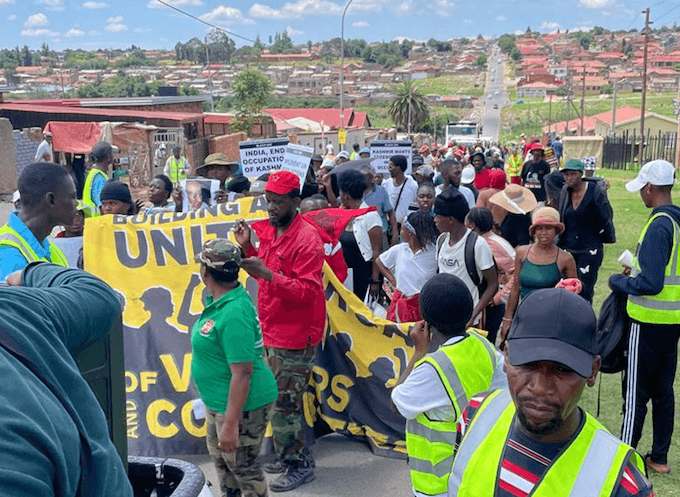
Photo: Premilla Mur.
Yet five days earlier, his lead minister within the SA Presidency – Khumbudzo Ntshavheni – vocally advocated systematic starvation as a weapon of class war, against thousands of underground informal-sector gold miners about two hours’ drive southwest of Johannesburg, in Stilfontein: “We are not sending help to criminals. We are going to smoke them out.” Ntshavheni knew the consequences, because two weeks before that, she had bragged to the media how the police and army “blocked communities in and around these abandoned mining shifts in Orkney from delivering food parcels, water and necessities to these illegal miners.”
As a result, starving mineworkers were forced to eat cockroaches and human flesh. It is likely that, by mid-January 2025 when courts finally ruled Ntshavheni’s murderous practice must cease, many dozens or even hundreds of mineworkers had died due to starvation or, because in a desperately weakened state, they had tried to escape by climbing up extremely steep mineshafts – falling to their deaths.
There was much more hollow, hypocritical rhetoric in the Johannesburg Leaders’ Declaration, e.g., “We will work for a just, comprehensive, and lasting peace in Sudan, the Democratic Republic of Congo, the Occupied Palestinian Territory, Ukraine, as well as ending other conflicts and wars around the globe.”
Those crafting the Declaration’s vapid phrasing were too fearful to name the aggressors and profiteers – much less arrange punishment – in the four cases, which range from capitalists within the BRICS such as Emirati gold traders and Russian (Wagner Group) soldiers in Sudan; to Chinese and Johannesburg- and London-listed mining houses in the eastern DRC; to all G20 economies’ firms which trade with Israel; to Russia killing hundreds of thousands of Ukrainian (and Russian) workers – yes, provoked initially by the G7’s eastward NATO military expansion but still inexcusable, and justifying a unified intervention to punish Putin effectively, to force him to return stolen territory (and children) and to pay reparations, in lieu of Trump’s incompetent Ukraine-surrender plan.
And speaking of Gaza, Ramaphosa’s brother-in-law Patrice Motsepe is still fueling the Israel Defense Forces with coal he co-supplies its powerplants (and 18% of the genocidaires’ grid), alongside Ramaphosa’s former coal-mining partners at Glencore, dating to the late 2000s in both cases. This fuel violates an ICJ ruling in July 2024 that states must halt “aid or assistance in maintaining the situation created by Israel’s illegal presence in the Occupied Palestinian Territory”, and a United Nations General Assembly resolution two months later (with a vote of 124 for, 14 against) for states to “prevent trade or investment relations that assist in the maintenance of the illegal situation” – plus Pretoria’s repeated Hague Group commitments to respect UN courts and prevent fuel from reaching the military.
Notwithstanding Palestine Solidarity Campaign protests at Motsepe’s offices and weekly demonstrations at Glencore’s Joburg headquarters, neither Ramaphosa nor the other G20 genocide collaborators had anything specific to say in the Leaders’ Declaration about the ICJ or International Criminal Court, which indeed they are actively undermining in relation both to Palestinians and climate justice, in view of an ICJ ruling in July that states (mainly G20 members) should pay their climate debt.
Other high-minded hypocritical fibs pothole the Leaders’ Declaration: “We affirm our unwavering commitment to act in accordance with international law including international humanitarian law and the Charter of the United Nations and its principle of peaceful settlement of disputes and in this regard, we condemn all attacks against civilians and infrastructure.” Yada yada.
When it comes to hunger crises, other important words are unmentionable in either the Declaration or G20 Food Task Force statement: multinational agribusiness, intellectual property, genetic engineering, carnivore, profiteering and speculation. These terms are not to be found, because they are assumed to be a natural part of corporate agriculture – although all undermine food sovereignty and climate sanity. Reforms like “land redistribution” and “agro-ecology” and genuine peasant empowerment are not mentioned; for they would violate the G20 Food Task Force’s commitment to “pursuing actions that are in compliance with WTO rules and obligations.” The G20 declaration pushes ‘food security’ phraseology without any concession whatsoever to the objectives of grassroots food sovereignty movements.
In addition to ignoring the content demanded by progressive anti-hunger and food-system activists, the most obvious aspect of any G20 official statement is silence about – and thus disrespect for – processes of civil society mobilization. The G20 Food Task Force statement ignores courageous movements around the world, e.g. the Via Campesina network, whose members have struggled valiantly for land redistribution and pro-peasant policies.
So civil society should have had no expectation of being taken seriously by the G20 in Johannesburg, within a country where more than 12 million of the 62 million population is considered to be food insecure, led by a hedonistic ruling class that exudes subimperial obeisance to agricultural imperialism.
Financial imperialism
The same upward-gazing obsession could be observed in the G20’s highest-profile task force – led by the same Trevor Manuel who bailed out the IMF in 2009 – on ‘Growth, Debt and Development’, which was aimed mainly at alleviating the home continent’s worsening fiscal crises, e.g. through IMF gold sales. The mass protests and demands from so many African movements where unrest has been intense in recent months – from Madagascar and Mozambique, up to Morocco and Tunisia – are not referenced, much less acknowledged and respected.
Specifically unmentionable for G20 financial-reform bureaucrats are the clear strategies coming from Kenya’s Gen Z since mid-2024, for example, demanding ‘debt audits’ to determine whether corrupt lending for corrupt projects should be considered ‘Odious Debt’ – so that the creditor takes a haircut, not just society’s most vulnerable. The two biggest South African parastatal debtors – Eskom electricity (for the Medupi and Kusile coal-fired power plants) and Transnet (for Chinese locomotives) – are obvious cases in which the fiscal burden of corruption soared over the past two decades due to Pretoria taking on foreign loan repayment obligations, even in cases where lenders like the World Bank were obviously implicated in the Odious Debt burden due to oft-acknowledged graft or project maldesign.
Many other civil society forces across Africa argue for ‘reparations’ based on standard ‘polluter pays’ principles, to be paid as ‘climate debt’ by the big Western and BRICS greenhouse gas emitters – including China, which is owed a substantial share of Africa’s foreign debt. Such ideas dare not be mentioned by Manuel’s small-minded team, so perhaps his declaration’s sentence of greatest merit is this: “Over recent presidencies, the G20 has debated Multilateral Development Bank reform, debt sustainability, and climate finance, yet progress has been slow and credibility is waning.”
One feature of waning credibility is non-acknowledgment of conflicts of interest. For many months, debt activists have worried that if Manuel – as chair of this commission, and the most effective neoliberal politician in the country’s history – also runs institutions that have African sovereign financial instruments among their assets (e.g. Africa’s largest insurance company, and the local branch of the notorious Rothschilds), then there is little hope for South Africa’s G20 presidency.
Moving to the Leaders’ Declaration, “We continue to urge the international community to support vulnerable countries with a strong reform agenda whose debt is sustainable but are facing liquidity challenges and encourage the IMF and the World Bank to continue their work on feasible options to support these countries, which should be country-specific and voluntary.” Translation: Africa’s toughest neoliberal finance ministers – aiming to privatize and to cut social spending (i.e. that ‘strong reform agenda’) – need to load on yet more debt, to swamp current and future generations with permanent structural adjustment obligations.
Climate chaos confirmed
The Leaders’ Declaration was correct to brag about the COP30: “We highlight the successful outcomes of the 2025 United Nations Framework Convention on Climate Change Conference COP30 in Belém.” After all, ruling classes from the G1, the other G7s and the BRICS have – since the 2009 Copenhagen Accord – resolutely lined up against everyone else, on three foundational positions:
1) do not agree to cut emissions or leave fossil fuels underground to the extent necessary to save us all from planetary catastrophe;
2) do not admit you emitted by acknowledging the ‘polluter pays’ principle because you’ll face liability claims, and have to pay ‘climate debt’ and reparations (as even the ICJ in July 2025 ruled is logical);
3) instead, do limit climate finance to loans, and ‘privatize the air’ through carbon markets, dubious offsets and other emissions-trading gimmickry.
From these three standpoints, COP30 was a roaring success for the G20 ultra-polluters. One obvious conclusion is that a ‘Global North’ (bad, villains) versus a ‘Global South’ (good, victims) is not an appropriate framing. Instead we have a configuration that allows the COP30 – like so many before it – to fuse imperial and subimperial interests. Speaking to the BBC, Li Shuo of the Asia Society remarked, “This partly reflects the power shift in the real world, the emerging power of the BASIC and BRICS countries, and the decline of the European Union.” (BASIC is Brazil, South Africa, India and China).
The BBC continued, “US President Donald Trump stayed away, but his stance emboldened his allies here. Russia, normally a relatively quiet participant, was to the fore in blocking efforts on roadmaps [to phase out oil, gas and coal]. And while Saudi Arabia and other major oil producers were predictably hostile to curbing fossil fuels, China stayed quiet and concentrated on doing deals.”
In addition to the U.S. – also absent from Belém due to Trump’s anti-science climate denialism – and Russia, the 24-member ‘Like Minded Group of Developing Countries’ is to blame for preventing fossil fuels from being left underground: Algeria, Bangladesh, Bolivia, China, Cuba, Ecuador, Egypt, El Salvador, India, Indonesia, Iran, Iraq, Jordan, Kuwait, Malaysia, Mali, Nicaragua, Pakistan, Saudi Arabia, Sri Lanka, Sudan, Syria, Venezuela and Vietnam. Of these, 11 are BRICS members, partners and invitees. The London Overseas Development Institute named China, India, Russia, Saudi Arabia and the United Arab Emirates as the main forces preventing even mention of a fossil fuel phase-out. The Financial Times reported that UN Secretary General António Guterres singled out the Saudis for most of the wrecking blame.
But Pretoria also helped foil COP30 climate-adaptation work because of a surreal personality battle within Ramaphosa’s centre-right co-governing party, the Democratic Alliance. The white-dominated 25%-supported party had won the right to name an environment minister in a Government of National Unity after the last election, in July 2024, and chose Dion George – whose background in corporate finance in the ultra-corrupt Sandton central business district of Johannesburg and his unashamed role as an apartheid-era soldier lowered expectations. George was sufficiently subimperialist in orientation that he was chosen as the UN’s COP29 co-chair on emissions mitigation in 2024 and COP30 co-chair of adaptation.
Those roles meant that when African delegations walked out of the COP29 in fury, he could stay behind and side with the rich climate vandals, so as not to spook the G20. Yet when it came to protecting lions and other big game from hunters, George’s traditional version of conservationism ran up against white game-farming and wildlife-trafficking interests, and so unceremoniously he was dumped as minister just as the COP30 began, replete with sleazy rumours of sexual harassment that he vows to take up in a libel suit.
But overall, as climate advocacy groups argued, the firing of George “gives the perception that the South African government is not serious about climate change or its leadership in the negotiations, despite this being a crisis that threatens the fundamental social and economic aspirations of all in South Africa.” The perception is the reality, of course, with Pretoria seeking not only to keep coal-fired power plants open much longer than promised in its Just Energy Transition Partnership fundraising, but to initiate massive new methane gas processing investments from the World Bank to better import the $12 billion in promised purchases from Trump’s U.S. oil company mates, or from local digging by Shell and Total, joined recently even by Brazil’s Petrobras.
Johannesburg’s decorative but ineffective bottom-up counter power
South African society had not been particularly well mobilized to deal with the contradictions, compared, say, to the most intense G20 counter-summit and protest, which was in Hamburg in 2017. On Friday just before the leaders’ summit began, a national Women’s Shut Down was held in at least 15 cities, protesting gender based violence. In the centre of town from November 20-22, there was a ‘We the 99%’ festival with several thousand participants demanding global economic justice, drawing on ‘Fight Inequality Alliance’ advocacy and the local New Economy Hub.
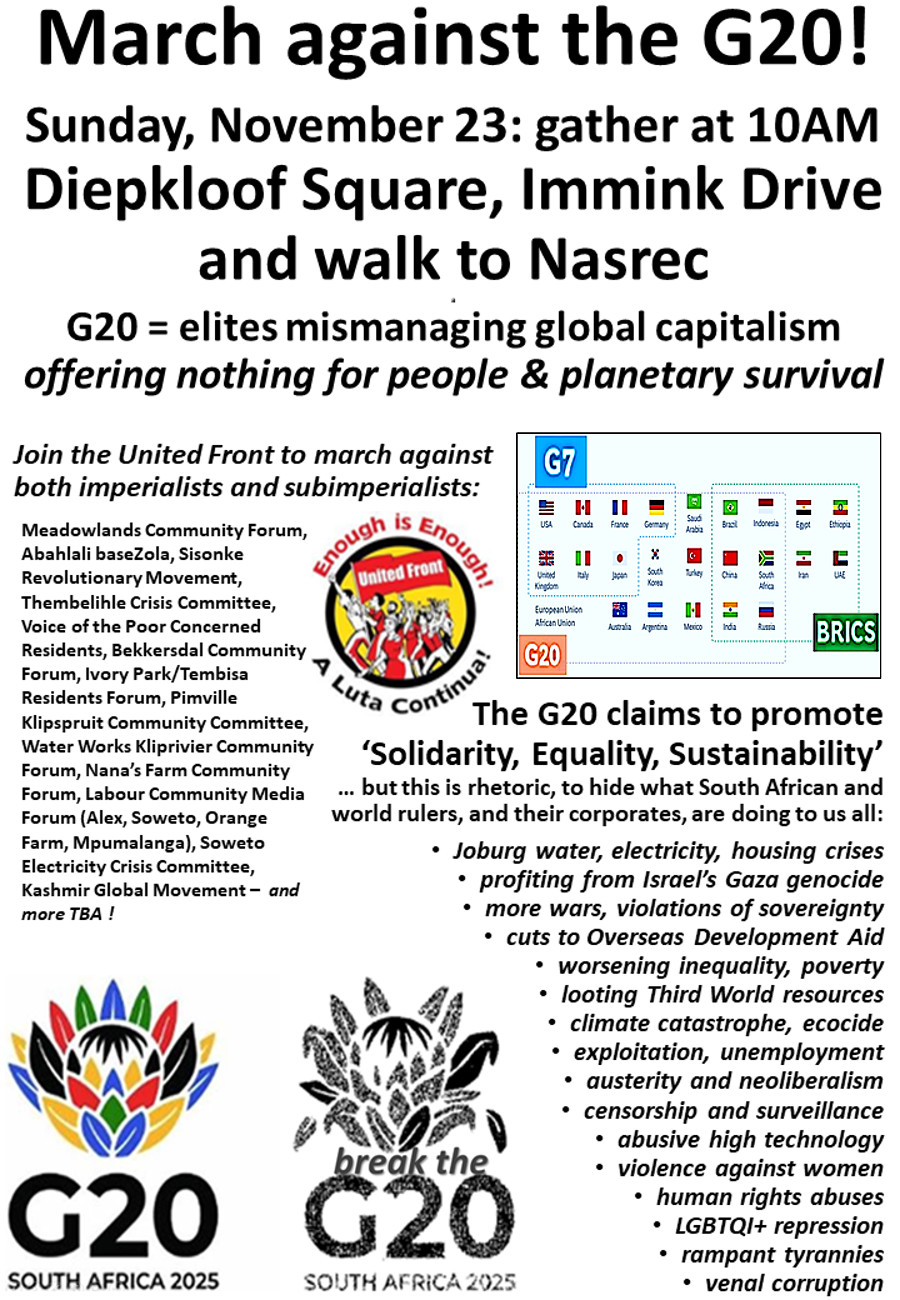
And Johannesburg’s United Front movement mobilized 350 community activists to march nearly an hour from Soweto to the conference site on the final day. Most aesthetically appealing, was the way a small artivist network, Camp, decorated some of the city’s best-known skyline buildings with a political light show.
But two other forces of dissent made more of a dent in the local news. A few dozen rightwing populist xenophobes (‘Operation Dudula’) protested the very idea of regional solidarity, alongside former president Jacob Zuma’s MK Party, on November 22, and attracted police tear gas and arrests near the conference site. Second, the main municipal trade union traded off a $235 million back-pay settlement with the mayor of Johannesburg, in exchange for a promise not to disrupt the event (an earlier threat, later denied).
The latter deal may have solved a problem for Johannesburg authorities in the short term, but also has generated awareness of the flimsy nature of municipal management, especially in a wet period that, just days before the G20 summit began, witnessed severe flooding and inadequate stormwater drainage – again revealing the country’s and city’s notorious lack of attention to climate adaptation and resilience.
And the mayor’s promise that during the G20, water would flow uninterrupted to all parts of the city – a source of sustained protest – was also broken, as predicted by the city’s lead water activist, Ferial Adam: “The contrast could not be starker: our government is spending close to R1-billion for a global summit in Sandton while nearby informal settlements and suburban residents alike cannot get a single bucket of clean water.”
These were merely indications of the way such depraved ‘North-South’ partnerships are being generated through G20 cooptation of South African elites, and indeed also within the COP process as well, as Lula’s recent role confirmed. It’s all too reminiscent of what a white-supremacist Rhodesian leader, Godfrey Huggins, described as the preferred neo-colonial arrangements he foresaw in managing racist rule (from 1933-53), in what later became Zimbabwe, South Africa’s immediate northeastern neighbour: a “partnership between a rider and a horse.”
Pay to Pollute, Starting in 2026
Image by Sam Grozyan.
The United States of America was unofficially represented at COP30, the annual UN climate conference (November 10-21) in Belem, Brazil by Senator Sheldon Whitehouse (D-RI). He was not granted the privilege of officially representing the U.S. The State Department refused to facilitate his trip, refused to acknowledge the senator as a representative of a congressional delegation, refusing to acknowledge COP30, refusing to acknowledge global warming. This is the first time in Senator Whitehouse’s career that the executive branch of government has dictated a congressional member’s CODEL (Congressional Delegation paid trip for members).
The EU’s Carbon Border Adjustment Mechanism (CBAM)
In meetings with country representatives outside of COP30 official proceedings, Senator Whitehouse learned what’s happening to hopefully limit global warming, concluding that one way to climate safety is by imposing a fee on polluters. According to studies by Potsdam Institute, “a price on carbon” is one of the ways not yet implemented to tackle global warming.
The senator met with the Europeans, the Brits, and the Australians. The EU is instituting a Carbon Border Adjustment Mechanism, which is a global price on carbon that comes via tariffs. It is already law and set to go into effect in 2026. The conservative UK government is also in the process of figuring out how they’ll handle a carbon tariff. Australia is also looking into it.
Whitehouse: “This is sending a global price signal that if your goods are more carbon intensive than ours, we are going to charge you for that. You cannot pollute and export for free any longer.” However, a fee on carbon pollution is no guarantee of climate safety; on the other hand, not instituting a carbon fee is a pathway for climate failure, likely taking down civilization at some unexpected juncture. It’s gotten that serious.
In that regard, the value of oil and gas subsidies in the U.S. are $700 billion per year. That’s the value of polluting for free that the fossil fuel industry receives. It’s no surprise they were willing to “grease” the president with several hundred million dollars to do whatever they want to do.
American Opinion Polls on Carbon Pollution
According to the senator, Trump does not represent American interests. He only represents fossil fuel interests, not the American public. Proof is found in recent polls, as expressed in Senator Whitehouse’s speech, stating that a proposal to “limit carbon pollution by big corporations” is supported by 72% of Americans. Whereas Trump’s Mar-a-Lago commitment to fossil fuel interests has been sealed with several hundred million dollars of grease following his open offer to do whatever they want for a one-billion-dollar quid pro quo. This is simply one more weird oddball difficult to rationalize stance against America’s best interests. Nearly 2/3rds of the American public want “limits to carbon pollution.”
According to the senator’s speech, when ask if a “fee should be imposed for polluting,” Americans polled said ‘Yes’ by a resounding 74%. Once again, Trump would certainly oppose such a fee since he has already sold his soul to the polluters. American citizens diametrically oppose Trump on carbon pollution. Two-thirds of Americans favor a fee on carbon polluters. Significantly, the EU is instituting such a fee; the UK is considering it; Australia is considering it. This may become a global movement now that all past approaches over the past 30 years by nations of the world, demonstrating concern about climate change at annual COPs, have so little to show for 30 years of meetings.
An updated poll Climate Change in the American Mind d/d June 17, 2025 conducted by Yale Climate Change Communications and George Mason University Center for Climate Change Communications d/d May 1-25, 2025, can be accessed.
COP30 Results- Global Warming Wins Once Again
According to Reuters d/d November 22, 2025: “World secures compromise deal at COP30 that sidesteps fossil fuels.” This is one more COP failure to properly address the key reason behind starting UN climate conferences 30 years ago. The first UN climate conference, COP1, held in Berlin in 1995 started a process of negotiations to create “legally binding emission reduction targets” for the developed countries of the world. That initial “statement of purpose” remains fluttering in midair directionless, heartless, meaningless, out of reach with each annual meeting. Next year Antalya, Turkey will host the staging arena for COP31’s chatter, wine, caviar, nearly guaranteed disappointing results, and photo ops for state leaders.
The Ultimate Impact of Failure to Challenge Climate Change
Senator Whitehouse’s Senate speech (Nov. 21) discusses the outcome of failure to address climate change. Accordingly, big trouble is on the docket by avoiding the climate change issue. This threat of upcoming trouble is voiced by leading figureheads in finance. Senator Whitehouse refers to it as the Great Climate Insurance Collapse, warned by finance authorities, claiming climate change alone could reduce global GDP by 10-20%.
“In 10 or 15 years, there are going to be regions of the country where you can’t get a mortgage” (Federal Reserve Board Chair Powell) because people will not be able to get home insurance. This, in turn, eliminates home mortgages. “Whole regions of the U.S. are going to become so climate risky that they’re uninsurable.” (Whitehouse)
According to the senator, Florida is on a fast-track: “In Florida the insurance market is already trembling, propped up, perhaps even fake.” The likely scenario is a cascade: “It goes from climate risk-to un-insurability-to mortgage failure-to property value collapse-to recession.” Still, a typical Florida family home is $407,830 in 2025 versus $410,000 in 2023, not too much of a decrease in value in two years but still a decrease as sources say typical Florida buyers experience “climate change denialism” to an extreme despite several obvious risks. Meanwhile, Florida is the most expensive state for home insurance in the country and likely going higher, pricing many buyers out of the market.
Extreme Climate Change Shows Up in the Damnedest Places, Clobbering a Town in Nebraska
“In Cozad, Neb., a hailstorm last year caused an estimated $100 million in damage, according to local insurance agent Brian Messersmith, in a town of just 4,000 people. After the storm, many homeowners and business owners in town say they were dropped by their insurers and forced to scramble to find new, generally more expensive, policies. Others saw the price of their existing policies go up significantly. The average cost of homeowners insurance in Nebraska this year is nearly $6,400, according to Bankrate. That’s the highest in the country, and almost $4,000 above the national average.” (It’s Harder to Get Home Insurance. That’s Changing Communities Across the U.S., NPR, November 12, 2025)
A cascading climate change situation is what the chief economist of Freddie Mac told a Senate committee could happen. Freddie Mac is not a green organization. Freddie Mac is a mortgage company warning the country of climate change negatively impacting the real estate market.
The finance community is warning of big economic trouble because of climate change. These are not green NGOs. The Economist magazine featured an article entitled The Next Housing Disaster, predicting a $25 trillion hit to global real estate because of climate change’s home insurance meltdown.
The president of Aon Insurance, one of the biggest in the country, testified before the Senate budget committee, saying climate risk is a “systemic risk,” which means the issue is not confined to where it originates, it spreads. For example, the 2008 recession was systemic with the mortgage meltdown hurting everybody throughout the economic system. But now we are confronted with global systemic risks that could be globally cataclysmic after years of ignoring climate change.
Two Million Canceled Home Insurance Policies
The climate-engineered home insurance crisis is already happening and threatens to get much worse as the Trump administration officially ignores climate change, labeling it a “hoax”: “In one five-year period, 2018-2023, insurers canceled nearly 2 million homeowner’s policies in the face of rising climate risks.” (How Climate Risks Are Putting Home Insurance Out of Reach, YaleEnvironment360, September 15, 2025) Why would major insurance companies cancel 2,000,000 home insurance policies if climate change is a hoax?
Gunther Thallinger of Allianz SE, the world’s largest insurance company warned about the prospect of hitting 3C, which Senator Whitehouse believes is coming: “The financial system as we know it ceases to exist and capitalism ceases to be viable.”
The Mortgage Bankers Association says the fiscal risk associated with climate change may exceed the capacity of insurance and governmental assistance in some regions of the country.
Climate Deniers Threaten Entire Financial System
If major finance executives, including the Chairman of the Federal Reserve, and leading finance entities like Aon Insurance and Allianz SE believe climate change is a systemic risk to the financial system, what more is needed to reverse the administration’s anti-science, anti-climate change campaign that will harm every American and take down the entire financial system. There are no winners under this scenario, only losers, including climate deniers.

No comments:
Post a Comment