“We will use every tool in our toolbox to ensure that this pipeline does not go ahead,” said one First Nations leader after the deal struck between PM Mark Carney and the Conservative premier of Alberta.
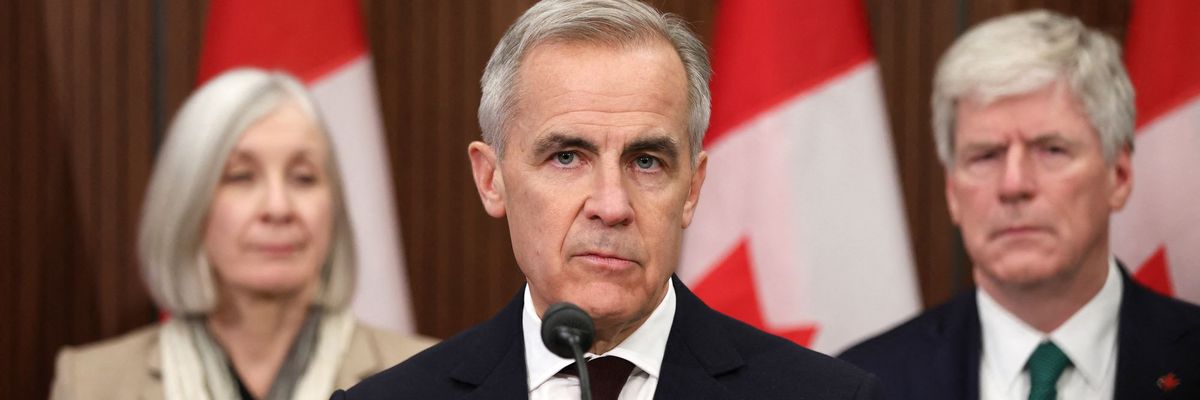
Canadian Prime Minister Mark Carney speaks during a press event on Parliament Hill, Ottawa, Ontario, Canada, on November 26, 2025.
(Photo by Dave Chan / AFP via Getty Images)
Jon Queally
Nov 28, 2025
COMMON DREAMS
First Nations groups backed by environmental and conservationist allies in Canada are denouncing a pipeline and tanker infrastructure agreement announced Thursday between Liberal Prime Minister Mark Carney and Conservative Alberta Premier Danielle Smith, calling the deal a betrayal and promising to fight against its implementation tooth and nail.
“We will use every tool in our toolbox to ensure that this pipeline does not go ahead,” said Heiltsuk Nation Chief Marilyn Slett in response to the Carney-Smith deal that would bring tens of millions of barrels of tar sands oil from Alberta to the coast of British Columbia for export by building new pipeline and lifting a moratorium against oil tankers operating in fragile British Columbia coastal water .
While Carney, who argues that the pipeline is in Canada’s economic interest, had vowed to secure the support of First Nations before finalizing any agreement with the Alberta, furious reactions to the deal made it clear that promise was not met.
Xhaaidlagha Gwaayaai, the president of the Haida nation, was emphatic: “This project is not going to happen.”
The agreement, according to the New York Times, is part of Carney’s “plan to curb Canada’s trade dependence on the United States, swings Canadian policy away from measures meant to fight climate change to focus instead on growing the oil and gas industry.”
In a statement, the Union of British Columbia Indian Chiefs (UBCIC) “loudly” voiced its opposition to the memorandum of understanding signed by Carney and Smith.
“This MOU is nothing less than a high risk and deeply irresponsible agreement that sacrifices Indigenous peoples, coastal communities, and the environment for political convenience,” said Grand Chief Stewart Phillip, president of the UBCIC. “By explicitly endorsing a new bitumen pipeline to BC’s coast and promising to rewrite the Oil Tanker Moratorium Act, the federal government is resurrecting one of the most deeply flawed and divisive ideas in Canadian energy politics.”
Slett, who serves as secretary-treasurer of the UBCIC, said the agreement “was negotiated without the involvement of the very Nations who would shoulder those risks, and to suggest ‘Indigenous co-ownership’ of a pipeline while ignoring the clear opposition of Coastal First Nations is unacceptable.”
Avi Lewis, running for the leadership of the progressive New Democratic Party (NDP) in upcoming elections, decried the agreement as a failure of historic proportions.
“Carney’s deal with Danielle Smith is the sellout of the century: scrapping climate legislation for a pipeline that will never be built,” said Lewis, a veteran journalist and climate activist. “We need power lines, not pipelines. Our path is through climate leadership and building good jobs in the clean economy.”
In response to the deal, the minister of Canadian culture, Steven Guilbeault, who formerly served as environment minister under the previous Liberal administration, resigned in protest.
“Despite this difficult economic context, I remain one of those for whom environmental issues must remain front and center,” Guilbeault said in a statement.
“Over the past few months, several elements of the climate action plan I worked on as Minister of the Environment have been, or are about to be, dismantled,” he said. “In my view, these measures remain essential to our climate action plan.”
David Eby, the premier of British Columbia who opposes the new pipeline into his province and was not included in the discussions between Carney and Smith, echoed those who said the project is more dead than alive, despite the MOU, calling it a potential “energy vampire” that would distracts from better energy solutions that don’t carry all the baggage of this proposed project.
“With all of the variables that have yet to be fulfilled—no proponent, no route, no money, no First Nations support—that it cannot draw limited federal resources, limited Indigenous governance resources, limited provincial resources away from the real projects that will employ people,” Eby added.
Keith Brooks, the programs director at Environmental Defence, decried the deal as “worse than we had anticipated” and “a gift to the oil industry and Alberta Premier Smith, at the expense of practically everyone else.”
“Filling this pipeline and expansion would require more oil sands mining, leading to more carbon pollution, more tailings, and worse impacts for communities near the tar sands,” warned Brooks. “The pipeline to BC would have to cross some of the most challenging terrain in Canada. The impacts of construction would be severe, and the impacts of a spill, devastating.”
Jessica Green, a professor at the University of Toronto with a focus on environmental politics, equated the “reckless” deal to a “climate dumpster fire” and called the push for more tar sands pipelines in Canada “the energy equivalent [of] investing in VHS tapes in 2025.”
At least the United States under President Donald Trump, she added, “has the cojones to say it doesn’t give a shit about climate” while Carney, despite the contents of the deal with Alberta, “is still pretending that Canada does.”
“Despite this difficult economic context, I remain one of those for whom environmental issues must remain front and center,” Guilbeault said in a statement.
“Over the past few months, several elements of the climate action plan I worked on as Minister of the Environment have been, or are about to be, dismantled,” he said. “In my view, these measures remain essential to our climate action plan.”
David Eby, the premier of British Columbia who opposes the new pipeline into his province and was not included in the discussions between Carney and Smith, echoed those who said the project is more dead than alive, despite the MOU, calling it a potential “energy vampire” that would distracts from better energy solutions that don’t carry all the baggage of this proposed project.
“With all of the variables that have yet to be fulfilled—no proponent, no route, no money, no First Nations support—that it cannot draw limited federal resources, limited Indigenous governance resources, limited provincial resources away from the real projects that will employ people,” Eby added.
Keith Brooks, the programs director at Environmental Defence, decried the deal as “worse than we had anticipated” and “a gift to the oil industry and Alberta Premier Smith, at the expense of practically everyone else.”
“Filling this pipeline and expansion would require more oil sands mining, leading to more carbon pollution, more tailings, and worse impacts for communities near the tar sands,” warned Brooks. “The pipeline to BC would have to cross some of the most challenging terrain in Canada. The impacts of construction would be severe, and the impacts of a spill, devastating.”
Jessica Green, a professor at the University of Toronto with a focus on environmental politics, equated the “reckless” deal to a “climate dumpster fire” and called the push for more tar sands pipelines in Canada “the energy equivalent [of] investing in VHS tapes in 2025.”
At least the United States under President Donald Trump, she added, “has the cojones to say it doesn’t give a shit about climate” while Carney, despite the contents of the deal with Alberta, “is still pretending that Canada does.”
By AFP
November 28, 2025

Canadian Prime Minister Mark Carney - Copyright AFP/File Dave Chan
Geneviève NORMAND
Critics accuse Canadian Prime Minister Mark Carney of betraying the fight against climate change.
Others say he is facing reality and has no choice but boost polluting sectors that are vital to an economy being punished by US President Donald Trump’s trade war.
But there is no dispute that since replacing former prime minister Justin Trudeau in March Carney has repositioned his Liberal Party on the environment.
Immediately after taking office, Carney scrapped Trudeau’s unpopular carbon tax on individuals.
He then launched a Major Projects Office to fast-track initiatives he said would strengthen Canada’s economic sovereignty, creating a bulwark against the impacts of Trump’s tariffs.
Mining and natural gas projects — criticized by some environmental advocates — were among the early picks.
But the most dramatic development came on Thursday, when Carney struck a deal with the conservative-led energy-producing Alberta province to advance a new oil pipeline, while increasing overall oil and gas production.
“Canada and Alberta are striking a new partnership to build a stronger, more sustainable, and more independent Albertan and Canadian economy,” Carney said.
“We will make Canada an energy superpower, drive down our emissions and diversify our export markets.”
The deal marked a clear pivot for Carney’s Liberal Party and a departure from the policies that defined Trudeau’s decade in power.
Alberta Premier Danielle Smith, who loathed Trudeau’s policies, said this month that “the tone of federal government has done a 180 in the last year.”
Steven Guilbeault, a member of Carney’s cabinet, who was also Trudeau’s environment minister, agreed.
He resigned Thursday, hours after the pipeline deal was signed.
Guilbeault said he entered politics “to champion the fight against climate change,” but that key green policies he implemented with Trudeau were being “dismantled” under Carney.
– Climate policy ‘erosion’? –
Carney, a former central banker, worked on climate issues before joining politics in January, but has emphasized market-driven solutions to environmental challenges.
In 2019, he became a UN envoy focused on mobilizing public and private finance to help achieve the goals of the Paris Accords.
He then joined the massive Canadian multinational firm Brookfield, steering private capital to aid climate action.
The Alberta pipeline plan is in its infancy and may never move forward.
But Carney’s memorandum of understanding with Alberta to advance an initiative that involves piping bitumen to Canada’s northwest Pacific coast and building a massive port to accommodate oil tankers has drawn outrage.
Carney said the plan could be a win-win.
Increased oil exports to Asia would reduce Canada’s economic dependence on an unreliable United States, he said.
And, he stressed, the deal requires oil companies to pay a steep industrial carbon tax, which could help fund cleaner energy sources, while the impact of rising emissions would be offset through carbon capture — a controversial technology.
Sierra Club Canada’s communications chief, Conor Curtis, told AFP there has been an “erosion of climate policy,” under the new Liberal government.
“A new oil pipeline is not necessary. We are in the middle of a global transition to renewable energy,” he said in an interview before Thursday’s signing.
– ‘Profound disruptions’ –
Tim McMillan, the former president of the Canadian Association of Petroleum Producers, said Carney had no choice but to embrace the oil sector.
“After 10 years of cancelled projects and lowering GDP per capita and standards of living in Canada, we’re at a point, especially with the US tariff threats, that Canada needs to look at our strengths,” McMillan told AFP.
“Oil and gas are at the top of that list.”
Even Guilbeault, a prominent environmental activist before entering politics, acknowledged Carney was in a tough spot, conceding that Trump had triggered “profound disruptions” in Canada’s key economic relationship.
“Despite this difficult economic context, I remain one of those for whom environmental issues must remain front and center,” he said.


No comments:
Post a Comment